
A flow meter spec often comes down to one number: accuracy. That number is easy to compare and easy to argue about in a meeting.
But accuracy only counts while the plant runs. A meter that reads ±0.2% is useless during the three days the line is down for installation.
This guide compares two ways to measure flow. Inline meters sit inside the pipe. Clamp-on ultrasonic meters sit on the outside. We look at install cost, downtime, leak risk, accuracy and ten-year cost.
It is written for the people who specify and build these systems. That means OEM skid builders, instrument distributors, EPC teams, MRO groups and water utilities.

The Trade-Off That Decides Most Projects
Every flow project balances two things. You want a precise reading. You also want the process to keep running.
Inline meters win the first test on paper. The sensor touches the fluid directly. The reading is clean and the calibration is traceable.
Clamp-on meters win the second test. They never touch the fluid and they never open the pipe. The line keeps running while the sensor goes on.
The gap between those two positions has narrowed. Signal processing got better. Transducer mounting got better. A well-installed clamp-on meter now holds about ±1% of reading on a clean liquid. That is enough for process monitoring, energy balancing and leak detection.
So the decision is rarely about accuracy alone. It is about total cost, risk and uptime.
How Each Meter Works
Inline meters
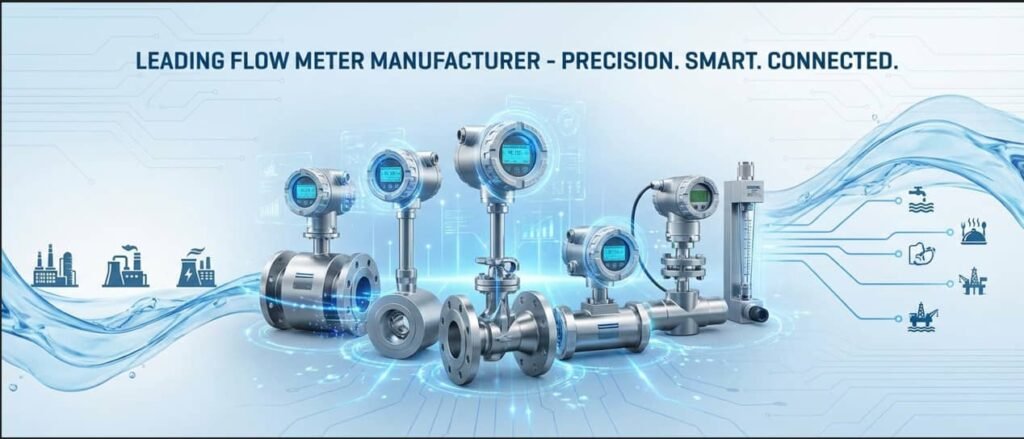
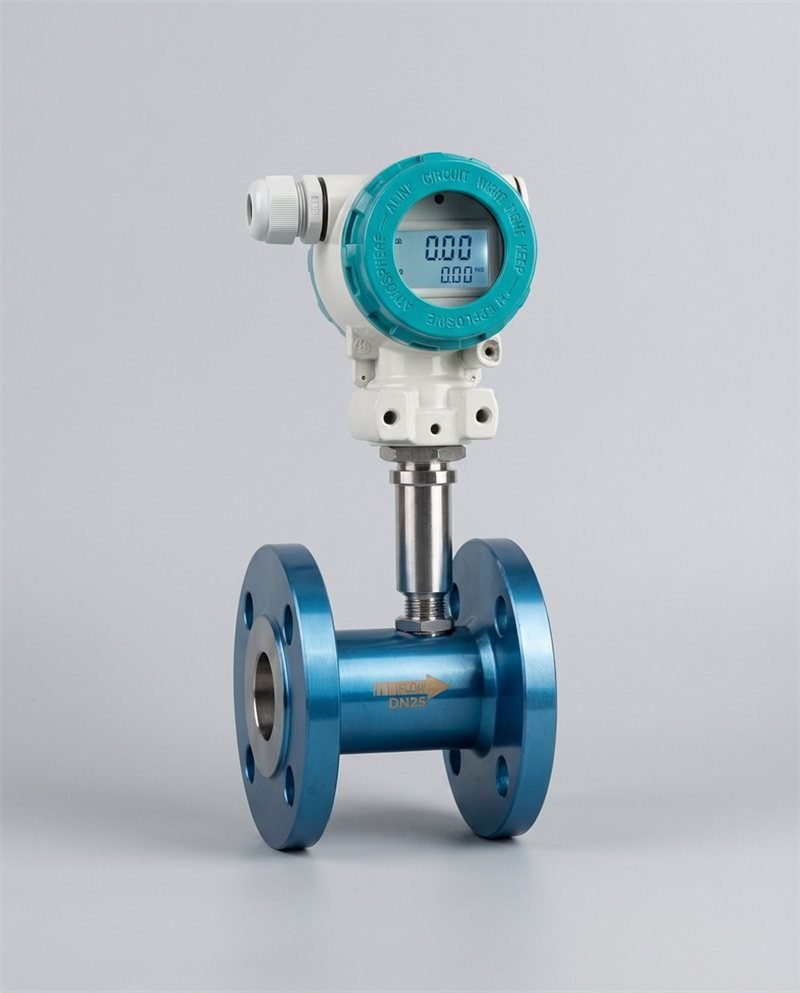
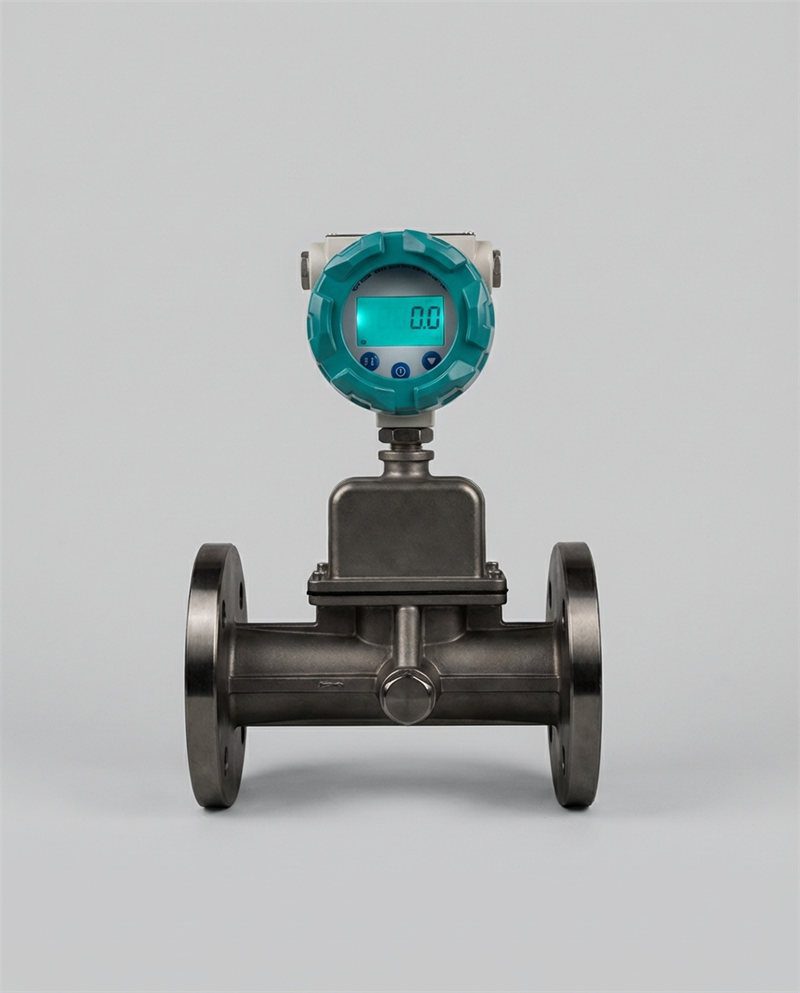
Inline meters put something in the flow path. Four designs cover most industrial work.
Um placa de orifício is a disc with a hole, bolted between two flanges. It measures the pressure drop across the hole. The plate is cheap and simple, but it creates a permanent pressure loss that the pump must pay for every hour of every year.
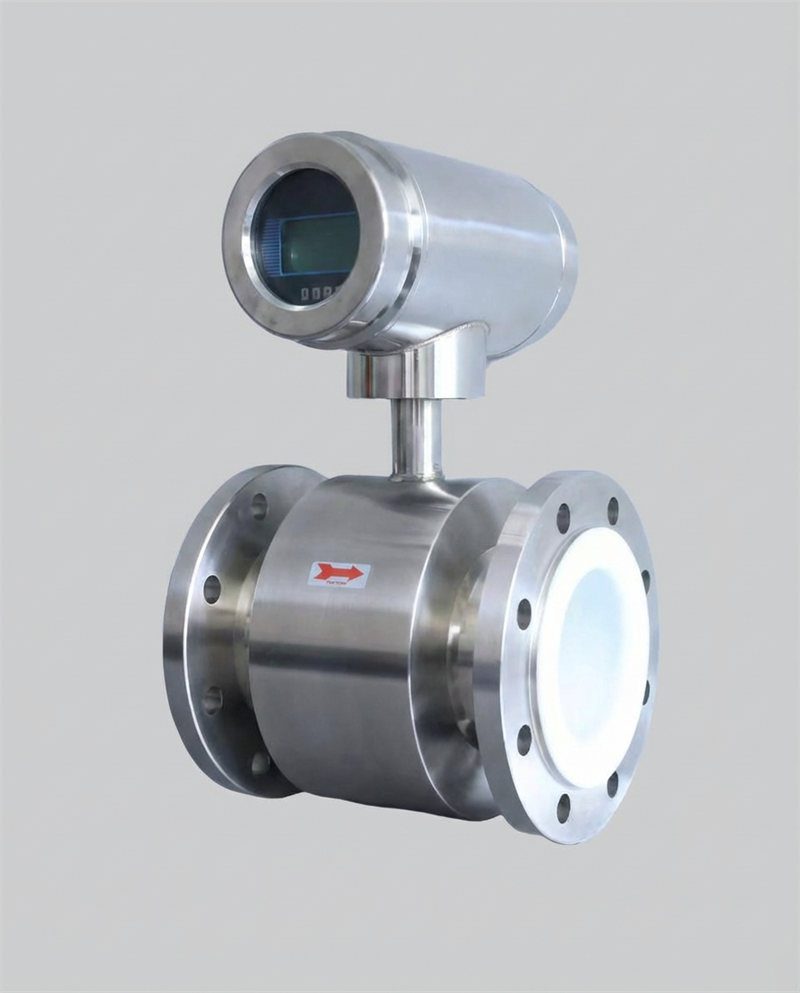
Um electromagnetic flow meter uses Faraday’s law. A conductive liquid moving through a magnetic field creates a small voltage. Two electrodes in the pipe wall pick up that voltage. The fluid must be conductive, usually above 5 µS/cm, so pure water and oils are out.
A Coriolis meter vibrates a tube and measures how the vibration twists as mass flows through it. It reads mass flow directly and reaches ±0.1%. It also costs the most and usually stops at smaller line sizes.
A turbine or vortex meter counts a spinning rotor or swirling vortices. Both need a body in the stream, and both wear or drift as the fluid attacks that body.
All four designs share one trait. Someone has to open the pipe.
Clamp-on ultrasonic meters
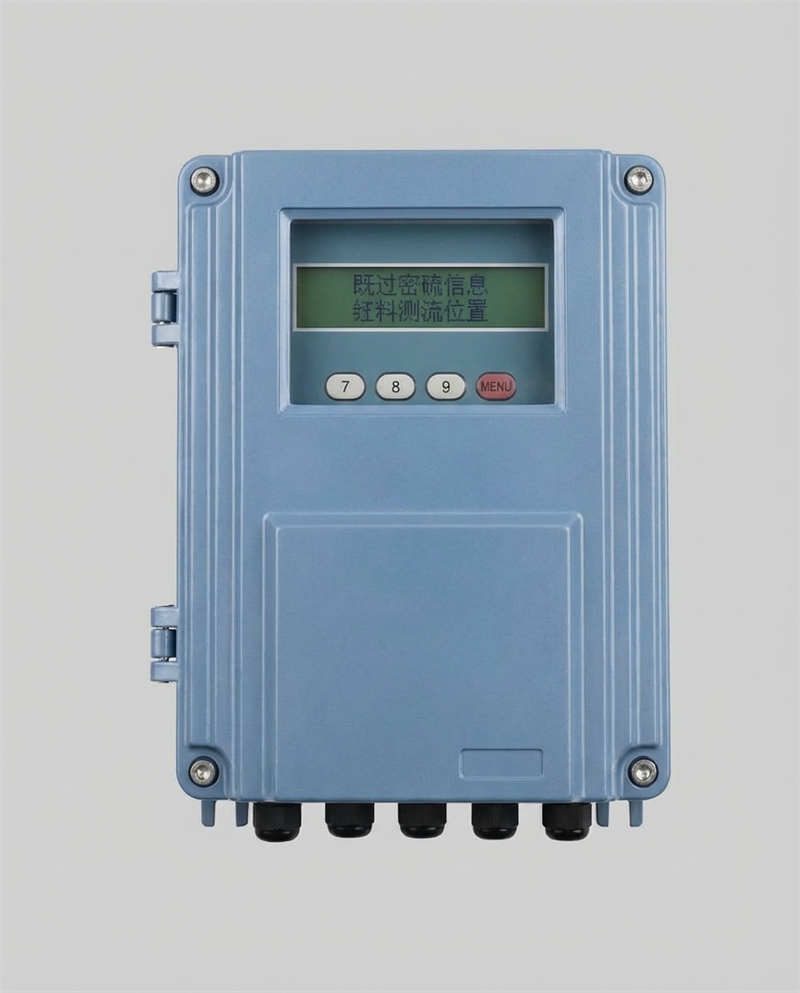
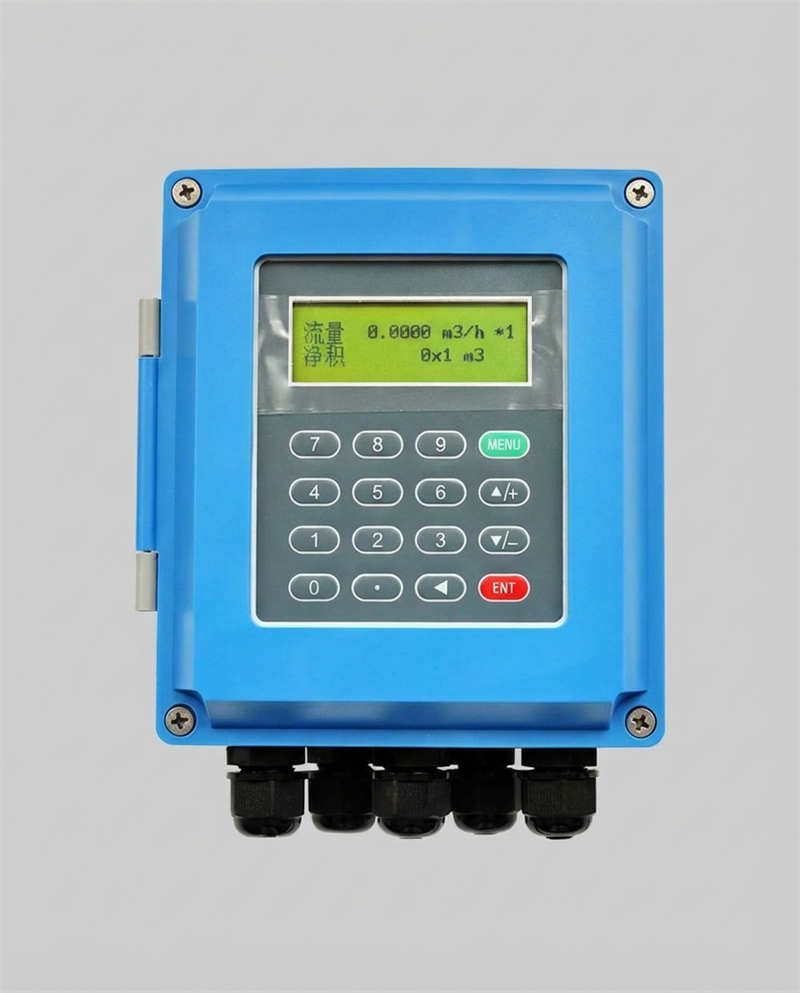
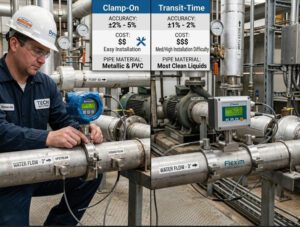
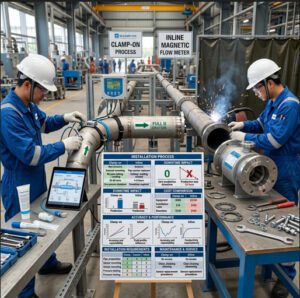
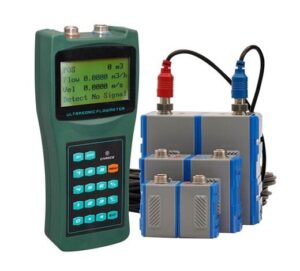
A clamp-on meter sends sound through the pipe wall. Two transducers sit on the outside, one upstream and one downstream. Each one sends and receives a pulse.
Sound travelling with the flow arrives a little sooner. Sound travelling against the flow arrives a little later. That time difference is tiny, often nanoseconds, but it rises in step with flow velocity.
This is the transit-time method, and it is the workhorse for clean liquids. The full physics sits in this transit-time measurement principle reference from Endress+Hauser. It carries the equation set.
A second method, Doppler, bounces sound off particles or bubbles. Doppler handles dirty water and slurry. It does not work on clean liquid, because there is nothing to reflect the sound.
What each design does to the flow
An inline body disturbs the stream. The orifice plate drops pressure. The turbine rotor adds drag. The Coriolis tube bends the path. Each of these changes the flow profile that the next meter downstream has to read.
Clamp-on sensors leave the bore untouched. Pressure drop is zero. The flow profile stays exactly as the piping designer intended.
| Recurso | Inline magnetic | Inline Coriolis | Clamp-on ultrasonic |
|---|---|---|---|
| Pipe must be opened | Sim | Sim | Não |
| Precisão típica | ±0,51 TP3T | ±0,11 TP3T | ±1,01 TP3T |
| Pressure drop | Nenhum | Low to moderate | Nenhum |
| Wetted parts | Liners, electrodes | Measuring tubes | Nenhum |
| Moving parts | Não | Não | Não |
| Fluid must be conductive | Sim | Não | Não |
| Typical size range | DN2 to DN2400 | Up to about DN300 | DN15 to DN6000 |
| Best fit | Conductive liquids, dirty service | Custody transfer, mass balance | Retrofit, large pipe, uptime-critical lines |

Plain-English Glossary
Flow work runs on shorthand. Here is what the common terms actually mean.
| Termo | What it means in practice |
|---|---|
| Transit-time | Method that times sound pulses travelling with and against the flow. Needs a liquid that carries sound well. |
| Doppler | Method that listens for a frequency shift from particles or bubbles. Needs dirty or aerated liquid. |
| Transducer | The sensor block that sends and receives sound. It clamps on the pipe wall. |
| Coupling gel | Grease that removes the air gap between transducer and pipe. Air blocks sound. |
| Reynolds number | A number that describes whether flow is smooth or turbulent. The meter uses it to correct the flow profile. |
| Straight run | The length of straight pipe before the meter. Bends and valves distort flow, so the meter needs calm water. |
| Relação de redução | How far down the meter can read before accuracy falls apart. A 400:1 meter reads well at 2.5% of full scale. |
| In-situ verification | Checking the meter on the live pipe instead of sending it to a lab. |
Installation Downtime and the Zero-Shutdown Advantage
Downtime is the cost that rarely appears in a quotation.
A shutdown carries four costs at once. You pay the crew. You lose output. You pay for the restart, which often wastes product while the line stabilises. And you spend permit time on lockout, drain-down and confined space checks.
For a chemical line running at USD 3,000 per hour of margin, a two-day installation costs more than the meter. That is the number to compare, not the list price.
Here is the same job done both ways.
Inline installation:
- Isolate the line and lock out the energy source.
- Drain the pipe and purge the product.
- Cut out a pipe section and prepare the ends.
- Weld or bolt in the meter spool and check alignment.
- Pressure test and inspect the welds.
- Refill, vent and bring the line back up.
- Commission the meter once flow is stable.
Clamp-on installation:
- Measure the pipe outside diameter and wall thickness.
- Clean the paint and rust from two small patches.
- Apply coupling gel and strap the transducers in place.
- Enter pipe size, material, wall thickness and fluid in the transmitter.
- Check signal strength and set the zero point.
The second list takes 30 to 60 minutes per point with two people. The first list takes one to three days, and most of that time the product is not moving.
This short video shows the transit-time idea in motion, which helps when you explain the choice to a project team.
https://www.youtube.com/watch?v=avm9vn09c0k
For EPC teams and MRO groups, the value goes beyond one meter. Many older lines were never instrumented because the retrofit cost was too high. A clamp-on point can go on a line that has run untouched for twenty years, and the process never notices.
Retrofit Impact and System Integrity
Every joint in a pipe is a future leak.
An inline meter adds two flanges and two welds to that count. It also adds a spool piece that must match the line size, the pressure rating and the material. Each joint carries a small chance of a weld defect and a slow drip. On a hazardous fluid, that chance is a risk register entry.
A clamp-on meter adds no joints. The pipe stays as it was built. That matters most in three places: high-pressure lines, toxic service and any line where a hot work permit is hard to get.
Positioning is also flexible. Flow profile in a real plant is never ideal. If the first mounting spot shows a distorted profile, you move the transducers a metre downstream. You do not cut, weld or re-certify anything. On an inline meter, moving means a new spool piece.
For OEM skid builders, the design effect is bigger than the install effect. A skid with clamp-on sensors drops the meter spool, two flange pairs and the associated pipe stress. The skid gets lighter and shorter. Fabrication gets simpler. Factory acceptance testing gets shorter because there is one less pressurised joint to test.
That is the trade skid builders usually care about. The pipe stays a pipe. The measurement becomes an accessory.
Maintenance and Accessibility
Sensor service is where the two designs separate again.
To replace a wetted sensor, you isolate, drain, purge and open the line. That is a permit, a crew and a production loss, all for a part that costs a fraction of the downtime.
To replace a clamp-on transducer, you cut the cable tie, peel the old block off, clean the spot and fit a new one. The fluid stays where it is. The line stays at pressure.
This changes MTTR, or mean time to repair. A clamp-on swap is a 15-minute job with a wrench. An inline swap is a planned shutdown. Maintenance planners feel that difference in the spares strategy. A clamp-on user keeps one spare transducer and one spare transmitter on the shelf. Both fit without a slot in the production schedule.
Calibration follows the same logic. An inline meter leaves the line and goes to a bench. A clamp-on meter is checked where it sits, with a portable reference or a built-in zero and signal check. The second option is not as rigorous, but it costs a fraction and it happens more often.
One maintenance item does belong to clamp-on only. Coupling gel dries out over time, faster on hot lines. Plan to re-gel every two to three years on cool service, and more often above 100 °C. Use high-temperature couplers on steam-adjacent lines.

Lifecycle Costs and Long-Term ROI
The example model
Numbers below are an example, not a quotation. The case is a 200 mm carbon steel water line, a ten-hour shutdown window and USD 2,500 per hour of lost output.
| Cost line, ten years | Inline magnetic | Clamp-on ultrasonic |
|---|---|---|
| Instrument and flanges | 2,100 | 2,400 |
| Installation labour | 1,800 | 480 |
| Lost output during install | 25,000 | 0 |
| Maintenance and verification | 3,600 | 1,200 |
| Ten-year total, USD | 32,500 | 4,080 |
The shutdown line drives the result. If the line is already down for a planned turnaround, that line drops close to zero and the two totals move much closer. In that case the decision turns on accuracy and fluid properties instead of uptime.
Here is the same comparison as installed cost per point. The hardware bars are close. The installation bars are not.
Over ten years, the ownership split looks like this for a plant that did choose the inline route. More than a quarter of the money went to the shutdown, not the instrument.
Operating costs
Corrosive and abrasive fluids attack anything wetted. An acid service eats electrodes and liners. A slurry polishes a turbine rotor until the K-factor drifts. Each of those parts is inside the pipe, and each replacement is a shutdown.
A clamp-on transducer never meets the fluid. Its wear items are the cable, the coupling gel and the electronics. None of them need the line to stop.
Scaling across a network
The cost curve matters most when you add points, not when you add one.
A utility that wants flow balance across twenty district metered areas faces twenty installations. Twenty inline meters mean twenty shutdowns, twenty weld packages and twenty permit files. Twenty clamp-on points mean twenty site visits, and most of them fit inside a normal working day without touching supply.
Jade Ant clamp-on ultrasonic flow meters were built around that pattern. The range covers DN15 to DN6000 and holds ±1.0% of reading. Turndown is 400:1. One model family can serve a plant room and a trunk main. Outputs include 4-20 mA, Modbus, HART and Profibus, and a battery version covers sites with no power.
Matching Technology to the Application
No single design wins everywhere. The matrix below is the shortcut version we use on site surveys.
| Aplicativo | Recommended design | Why it fits |
|---|---|---|
| Pharmaceutical Water for Injection | Inline hygienic meter, clamp-on for verification | The loop must be sterile and drainable. Clamp-on is used to cross-check, not to replace the hygienic instrument. |
| Corrosive chemical transfer | Clamp-on ultrasonic | No wetted parts means nothing to corrode. Sensor swaps need no line opening. |
| Abrasive slurry | Doppler clamp-on or inline magnetic with a hard liner | Clamp-on avoids rotor wear. Magnetic handles dirty conductive slurry well. |
| Cooling water and HVAC | Clamp-on ultrasonic | Low cost per point, no pressure drop, easy to add to an existing riser. |
| Custody transfer and billing | Inline meter with pattern approval | Regulators require a certified, traceable instrument in the flow path. |
| Large transmission mains, DN600 and up | Clamp-on ultrasonic | Inline meters at this size cost far more than the pipe section they replace. |
| Compressed air and gas | Thermal mass meters or vortex | Ultrasonic liquid meters do not measure gas. Use the right physics. |

Water utilities
Water networks are the strongest case for non-invasive sensing. Trunk mains run from DN400 to DN2000 and often sit under a road. Cutting one is a civil project, not an instrument job.
Industry studies of older networks often put water losses at 20% or more of treated volume. You cannot manage a loss you cannot see. Clamp-on points let a utility meter district boundaries without digging. Water utility practices now treat that measurement density as the base layer for a leak strategy.
Heavy industry and chemicals
Hazardous fluids change the risk equation. A leak on a toxic line is not a maintenance cost, it is an incident. Fewer joints means fewer paths to that incident.
Hot work permits add a second barrier. Welding on a live chemical line needs isolation, gas testing and sign-off. A clamp-on install needs a clean patch of pipe and a wrench.
Pharmaceutical and high-purity
Here the answer often flips. Hygienic processes need a drainable, sterilisable loop, and that means an inline instrument with the right surface finish and certification. Clamp-on still earns a role as a checking tool, because it verifies the hygienic meter without breaking the loop.
Closing the Accuracy Gap
The old rule said clamp-on meters were good for trend data only. That rule is out of date, but the reason it existed is still worth understanding.
A clamp-on meter calculates flow from sound speed, pipe geometry and transit time. Three of those inputs come from you. If the wall thickness is wrong by 2 mm, the meter’s geometry model is wrong, and the reading drifts with it. Most “inaccurate” clamp-on installations are really inaccurate data entries.
Modern transmitters also correct for things the old ones ignored. They compensate for pipe material and temperature. They apply Reynolds-number correction so the profile factor tracks real flow. They use cross-correlation to reject noise from pumps and valves.
The practical accuracy band looks like this.
| Tecnologia | Precisão típica | What limits it |
|---|---|---|
| Coriolis | ±0,11 TP3T | Cost, size limit, pressure drop |
| Inline magnetic | ±0,51 TP3T | Liner wear, electrode fouling, low conductivity |
| Clamp-on ultrasonic, good install | ±1,01 TP3T | Wall thickness data, liner, straight run, coupling |
| Clamp-on ultrasonic, poor install | ±2% to ±5% | Air gaps, wrong fluid sound speed, distorted profile |
Four habits keep a clamp-on point in the top band.
- Measure wall thickness with an ultrasonic gauge. Do not trust the drawing.
- Confirm the liner material and thickness, then enter both in the transmitter.
- Respect straight run. Ten diameters upstream and five downstream is a working minimum.
- Check signal strength and signal quality at commissioning, and record both numbers in the asset file.
For regulated work, the reference point is not a vendor claim but the metering code. In the United States, national metering standards set the rules for commercial instruments. Those rules assume a device inside the flow path.
An Implementation Guide for System Integrators
A clamp-on project fails at the survey stage far more often than at the wiring stage. Five checks catch most of the risk.
Pipe data. Outside diameter, wall thickness, material and liner. Measure, do not assume. Cast iron and concrete pipes need extra care because sound scatters inside the wall.
Fluid data. Sound speed, temperature, pressure and solids content. Entrained air is the most common cause of a lost signal, so check whether the line runs full and whether pumps aerate the stream.
Straight run and access. Count the diameters between the meter spot and the nearest bend, valve or pump. Check that a person can reach the spot with a ladder and a wrench.
Sensor frequency. Small pipes and thin walls suit higher frequency, typically 5 MHz. Large pipes and attenuating materials such as cast iron suit lower frequency, typically 1 MHz. A 2 MHz pair covers most general work.
Integration. Decide the signal path early. A 4-20 mA loop suits a PLC analog card. Modbus RTU or TCP suits a data logger. HART suits an existing asset management system. Map the diagnostics too, because signal strength and empty-pipe alarms are what turn a reading into a trustworthy one.
Teams that follow automation and instrumentation standards for tagging and loop documentation will find the integration step short. The meter behaves like any other transmitter once it is on the network.
For skid builders, one design decision saves the most time later. Mount the transducers on a section of pipe that is straight, accessible and away from the pump discharge. Then bring the cables to a terminal box on the skid edge. The customer’s team can service the sensors without climbing into the frame. Your skid-mounted flow meter selection also gets simpler, because the meter no longer drives the pipe layout.

Future-Proofing Industrial Flow Measurement
The choice between invasive and non-invasive sensing is a choice about what you are protecting. Inline meters protect accuracy in controlled conditions. Clamp-on meters protect uptime, and uptime is what most plants actually lose money on.
Three short recommendations, by buyer.
OEM skid builders. Default to clamp-on for monitoring points and keep the inline meter only where the process fluid demands it. You ship a lighter skid, you test fewer joints, and you give the end user a sensor they can swap in fifteen minutes. Our intelligent electromagnetic flow meters e vortex flow meters still make sense on conductive or steam service. The two families sit side by side on the same skid.
EPC and system integrators. Price the shutdown, not just the instrument. A ten-year TCO comparison usually changes the recommendation on retrofit scope. It also gives the client a defensible reason to accept the change.
Utilities and MRO teams. Start with the points you cannot reach with an inline meter: large mains, buried lines, and anything that cannot be isolated. Use the retrofit checklist to confirm pipe data before you order.
The shift from reactive to proactive monitoring is not a technology problem anymore. It is a cost-per-point problem. Clamp-on sensing pushed that number down far enough that a line which never had a meter can now have one.
If you are weighing both designs on a live project, talk to our application engineers and send the pipe size and fluid data. You will get a straight answer on which one fits, including the cases where the answer is not ours. You can also read more about Jade Ant Instruments and the industries we serve.
Perguntas frequentes
How does clamp-on accuracy compare with a Coriolis meter in high-viscosity fluids?
A Coriolis meter still wins on very viscous liquids. It measures mass directly and does not depend on the sound path. A clamp-on transit-time meter struggles when viscosity damps the signal and when the profile becomes flat and slow. For heavy oil or syrup, expect the clamp-on option to lose about one percentage point of accuracy and to need a lower transducer frequency. Above roughly 1000 cP, test before you commit.
Can clamp-on sensors work on lined pipes such as PTFE or rubber?
They can, but the liner becomes part of the acoustic path. A soft rubber liner absorbs sound and cuts signal strength. A PTFE liner can delaminate or trap gas at the bond line. Enter the liner material and thickness in the transmitter, and expect a shorter maximum path length. Very thick liners may rule out clamp-on entirely.
What is the largest pipe a clamp-on meter can handle?
The practical ceiling is set by signal strength, not by catalogue size. Jade Ant meters are specified to DN6000, and large-diameter installations are routine on water mains. At that size you need a clean wall, a solid coupling and often a lower frequency. Signal attenuation grows with wall thickness and with cast iron or concrete pipe.
For OEM skid builders, how do clamp-on sensors change footprint and weight?
They remove the meter spool, two flange pairs and the pipe stress that comes with them. A DN100 skid can lose 300 to 500 mm of length and a matching amount of weight. Fewer pressure joints also shorten the factory acceptance test and reduce the number of welds that need inspection.
How much faster is a sensor swap on clamp-on versus inline?
Most clamp-on swaps take 15 to 30 minutes with the line live. An inline swap needs isolation, drain, purge, a permit and a restart. That lands in the one to three day range, and it often waits for a planned window. That gap is the real maintenance argument, not the part price.
How do you handle entrained air and bubbles?
Air is the main enemy of ultrasonic measurement. Bubbles scatter the sound and the signal drops out. Fix the cause first: raise back pressure, move the sensor away from a pump discharge, or avoid the top of a horizontal line where gas collects. If the process always carries air, use a Doppler meter or a dual-path transit-time model with cross-correlation.
Are clamp-on meters accepted for custody transfer?
Generally no. Fiscal and billing applications need a pattern-approved instrument in the flow path, with traceable calibration and tamper protection. Clamp-on meters are widely used to check those instruments, to balance a network and to find losses. Treat them as verification and monitoring tools, not as billing devices.
Does internal scaling or corrosion ruin the reading?
It shifts it. Scale changes the effective wall thickness and can block the sound path entirely. A 3 mm scale layer on a 200 mm line can move the reading by several percent. Check wall thickness at installation, log signal strength as a baseline, and watch for a slow decline, which usually means the pipe is fouling.
How do you justify clamp-on to a client who only looks at purchase price?
Put the shutdown on the same page as the instrument. One ten-hour stoppage on a line worth USD 2,500 per hour costs more than either meter. Add the avoided weld package, the avoided pressure test and the lower spares holding, and the ten-year total usually settles the argument. If the line is already down for a turnaround, argue on access and service time instead.
Which hazardous area certifications are available for clamp-on transducers?
Certified versions exist for most common zones. Transducers are passive devices, so they are often rated for intrinsic safety, while the transmitter sits in a safe area or in an Ex-rated enclosure. Ask for the certificate that matches your zone, gas group and temperature class before you specify. Do not assume a standard unit carries the marking.