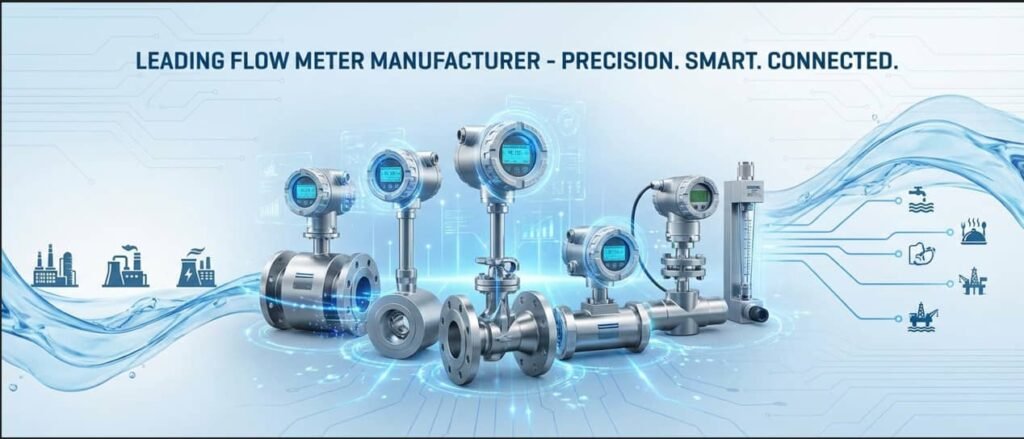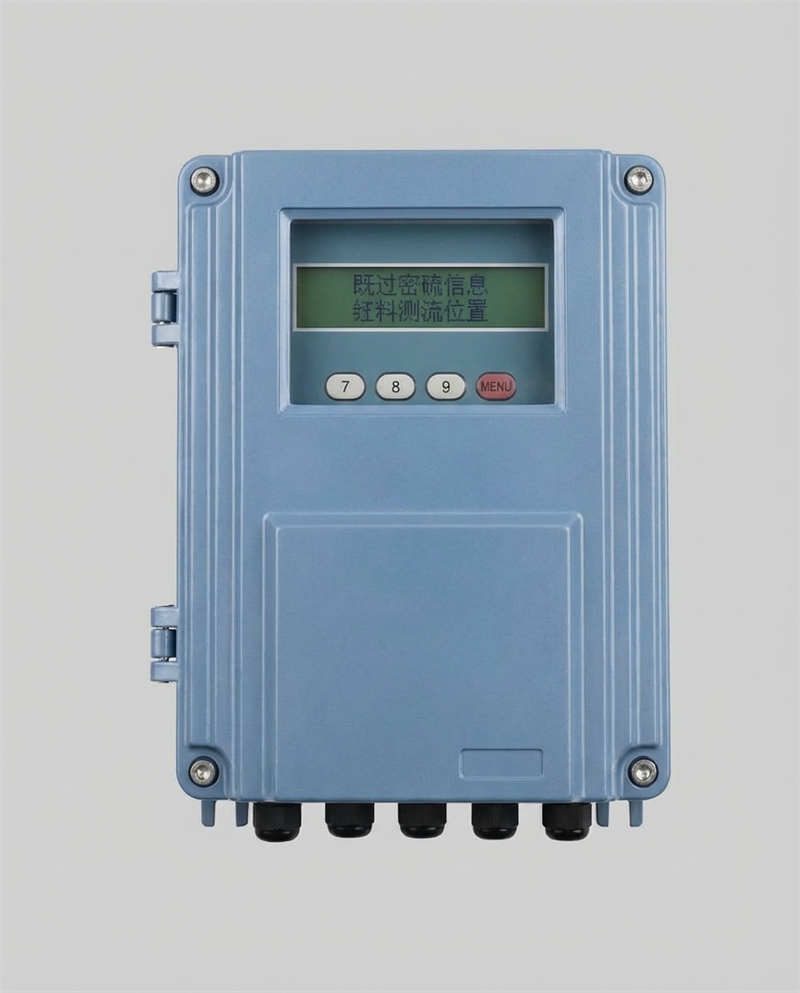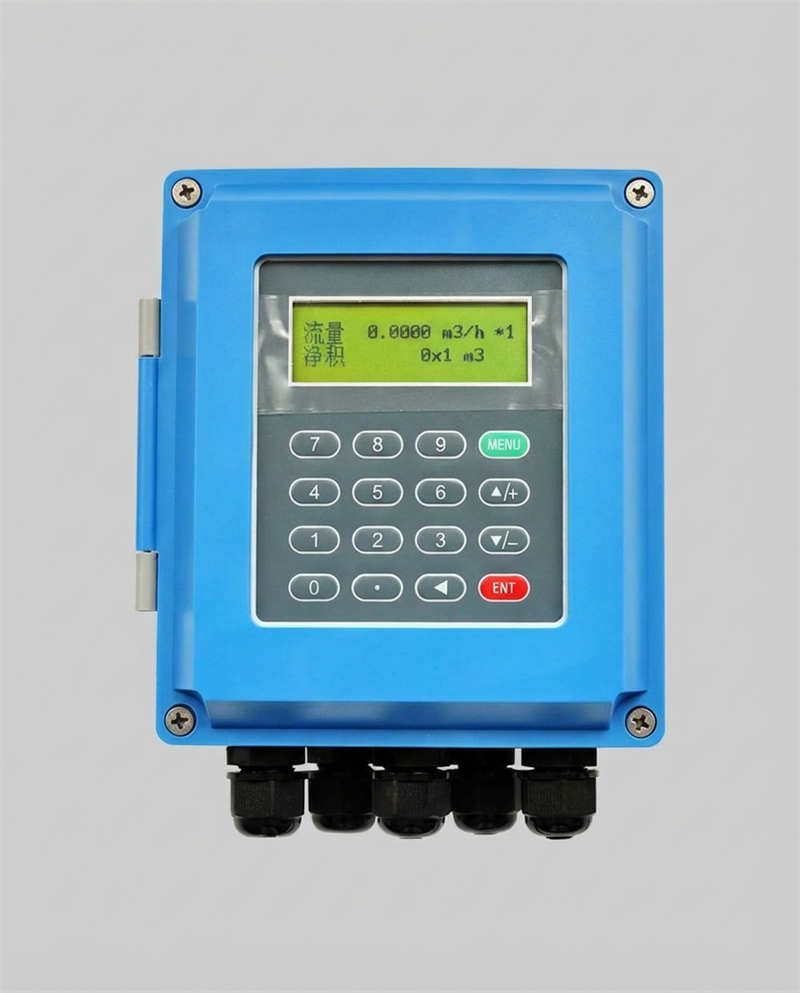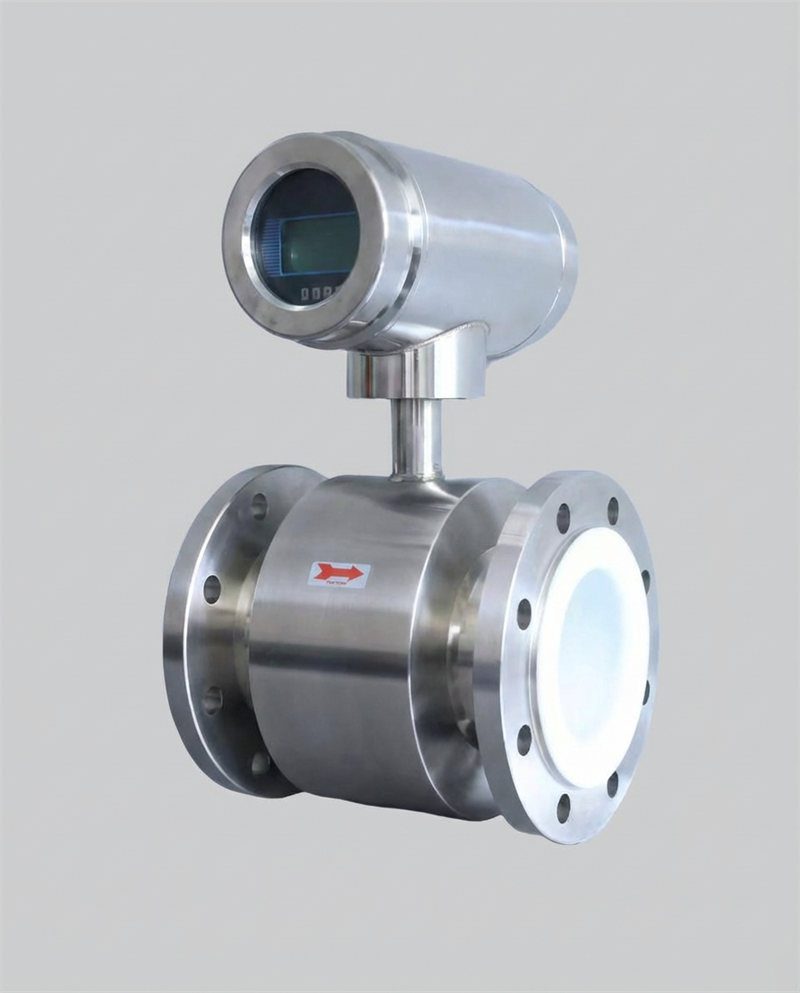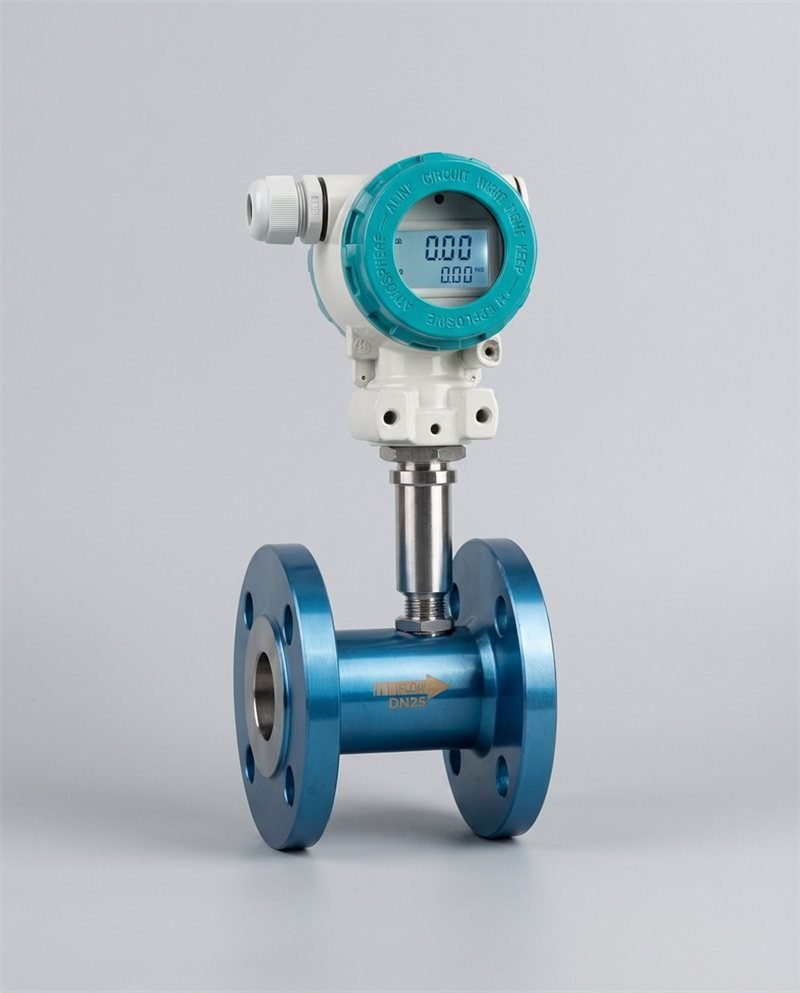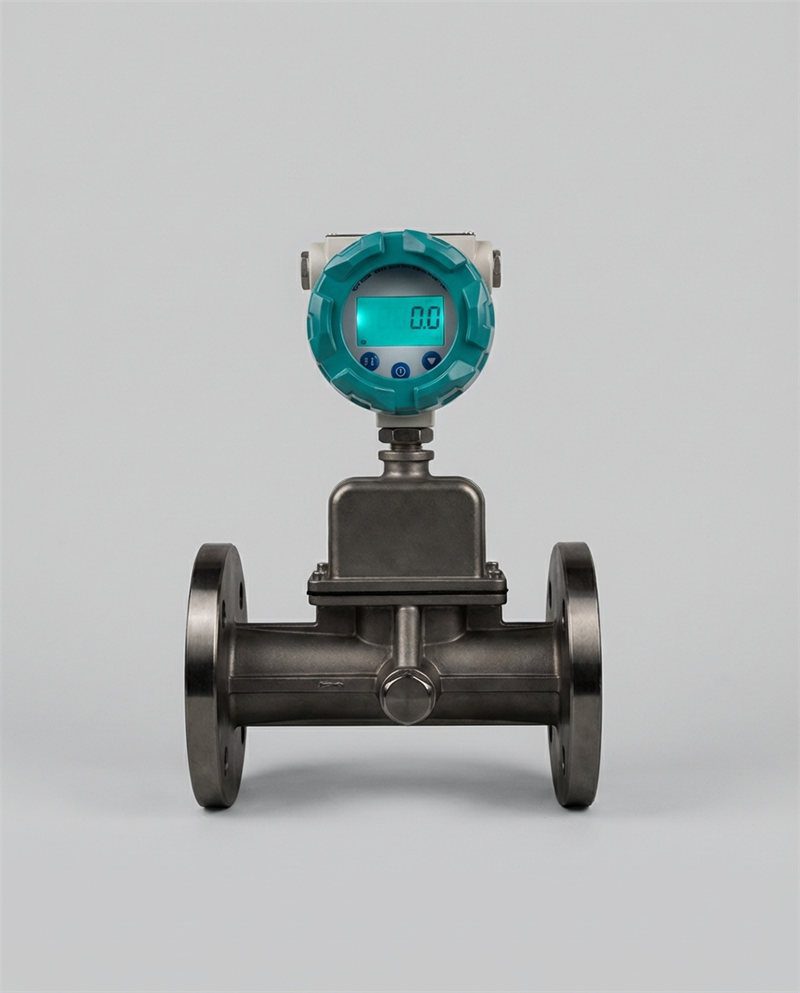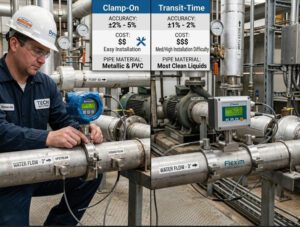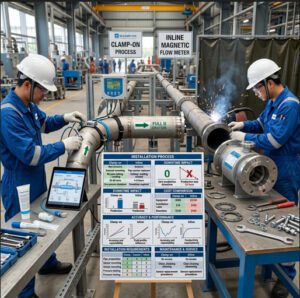
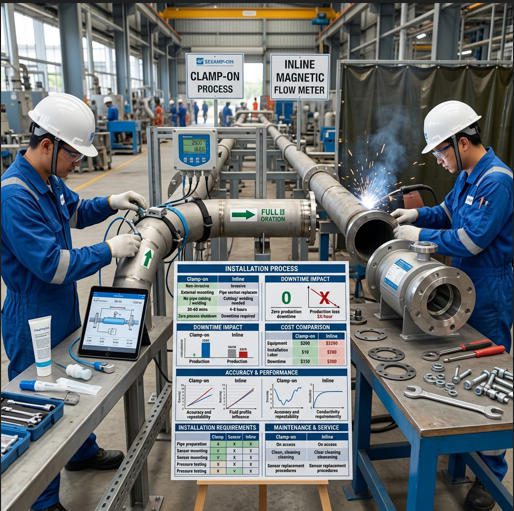
A flanged meter adds two flanges, two welds and a hydro-test round to every measuring point on a skid. A clamp-on sensor adds a strap and a cable. That one difference changes build hours, leak paths and pump head, and it is the reason skid builders keep asking for the clamp-on version of the same measurement.
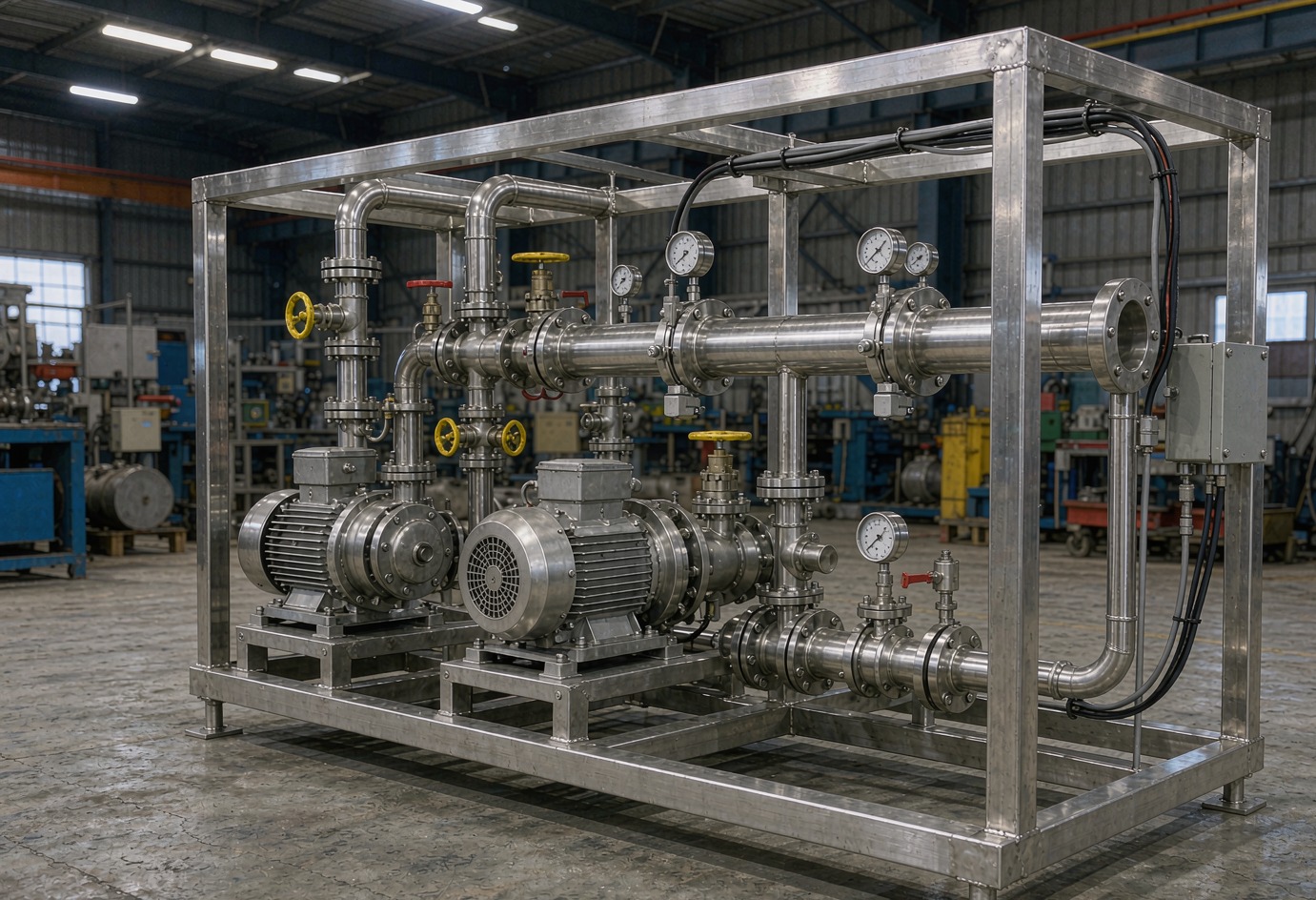
I. Precision Without Cutting the Pipe
Skid buyers want three things at once. They want a smaller footprint, a faster factory acceptance test (FAT), and fewer joints that can leak. They also want flow data they can trust.
Inline meters make that a trade-off. A magnetic or Coriolis meter sits in the flow path. It needs flanges, gaskets, straight pipe, and a shutdown if it ever has to come out. The accuracy is easy. The pipework is not.
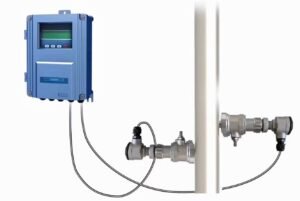
A clamp-on ultrasonic flow sensor is a pair of transducers strapped to the outside of the pipe. The pair sends sound pulses upstream and downstream and times the difference. Velocity comes from that time difference, and velocity times pipe area gives flow rate. The physics are explained in this walkthrough of how transit-time sensing works.
Nothing touches the liquid. For a builder, clamp-on flow sensors for OEM skids remove three headaches at once: leak paths, pressure loss and downtime for service.
This guide is for the people who build, specify and stock these systems. That means OEM equipment and skid-mount manufacturers, instrument distributors and importers, EPC and system integrators, industrial MRO buyers, and municipal utility teams.
The thesis is simple. Clamp-on sensing lets you put accurate flow measurement on a skid without changing the hydraulic design, the pressure boundary, or the maintenance plan.
II. Advantage 1: Installation Without Cutting the Pipe
Clamp-on sensors remove the cut, the weld and the leak risk that come with every inline meter.
No weld points, no extra flanges. Each flanged meter needs two flanges, two gaskets, eight or more bolts and two welds. On a skid with six measuring points, that is twelve flanges you fabricate, torque and leak-test. Clamp-on takes all of it off the drawing. The pipe run gets shorter and the bill of materials gets lighter.
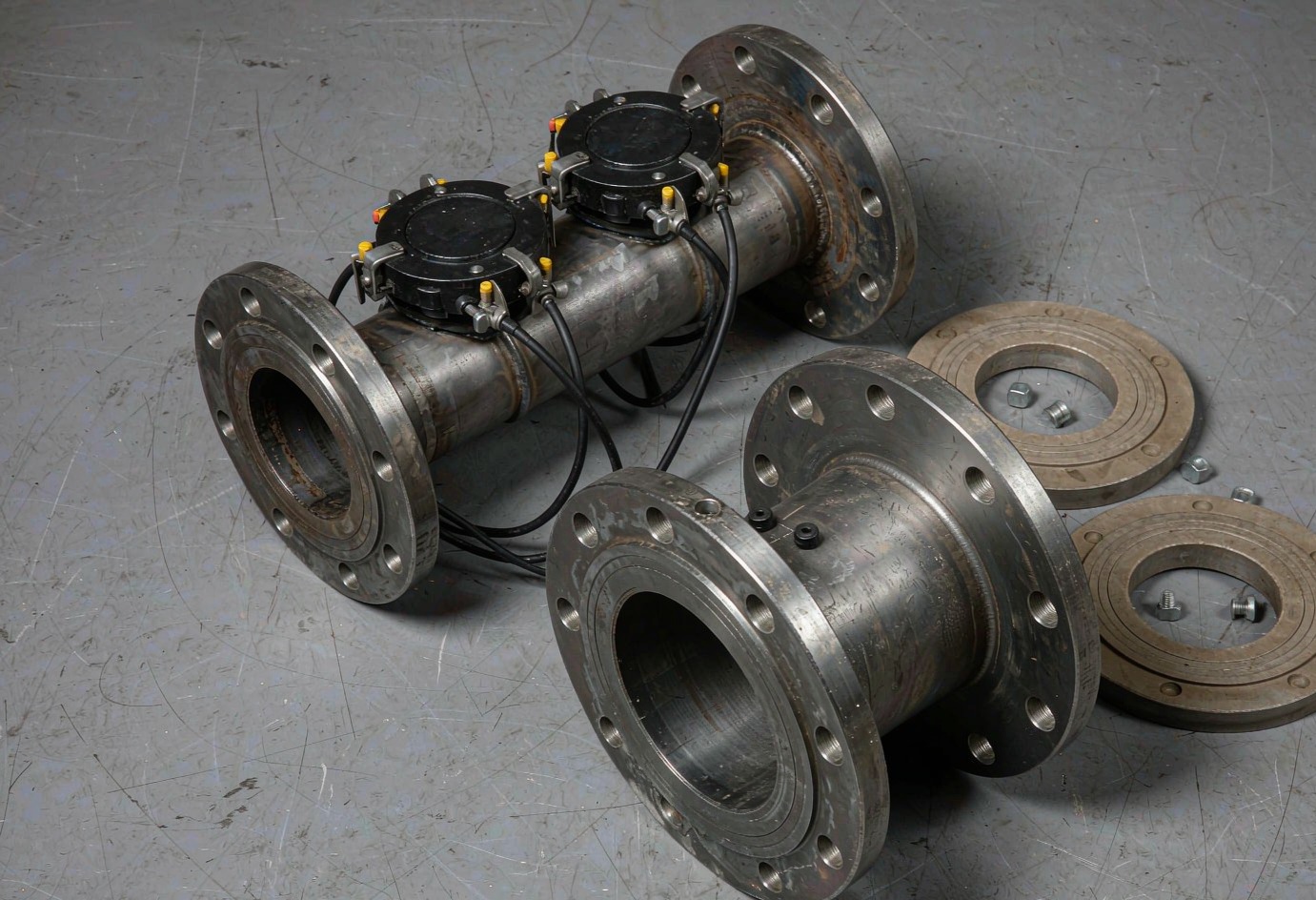
The pressure boundary stays intact. You never cut the pipe, so the original pressure rating and material certificate still apply. Quick definition: pressure boundary — every part that holds line pressure, such as the pipe wall, the welds and the flanges. That matters on alloy and high-pressure spools, where a new weld means new paperwork, new NDT and a new ASME code review. On a clamp-on job, the pipe is untouched.
Assembly gets faster. The chart below compares the build hours for one measuring point. The numbers are illustrative, taken from typical fabrication and FAT schedules, but the pattern is stable across projects.
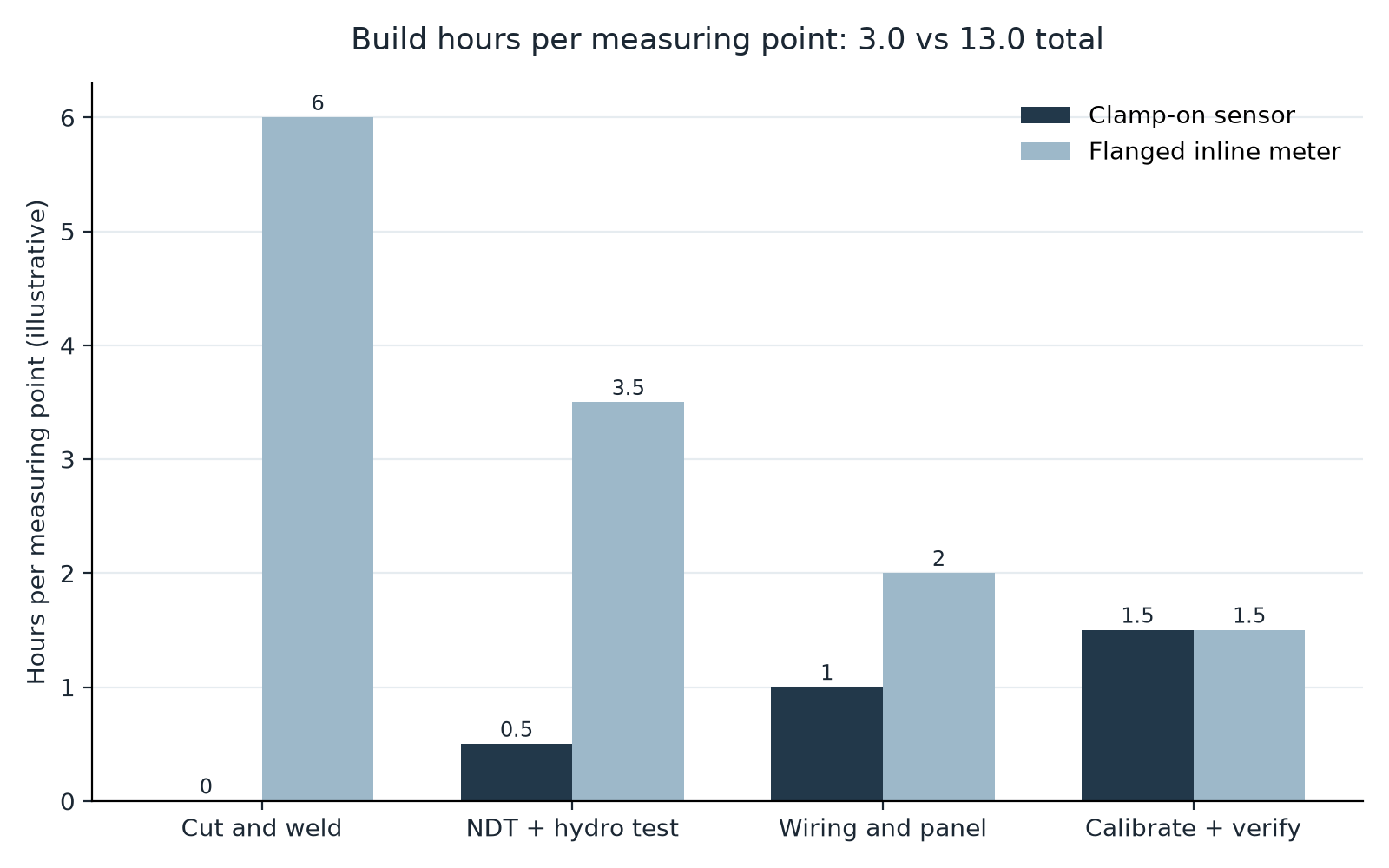
Most of the gap sits in two bars: cutting and welding, then NDT and hydro test. A clamp-on point has neither. You clean a patch of pipe, fit the transducers, run the cable and check the signal. Jade Ant Instruments ships each OEM pair with a spacing table cut to the drawing, so the fabricator does not calculate it twice.
Industry insight: the hidden cost of an inline meter is not the weld. It is the re-test. Any spool that gets a new weld has to go back through hydro test and sign-off, and that queue is where FAT dates slip.
III. Advantage 2: No Pressure Drop, No Obstruction
A sensor outside the pipe cannot slow the flow. A meter body inside the pipe always does.
Zero restriction. An inline magnetic or turbine meter puts a body, a liner and often a reducer in the flow path. At 3 m/s, a typical DN100 body adds roughly 0.1 to 0.3 bar of pressure loss. Clamp-on adds nothing.
No dead zones. Meter bodies create wakes and small recirculation zones. Those zones collect debris and disturb the profile just downstream. With clamp-on, the bore stays clean and round.
Better behaviour at low pressure and high viscosity. When the pump curve is tight or the liquid is thick, every 0.1 bar counts. Removing the body often lets a smaller pump do the same job.
| Meter type | Typical pressure loss at 3 m/s | What you pay for it |
|---|---|---|
| Clamp-on ultrasonic | Nenhum | Nothing extra on the pump |
| Flanged electromagnetic | 0.1–0.3 bar | Pump head, energy, larger motor |
| Turbina | 0.3–0.7 bar | Pump head plus wear on the rotor |
| Coriolis | 0.2–1.0 bar | Pump head, and a heavier support frame |
The energy number is small per point and real across a fleet. Take 50 m³/h and 0.2 bar. The pump absorbs about 0.28 kW more than it needs. Over 6,000 running hours that is roughly 1,680 kWh, or about 200 USD a year at 0.12 USD per kWh. (Illustrative example.) Multiply it by the number of points on the skid and the years in service.
IV. Advantage 3: Service Without Shutting the System Down
A sensor on the outside of the pipe can be replaced while the process keeps running.
Field swap in minutes. A transducer comes off with a clamp and goes back with a clamp. Our service notes put a swap at about 20 minutes, including a signal check. An inline meter means isolation, drain, unbolt, new gaskets, re-torque and a leak test.
No draining for calibration. A verification check means clamping a reference unit next to the installed pair and comparing readings. Nothing leaves the skid. No chemical goes to waste, and no line has to be purged.
Lower MRO load. Maintenance teams plan around spare transducers, not spare meter bodies. A transducer fits in a toolbox. A DN200 meter body needs a pallet, a crane and a permit.
If your team already runs a verification routine, this field calibration and troubleshooting workflow maps onto clamp-on hardware with no changes to the procedure.
Industry insight: the spare-parts decision follows the same logic. Holding one transducer pair as a spare covers several pipe sizes. Holding one meter body covers one line.
V. Advantage 4: One Sensor Family, Many Pipes and Fluids
A single clamp-on design adapts to different projects, because the sensor never meets the liquid.
Pipe materials are not a barrier. Stainless steel, carbon steel, PVC, HDPE and most alloys all carry sound well enough. Each material only changes the spacing value and the frequency you select.
Aggressive fluids are a non-issue. Acid, brine, slurry and hot oil never touch the sensor. There is no wetted part to corrode, erode or coat, so the measurement does not drift as the fluid attacks the hardware.
Inventory gets simpler. Distributors and integrators can hold one electronics platform and a few transducer pairs, then cover a wide size range. That is a smaller stocking commitment than one meter body per line size. The clamp-on ultrasonic flow sensors we supply follow that pattern: one transmitter, several transducer pairs, and a spacing table for each size.
| Pipe or fluid case | Works with clamp-on? | What to watch |
|---|---|---|
| Stainless, carbon steel, PVC | Sim | Clean surface, correct spacing |
| HDPE and thick plastic | Yes, with care | Sound bends at the wall, so use a Z-mount |
| Cement-lined ductile iron | Usually no | Liner scatters the signal |
| PTFE-lined pipe | Rarely | Liner blocks the acoustic path |
| Slurry with fine solids | Yes, up to a point | Heavy solids attenuate the signal |
| High temperature, 150–200 °C | Yes, with high-temp pairs | Couplant dries faster |
For municipal work, the same hardware covers treated water, raw water and wastewater lines. The practice notes behind those networks, such as the AWWA water utility standards, assume meters that can be verified in place. Clamp-on fits that expectation well.
Before you commit a size, run the fluid through a fluid compatibility check. Two minutes there saves a return shipment later.
VI. Advantage 5: Retrofit and Rapid Deployment
Clamp-on lets you add measurement to an existing skid without redesigning the layout. That makes clamp-on flow sensors for OEM skids useful twice: as a build option, and as an aftermarket kit.
It fits where nothing else will. Compact skids pack valves, manifolds and short spools into a small frame. A flanged meter needs space on both sides for bolts and wrenches. A clamp-on pair needs access to a straight section, and that is often the only space left.
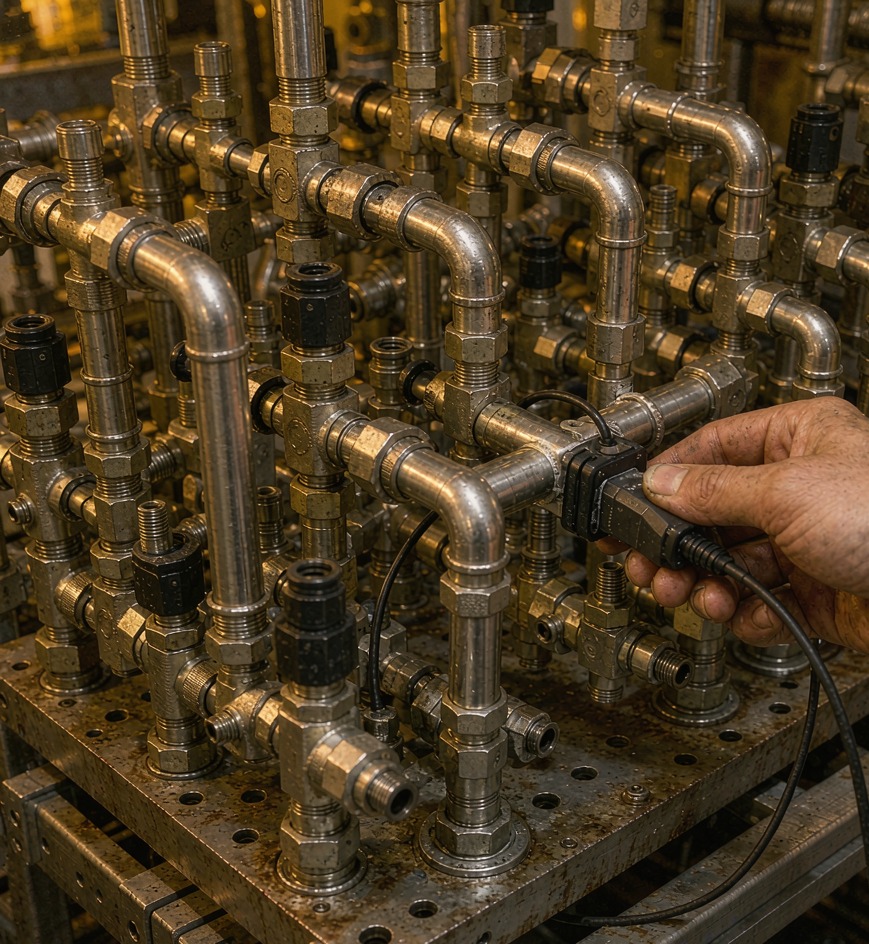
You can sell an upgrade later. Leave a marked straight section and a cable route in the design. The end user can add flow data after commissioning without cutting your pipework. That is a sales argument, not just an engineering convenience.
Engineering hours drop. No isometrics to redraw, no spool to re-issue, no re-test. On a brownfield job, that can save more calendar time than the hardware costs.
This short demonstration shows the sequence on a live line: transducers on the pipe, spacing entered, signal confirmed before the reading is trusted.
https://www.youtube.com/watch?v=zvjgBjf9MjI
For projects that start with an installed skid rather than a drawing, this retrofit path for clamp-on meters covers survey, mounting and sign-off.
VII. Advantage 6: Hygiene and Contamination Control
On pharmaceutical, food and utility skids, keeping the sensor out of the product is a purity requirement, not a preference.
No crevices. Every flanged joint adds a gasket gap where product can sit. A clamp-on sensor adds none. The bore stays smooth, and cleaning fluid reaches every surface.
Sanitary compliance gets easier. A hygienic meter body has to meet 3-A sanitary standards for surface finish and cleanability, and each gasket is another item to document. With clamp-on, the pipe stays a pipe.
CIP cycles get shorter. Less hardware inside the wash path means fewer shadow areas and less validation work. A team that runs clean-in-place (CIP) three times a week feels that difference quickly.
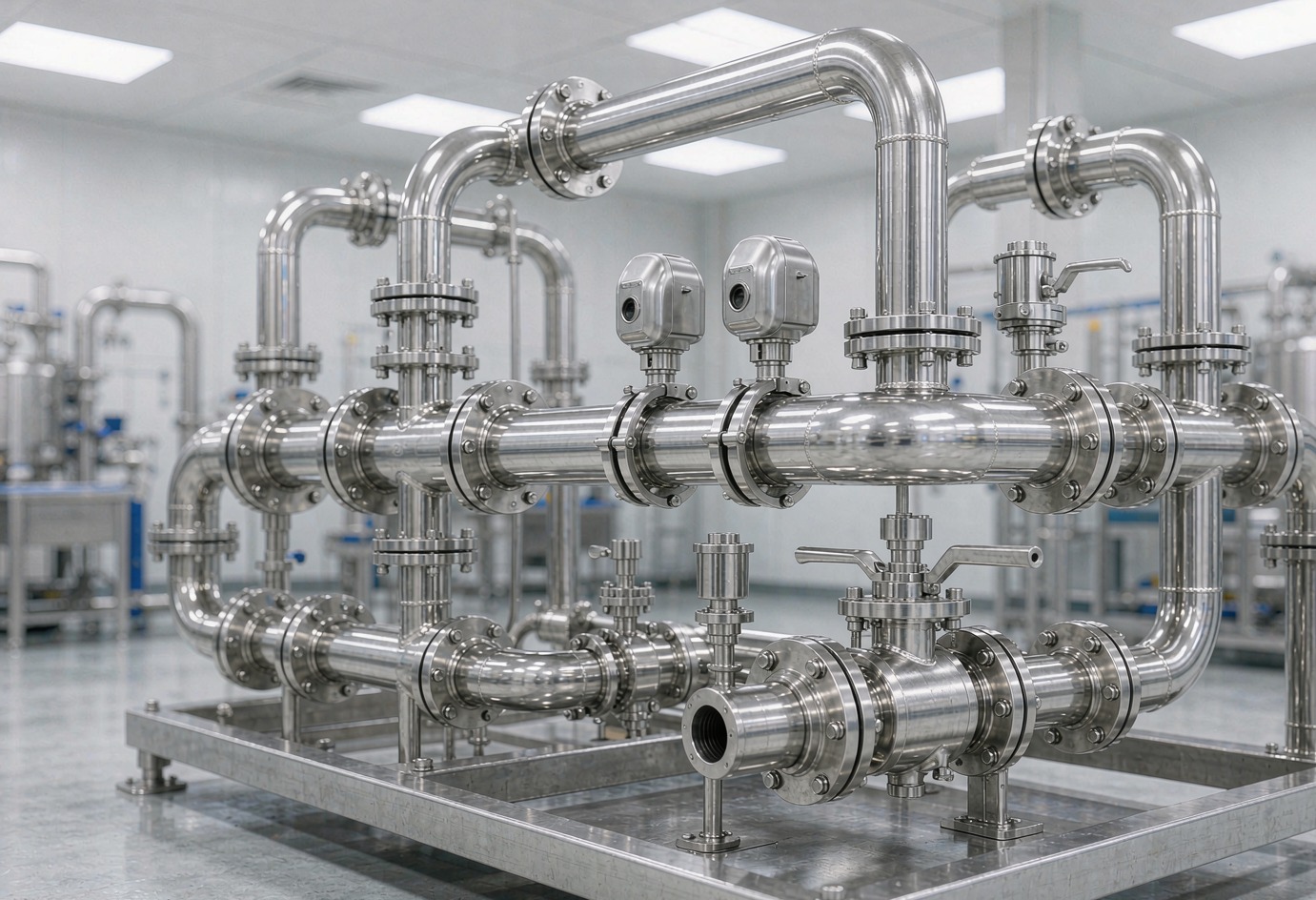
Industry insight: in a validated hygienic system, every new wetted joint pulls a change control. Avoiding the joint avoids the paperwork as well as the cleaning risk.
VIII. Advantage 7: Cost Efficiency at Scale
The purchase price of a clamp-on set is close to a mid-range inline meter. The installed cost is not.
Fewer specialty parts. No flanges, no gaskets, no upstream strainer, no bypass line, no extra supports for a heavy body. On a multi-point skid, the saving repeats at every point.
Cheaper installation than magnetic or Coriolis. Welding labour, NDT and hydro test usually cost more than the meter itself on small lines. Removing them changes the project economics, not just the line item.
A stronger commercial offer. A skid with no wetted meters is easier to sell to an end user who hates downtime. That is a positioning advantage for OEMs and distributors alike.
The pie below shows where the saving usually sits on a skid build. Jade Ant Instruments prices both options for OEM customers, and this is the split that repeats. Treat it as illustrative and check it against your own labour rates.
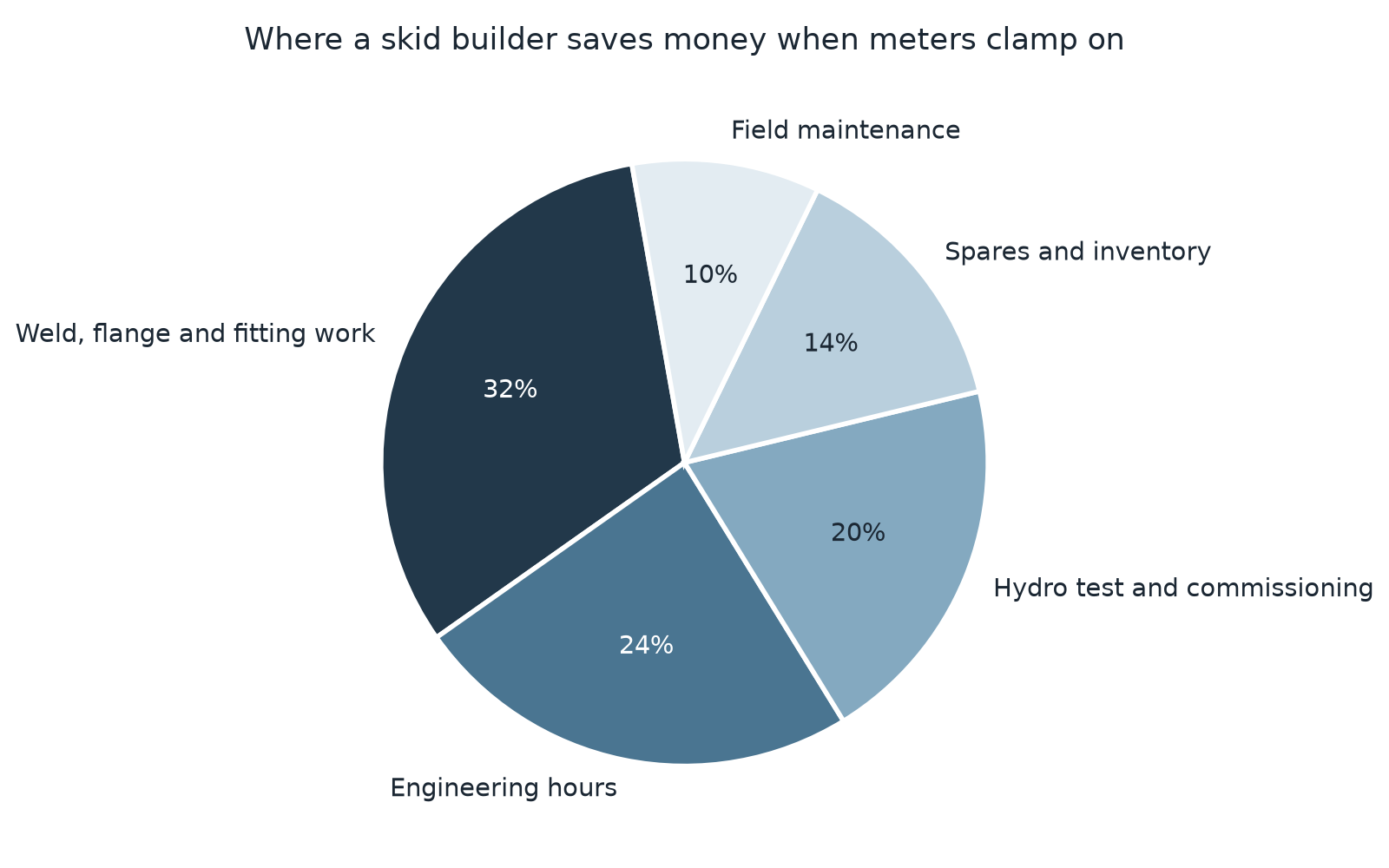
For a line-by-line model, including service life and energy, this cost and ROI breakdown runs the arithmetic on a single measuring point.
IX. Implementation Strategy for EPCs and Integrators
Moving a design from inline to clamp-on is mostly a drawing change. Five steps keep it repeatable.
- Reserve the straight run. Allow 10D upstream and 5D downstream as a baseline. Quick definition: straight run — the undisturbed pipe length before and after the sensor, counted in pipe diameters (D). A DN100 line therefore needs about 1 m upstream.
- Fix the mounting point in the drawing. Give the fabricator a dimension from the nearest flange. A sensor placed by eye on site is a sensor placed twice.
- Standardise the bracket. One bracket design per pipe size range gives repeatable spacing, protects the cable and speeds field service.
- Pick the output at design stage. 4–20 mA for a simple loop, Modbus RTU for a local panel, Modbus TCP or Ethernet for the plant network, HART where a legacy loop already exists. The ISA instrumentation standards are the reference most EPC specifications cite.
- Write the verification step into the FAT. Record gain and signal quality at the factory, then compare the same numbers at site. A number on a sheet is easier to defend than an opinion.
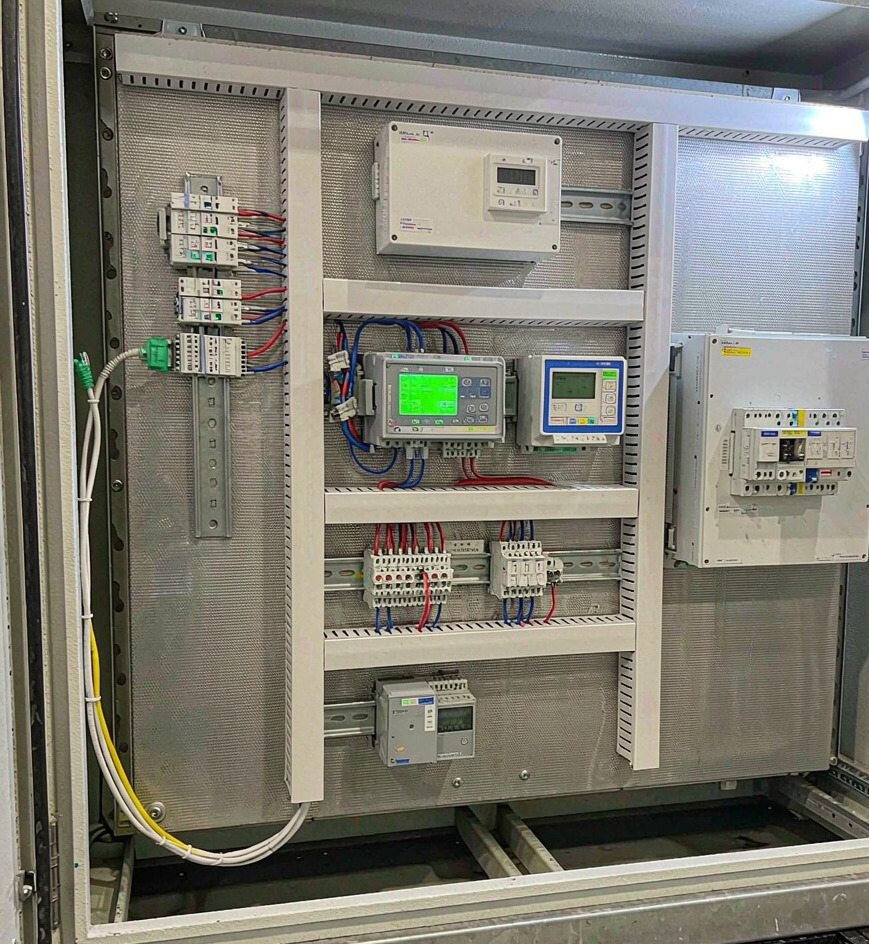
Distributors can use the same five steps as a pre-sales checklist. When a customer sends a skid drawing, the answers usually decide the model in one pass. This skid-mounted flow meter selection guide covers the sizing detail behind each step.
X. Conclusion
The seven advantages stack. No cut means no weld, no weld means no re-test, no re-test means a shorter build. No body in the pipe means no pressure loss, no debris trap and a smaller pump. No wetted parts means no corrosion, no crevices and a sensor you can swap in 20 minutes.
For an OEM, that shows up as fewer parts, shorter FAT and fewer warranty calls. For a distributor, it means a smaller stock holding that covers more lines. For an EPC, it means less site work and fewer permits. For a utility, it means measurement without service interruption.
The design habit is the real change. Once the straight run is reserved at drawing stage, flow measurement stops being a piping problem and becomes an instrumentation choice. Clamp-on flow sensors for OEM skids make that habit easy to keep, because nothing else on the drawing has to move.
Jade Ant Instruments supplies clamp-on ultrasonic flow meters to skid builders, distributors and utility teams, and we review pipe data before a model is quoted. Send a skid drawing or a pipe list, and we will mark the mounting points, the spacing values and the cable route on it.
Terms You Should Know
| Termo | Plain meaning | Example |
|---|---|---|
| Transducer | The crystal pair that sends and receives sound | A 2 MHz pair on a DN100 line |
| Couplant | Grease or paste that carries sound into the metal | Silicone grease on a water line |
| Straight run (D) | Undisturbed pipe before and after the sensor | 10D up, 5D down |
| Pressure boundary | The parts that hold line pressure | Pipe and welds, not the sensor |
| Hydro test | A pressure test that proves a spool holds | 1.5× design pressure for 30 minutes |
| CIP | Clean-in-place, a wash cycle run without opening the line | Caustic wash, rinse, sanitise |
| Serviço de arrumação | Range between the lowest and highest flow inside the accuracy band | 100:1 |
| FAT | Factory acceptance test, the build sign-off before shipment | Flow check at three load points |
PERGUNTAS FREQUENTES
How does clamp-on accuracy compare with an inline meter on a high-precision skid?
An inline magnetic meter typically holds ±0.2% to ±0.5% of reading. A clamp-on set holds about ±0.5% to ±1% of reading when the pipe data is right and the straight run is met. For process control, that is enough. For custody transfer, use Coriolis or a calibrated inline meter.
Can clamp-on sensors handle high-pressure lines without slipping or losing calibration?
Yes. The transducers sit outside the pressure boundary, so line pressure does not act on them. A 100 bar line measures the same as a 6 bar line. What changes calibration is movement, not pressure, so use steel clamps and check gain after any pipe work nearby.
What is the largest pipe diameter clamp-on can measure?
Standard pairs cover lines from about DN15 up to DN6000. Above DN600, expect a Z-mount, a lower frequency and more acoustic power. Very small lines below DN15 are the harder end, because the beam has little room to cross the bore.
Do clamp-on sensors need special pipe preparation?
The pipe needs a clean, bare metal patch slightly larger than each transducer face. Remove paint, rust and loose scale, then apply couplant and clamp. Smooth stainless needs no roughening, but a heavily pitted cast iron surface may need a low-frequency pair to get a usable signal.
How do they perform with fluids that carry solids or air bubbles?
Fine solids are usually tolerated, because they scatter only a little sound. Air is the problem. Above about 1–2% air by volume, signal quality drops, and at 5% the meter often stops reading. Move the sensor to a higher-pressure section and the reading usually returns.
Can the sensors feed Modbus or Ethernet/IP control systems?
Yes. Most clamp-on transmitters offer 4–20 mA, pulse, Modbus RTU and Modbus TCP, and some add HART or Ethernet/IP. Check the protocol at order stage, because a gateway adds cost and a failure point. Confirm the register map before you write PLC code.
How do we keep the sensors secure on a pump-driven skid that vibrates?
Use steel clamps rather than nylon straps, and mount on a straight section away from pump discharge. Check gain and signal quality after the first run-in. A sensor that moves half a millimetre loses gain, and the reading drifts before any alarm appears.
Are clamp-on sensors compatible with lined pipes?
Only in some cases. Rubber and cement linings usually scatter or absorb too much sound, and PTFE linings block it almost completely. Measure the liner and test the signal at site before you commit. If the signal is weak, an insertion meter is the honest answer.
How much faster is installation than a flange-mount meter?
A clamp-on point usually takes 2–4 hours from marking to a verified reading. A flanged meter on the same line takes 12–16 hours once you count cutting, welding, NDT, hydro test and re-painting. The gap grows on small lines, where welding cost dominates.
How does an OEM issue a calibration certificate for a non-intrusive sensor?
The certificate covers the transmitter and transducer pair, with the reference method and traceability stated. For skid work, pair it with a factory signal check and a site verification record. If the client needs wet calibration, send the pair to a lab and keep the certificate with the skid documentation pack.