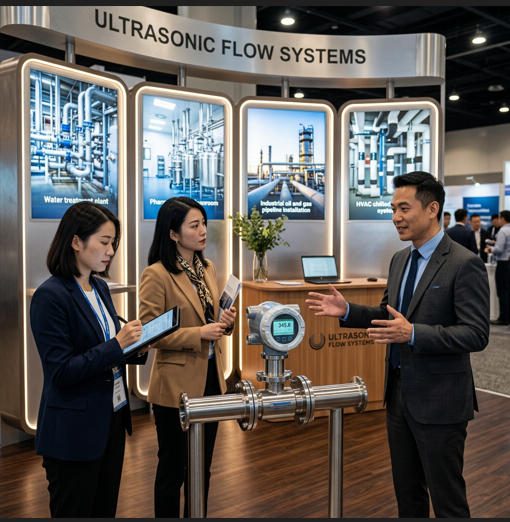
A comprehensive case study series revealing untapped market opportunities and revenue streams in niche sectors leveraging ultrasonic flow measurement technology — written exclusively for B2B flow instrumentation distributors and agents.
Why Ultrasonic Flow Meters Are Revolutionizing Non-Traditional Markets

Modern industrial facilities demand measurement solutions that deliver zero downtime, zero contamination risk, and real-time data integration. Ultrasonic flow meters check every box.
For two decades, ultrasonic flow meters were a water utility product. If you asked a procurement engineer in 2008 where these instruments belonged, the answer was almost always: municipal distribution networks, maybe natural gas pipelines. That default assumption is costing distributors and agents serious money in 2025.
The global ultrasonic flow meter market is valued at USD 2.22 billion in 2026 and projected to reach USD 3.27 billion by 2033, at a CAGR of 5.7% (Coherent Market Insights). But the growth story is not in water utilities — it is in pharmaceutical plants in India, craft breweries in Southeast Asia, biodiesel refineries in Brazil, CSP plants in the Middle East, and district heating networks in Scandinavia.
The technology has matured dramatically. Today’s industrial ultrasonic flow meters handle fluid temperatures beyond 200°C, carry ATEX/IECEx certifications for explosive atmospheres, stream real-time data to cloud SCADA platforms, and install without breaking a single pipe. For B2B distributors and agents, this creates a fundamental competitive choice: stay a generalist competing on price in commodity markets, or become the specialist that commands 30–40% higher margins, earns long-term service contracts, and builds customer relationships that last a decade.
This guide walks through 8 niche industries where that opportunity is real, proven, and accessible right now.
業界の洞察 The clamp-on ultrasonic flow meter sub-segment alone was valued at $3.8 billion in 2025 and is projected to reach $6.2 billion by 2033 at 7.2% CAGR — nearly double the growth rate of the broader flow meter market (DataIntelo, 2025). The non-invasive segment is where the most aggressive growth is happening.
The Pharmaceutical Manufacturing Revolution
How Ultrasonic Flow Meters Ensure Drug Production Compliance

Injectable drug manufacturing requires absolute measurement precision — one contaminated batch can cost a facility over $200,000 in product loss alone, before regulatory penalties.
The Challenge: Precision in Liquid Handling
Pharmaceutical manufacturing operates under a level of regulatory scrutiny that most industries never encounter. In FY2024, the FDA conducted 972 drug quality assurance inspections — a 27% increase from the prior year — with a marked rise in warning letters for facilities failing to maintain adequate process controls. Across the Atlantic, the European Medicines Agency (EMA) enforces similarly rigorous GMP (Good Manufacturing Practice) requirements.
The core problem with traditional mechanical flow meters — turbine meters, paddlewheel sensors, oval gear meters — in pharmaceutical environments is contamination risk. Any sensor placed inside a pipeline carrying Water for Injection (WFI), buffer solutions, or active pharmaceutical ingredients (APIs) creates a physical surface where biofilm can accumulate and particles can shed into the product stream.
A single contamination event in a batch of injectable medication does not just mean scrapping that batch. It triggers an FDA investigation, a potential facility shutdown, and reputational damage that takes years to recover from. For a mid-size contract pharmaceutical manufacturer producing 50,000 injectable vials per day, one rejected batch represents a direct loss exceeding $200,000 — before accounting for regulatory response costs.
Traditional meter installations also require CIP (Clean-In-Place) validation every time a meter is serviced or replaced. Each CIP validation cycle consumes 6–8 hours of production line time and generates 40–60 pages of documentation. Multiply that across a 20-line facility with quarterly calibration schedules, and you are looking at 480–640 hours of lost production annually — purely from meter maintenance logistics.
The Solution: Non-Invasive Ultrasonic Technology
Clamp-on ultrasonic flow meters solve this problem at its root by measuring the transit time of ultrasonic pulses through the pipe wall and the fluid — with zero sensor-to-product contact. There is nothing inside the pipe. Nothing to clean. Nothing to validate for product contact. No CIP cycle disruption.
These meters integrate directly with pharmaceutical SCADA, MES (Manufacturing Execution Systems), and batch record platforms via Modbus RTU, HART, or 4-20mA outputs — enabling real-time batch documentation that satisfies 21 CFR Part 11 requirements for electronic records and audit trails without any additional middleware.
Case Study: Injectable Medication Production
A contract pharmaceutical manufacturer in Southeast Asia producing parenteral (injectable) products ran a 60,000-vial-per-day production line using aging turbine meters on its WFI and buffer preparation lines. Each meter required quarterly recalibration with a mandatory 6-hour line shutdown — 24 hours of lost production annually per line, across 14 measurement points.
After replacing all 14 turbine meters with clamp-on ultrasonic units, the results over 12 months were tracked as follows:
| Performance Metric | Before Installation | After Installation | Change |
|---|---|---|---|
| Annual calibration downtime per line | 24 hours | 2 hours | −91.7% |
| Batch documentation time per lot | 4.2 hours | 1.1 hours | −73.8% |
| Contamination-related batch holds | 3 events/year | 0 events | −100% |
| CIP validation cycles avoided | ベースライン | 56 cycles saved | — |
| Estimated total annual savings | — | USD 380,000 | — |
The full hardware investment payback period was 11 months. The facility’s quality manager reported that the ultrasonic meters were cited positively during a subsequent FDA pre-approval inspection as evidence of robust process control infrastructure.
Market Opportunity for Distributors
💡 Distributor Insight: Pharmaceutical manufacturing is relocating rapidly to India, South Korea, Vietnam, and Indonesia. Each new facility is a greenfield instrumentation project. FDA/EMA compliance requirements mean product credibility matters far more than unit price — an environment where a knowledgeable distributor who guides plant engineers through validation documentation commands 30–40% margin premiums over catalog-order competitors. Recurring calibration contracts on a 20-line facility can generate $15,000–$25,000 per year in pure service revenue.
Food and Beverage Processing Innovation
Ultrasonic Flow Meters in Precision Food Manufacturing

Sanitary piping in food processing facilities requires non-invasive, hygienic flow measurement that maintains product integrity across viscosity-variable production runs.
The Challenge: Maintaining Product Quality and Safety
The Food Safety Modernization Act (FSMA) in the United States and the HACCP (Hazard Analysis and Critical Control Points) framework — now mandatory in most export markets — place the burden of preventive process controls directly on producers. Flow measurement is a critical control point in virtually every food and beverage process: liquid ingredient dosing, CIP solution concentration, pasteurization flow rates, and filling line throughput all require accurate, documented measurement.
The technical complication is fluid variability. A craft brewery might run a thin lager at 1 cP viscosity one week, then switch to a thick, high-gravity stout at 4–6 cP the next. A dairy processor handles skim milk and then full-cream homogenized products in the same pipeline within the same shift. Traditional positive displacement meters handle viscosity reasonably but require full product contact and complex sanitary installation. Electromagnetic flow meters work with conductive fluids but are blind to oils, fats, and most beverages containing suspended solids.
The Solution: Clamp-On Technology for Food Applications
Clamp-on ultrasonic flow meters are completely independent of fluid conductivity and largely independent of viscosity within standard food processing ranges. Advanced signal processing algorithms automatically compensate for viscosity variation, maintaining measurement accuracy within ±1.5% even when product specifications change between runs.
Installation on existing sanitary piping — typically 316L stainless steel to 3-A or DIN 11850 hygienic standards — requires no pipe cutting, no welding, and no production shutdown. A two-technician installation on a standard 4-inch dairy line takes under 2 hours from arrival to first measurement. As documented by GAO Tek’s food industry case studies, clamp-on installation consistently eliminates the downtime costs that make alternative meter installations economically painful for continuous-production food facilities.
Case Study: Craft Beverage Production Facility
A regional craft brewery in Eastern Europe producing 28,000 hectoliters annually was struggling to scale production while maintaining the recipe consistency that defined their brand identity. Their existing rotameter-based flow measurement on brewing water, wort transfer, and CIP chemical lines was accurate to only ±5% — creating batch-to-batch variation detectable in consumer taste panel testing.
After installing clamp-on ultrasonic meters on six critical process lines, documented results over the following 8 months included:
- Recipe repeatability improved from 82% to 97% batch-to-batch consistency
- CIP chemical consumption dropped 18% through precise dosing control — saving €14,200 annually in chemical costs alone
- Water usage per hectoliter produced fell from 6.4L to 5.1L — a 20% efficiency gain that also supported their sustainability certification application
- The facility achieved ISO 22000 food safety management certification within 8 months, with meter data logging cited as supporting evidence of documented process control
Case Study: Dairy Processing Operations
A dairy cooperative in South America processing 180,000 liters of raw milk per day faced persistent billing disputes with their cream separator contractor and chronic inaccuracy in fat standardization. Their electromagnetic flow meters on cream lines produced erratic readings whenever fat content shifted — a fundamental limitation of mag meters where non-conductive fat globules disrupt the measurement signal.
Replacing the mag meters with transit-time ultrasonic units featuring integrated temperature compensation resolved the conductivity issue entirely. Within the first quarter post-installation, fat standardization accuracy improved to ±0.08% (from ±0.35%), and product give-away through over-standardization dropped by 12,400 liters per month. At local cream pricing, that recovered product was worth approximately USD 74,400 per year — a payback period of under 9 months on the meter investment.
Market Opportunity for Distributors
🌱 Market Signal: Craft beverage markets in Southeast Asia, Latin America, and Eastern Europe are growing at 8–12% annually. Artisanal producers typically lack in-house instrumentation expertise, making the distributor’s application knowledge a genuine differentiator. Seasonal production patterns — breweries ramping up for summer, juice processors running at capacity during harvest — create natural opportunities for recurring service contracts covering seasonal commissioning, recalibration, and performance verification.
Renewable Energy and Biofuel Applications
Ultrasonic Flow Measurement in Next-Generation Energy Production
The Challenge: Monitoring Complex Fluid Systems
Renewable energy facilities present some of the most demanding fluid measurement environments on earth. Biodiesel production involves a sequence of palm oil or soybean feedstocks, methanol reactants, glycerol by-products, and wash water — each with dramatically different viscosities, densities, and chemical aggressiveness toward sensor materials. A concentrated solar power (CSP) plant using molten salt as its heat transfer medium operates at temperatures between 290°C and 565°C. Geothermal systems push mineral-laden brines at elevated temperatures and pressures that destroy most conventional meters within months.
In two-phase flow conditions — where liquid and gas phases coexist, as is common in biofuel and geothermal applications — traditional differential pressure meters produce unreliable readings that compromise process optimization and energy efficiency calculations.
The Solution: High-Temperature Ultrasonic Meters
Specialized high-temperature ultrasonic flow meters designed for energy applications operate continuously at fluid temperatures up to 200–300°C in standard configurations, with high-performance variants — such as the Baker Hughes Panametrics PanaFlow HT — rated for extreme processes from -200°C to +600°C. Their non-invasive design eliminates thermal stress on measurement components from direct fluid contact, and their data logging capabilities — typically 0.1-second sampling intervals with 30+ days of onboard storage — provide the operational intelligence needed for real-time efficiency optimization.
Advanced ultrasonic algorithms achieve ±2–3% accuracy in two-phase flow conditions, providing reliable data where differential pressure meters would fail entirely.
Watch this overview of how ultrasonic flow technology works across industrial applications — essential background knowledge for any distributor team entering energy market conversations:
Case Study: Biodiesel Production Facility
A biodiesel plant in Southeast Asia processing 50,000 metric tons of palm oil feedstock annually was running differential pressure (dP) flow meters on its transesterification reactor lines. The dP meters required quarterly cleaning of their impulse lines due to glycerol fouling — each maintenance cycle took a reactor line offline for 6–8 hours, totaling 32 hours of downtime per line annually.
| Performance Metric | DP Meters (Before) | Ultrasonic Meters (After) | Improvement |
|---|---|---|---|
| Annual maintenance downtime/line | 32 hours | 4 hours | −87.5% |
| Feedstock measurement accuracy | ±3.5% | ±1.2% | +71% better |
| Annual yield improvement | ベースライン | +1.8% | +USD 210,000/yr |
| Estimated meter service life | 3~5年 | 10+ years | 2–3× longer |
Case Study: Concentrated Solar Power (CSP) Plant
A 50 MW CSP plant in the Middle East using molten salt thermal storage needed to accurately measure salt flow between its hot tank (565°C) and cold tank (290°C) to calculate real-time thermal energy generation and optimize turbine dispatch. No conventional contact sensor could survive the thermal environment.
High-temperature clamp-on ultrasonic meters with specialized transducer coupling compounds rated above 300°C were installed and integrated with the plant’s DCS (Distributed Control System) via HART protocol. Over 18 months of operation, the improved thermal measurement accuracy identified a previously undetected 4.2% heat loss in the secondary piping network — a finding that, once rectified through targeted insulation upgrades, improved annual energy output by an estimated 2,100 MWh.
Market Opportunity for Distributors
💡 Distributor Insight: The IEA projects renewable capacity additions exceeding 5,500 GW globally between 2024 and 2030. Each new biofuel plant, CSP installation, and geothermal facility is a greenfield instrumentation opportunity. High-temperature specialized meters command pricing premiums of 40–80% over standard models, and the technical expertise required to specify and commission them correctly creates significant barriers to entry for generalist competitors who quote from catalogs without application engineering support.
Chemical Processing and Specialty Manufacturing
Precision Flow Control in Hazardous Chemical Environments

Chemical processing environments demand instrumentation that is both accurate and inherently safe — ATEX/IECEx certified ultrasonic meters meet both requirements without compromise.
The Challenge: Safety and Accuracy in Corrosive Applications
Chemical processing plants handle fluids that destroy conventional sensors — concentrated sulfuric acid, caustic soda at 50% concentration, chlorinated solvents, and reactive organic compounds that corrode standard wetted materials within weeks. Beyond material compatibility, many chemical processes occur in classified hazardous areas — Zone 1 or Zone 2 under the ATEX Directive (Europe) or IECEx scheme (International) — where any instrument that can produce an electrical spark is a liability, not a measurement tool.
ATEX (Atmosphères Explosibles): European Union directive requiring equipment used in explosive atmospheres to meet specific safety certifications. IECEx: The international equivalent certification scheme for equipment used in explosive atmospheres.
In these environments, a flow meter specification is not primarily a procurement decision — it is a process safety decision. An instrument that fails unpredictably in a Zone 1 area can be the initiating event for a catastrophic explosion. The procurement process is therefore far more rigorous, the specifications far more demanding, and the value of a certified, knowledgeable supplier far higher than in commodity applications.
The Solution: Specialized Ultrasonic Systems
ATEX- and IECEx-certified ultrasonic flow meters achieve intrinsic safety (Ex i classification) — meaning the instrument cannot produce a spark or thermal event sufficient to ignite an explosive atmosphere, even under complete electrical fault conditions. Combined with chemical-resistant transducer materials (PEEK, PVDF, or Hastelloy-C depending on the fluid) and remote electronics enclosures positioned outside the hazardous zone, these systems deliver accurate measurement in conditions where virtually every alternative technology either fails or is prohibited.
Remote monitoring capabilities allow engineers to access real-time flow data from a safe location — critical in facilities where personnel exposure to process areas must be minimized. As detailed in the comparison between clamp-on and inline ultrasonic configurations, the non-invasive design also eliminates the process isolation and depressurization requirements that make inline sensor replacement in chemical environments a costly, time-consuming operation.
Case Study: Industrial Coating Manufacturing
A specialty coatings manufacturer producing two-component epoxy and polyurethane systems needed to blend resin and hardener in precise ratios — typically 4:1 or 2:1 by volume — across 12 production lines. A 3% deviation in the mix ratio produced coatings that failed adhesion testing, resulting in batch rejections and customer returns costing the plant approximately USD 180,000 per year.
Installing ultrasonic flow meters on both the resin and hardener feed lines — with real-time ratio calculation fed directly to the batching PLC — reduced mix ratio deviation to below 0.8%. In the first year post-installation, batch rejection rate fell from 6.2% to 0.9%, recovering USD 161,000 in saved product and USD 38,000 in reduced raw material over-dosing. Total first-year measurable benefit: USD 199,000.
Case Study: Water Treatment Chemical Dosing
A municipal water authority in the Asia-Pacific region was using peristaltic pumps with manual flow estimation to dose aluminum sulfate (alum) as a coagulant in their 200 ML/day treatment plant. Under-dosing resulted in turbidity exceedances; over-dosing wasted chemical and increased sludge volume and disposal costs.
Installing clamp-on ultrasonic meters on the alum dosing lines — measuring actual delivered flow rather than estimated pump output — and integrating the signal with turbidity analyzers in a closed-loop control scheme reduced alum consumption by 14% while turbidity exceedances fell from 8 per year to 1. The chemical cost saving alone was USD 52,000 annually.
Market Opportunity for Distributors
🌱 Market Signal: ATEX/IECEx certification is a mandatory procurement requirement in hazardous area applications — meaning certified distributors automatically eliminate non-certified competitors from the bid shortlist without ever competing on price. High customer switching costs in certified installations (driven by the change management documentation required to substitute instrumentation in a certified hazardous area) create exceptional customer loyalty. Once established in a chemical processing account, a distributor relationship typically spans 8–15 years.
HVAC and District Heating Systems
Ultrasonic Flow Meters Optimizing Thermal Distribution Networks
The Challenge: Measuring Heat Transfer Efficiency
District heating — the centralized generation and distribution of thermal energy to multiple buildings through insulated pipelines — is a cornerstone of urban energy infrastructure in Northern Europe, China, and increasingly Eastern Europe and parts of Asia. A large district heating network serving 50,000 households can distribute 400–800 GWh of thermal energy annually. At that scale, a 1% measurement error in the billing system translates to millions of dollars in either under-recovered revenue or customer overcharging — both of which trigger regulatory scrutiny and customer disputes.
Billing accuracy requires simultaneous, precisely matched flow measurement and temperature differential (ΔT) measurement. A flow meter drifting by 2% combined with a temperature sensor pair with 0.1°C offset can produce combined billing errors exceeding 5% — errors that are difficult to detect without reference measurement and expensive to rectify retroactively.
The Solution: Energy Calculation Capabilities
Modern ultrasonic heat meters integrate the flow transducer with matched Pt1000 temperature sensors and an onboard energy calculator that outputs kWh or BTU as a primary measurement — not a derived approximation. The best-in-class systems achieve Class 1 accuracy under the European EN 1434 standard, with billing measurement uncertainty below 3% across the full operating flow range.
Data integration with BMS (Building Management Systems) via BACnet, Modbus, or M-Bus communication protocols enables automated energy reporting, anomaly detection, and demand-side management — capabilities that are increasingly mandated by energy efficiency regulations in the EU and China.
Case Study: District Heating Network in Nordic Region
A district heating utility in Finland serving 35,000 residential and commercial connections replaced aging mechanical heat meters with 3-path ultrasonic meters across its distribution network over a 3-year phased upgrade program. The documented outcomes after full deployment included:
- Customer billing disputes dropped from an average of 340 per year to 28 — an 91.8% reduction that freed significant customer service resources
- System-wide heat loss identification: The improved measurement resolution revealed 6 distribution segments with anomalously high losses, pointing to insulation failures that, once repaired, recovered an estimated 12 GWh of annual thermal energy — worth approximately €480,000 at residential heat tariffs
- Predictive maintenance: Flow pattern analysis flagged 3 pump stations showing early efficiency degradation 4–6 weeks before they would have required emergency intervention
- Carbon reporting: Precise energy consumption data enabled the utility to publish verified annual carbon footprint figures, supporting their ESG reporting requirements under the EU Taxonomy Regulation
Case Study: Large Commercial Building HVAC Integration
A 280,000 m² mixed-use commercial complex in Singapore installed ultrasonic energy meters on all 14 tenant chiller circuits to enable accurate departmental energy allocation and internal cost recovery. Prior to installation, energy costs were allocated by floor area — a crude method that created persistent disputes with anchor tenants running 24/7 data center operations versus regular business-hours office users.
Post-installation, energy allocation accuracy improved sufficiently to reduce internal billing disputes to zero and enabled the facility management team to identify chiller plant inefficiencies worth SGD 280,000 annually in avoidable energy spend — discovered purely through the granular flow and energy data the ultrasonic meters provided.
Market Opportunity for Distributors
💡 Distributor Insight: Aging district heating infrastructure across Eastern Europe, China, and Southeast Asia represents a multi-decade replacement cycle — and most of it was installed with mechanical meters that are already overdue for modernization. Smart building regulations in the EU (the Energy Performance of Buildings Directive) and China’s 14th Five-Year Plan for building energy efficiency both mandate sub-metering — creating mandatory demand, not optional demand. Distributors who establish energy auditing service partnerships alongside meter sales can generate recurring consulting revenue while driving hardware replacement cycles.
Advanced Medical Device Manufacturing
Ultrasonic Flow Measurement in Sterile Processing Environments

Medical device manufacturing clean rooms demand measurement instruments that leave absolutely zero contamination footprint — clamp-on ultrasonic technology is the only viable non-invasive solution.
The Challenge: Contamination Prevention in Critical Applications
Medical device manufacturing — particularly for dialysis equipment, infusion pumps, and surgical fluid management systems — operates in sterile processing environments where any contamination of the fluid handling system can compromise device safety and trigger regulatory action. Validation and documentation demands under FDA 21 CFR Part 820 (Quality System Regulation) and ISO 13485 require comprehensive records of every process parameter at every production stage.
Integration with automated manufacturing systems adds further complexity: flow measurement data must be machine-readable, time-stamped, and traceable to individual production lots — requirements that rule out manual observation or standalone analog indicators.
The Solution: Portable and Clamp-On Measurement
Portable clamp-on ultrasonic meters serve a critical dual role in medical device manufacturing: temporary installation for IQ/OQ/PQ validation (Installation Qualification, Operational Qualification, Performance Qualification — the three-stage validation protocol required for FDA-regulated manufacturing processes) and permanent installation for ongoing process monitoring.
Smart distributors recognize the strategic value of introducing portable units first: a facility that uses your portable meter for a validation project has already experienced the technology’s performance firsthand before committing to permanent installation — removing the uncertainty that typically extends capital procurement timelines in regulated industries. Full data archiving with tamper-evident audit trails satisfies the traceability requirements of both FDA and EU MDR (Medical Device Regulation).
Case Study: Dialysis Equipment Production
A dialysis equipment manufacturer in Germany producing 600,000 membrane modules annually needed to validate the flow performance of each module at the end of the production line. Their existing test rig used turbine meters that required recalibration every 500 test cycles — creating both a quality risk (if drift occurred between calibrations) and an operational bottleneck (5 days of annual test rig downtime for calibration).
Replacing the turbine meters with non-invasive ultrasonic sensors designed specifically for medical device fluid monitoring eliminated the calibration cycle entirely — the meters are verified against a traceable reference annually rather than after every 500 cycles. Test rig uptime improved by 5 days annually, and the regulatory approval timeline for a new module design was accelerated by 6 weeks because the ultrasonic meters’ continuous data logging provided production history documentation that satisfied the notified body’s technical file requirements without additional retrospective testing.
Market Opportunity for Distributors
🌱 Market Signal: Medical device manufacturing outsourcing is growing rapidly across Asia — particularly in Malaysia, Thailand, and China — as OEMs seek cost-efficient production without compromising regulatory compliance. Contract manufacturers in these regions are actively seeking suppliers with validation expertise, not just hardware. Distributors who can provide both the ultrasonic meters and the IQ/OQ/PQ validation documentation support are accessing a market where the value-added service fee often exceeds the hardware margin.
Pulp, Paper, and Specialty Fiber Industries
Flow Measurement in Complex Fiber Slurry Applications
The Challenge: Measuring Non-Newtonian Fluids
Paper pulp slurry is one of the most hostile fluids in industrial processing. It is a non-Newtonian fluid — meaning its viscosity changes depending on how fast it flows, unlike water which has constant viscosity at a given temperature. This behavior breaks the fundamental assumptions built into most conventional flow meter calibration algorithms.
At typical pulp consistencies of 1–5% fiber (meaning 1–5 grams of fiber per 100 grams of slurry), conventional turbine meters foul within hours as fibers wrap around the rotor. Electromagnetic flow meters — often the preferred alternative — require the fluid to be electrically conductive and struggle with consistency variations that change the effective conductivity of the slurry. Maintenance costs in a typical kraft pulp mill with conventional inline meters can reach USD 120,000–180,000 annually in replacement parts, labor, and lost production during meter changeouts.
The Solution: Clamp-On Ultrasonic Technology for Slurries
Clamp-on ultrasonic meters have no internal components — nothing inside the pipe to foul, jam, or require replacement. The transducers attach to the outside of the pipe (typically carbon steel or HDPE in mill environments), and the ultrasonic signal propagates through the pipe wall and the slurry. There is no moving part, no wetted surface, and no maintenance intervention required between scheduled calibration checks.
As confirmed in documented case studies by Endress+Hauser in pulp and paper applications, ultrasonic meters accurately reflect calculated flow rates in fiber slurry conditions where alternative technologies require frequent intervention. The robust design withstands the vibration, temperature variation, and chemical exposure inherent in mill environments.
Case Study: Recycled Fiber Processing Mill
A recycled fiber processing mill in Scandinavia handling 800 metric tons of mixed paper stock per day was experiencing chronic measurement reliability issues on its main pulp flow lines. Electromagnetic meters were replaced every 14–18 months due to liner deterioration from fiber abrasion. Each replacement required a 12-hour line shutdown and cost approximately USD 8,500 in hardware and labor per event — across 9 critical measurement points, annual meter maintenance costs exceeded USD 95,000.
Transitioning to clamp-on ultrasonic meters across all 9 measurement points delivered the following documented outcomes over 24 months:
- Meter-related maintenance costs: reduced from USD 95,000 to USD 8,200 annually (calibration verification only) — 91.4% cost reduction
- Production uptime improvement: 108 hours of previously scheduled maintenance downtime eliminated per year
- Slurry consistency monitoring accuracy: improved sufficiently to reduce fiber loss in white water recovery by 3.2%, saving approximately USD 67,000 per year in recovered fiber value
- The mill’s sustainability audit credited the reduced water and chemical consumption enabled by better consistency control toward their ISO 14001 environmental management certification renewal
Market Opportunity for Distributors
💡 Distributor Insight: Sustainability-driven mill modernization is accelerating across Asia and Latin America as paper producers face increasing pressure to document water usage, chemical consumption, and fiber yield efficiency for ESG reporting. International mill automation projects — often financed by development banks — require instrumentation suppliers with both technical certification and regional service capabilities. Distributors who position themselves as specialists in fiber slurry measurement, rather than generalists, command service fees 2–3× above standard rates because the application expertise is genuinely scarce.
Agricultural and Irrigation Technology
Smart Flow Measurement for Precision Agriculture

Modern precision agriculture operations use IoT-enabled ultrasonic flow meters to manage irrigation at the field level — reducing water consumption by 20–30% while improving yields through data-driven application control.
The Challenge: Water Resource Management and Cost Control
Agricultural water management is under pressure from three directions simultaneously: increasing water scarcity, rising irrigation energy costs, and regulatory requirements for water usage documentation in export markets. A large-scale vegetable operation irrigating 2,000 hectares can consume 8–12 million cubic meters of water annually. A 10% measurement error in irrigation flow — entirely possible with conventional mechanical meters that drift in field conditions — means the operation cannot distinguish between efficient and wasteful water application, making optimization impossible.
Fertilizer injection accuracy compounds the problem. A fertigation system applying nitrogen at 200 kg/ha intended rate but delivering 215 kg/ha due to flow measurement error wastes $340 per hectare in fertilizer cost annually — across 2,000 ha, that is USD 680,000 in annual fertilizer over-application, plus potential soil and groundwater quality issues that threaten export certification.
The Solution: Wireless and IoT-Enabled Ultrasonic Meters
Battery-powered wireless ultrasonic flow meters eliminate the expensive trenching and conduit infrastructure that makes conventional wired instrumentation economically prohibitive across large agricultural areas. A LoRaWAN or cellular-connected ultrasonic meter can be deployed at an irrigation head in under 30 minutes, transmitting hourly flow data to cloud-based agricultural management platforms without any physical cable infrastructure.
Integration with agronomic platforms — connecting flow measurement data with soil moisture sensors, weather stations, and crop growth models — enables the kind of data-driven irrigation scheduling that peer-reviewed research consistently shows can reduce water consumption by 20–35% while maintaining or improving yields.
Case Study: Large-Scale Vegetable Production Operation
A commercial vegetable operation in Australia producing leafy greens and brassicas across 1,800 hectares was operating with mechanical paddlewheel meters on its irrigation mainlines — meters that required quarterly field servicing and drifted by up to 8% between services due to sand and debris fouling in the irrigation water.
Deploying battery-powered wireless ultrasonic meters at 240 irrigation head positions, integrated with the farm’s existing agronomic management platform via API, delivered the following results over the first full growing season:
| Metric | Before (Mechanical Meters) | After (Wireless Ultrasonic) | Change |
|---|---|---|---|
| Water usage accuracy | ±8% (between services) | ±1.5% continuous | +81% improvement |
| Total water consumption | ベースライン | −23% | Saved 1.8M m³/season |
| Fertilizer application accuracy | ±12% estimated | ±2.1% | +82% improvement |
| Fertilizer cost reduction | — | −18% | AUD 214,000/year |
| Meter field service visits | 960/year | 48/year (annual checks) | −95% |
| Yield improvement | ベースライン | +6.8% | +AUD 380,000/season |
The operation also achieved GlobalG.A.P. water stewardship certification renewal — a requirement for their European export contracts — supported by the continuous, verified flow data the ultrasonic meters provided.
Market Opportunity for Distributors
🌱 Market Signal: Precision agriculture technology adoption is accelerating globally, driven by government subsidies in the US (Farm Bill), EU (Common Agricultural Policy), Australia (Water Use Efficiency programs), and India (PM-KUSUM scheme). Each program creates partially subsidized demand that reduces the price sensitivity of agricultural buyers. Wireless IoT meters also open a recurring revenue stream — cloud platform subscription fees and annual data analytics service contracts that continue long after the hardware sale is complete.
Competitive Advantages for Your Distribution Business
Positioning Yourself as a Specialist in Niche Markets
Developing Technical Expertise
The single most powerful competitive advantage a B2B flow instrumentation distributor can build is application-specific technical depth that generalist competitors cannot easily replicate. This means moving beyond knowing which meter fits which pipe size, to understanding why a pharmaceutical plant’s validation engineer needs 21 CFR Part 11 compliant data logging, or why a CSP plant’s DCS engineer requires HART revision 7 compatibility.
Manufacturers — including the team at ジェイド・アント・インストゥルメンツ — provide application engineering support to distribution partners precisely because the distributor’s technical confidence in customer conversations is what closes the sale. Leverage that support aggressively. Industry certifications from organizations like the ISA (International Society of Automation) — particularly the CCST (Certified Control Systems Technician) and CAP (Certified Automation Professional) designations — establish technical credibility that is visible to engineering and procurement teams evaluating potential suppliers.
Creating Targeted Marketing Strategies
Vertical-specific case studies with documented ROI data — numbers like the ones presented in this guide — are the most effective marketing asset a niche instrumentation distributor can produce. A pharmaceutical plant engineer who reads a case study showing 91.7% downtime reduction and an 11-month payback period does not need a product brochure. They need a site visit to discuss implementation.
Industry-specific webinars hosted in partnership with industry associations — the Parenteral Drug Association for pharma, the Brewers Association for craft beverage, or regional HVAC engineering societies for building energy — position your team as thought leaders rather than product vendors. That positioning shift changes the entire pricing conversation.
Building Long-Term Customer Relationships
Application consultation services — where your team visits a facility, reviews the existing instrumentation, identifies measurement problems, and proposes solutions — transform a transactional distributor relationship into a strategic partnership. Customers who have received genuine application expertise from your team do not shop your products on price; they call you first when a new project arises.
Preventive maintenance programs and upgrade schedules tied to meter service life create predictable recurring revenue while demonstrating commitment to the customer’s operational performance rather than just the initial sale.
Expanding Your Service Offerings
The most profitable distributors in niche flow instrumentation markets have built service revenues that rival or exceed their hardware revenues. Installation and commissioning services, calibration and verification programs, and data analysis consulting — particularly for customers who have invested in IoT-connected meters but lack the internal expertise to extract actionable insight from the data — each represent genuine value that customers will pay premium rates for because the alternative is hiring their own instrumentation engineers.
Future Trends and Market Growth Projections
Emerging Applications and Technology Evolution
Next-Generation Capabilities
The next generation of ultrasonic flow meters is converging with artificial intelligence in ways that will fundamentally change the distributor’s service model. AI-powered predictive analytics — where machine learning algorithms analyze patterns in flow measurement data to predict imminent equipment failures or process anomalies — is already being embedded in high-end meters from major manufacturers and will become standard across mid-range products within 3–5 years.
Enhanced multi-phase flow measurement — accurately distinguishing and measuring liquid, gas, and solid phase fractions simultaneously — is transitioning from laboratory capability to field-deployable instrument. This capability will unlock applications in mining slurry transport, two-phase geothermal flows, and enhanced oil recovery operations that are currently served by inferior measurement alternatives.
Advanced wireless connectivity — including 5G NR (New Radio) for industrial IoT — will enable real-time, high-frequency data streaming from meters in locations where current wireless infrastructure is insufficient, opening precision agriculture applications in remote regions and enabling new remote monitoring service models for distributors.
Market Growth Drivers
Four macro forces are simultaneously driving demand across every niche market described in this guide:
- Regulatory compliance escalation: FDA, EMA, ATEX, EN 1434, FSMA — every regulated industry is experiencing stricter measurement and documentation requirements that favor ultrasonic technology’s audit-trail capabilities
- Sustainability and ESG reporting: Corporate sustainability commitments and mandatory ESG disclosure requirements (EU Taxonomy, SEC climate disclosure rules) require precise measurement of energy consumption, water usage, and process efficiency — data that ultrasonic meters are uniquely positioned to provide
- Industry 4.0 and digital transformation: Factory digitalization programs across manufacturing globally are creating demand for measurement instruments with digital communication protocols and data integration capabilities that legacy mechanical meters cannot satisfy
- Global manufacturing decentralization: Production reshoring and nearshoring trends are creating new manufacturing facilities in emerging markets — each representing a greenfield instrumentation opportunity for well-positioned regional distributors
Preparing Your Business for Future Opportunities
Distributors who will capture the next wave of growth are those who invest now in three areas: technology partnerships with manufacturers — like ジェイド・アント・インストゥルメンツ — who are actively developing IoT-ready and AI-capable instrumentation; continuous education programs that keep sales and technical teams current with application developments in their target verticals; and strategic inventory positioning in the product categories where niche market demand is accelerating fastest — particularly high-temperature models, ATEX-certified systems, and wireless IoT-enabled units.
Conclusion: Capitalizing on the Ultrasonic Flow Meter Revolution
Why Niche Markets Represent Your Biggest Growth Opportunity
The comparison between niche vertical markets and commodity water metering, when viewed through the lens of distributor economics, is not close. Consider the key dimensions:
| Business Metric | Commodity Water Metering | Niche Vertical Markets |
|---|---|---|
| Average gross margin | 15–22% | 28–45% |
| Customer lifetime value | 2–4 years | 8–15 years |
| Service revenue attached per sale | ミニマル | 30–60% of hardware value annually |
| Competitive intensity | High (price-driven) | Low-Medium (expertise-driven) |
| Customer switching frequency | High (tender cycles) | Low (high switching costs) |
| Primary buying criterion | Lowest price | Technical credibility + ROI |
Your Action Plan for Market Expansion
Start by identifying one or two target verticals that have genuine overlap with your existing customer geography and relationships. A distributor already selling to pharmaceutical equipment manufacturers has natural entry points into pharma instrumentation. A distributor with HVAC contractor relationships has ready access to district heating procurement teams.
Build your expertise through manufacturer application training, industry association membership, and — critically — executing one or two reference installations with carefully documented ROI outcomes. Those documented case studies become your most powerful marketing asset in every subsequent customer conversation in that vertical.
Develop go-to-market strategies that center on education rather than promotion: webinars, technical lunch-and-learns with plant engineers, co-authored articles in industry trade publications. The distributor who teaches a pharmaceutical plant engineer how to solve a validation problem earns a trusted advisor relationship that no competitor can easily dislodge.
Measure success not just by revenue but by margin quality, service contract attachment rates, and customer retention — the metrics that reveal whether you are building a durable niche business or simply replacing commodity volume.
Ready to Unlock New Revenue Streams in High-Growth Niche Markets?
Download our comprehensive distributor’s guide to ultrasonic flow meter applications and discover detailed market analysis, implementation timelines, and profitability projections for each industry sector. Get exclusive access to our case study library, competitive positioning templates, and technical training resources designed specifically for B2B flow instrumentation distributors and agents.
よくある質問
1. What makes ultrasonic flow meters suitable for pharmaceutical applications compared to traditional mechanical meters?
Ultrasonic flow meters provide non-invasive, non-contact measurement that eliminates contamination risks critical in pharmaceutical manufacturing. They require zero product contact, enabling precise monitoring without compromising product integrity or requiring system shutdown for meter maintenance — essential for regulatory compliance with FDA and EMA standards. In documented pharma installations, facilities have eliminated contamination-related batch holds entirely post-installation.
2. How do ultrasonic meters handle the measurement challenges in food processing with varying product viscosity?
Modern ultrasonic technology uses clamp-on transducers that measure flow through the pipe wall, making them fundamentally independent of fluid viscosity changes. Advanced signal processing algorithms compensate for viscosity variations automatically, ensuring accurate measurements within ±1.5% even when processing products with dramatically different flow characteristics — from thin lagers to heavy cream — without any recalibration between production runs.
3. What are the specific advantages of ultrasonic flow meters in high-temperature renewable energy applications?
Specialized ultrasonic meters operate reliably at temperatures exceeding 200°C, critical for molten salt systems in concentrated solar power plants and thermal fluid applications in geothermal energy. Their non-invasive design eliminates thermal stress on measurement components, extending operational life to 10+ years. In documented CSP applications, high-temperature ultrasonic meters have identified heat loss anomalies recovering 2,000+ MWh of annual energy output that would have remained invisible to lower-accuracy alternatives.
4. Can ultrasonic flow meters be used in hazardous chemical environments, and what certifications are required?
Yes. Ultrasonic meters specifically designed for hazardous areas carry ATEX (European Directive 2014/34/EU) and IECEx (International Electrotechnical Commission) certifications for explosive atmospheres. Intrinsically safe (Ex i) models eliminate ignition risks while providing accurate measurement in corrosive chemical environments — including concentrated acids, caustic solutions, and reactive organic solvents — where traditional meters would either fail or be prohibited by safety regulations.
5. How do distributors justify the premium pricing of ultrasonic meters to cost-conscious customers in emerging markets?
ROI calculations should anchor to total cost of ownership across a 5–10 year horizon: elimination of maintenance downtime (worth $8,000–$25,000 per meter per year in high-maintenance applications), zero product contamination losses, recovered product yield through improved measurement accuracy, and extended operational life compared to mechanical alternatives. Case studies demonstrating 9–18 month payback periods with ongoing efficiency gains are consistently more persuasive than specification sheets for budget-conscious decision-makers.
6. What integration capabilities do ultrasonic flow meters offer with existing SCADA and building management systems?
Modern ultrasonic meters support multiple communication protocols simultaneously: Modbus RTU/TCP, HART (Highway Addressable Remote Transducer), 4–20mA analog, M-Bus (for heat meters), BACnet, and increasingly OPC-UA for Industry 4.0 environments. Data logging capabilities — typically onboard storage of 30+ days at 0.1-second resolution — support real-time monitoring, historical analysis, and automated regulatory reporting without additional data infrastructure investment.
7. Are clamp-on ultrasonic meters truly non-invasive, and can they be installed without system shutdown?
Yes. Clamp-on technology attaches to the external pipe surface using acoustic coupling gel and mechanical clamp fixtures — no pipe cutting, no welding, no process isolation. Installation on a standard industrial pipeline takes 30 minutes to 2 hours depending on pipe size and accessibility. In continuous production environments like beverage processing and district heating where every hour of shutdown costs thousands in lost production, this non-invasive installation capability is frequently the single most compelling selling point in the procurement conversation.
8. How accurate are ultrasonic meters for measuring two-phase flows in biofuel and renewable energy applications?
Advanced ultrasonic technology achieves ±2–3% accuracy even in two-phase conditions — where liquid and gas phases coexist — common in biodiesel production reactors and geothermal brine systems. Specialized signal processing algorithms distinguish between liquid and vapor phases, providing reliable measurement data where differential pressure meters produce erratic, untrustworthy readings. In documented biodiesel facility deployments, switching from DP to ultrasonic meters on two-phase lines improved feedstock ratio control accuracy sufficiently to deliver $200,000+ in annual yield improvements.
9. What training and certification programs should distributors pursue to build credibility in specialized vertical markets?
Manufacturers provide application-specific training covering installation, calibration, troubleshooting, and industry-specific regulatory compliance for distribution partners. Industry certifications from organizations like the ISA (Certified Automation Professional) そして Water Quality Association for water treatment applications establish third-party validated technical credibility. In niche markets where procurement teams are evaluating supplier expertise as much as product specification, these credentials materially influence vendor selection decisions and justify premium pricing.
10. How do wireless and IoT-enabled ultrasonic meters reduce implementation costs in distributed agricultural applications?
Battery-powered wireless ultrasonic units eliminate the trenching, conduit installation, and cable infrastructure that makes conventional wired instrumentation economically prohibitive across large agricultural areas. A typical wired installation across 200 irrigation head positions would require 40–80km of cable and associated civil works costing $300,000–$500,000. The wireless equivalent deploys in days with minimal civil disruption. Cloud-based analytics platforms then aggregate data from all locations for centralized monitoring, irrigation scheduling optimization, and fertilizer application control — typically delivered as a recurring subscription service.
11. What predictive maintenance capabilities do modern ultrasonic flow meters provide, and how can distributors monetize this service?
Integrated diagnostics continuously monitor transducer signal strength, signal-to-noise ratio, pipe wall condition (using reflective signal analysis), and electronic component health — generating anomaly alerts before failures occur. Distributors can offer managed monitoring services with automated alert escalation, scheduled preventive maintenance visits triggered by diagnostic thresholds rather than arbitrary time intervals, and quarterly performance optimization reports. This service model creates predictable recurring revenue of $2,000–$8,000 per customer per year while demonstrably improving customer uptime — making it a genuinely easy renewal conversation.
12. How do ultrasonic meters support sustainability reporting and ESG compliance initiatives?
Precise, continuous flow measurement enables accurate energy consumption tracking (kWh/BTU), water usage quantification, waste reduction documentation, and resource efficiency trending — all critical inputs for ESG (Environmental, Social, Governance) reporting under frameworks like GRI, SASB, and the EU Taxonomy Regulation. Customers facing mandatory ESG disclosure requirements increasingly recognize that their reporting credibility depends on the quality of underlying measurement data — making instrumentation upgrade decisions driven by sustainability governance rather than pure process economics.
13. What are the key differences between portable ultrasonic meters for validation purposes versus permanently installed systems?
Portable units — battery-powered, carried to the measurement location, clamped temporarily, and removed after the measurement session — serve validation, commissioning, troubleshooting, and comparative testing purposes. They provide the measurement performance of permanent instruments without the capital commitment, making them ideal for ROI demonstration before purchase decisions. Permanent systems integrate into process control architecture with continuous data logging, alarm outputs, and communication protocol connectivity. The optimal distributor strategy is to use portable meters as a sales tool: demonstrate performance on the customer’s own process, document the results, and use that data to justify the permanent installation specification.
14. How do ultrasonic meters address measurement challenges in district heating systems where billing accuracy is critical?
Integrated temperature compensation — using matched Pt1000 sensor pairs on supply and return lines with calibration traceability — combined with precision flow measurement allows the meter to calculate heat energy consumption (BTU or kWh) directly, not derived through approximation. Systems meeting Class 1 accuracy under EN 1434 standard achieve billing uncertainty below 3% across the full flow range, eliminating the systematic errors that cause billing disputes. Real-time data also enables operators to identify network segments with anomalous heat losses, pinpointing insulation failures or unauthorized diversions that would otherwise remain undetected for years.
15. What competitive advantages can distributors develop by specializing in niche vertical markets rather than remaining generalists?
Specialization delivers five compounding advantages: deeper technical expertise that enables genuine application problem-solving (not just product selection); stronger customer relationships built on trust rather than price competition; premium pricing power because specialized knowledge is demonstrably scarce; reduced competitive intensity as generalist competitors lack the vertical knowledge to compete effectively; and higher customer lifetime value because niche customers with complex applications do not change suppliers casually when the relationship is built on demonstrated expertise. The data consistently shows niche vertical specialists in flow instrumentation achieve 2–3× higher gross margins per transaction and 4–5× longer average customer relationships than generalist distributors serving commodity markets.