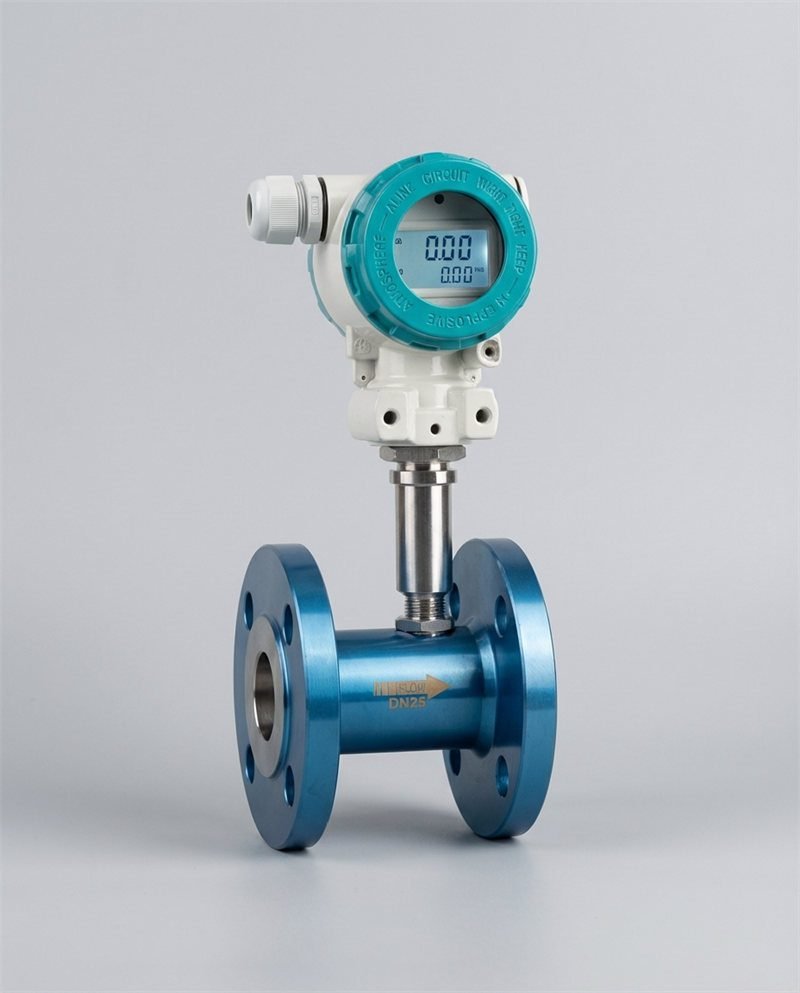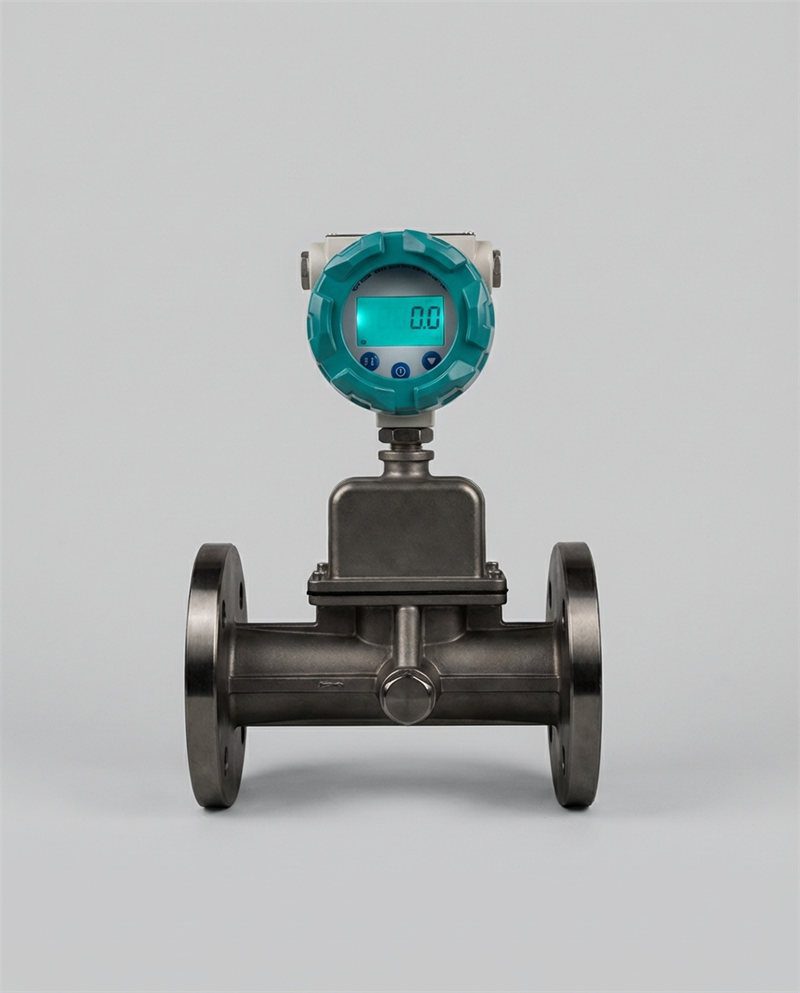

In industrial flow measurement, two things drive technology adoption more than anything else: the cost of getting it wrong, and the cost of maintaining what you install. A 1% measurement error on a crude oil transfer line carrying 50,000 barrels per day translates to roughly $35,000 in unaccounted product every 24 hours. A mechanical meter that requires a process shutdown for annual maintenance adds downtime costs on top of service labour. These are the conditions under which ultrasonic flow meters have steadily displaced older technologies across process industries.
The global industrial ultrasonic flow meter market was valued at USD 1.24 billion in 2025 and is projected to reach USD 2.19 billion by 2034 at a 6.5% CAGR — driven by oil and gas modernisation, chemical plant expansions, and the industrial push toward digitalisation and predictive maintenance. (Fortune Business Insights, 2025)
This guide covers the top 8 applications and technical features of ultrasonic flow meters in industrial settings — from the physics of transit-time measurement to the practical economics of clamp-on installation. Each section is grounded in real application data, not catalog descriptions.
1. Accuracy and Reliability in Industrial Flow Measurement
Principles Behind Ultrasonic Timing and Velocity Measurements
An ultrasonic flow meter measures fluid velocity by exploiting the physics of sound propagation. Two piezoelectric transducers send ultrasonic pulses diagonally across the pipe in opposite directions — one with the flow, one against it. The transit-time difference (Δt) between the two directions is directly proportional to the average fluid velocity along the acoustic path.
The velocity is then multiplied by the pipe’s cross-sectional area — precisely known from the spool-piece geometry in inline meters, or entered as a pipe parameter in clamp-on configurations — to yield volumetric flow rate. Multi-path designs (4 to 8 acoustic chords across the pipe cross-section) average velocity across the full profile, enabling accuracy of ±0.15% to ±0.5% even in imperfect upstream conditions. This is the technology behind fiscal-grade gas measurement per AGA報告書第9号 and liquid custody transfer per API MPMS Chapter 5.8.
Factors That Affect Accuracy: Pipe Material, Temperature, Pressure
Accuracy in real installations depends on three variables that catalog specifications do not fully capture:
- Pipe material and wall condition: For clamp-on meters, the acoustic signal must pass through the pipe wall. Carbon steel, stainless steel, PVC, and HDPE all transmit ultrasound acceptably. Heavily corroded walls, rubber-lined pipes with air-gap linings, or bitumen-coated cast iron can attenuate the signal significantly. A clamp-on meter on a well-maintained DN200 carbon steel pipe typically delivers ±1.0–1.5% of reading; the same unit on a corroded 40-year-old pipe in a municipal water network may deliver ±3–5%.
- 温度: The speed of sound in a fluid is temperature-dependent. At 20°C, sound travels through water at ~1,480 m/s; at 80°C, it travels at ~1,550 m/s. Without active temperature compensation, this 5% shift in sound velocity would produce a proportional flow-reading error. Quality ultrasonic meters include built-in temperature sensors and compensation algorithms that correct for this effect continuously.
- Pressure (gas applications): Gas density — and therefore acoustic impedance — varies with pressure. A natural gas meter calibrated at atmospheric pressure and then installed on a 40 bar supply line must apply pressure compensation to produce an accurate mass flow reading. This is done using the real gas equation of state, with pressure and temperature inputs, to correct volumetric flow to standard conditions (SCFM or Nm³/h).
Comparison with Other Metering Technologies
| テクノロジー | 標準精度 | 圧力降下 | 可動部品 | Max Temp. (°C) | Fluid Contact Required | Approx. Install Cost (DN100) | Best Fit |
|---|---|---|---|---|---|---|---|
| Ultrasonic (multi-path) | ±0.15–0.5% | なし | なし | 250+ | No (clamp-on) | $3,000–$20,000 | Custody transfer, gas, large pipes |
| Ultrasonic (single-path clamp) | ±1.0–2.0% | なし | なし | 160+ | いいえ | $800–$4,000 | Monitoring, retrofit, HVAC |
| コリオリ | ±0.1–0.2% | 高 | None (vibrating tube) | 400 | はい | $8,000–$30,000 | Mass flow, high-value liquids |
| Electromagnetic (mag) | ±0.2–0.5% | なし | なし | 180 | Yes (electrode) | $2,000~$8,000 | Conductive liquids, water/wastewater |
| ボルテックス | ±0.75–1.5% | 中程度 | なし | 450 | はい | $1,500–$6,000 | Steam, gas, moderate-accuracy liquid |
| タービン | ±0.5–1.0% | Low–moderate | Yes (rotor) | 150 | はい | $800–$4,000 | Clean liquids, low-cost fuel metering |
| Orifice plate (DP) | ±1.0–3.0% | 高(恒常的) | なし | 600+ | はい | $500–$3,000 | Gas, steam, well-developed flow |
Table 1: Industrial flow meter technology comparison. Installed cost includes meter, labour, pipe work, and commissioning for a DN100 line. Sources: manufacturer data sheets, Jade Ant Instruments technology comparison guide, and industry TCO studies.
2. Liquid Flow Measurement in Chemical Processing
 Chemical plants handling acids, caustics, and solvents rely on non-contact ultrasonic measurement to eliminate wetted-parts corrosion failures that cost $15,000–$80,000 per incident in a typical specialty chemical facility.
Suitability for Corrosive or Difficult Liquids
Chemical plants handle fluids that destroy conventional flow meters from the inside out. Hydrochloric acid eats through 316L stainless electrodes in electromagnetic meters. Concentrated sulfuric acid attacks PTFE liner welds over 18–24 months. Organic solvents swell elastomeric seals in turbine meters, causing catastrophic bearing failure. Each replacement costs $15,000–$80,000 in parts, labour, and lost production time in a typical specialty chemical plant.
Clamp-on ultrasonic meters eliminate this failure mode entirely. The transducers never contact the process fluid — they couple acoustically to the outside of the pipe. On a DN150 carbon steel pipe carrying 30% hydrochloric acid at 60°C, the meter measures through the pipe wall while the sensor housing sees only ambient air. There are zero wetted parts at risk of chemical attack. As the turbine vs ultrasonic comparison for chemical plants from Jade Ant Instruments documents, the lifetime maintenance cost advantage of clamp-on ultrasonic versus turbine meters in aggressive-liquid service typically exceeds 40% over a 7-year horizon.
For inline applications where higher accuracy is required — batch dosing, recipe control, or regulatory reporting — spool-piece ultrasonic meters use transducers with wetted faces engineered from materials matched to the process: Hastelloy C-276 for HCl service, titanium for oxidising acids, PVDF for concentrated caustics. The material selection library for ultrasonic transducers is far wider than for electrode-based meters, which are limited by the materials that can be precision-machined into small electrode geometries.
Installation Considerations: Clamp-On vs Inline
The installation choice in chemical plants is driven by three constraints: process interruption tolerance, required accuracy, and pipe access. The rule of thumb: if the pipe can never be taken offline for installation (continuous production lines, critical safety systems), clamp-on is the only viable option. If the line can be isolated during a planned turnaround and accuracy better than ±1.5% is required, inline spool-piece meters deliver superior performance and long-term calibration stability.
A practical middle ground is the hot-tap insertion meter — an inline-accuracy device that can be installed through a valve assembly without stopping the process. Suitable for DN150 and above, hot-tap insertion meters offer ±0.5–1.0% accuracy with a single traversal point, and ±0.3–0.5% in multi-point traversal configurations. They are increasingly specified for large-diameter chemical plant headers where shutting down for a full spool-piece installation would cost more than a week of production revenue.
3. Gas Flow Monitoring in Power Plants
⚡ Why Power Plants Choose Ultrasonic for Gas Measurement
A 500 MW combined-cycle gas turbine plant consumes approximately 1.2 million m³ of natural gas per day. A 1% metering error on that volume represents 12,000 m³/day — worth roughly $4,300–$6,000 at typical industrial gas prices. Over a year, that is a $1.6–$2.2 million discrepancy that accumulates silently unless the primary gas meter is accurate and verified. This is the financial context in which power generation engineers specify AGA-9-compliant multi-path ultrasonic meters for fuel gas fiscal metering — not because they prefer one technology over another, but because the measurement uncertainty cost makes anything less than ±0.5% accuracy unacceptable.
Applications in Boiler Feedwater and Combustion Air
Beyond fuel gas metering, ultrasonic meters play three specific roles in power plant operations:
- Boiler feedwater flow: High-purity demineralised water at 150–300°C and 50–200 bar. Ultrasonic inline meters on boiler feedwater lines provide the accurate flow data needed to calculate boiler efficiency (steam output divided by heat input). A 2% improvement in boiler efficiency monitoring accuracy typically reduces fuel consumption by 0.5–1%, representing $200,000–$500,000 per year on a large combined-heat-and-power plant. The ISA InTech guide on flowmeters for boiler efficiency documents this measurement pathway in detail.
- Combustion air flow: Accurate air-to-fuel ratio control requires precise combustion air measurement. Ultrasonic transit-time meters in the combustion air ductwork — where flows are large volume, relatively clean, and at near-ambient temperature — complement thermal mass meters for fuel gas, providing the denominator of the air/fuel ratio calculation.
- Cooling water monitoring: Large power plants circulate millions of gallons per day through condenser cooling circuits. Clamp-on meters on large cooling water pipes (DN600–DN2400) can be installed without any shutdown, making them cost-effective for both permanent monitoring and periodic efficiency audits.
Pressure and Temperature Compensation for Gases
Gas measurement at elevated pressure and temperature requires PTZ (Pressure-Temperature-compressibility) compensation. For natural gas applications, the meter’s flow computer accepts live pressure and temperature inputs, calculates the compressibility factor Z using AGA-8 equations, and corrects the measured volumetric flow to standard conditions (0°C, 1.01325 bar). The result is a mass flow or standard volumetric flow rate that is directly comparable to custody transfer invoices and process control setpoints regardless of line operating conditions.
▶ Ultrasonic flow meter basics — working principle, transit-time vs Doppler, and key industrial application scenarios explained. Suitable for process engineers evaluating technology for new or retrofit installations.
4. Slurry and Multi-Phase Flow Handling
 In mining and mineral processing, slurry lines carrying 15–40% solids by weight destroy mechanical meters in months. Doppler ultrasonic meters installed externally on the pipe exterior last the full service life of the piping itself — typically 10–15 years.
How Ultrasonic Meters Handle Solids and Phase Mixtures
When the fluid contains suspended solids, entrained gas bubbles, or phase discontinuities, Doppler ultrasonic meters become the instrument of choice. Instead of measuring transit-time through the bulk fluid, a Doppler meter emits a continuous ultrasonic beam and measures the frequency shift of the signal reflected back from particles or bubbles moving with the flow. This reflected signal exists precisely because the fluid is dirty — making Doppler meters more capable, not less, in the conditions that destroy transit-time measurement.
Typical applications for Doppler ultrasonic meters include: activated sludge in wastewater treatment (solids content 2–8%), mining tailings pipelines (solids 15–45% by weight), paper pulp slurry (fibre suspensions at 2–5% consistency), coal slurry transport, and crude oil with emulsified water and sand. In all of these applications, the meter is clamped to the outside of the pipe — there are no internal components exposed to the abrasive or clogging effects of the slurry. A mining operator running magnetite slurry at 35% solids reported that clamp-on Doppler meters installed in 2019 were still in service without maintenance intervention five years later, while the magnetic flow meter they replaced required electrode replacement every 14 months at a cost of $2,800 per maintenance event.
Signal Processing Strategies for Noisy Environments
Multi-phase flows introduce acoustic noise that can corrupt measurement in less sophisticated meters. Three signal-processing strategies address this:
- Frequency domain filtering: The meter’s DSP (Digital Signal Processor) performs FFT analysis on the received signal, separating the Doppler-shifted component from ambient vibration, pipe resonance, and pump-induced noise. Filters are set to the expected Doppler frequency range based on typical fluid velocity, rejecting signals outside that band.
- Signal averaging: Instead of reporting instantaneous velocity, the meter averages over a configurable window (typically 1–60 seconds). This smooths out the turbulent velocity fluctuations inherent in multiphase flow without masking the real mean flow trend.
- Correlation-mode processing: Advanced transit-time meters with correlation processing cross-correlate upstream and downstream signals to extract transit-time even when signal quality is degraded by partial aeration or light particle loading — bridging the gap between clean-fluid transit-time accuracy and dirty-fluid Doppler robustness.
5. Bi-Directional Flow Capabilities
Benefits for Reverse Flow Detection and Energy Recovery
Ultrasonic transit-time meters detect flow direction inherently — the physics of the measurement gives a positive Δt for forward flow and a negative Δt for reverse flow, with the same accuracy in both directions. This bidirectional capability has direct operational and financial value in four industrial scenarios:
- Reciprocating compressor lines: Positive displacement compressors create bidirectional pulsations during their suction and discharge cycles. A meter that treats reverse flow as zero will systematically under-read on pulsating lines. An ultrasonic meter that integrates both forward and reverse flow components delivers a correct net flow reading even on highly pulsating gas lines.
- District energy networks: In hot-water or chilled-water district energy systems, heat exchangers that temporarily reverse flow during demand rebalancing can cause conventional unidirectional meters to stall or over-read. Bidirectional ultrasonic meters track net energy transfer correctly through demand transitions.
- Energy recovery systems: Heat recovery loops in chemical plants and refineries circulate fluid between heat sources and sinks. When the heat source cools below a threshold and flow reverses to prevent overcooling, a bidirectional meter captures the reversal event and the heat recovered during it — data that would otherwise be lost or misreported as zero by a unidirectional device. Per a case study from Pumps & Systems, proper bidirectional metering on an industrial cooling loop improved heat recovery accounting accuracy by 11%, directly reducing chiller energy consumption through better demand management.
- Batch reactor charging: In pharmaceutical and fine chemical reactors, reagents may be charged and partially recovered in the same session. Bidirectional metering on reactor charge lines enables precise material balance accounting — a requirement under FDA process validation guidelines.
Calibration Implications for Bidirectional Systems
Bidirectional meters must be calibrated in both flow directions to verify symmetry. An asymmetric installation — for example, a clamp-on meter where pipe roughness or a weld bead is different on the upstream versus downstream side — can introduce a zero-point offset that reads as false forward or reverse flow at low velocities. The calibration procedure per AGA-9 for gas meters and ISO 17089 for liquid meters requires a zero-flow check (confirming the meter reads zero with the pipe sealed) and a span verification in both directions at minimum 25%, 50%, and 100% of rated flow. Most quality ultrasonic meters include a built-in zero-verification mode accessible from the front panel or via HART — a 2-minute check that should be performed annually as part of any calibration management programme.
Accuracy figures are typical field values, not laboratory ideals. Clamp-on ultrasonic accuracy in corrosive service is listed against the only realistic alternative — pipe penetration — which is often not acceptable. Source: manufacturer data sheets, ScienceDirect field studies, AGA-9.
6. Non-Contact Measurement Advantages
Safety and Contamination Avoidance
Non-contact measurement is not just a convenience feature — in several industrial contexts, it is the only permissible approach. Three categories of application make this clear:
High-purity pharmaceutical water: USP purified water and Water for Injection (WFI) systems cannot tolerate any wetted fittings that create dead legs, crevices, or non-drainable volumes — FDA 21 CFR Part 211.65 and European GMP Annex 1 both prohibit flow devices that introduce contamination risk. Clamp-on ultrasonic meters on validated WFI loop piping measure through the pipe wall without creating any new wetted connection. When a major European vaccine manufacturer retrofitted 24 clamp-on meters on their WFI distribution loop in 2023, they avoided the revalidation process that installing any wetted device would have triggered — saving an estimated €180,000 in validation engineering and laboratory testing.
Radioactive fluid systems: Nuclear power plants measuring reactor cooling water and spent fuel pool circulation use clamp-on ultrasonic meters specifically because the alternative — any device requiring pipe penetration — creates radiation exposure risk during installation and maintenance. The meter electronics can be located outside the radiation zone (up to 30m cable runs are standard), with only the transducers in the measured area.
Aggressive chemical service: As noted in Section 2, acids, caustics, and solvents that would corrode, dissolve, or swell any wetted component are precisely the applications where clamp-on measurement provides the most compelling safety argument. Eliminating pipe penetrations in HF alkylation units, chlor-alkali plants, and concentrated acid transfer systems removes entire categories of process safety incident risk.
Maintenance Reductions and Installation Flexibility
The maintenance arithmetic for non-contact ultrasonic meters is straightforward. A turbine meter on a diesel transfer line has bearings that wear, rotors that foul, and seals that must be replaced — typically every 18–36 months at a cost of $800–$2,500 per maintenance event. Over 10 years: 4–6 maintenance events plus potential 1–2 unplanned failures, total maintenance cost $6,000–$18,000 per meter. A clamp-on ultrasonic meter on the same line has no wearing parts, no process contact, and one maintenance activity: couplant compound inspection and replacement every 2–3 years, taking 30 minutes and costing less than $50 in materials. Ten-year maintenance cost: ~$200. The non-invasive meter comparison from Jade Ant Instruments provides a full TCO analysis across meter types.
7. Maintenance and Installation Considerations
 A two-person team can install a clamp-on ultrasonic meter on a DN300 pipeline in under 90 minutes — no welding permits, no pipe isolation, no production loss. The same measurement point with an inline spool piece typically requires 2–3 days of scheduled plant downtime.
Mounting Options: Clamp-On, Inline, Spool Pieces
The three installation architectures for industrial ultrasonic meters each address a different combination of accuracy requirement, installation constraint, and budget:
- Clamp-on fixed installation: Transducers strapped or bolted to the outside of an existing pipe. No process interruption. Accuracy ±1–2% (single-path) or ±0.5–1% (dual-path). Best for retrofit, monitoring, and any application where pipe cutting is not permitted. Cost: $800–$8,000 installed.
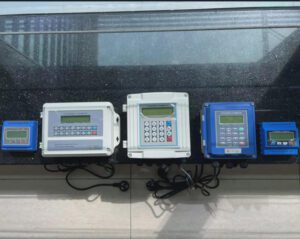
- Portable clamp-on: A single transmitter unit with interchangeable transducer sets covering DN15 to DN3000. The audit engineer’s primary tool — one kit audits an entire plant. Best for energy audits, leak detection surveys, commissioning verification, and comparative testing against permanent meters. Cost: $2,000–$8,000 per portable kit.
- Inline spool-piece meter: A pre-fabricated pipe section with integrated transducers. Requires process isolation and pipe cutting for installation but delivers the best accuracy (±0.15–0.5% multi-path) and most stable long-term calibration. NIST-traceable wet-flow calibration at the factory provides an accuracy certificate accepted by custody transfer authorities. Cost: $3,000–$50,000 depending on pipe size and path count.
- Hot-tap insertion meter: Installed through an existing isolation valve or through a hot-tap valve assembly drilled into the pipe under pressure. Provides inline-quality measurement without a full process shutdown. Cost: $4,000–$15,000 per point including the hot-tap valve assembly.
Calibration Routines and Periodic Verification
Calibration frequency should reflect the financial stakes of measurement error. For fiscal gas metering (where a 0.1% error represents thousands of dollars daily), annual wet-flow calibration at an ISO 17025-accredited lab is standard. For process monitoring (where ±2% is acceptable), biennial verification using a portable clamp-on reference meter is sufficient. For energy sub-metering (LEED, ISO 50001 compliance), annual in-situ verification using the meter’s built-in diagnostics plus a cross-check against utility invoice totals is the minimum requirement. The Endress+Hauser flow measurement overview documents calibration interval guidelines across measurement categories and industries.
8. Cost of Ownership and ROI
Energy Savings from Precise Flow Control
In process industries, flow measurement accuracy directly determines control quality, and control quality directly determines energy consumption. A poorly calibrated flow meter on a pump recirculation line can cause the control system to run the pump at 110% of required speed — wasting 21% more electrical energy than necessary (fan and pump laws: power scales with the cube of speed). On a 75 kW process pump running 8,760 hours per year at $0.10/kWh, this 21% overconsumption costs $13,800 per year. Accurate flow measurement eliminates the overconsumption by giving the VFD controller the data it needs to optimise pump speed. As VP Instruments’ flow meter ROI analysis demonstrates, compressed air flow meters alone typically deliver payback within 6–18 months through leak detection and compressor optimisation.
Longevity and Reduced Maintenance Costs
Illustrative 10-year TCO for DN100 process liquid application. Turbine meter includes 4–5 maintenance events at $1,800–$3,000 each plus bearing/seal replacement. Clamp-on ultrasonic includes couplant inspection only. Source: compiled from industry TCO studies and field maintenance records.
The 10-year TCO comparison above illustrates a pattern that repeats consistently across industrial applications: the higher purchase price of a quality clamp-on ultrasonic meter is typically recovered within 2–4 years through avoided maintenance costs alone, before energy savings and downtime avoidance are factored in. A 2025 analysis by シエラ・インスツルメンツ across 15 facility energy management case studies found an average 10–30% reduction in compressed air and process gas costs attributable directly to accurate flow measurement enabling right-sized compressor operation.
Safety and Compliance Benefits
 ATEX/IECEx Zone 1-certified clamp-on ultrasonic meters can be installed on flammable gas and liquid lines without creating any new ignition source — a requirement that eliminates most competing technologies from hazardous area metering applications.
Intrinsic Safety in Hazardous Environments
In oil and gas processing, petrochemical plants, paint booth exhaust systems, and solvent storage areas, the atmosphere may contain flammable or explosive gases. Any instrument installed in these areas must be certified for the applicable hazardous area classification:
- ATEX/IECEx Zone 1/2 (Europe/international): Explosive atmospheres that may occur in normal operation (Zone 1) or only under abnormal conditions (Zone 2). Clamp-on ultrasonic meters with ATEX/IECEx certification use intrinsically safe (Ex ia) or flameproof (Ex d) electronics to prevent the meter from being an ignition source.
- NEC Class I Division 1/2 (North America): Equivalent classification system. Meters certified for Class I Div 1 can be installed in continuously explosive atmospheres.
- Key advantage of non-contact measurement: A clamp-on meter adds zero new pipe penetrations to the hazardous area piping — every penetration eliminated is a potential leak source removed. In a plant with 20 metering points on flammable hydrocarbon lines, switching from inline turbine meters to clamp-on ultrasonic meters eliminates 40 pipe flanges (2 per meter) from the hazardous area piping system.
Compliance with Industry Standards and Documentation
Industrial ultrasonic flow meters are specified against and must comply with a range of international standards depending on application:
| 標準 | Applies To | 主要要件 | Relevant Application |
|---|---|---|---|
| AGA報告書第9号 | Multipath gas ultrasonic meters | Accuracy ≤ ±0.7% at Qmin; ≤ ±0.7% at Qmax | 天然ガスの引渡し計量 |
| API MPMS Ch. 5.8 | Liquid custody transfer ultrasonic | Multi-path, ±0.25% fiscal accuracy | Crude oil, refined products |
| ISO 17089-1 | Gas meters — ultrasonic | Calibration traceability, diagnostic requirements | Industrial gas metering, billing |
| OIML R 49 | Water meters — ultrasonic | Accuracy Class 1 or 2; MID Directive EU | Municipal water, district energy |
| ATEX Directive 2014/34/EU | Hazardous area instruments | Zone certification, ignition protection method | Oil & gas, chemical, petrochemical |
| FDA 21 CFR Part 211 | Pharmaceutical equipment | No contamination risk; calibration traceability | WFI, purified water systems |
| ISO 50001 | Energy management systems | Significant energy use measurement; calibration records | Industrial energy management |
Table 2: Key standards governing industrial ultrasonic flow meter applications. For calibration traceability requirements, NIST Special Publication 250-73 defines the US national calibration service for water flowmeters.
Selecting and Implementing Ultrasonic Flow Meters
Criteria for Choosing Clamp-On vs Inline Meters
The selection decision reduces to a systematic evaluation of five criteria for each measurement point:
✅ Quick Selection Framework: Clamp-On vs Inline Ultrasonic
- Can the process be shut down for installation? If no → clamp-on only. If yes → inline is an option.
- Required accuracy? ±1–2% acceptable → clamp-on. Better than ±0.5% required → inline multi-path.
- Is the fluid corrosive, pure, or radioactive? Yes → clamp-on eliminates wetted-parts risk. No → inline is viable.
- Is this fiscal/custody transfer metering? Yes → inline multi-path with NIST-traceable calibration. No → clamp-on delivers adequate accuracy at lower total cost.
- Is the pipe size DN600 or larger? Yes → clamp-on installation cost is far lower than spool-piece fabrication. Consider hot-tap insertion for single-point accuracy improvement.
Integration with SCADA and Control Systems
Modern industrial ultrasonic meters support the full spectrum of control system integration protocols. Selection of the right output depends on the plant’s existing automation infrastructure:
- 4–20 mA analog: Universal. Compatible with every PLC, DCS, and SCADA input card manufactured in the last 40 years. Carries one variable (flow rate or totalized flow). No wiring changes required for retrofit.
- HART(Highway Addressable Remote Transducer): Digital overlay on 4–20 mA. Allows remote configuration, multi-variable access (flow + velocity + signal quality + diagnostics), and integration with asset management software. HART 7 is the current standard; supports burst mode for high-speed data acquisition.
- Modbus RTU/TCP: The standard for industrial SCADA and industrial IoT integration. Modbus TCP over Ethernet enables direct integration with plant-level data historians (OSIsoft PI, Ignition, Wonderware) and cloud analytics platforms.
- PROFIBUS/PROFINET: Siemens-ecosystem DCS standard. Available on most premium ultrasonic meter platforms for direct integration with Siemens PCS7 and TIA Portal systems.
- BACnet/IP: Building automation standard. Required for HVAC and district energy applications integrating with Johnson Controls, Honeywell Niagara, or Schneider EcoStruxure BMS platforms.
について protocol selection guide for ultrasonic meters on the Jade Ant Instruments site covers the compatibility matrix between meter communication protocols and major industrial control platforms — including specific configuration steps for HART and Modbus integration.
Vendor Support, Service Life, and Upgrade Paths
An ultrasonic meter installed in 2025 will still be measuring flow in 2040. Over that 15-year horizon, the meter firmware will need updates, the transducers may need replacement (typical MTBF: 100,000+ hours, approximately 11 years at 24/7 operation), and the control system it communicates with may be upgraded two or three generations. Vendor evaluation should include: (1) firmware update policy and backward compatibility commitment, (2) transducer interchangeability (can a 2030 replacement transducer work in a 2025 transmitter body?), (3) protocol upgrade path (does the vendor offer fieldbus retrofit modules?), and (4) access to calibration services within your region. Suppliers who have maintained product platform continuity for 10+ years — not just those with the latest catalog — are the safe long-term choice for high-criticality measurement points.
 Full SCADA integration via Modbus TCP/IP allows plant engineers to monitor flow, velocity, signal quality, and meter diagnostics from the control room — eliminating field walks for routine performance checks and enabling predictive maintenance scheduling.
Key Takeaways for Industrial Flow Meter Selection
Ultrasonic flow meters occupy a unique position in industrial instrumentation: they are simultaneously the most versatile (covering DN15 to DN3000, cryogenic to 450°C, clean liquids to heavy slurries) and the lowest-maintenance (no moving parts, no wetted components in clamp-on configurations, no process contact) technology available. The economics of that combination compound over the 10–15 year service life typical of process instrumentation — and the case studies across chemical, power, pharmaceutical, and oil and gas industries consistently confirm payback periods of 12–36 months against competing technologies.
The eight application areas covered in this guide — accuracy benchmarking, chemical liquid service, power plant gas measurement, slurry and multiphase handling, bidirectional capability, non-contact safety, installation and maintenance, and SCADA integration — represent the decision dimensions that matter most to B2B process engineers. No single meter technology excels in all dimensions simultaneously: inline multi-path meters deliver superior accuracy but require process shutdown for installation; clamp-on meters offer unmatched retrofit flexibility but with moderate accuracy limits; Doppler meters enable measurement in fluids that destroy transit-time performance. The optimal specification maps each measurement point’s actual requirements to the technology that meets them at the lowest 10-year total cost.
For teams evaluating ultrasonic meter options across multiple application types, the transit-time vs Doppler selection guide そして 5-factor flow meter selection framework from Jade Ant Instruments provide structured starting points for application-specific specification — covering fluid properties, installation constraints, accuracy requirements, protocol compatibility, and lifetime cost in a single evaluation framework.
Need Technical Support Specifying Ultrasonic Flow Meters for Your Process?
Jade Ant Instruments provides application engineering, competitive quotations, and calibration documentation for clamp-on and inline ultrasonic meters across all major industrial sectors worldwide.
Explore Ultrasonic Meter Solutions →📖 Glossary of Key Technical Terms
- Transit-Time Measurement
- An ultrasonic measurement principle that calculates fluid velocity from the difference in travel time between pulses sent upstream and downstream. Requires clean, acoustically transparent fluid. Accuracy ±0.15–2.0% depending on path count and installation. Example: Natural gas at 10 bar in a DN200 steel header.
- Doppler Measurement
- An ultrasonic measurement principle that measures the frequency shift of signals reflected off particles or bubbles in the fluid. Requires minimum suspended solids or gas content to function. Accuracy ±2–5%. Example: Activated sludge at 4% solids content in a wastewater treatment plant.
- Multi-Path Meter
- An inline ultrasonic meter using 4–8 acoustic chords at different positions across the pipe cross-section to measure the full velocity profile, not just the centreline velocity. Accuracy ±0.15–0.5%. Required for AGA-9 and API 5.8 fiscal metering.
- Δt (Transit-Time Difference)
- The time difference between the downstream-travelling and upstream-travelling ultrasonic pulses in a transit-time meter. Proportional to fluid velocity. At zero flow, Δt = 0. At 1 m/s in a DN100 pipe, Δt ≈ 1–5 microseconds depending on geometry.
- PTZ Compensation
- Correction of gas volumetric flow for actual Pressure, Temperature, and compressibility factor (Z) to convert to standard conditions (0°C, 1 atm). Essential for gas meters where density changes with operating conditions. Without PTZ, a meter calibrated at standard conditions will over-read at elevated pressure.
- ATEX / IECEx
- European (ATEX) and international (IECEx) certification frameworks for electrical equipment in explosive atmospheres. Zone 1 = explosive atmosphere likely in normal operation; Zone 2 = only under abnormal conditions. A meter without the appropriate zone certification cannot legally be installed in a classified hazardous area.
- AGA報告書第9号
- The American Gas Association’s performance standard for multipath ultrasonic meters used in natural gas fiscal metering. Specifies accuracy limits (±0.7% at Qmin, ±0.7% at Qmax), diagnostic requirements, and calibration traceability. The reference standard for gas custody transfer metering in North America and widely referenced internationally.
- Clamp-On Configuration
- An installation method where ultrasonic transducers are attached to the outside of an existing pipe without cutting or welding. No process contact, zero pressure loss, no shutdown required. Accuracy typically ±1–2% (single-path). The standard retrofit solution for process monitoring, energy audits, and corrosive-fluid measurement.