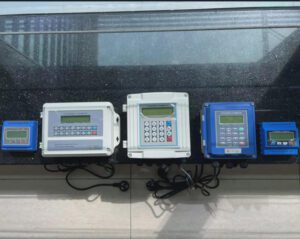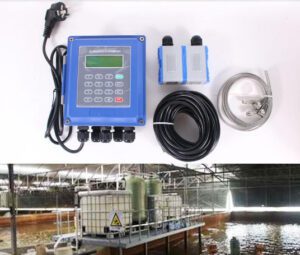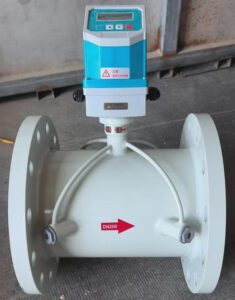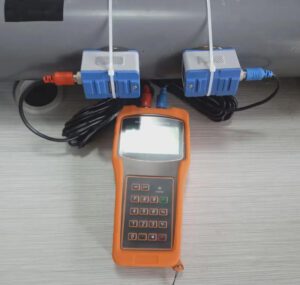
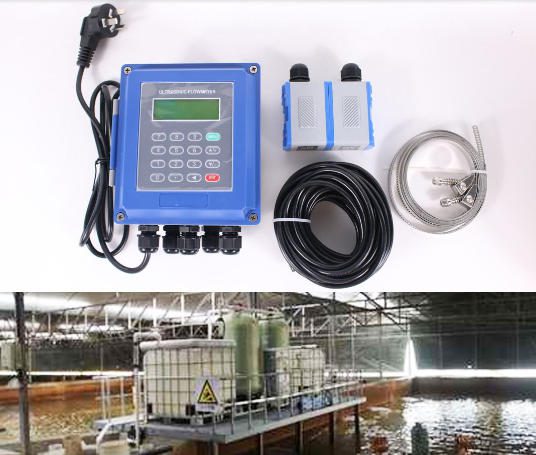
Clamp-On Ultrasonic Flow Meter Retrofit: How to Add Flow Metering Without Cutting Pipe or Stopping the Line
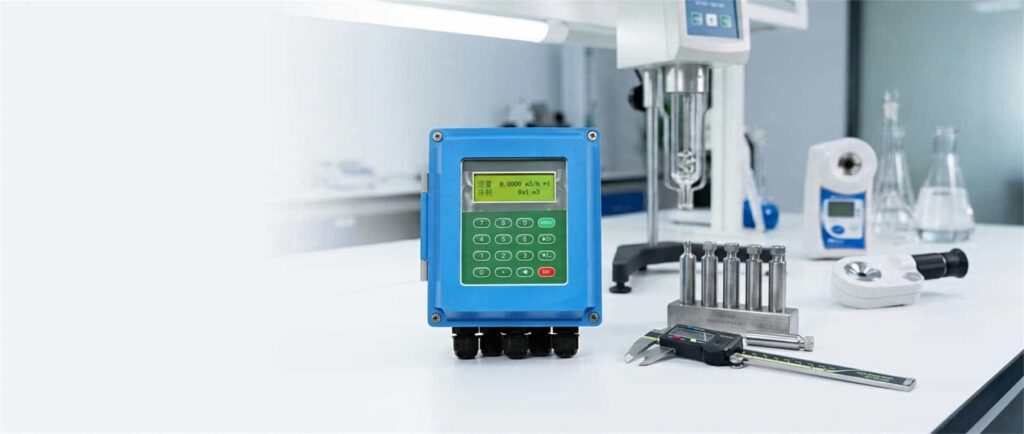
Transducers strapped to the outside of a live pipe. Nothing touches the fluid.
Quick answer: A clamp-on ultrasonic flow meter measures flow from outside the pipe. Two sensors send sound through the pipe wall and the liquid, and the meter turns the timing into a flow rate. You do not cut the pipe, drain the line, or weld. On a DN100 brownfield line, one published comparison puts the 5-year cost at about USD 3,000 for clamp-on and about USD 16,000 for inline. The trade-off is accuracy. Expect 1–2% from a single-path unit and 0.5–1% from a dual-path unit, with good installation.
I. The Paradigm Shift in Flow Monitoring
The cost of stopping a line to measure it
Most plants do not struggle to justify a flow meter. They struggle to justify the shutdown needed to install one.
An inline meter means isolating the line, draining it, cutting the pipe, welding or bolting flanges, pressure testing, and restarting. Jade Ant Instruments’ installation guide gives 4–8 hours for a 6-inch line, and that is before permits and restart checks.
Here is a simple way to size that cost for your own site:
With a 4-hour stop and USD 5,000 of lost output per hour, you spend USD 20,000 before the meter reads its first number. The meter may cost a tenth of that.
Cutting into a pipe also adds risk. Every new flange is a new place to leak, which matters most on high-pressure, hot, or hazardous lines.
Measuring from the outside in
A clamp-on ultrasonic flow meter is a meter whose sensors (called transducers) are strapped to the outside of the pipe. A transducer is a small device that turns electrical pulses into sound and sound back into electrical signals.
The sound passes through the pipe wall, crosses the liquid, and returns. The meter reads what happened to the sound and calculates how fast the liquid is moving.
“Silent efficiency”
We call the result silent efficiency: precise monitoring that nobody on the production floor notices. There is no shutdown notice, no hot-work permit, and no drop in pressure or throughput.
The measurement just appears in your SCADA screen one afternoon.
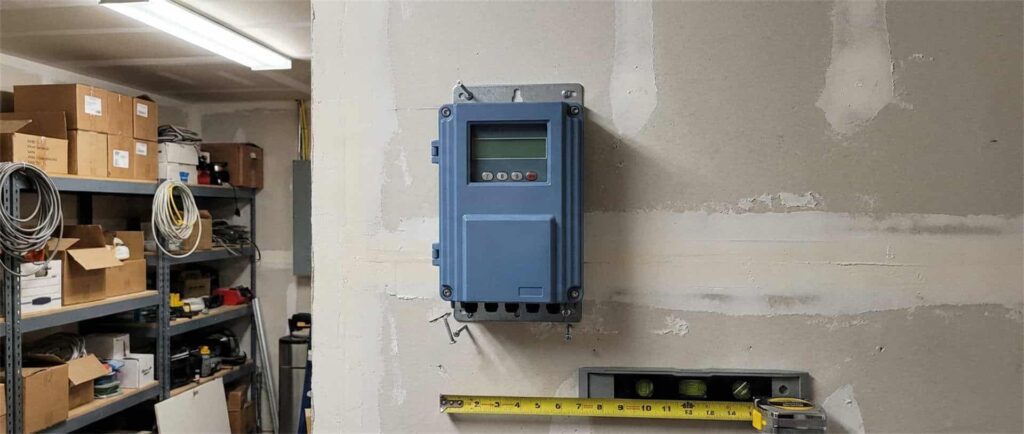
The traditional route: flanges, spool pieces and a planned outage for every measurement point.
Who gets the most from this
Different readers get different value, so here is the short version:
- OEMs and skid builders fit fewer flanges and welds, and can still ship a skid with monitoring ready.
- EPCs and integrators add instruments to legacy pipe without redesigning the network.
- MRO teams verify and swap sensors on a running line.
- Distributors and importers sell a retrofit tool that does not depend on the customer’s outage calendar.
- Municipal and utility managers meter district boundaries without digging up mains or interrupting supply.
Jade Ant Instruments builds clamp-on, insertion and inline ultrasonic meters, so we will also tell you where clamp-on is the wrong answer. That comes up in Sections VI and VIII.
II. The Technology Behind the Silence: How It Works
Transit-time and Doppler: two ways to read flow with sound
Clamp-on meters use one of two physics methods. Which one you need depends on how clean the liquid is.
Transit-time meters send one pulse with the flow and one against it. Sound travels slightly faster with the flow, so the downstream pulse arrives first. The gap between arrival times tells the meter the fluid velocity. Wikipedia’s ultrasonic flow meter entry gives the full derivation:
In this formula, is the average fluid velocity along the sound path, is the distance between the transducers, is the beam angle, and et are the two travel times.
Then flow rate follows from the pipe’s cross-section:
Worked example. A DN200 pipe has an inner diameter of 0.2 m, so its area is about 0.0314 m². At 1.5 m/s the flow is 0.0314 × 1.5 = 0.0471 m³/s, which is about 170 m³/h.
Doppler meters work the opposite way. They need particles or bubbles in the liquid. The meter sends a continuous beam, and the particles reflect it back at a slightly shifted frequency. That shift is proportional to velocity.
The simple selection rule:
| Your fluid | Pick | Why |
|---|---|---|
| Clean water, oils, chemicals, treated process water | Transit-time | Sound travels cleanly and the timing is precise |
| Wastewater, sludge, slurry, aerated liquid | Doppler | The particles and bubbles are the reflectors |
Picking wrong gives you either no reading (Doppler on clean water) or a noisy one (transit-time on dirty water). Jade Ant’s transit-time vs Doppler selection guide has a checklist for the borderline cases.

Video: “Doppler vs Transit Time – Let’s talk Ultrasonic Flow Meters.” Click the image to watch on YouTube.
Signal propagation: sound through a pipe wall
The sound has to cross three layers on the way in and three on the way out: the pipe wall, the liquid, and the wall again. A thin layer of acoustic couplant (a viscous gel) between each transducer and the pipe removes air gaps. Air blocks ultrasound almost completely.
The transducers can sit in two common layouts. Reflex (V) mode bounces the beam off the far wall so both transducers sit on the same side. Direct (Z) mode puts them on opposite sides.

Transit-time principle. File: Mesure de débit sur conduite en charge, by Aurloz, CC BY-SA 4.0, via Wikimedia Commons.

External probes in place. File: Sondes externes, by Aurloz, CC BY-SA 4.0, via Wikimedia Commons.
What digital signal processing does
Real pipes are noisy. Pumps vibrate, valves rattle, and the pipe itself rings like a bell. Digital signal processing (DSP) is the electronics step that separates the weak flow signal from that background noise.
In plain terms, the meter does three things:
- It filters out frequencies that do not match the transmitted pulse.
- It compares the sent and received waveforms to pin down the arrival time very precisely.
- It averages many readings per second so the display stays steady.
This is why a modern meter can show a stable reading on a pipe next to a running pump.
Which pipes work
Clamp-on meters work on carbon steel, stainless steel, copper, PVC, CPVC, HDPE, PP, and PVDF. Trouble starts with:
- Rubber-lined pipe where an air gap sits between liner and steel
- Bitumen-coated internal walls
- Concrete-lined pipe
- Heavily corroded steel with wall thickness that varies by more than about 15%
A Signal Quality Index (SQI) check, explained in Section VII, tells you in minutes whether a spot is workable.
III. Eliminating the “Downtime Dilemma” for MRO and Utility Companies
Skipping the cut-and-weld cycle
The biggest advantage of clamp-on is simple: the pipe stays closed. That removes the hot-work permit, the isolation procedure, the drain-down, the weld inspection, and the restart.
Jade Ant’s comparison for a DN100 brownfield line makes the gap visible:
| Cost element | Clamp-on (USD) | Inline spool piece (USD) |
|---|---|---|
| Meter purchase | 1,500–4,000 | 3,000–8,000 |
| Installation labor | 150–400 | 1,200–3,500 |
| Pipe cutting and flanging | 0 | 600–2,000 |
| Process shutdown | 0 | 2,000–15,000+ |
| Pressure test and sign-off | 0 | 200–800 |
| Commissioning | 100–300 | 300–800 |
| Total installed | 1,750–4,700 | 7,300–30,100 |
Source: Jade Ant Instruments’ clamp-on ultrasonic flow meter guide. Ranges are planning figures. Your local labor rates and downtime cost will move them.
Zero new leak points
Every flange you add is a gasket, a set of bolts, and a long-term leak risk. A clamp-on meter adds none.
Jade Ant’s installation guide puts a number on this for hazardous plants: swapping 20 inline meters for clamp-on units removes 40 flanges from the piping system, two per meter.
Minutes, not days
Time to first reading is where the difference feels real. The installation guide gives these ranges for a 6-inch pipe:
Midpoints of the published ranges: inline 4–8 h, insertion 2–4 h, clamp-on 0.5–1 h.
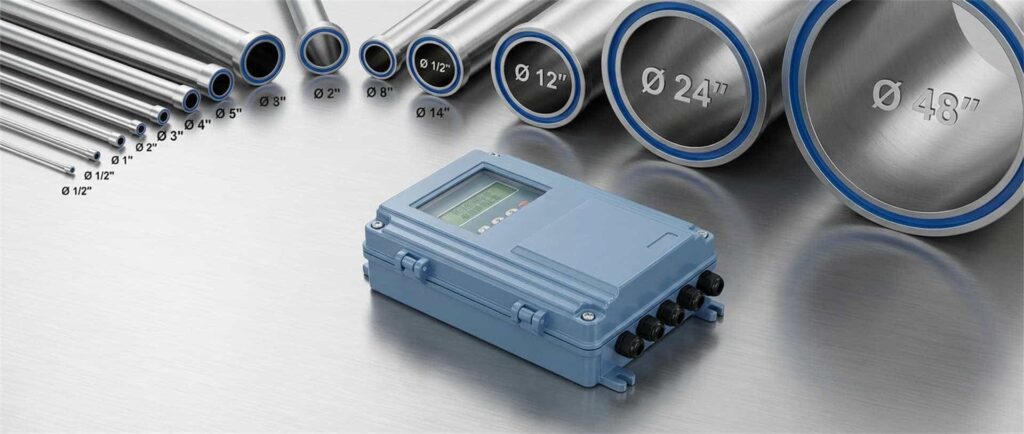
For a utility, that speed also changes what is possible. A technician can measure a district inlet in the morning, move to the next one after lunch, and have a night-flow profile by the end of the week. Jade Ant’s portable ultrasonic flowmeters for water audits guide lays out how crews run that kind of survey.
For a walkthrough, this short video shows a clamp-on meter being mounted and commissioned.
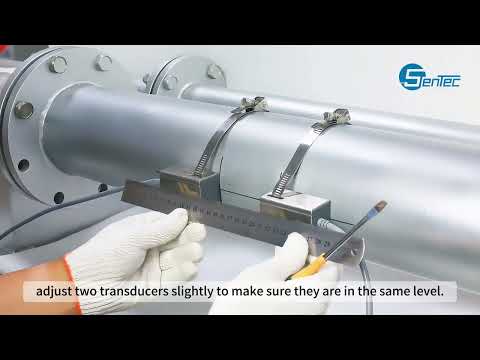
Video: “Clamp-on Ultrasonic Flow Meter | Installation & Commissioning Demonstration” (SENTEC). Click the image to watch on YouTube.
IV. Strategic Advantages for OEM and Skid-Mount Manufacturers
Simpler skid design
Every inline meter on a skid needs two flanges, gaskets, bolts, a spool piece, and room around it for wrenches. On a skid with six measurement points, that is twelve flanges you build, torque, leak-test, and later field-service.
Clamp-on meters take most of that off the drawing. The pipe run gets shorter. The weld count drops. Leak testing has fewer joints to check.
Easier field servicing
Your end customer will thank you for this one. A sensor that is strapped on can be unstrapped. Replacing a transducer takes about 20 minutes and does not require draining the skid, according to Jade Ant’s application notes.
Calibration checks work the same way. A technician clamps a reference unit next to the installed one and compares readings. Nothing gets removed.
A plug-and-play selling point
Think about what your end user actually wants: a skid that shows what is flowing without a separate instrumentation project.
Build the clamp-on measurement spots into the design. Leave a clean, straight section of pipe with a marked location and a cable route. The customer can add monitoring later without cutting into your skid.
A practical bonus: during factory acceptance testing (FAT), a portable clamp-on kit lets you check flow at several load points without fitting permanent meters to every line. Remove the kit afterward and move on to the next skid.
V. Solving the Retrofit Challenge for EPCs and System Integrators
A non-destructive approach for old pipe
Legacy pipe is often the problem. Walls are thinner than the drawings say, welds are decades old, and nobody wants to heat or cut it.
Clamp-on avoids heat, cutting, and new weld joints. It also gives you a chance to learn about the pipe. Before mounting, you measure wall thickness with an ultrasonic thickness gauge at several points around the pipe. That reading is standard non-destructive testing (NDT), and it tells you whether the spot is healthy enough for a good measurement.
Industry insight: The same survey that decides where to clamp can also flag where the wall is thinning. EPC teams sometimes hand that thickness data to the owner as a free by-product of the instrumentation job.
Finding the right straight section without rerouting
Straight run is the length of straight, undisturbed pipe before and after a meter. Elbows, valves, and pumps make the flow swirl, and swirl causes error.
With an inline meter, if the straight run is not there, you either live with the error or re-pipe. With a clamp-on meter, you slide along the pipe until you find a good section. Jade Ant’s installation guide lists these minimums for ultrasonic transit-time meters:
| Upstream disturbance | Upstream / downstream straight run |
|---|---|
| Single 90° elbow | 10D / 5D |
| Two elbows in different planes | 20D / 5D |
| Partially open gate valve | 30D / 5D |
| Reducer or expander | 10D / 5D |
“D” is the pipe’s inside diameter. On a DN100 pipe, 10D is about 1 m.
If the layout truly cannot meet these numbers, you have options. Move the meter to a different section, use a vertical riser, choose a dual-path unit, or add a flow conditioner upstream. Check the result against a reference reading before you sign off.
Adding points without redesigning the network
Scaling is where clamp-on fits retrofit work. Each new point is a transducer pair, a cable, and a configuration. You do not touch the hydraulics.
Utilities see this most clearly. Jade Ant’s planning numbers for a network with 200 district metering points: 200 × USD 3,500 for clamp-on is USD 700,000, against 200 × USD 12,000 for inline at USD 2.4 million. That USD 1.7 million gap often decides whether a water-loss program gets approved at all.
VI. Comparative Analysis: Clamp-On vs. Inline Meters
Total cost of ownership and ROI
TCO (total cost of ownership) is everything a meter costs you over its life: purchase, installation, shutdown, calibration, and maintenance.
Here is the 5-year picture for a DN100 brownfield line, from Jade Ant’s published comparison.
| 5-year cost (USD, illustrative) | Clamp-on | Inline |
|---|---|---|
| Equipment | 2,200 | 5,500 |
| Installation and shutdown | 300 | 8,000 |
| Maintenance and calibration | 500 | 2,500 |
| Total | 3,000 | 16,000 |
Treat these as a template, not a quote. Replace the shutdown line with your own hours-times-output number and the gap often widens.
Maintenance: no draining to clean or swap
Clamp-on meters have no wetted parts, so there is nothing inside the pipe to foul, corrode, or wear. The routine tasks are:
- Check the couplant every 12 months or so, and replace it if the signal drops.
- Re-seat the transducers if the pipe has been repainted or vibrated loose.
- Read the SQI trend on the transmitter.
Compare that with an inline meter: isolate, drain, unbolt, pull the spool, install the replacement, pressure test, restart. That is half a day or more for one meter.
The accuracy gap, and how it closes
You should know the trade-off up front. Clamp-on is usually less accurate than inline at the top end:
| Meter type | Typical accuracy (% of reading) |
|---|---|
| Clamp-on, single-path | 1.0–2.0% |
| Clamp-on, dual-path | 0.5–1.0% |
| Inline ultrasonic, multi-path | 0.15–0.5% |
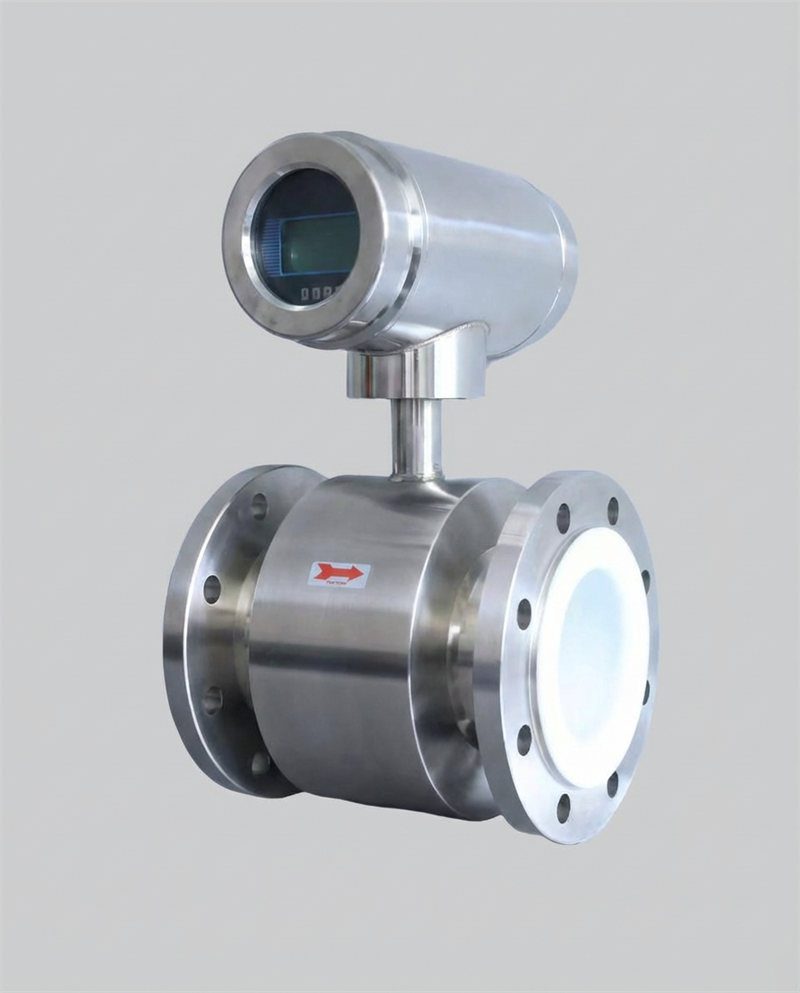
| Electromagnetic (see Wikipedia on magnetic flow meters) | 0.2–0.5% |
| Coriolis | 0.1–0.2% |
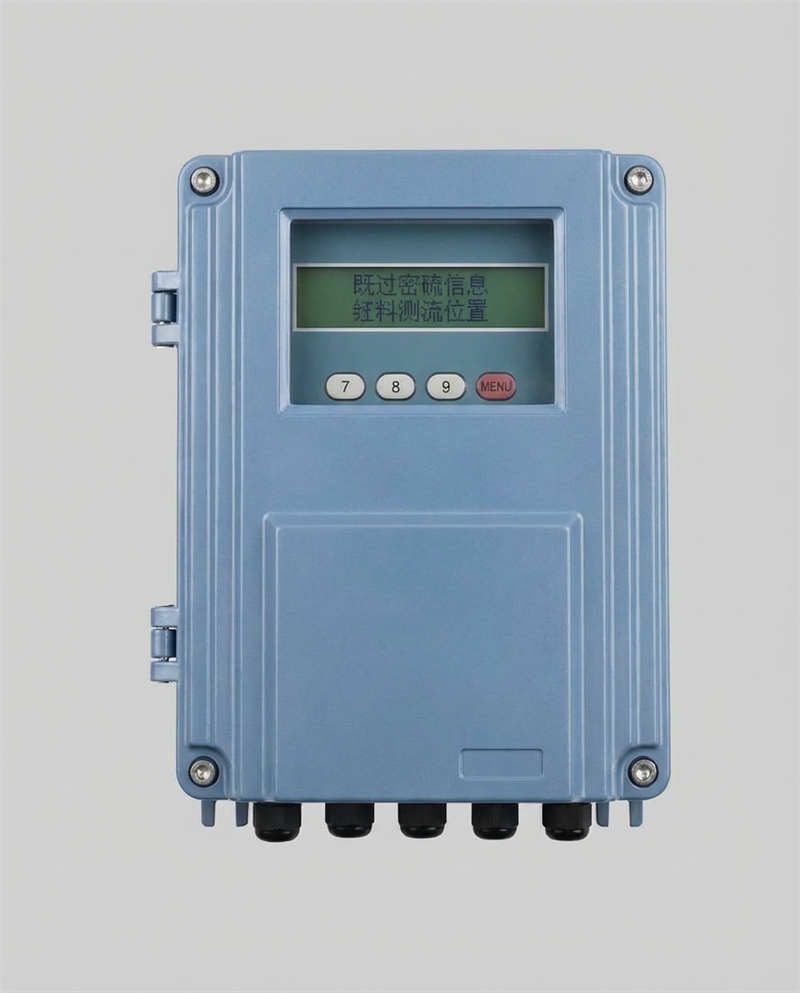
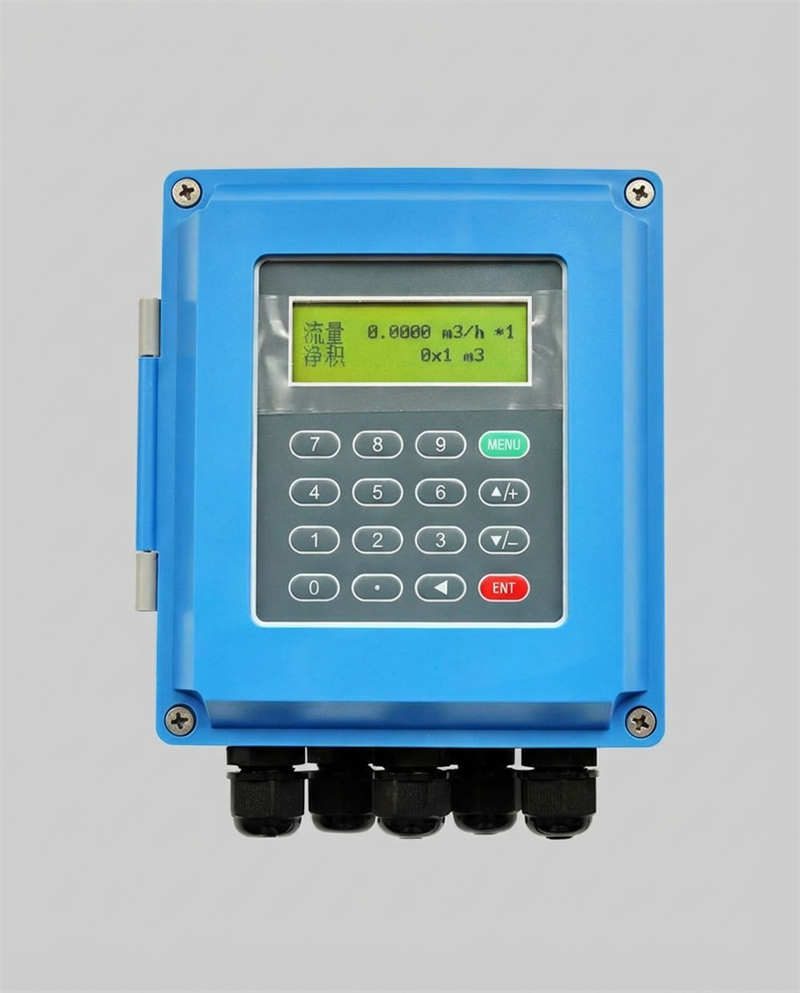
Jade Ant’s ultrasonic flow meter product page lists ±1% accuracy and repeatability better than 0.2% for its wall-mounted unit. Clamp-on spans DN32–DN1000 and insertion spans DN50–DN6000.
Two things shrink the gap in practice:
- Dual-path sensors sample two lines across the pipe instead of one, which cuts profile error.
- Installation care. Jade Ant analyzed 1,847 field tickets and found that straight-run problems (28%), wrong orientation or trapped air (18%), and grounding or electrical faults (15%) accounted for 61% of accuracy complaints. These are installation errors, not technology limits.
Where clamp-on is not the answer: Fiscal custody transfer of gas or liquid hydrocarbons is still specified with inline multi-path meters under AGA-9 or API MPMS 5.8. If a contract or tax authority will use the number to move money, spec inline.
For most process monitoring, energy balances, and water-loss work, 1% is the actual requirement. Jade Ant’s clamp-on vs transit-time comparison covers this in more depth.

An inline measuring spool for comparison. File: Manchette de mesure par Ultraflux, by Aurloz, CC BY-SA 4.0, via Wikimedia Commons.
VII. Overcoming Implementation Hurdles (The “Pain Point” Solver)
Wall thickness, coatings, and good coupling
Most clamp-on problems trace back to one of four causes: a wrong pipe dimension, a rough or painted surface, too little couplant, or a damaged pipe wall.
Here is the sequence that field teams follow:
- Measure the real outside diameter with a pi tape or caliper. Do not trust the nominal size on a drawing.
- Measure wall thickness at 3–4 points around the pipe.
- Clean the contact patch down to bare, flat metal or plastic.
- Apply a generous layer of couplant to each transducer face, then clamp.
- Read the Signal Quality Index (SQI). The SQI is a 0–100% score for how well the sound is getting through. Above 60% is reliable. Below 50%, stop and investigate.
Dimensions matter more than most people expect. Flow area scales with the square of diameter, so a small error in OD grows:
That is a 1 mm mistake on a DN100 pipe causing a 2% error that no calibration can remove. The Soaring Instrument installation walkthrough is a useful second reference for the mounting steps.

Reflex (V) mounting. File: Montage de sondes en mode reflex, by Aurloz, CC BY-SA 4.0, via Wikimedia Commons.
Turbulence and sensor placement
Placement beats everything else for stability. Avoid these spots:
- Directly after an elbow, valve, or reducer
- Right above a pump outlet or check valve
- A vertical pipe that may drain at low flow, leaving air in the sound path
- A pipe high point where gas collects
Choose a section where the pipe is always full, the flow is calm, and you have the straight run in the table above. If you must compromise, go for more distance downstream of a disturbance rather than less.
Choosing frequency and sensor type
Transducers run roughly in the 0.5–4 MHz range. As a general rule:
| Situation | Typical choice |
|---|---|
| Small pipe, thin wall, clean liquid | Higher-frequency transducers |
| Large pipe, thick wall, or sound-absorbing pipe material | Lower-frequency transducers |
| Dirty liquid with solids or bubbles | Doppler sensor set |
| Very viscous liquid | Ask for a meter with Reynolds-number correction, and test on site |
Viscous fluids can flow in a smooth, layered way (laminar flow) rather than churning (turbulent flow). The velocity profile is different, so the meter needs to correct for it. Confirm that your model does, and run a site check before committing.
Not sure which fits? Jade Ant’s ultrasonic water flow meter selection tips walks through clamp-on vs inline and transit-time vs Doppler for typical duties.
VIII. Regulatory Compliance and Safety Standards
ATEX and IECEx for explosive atmospheres
ATEX (Europe) and IECEx (international) are certification schemes for equipment used where flammable gas or dust may be present. The IECEx system lists the approved certification bodies and test labs.
A clamp-on meter helps here in a specific way: it adds no pipe penetration, so it creates no new leak path in a classified area. But the transmitter and transducers are still electrical equipment. Whatever you install in a Zone 1 or Zone 2 area must carry the right certificate for that zone. Ask for it by model number before ordering.
ISO and ASME standards
Two documents matter most for clamp-on liquid measurement:
- ISO 12242:2012 covers ultrasonic transit-time meters for liquids in closed conduits. It addresses performance, calibration, output, and installation, and it explicitly includes clamp-on transducers.
- ASME MFC-5.1 applies to transit-time meters on single-phase liquids in completely filled pipes. Note that it does not cover Doppler meters.
For calibration records that stand up to an audit, NIST’s guidance on metrological traceability explains why a certificate needs an unbroken chain of comparisons back to a national standard.
Lower environmental risk during installation
When the pipe is never opened, there is nothing to spill. No drain-down of chemicals. No gasket seating on a line that held acid. No weld spatter near flammable material.
For a plant whose permit or insurance conditions penalize any line-break event, that is worth more than the accuracy difference.
IX. Future-Proofing Fluid Management: Integration with Industry 4.0
IoT and SCADA connectivity
A flow reading is more useful when it lands where decisions are made. Jade Ant’s meters support 4–20 mA, pulse, HART, and Modbus outputs, so most can connect to an existing PLC, DCS, or SCADA system without a hardware overhaul. Protocol options vary by model, so confirm the exact list before ordering. If you want a plain-language refresher, Turbines Incorporated’s explainer on flow meter communication protocols is a good primer for junior engineers.
For remote sites, wireless options matter. Jade Ant’s smart ultrasonic meters with wireless and touch controls combine onboard displays, wireless radios, and self-diagnostics.
Predictive maintenance from flow trends
Your flow data is a health check for the equipment around it. A simple rule works well: record normal flow at each pump speed when everything is healthy. Later, if flow drops 10% at the same speed, something has changed.
| Symptom in the trend | Likely cause |
|---|---|
| Flow slowly falls at constant pump speed | Impeller wear, partial blockage, fouled heat exchanger |
| Night flow never drops to its usual floor | Leak in the zone |
| Sudden step change | Valve moved or closed |
| Signal quality slowly declines | Couplant drying out or pipe surface changed |
Jade Ant’s industrial applications of ultrasonic meters page covers more cases, including bidirectional flow and energy recovery.
Remote diagnostics
Diagnostics such as signal strength, speed of sound in the liquid, and error codes can travel over HART or Modbus to the control room. That cuts the trips a technician makes just to “look at the meter.”
Here is one useful detail. Speed of sound in water is about 1,480 m/s at 20 °C and rises with temperature. If the speed-of-sound reading changes and the temperature did not, the liquid itself may have changed.
Estimated 2025 split as aggregated in Jade Ant’s clamp-on market summary. Water and wastewater lead, which matches where retrofit pressure is highest.
For water utilities, the case for better data is large. The World Bank estimates utilities worldwide lose about 126 billion cubic meters a year to non-revenue water, according to its explainer on non-revenue water. You cannot cut a loss you are not measuring.
X. The Strategic Move Toward Non-Invasive Monitoring
What you gain
The benefits come down to three things:
- No downtime. You measure without stopping the line.
- Less risk. No new flanges, no hot work, no spill during installation.
- Lower cost. In the DN100 model, 5-year cost was about USD 3,000 against USD 16,000.
Where to start
Look at your site with a different question. Not “where do we have a shutdown window?” but “where do we lack data, and could we measure it from outside the pipe?”
Pick three candidates: a line where nobody wants to cut, a pump you suspect is underperforming, and a district or skid inlet where you only have estimates. Run a portable survey on all three. The pipe survey and signal check cost an afternoon.
If you want help sizing a retrofit, the Jade Ant Instruments contact page has the email, WhatsApp number, and quote form. Send us the fluid, pipe material, outside diameter, wall thickness, and available straight run.
A closing thought
Efficiency is not only about how the fluid flows. It is also about how smoothly you can see it flowing. The best monitoring project is the one nobody on the floor had to stop work for.
Glossaire des termes clés
Acoustic couplant: A gel between the transducer and pipe that removes air gaps. Example: a thin layer on each transducer face before clamping on a DN100 steel pipe.
Clamp-on meter: A meter with sensors on the outside of the pipe and no contact with the fluid.
Doppler meter: A meter that reads the frequency shift of sound reflected from particles or bubbles. Example: a sludge line with 3% solids.
DSP (digital signal processing): Electronics that filter noise and extract the flow signal from a weak return pulse.
Laminar vs. turbulent flow: Laminar is smooth and layered, common in thick fluids at low speed. Turbulent is churning, common in water at normal speed. Meters need a different correction for each.
NDT (non-destructive testing): Checking a pipe’s condition without damaging it. Example: measuring wall thickness with an ultrasonic gauge.
Non-revenue water (NRW): Water a utility produces but never bills, through leaks, meter errors, or unbilled use.
SQI (Signal Quality Index): A 0–100% score of received signal quality. Above 60% is reliable.
Straight run: The length of undisturbed straight pipe before and after a meter, measured in pipe diameters (D).
TCO (total cost of ownership): All costs over a meter’s life, not just the purchase price.
Transit-time meter: A meter that measures the time difference between pulses sent with and against the flow.
Préparation de la chambre : The ratio of highest to lowest flow a meter can measure accurately. A 100:1 turndown still reads at 1% of maximum.
Questions fréquemment posées
1. How does the accuracy of a clamp-on meter compare to a magnetic or Coriolis meter?
On a well-prepared pipe, a single-path clamp-on meter typically delivers 1–2% of reading and a dual-path unit 0.5–1%. Electromagnetic meters usually reach 0.2–0.5%, and Coriolis meters 0.1–0.2%. The gap matters for billing and custody transfer. For process monitoring, energy balances, and leak detection, 1% is usually enough, and clamp-on delivers it without a shutdown.
2. Can clamp-on meters be used on pipes with internal liners such as Teflon or rubber?
Sometimes, but test first. Sound needs a continuous path through the wall. A rubber or plastic liner that is loose and leaves an air gap blocks the signal, while a tightly bonded liner often passes enough sound to work. Concrete and bitumen linings attenuate the signal heavily. Clamp the transducers on temporarily and read the Signal Quality Index before you commit.
3. Do I need to know the exact pipe material and wall thickness, and how thick a wall can the signal cross?
Yes, you need both. The meter uses the material and thickness to calculate how the sound bends and how long it spends in the wall. A wrong entry gives a persistent error. Measure outside diameter with a pi tape and wall thickness with an ultrasonic thickness gauge. The maximum wall depends on the transducer frequency and the pipe material, so check the range printed on the transducer datasheet. Thick walls, lined pipes, and corroded steel are the cases to site-test.
4. How do bubbles, suspended solids, and partially empty pipes affect the measurement?
Transit-time meters struggle when bubbles or solids scatter the sound, so heavily aerated or sludgy liquids call for a Doppler meter instead. Both types need a full pipe. A partly empty pipe leaves air in the sound path and gives low, unstable, or zero readings. Fix it by choosing a section that stays full, such as an upward vertical run or a low point, away from pump suctions and vents. For open channels and partly full gravity sewers, you need a different technology, such as a level-based open-channel meter.
5. What is the ideal straight-run requirement before and after the sensors?
As a baseline, allow 10 pipe diameters upstream and 5 downstream after a single 90° elbow. Two elbows in different planes need about 20D upstream, and a partially open valve about 30D. Where you cannot meet these, move to a better section, use a vertical run, try a dual-path unit, or add a flow conditioner. Always write the actual distances in the commissioning record.
6. How long do the transducers last, and what does maintenance involve?
There are no moving parts and no wetted surfaces, so wear is low. The routine job is checking the couplant about once a year and replacing it if signal quality drops. To get a solid acoustic bond, clean the contact patch to bare surface, apply plenty of couplant, clamp firmly, and confirm the SQI is above 60%. Replacing a transducer takes about 20 minutes and does not need the line drained. Ask your supplier for an MTBF figure and the warranty terms for the exact model.
7. Can clamp-on meters be used for both liquids and gases?
They are strongest on liquids. Gas carries sound poorly and the signal through a pipe wall is weak, so clamp-on gas measurement is more difficult. For gas and steam, inline transit-time meters with wetted transducers are usually the better choice. If you must measure gas non-invasively, ask the supplier for a gas-rated model and for application references.
8. Are clamp-on meters suitable for high-temperature or high-pressure lines, and what power do they need in remote locations?
Because the sensor stays outside the pipe, pipe pressure does not limit the meter. Temperature does limit the transducers. Jade Ant lists standard clamp-on ranges of about −40 °C to +160 °C, with a high-temperature option to about +200 °C. For power, the wall-mounted unit on Jade Ant’s product page draws about 50 mA operating current on 8–36 V DC or 85–264 V AC supply. That is roughly 1.2 W at 24 V DC, which is within reach of a small solar and battery setup. Portable units run on internal batteries, commonly 16–30 hours per charge.
9. How do I integrate the output into my PLC, and can one transmitter serve several sensor sets?
For a quick connection, wire the 4–20 mA output to an existing analog input and scale it. For richer data, use Modbus over RS-485 or HART to bring in totals, signal quality, and alarms. Portable kits handle several pipe sizes by swapping transducer sets on one transmitter. For permanent multi-point monitoring, ask whether the transmitter has multiple channels, because that varies by model.
10. How do I verify calibration without a reference meter?
You can build good confidence with four checks. First, confirm a zero reading at true zero flow by closing valves. Second, check that the displayed speed of sound matches the expected value for your fluid and temperature, about 1,480 m/s for water at 20 °C. Third, run a tank fill or drawdown test and compare the volume to the meter total. Fourth, compare against a mass balance or the pump curve. Keep the records under a traceable procedure, as described in the NIST traceability guidance. For billing-grade use, get an independent reference check.