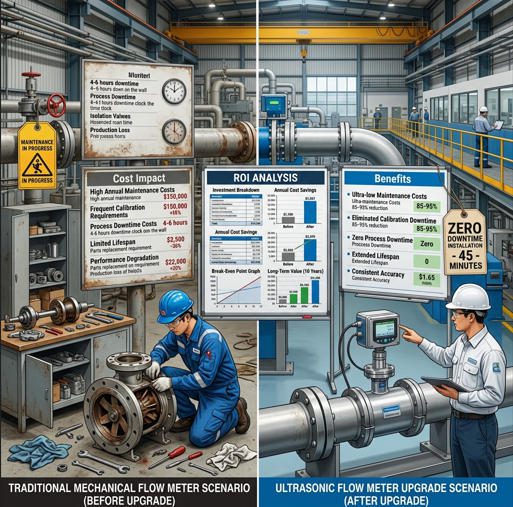
Discover how upgrading from traditional inferential meters to ultrasonic technology can dramatically reduce your operational costs, eliminate costly downtime, and improve measurement accuracy — with a detailed ROI framework and real-world case studies tailored for instrumentation distributors and agents.
Let’s start with a number your customers rarely see: $260,000. That’s the average cost of one hour of unplanned manufacturing downtime across mid-to-large industrial facilities, according to the Siemens True Cost of Downtime 2024 report. And when a legacy turbine or mechanical inferential flow meter fails mid-shift — taking a production line offline while a technician sources a bearing replacement — every minute on the clock is ticking against your customer’s profitability.
For instrumentation distributors and agents, this represents both a risk and an opportunity. Your customers are running aging flow measurement infrastructure that silently erodes margins through maintenance labor, parts inventory, calibration fees, production losses, and billing inaccuracies. The story rarely appears as a single large line item on a budget sheet — it accumulates quietly, quarter after quarter.
This analysis breaks down exactly where those costs hide, quantifies the financial case for switching to ultrasonic flow meter technology, and gives you the tools, case studies, and financial models to close more deals with data-driven confidence.

1. The True Cost of Maintaining Traditional Inferential Flow Meters
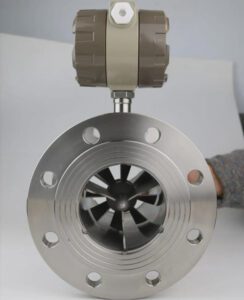
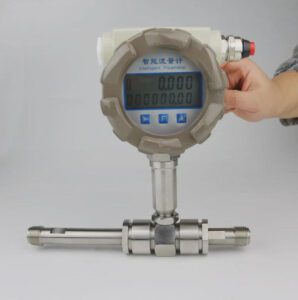
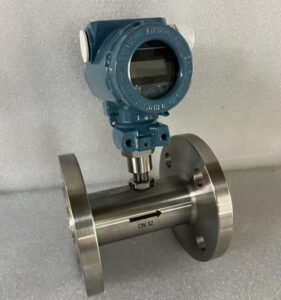
Inferential flow meters — turbines, paddle wheels, positive displacement meters — share one fundamental characteristic: they require the flowing fluid to interact physically with a mechanical component inside the pipe. That contact is the source of every cost challenge discussed below.
Common Maintenance Challenges with Conventional Systems
Scheduled maintenance requirements and labor expenses
A typical turbine flow meter on a water or chemical service line requires bearing inspection and lubrication every 6–12 months, seal replacement every 12–18 months, and full rotor overhaul every 2–3 years. Each visit involves a two-person instrument technician team, process isolation, and recommissioning — typically 4–6 hours of labor per event.
At an average instrumentation technician labor rate of $85–$120/hour, a single scheduled maintenance event costs $680–$1,440 in labor alone — before parts. Multiply that by 50–200 meter locations across a mid-sized water utility or chemical plant, and annual maintenance labor reaches $34,000–$288,000.
Replacement parts inventory and supply chain costs
Parts availability is an increasingly acute problem. As legacy meter platforms age past 10–15 years, manufacturers either discontinue specific components or move production to newer models. A facility manager at a Southeast Asian petrochemical complex reported in 2024 that sourcing rotor bearings for their 12-year-old turbine meters now required 8–14 week lead times and 40% premium pricing over original catalog costs — because the OEM had ceased production of that SKU.
Facilities must then carry safety stock of wear parts, tying up working capital and creating risk of obsolete inventory as the meter platform approaches end-of-life.
Downtime Impact on Your Bottom Line
Production losses during meter servicing
Le average scheduled maintenance event for a mechanical inline meter requires 4–8 hours of process isolation. For a production line generating $60,000/hour of output, even a 4-hour window represents $240,000 in opportunity cost — before contractor labor, replacement parts, or testing fees are counted. Most plant managers absorb this as “planned maintenance” without calculating the true dollar value until a budget review forces the comparison.
Emergency repair costs and expedited shipping fees
Unplanned failures are significantly more expensive. When a rotor seizes or a seal ruptures unexpectedly, the response involves emergency technician callouts (1.5–2× standard labor rates), expedited parts shipping ($200–$800 per event for air freight), and unplanned production downtime. Industry data from AlphaCIS’s manufacturing downtime analysis shows mid-sized facilities incur $22,000–$50,000 per unplanned downtime hour — with large chemical or pharmaceutical plants reaching multiples of that figure.
Accuracy Degradation Over Time
How wear and tear affect measurement precision
A brand-new turbine meter calibrated to ±0.5% accuracy at installation will drift as bearings wear. Research from Kytola Instruments confirms that once annual maintenance costs approach 50% of replacement cost, measurement drift typically exceeds the original accuracy specification by 2–3×. In a water utility billing environment, a meter reading 3% high on a 5,000 m³/day supply main generates a 150 m³/day billing overcharge — or, if reading low, a 150 m³/day revenue gap.
Revenue loss from billing inaccuracies and customer disputes
A 2% measurement error on a chemical plant raw material intake line processing $5 million/year of feedstock creates a $100,000 annual inventory reconciliation discrepancy. That’s not a compliance footnote — it’s a cash flow impact that appears as recurring write-offs or customer dispute credits.
2. Understanding Ultrasonic Flow Meter Technology
▲ How ultrasonic flow meters work: transit-time and Doppler principles explained with industrial application context. Suitable for distributor sales teams building technical fluency. (Source: RealPars)
How Ultrasonic Meters Operate Differently
Non-invasive measurement principles and advantages
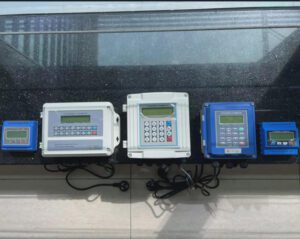
Ultrasonic flow meters measure fluid velocity by sending piezoelectric ultrasonic pulses through the pipe. In the transit-time method, two transducers fire pulses in opposite directions — one with the flow, one against it. The time difference (Δt) between arrival times is directly proportional to fluid velocity.
For particle-laden or aerated fluids, the Doppler shift method measures the frequency shift of signals reflected off particles or bubbles. Both approaches share a critical characteristic: the transducers never need to enter the pipe. Clamp-on configurations attach externally to the pipe surface — zero pipe cutting, zero process contact.
Why there are no moving parts to wear out
The measurement mechanism is entirely acoustic — sound pulses travel through the fluid, arrive at a receiving transducer, and the electronics calculate velocity from the timing difference. There is no rotor to seize, no bearing to wear, no seal to degrade. The only physical “moving part” in the measurement is the ultrasonic wave itself.
- Rotating parts wear and degrade with every revolution
- Seals degrade — chemical attack, temperature cycling
- Bearings require lubrication and periodic replacement
- Pipe penetration required — shutdown to install or replace
- Accuracy drifts as mechanical tolerances loosen with age
- Calibration required every 6–12 months in demanding services
- Parts obsolescence risk increases after 10+ years
- No moving parts — acoustic-only measurement mechanism
- No wetted components in clamp-on configurations
- No bearings, no seals, no mechanical wear surfaces
- Clamp-on installation — zero process shutdown required
- Accuracy stable across 10–20+ year service life
- Self-diagnostic Signal Quality Index (SQI) enables condition monitoring
- Solid-state electronics — no mechanical obsolescence risk
Superior Accuracy in Real-World Applications
Measurement precision across varying fluid conditions
Transit-time ultrasonic meters achieve ±0.5%–±2% accuracy in clamp-on single-path configurations, improving to ±0.15%–±0.5% in multi-path inline designs. For context, a well-maintained turbine meter on a clean water line starts at ±0.5% and degrades to ±2%–±5% within 3–5 years of service — without a maintenance event to catch the drift.
A 2022 independent field study published in Mesure des débits et instrumentation (ScienceDirect) tested seven clamp-on transit-time meters under real industrial operating conditions. Meters installed on well-characterised clean-pipe sections consistently delivered 1.0% of reading — stable, repeatable, and without any recalibration across the 18-month study period.
Consistency and reliability over extended operational periods
Because ultrasonic meters have no mechanical wear surfaces, their calibration stability is structurally different from mechanical meters. The measurement algorithm — the mathematical relationship between Δt and flow velocity — does not drift as a function of wear. Stability is governed by transducer health and electronic drift, both of which are manageable and monitorable through built-in diagnostics.
Minimal Maintenance Requirements
Reduced service intervals and labor needs
A clamp-on ultrasonic meter’s maintenance schedule is straightforward: annual visual inspection, couplant integrity check (10 minutes, no special tools), and firmware verification. No pipe isolation. No process shutdown. No mechanical disassembly. The industry consensus on ultrasonic meter service intervals is 1–3 years for most applications — versus 6–12 months for turbine meters in comparable services.
Predictive maintenance capabilities and remote diagnostics
Modern ultrasonic transmitters continuously report a Signal Quality Index (SQI) — a real-time 0–100% indicator of acoustic coupling integrity. When SQI shows a declining trend over weeks, it alerts the maintenance team that couplant inspection is needed — before accuracy is affected. This is the difference between a $50 preventive material cost and a $15,000 emergency calibration-failure event.

3. Building Your Business Case: The ROI Calculator
Key Financial Metrics for Comparison
Initial capital investment vs. long-term savings
The purchase price differential between a turbine meter and an equivalent ultrasonic meter is typically 20–40% in favor of the mechanical option — a real cost difference that procurement teams notice immediately. However, when total cost of ownership (TCO) is calculated across a 5–10 year horizon, the comparison reverses decisively.
Refer to the 10-year TCO breakdown in the table below. This is built from aggregated data from the Pokcenser Automation long-term maintenance cost analysis, manufacturer TCO studies, and field data compiled by Jade Ant Instruments’ non-invasive meter guide — not catalog assumptions.
| Catégorie de coûts | Traditional Turbine / Mechanical (10-yr, DN100) | Clamp-On Ultrasonic (10-yr, DN100) | Ultrasonic Saving |
|---|---|---|---|
| Equipment purchase | $1,800 – $3,500 | $2,500 – $4,500 | −$700 to −$1,000 |
| Initial installation labor | $800 – $2,500 (pipe cut, flanges, shutdown) | $200 – $500 (clamp-on, no shutdown) | +$600 – $2,000 |
| Scheduled maintenance (10 yr) | $8,500 – $18,000 (5–8 events @ $1,700–$2,250) | $800 – $1,500 (annual inspection only) | +$7,700 – $16,500 |
| Replacement parts (10 yr) | $2,400 – $6,000 (bearings, seals, rotors) | $200 – $600 (couplant, minor spares) | +$2,200 – $5,400 |
| Calibration & recertification | $1,500 – $4,000 (annual/biennial) | $500 – $1,200 (biennial verification) | +$1,000 – $2,800 |
| Unplanned downtime (avg. 1–2 events) | $10,000 – $45,000 (production loss + emergency repair) | $500 – $2,000 (sensor swap, no process shutdown) | +$9,500 – $43,000 |
| Revenue leakage from inaccuracy | $3,000 – $12,000 (2–5% accuracy drift) | $300 – $800 (±1% stable accuracy) | +$2,700 – $11,200 |
| 10-Year TCO Total | $28,000 – $91,000 | $5,000 – $11,100 | +$23,000 – $80,000 saved |
Sources: Pokcenser Automation TCO analysis; Jade Ant Instruments distributor cost models; AlphaCIS downtime data; industry field reports. Values are illustrative for a typical DN100 brownfield installation in process liquid service.
Calculating your payback period accurately
The payback period formula is straightforward: divide the net additional upfront investment (ultrasonic meter cost minus traditional meter cost, plus any installation differential) by the annual cost savings achieved. For most industrial applications, this yields a payback of 2–4 years — after which every year of operation generates pure cost advantage for the ultrasonic solution.
📊 Interactive Payback Period Estimator
Enter your customer’s operational parameters to generate a site-specific payback projection. Share the output directly in your proposal documents.
Scenario Modeling for Different Industry Applications
Water and wastewater treatment facilities
A regional water utility with 80 mechanical meters on distribution mains typically spends $180,000–$320,000/year on maintenance, calibration, and unplanned repair across the fleet — an average of $2,250–$4,000 per meter location annually. Industry data from WaterFM confirms that replacing or recalibrating older meters can increase revenue capture by 5–20% through reduced non-revenue water — a figure that directly translates to recovered billings for utilities losing 30–40% of treated water through metering errors and system losses.
Oil and gas operations
A 1% metering error on a crude oil transfer line carrying 50,000 barrels/day translates to roughly $35,000 in unaccounted product daily — $12.8 million annually. This is why oil and gas operators increasingly specify multi-path inline ultrasonic meters for custody transfer: at ±0.25% accuracy guaranteed by API MPMS Chapter 5.8 certification, the measurement uncertainty cost becomes negligible compared to a legacy orifice plate at ±1.5–3%.
Benchmark Comparisons
4. Real-World Case Study Series: Distributor Success Stories
Case Study #1 – Water Utility District
Municipal Water Distribution Authority — Southeast Asia
Baseline situation and operational challenges
The authority was spending $196,000/year on meter maintenance across 64 locations. Non-revenue water (NRW) — the gap between water produced and water billed — was running at 34%, indicating significant metering inaccuracies layered on top of physical losses. Eight emergency repair events in the prior 12 months had cost a combined $287,000 in production losses and expedited parts.
Implementation strategy and timeline
A phased upgrade prioritized the 22 highest-maintenance locations first. Clamp-on transit-time ultrasonic meters were installed over a 6-week period with zero production shutdowns. The entire phase-one installation was completed by a two-person technical team — no piping contractors, no welding permits, no process isolation required.
Results
Case Study #2 – Chemical Processing Facility
Specialty Chemical Manufacturer — Central Europe
Baseline situation and operational challenges
The facility was replacing turbine meter internals (seals, rotors, bearings) every 8–14 months on acid service lines — each replacement costing $2,800–$4,500 in parts and labor. Six billing disputes with chemical customers in the prior two years had been traced to accuracy drift, resulting in $68,000 in credited overcharges and one customer contract renegotiation.
Implementation strategy and timeline
Clamp-on ultrasonic meters were specified for all corrosive-service lines where pipe condition allowed. For three critical high-accuracy dosing lines, inline spool-piece ultrasonic meters were installed during a planned quarterly turnaround. Total project timeline: 11 weeks including pre-installation pipe condition surveys and signal quality verification.
Results
Case Study #3 – HVAC and Building Systems Integration
District Cooling Operator — Middle East Commercial Complex
Baseline situation and operational challenges
Paddle wheel meters on chilled water tenant billing loops were generating ±4–6% inaccuracies, causing systematic billing disputes and one regulatory audit flag by the district energy regulator. Annual maintenance across 28 locations cost $64,000, and a planned new building connection required meter specification approval — which the aging paddle wheel system failed.
Implementation strategy and timeline
Dual-path clamp-on transit-time ultrasonic meters with integrated supply/return temperature sensors were specified — creating complete BTU heat meters for tenant billing. Installation was completed floor by floor over 8 weekends, with no disruption to building operations or tenant HVAC service. Meters were commissioned with Modbus RTU output direct to the building management system (BMS).
Results
Case Study #4 – Food and Beverage Manufacturing
Dairy Processing Plant — Northern Europe
Baseline situation and operational challenges
During a regulatory audit, three turbine meters on product transfer lines were flagged for non-compliance — the rotor housings created potential dead-leg contamination zones incompatible with FDA 21 CFR Part 110 and EHEDG hygienic design requirements. The facility faced a compliance remediation order requiring meter replacement within 90 days.
Implementation strategy and timeline
Clamp-on ultrasonic meters were specified for all product transfer lines — the external installation eliminated all wetted-parts compliance risk without requiring any pipe modification or re-validation of the product contact surfaces. Two critical dosing lines received inline ultrasonic meters with hygienic PVDF transducer faces. The entire installation was completed within 34 days — 56 days ahead of the compliance deadline.
Results

5. Maintenance Cost Breakdown: Traditional vs. Ultrasonic
Annual Maintenance Expenses Comparison
Labor costs for scheduled service visits
The labor cost differential is the single largest driver in the TCO comparison. A turbine meter on a water service line requires 5–8 technician visits across a 10-year period: quarterly inspection (light), annual bearing check, biennial seal replacement, and at least one full overhaul. Each event averages 3–5 hours of labor at $85–$120/hour — totaling $1,275–$4,800 in labor per event.
An ultrasonic meter requires one annual visit for SQI verification and couplant inspection — 30 minutes, one technician. Total 10-year labor: 5 hours versus 30–50 hours for the turbine equivalent.
Replacement parts and component costs
A turbine meter’s wear-part bill over 10 years on a typical industrial service: bearings ($80–$200 per set × 3 replacements), seals ($40–$120 × 4 replacements), one rotor assembly ($350–$900). Total parts: $670–$2,080 per meter location. Ultrasonic equivalent: couplant compound ($15–$40 per application × 3 applications) = $45–$120 over 10 years.
Unplanned Downtime Expenses
Production loss calculations per hour
When a mechanical meter fails unexpectedly, the cost equation extends well beyond the repair itself. Using the ReliaMag downtime cost framework: (Lost Production Value per Hour + Labor Cost per Hour + Overhead) × Downtime Duration + Emergency Repair Cost. For a mid-sized chemical facility at $45,000/hour production value and a 6-hour emergency meter failure: $270,000 + $3,500 repair = $273,500 per incident. Ultrasonic meters, with no mechanical failure modes, reduce this category to near zero.
Emergency repair premiums and expedited logistics
Emergency callout labor rates run 1.5–2× standard rates. Air freight for a specialty bearing set from an overseas supplier adds $250–$800. A calibration recertification following an emergency repair adds $400–$1,200. These hidden costs accumulate invisibly across a fleet — until they’re tallied in a TCO analysis that makes the case for upgrading unmissable.
Calibration and Certification Costs
Recalibration frequency and associated fees
According to Flowell’s calibration cost guide, mechanical flow meters in demanding industrial service require annual or biennial recalibration at $150–$600 for basic lab calibration and $500–$2,000+ for on-site or mobile van calibration. Over a 10-year period, this accumulates to $1,500–$10,000 per meter location. Ultrasonic meters, with stable calibration curves and built-in SQI diagnostics, typically require biennial verification — cutting recalibration costs by 40–60%.
Regulatory compliance documentation expenses
Compliance-critical applications (water utility billing, pharmaceutical production, food contact lines) require traceable calibration certificates with every recalibration event. The documentation package — accredited calibration report, uncertainty budget, calibration records — adds $100–$400 per event to the calibration invoice. Ultrasonic meters’ superior measurement stability means fewer mandatory recalibration cycles, reducing documentation costs proportionally.
System Upgrade and Obsolescence Risk
Lifespan comparison and replacement timelines
| Paramètre | Traditional Mechanical (Turbine/PD) | Ultrasons à fixation par serrage | Inline Multi-Path Ultrasonic |
|---|---|---|---|
| Operational lifespan | 5–10 years (wear-limited) | 10–15 years (coupling-limited) | 15–25 years (electronics-limited) |
| Accuracy at end of life | ±2% – ±5% (degraded by wear) | ±1% – ±2% (stable, SQI-monitored) | ±0.5% – ±1% (factory calibration stable) |
| Moving parts | Yes — rotor, bearings, seals | Aucun | Aucun |
| Parts obsolescence risk | High after 10+ years | Low — standard transducers | Low — firmware upgradeable |
| Replacement frequency | Full replacement every 5–10 yr | Transducer swap at 10–15 yr ($200–$500) | No scheduled replacement required |
| IoT / SCADA integration | Limited (pulse output only) | Full — 4–20 mA, HART, Modbus | Full — HART, Modbus, PROFIBUS, OPC UA |
Technology obsolescence and parts availability issues
Le Instrumart guide to flow meter replacement identifies parts obsolescence as one of the top warning signs that a meter fleet needs urgent attention. When a manufacturer discontinues a rotor or bearing SKU, facilities face a choice: pay significant premium for third-party substitutes (which may not meet original calibration specifications), or carry prohibitively expensive multi-year safety stocks. Ultrasonic meters — with no mechanical wear parts and firmware that can be updated remotely — face no equivalent risk.
6. Accuracy Improvements and Revenue Impact
Measurement Accuracy and Billing Accuracy
How measurement errors translate to financial losses
The financial arithmetic of measurement error is linear: every percentage point of systematic bias on a high-volume flow line converts directly to money either lost (if reading low) or disputed (if reading high). A district heating operator billing $3.2 million/year in thermal energy charges with a ±3% meter fleet faces a $96,000 annual exposure to billing disputes or under-recovery — on top of the meter’s maintenance costs.
Ultrasonic precision reducing customer disputes
Ultrasonic meters’ stable ±0.5%–±1% accuracy, combined with built-in data logging and audit trails, directly reduces billing disputes. As the Badger Meter case study library documents across utility deployments, accuracy upgrades of this magnitude have driven 96% reductions in monthly service calls related to billing queries — a measurable customer satisfaction improvement that directly feeds contract retention.
Reduced Revenue Leakage
Quantifying losses from undermetering
Undermetering — where a meter reads systematically low due to wear or calibration drift — is invisible until reconciliation reveals the gap. For a water utility processing 50,000 m³/day with a 2% undermetering condition across 30% of its meter fleet, the unrecovered revenue at $1.20/m³ equals $131,400/year in systematic under-billing. That figure is recovered immediately upon meter upgrade — making the business case for instrumentation distributors essentially self-funding.
Customer confidence and contract retention benefits
Beyond direct revenue recovery, accurate metering builds the billing credibility that sustains long-term customer relationships. Industrial customers who experience recurring disputes over flow measurement data will eventually self-audit — and may install their own reference meters. Preventing that outcome by proactively upgrading to traceable ultrasonic measurement is a customer retention strategy, not just a cost-reduction exercise.
Compliance and Regulatory Benefits
Meeting industry standards with superior accuracy
Regulatory accuracy requirements are tightening across all major industrial sectors. The EU Measuring Instruments Directive (MID) and the equivalent national metrological requirements in most Asian and North American markets now specify minimum accuracy thresholds for utility billing meters that many aging mechanical meter fleets cannot reliably sustain after 5+ years of service. Ultrasonic meters designed to OIML R49 Class 1 or Class 2 specifications enter service compliant and remain compliant through their operational life without the degradation curve that mechanical meters follow.
Documentation and audit trail improvements
Modern ultrasonic transmitters store time-stamped flow records at configurable intervals — down to 1-minute resolution in many models. This data log serves as a verifiable audit trail for regulatory inspections, customer billing disputes, and process efficiency audits. Legacy mechanical meters offer none of this capability: their output is a 4–20 mA signal or a pulse count with no embedded history.
Data Quality for Business Intelligence
Better operational insights from precise measurements
Accurate, high-resolution flow data transforms operational decision-making. A chemical plant that upgrades from a ±3% turbine fleet to ±1% ultrasonic measurement gains the ability to detect 1% process inefficiencies that were previously below the measurement noise floor — enabling feed ratio optimization, pump efficiency improvements, and energy conservation at a level of precision that was simply not accessible before.
Predictive analytics and process optimization opportunities
Ultrasonic meters with HART or Modbus connectivity feed real-time flow data to Industrial IoT and SCADA platforms where AI-based analytics can identify equipment degradation, flow efficiency trends, and energy optimization opportunities. One European industrial facility using cloud-connected ultrasonic meters on HVAC loops identified a chiller energy overconsumption pattern worth $38,000/year in recoverable savings — a pattern that the legacy paddle wheel meters had been too inaccurate to reveal.
7. System Downtime Analysis: Minimizing Operational Interruptions
Traditional Meter Downtime Causes
All four categories are eliminated or near-eliminated in clamp-on ultrasonic meter configurations — which have no bearings, seals, rotors, or calibration-drift mechanisms.
Downtime Frequency Comparison
Average service interruptions with traditional meters
Survey data from Sur-Flo Controls’ downtime reduction analysis shows that a typical industrial turbine meter fleet of 50 units generates 4–8 unplanned service interruptions per year — each requiring process isolation and an average of 5–7 hours of resolution time. Planned maintenance adds a further 50–100 scheduled process isolation events annually. The total process interruption burden is significant even before the dollar cost is calculated.
Ultrasonic technology’s non-invasive advantage
A clamp-on ultrasonic meter introduces zero process interruptions — for installation, for maintenance, and for transducer replacement. The entire lifecycle of the instrument, from unboxing to eventual transducer swap after 10–15 years, occurs without stopping the process. This is not a marginal improvement — it is a categorical elimination of a recurring cost category.
Installation and Commissioning Impact
Minimizing disruption during meter replacement
Replacing a legacy inline turbine meter with a new ultrasonic clamp-on involves: pipe surface preparation (wire brush, 10 minutes), transducer spacing calculation (software-assisted, 5 minutes), couplant application and transducer mounting (15 minutes), parameter entry and SQI verification (20 minutes). Total: under 60 minutes, by one technician, with the process running at full flow throughout.
Hot-tap installation capabilities for continuous operation
Where inline spool-piece ultrasonic meters are required for higher accuracy applications, hot-tap installation technology allows meter insertion through a pressure-rated valve assembly drilled into the pipe under operating pressure. No process shutdown. No depressurization. A two-person crew completes hot-tap insertion on a DN200 line in 3–4 hours — versus the 1–3 day shutdown that a conventional inline meter replacement requires.
Remote Monitoring and Predictive Maintenance
Early warning systems preventing unexpected failures
Ultrasonic transmitters with embedded diagnostics monitor signal quality, fluid temperature, flow profile symmetry, and electronics health continuously. An SQI trend declining from 85% to 62% over six weeks signals that couplant inspection is needed — typically a $50 material cost resolved in 30 minutes. Without that early warning, the same condition progresses to an SQI below 40%, at which point measurement accuracy is compromised and an emergency site visit is required.
Scheduled maintenance windows vs. emergency repairs
The operational model shifts fundamentally: from reactive emergency repairs (expensive, disruptive, unpredictable) to planned preventive visits (cheap, scheduled, zero production impact). Over a 10-year fleet, this shift typically reduces total maintenance-related expenditure by 55–65% and reduces meter-related production interruptions by 90%+.
Business Continuity Planning
Reducing risk exposure for critical applications
For applications on the critical path of production — a feedstock flow meter that, if it fails, stops the entire batch process — the risk-adjusted value of ultrasonic measurement is higher still. A facility producing $2 million/day of pharmaceutical product cannot afford a 4-hour meter failure event costing $333,000 in production loss. Specifying ultrasonic measurement for critical-path flow points is risk management, not a premium purchase.
Service level agreement (SLA) improvements
Distributors who sell ultrasonic meter upgrades to customers with uptime SLAs — utilities with contractual reliability commitments, contract manufacturers with OEM delivery schedules — can demonstrate that the meter fleet change directly contributes to SLA compliance. This elevates the conversation from “meter replacement” to “operational reliability improvement” — a positioning that supports premium pricing and long-term service contracts.
8. Implementation Strategy for Distributors and Agents

Assessment and Planning Phase
Evaluating your customer base for upgrade opportunities
The highest-ROI upgrade candidates share a recognizable profile: meter fleets older than 8 years, applications involving corrosive or abrasive fluids, customers with documented maintenance cost pain, and sites where billing accuracy disputes have occurred. Start by requesting maintenance logs from 3–5 key accounts — the cost data is almost always more compelling than your customers realize before they see it totaled.
Le Jade Ant Instruments five-factor flow meter selection framework provides a systematic evaluation structure — covering performance requirements, fluid properties, installation constraints, environmental conditions, and lifecycle economics — that gives your technical team a consistent methodology for generating application-specific meter recommendations.
Identifying high-ROI replacement candidates
Prioritize meter locations that combine high maintenance frequency, long process shutdown requirements, and high production value per downtime hour. A single DN200 turbine meter on a chemical plant header that generates 3 unplanned failures/year and 6 hours of shutdown each represents a $30,000–$60,000/year downtime liability. That single location can justify the entire upgrade project’s investment — making it the ideal anchor point for your proposal.
Customer Proposal Development
Using case studies and ROI data to build compelling proposals
The most effective proposals lead with the customer’s own cost data, not generic claims. Use the maintenance logs you’ve gathered to calculate current total cost of ownership, then model the post-upgrade scenario using conservative assumptions (50% maintenance reduction, 85% downtime reduction). The output is a site-specific savings projection that no purchasing manager can dismiss as “vendor marketing.”
Customizing financial projections for specific accounts
Different customer personas prioritize different financial metrics. CFOs respond to payback period and NPV. Operations managers respond to downtime hours eliminated. Procurement managers respond to 5-year TCO comparisons. Sustainability officers respond to energy efficiency data. Build your proposal structure to address all four — the Jade Ant Instruments manufacturer comparison guide provides technology-by-technology TCO data that can be incorporated directly into customer-facing materials.
Installation and Training Support
Ensuring smooth transitions for your customers
The most common cause of clamp-on meter underperformance in the field is installation error — specifically, using nominal pipe OD from a datasheet instead of measuring actual OD with a pi tape, or using wrong-mode transducer configuration (V-mode vs. Z-mode) for the pipe diameter. A half-day installation training session for customer technicians reduces first-installation error rates from ~40% to under 10% — dramatically improving post-sale satisfaction.
Technical training and ongoing support protocols
Establish a technical support protocol that covers the first three months after installation: a 30-day SQI verification check, a 90-day accuracy cross-check against a portable reference meter, and a documented commissioning record that the customer retains for their calibration management system. This structured follow-up positions your distributor organization as an application partner, not a one-time product seller.
Post-Implementation Monitoring
Tracking actual vs. projected savings
Six months after a major installation, schedule a review meeting to compare actual maintenance events, downtime incidents, and calibration costs against the pre-upgrade baseline. In most cases, actual savings equal or exceed projected savings — and this data becomes the foundation of the case study that powers your next sale.
Building case studies from your successful deployments
A well-documented case study — with before/after cost data, installation timeline, and quantified results — is worth more than any marketing brochure. Four well-structured case studies covering different industries (water, chemical, HVAC, food) give your sales team credible evidence for every major vertical they approach.
9. Financial Justification Tools for Your Sales Team
Total Cost of Ownership (TCO) Worksheets
Comprehensive expense tracking templates
A complete TCO worksheet for an industrial flow meter fleet covers five cost categories: (1) equipment purchase and installation, (2) scheduled maintenance labor and parts, (3) unplanned downtime and emergency repair, (4) calibration and compliance documentation, and (5) revenue leakage from measurement inaccuracy. Each category should be quantified for both the existing fleet and the proposed ultrasonic upgrade — with data sourced from the customer’s own maintenance records wherever possible.
Customizable spreadsheets for different applications
Below is a simplified 5-year TCO comparison template that your sales team can adapt for customer proposals:
| Catégorie de coûts | Year 1 | Year 2 | Year 3 | Year 4 | Year 5 | 5-yr Total |
|---|---|---|---|---|---|---|
| 📍 Traditional Mechanical Meter (per location, typical industrial service) | ||||||
| Equipment + installation | $4,200 | – | – | – | – | $4,200 |
| Scheduled maintenance | $1,400 | $1,400 | $1,800 | $1,800 | $2,200 | $8,600 |
| Unplanned downtime (avg.) | $8,500 | $0 | $12,000 | $0 | $9,500 | $30,000 |
| Calibration + compliance | $750 | $750 | $750 | $750 | $750 | $3,750 |
| Revenue leakage | $1,200 | $1,500 | $2,000 | $2,800 | $3,500 | $11,000 |
| TOTAL | $16,050 | $3,650 | $16,550 | $5,350 | $15,950 | $57,550 |
| 📡 Clamp-On Ultrasonic Meter (per location, same service) | ||||||
| Equipment + installation | $4,800 | – | – | – | – | $4,800 |
| Scheduled maintenance | $120 | $120 | $120 | $120 | $120 | $600 |
| Unplanned downtime (avg.) | $0 | $0 | $0 | $0 | $0 | $0 |
| Calibration + compliance | $350 | $0 | $350 | $0 | $350 | $1,050 |
| Revenue leakage | $200 | $200 | $200 | $200 | $200 | $1,000 |
| TOTAL | $5,470 | $320 | $670 | $320 | $670 | $7,450 |
| 5-Year Net Savings per Location (Ultrasonic vs. Traditional) | $50,100 | |||||
Illustrative values for a single DN100 industrial process liquid meter location. Unplanned downtime averaged across 5-year probability. Adapt with customer-specific data for proposal use.
Payback Period Calculators
Visual timelines showing investment recovery
Sensitivity analysis for different cost scenarios
For cost-conservative customers, run three scenarios: Base Case (50% maintenance reduction, average downtime probability), Conservative (35% maintenance reduction, half average downtime), and Optimistic (65% maintenance reduction, eliminating all unplanned downtime). Even the conservative scenario typically shows payback within 3.5 years — a result that withstands procurement scrutiny and removes the “what if the savings don’t materialize” objection.
Lifetime Value Projections
10-year and 20-year cost comparisons
At a 10-year horizon, the ultrasonic advantage is approximately $50,000–$80,000 per meter location in typical industrial service. At 20 years — the realistic service life of a quality ultrasonic meter — the cumulative saving reaches $100,000–$160,000 per location, while the traditional meter will have been replaced at least once, adding another full installation cost cycle. The 20-year comparison is the most compelling number for capital budget committees evaluating long-term facility investment.
Accounting for inflation and technology advancement
Maintenance labor rates have been inflating at 4–6% annually in most industrial markets. Spare parts for legacy mechanical meters inflate faster still as supply chains contract. Building these inflation assumptions into your 10-year and 20-year projections — using real CPI data from the customer’s operating region — makes the financial model more credible and typically makes the ultrasonic case even stronger.
Competitive Positioning Documents
How ultrasonic solutions outperform alternatives
Position ultrasonic meters not just against the incumbent mechanical fleet, but against competing upgrade options: electromagnetic meters (require pipe penetration, conductive fluids only), vortex meters (pressure drop, limited to clean liquids), and differential pressure systems (high permanent pressure loss, frequent recalibration). The Jade Ant Instruments ultrasonic vs. magnetic vs. turbine comparison guide provides a side-by-side specification comparison suitable for inclusion in customer technical proposals.
Differentiation strategies for your sales conversations
The most effective differentiator for instrumentation distributors selling ultrasonic upgrades is the depth of application knowledge behind the recommendation — not the meter itself. Any distributor can quote a catalog price. Fewer can walk into a customer’s plant, assess their pipe conditions with a portable signal quality checker, calculate a site-specific payback projection using actual maintenance logs, and present a phased upgrade plan with installation timelines and commissioning protocols. That capability is what converts a product sale into a preferred supplier relationship.
10. Risk Mitigation and Long-Term Value
Technology Reliability and Longevity
Expected lifespan and performance degradation curves
A quality inline ultrasonic meter has a mean time between failures (MTBF) exceeding 100,000 hours — approximately 11.4 years of continuous 24/7 operation. Clamp-on meter transducers, protected from fluid contact and housed in IP68-rated enclosures, achieve similar MTBF figures. Crucially, ultrasonic meters do not follow the progressive accuracy degradation curve that mechanical meters exhibit: their measurement accuracy remains stable until a specific component (typically a transducer or electronic board) fails — at which point it is replaced and performance is restored immediately. There is no slow drift that progressively erodes billing accuracy and requires monitoring.
Warranty and support considerations
Most quality ultrasonic meter manufacturers offer 2–5 year product warranties, with extended service agreements available. When evaluating supplier options for your distribution portfolio, verify: (1) local technical support availability in your sales territory, (2) transducer backward compatibility commitment (will a 2033 replacement transducer work in a 2025 transmitter?), and (3) firmware update availability and backward compatibility. These factors determine whether your customers can sustain the investment across a 15–20 year operational horizon.
Supplier Stability and Parts Availability
Ensuring long-term availability of components
Unlike mechanical meters whose wear parts are model-specific and vulnerable to discontinuation, ultrasonic transducers use standardized piezoelectric elements with broad cross-platform compatibility. The electronics — the primary long-term reliability concern — are solid-state and firmware-upgradeable, meaning a 10-year-old transmitter can receive new algorithm improvements without hardware replacement. This architectural advantage structurally reduces the parts obsolescence risk that haunts legacy mechanical meter fleets.
Supply chain resilience and vendor reliability
For instrumentation distributors, supplier stability is as important as product performance. Evaluate your ultrasonic meter suppliers on: manufacturing ISO certification (ISO 9001 at minimum), in-country service center availability, stocking of regional spare parts inventory, and track record of platform longevity. Suppliers who have maintained a consistent product platform for 10+ years — not just the latest catalog — are the safer choice for customers making 15-year infrastructure commitments.
Regulatory and Environmental Compliance
Meeting current and anticipated future standards
Regulatory requirements for industrial flow measurement are in a period of tightening across all major markets. The EU’s updated MID (Measuring Instruments Directive) revisions, stricter EPA water quality reporting requirements in North America, and expanding ISO 50001 energy management certification programmes all demand more accurate, better-documented, and more traceable flow measurement than many aging mechanical meter fleets can provide. Ultrasonic meters specified to current standards enter service future-compliant — reducing the risk of another forced upgrade cycle driven by regulatory non-compliance.
Environmental benefits and sustainability advantages
Ultrasonic meters introduce zero permanent pressure drop into the pipeline — eliminating the pump energy penalty that DP-based meters and turbine meters impose. In a large facility with 50 DN150 process lines, eliminating the average 0.5–2 bar pressure drop of inline mechanical meters can reduce pump energy consumption by 3–8%, with corresponding reductions in electrical energy use and carbon emissions. For customers with net-zero commitments and ISO 50001 energy management programmes, this operational efficiency benefit has a quantifiable carbon accounting value.
Scalability and Future-Proofing
System flexibility for changing operational needs
A clamp-on ultrasonic meter can be relocated to a different pipe simply by removing the transducer clamps and remounting on the new location — a 30-minute operation. When a process line is decommissioned or reconfigured, the meter moves with it. No pipe modification, no new installation cost. This flexibility has real balance-sheet value for facilities that undergo process changes every 3–5 years — the meter investment follows the process rather than becoming sunk cost in the old piping layout.
Integration with Industry 4.0 and IoT platforms
Modern ultrasonic transmitters support OPC UA, MQTT, and Modbus TCP protocols enabling direct integration with cloud data platforms (Azure IoT Hub, AWS IoT Core), AI-based process optimization platforms, and digital twin environments. As MarketsandMarkets notes, the intelligent flow meter market — meters with embedded analytics and connectivity — is projected to grow from $4.88 billion in 2024 to $6.73 billion by 2030, with AI-enabled ultrasonic meters at the centre of this growth. Distributors who position ultrasonic meters as the measurement foundation of their customers’ digital transformation programmes are selling into a decade-long upgrade cycle, not a one-time replacement.
Making the Business Case for Ultrasonic Technology
Summarizing the Financial and Operational Benefits
The evidence across case studies, TCO models, and real-world cost data consistently points to the same conclusion. A typical industrial customer running a 50-location mechanical meter fleet is spending $1.4M–$4.6M over 10 years on an asset that delivers declining accuracy, escalating maintenance costs, and growing obsolescence risk. The equivalent ultrasonic fleet costs $250,000–$560,000 over the same period — a savings differential of $1.1M–$4M that is recoverable through documented, quantifiable cost categories, not optimistic projections.
For your distribution business, each upgrade project represents equipment sales, installation support revenue, calibration service contracts, and the long-term service relationship that follows. A customer who upgrades 50 meters with your organization — and sees the projected savings materialize — will return for every subsequent expansion, every new site, and every adjacent product need. That is the compounding business value of ultrasonic technology as a distribution strategy.
Jade Ant Instruments supports distribution partners with application engineering data, site-specific selection guidance, and the technical documentation your sales team needs to close upgrade proposals with confidence. The complete clamp-on meter selection guide covers fluid compatibility, pipe material assessment, installation protocols, and accuracy verification procedures — all the technical depth your team needs behind the financial case.
Next Steps for Distributors and Agents
Start with the three accounts in your existing portfolio where maintenance pain is most visible — customers who have complained about meter reliability, customers who have had billing disputes, or customers whose process lines run aggressive fluids. Request their maintenance logs from the past 24 months. Build their current TCO using the framework in Section 9. Present the comparison with a site-specific ROI projection built from their own data. That proposal, grounded in their real numbers, closes faster and at higher margins than any product-feature presentation.
Building Long-Term Customer Relationships
The distributor who presents a data-driven upgrade case, executes the installation cleanly, and follows up with a 6-month savings verification review occupies a fundamentally different position in the customer relationship than the distributor who quotes products and waits for purchase orders. The first is a trusted technical advisor. The second is a commodity supplier. Ultrasonic meter upgrades — with their compelling ROI story, documented case studies, and visible operational impact — are the highest-leverage product category for making that transition in your key accounts.
Ready to Help Your Customers Reduce Costs and Improve Efficiency?
Access our complete ROI Calculator, case study library, and implementation guide — exclusively for instrumentation distributors and agents. Download your free resources today and start building site-specific upgrade proposals that close.
Contact Jade Ant Instruments — Get Your Free Resources Today →📖 Glossaire des termes clés
A meter that infers flow rate from a secondary physical effect — rotor spin speed (turbine), pressure differential (orifice), or vortex shedding frequency — rather than measuring flow directly. All inferential types have mechanical elements inside the pipe. Example: A turbine meter on a water supply main that counts rotor revolutions to calculate volumetric flow.
An ultrasonic measurement principle where two transducers send pulses upstream and downstream simultaneously. Flow velocity is calculated from the time difference (Δt) between arrival times. Requires clean, particle-free fluid. Accuracy: ±0.5%–±2% (clamp-on), ±0.15%–±0.5% (multi-path inline).
An ultrasonic measurement principle where a single transducer emits a continuous beam and measures the frequency shift of signals reflected by particles or bubbles in the fluid. Requires minimum particle/bubble content (≥75 mg/L). Suitable for wastewater, slurry, and aerated liquids. Accuracy: ±2%–±5%.
A real-time 0–100% indicator of received ultrasonic signal strength displayed on the transmitter. SQI above 60%: reliable measurement. SQI 50–60%: investigate pipe condition. SQI below 50%: measurement accuracy may be compromised — act immediately. The primary field diagnostic for clamp-on meter health.
The complete 5–20 year cost of a flow meter installation: equipment + installation + scheduled maintenance + unplanned downtime + calibration + revenue leakage from inaccuracy. TCO is typically 5–10× the purchase price for mechanical meters in demanding industrial service.
Water produced by a utility that is not billed to customers — including physical losses (leakage) and commercial losses (meter inaccuracy, unauthorized use). Global average: 30–40% in developing markets. Accurate flow metering at District Metered Area (DMA) inlets is the primary NRW measurement tool.
A procedure that allows an inline meter or sensor to be inserted into a pressurized pipe through a valve assembly without stopping the process. Eliminates the production shutdown cost of conventional inline meter installation. Applicable for pipes DN100 and above.