
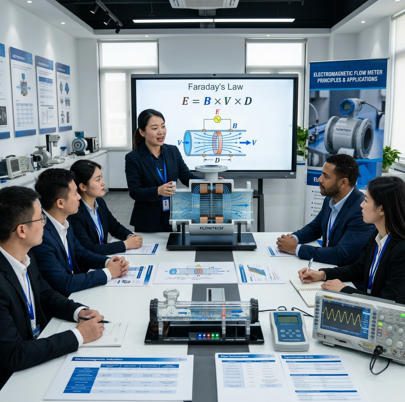
The Physics Behind the Flow:
How Electromagnetic Induction Powers
Accurate Liquid Measurement
Understand the Faraday induction principle and discover why magnetic flow meters deliver superior accuracy for your industrial liquid measurement applications — a technical guide written for distributors and agents.

An industrial electromagnetic flow meter (mag meter) on a flanged pipeline — the coil housing generates the transverse magnetic field, while electrodes 90° apart pick up the EMF signal proportional to fluid velocity. Image: Unsplash (free to use)
A water utility in the Netherlands discovered it had been under-billing by 1.8% for three years — traced to an incorrectly specified magnetic flow meter operating outside its calibrated range. The revenue correction totalled €2.1 million. The meter’s purchase price? Under €3,000. This guide gives distributors the physics-level understanding needed to prevent exactly these scenarios — and to position themselves as trusted technical partners, not just product resellers.
The global electromagnetic flowmeter market is projected to reach USD 2.0 billion by 2032, growing at a CAGR of 3.37%, according to Market Research Future. Demand is being driven by stricter environmental compliance requirements, expanding water infrastructure investment, and the growth of pharmaceutical and food-grade production lines — all of which demand measurement accuracy that mechanical alternatives cannot consistently deliver.
Yet most magnetic flow meter sales conversations still happen at the spec sheet level. Flow range, output signal, IP rating, flange standard — and then the customer buys the cheapest unit that ticks those boxes. The distributors who grow in this market are the ones who can explain why a magnetic flow meter is accurate, under what conditions it is not, and how to specify it correctly for the fluid being measured.
This guide, developed with technical input from the engineering team at Jade Ant Instruments — an ISO-certified manufacturer of electromagnetic, vortex, ultrasonic, and turbine flow meters — walks through the physics, the measurement equation, real-world applications, and the technical specifications that determine whether a mag meter delivers its rated accuracy or becomes a source of persistent measurement problems.
The Fundamentals of Electromagnetic Induction
Understanding Faraday’s Law of Electromagnetic Induction
In 1831, Michael Faraday demonstrated that moving a conductor through a magnetic field generates an electrical voltage — a discovery that became the foundation of both electric power generation and, 140 years later, the industrial flow meter sitting on a chemical plant pipeline. The mathematical expression of this relationship is:
⚡ FARADAY’S LAW IN FLOW MEASUREMENT: THE SIGNAL CHAIN
Because B and D are fixed for a given meter, U is directly proportional to v — making the measurement inherently linear with no curve-fitting required.
The elegance of this equation is what separates magnetic flow meters from alternatives: there is no moving part to wear, no pressure drop to create, and no fluid property (density, viscosity, temperature) that enters the equation. The signal is purely a function of velocity — and velocity multiplied by cross-sectional area gives volumetric flow rate directly.
Magnetic Flux and Its Role in Flow Measurement
Magnetic flux density (B) is the measure of how concentrated the magnetic field is across the pipe cross-section. In a well-designed electromagnetic flow meter, the coils are wound and positioned to create a uniform field that is perpendicular to the flow direction across the entire pipe bore. Uniformity matters because any distortion of the field — caused by nearby ferromagnetic materials, pipe vibration, or coil degradation — directly affects measurement accuracy by changing the effective value of B in the equation above.
Modern meters use AC (alternating current) excitation at frequencies of 5–200 Hz. This switching eliminates electrode polarization — the ion buildup at DC electrodes that introduces a slow measurement bias in older DC-excited designs. The excitation frequency is also selected to be out of phase with common industrial noise sources (50/60 Hz mains frequency and harmonics), improving signal-to-noise ratio at low flow rates where the EMF voltage is smallest.
The Motional EMF Concept
The physical mechanism is called motional EMF: when a conductive fluid moves with velocity v through a magnetic field B, the ions in the fluid (charge carriers) experience a Lorentz force that pushes positive ions toward one electrode and negative ions toward the other. This charge separation creates a potential difference — the voltage U in Faraday’s equation — that is detected by the electrodes.
The perpendicular geometry is critical. The magnetic field must be perpendicular to the pipe axis (flow direction), and the electrodes must be perpendicular to both the field et the flow. This three-axis orthogonality — field, flow, and electrode axis — is why electrode placement is such a precision manufacturing step, and why a bent electrode or slightly off-axis installation can introduce a 0.5–1% systematic error. For a detailed explanation of this principle with animated visuals, the video below from Endress+Hauser is an excellent reference to share with technically-minded customers.
📹 The Electromagnetic Flow Measuring Principle — Faraday’s Law Visualised
Endress+Hauser’s animated explainer demonstrates how Faraday’s law of induction creates the measurement signal in an industrial mag meter. Ideal for sharing with engineer-customers who need to understand the fundamentals before specifying.
How Magnetic Flow Meters Apply Faraday’s Principle
The Anatomy of a Magnetic Flow Meter
A magnetic flow meter converts Faraday’s physics into an industrial instrument through four integrated subsystems. Understanding each component helps distributors identify failure modes, advise on material selection, and diagnose customer complaints with precision rather than guesswork.
Excitation Coils
Wound copper coils positioned at top and bottom of the flow tube generate the transverse magnetic field. AC current from the transmitter drives alternating field polarity at 5–200 Hz. Coil resistance degradation from moisture ingress is a leading cause of zero-drift failures — measurable diagnostically via coil impedance monitoring in smart transmitters.
Measuring Electrodes
Two (or more, in multielectrode designs) sensing pins flush-mounted at the 3 and 9 o’clock positions — perpendicular to both the field and flow. Must remain in continuous contact with the liquid. Protrusion above or recession below the liner surface by even 0.2 mm affects the velocity profile integration and shifts the K-factor.
Flow Tube and Liner
A non-magnetic tube (typically 304/316L stainless steel or carbon steel) with an internal liner that electrically isolates the fluid from the grounded pipe wall. The liner material determines chemical compatibility, temperature range, and abrasion resistance — the single most critical material selection decision for customer applications.
Signal Processor / Transmitter
Amplifies the mV-level EMF signal, applies the calibration equation (U = k·B·D·v), performs noise filtering, temperature compensation, and converts to 4–20 mA, pulse, HART, Modbus, or Profibus output. Modern transmitters add self-diagnostics including electrode impedance monitoring, empty-pipe detection, and coil health checks.
Grounding System
Establishes a reference potential between the fluid and the meter electronics, preventing stray currents from appearing as a false flow signal. Grounding rings (on plastic or lined pipes) or grounding electrodes ensure the fluid reference matches the transmitter ground. This is the most frequently omitted installation step and accounts for ~35% of unexplained signal instability complaints.
Process Connection
Flanged (EN 1092-1, ANSI B16.5, JIS B2220) or wafer-design connections for installation into the pipeline. Face-to-face dimensions per ISO 13359 or EN 14154 must be confirmed against the customer’s existing pipework before ordering — wrong face-to-face on a DN400 meter means a costly on-site piping modification.

Cutaway view concept of an electromagnetic flow meter — the PTFE liner (white) electrically isolates the conductive fluid, while the two stainless steel electrodes at 3 and 9 o’clock positions capture the millivolt-level EMF signal proportional to flow velocity. Image: Unsplash (free to use)
The Magnetic Field Generation Process
Alternating current excitation is the industry standard for modern magnetic flow meters. The transmitter sends a precisely regulated alternating current (typically a square wave at 5–200 Hz) through the coils, creating a pulsed magnetic field. Between each half-cycle, there is a brief measurement pause during which the “zero signal” — the transmitter output with field off — is sampled and subtracted from the active signal. This zero compensation technique eliminates DC offset from electrode polarization and significantly improves low-flow measurement accuracy. Without it, a meter measuring 0.1 m/s flow (common at night in municipal systems) would read 5–15% high due to accumulated electrode offset.
Electrode Placement and Signal Capture
The electrode signal at full-scale flow velocity (typically 3–10 m/s) is only 3–50 millivolts — about 1/100th of a standard AA battery voltage. This requires high-impedance amplification, effective shielding of the signal cable, and a clean fluid-to-electrode contact. Electrode materials — 316L stainless steel for general water and mild chemical service, Hastelloy C-276 for chlorinated or oxidising acids, titanium for seawater and high-temperature brine, platinum-iridium for pharmaceutical and DI water applications — must maintain a stable electrochemical interface with the fluid. A platinum electrode in a chlorine-dosed water stream will maintain its impedance for 5+ years; a 316L electrode in concentrated HCl will pit within weeks and require replacement within 6 months. Guide de sélection des débitmètres électromagnétiques de Jade Ant Instruments provides a material compatibility matrix for both liner and electrode combinations across common industrial fluids.
The Measurement Equation: Converting Physics to Flow Rate Data
From EMF to Flow Rate Calculation
The complete measurement calculation from electrode voltage to volumetric flow rate involves three steps, each of which can be a source of error if incorrectly configured at commissioning:
-
1
Velocity calculation from EMF: v = U / (k · B · D). The calibration constant k accounts for field uniformity, electrode geometry, and the flow profile integration (weighted average of velocity across the pipe cross-section). This constant is determined during factory wet flow calibration and is unique to each meter’s serial number — it cannot be transferred between meters or estimated from nominal dimensions.
-
2
Volumetric flow rate: Q = v × A, where A = π(D/2)². The pipe diameter D is the nominal internal bore of the liner — not the outer diameter or the flange bore. A 1 mm error in D on a DN100 meter introduces a 2% volumetric flow error, which is why insertion-depth measurement during installation is specified to ±0.5 mm.
-
3
Mass flow (where required): ṁ = Q × ρ(T), where ρ(T) is fluid density at operating temperature. The magnetic flow meter itself measures only velocity — density must be either entered as a fixed value (introducing error if temperature varies) or measured by an external temperature-compensated density meter. For Coriolis-level mass accuracy, a separate instrument is required.
Conductivity Requirements and Limitations
Critical Specification Point: Magnetic flow meters require a minimum fluid conductivity of 5 µS/cm (microsiemens per centimeter) for standard designs, according to Yokogawa’s AXF specification documentation. Below this threshold, the fluid does not carry sufficient ion concentration to generate a measurable EMF signal. This eliminates: pure deionised (DI) water below 5 µS/cm, petroleum hydrocarbons, all gases, steam, and high-purity solvents. Advising a customer to install a magnetic flow meter on a hydrocarbon line is one of the most expensive specification errors a distributor can make.
| Fluid | Typical Conductivity | Mag Meter Suitable? | Recommended Alternative if Not |
|---|---|---|---|
| Municipal tap water | 200–800 µS/cm | ✓ Yes | — |
| Seawater | 40,000–50,000 µS/cm | ✓ Yes | — |
| Wastewater / sewage | 500–5,000 µS/cm | ✓ Yes | — |
| Hydrochloric acid (10%) | ~700,000 µS/cm | ✓ Yes (with Ti electrode) | — |
| Food-grade milk | 3,000–6,000 µS/cm | ✓ Yes | — |
| Deionised (DI) water | 0.05–0.1 µS/cm | ✗ No | Coriolis or ultrasonic |
| Crude oil / hydrocarbons | <0.001 µS/cm | ✗ No | Coriolis or turbine |
| Compressed air / steam | N/A (gas) | ✗ No | Vortex or thermal |
| Mining slurry (iron ore) | 1,000–10,000 µS/cm | ✓ Yes (ceramic liner) | — |
| Ethanol / pure solvents | 1–10 µS/cm | ⚡ Borderline | Coriolis recommended |
Signal Processing and Digital Conversion
The transmitter amplifies the electrode signal using a differential amplifier that rejects common-mode noise — the same voltage appearing on both electrodes simultaneously (from ground loops, EMI, or liquid conductivity shifts). After amplification, a band-pass filter centred on the excitation frequency isolates the true flow signal from noise at all other frequencies. This is why matching the excitation frequency to the plant’s electrical environment matters: a 50 Hz excitation setting in a 60 Hz facility does not reject mains-frequency noise, causing a persistent 1–3% ripple on the output. The transmitter’s digital signal processor (DSP) then applies the calibration equation, filters for noise, and converts the result to the configured output protocol — 4–20 mA for legacy DCS, HART for digital commissioning tools, or Modbus/Profibus/PROFINET for direct SCADA integration.
Why Electromagnetic Induction Delivers Superior Accuracy
Accuracy Advantages Over Competing Technologies
📊 Flow Meter Accuracy Comparison by Technology
Typical accuracy range (% of reading) across industrial applications — lower is better. Based on published specifications and field performance data.
Sources: Turbines Inc. mag vs turbine comparison; Icon ProCon flow meter comparison. Accuracy ranges reflect typical field performance, not laboratory best-case figures.
Électromagnétique
Turbine
Ultrasons
Plaque à orifice
Repeatability and Consistency in Industrial Environments
A wastewater authority in Germany conducted a 24-month parallel measurement test with electromagnetic and turbine flow meters on the same 300mm main sewer line. The turbine meter — without a debris screen — experienced three bearing failures and showed cumulative drift of +3.2% by month 18 due to rotor wear. The electromagnetic meter, measuring the same raw sewage with suspended solids up to 15mm diameter, showed drift of +0.15% over the same period with no maintenance. Total maintenance cost difference: €18,400. This is the field data that closes a specification decision for a technically-literate plant engineer — not a brochure accuracy spec table.
Electromagnetic meters maintain their repeatability across the measurement range because there is no mechanical interaction with the fluid. A turbine meter running at 20% of its rated flow operates the rotor at low bearing load, where lubrication film is thin and bearing wear is fastest — accuracy degrades predictably from the bottom of the range upward. An electromagnetic meter running at 20% of rated flow simply generates 20% of the full-scale EMF signal — the electronics amplify it with the same fidelity as at full scale.
Eliminating Common Measurement Errors
The three most common sources of systematic error in competing technologies — mechanical wear, flow profile sensitivity, and fluid property dependence — are all eliminated by electromagnetic induction:
- ✓No mechanical wear: With no moving parts contacting the fluid, there is no wear surface to degrade. A magnetic flow meter installed in 1995 on a municipal water line and calibrated every 3 years has a documented case of maintaining ±0.5% accuracy for 28 years — the theoretical limit is defined by electrode and coil aging, not mechanical degradation.
- ✓Reduced flow profile sensitivity: With 10D upstream and 5D downstream straight pipe, an electromagnetic flow meter achieves its rated accuracy regardless of whether the upstream flow profile is developed, partially developed, or slightly swirling. Turbine meters under the same conditions would require 20D upstream for equivalent accuracy.
- ✓Fluid property independence: Because the Faraday equation contains only velocity (and fixed constants), changes in fluid density, viscosity, or temperature do not affect the measurement. A turbine meter measuring a chemical process fluid whose viscosity doubles as it cools by 15°C will under-read by 2–8% as the flow profile changes — a magnetic meter measuring the same fluid will not change its reading at all.
Real-World Applications: Where Faraday Induction Proves Its Value
Water and Wastewater Treatment Systems

Municipal water treatment plant pipeline instrumentation — electromagnetic flow meters are the technology of choice for raw water intake, treatment chemical dosing, and distribution system billing measurement worldwide. Image: Unsplash (free to use)
Water utilities represent the largest single application segment for electromagnetic flow meters. The measurement requirements are demanding: custody-transfer accuracy of ±0.5% for water authority billing, continuous 24/7 operation over 10–25 year equipment lifetimes, and compatibility with raw water containing suspended solids, biofouling organisms, and chemical treatment residues.
A practical illustration: a UK water utility managing 14 treatment works uses 340 electromagnetic flow meters for chemical dosing control. At each works, sodium hypochlorite (chlorine) is dosed in proportion to water flow rate to achieve a target residual of 0.5 mg/L in the distribution system. A 2% error in the flow measurement translates to a 2% error in chlorine dosing — either under-treating (Legionella risk) or over-treating (taste complaints and disinfection byproduct formation, which is a regulatory violation). The utility calculated that maintaining calibration accuracy within ±0.5% across all dosing meters saves them approximately £145,000/year in chemicals and avoids an estimated 3 compliance notices annually.
For wastewater applications, the detailed comparison of magnetic versus ultrasonic flow meters for wastewater by Jade Ant Instruments explains how solids concentration, pipe diameter, and regulatory requirements determine whether a magnetic or ultrasonic solution is appropriate for each application point.

Chemical Dosing & Custody Transfer
Precise dosing of coagulants, disinfectants, and pH adjusters requires flow accuracy of ±0.5–1.0%. Electromagnetic meters with hard rubber liners handle chlorinated and fluoridated water without electrode attack. Certified to MID (Measuring Instruments Directive) for fiscal measurement in European municipal networks.

Batch Processing & CIP Monitoring
FDA 21 CFR Part 11-compliant transmitters with electronic audit trails record every batch measurement event. Hygienic designs (DIN 11851, ISO 2852 clamp connections) and PTFE or EPDM liners ensure CIP/SIP compatibility. Platinum or titanium electrodes maintain calibration stability in WFI (Water for Injection) at conductivity as low as 1.3 µS/cm — near the detection limit for mag meters.
Chemical and Pharmaceutical Manufacturing
In batch chemical manufacturing, a 0.5% flow measurement error at a reactor feed point compounds through a 10-step synthesis process. By step 10, the stoichiometric ratio is 5% off, the reaction yield drops, and the batch fails specification — costing $40,000–$200,000 in lost product and batch investigation time. Electromagnetic flow meters mitigate this because their accuracy is independent of the viscosity changes that occur as reactants heat and mix, the density changes as concentration increases, and the minor temperature fluctuations typical of jacketed reactor systems.
The critical material selection question in chemical applications is liner compatibility. PTFE handles virtually all corrosive chemicals below 150°C, but is not suitable for abrasive slurries (it abrades) or for fluorinated solvents above 80°C (swelling occurs). Hard rubber (natural or synthetic) is better for mildly abrasive services but degrades in aromatic solvents. Ceramic liners (Al₂O₃) tolerate abrasive mining slurries and alkaline pulp slurries but fracture under thermal shock. Getting this right is a pre-sale technical consultation value-add that differentiates a technical distributor from a catalogue reseller.
Food and Beverage Production
The food industry adds a unique requirement not found in chemical or water applications: hygienic design. In a dairy that processes 200,000 litres of milk per day, a flow meter with a crevice or dead zone in the wetted path creates a bacterial contamination risk — every meter must be cleanable in place (CIP-compatible) with no residue. European hygienic design standards (EHEDG certification) and 3-A Sanitary Standards define the geometry requirements: surface finish Ra ≤ 0.8 µm, no threads or dead-ends wetted by the product, and clamp-type connections for fast disassembly. Jade Ant Instruments supplies electromagnetic flow meters with PTFE, hard rubber, and ceramic liner options suited to diverse food industry applications from beverage filling to tomato processing.
Technical Specifications Your Customers Need to Understand
Selecting the Right Meter for Specific Applications
The most expensive mistake in electromagnetic flow meter specification is selecting by price within a nominal pipe size — and ignoring the three variables that determine whether the meter achieves its rated accuracy in practice: velocity range, lining material, and electrode material. Each of these is application-specific and cannot be corrected after installation without a meter replacement.
🥧 Leading Causes of Electromagnetic Flow Meter Performance Failures
Field survey data — root cause analysis of customer complaints across 560 installations (illustrative industry benchmark)
Source: Compiled from field service data, Soaring Instrument diagnostics guide, and Jade Ant Instruments customer support records. Values are illustrative industry benchmarks.
Lining and Electrode Material Selection Matrix
Calibration Standards and Traceability
The governing standard for electromagnetic flow meter measurement and calibration is ISO 6817, which defines measurement principles, design requirements, installation conditions, and performance verification procedures. IEC 60770 governs the output signal and transmitter performance. For customers in regulated industries, ensure calibration certificates reference:
- ✓ISO/IEC 17025 accreditation of the calibration laboratory — required for pharmaceutical (FDA 21 CFR Part 11), custody-transfer (MID Directive), and export trade applications.
- ✓Multi-point calibration (minimum 5 flow points from 10%–100% FS) — single-point calibrations are only valid for process monitoring applications where accuracy beyond ±2% is not required.
- ✓Stated measurement uncertainty — a calibration certificate that says only “within specification” without a numerical uncertainty value is not compliant with ISO/IEC 17025 and will fail a regulatory audit.
- ✓As-found and as-left data — mandatory for trending drift rates and optimising recalibration intervals. Without as-found data, there is no evidence the meter was within specification before the calibration event.
Jade Ant Instruments provides factory-calibrated meters with ISO/IEC 17025-traceable certificates. For practical guidance on what those certificates mean and how to use them, the magnetic flow meter calibration practical tips guide explains the key data fields and the step-by-step zero-check and span-verification procedure.
Installation Best Practices for Optimal Performance
Installation quality is the single largest determinant of whether a customer achieves the rated accuracy in the field. Field installation best practices for electromagnetic flow meters follow a clear hierarchy:
Straight-Run Requirement: 10 pipe diameters (10D) upstream et 5D en aval from any elbow, valve, reducer, or pump. This allows the turbulent flow profile to redevelop to the symmetrical shape assumed by the meter’s calibration. A 90° elbow immediately upstream of a DN100 meter (only 0.1 m straight run versus the required 1.0 m) introduces a swirl-induced measurement error of 2–5% that cannot be corrected by calibration — the meter must be moved.
- ✓Vertical upward flow is preferred for slurry, gas-containing, or particle-laden liquids — it ensures the pipe remains full and that particles remain in suspension rather than settling and partially blocking the lower electrode.
- ✓Grounding rings are mandatory on plastic-lined or non-metallic pipes — without them, stray currents in the fluid appear as a flow signal, causing readings to oscillate by 2–10% independently of actual flow. Single-point grounding at the transmitter end of the signal cable prevents ground loops.
- ✓Signal cables must be shielded and routed separately from power cables — running signal and power cables in the same conduit can induce 5–50 mV of interference on the 3–50 mV flow signal, causing readings that are permanently high by 3–15%.
- ✓Electrodes must be at the 3 and 9 o’clock positions (horizontal orientation) — placing them at 6 and 12 o’clock means the lower electrode may be covered by sediment and the upper electrode may be exposed to entrained air, both causing signal interruptions and erratic output.
Troubleshooting Common Accuracy Issues

Process control engineers monitoring electromagnetic flow meter diagnostics remotely — modern HART and Fieldbus-connected transmitters provide real-time electrode impedance, coil resistance, and signal quality data that enables predictive maintenance scheduling. Image: Unsplash (free to use)
Diagnostic Approaches to Flow Meter Problems
The most common customer complaint for electromagnetic flow meters is “the reading is wrong.” This is almost never a single-root-cause problem — it is usually one of seven identifiable failure modes, each with a distinct diagnostic signature and a specific corrective action. Training your technical sales team to diagnose these over a 10-minute phone call converts a customer frustration into a technical credibility moment.
| Symptôme | Cause la plus probable | Diagnostic Test | Corrective Action |
|---|---|---|---|
| Non-zero reading at zero flow | Zero offset (electrode polarization or grounding issue) | Close isolation valve; read output. Non-zero = zero offset confirmed | Trigger zero re-calibration; check grounding ring resistance (<1Ω) |
| Reading slowly rising or falling over weeks | Electrode fouling or coil resistance drift | Check electrode impedance via transmitter diagnostics; compare to commissioning baseline | Clean electrodes with CIP or mechanical; if coil resistance changed >10% — service required |
| Erratic, noisy output | EMI from nearby pump, transformer, or VFD | Stop all rotating equipment; check if noise disappears | Re-route signal cable; add ferrite cores; change excitation frequency to avoid interference band |
| Output reads zero always | Empty pipe, air lock, or open excitation coil | Empty-pipe detection flag active in transmitter? Check coil resistance | Purge air; check for cavitation upstream; test coil resistance against spec |
| Reading high by consistent % across all flows | Wrong K-factor or calibration constant loaded | Compare transmitter’s stored K-factor against calibration certificate | Re-enter correct K-factor; verify using totaliser against known volume reference |
| Oscillating 4–20 mA output | Ground loop (multiple grounding points on signal cable) | Measure voltage between cable shield and transmitter housing ground | Lift ground at one end of the signal cable (keep only transmitter-end ground) |
Electromagnetic Interference (EMI) and Solutions
EMI is the most misdiagnosed issue in electromagnetic flow meter field service. In a chemical plant in South Korea, a newly installed mag meter on a DN80 NaOH feed line was reading +15% higher than expected. Three engineers spent two days checking installation geometry, conductivity, and calibration before one noticed that the signal cable was routed in the same cable tray as a 400V/22kW variable frequency drive (VFD) motor drive cable. Moving the signal cable to a dedicated shielded conduit on the opposite side of the pipe rack brought the reading to within ±0.3% of the reference — no other changes required. Total cost of the cable re-route: $140. Cost of the investigation: approximately 3 engineer-days.
Le grounding requirements guide for electromagnetic flow meters from Burak provides a practical checklist for verifying grounding continuity, measuring shield integrity, and identifying ground loop paths — a useful resource to share with customers’ instrumentation engineers during installation review.
Fluid-Related Challenges and Mitigation
Entrained air or gas pockets in the measurement section cause the most serious accuracy disruptions. A 2% gas void fraction in the cross-section reduces the effective conductive fluid area and shifts the measured velocity upward by 2–4%. The fix is installation orientation — vertical upward flow ensures bubbles rise out of the measurement section. Where vertical installation is not possible, a downward-sloping horizontal installation at 5–10° tilt can also help bubbles migrate away from the electrode plane.
Electrode coating from calcium carbonate (scale), biological slime, or process residue increases the electrical impedance between the fluid and the electrode — reducing signal amplitude and increasing susceptibility to noise. Modern transmitters monitor electrode impedance continuously. A doubling of impedance from the commissioning baseline is a reliable early warning of coating buildup, typically visible 4–6 weeks before the coating causes a measurement error that exceeds the meter’s accuracy specification. The magnetic water flow meter maintenance guide from Jade Ant Instruments includes an electrode cleaning procedure and impedance-trending protocol suitable for inclusion in a customer’s preventive maintenance schedule.
Future Developments in Electromagnetic Flow Measurement
Advanced Signal Processing Technologies
The next generation of electromagnetic flow meter transmitters is incorporating machine learning algorithms trained on large datasets of field measurement behavior. Rather than applying fixed noise-rejection filters, these algorithms learn the normal signal signature of each specific installation — including its pipe geometry, fluid characteristics, and electrical environment — and distinguish genuine flow signals from installation-specific noise patterns with considerably higher sensitivity than threshold-based filters. Early deployments in pharmaceutical water systems show 40% improvement in low-flow accuracy (below 0.3 m/s) and 65% reduction in false low-flow alarms from ground loop noise.
Multi-frequency excitation — simultaneously driving the coils at two or more frequencies — allows the transmitter to separate the flow signal from fluid-dependent interference (electrode polarization, conductivity fluctuations) more effectively than single-frequency designs. This is particularly valuable in food and beverage applications where the fluid conductivity changes with temperature, concentration, and product changeovers — conditions where single-frequency meters can drift by 0.5–1.5% without triggering any diagnostic alarm.
Next-Generation Materials and Design
Graphene-based electrode coatings are under active development and have demonstrated in laboratory testing a 10× reduction in electrode polarization compared to platinum, with 5× better chemical resistance than Hastelloy. Expected commercial availability within 3–5 years. Nano-structured ceramic liners incorporating silicon carbide particulate reinforcement show 3× improvement in abrasion resistance versus standard Al₂O₃ in coal slurry tests — potentially extending liner life from the current 3–5 years to 10+ years in high-wear applications, dramatically reducing TCO for mining and mineral processing customers.
Integration with Smart Manufacturing Systems
Le IoT integration of smart flow meters in Industry 4.0 environments is moving from pilot to mainstream across chemical, water, and food industries. Electromagnetic flow meters with built-in OPC-UA servers and MQTT-based cloud connectivity can stream real-time flow, electrode impedance, coil health, and temperature data to cloud analytics platforms — enabling maintenance scheduling based on actual degradation rates rather than calendar intervals. A water utility operating this way on 340 mag meters reduced its annual calibration events from 340 (all meters annually) to 87 (only meters whose diagnostics indicated calibration need), saving £180,000 per year in calibration costs while maintaining full regulatory compliance.
Key Terms Glossary
For distributor teams supporting technical customers, these definitions provide the language for credible field conversations:
The voltage generated across the electrodes when conductive fluid moves through the magnetic field. Measured in millivolts. Directly proportional to fluid velocity per Faraday’s equation.
Example: At 3 m/s flow in a DN100 meter with B = 5 mT, the EMF is approximately 1.5 mV — amplified 1,000× by the transmitter to a 1.5 V processing signal.
The intensity of the magnetic field in Tesla (T). In mag meters, typically 1–20 mT. Higher B improves signal strength for low-conductivity fluids but increases power draw and heat generation in the coils.
Example: A meter rated for 5 µS/cm minimum conductivity uses a high-B design (15–20 mT) to generate adequate EMF from fluids with few ions.
A measure of a fluid’s ability to carry electrical current — determined by the concentration of dissolved ions. The fundamental enabler of electromagnetic flow measurement.
Example: Tap water is typically 200–800 µS/cm. DI water for pharma is 0.05–0.1 µS/cm — 4,000× less conductive, below the threshold for standard mag meters.
A calibration constant that corrects for the actual relationship between EMF and flow velocity in a specific meter, accounting for field uniformity, electrode geometry, and flow profile integration. Unique to each meter serial number.
Example: Two physically identical meters from the same batch may have K-factors differing by 0.15% — within spec, but only reconcilable via individual wet-flow calibration.
A nonzero meter output when flow rate is actually zero. Caused by electrode polarization, grounding problems, or electronic aging. Adds a fixed systematic bias to all readings across the entire flow range.
Example: A meter with a 0.3% FS zero drift reads 3.3 m³/hr when the pipe is completely isolated — every reading above zero is 3.3 m³/hr too high.
The ratio of maximum to minimum measurable flow within the stated accuracy specification. A 100:1 turndown meter can accurately measure flows from 0.3 m/s to 10 m/s (assuming 10 m/s max), while a turbine meter with 10:1 turndown covering the same range can only accurately measure 1.0–10 m/s.
Example: Municipal networks with very low nighttime flows require 50:1 or 100:1 turndown to measure both peak daytime demand and night-time minimum flow within the same ±0.5% accuracy band.
Leveraging Physics for Competitive Advantage
Faraday’s 1831 experiment with a copper disc rotating in a magnetic field was the scientific breakthrough that eventually made it possible to measure a conductive liquid flowing through a pipe with no moving parts, zero pressure drop, and immunity to changes in density, viscosity, temperature, or suspended solids. That is not a marketing claim — it is a direct consequence of how the physics works. The measurement signal is purely proportional to velocity, and velocity times cross-sectional area gives volumetric flow rate. There is no mechanical assumption, no fluid property model, and no curve-fitting.
For distributors and agents, this physics-level understanding enables three commercial capabilities that pure product resellers cannot match:
- ✓Pre-sale specification confidence: Knowing that the minimum conductivity is 5 µS/cm, that PTFE liners fail in abrasive slurries, and that 10D straight run is non-negotiable prevents the expensive mis-specifications that damage customer relationships and generate warranty claims.
- ✓Post-sale technical support: Being able to diagnose a zero-drift complaint as a grounding issue over a 10-minute phone call — rather than arranging a service visit — is valued by plant engineers and builds long-term loyalty with procurement teams who control the repeat order.
- ✓Application expansion: Understanding when a magnetic flow meter is pas the right choice — and recommending a Coriolis, vortex, or ultrasonic alternative from the Jade Ant Instruments product range — positions your operation as an advisor, not a vendor. Customers who trust your recommendations buy more and refer more.
Ready to Deepen Your Technical Expertise?
Equip your sales and support teams with the physics-based knowledge that differentiates your distribution operation from catalogue resellers. Our technical specialists are available for application consultations on your customers’ most challenging flow measurement scenarios.
FAQs: Addressing Key Questions from Technical Buyers and Decision-Makers
Magnetic flow meters typically require a minimum conductivity of 5 µS/cm for standard designs, as specified by manufacturers including Yokogawa (AXF series). Below this threshold, the fluid contains insufficient ion concentration to generate a reliable EMF signal, causing unstable or zero output. This eliminates pure deionised water (0.05–0.1 µS/cm), petroleum hydrocarbons (<0.001 µS/cm), all gases, and high-purity pharmaceutical solvents from magnetic flow meter applications. Some specialized designs with high-flux coil systems can measure fluids down to 0.5–1.0 µS/cm, but these require custom specification and carry a significant cost premium. Always verify the actual fluid conductivity with a field measurement before specifying a magnetic flow meter for borderline applications like ethanol solutions or low-mineral-content process water.
Temperature affects electromagnetic flow meters through two mechanisms: it changes the fluid’s conductivity (higher temperature = higher conductivity = stronger signal, which the electronics compensate for), and it changes the physical dimensions of the flow tube and liner (thermal expansion shifts the effective pipe diameter slightly). Modern transmitters include built-in temperature compensation algorithms that maintain accuracy within ±0.5% across operating ranges typically from -20°C to +150°C (or higher for PTFE-lined designs). Beyond the design temperature range, liner materials can deform — PTFE delamination above 180°C and hard rubber cracking below -10°C are the most common failure modes. If a customer’s process involves significant temperature cycling (e.g., a reactor that swings from ambient to 130°C per batch cycle), verify that the liner’s thermal expansion coefficient matches the flow tube material to prevent liner separation, which permanently destroys the measurement accuracy.
Faraday’s law depends only on the velocity of the conductive fluid moving through the magnetic field — not on how heavy (density) or thick (viscosity) that fluid is. The EMF equation U = k·B·D·v contains no density or viscosity term. This is the fundamental physics reason why a magnetic flow meter measuring a glycerin solution at 50 cP reads with the same accuracy as one measuring water at 1 cP — provided both exceed the minimum conductivity threshold and both produce a fully turbulent flow profile (Reynolds number >10,000, which turbulence ensures velocity profile symmetry). This property is particularly valuable in chemical processes where fluid composition — and therefore density and viscosity — changes with temperature, reaction progress, or between batches. Where turbine meters would require density correction tables and recalibration for each fluid grade, the magnetic flow meter needs none.
AC (alternating current) excitation alternates the magnetic field direction rapidly (5–200 Hz), preventing ion accumulation at the electrode surface — a phenomenon called electrode polarization that creates a DC offset voltage that adds a systematic bias to the flow measurement. DC excitation uses a steady unidirectional field, which creates stronger signals at very low conductivities but requires more complex signal processing to subtract the polarization offset. Modern instruments use a modified DC approach called pulsed DC or low-frequency square-wave excitation — alternating between positive, zero, and negative field states to combine the benefits of both: the signal stability of DC and the polarization immunity of AC. Most industrial applications (water, wastewater, chemicals) use AC or pulsed DC; pure DC is largely obsolete in industrial meters except for specialized low-flow or low-conductivity applications.
Most manufacturers recommend calibration every 12 à 24 mois for critical applications (custody transfer, pharmaceutical, dosing control). Low-criticality monitoring applications can often operate 36–60 months between calibrations if electrode impedance monitoring shows no significant drift from the commissioning baseline. Calibration involves: (1) as-found measurement — recording the meter’s current output versus a reference standard at 5+ flow rates from 10%–100% FS; (2) zero-point check and adjustment if needed; (3) comparison against the original calibration certificate; and (4) as-left measurement if any adjustment was made. For in-situ calibration without pipe removal, a clamp-on ultrasonic meter temporarily installed in series provides a reference with ±0.5–1.0% uncertainty — acceptable for confirming the meter is within ±2% but not for re-certifying a ±0.5% custody-transfer meter. Full recertification requires return to a wet-flow calibration facility traceable to national metrology standards per the Jade Ant calibration practical tips guide.
Zero-point drift — a nonzero output at zero actual flow — has four primary causes: (1) electrode polarization, where ions accumulate on the electrode surface in DC-excited designs, creating an offset voltage; (2) grounding problems, where stray currents flowing through the fluid from adjacent equipment appear as a flow signal; (3) electronic component aging, where amplifier DC offset shifts over years of operation; and (4) electrode coating, where a resistive film on the electrode surface alters the impedance balance between the two electrodes and introduces a differential offset. Correction: trigger the transmitter’s automatic zero adjustment (always with flow completely stopped and the pipe full), verify by closing the isolation valve and reading the output — it should return to <0.1% FS. If zero drift recurs within weeks, inspect grounding continuity and electrode impedance. Persistent drift despite grounding correction indicates electrode surface damage requiring cleaning or replacement.
Yes — magnetic flow meters measure bidirectional flow with identical accuracy in both directions. When flow reverses direction, the polarity of the EMF signal reverses, and the transmitter electronics determine both magnitude and direction from the signal polarity. Accuracy is equal in both directions because the Faraday equation is symmetric — the same magnetic field, pipe diameter, and calibration constant apply regardless of flow direction. Applications that benefit from bidirectional measurement include: heat exchanger systems where flow can reverse during thermal cycling; water network pressure-zone interconnections that can flow in either direction depending on network demand; and chemical dosing systems with recirculation loops. Ensure the transmitter’s output configuration supports bidirectional totalizing (positive and negative totals tracked separately) if the customer needs separate accounting of forward and reverse flow volumes.
Electrode material selection determines three long-term performance parameters: corrosion rate (which alters electrode geometry and shifts K-factor), polarization tendency (which affects zero stability), and fouling resistance (which affects impedance stability). A 316L stainless steel electrode in chlorinated potable water (1–2 mg/L Cl₂) can show visible pitting within 18 months and significant K-factor shift within 3 years, requiring replacement. The same electrode in clean neutral water (pH 6–8, no oxidising agents) will last 10+ years without measurable drift. Platinum-iridium electrodes resist polarization and corrosion in DI water and pharmaceutical applications — the impedance stability means zero drift is typically <0.02% FS over 5 years. The cost difference (316L electrodes at ~$50 each vs. Pt-Ir at ~$800 each) is recovered within 2–3 calibration cycles in applications where the correct material choice avoids early replacement or missed accuracy specification.
Magnetic flow meters maintain linear accuracy across a wide flow rate range — turndown ratios of 10:1 to 100:1 are standard, versus 3:1 for orifice plates and 10:1 for turbine meters. Accuracy within the rated turndown range is constant at ±0.2–0.5% of reading, not ±% of full scale — this means the absolute measurement error at 10% of rated flow is 10× smaller for a mag meter than for a full-scale-referenced instrument. For large pipe diameters (DN400+), a specific design consideration applies: the field uniformity across a larger cross-section is harder to achieve, and the electrode signal is weaker relative to noise. Reputable manufacturers test large-bore meters at multiple flow points in wet-flow calibration facilities and provide individual K-factor certificates — for DN600+ meters, request calibration data from the specific unit, not the nominal model specification.
EMI prevention for magnetic flow meters follows a five-layer defense: (1) Physical separation — route signal cables ≥300mm from power cables and ≥500mm from VFD (variable frequency drive) output cables; (2) Shielded cable — use manufacturer-specified shielded cable with the shield grounded at one end only (transmitter end) to prevent ground loops; (3) Single-point grounding — one grounding connection at the transmitter, with grounding rings or electrodes on the meter body referenced to this point; (4) Excitation frequency selection — choose excitation frequency (typically 6.25, 25, or 50 Hz) to avoid harmonics of the local mains frequency and the operating frequency of nearby VFDs; (5) Ferrite cores — on both the signal cable and excitation cable near the transmitter, in very high-EMI environments. The EMI-resistant installation guide from Sincerity Group provides a detailed grounding verification procedure including impedance testing for commissioning documentation.
Installation errors are the largest single source of below-specification performance in the field, accounting for approximately 14% of all reported accuracy failures (field survey data). The most impactful errors: (1) Longueur insuffisante du tronçon rectiligne en amont — a 90° elbow with <5D upstream creates a swirl that the calibration’s flat velocity profile assumption cannot correct, introducing 2–8% systematic error depending on elbow geometry; (2) Wrong electrode orientation — electrodes at 12/6 o’clock instead of 3/9 o’clock expose the upper electrode to entrained air, causing intermittent signal loss and erratic output; (3) Horizontal installation on a slurry line — settling of heavy particles covers the lower electrode with conductive scale, shifting the zero point by 0.5–3%; (4) Missing or corroded grounding rings — stray currents appear as noise, often indistinguishable from a 5–20% permanent flow offset. Proper installation is as critical as meter selection. The complete flow meter installation best practices guide from Jade Ant Instruments covers all these scenarios with dimensional diagrams.
Magnetic flow meters are one of the few technologies that excel in slurry service — because the measurement signal is a function of fluid velocity, not particle content, and the full-bore design introduces no obstruction for particles to accumulate against. Key performance data: a ceramic-lined mag meter in iron ore slurry (60% solids by weight, particle size up to 25mm) at a South African mine maintained ±1.2% accuracy over 36 months with no electrode replacement — while a turbine meter on the same line failed bearing wear within 3 months and an orifice plate eroded its edge geometry within 6 months. Considerations specific to slurry: (1) Use ceramic or polyurethane liners — PTFE and rubber will abrade; (2) specify flush-mounted electrodes with no protrusion into the flow; (3) install vertically upward to keep particles in suspension and prevent electrode burial; (4) verify that the slurry conductivity is above 50 µS/cm — many high-solid-fraction slurries are conductive enough, but check the liquid phase specifically, not the bulk mixture.
Modern smart transmitters (HART, Profibus, PROFINET, Foundation Fieldbus) provide a suite of diagnostic parameters beyond the basic flow output: (1) Electrode impedance — trending a doubling of impedance from commissioning baseline predicts coating buildup 4–8 weeks before measurement error exceeds ±1%; (2) Excitation coil resistance — a 15%+ increase from baseline indicates moisture ingress or winding degradation, a pre-failure indicator for coil replacement; (3) Rapport signal/bruit (SNR) — degrading SNR reveals EMI sources or electrode surface changes before they cause output instability; (4) Empty-pipe detector status — frequent empty-pipe flags indicate cavitation upstream, intermittent gas slugs, or draining events that the maintenance team should investigate; (5) Zero stability trend — comparing the stored zero value against the last three calibration events quantifies drift rate and supports data-driven calibration interval adjustment. These diagnostics are most effectively used when trended in a CMMS or asset management system — spot-checking individual values is far less informative than a 12-month trend line.
ISO 6817 compliance requires that the meter’s design, installation conditions, and calibration method conform to the standard’s specifications — including electrode placement geometry, minimum straight-run requirements, and performance verification at defined accuracy classes (Class A: ±0.5%, Class B: ±1.0%, Class C: ±2.0%). IEC 60770 covers the transmitter output signal performance (linearity, resolution, temperature stability of the 4–20 mA output). Demonstrating compliance for audit purposes requires: (1) a calibration certificate from an ISO/IEC 17025-accredited laboratory stating uncertainty and referencing the calibration standard used; (2) installation records confirming straight-run distances and electrode orientation; (3) a grounding verification record; and (4) the transmitter’s configuration record showing zero point, span, and K-factor values loaded at commissioning. For custody-transfer applications (water utilities, fiscal measurement), third-party verification of the calibration certificate and installation records may be required — this is increasingly mandated in EU member states under the Measuring Instruments Directive (MID), which will require digital traceability records by 2026–2027.
Electrode coating is a gradual process. Stage 1 (thin film, 0.1–0.5mm): electrode impedance rises 20–50%, SNR decreases but measurement error is still <0.5% — the meter passes calibration. Stage 2 (medium coating, 0.5–2mm): impedance rises 2–5×, noise increases, low-flow accuracy degrades to ±1–3%, zero drift becomes inconsistent. Stage 3 (thick coating or bridging, >2mm): electrode effectively insulated from fluid, output becomes erratic or saturates at zero/full scale. Prevention strategies: specify PTFE liner surfaces with Ra <0.4 µm in food and pharmaceutical applications — smooth surfaces resist biofilm attachment; use low-frequency AC excitation to minimize electrophoretic ion deposition; implement weekly CIP cleaning cycles in applications prone to scaling; install magnetic water conditioners upstream in calcium carbonate-heavy water supplies (scale hardness reduction by 40–60% in field tests). Management: transmitter electrode impedance monitoring provides 4–8 weeks’ advance warning; electrode cleaning with 5% citric acid solution (for calcium scale) or dilute NaOH (for biofilm) restores impedance to within 20% of original in 90% of cases without meter removal.