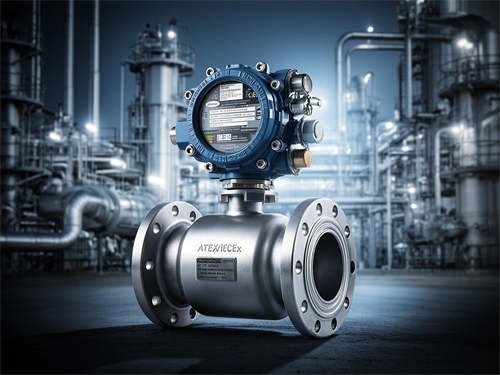
How to Choose the Right Gas Flow Meter for Your Application

This guide is for people who design, specify, distribute, or maintain gas measurement systems. It is meant to take the guesswork out of choosing a meter in complex industrial and utility settings.
1. Why the Right Gas Flow Meter Matters in Industrial Applications
A gas flow meter rarely fails on day one. The trouble shows up months later. A biogas plant’s CHP engine starts hunting because the meter can’t see low flows at night. A compressed air audit shows 12% “missing” air that nobody can find. A utility inspector flags a billing meter that was never approved for fiscal use.
Almost every one of these problems starts at the specification stage. Nobody built the meter badly. It was simply chosen for the wrong job.
Poor selection costs money in three ways:
- System inefficiency. An oversized meter sits at the bottom of its range, where accuracy falls apart. A high pressure drop meter makes the compressor or blower work harder every hour for years.
- Compliance risk. A meter without the right fiscal approval (NMI, MID, OIML, or AGA-based) can’t be used for billing. A meter without ATEX or IECEx certification can’t legally go into a Zone 1 area.
- Higher lifecycle cost. Recalibration trips, bearing replacements, unplanned shutdowns, and wasted energy often add up to two or three times the purchase price.
Each of our client groups feels a different pain. OEM skid builders need compact meters that integrate cleanly and don’t cause warranty callbacks. EPC contractors and system integrators need meters that commission on the first try and talk to the control system. Municipal operators need meters that run for years at unmanned stations.
The core message of this guide is simple: let the application drive the choice, not the price. The cheapest meter on the quote sheet is often the most expensive one on the balance sheet.
2. Understanding Your Application: The Foundation of Flow Meter Selection
You need to understand the process before you can compare meter technologies. Five variables do most of the work.
The five variables that decide 80% of the choice
| Variable | What to Ask | Why It Matters |
|---|---|---|
| Gas type | Natural gas, biogas, compressed air, N₂, O₂, H₂, CO₂, flare gas? | Some meters (thermal, ultrasonic) are sensitive to gas composition. Others (Coriolis, turbine) are much less so. |
| Operating pressure | Minimum, normal, maximum (bar g) | Gas density changes with pressure. Low-pressure gas is hard for vortex and Coriolis meters. |
| Temperature | Process and ambient range | This drives compensation needs, seal materials, and electronics ratings. |
| Flow range | Minimum, normal, maximum (Nm³/h or kg/h) | This sets the turndown you need. It’s the most commonly misjudged variable. |
| Pipe size | DN, schedule, material, available straight run | This decides between inline and insertion meters and sets the installation cost. |
Definition: Nm³/h (normal cubic meters per hour). This is gas volume corrected to a reference condition, usually 0 °C and 1.01325 bar. It lets you compare gas flows fairly even when line pressure changes. One cubic meter of air at 7 bar g holds roughly eight times more gas than one cubic meter at atmospheric pressure.
Challenges for skid builders and integrators
Retrofits and scale-ups cause the most selection errors. Here are three patterns we see again and again:
- Design flow vs. real flow. A skid might be designed for 1,000 Nm³/h but run at 250–400 Nm³/h for most of its life. A meter sized for design flow then spends its life at the weak bottom of its range.
- Copy-paste specifications. A meter that worked on a 6 bar natural gas skid gets reused on a 30 mbar biogas skid. Vortex shedding can become unstable at that low gas density.
- Compressed footprint. OEM skids often leave only 3–5 pipe diameters (D) of straight pipe. Many meters need 15–20D to hit their rated accuracy.
Process stability and environment
Ask how steady the process is. Pulsating flow downstream of reciprocating compressors or rotary lobe blowers can push turbine meters to over-read by several percent.
Then look at the environment. Is the site a classified hazardous area? Is the meter outdoors at −30 °C or in direct desert sun? Will it see condensate, dust, or vibration? These questions filter the options before accuracy even comes up.
Industry insight: Hydrogen blending into natural gas networks is moving from pilots toward practice in parts of Europe, the UK, and Australia. Operators who specify meters today for 15–20-year service should ask suppliers directly about hydrogen-blend performance. Thermal and ultrasonic meters may need gas-specific calibration or configuration when the blend changes.
3. Critical Selection Criteria: Accuracy, Repeatability, Pressure Drop, and Turndown Ratio
Accuracy vs. repeatability
Precisión is how close the reading is to the true flow. Repetibilidad is how closely the meter gives the same reading under the same conditions, again and again.
Here’s a simple example. Picture a dart player who always hits the same spot, two inches left of the bullseye. That player is highly repeatable but not accurate. Calibration moves the cluster onto the bullseye.
Both matter, but in different places:
- Transferencia de custodia (billing between buyer and seller) needs both, backed by a traceable calibration certificate. A 1% error on a line moving $2 million of gas a year is $20,000 going to the wrong party.
- Control de procesos (burner ratio, blending, PID loops) cares most about repeatability. A controller can work well with a small fixed bias. It can’t work with a reading that wanders.
Watch the fine print: “±1% of reading” and “±1% of full scale” are very different specs. At 10% of full flow, a ±1% FS meter can be off by ±10% of the actual reading.
Pressure drop and energy-efficient skid design
Permanent pressure loss is the pressure the gas never gets back after passing the meter. Your compressor or blower has to make it up.
Take a DN150 natural gas line at 4 bar g moving 5,000 Nm³/h. A 150 mbar permanent loss across an orifice plate needs about 6 kW of extra compression power. Over 8,000 operating hours at $0.075/kWh, that’s about $3,600 a year, every year. Full-bore ultrasonic meters and insertion thermal meters add almost no permanent loss.
Turndown ratio for variable loads
Turndown ratio is the maximum accurate flow divided by the minimum accurate flow. A 100:1 meter rated at 1,000 Nm³/h stays accurate down to 10 Nm³/h. A 4:1 meter loses accuracy below 250 Nm³/h.
High turndown matters most for biogas plants (digester output swings with feedstock and season), burner control (low-fire vs. high-fire), and compressed air networks (night and weekend leak loads vs. full production).
Indicative values for standard industrial models. Actual turndown depends on size, pressure, gas density, and the manufacturer.
Guidance for MRO teams
Maintenance and repair (MRO) teams should ask three questions before the purchase order goes out:
- Does it have moving parts? Bearings and rotors wear. No-moving-parts designs (thermal, vortex, ultrasonic, Coriolis, orifice) usually go longer between service visits.
- Can it be verified without removal? Onboard diagnostics or zero-point checks save a shutdown and a trip to the calibration lab.
- What does drift look like? Ask the supplier for field data on calibration shift after 12 and 24 months, not just the day-one accuracy.
4. Comparative Analysis of 10 Gas Flow Meter Technologies
4.1 Differential Pressure (Orifice Plate)

An orifice plate is a thin plate with a precise hole, clamped between flanges. The gas speeds up through the hole and creates a pressure difference (DP). A DP transmitter reads that difference, and a flow computer converts it to flow.
- Pros: Universally accepted and standardized (ISO 5167, AGA Report No. 3). No calibration rig is needed because flow is calculated from geometry. Low hardware cost.
- Cons: Low turndown (about 3–4:1 per transmitter). High permanent pressure loss. Needs long straight runs. Accuracy degrades when the plate edge wears or gets dirty.
- Ideal use: Large-bore natural gas where the standard is written into contracts, and high-temperature or high-pressure gas.
- OEM fit: Moderate. It needs a plate, a transmitter, impulse lines, and often a flow computer, which means more parts to integrate.
- Maintenance: Inspect the plate yearly for edge wear, check impulse lines for blockage or leaks, and verify transmitter zero.
4.2 Thermal Mass Flow Meters
A thermal mass flow meter measures how much heat the moving gas carries away from a heated sensor. More gas molecules passing by means more cooling. So the meter reads mass flow directly, with no separate pressure or temperature compensation.
- Pros: Wide turndown (100:1 is common). Very low pressure drop. Excellent low-flow sensitivity. Insertion versions fit large pipes at low cost.
- Cons: Calibrated for a specific gas mixture, so composition changes shift the reading. Liquid droplets on the sensor cause false spikes.
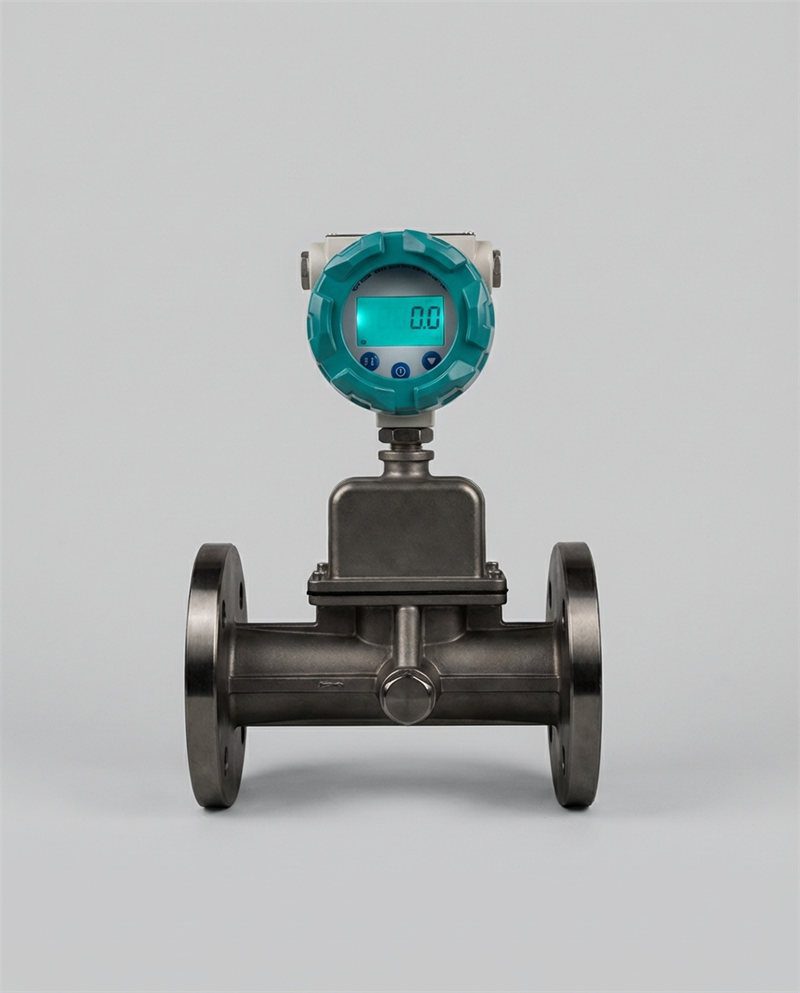
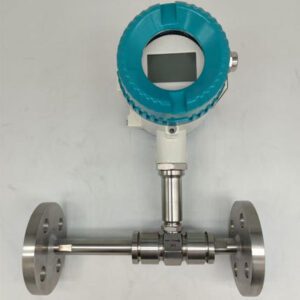
- Ideal use: Compressed air audits, biogas, digester gas, flare gas, and burner combustion air. Our thermal gas mass flow meter is often specified for these applications.
- OEM fit: Excellent. It’s compact, one device does it all, and it offers 4–20 mA, pulse, and Modbus outputs.
- Maintenance: Clean the sensor periodically in dirty gas. Re-check gas calibration if the process gas changes.
4.3 Ultrasonic Flow Meters (Transit-Time)

Transit-time meters send sound pulses across the pipe, with the flow and against it. A pulse traveling with the flow arrives slightly sooner. The time difference gives the gas velocity.
- Pros: No moving parts and essentially zero pressure loss in full-bore designs. Wide turndown. Rich diagnostics such as speed of sound, gain, and path-by-path velocity. Multipath meters are the benchmark for large custody transfer.
- Cons: High upfront cost for multipath inline meters. Sensitive to pulsation noise from pressure-reducing valves. Low-pressure gas weakens the acoustic signal.
- Ideal use: Transmission and distribution custody transfer, large-bore process gas, and bidirectional storage lines. The AGA Report No. 9 overview from ASGMT explains the performance requirements for fiscal use.
- OEM fit: Good for larger skids. It has digital outputs and needs a little more commissioning expertise.
- Maintenance: Low. Trend the diagnostics and verify speed of sound against a gas composition calculation.
4.4 Vortex Shedding Flow Meters

A bluff body in the pipe sheds swirling eddies, first on one side and then the other. This is the Kármán vortex street effect. The shedding frequency rises in step with velocity.
- Pros: No moving parts, handles steam and gas, and is robust at high temperatures. Built-in temperature and pressure compensation makes it a practical one-box solution.
- Cons: Needs a minimum velocity, so it goes blind at very low flow. Sensitive to pipe vibration. Needs 15–30D of upstream straight run.
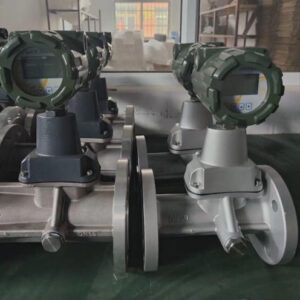
- Ideal use: Plant utilities, steam, compressed air mains, and nitrogen headers. See our vortex flow meter with integrated T/P compensation.
- OEM fit: Good. It comes in standard flanged or wafer sizes.
- Maintenance: Low. Check the sensor for fouling and review vibration if readings get noisy at low flow.
4.5 Turbine Flow Meters
A bladed rotor spins in the gas stream at a speed proportional to velocity.
- Pros: High accuracy on clean, steady gas. Proven for fiscal use under AGA Report No. 7. Fast response and a moderate price.
- Cons: Bearings wear. Over-reads in pulsating flow. Damaged by debris and liquid slugs. Needs upstream filtration.
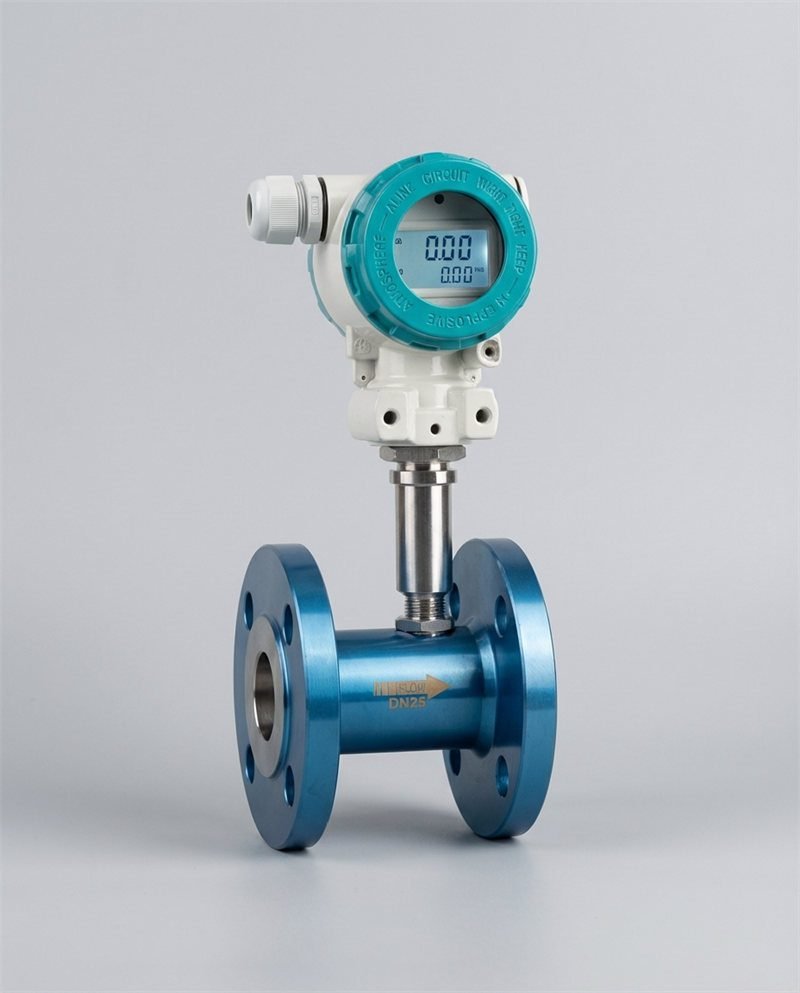
- Ideal use: Clean natural gas distribution and industrial metering. Our gas and steam turbine flow meter line covers these duties.
- OEM fit: Good. It gives a standard pulse output.
- Maintenance: Moderate. Lubricate bearings (on some models), check the rotor, and recalibrate every 1–3 years.
4.6 Coriolis Mass Flow Meters

Gas flows through vibrating tubes. The mass flow creates a tiny twist in the tubes, and sensors measure it. Coriolis is the only common technology that measures mass directly, whatever the gas composition.
- Pros: Very high accuracy (±0.35–0.5% for gas on many models). Unaffected by composition changes. No straight run needed.
- Cons: Expensive. Heavy in larger sizes. Practical size limits (usually DN150 and below for gas). Noticeable pressure drop at low line pressure.
- Ideal use: CNG and hydrogen dispensers, specialty gas blending, and high-value gas where composition varies.
- OEM fit: Excellent for compact dispensing skids.
- Maintenance: Low. Verify zero in the field and use the tube health diagnostics.
4.7 Diaphragm Meters (Low-Flow Utility Use)

Flexible diaphragms fill and empty measuring chambers of known volume. Every cycle counts a fixed amount of gas.
- Pros: Very wide turndown (a G4 meter covers roughly 0.04–6 m³/h, or 150:1). Needs no power. Very low cost per point. Accepted for billing almost everywhere.
- Cons: Low pressure only (usually below 0.5 bar). Bulky for the flow they handle. Not suitable for process control.
- Ideal use: Residential, small commercial, and light industrial billing.
- OEM fit: Limited. Pulse or smart-module add-ons are available.
- Maintenance: Nearly none. Utilities replace or sample-test by population.
4.8 Rotary Meters
Two figure-eight lobes rotate and trap fixed volumes of gas. This is positive displacement at higher pressures and flows than diaphragm meters.
- Pros: High accuracy and wide turndown. No straight-run requirement. Compact for commercial and industrial billing.
- Cons: Can stall and block flow if debris jams the lobes. Needs filtration and correct lubrication. Slight noise and pulsation.
- Ideal use: Commercial and industrial gas billing from about 16 to 1,000 m³/h.
- OEM fit: Moderate. It’s heavy but has a small footprint.
- Maintenance: Change the oil, check differential pressure across the meter (a rising DP warns of wear), and keep the filter clean.
4.9 Variable Area (Rotameter)

A float rises in a tapered tube until the gas flow balances its weight. You read the flow from a scale.
- Pros: Very cheap. Needs no power. Instant visual indication. Metal-tube versions add a 4–20 mA output.
- Cons: Low accuracy (±2–5% of full scale). Must be mounted vertically. Calibrated for one gas at one pressure.
- Ideal use: Purge gas, analyzer sample lines, and local indication on OEM machines.
- OEM fit: Excellent for simple indication.
- Maintenance: Clean the tube and float, and check for sticking.
4.10 Pitot Tube Meters
A pitot tube, or its multi-port averaging version, senses the difference between impact pressure and static pressure across the pipe.
- Pros: Low permanent pressure loss. Hot-tap insertion without shutdown. Cheap in very large ducts.
- Cons: Low turndown. Weak signal at low velocity. Ports plug in dirty gas.
- Ideal use: Large air ducts, combustion air, and stack flow.
- OEM fit: Good for large ductwork.
- Maintenance: Purge ports on dirty service and check transmitter zero.
Side-by-side summary
| Technology | Typical Accuracy (Gas) | Turndown | Pressure Loss | Moving Parts | Relative Cost | Best Fit |
|---|---|---|---|---|---|---|
| Placa de orificio | ±0.6–2% of rate | 3–4:1 | Alta | No | Low (element) | Standardized large-bore NG |
| Thermal mass | ±1–1.5% of reading | 100:1 | Very low | No | Low–Medium | Compressed air, biogas, flare |
| Ultrasonic (multipath) | ±0.1–0.5% (calibrated) | 50–100:1 | Ninguno | No | Alta | Custody transfer, large pipes |
| Vortex | ±1% of reading | 20–30:1 | Medium | No | Medium | Utilities, steam, air mains |
| Turbina | ±0.5–1% | 10–30:1 | Medium | Yes | Medium | Clean NG distribution |
| Coriolis | ±0.35–0.5% | 20–100:1 | Medium–High | No | Very high | CNG, H₂, specialty gas |
| Diaphragm | Class 1.5 | 150:1 | Bajo | Yes | Very low | Residential billing |
| Rotary | ±0.5–1% | 30–160:1 | Bajo | Yes | Medium | Commercial billing |
| Rotameter | ±2–5% FS | 10:1 | Bajo | Float | Very low | Purge, local indication |
| Pitot/averaging pitot | ±1–2% | 3–10:1 | Very low | No | Bajo | Large ducts |
Figures are indicative. Always confirm against the datasheet for the model and size you’re considering.
5. Technology Match: Aligning Meter Types with Industry-Specific Needs
OEM equipment and skid-mount manufacturers
OEMs care about three things: space, integration, and a low warranty-return rate. A compact all-in-one meter with built-in compensation removes a flow computer from the bill of materials. Calibration flexibility also matters. One mechanical design that can be factory-configured for air, N₂, or natural gas simplifies your inventory.
Common match: Thermal mass meters for burner and air skids, vortex meters for utility skids, and Coriolis meters for dispensing.
A burner OEM we work with standardized on one insertion thermal model across three skid sizes. They cut their meter part numbers from nine to three and removed separate P/T transmitters from every skid.
EPC contractors and system integrators
For EPC and integration teams, the hidden cost is commissioning hours. Look for these:
- A native HART protocol over 4–20 mA for asset management systems
- Modbus RTU/TCP register maps delivered with the documentation, based on the open Modbus specification
- DD/DTM files ready before site acceptance testing
- Clear straight-run and orientation drawings for the piping designers
Common match: Vortex meters for plant utilities, ultrasonic meters for large headers, and orifice plates where the client standard demands them.
Municipal utilities
Unmanned stations need meters that survive without supervision. Look for weather-rated enclosures, battery or low-power options, and legal-metrology approval. Examples include NMI (Australia), MID (Europe), or pattern approval based on OIML recommendations such as R 137.
Common match: Diaphragm and rotary meters for billing, ultrasonic meters for district metering, and thermal meters for digester gas at wastewater plants.
Industrial terminals and MRO companies
For terminals and MRO teams, uptime is everything. Ask for spare part lead times, published MTBF figures, and diagnostics that separate “the meter is failing” from “the process changed.”
Definition: MTBF (Mean Time Between Failures). This is the average operating time between failures. An MTBF of 100,000 hours means that, across a large population of meters, failures average about once every 11 years per device.
Common match: No-moving-parts technologies that report their own health.
Instrument importers and distributors
Distributors sell trust along with hardware. Your supplier needs to back you up with multi-region certificates (ATEX, IECEx, and local approvals), English and local-language manuals, application support, and training. The gas flow meter selection guide written for distributors from Jade Ant Instruments covers the needs-assessment questions to ask before quoting.
6. Installation, Calibration, and Environmental Considerations
The most common installation mistakes
- Too little straight run. A meter installed 3D after a double elbow reads a swirled, distorted profile. Errors of 2–5% are common with vortex, turbine, and single-path ultrasonic meters.
- Wrong orientation. Rotameters must be vertical. Some vortex meters need the transmitter head positioned so condensate doesn’t collect at the sensor in wet gas.
- Temperature and pressure compensation gaps. A volumetric meter reading actual m³/h without P/T correction can be 20–30% off the standard-volume figure the accounting team expects.
- Poor grounding and cable routing. VFD noise can put phantom pulses on turbine and vortex signals.
Typical straight-run requirements
| Technology | Upstream | Downstream | Notas |
|---|---|---|---|
| Placa de orificio | 20–40D | 5–8D | Flow conditioner can reduce this |
| Vortex | 15–30D | 5D | 30D after two elbows in different planes |
| Turbina | 10–20D | 5D | Add filtration upstream |
| Thermal (insertion) | 15–20D | 5D | Profile-sensitive at a single point |
| Ultrasonic (multipath) | 10–20D | 3–5D | Fewer paths need more straight run |
| Coriolis | 0D | 0D | Mount stress-free |
| Rotary / diaphragm | 0D | 0D | Filter upstream |
D = pipe inside diameter. For a DN100 line, 20D is about 2 meters.
Best practices for low noise and long-term accuracy
- Use shielded twisted-pair cable, ground it at one end only, and keep it separate from VFD power cables.
- Install pulsation dampers or move the meter away from reciprocating compressors.
- Put the meter downstream of pressure-reducing valves only if there’s enough distance. Valve noise can swamp ultrasonic signals.
- Record an “as-found” baseline of diagnostics at commissioning so later drift is easy to spot.
Hazardous area certifications
In oil and gas plants, chemical sites, and biogas facilities, the electrical certification matters as much as the accuracy.
- ATEX: The EU framework for equipment in explosive atmospheres. The ATEX directive defines equipment categories that line up with zones.
- IECEx: The international scheme, accepted in many countries outside the EU. You can check certificates on the IECEx certification portal.
- FM / CSA / UL: Required for North American Class/Division areas.
Definition: Zone 1. This is an area where an explosive gas atmosphere is likely during normal operation. Zone 1 meters typically carry an Ex d (flameproof) or Ex ia/ib (intrinsically safe) rating, such as Ex d IIC T6 Gb.
For more detail on acoustic meters in dangerous services, see our article on ultrasonic meters for hazardous fluid monitoring.
7. Lifecycle Cost Analysis: Beyond the Initial Purchase Price
The Total Cost of Ownership (TCO) model
TCO = Purchase + Installation + Calibration + Maintenance + Energy Loss + Downtime + End-of-Life Replacement
For most industrial gas meters, the purchase price is only 25–40% of the 10-year cost.
This is an indicative split for a mid-size mechanical meter in general industrial service. Your mix will vary with duty and location.
Case example: ultrasonic vs. orifice in a natural gas distribution skid
Scenario: A DN150 natural gas distribution skid runs at 4 bar g, carries an average flow of 5,000 Nm³/h, and operates 8,000 hours a year.
| Cost Item (5 Years) | Orifice Plate System | Inline 2-Path Ultrasonic |
|---|---|---|
| Purchase + installation (plate, meter tube, DP transmitter, flow computer vs. meter + electronics) | $9,500 | $22,000 |
| Maintenance (plate inspection, impulse lines, transmitter checks) | $9,000 | $2,000 |
| Energy loss (150 mbar permanent loss, ~48,000 kWh/yr at $0.075) | $18,000 | ~$0 |
| Downtime (2 plate change-outs with bypass operation) | $4,000 | $0 |
| Field verification (diagnostic review) | $0 | $1,500 |
| 5-year total | $40,500 | $25,500 |
The ultrasonic meter costs $12,500 more upfront but saves about $15,000 over five years. That leaves out a bigger lever: measurement uncertainty. This line moves about 40 million Nm³ a year. If better turndown and diagnostics cut the unaccounted-for gas by just 0.2%, that’s another 80,000 Nm³ a year recovered.
ROI justification for continuous processes
A higher-cost meter usually pays back when three conditions are true:
- The process runs more than 6,000 hours a year.
- The gas is valuable, or the meter feeds billing or emissions reporting.
- A shutdown to service the meter is expensive or hard to schedule.
Simple payback = extra upfront cost ÷ annual savings. In the example above, $12,500 ÷ about $3,000 a year gives a payback of roughly 4 years, based on operating savings alone. Many of our EPC clients use a 3-year payback as the approval threshold for continuous-duty plants.
8. Smart Features and Digital Integration for Industry 4.0 Readiness
Digital diagnostics and predictive maintenance
Modern meters can report on their own condition. Examples include signal gain on ultrasonic paths, sensor resistance drift on thermal probes, and shedding signal quality on vortex meters.
Definition: Predictive maintenance. This means servicing equipment based on its measured condition rather than a fixed calendar. Instead of pulling a meter every 12 months “just in case,” you pull it when a diagnostic trend says it’s needed.
A water utility customer that monitors digester gas at three treatment plants moved from annual meter removals to trend-based checks. That cut site visits per meter from four a year to one, and they caught a wet-sensor problem weeks before it would have affected CHP fuel reporting.
IIoT compatibility
Definition: IIoT (Industrial Internet of Things). These are field devices that share data over networks with cloud or edge platforms for analytics.
For system integrators and utility SCADA teams, check for these features:
- Modbus TCP or Ethernet-based protocols on the device, or via a gateway
- Data logging with timestamps, so records survive communication outages
- Wireless options (4G, NB-IoT, LoRaWAN) for remote stations with no cabling budget
- Cybersecurity basics: password-protected configuration and write protection
Future-proofing
Specify meters that allow field firmware updates, multiple output options on one device (4–20 mA plus pulse plus Modbus), and gas-table updates for future blends such as hydrogen in natural gas. A meter that can’t be reconfigured tends to become a stranded asset when the process changes.
Industry insight: Emissions reporting rules for methane and CO₂ keep tightening in many regions. Flare gas and vent gas meters that once served as rough indicators increasingly need defensible accuracy, audit trails, and traceable calibration. That shift favors meters with self-diagnostics and logged data.
9. 10-Point Evaluation Checklist for Buyers
Use this checklist before any request for quotation (RFQ) goes out. It works for OEMs, EPCs, distributors, MRO teams, and utilities alike.
- Define gas type and composition. Include moisture, H₂S, particulates, and how much the composition varies.
- Confirm operating pressure and temperature range. Give minimum, normal, and maximum values, not just the design values.
- Determine minimum and maximum flow rates. Use logged data where possible, and include night and startup flows.
- Set required accuracy and repeatability. Say whether the meter is for billing, reporting, or control.
- Check pipe size and installation constraints. Note the available straight run, orientation, and access for removal.
- List output signal and communication needs. For example: 4–20 mA, pulse, HART, Modbus RTU/TCP, or wireless.
- List required approvals. For example: ATEX, IECEx, SIL, NMI, MID, OIML, or AGA-based requirements.
- Plan maintenance access and the recalibration interval. Decide on in-situ verification vs. lab calibration.
- Confirm power availability. Loop-powered, 24 VDC, AC, or battery for remote sites.
- Compare lifecycle cost with budget constraints. Put the 5- or 10-year TCO beside the purchase price.
| Checklist Item | Your Value | Notes / Source |
|---|---|---|
| Gas type & composition | ||
| Pressure range (bar g) | ||
| Temperature range (°C) | ||
| Flow range (Nm³/h or kg/h) | ||
| Accuracy / repeatability | ||
| Pipe size & straight run | ||
| Output & protocol | ||
| Approvals | ||
| Maintenance & calibration | ||
| Power | ||
| Budget / TCO target |
Tip: Copy this table into Excel and send it with your RFQ. A complete sheet usually cuts quote turnaround in half and avoids “assumed” values that cause mismatches later.
If you want a second opinion on a completed sheet, the application engineers at Jade Ant Instruments can review it and point out risks before you commit. Send your application data to our engineering team.
Watch: A practical flow meter selection walkthrough
https://www.youtube.com/watch?v=zQOlIZE49O0
This video walks through liquid, gas, steam, and mass flow selection logic. It’s a good primer to share with purchasing or project teams before a technical review.
Glosario de términos clave
| Term | Plain-English Meaning | Quick Example |
|---|---|---|
| Transferencia de custodia | Measurement that decides a payment between two parties | Gas utility billing a factory |
| Turndown ratio | Max accurate flow ÷ min accurate flow | 100:1 means 1,000 down to 10 Nm³/h |
| Repetibilidad | Same reading under the same conditions | ±0.2% repeatability for a burner loop |
| Permanent pressure loss | Pressure the gas never recovers after the meter | 150 mbar across an orifice |
| Straight run | Clear straight pipe before and after the meter | 20D = 2 m on DN100 |
| Nm³/h | Gas volume at reference conditions | Lets you compare 2 bar and 8 bar flows |
| Compensation | Correcting volume for pressure and temperature | Vortex with built-in P/T sensors |
| Insertion meter | Probe inserted through a fitting into a large pipe | Thermal probe in a DN600 air duct |
| Ex d / Ex ia | Flameproof / intrinsically safe protection types | Zone 1 meter labeled Ex d IIC T6 |
| AGA 3 / 7 / 10 | Orifice / turbine / speed-of-sound standards | AGA 10 checks ultrasonic diagnostics |
10. FAQs: Expert Answers to Real-World Buyer Concerns
1. What is the most accurate gas flow meter for custody transfer applications?
For large pipelines, flow-calibrated multipath ultrasonic meters are the current benchmark, with uncertainty around ±0.1–0.3% after calibration. For smaller, high-value flows with changing composition, Coriolis meters give about ±0.35–0.5% mass accuracy. Turbine and rotary meters are still widely approved for mid-size billing. The “right” answer also depends on which standard your contract or regulator names. Our overview of custody transfer compliance and ROI for natural gas goes deeper.
2. Can thermal mass flow meters measure wet or dirty gases?
With limits. Dust and dry particulates are manageable with periodic sensor cleaning. Liquid droplets are the real problem, because water hitting the heated sensor causes sudden cooling and false high readings. For saturated biogas, use a condensate trap and moisture knockout upstream, plus a sensor designed for wet gas service. Our article on thermal meters in biogas and renewable energy digesters covers practical setups.
3. How does gas composition affect flow measurement accuracy?
It depends on the principle. Thermal meters depend on the gas’s heat properties, so a methane swing from 55% to 65% in biogas can shift the reading by several percent unless the meter is compensated. Ultrasonic meters rely on the speed of sound. Orifice and vortex meters need correct density. Coriolis meters measure mass directly and are least affected. Always give suppliers a realistic composition range, not a single value.
4. What are the advantages of ultrasonic over turbine meters in high-flow applications?
Ultrasonic meters have no moving parts to wear, no pressure loss, wider turndown, and diagnostics that show whether the meter is healthy without removing it. In large pipes (DN200 and above), they also avoid the damage a turbine rotor can suffer from debris or overspeed. Turbines still win on upfront cost in mid sizes and on tolerance to some valve noise.
5. When should I choose Coriolis over thermal for mass flow measurement?
Choose Coriolis when the gas composition varies, when you need the highest accuracy, or when the gas is at high pressure, as with CNG and hydrogen dispensing. Choose thermal when the pipe is large, the pressure is low, the pressure drop must be minimal, or the budget matters. Thermal is also far more practical above DN100. For a deeper look at thermal control options, see thermal mass flow controllers compared with conventional meters.
6. How do I compensate for pressure and temperature variations in my readings?
Either use a meter with built-in P/T compensation (common on vortex and turbine meters) or add pressure and temperature transmitters feeding a flow computer. Mass-based meters like thermal and Coriolis don’t need this step for mass output. For natural gas fiscal work, the flow computer also applies a compressibility calculation such as AGA 8.
7. Are there flow meters that don’t require straight pipe runs?
Yes. Coriolis, rotary, and diaphragm meters need essentially no straight run. Multipath ultrasonic meters and flow conditioners can greatly shorten the requirement for other types. This is often the deciding factor on tight OEM skids.
8. What maintenance is required for vortex shedding meters in industrial settings?
Very little. Inspect the bluff body and sensor for fouling or erosion every 1–3 years, check the process connection gaskets, and review signal quality if low-flow readings get unstable, which usually points to vibration. Our complete vortex meter guide for steam and gas includes a troubleshooting section.
9. Can I integrate a flow meter with my existing PLC/SCADA system?
Almost always. The 4–20 mA and pulse outputs work with any PLC. HART adds diagnostics over the same wires. Modbus RTU/TCP lets you read totals, alarms, and diagnostics directly. Ask the supplier for the register map before purchase so your integrator can prepare the tags ahead of time.
10. How do I verify the calibration of a gas flow meter in the field?
The options include comparing against a reference meter installed in series, using the meter’s built-in verification (zero checks, sensor resistance, speed of sound compared with calculated values), or sending the meter to an accredited lab. For fiscal meters, follow the interval set by your regulator or contract. For process meters, trend the diagnostics and verify when drift appears.
11. What is the typical lifespan of a diaphragm gas meter in municipal applications?
Diaphragm meters typically serve 15–25 years. Many utilities replace or sample-test them by population based on local legal-metrology rules. Service life shortens when the gas is dirty or wet.
12. Are there explosion-proof flow meters suitable for Zone 1 environments?
Yes. Look for ATEX or IECEx marking with equipment protection level Gb or better, such as Ex d IIC T6 Gb or Ex ia IIC T4 Ga. Make sure the gas group (IIA, IIB, IIC) and temperature class match your area classification. Hydrogen needs IIC.
13. How does turndown ratio impact performance in variable-load processes?
If your flow drops below the meter’s minimum, readings become inaccurate or drop to zero. In a burner or digester, that means poor fuel-to-air ratio control and missing gas totals. Size the meter so normal operation sits at 30–70% of its range, and check that the lowest real flow stays above the meter’s minimum.
14. What are the key differences between AGA 3, AGA 7, and AGA 10 standards?
AGA Report No. 3 covers orifice meters: plate design, meter tubes, and flow calculation. AGA Report No. 7 covers turbine meters for natural gas. AGA Report No. 10 isn’t a meter standard at all. It calculates the speed of sound in natural gas from its composition, and it’s widely used to cross-check ultrasonic meter diagnostics. AGA 9 is the ultrasonic meter standard.
15. Can a single flow meter handle both high and low flow rates in biogas recovery systems?
Often yes, if you choose a high-turndown technology. Thermal mass meters with 100:1 or wider turndown are the common choice for digester and landfill gas. When the range is extreme, for example during startup and flaring, some plants install two meters in parallel with automatic switchover. For more selection logic, read our breakdown of 2026 thermal air meter types.
Final Takeaway
Choosing the right gas meter doesn’t mean finding the “best” technology. It means matching a measurement principle to a real process: its gas, its pressure, its flow swings, its installation limits, and its compliance rules. Start with the checklist, run the TCO numbers, and involve your supplier’s engineers early.
For more technical articles, browse the Jade Ant Instruments flow measurement blog. Or start at the Jade Ant Instruments flow meter manufacturer homepage to see the full gas and steam measurement range.