SIP Flow Meters: How They Work, Where They Fit, and the Costly Problems They Prevent

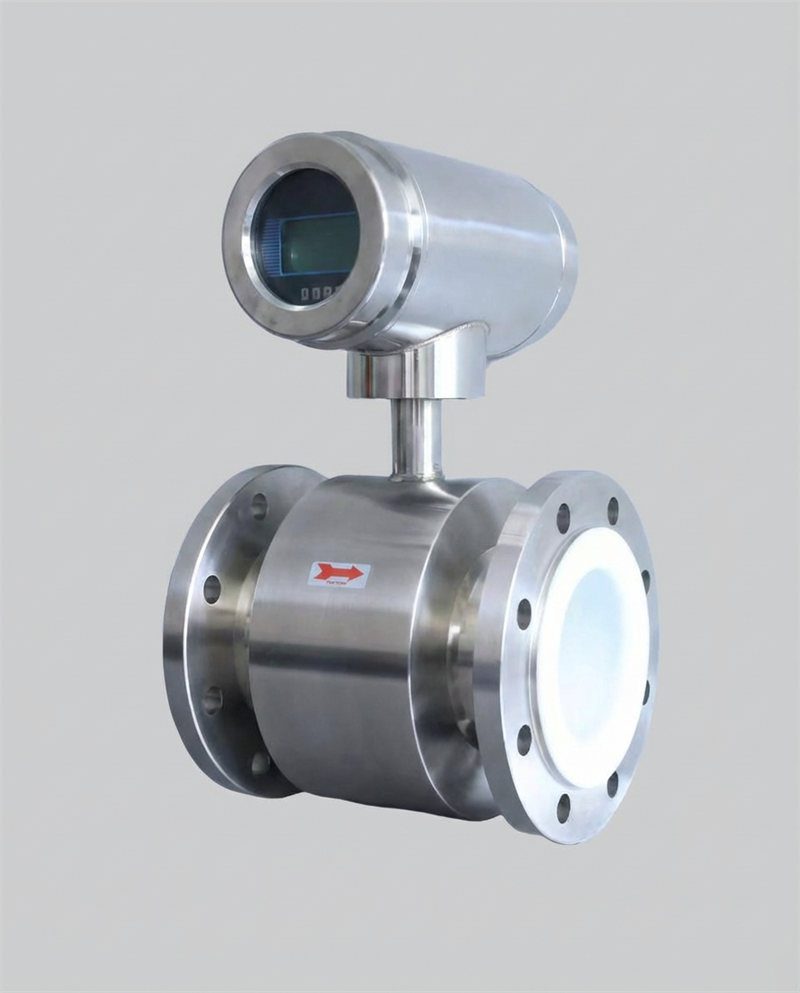
Image: KROHNE OPTIFLUX 2000 electromagnetic flow meter, via Wikimedia Commons
Thesis Statement
SIP flow meters help businesses in many industries run tighter processes, avoid costly errors, and stay compliant with regulations.
Picture a dairy line that runs 20,000 liters of milk an hour. If the meter at the pasteurizer outlet reads 1% high, the plant gives away about 200 liters an hour without knowing it. Over two shifts a day, that adds up to more than a tanker of product every month. When margins depend on precision and efficiency, you need to understand the tools that measure them.
A SIP flow meter measures liquid flow in processes that need very high cleanliness. Most of the industry expands “SIP” as Sterilize-In-Place, and some suppliers write it as Sanitary In-Place. Both mean the same thing: the meter stays in the pipeline while hot steam or hot water sterilizes the whole system, and nobody has to take it apart. You’ll find these meters in food and beverage plants, pharmaceutical facilities, and biotech labs.
Quick definition (for featured snippets): A SIP flow meter is a hygienic flow instrument built to survive repeated in-line sterilization, usually saturated steam at 121–140 °C, without losing accuracy, trapping product, or harboring bacteria.
This guide covers how SIP flow meters work, where they sit in a process workflow, and which expensive problems they help you avoid. It’s written for OEM skid builders, instrument distributors, EPC contractors, MRO teams, and utility engineers who have to specify, sell, or maintain these meters.
Key Terms at a Glance
Several technical terms come up often in this article. Each one is defined here so you can refer back to it.
| Term | Plain-English Meaning | Real Example |
|---|---|---|
| CIP (Clean-In-Place) | Cleaning pipes and equipment with chemical washes, no disassembly | 1.5% caustic soda at 80 °C circulated for 20 minutes |
| SIP (Sterilize-In-Place) | Killing microbes in place, usually with steam | Saturated steam at 121 °C held for 30 minutes |
| Wetted parts | Any meter surface that touches the product | Liner, electrodes, measuring tube |
| Ra (surface roughness) | How smooth a surface is, in micrometers (µm). Lower is smoother | Ra ≤ 0.8 µm for dairy, often ≤ 0.5 µm for pharma |
| Dead leg | A pipe pocket where liquid sits still and bacteria can grow | A tee branch that’s rarely flushed |
| Tri-clamp | A quick-release sanitary fitting held by a hinged clamp | 1.5″ tri-clamp on a juice line |
| Turndown ratio | Highest accurate flow ÷ lowest accurate flow | 100:1 means 0.1 to 10 m/s |
| Thermal shock | Sudden temperature swing that stresses materials | 135 °C steam followed by a 20 °C cold rinse |
| Conductivity | How well a liquid carries electricity (µS/cm) | Milk ≈ 5,000 µS/cm; WFI ≈ 1 µS/cm |
| WFI (Water for Injection) | Ultra-pure water used to make injectable drugs | Loop water in a vaccine plant |
Definition and Function of SIP Flow Meter
A SIP flow meter is a specialized instrument that measures liquid flow accurately while meeting hygiene standards.
A standard flow meter only has to measure. A SIP-rated meter also has to survive the cleaning program, sometimes several times a day, for ten years or more. That second requirement is what shapes how the meter is built.
How SIP Flow Meters Are Built
Most SIP flow meters use one of two measuring principles.
Electromagnetic (mag) meters work on Faraday’s law. A conductive liquid moving through a magnetic field creates a small voltage, and that voltage rises with flow speed. Electrodes in the tube wall read it. The tube has no moving parts and nothing blocking the flow. If you want the physics in more depth, see the magnetic flow meter overview on Wikipedia.

Image: Electromagnetic flowmeter operating principle, by Pedro.orsi, CC BY-SA 3.0, via Wikimedia Commons
Coriolis meters vibrate one or two tubes. When liquid flows through, the tubes twist slightly, and the size of that twist tells the meter the mass flow. The same meter also reports density and temperature.
Whichever principle is used, the design details are what make a meter SIP-ready:
| Design Feature | Why It Matters During SIP | What to Ask Your Supplier |
|---|---|---|
| 316L stainless steel body, electropolished | Resists steam corrosion and caustic attack | Is Ra certified, and at what value? |
| PFA liner (mag meters) | Handles 150 °C+ and resists steam permeation | Is the liner vacuum-rated? |
| Full-bore, crevice-free tube | No place for product or bacteria to hide | Is it self-draining when mounted vertically? |
| FDA-compliant seals (EPDM, FKM) | Seals are usually the first part to fail | What is the rated temperature cycle life? |
| Remote-mount transmitter option | Keeps electronics away from heat | What is the maximum cable length? |
| Tri-clamp or DIN 11851 ends | Fast removal for calibration, no threads | Which sanitary standards does it meet? |
Industry Insight: The Vacuum Problem Nobody Mentions in the Datasheet
At the end of a steam cycle, the steam condenses back into water. Water takes up far less space than steam, so a closed line can pull into a partial vacuum within seconds. A PTFE liner that isn’t locked into the meter body can bulge or collapse under that vacuum.
Experienced skid builders catch this at the specification stage. They ask for a PFA liner with a stainless mesh reinforcement, or one that is mechanically anchored in the body. It’s also a common reason a lower-cost meter looks fine at the factory acceptance test and then fails in the field after about six months of SIP cycles.
Why Accurate Measurement Pays Off
Accurate flow measurement tightens the whole process:
- ✅ Batch dosing: A syrup line dosing ±0.5% instead of ±2% cuts sugar overuse by several tonnes a year in a mid-sized bottling plant.
- ✅ Yield tracking: When the inlet and outlet meters agree, losses show up quickly and can be traced to a leaking valve or a bad product-water interface.
- ✅ Less waste: Accurate flow totals let operators cut over from product to rinse water at the right moment, not “a bit later to be safe.”
For a detailed breakdown of how mag meters perform across sectors, including hygienic lines, see our guide to top magnetic flow meter applications.
Integration into Process Workflows
SIP flow meters are placed at key points in production and utility workflows to improve monitoring and control.
Where the meter goes matters as much as which meter you buy. In a typical hygienic plant, four places account for most installations.

Image: KROHNE OPTIMASS 7000 Coriolis mass flow meter, via Wikimedia Commons
Typical Installation Points
| Workflow Point | What the Meter Does | Typical Technology | Typical Buyer |
|---|---|---|---|
| Receiving / unloading | Counts incoming raw milk, juice, or API solution | Sanitary mag or Coriolis | End user, MRO team |
| Transfer between tanks | Confirms how much moved from tank A to tank B | Sanitary mag | EPC / system integrator |
| In-line with process equipment | Controls feed to pasteurizers, fillers, bioreactors | Coriolis for mass, mag for volume | OEM skid manufacturer |
| CIP/SIP supply and return | Verifies cleaning flow velocity (often ≥ 1.5 m/s) | Sanitary mag | OEM, end user |
| Utility loops (PW/WFI) | Monitors purified water distribution | Coriolis or ultrasonic | Pharma EPC, utility engineer |
Industry Insight: Don’t Use a Mag Meter on WFI
Here’s a mistake distributors see on quotes all the time. A standard mag meter needs a liquid conductivity of at least 5 µS/cm, and some high-sensitivity models go down to about 1 µS/cm. Pharma-grade WFI and purified water usually sit at or below 1.3 µS/cm. So a mag meter that works fine on the CIP return may give unstable or zero readings on the WFI loop right beside it.
For those ultra-pure loops, specify Coriolis or clamp-on ultrasonic meters instead. Our write-up on Coriolis flow meter pros and cons explains when the higher price of a Coriolis meter is worth paying.
Real-Time Data, Better Decisions
Once a meter sits at the right point and connects to the PLC or SCADA (Supervisory Control and Data Acquisition) system, the data starts paying back:
- Informed decisions: Operators see live flow, totals, and temperature, so a slow transfer shows up at minute 3 instead of minute 30.
- Timely maintenance: Modern transmitters flag electrode coating, empty pipe, or drift before the product is affected.
- CIP verification: The meter confirms the cleaning solution actually reached the target velocity. Many auditors now ask for that record.
- Smoother handovers: HART, Modbus RS-485, or 4–20 mA outputs let an EPC contractor plug the meter into an existing DCS without custom drivers.
For OEM skid builders, the practical issue is space. Sanitary skids are compact, so a meter with short straight-run requirements and a rotatable display saves real frame length. Jade Ant Instruments supplies tri-clamp sanitary electromagnetic flow meters with configurable outputs, which helps skid builders standardize one meter platform across several machine models rather than redesigning the wiring for each one.
Prevention of Common Problems
SIP flow meters head off several problems that hygienic plants run into again and again.
Most flow-related losses in hygienic plants come from a handful of recurring causes. The chart below shows how those losses usually break down, based on common patterns seen in food and pharma plant audits. The percentages are illustrative, not survey data.
Problem 1: Inaccurate Flow Measurement
The trouble with a wrong reading is that it looks normal on the screen. Common causes in hygienic lines include:
- ⚠️ Thermal drift: Meters not designed for SIP can shift calibration after repeated heating to 130 °C and cooling back down.
- ⚠️ Mechanical wear: Turbine or gear meters have bearings. Steam and caustic wear them out, and the reading slowly creeps.
- ⚠️ Entrained air: Air bubbles after a tank changeover distort readings in both mag and Coriolis meters.
A properly specified SIP meter handles the first two by design. The third is an installation issue, which we cover in the FAQ.
Problem 2: Contamination Risk
Bacteria like Listeria y Pseudomonas form biofilms in crevices, gasket gaps, and rough welds. Once a biofilm forms, it shields bacteria from cleaning chemicals. A meter with a stepped bore, a threaded fitting, or a surface rougher than Ra 0.8 µm can turn into a permanent contamination source.
That’s why hygienic design groups like EHEDG (European Hygienic Engineering & Design Group) y 3-A Sanitary Standards, Inc. focus on drainability, crevice-free surfaces, and material choice. For biopharma equipment, the ASME BPE standard for bioprocessing equipment sets even tighter rules on surface finish and weld quality.
Problem 3: Regulatory Non-Compliance
Regulators want proof as well as clean equipment. In pharma, electronic batch records must meet FDA 21 CFR Part 11 rules on electronic records. A flow meter that sends timestamped digital data to a validated system makes that much easier than an operator writing numbers on a clipboard.
Calibration traceability matters too. Auditors often ask to see a meter’s current calibration certificate and its verification history. Our practical guide to magnetic flow meter calibration explains how to set up a verification schedule that holds up in an audit.
The Business Result
| Problem Avoided | Direct Cost If It Happens | How a SIP Flow Meter Helps |
|---|---|---|
| Unplanned line stop | Lost production per hour, plus restart CIP | Robust design survives thousands of SIP cycles |
| Contaminated batch | Full batch write-off, possible recall | Crevice-free, drainable wetted path |
| Failed audit finding | Corrective action plan, delayed release | Digital records and traceable calibration |
| Product giveaway | Margin lost on every liter | Accuracy of ±0.2–0.5% of rate |
| Overlong CIP cycles | Water, chemicals, energy, and time | Verified flow lets you shorten cycles safely |
Counterargument
Some argue that SIP flow meters are an unnecessary expense for certain operations.
It’s a reasonable objection. A sanitary mag meter can cost two to three times as much as an industrial meter of the same size, and a sanitary Coriolis meter can cost ten times more. A small craft brewery or a utility running non-potable water may not need that level of hygiene.
But the long-term savings from less waste, better compliance, and smoother operation usually far outweigh the upfront cost.
Here’s a worked example with realistic numbers. An OEM supplies a juice blending skid to a mid-sized beverage producer and upgrades three meters to SIP-rated sanitary mag meters.
| Cost / Savings Item | Annual Value (USD) |
|---|---|
| Extra upfront cost of 3 SIP meters (incl. install) | –9,000 (one time) |
| Less product giveaway (0.5% on 1.2M L/yr of concentrate) | +4,800 |
| CIP cycle shortened 10 min/day (water, chemicals, energy, uptime) | +3,600 |
| One avoided rejected batch per year | +2,400 |
| Net annual savings | +10,800 |
Payback comes in about 10 months. The chart below tracks cumulative net savings over five years.
Where the objection does hold: if your process never gets steam-sterilized, and no product safety or regulatory rule applies, a CIP-rated sanitary meter or even a standard industrial meter may be enough. The right approach is to match the meter to the actual cleaning program. Paying for the highest grade everywhere wastes money. Our article on how to choose a flow meter using five engineering factors walks through that decision.
SIP flow meters make processes run better, prevent errors, and keep plants in line with industry standards.
A SIP flow meter measures, but it also has to survive steam, caustic, and thermal shock without drifting, leaking, or growing bacteria. When it sits at the right transfer points and connects to your control system, it turns cleaning cycles, batch totals, and audit records into data you can trust.

Image: Coriolis flow meter in service, via Wikimedia Commons
Key takeaway: Companies that understand SIP flow meters and specify them carefully get more dependable operations. The payback shows up as less waste, faster cleaning, cleaner audits, and fewer 2 a.m. calls about a failed batch. That’s what supports steady growth.
Want to see how a sanitary meter performs in hygienic service? This short video walks through an electromagnetic flow sensor built for CIP/SIP processes:
https://www.youtube.com/watch?v=O6VpG8Vn3Po
If you’re comparing suppliers for a skid project, distribution line, or plant retrofit, our magnetic flow meter brand comparison guide is a useful place to start. When you have your process data ready (fluid, temperature, SIP program, pipe size, and output needs), you can request an application review and quote from our engineering team.
Related FAQs
1. What types of industries benefit from SIP flow meters?
The main users are dairy, brewing, juice and soft drinks, pharmaceuticals, biotech, cosmetics, and infant nutrition. Any process that sterilizes lines with steam or superheated water benefits. Some municipal utilities also use sanitary meters on potable water dosing lines where hygiene standards apply.
2. How does a SIP flow meter differ from standard flow meters?
A standard meter only has to measure accurately. A SIP flow meter also has to handle repeated steam at 121–140 °C, polished wetted surfaces (typically Ra ≤ 0.8 µm), FDA-compliant materials, crevice-free bores, and sanitary fittings such as tri-clamp ends. Standard meters often use threaded joints, rougher surfaces, and liners that can’t take steam.
3. What are the maintenance requirements for SIP flow meters?
Mag and Coriolis SIP meters have no moving parts, so upkeep is light. Check seals and gaskets on a set schedule, often every 6–12 months depending on SIP frequency. Review the transmitter’s diagnostics for electrode coating or drift, and verify calibration once a year. Seals, not the sensor, are usually the first part to wear.
4. Can SIP flow meters be used for both hot and cold liquids?
Yes. A typical SIP-rated meter measures product from about –20 °C up to 150 °C and survives steam cycles in between. The real risk is thermal shock, meaning a fast swing from hot steam to a cold rinse. PFA liners and a remote-mounted transmitter handle this far better than ceramic liners or compact electronics.
5. What is the typical lifespan of a SIP flow meter?
A well-specified sanitary mag or Coriolis meter usually lasts 10–15 years in food and pharma service. Seals may be replaced several times in that period. Lifespan drops sharply if the liner isn’t vacuum-rated or the SIP temperature goes beyond the meter’s rating.
6. How do I choose the right SIP flow meter for my application?
Start with five facts: fluid conductivity, SIP temperature and duration, required accuracy, pipe size, and output signal. Liquids above 5 µS/cm, such as milk, juice, or beer, suit a sanitary mag meter. Ultra-pure water or applications that need mass flow call for Coriolis. Then confirm certifications and connection type with your supplier.
7. What are the calibration procedures for SIP flow meters?
Each meter should leave the factory with a wet-calibration certificate. In the field, most plants run an annual check against a master meter, a gravimetric (weighing) test, or the transmitter’s built-in verification function. Record the results in your quality system so the history is traceable for auditors.
8. How do SIP flow meters contribute to regulatory compliance?
They support compliance in three ways. Hygienic design lowers contamination risk, digital outputs create timestamped batch records, and traceable calibration proves the readings can be trusted. Together, these help plants meet GMP (Good Manufacturing Practice) rules and FDA and EU food safety requirements.
9. What are the installation requirements for SIP flow meters?
Mount the meter so it drains fully, usually vertically with flow going upward. Keep the pipe full during measurement, and allow roughly 5 pipe diameters of straight run upstream and 2 downstream for mag meters. Avoid dead legs near the meter, ground the meter properly, and mount the transmitter remotely if the area gets very hot.
10. How do I troubleshoot issues with my SIP flow meter?
For unstable readings, check first for air bubbles, a partly empty pipe, or poor grounding. If the reading drifts after SIP cycles, inspect the liner for deformation and the seals for leaks. A zero reading on very pure water usually means the conductivity is too low for a mag meter.
11. Are there any certifications necessary for SIP flow meters?
Common ones include 3-A Sanitary Standards (dairy, US), EHEDG (Europe), FDA-compliant wetted materials, USP Class VI for pharma elastomers, and ASME BPE conformity for biopharma equipment. What you actually need depends on your market and your customer’s specification.
12. What is the average cost of a SIP flow meter?
As a rough guide, sanitary mag meters from Asian manufacturers usually cost about USD 800–3,000. Comparable Western brands run about USD 2,500–6,000. Sanitary Coriolis meters often cost USD 5,000–20,000 or more. Size, certifications, and output options move the price a lot.
13. How does the accuracy of a SIP flow meter compare to other measuring devices?
Sanitary mag meters typically reach ±0.2–0.5% of rate, and Coriolis meters reach ±0.1% or better. By comparison, rotameters often sit around ±2–5%, and turbine meters lose accuracy as their bearings wear under steam.
14. Can SIP flow meters be integrated with existing control systems?
Yes. Most offer 4–20 mA, pulse, HART, or Modbus RS-485 outputs, and some add PROFIBUS or EtherNet/IP. That lets EPC contractors and MRO teams connect them to existing PLC, DCS, or SCADA systems without custom programming.