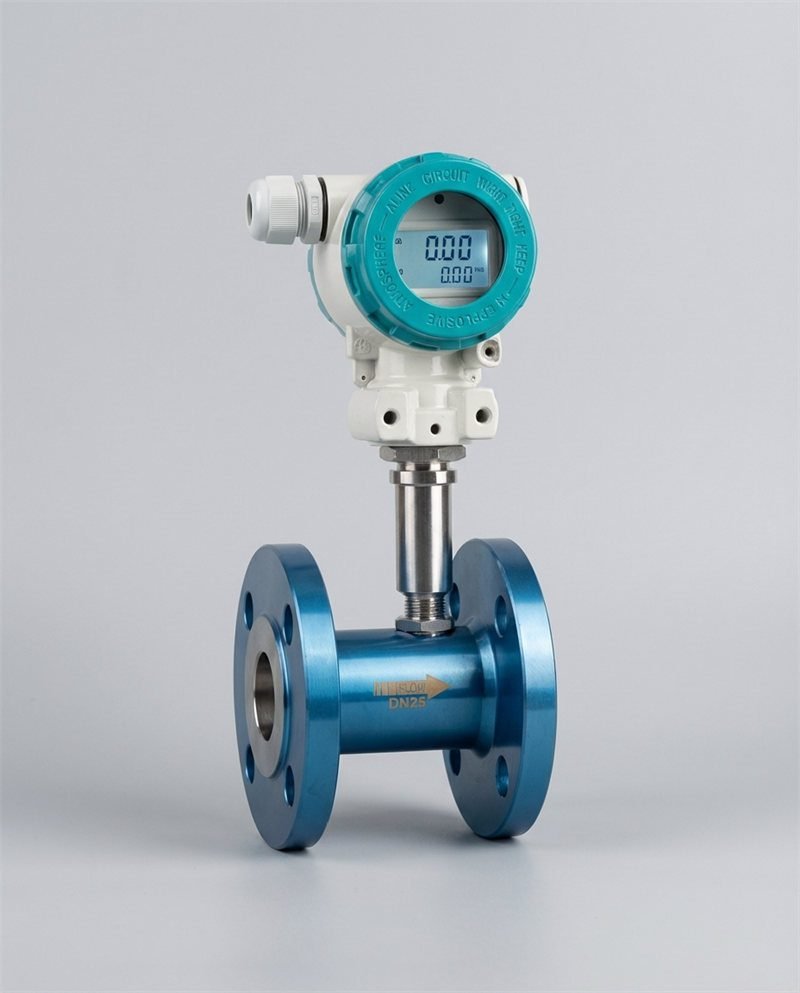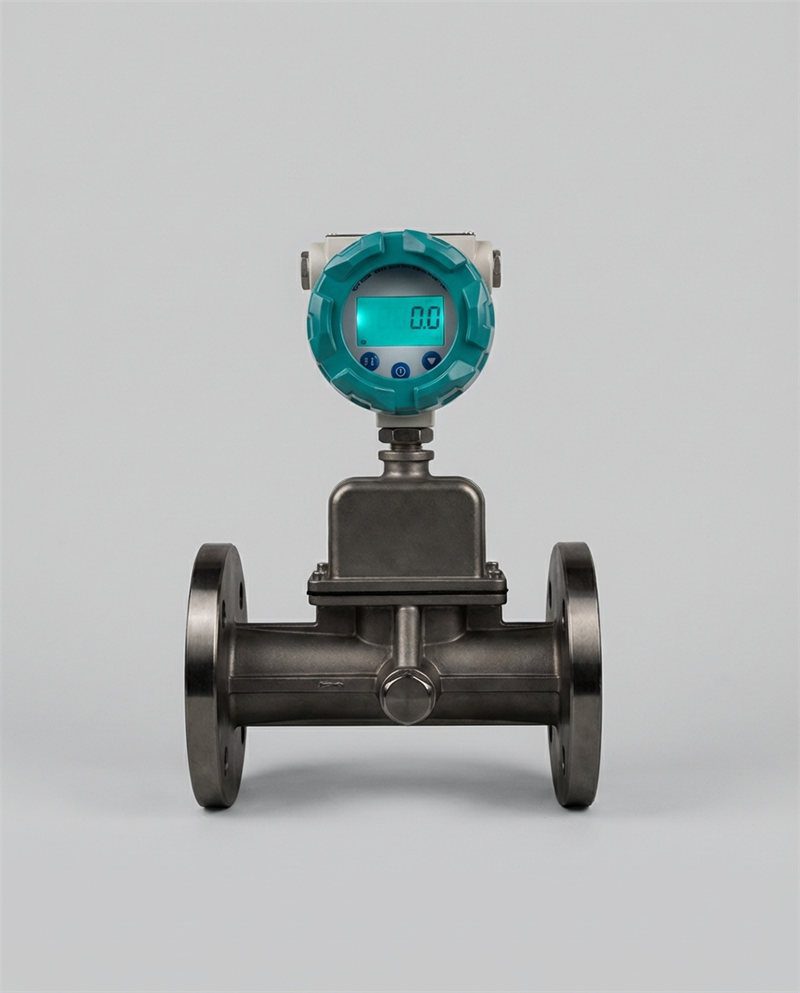
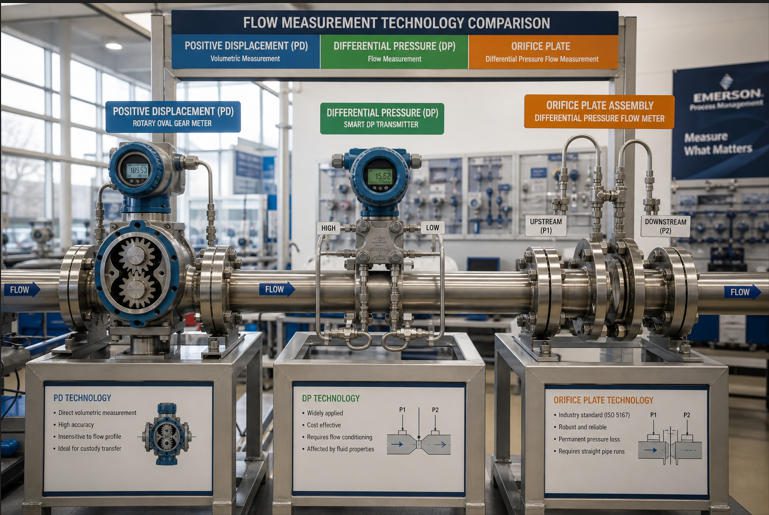
Reviewer’s note: Differential-pressure-based flow measurement is still one of the most used approaches in oil & gas, chemical processing, utilities, steam systems, and water treatment. But the phrase “DP flow” often hides three very different decisions: the pressure transmitter, the differential pressure transmitter, and the primary flow element such as an orifice plate.

Purpose of the Review and What Readers Will Learn
This review compares PD transmitters, DP transmitters, and orifice plates from a practical engineering perspective. The goal is not to crown one universal winner. In real plants, the best answer depends on the fluid, operating pressure, turndown, available straight pipe, maintenance culture, energy cost, and required custody or process-control accuracy.
For clarity, this article uses the terms as follows:
- PD transmitter: a pressure-drop or pressure-differential transmitter used in simpler differential pressure applications, often with fewer diagnostics or limited compensation.
- DP transmitter: a smart differential pressure transmitter designed to measure the pressure difference between high- and low-pressure ports, often supporting square-root extraction, HART/fieldbus communication, damping, diagnostics, and temperature/line-pressure compensation.
- Orifice plate: a primary flow element installed in the pipe to create a differential pressure. It is not a transmitter by itself; it must be paired with a DP/PD measurement device.
Brief Overview of Differential Pressure Flow Measurement Concepts
Differential pressure flow measurement is based on a simple physical idea: when fluid passes through a restriction, velocity increases and static pressure drops. The measured pressure difference can be converted into flow. The relationship is not linear; flow is approximately proportional to the square root of differential pressure.
The general logic is:
Flow rate ∝ √ΔP
That square-root relationship is why a transmitter with stable low-range performance matters. A small error in low differential pressure can become a meaningful flow error, especially at low flow rates.
For standards-based DP devices, ISO 5167 differential pressure flow measurement is one of the most important references for geometry, installation conditions, and calculation methods. For general principle comparison, the Engineering ToolBox guide to orifice, nozzle, and Venturi meters provides a useful technical overview.
Why Choosing the Right Transmitter/Element Matters for Accuracy and Reliability
A DP flow system is only as strong as its weakest part. A high-end smart transmitter cannot rescue a poorly installed orifice plate with distorted upstream flow. Likewise, a precisely machined orifice plate will not perform well if impulse lines plug, freeze, leak, or accumulate condensate.
In field reviews, the most common source of DP flow disappointment is not the theoretical equation. It is the installation reality: insufficient straight run, wet gas, dirty liquids, steam condensate legs, wrong impulse-line slope, incorrect beta ratio, or a transmitter ranged too widely for the actual operating window.
Overview of DP-Based Flow Measurement Options
PD Transmitters: Fundamental Operating Principle
A PD transmitter measures pressure drop between two points. In basic applications, it may be used to monitor filter loading, pump differential, or pressure loss across a restriction. When used for flow, the transmitter typically reads the pressure difference created by a primary element and sends a 4–20 mA signal to a PLC, DCS, or local indicator.
The advantage is simplicity. The limitation is that lower-cost PD transmitters may have less advanced diagnostics, weaker temperature compensation, narrower turndown, or limited communication compared with smart DP transmitters.
DP Transmitters: Fundamental Operating Principle
A DP transmitter uses two pressure ports: high side and low side. The sensing element converts the difference between these pressures into an electrical signal. Smart DP transmitters can apply square-root extraction, damping, diagnostics, range adjustment, and digital communication.
For readers comparing transmitter options, Jade Ant Instruments discusses related selection considerations in its smart pressure transmitter comparison. In practice, the best DP transmitter is not simply the one with the smallest reference accuracy number; it is the one that stays stable under the plant’s actual temperature swings, line pressure, vibration, and maintenance intervals.
Orifice Plates: Fundamental Operating Principle
An orifice plate is a thin plate with a precisely machined hole. When installed between flanges, it restricts flow and creates a pressure drop. The upstream and downstream pressures are routed to a transmitter. The orifice bore, pipe internal diameter, beta ratio, pressure taps, edge sharpness, plate flatness, and installation straight run all influence accuracy.

Technical Performance Benchmarks
Accuracy, Repeatability, and Response Time
Accuracy in DP flow is a system property. It includes transmitter reference accuracy, rangeability, primary element uncertainty, fluid-property assumptions, installation effects, and signal processing. A smart DP transmitter may advertise excellent reference accuracy, but the total installed uncertainty of an orifice-based flow loop can be much larger if upstream flow profile or fluid density is not controlled.
Industry insight: In many brownfield plants, repeatability is often more valuable than laboratory accuracy. For example, a utility steam line used for boiler balancing may tolerate moderate absolute error if the measurement tracks load changes reliably. A chemical dosing or custody-adjacent application may require tighter calibration and documented uncertainty.
Pressure Drop, Rangeability, and Turndown
Orifice plates create permanent pressure loss. That pressure loss can become a hidden operating expense in high-flow pump or compressor systems. DP transmitters themselves do not create the pressure drop; the primary element does. Therefore, comparing “DP transmitter vs orifice plate” is partly a category mismatch: one measures pressure difference, while the other creates it.
Typical turndown also deserves attention. Because flow follows the square root of differential pressure, a 10:1 flow turndown requires about 100:1 differential pressure range. That is why transmitter range selection and low-end stability are so important.
Excel-Ready Comparison Table
The following table can be copied directly into Excel for early-stage screening.
| Criteria | PD Transmitter | Smart DP Transmitter | Orifice Plate | Reviewer Comment |
|---|---|---|---|---|
| Primary role | Measures pressure drop | Measures differential pressure with diagnostics | Creates differential pressure | Orifice plate must be paired with a transmitter |
| Installed accuracy potential | Moderate | High when correctly ranged | Depends heavily on geometry and installation | System uncertainty matters more than brochure accuracy |
| Turndown | Limited to moderate | Moderate to high | Limited by beta ratio and ΔP range | Low-flow DP accuracy must be checked |
| Pressure loss | None by itself | None by itself | Medium to high | Energy cost can dominate lifecycle cost |
| Maintenance risk | Impulse-line issues | Impulse-line plus diagnostic management | Edge wear, fouling, plate damage | Dirty fluids increase inspection needs |
Bar Chart: Relative Installed Performance Factors
The chart below is a reviewer-style qualitative scoring model, where 5 is strongest. Actual project scoring should be adjusted for process conditions.
Relative Performance Score by Technology
5 = strongest / lowest concern, qualitative reviewer model
0
1
2
3
4
5
Accuracy
Turndown
Low Loss
Diagnostics
PD transmitter
Smart DP transmitter
Orifice plate
Installation and Configuration
Pipe Size, Placement, and Installation Effects
Installation can decide whether a DP flow system performs acceptably or becomes a recurring maintenance complaint. Orifice plates need a developed velocity profile. Elbows, valves, reducers, expanders, pumps, and partially open control valves can distort the profile and shift the discharge coefficient.
In a plant audit, a reviewer should check:
- Upstream and downstream straight-run availability
- Pressure tap type and location
- Beta ratio suitability
- Pipe internal diameter accuracy
- Impulse-line slope and fill condition
- Gas pockets in liquid service or liquid accumulation in gas service
- Steam condensate pot elevation and equalization
Typical Orifice Plate + DP Transmitter Installation
Flow direction
Orifice plate
High side
Low side
DP Transmitter
PLC / DCS
Reviewer checks: straight run, tap condition, impulse lines, fluid phase behavior, transmitter range.
Wetted Materials and Compatibility
Material selection should be based on corrosion, erosion, temperature, pressure, and cleaning chemicals. Stainless steel may be sufficient for clean water or many utility services, but aggressive acids, chlorides, sour gas, abrasive slurry, or high-temperature steam may require special alloys, coatings, or remote seals.
For broader flowmeter selection, the industrial flow meter selection guide from Jade Ant Instruments is useful because it starts with fluid behavior rather than only meter type.
Signal Processing and Calibration Considerations
Excitation, Sensing, and Temperature Compensation
Smart DP transmitters typically include digital compensation for sensor temperature and static pressure effects. This matters in steam, compressed gas, and outdoor installations where ambient temperature can change significantly between day and night.
For gas and steam flow, density compensation may require pressure and temperature inputs. Without compensation, a DP loop can repeat beautifully while reporting the wrong mass flow when operating conditions move away from design assumptions.
Drifts Due to Process Conditions and Drift
Drift is rarely caused by the transmitter alone. In field conditions, apparent drift can come from plugged impulse lines, damaged orifice edges, condensate imbalance, zero shifts after maintenance, valve leakage in a manifold, or density changes.
Reviewer insight: If operators recalibrate the transmitter every shutdown but never inspect the orifice plate or impulse tubing, they may be correcting the symptom instead of the measurement system.
DP Transmitter vs PD Transmitter: Key Differences
Measurement Principle Implications
Both PD and DP transmitters measure pressure difference, but a smart DP transmitter is usually engineered for more demanding process measurement. It often provides better rangeability, digital setup, diagnostics, square-root extraction, communication, and stability under changing process conditions.
A basic PD transmitter can be suitable for filter monitoring, pump differential, and simple pressure-drop indication. For flow measurement where the signal feeds control, energy accounting, or production reporting, a smart DP transmitter is usually easier to defend technically.
Common Mode and Isolation Considerations
Common-mode pressure is the line pressure applied to both sides of the transmitter. A transmitter may measure a small differential pressure while both ports sit at high static pressure. Good common-mode rejection is critical because a small zero shift at high line pressure can create a noticeable flow error.
Isolation diaphragms, manifolds, and impulse lines must be selected for pressure rating, temperature, and process compatibility. Remote seals may be needed for viscous, crystallizing, corrosive, or sanitary fluids, but they introduce fill-fluid temperature effects and slower response.
Orifice Plate Specifics and Flow Elements
Beta Ratio, Edge Geometry, and Installation Effects
The beta ratio is the orifice bore diameter divided by the pipe internal diameter. A higher beta ratio usually creates lower pressure loss but may be more sensitive to installation effects. A lower beta ratio creates more differential pressure but increases permanent pressure loss.
The sharp upstream edge of a concentric square-edged orifice plate is central to its behavior. Rounding, nicks, deposits, or erosion can alter the discharge coefficient. In dirty service, the plate should be treated as an inspection item, not a permanent “install and forget” component.

C-Coefficient and Discharge Coefficient Considerations
The discharge coefficient, often represented as Cd, adjusts the theoretical flow equation to actual behavior. It is influenced by Reynolds number, beta ratio, tap configuration, and geometry. Standards such as ISO 5167 define how to use these values under specified conditions.
For vendor comparison, engineers should avoid comparing only transmitter accuracy. Ask for the complete flow calculation basis, including bore size, beta ratio, tap type, fluid properties, Reynolds number range, and expected permanent pressure loss.
Maintenance, Reliability, and Lifecycle Costs
Maintenance Cycles and Diagnostics
A smart DP transmitter with diagnostics can reduce troubleshooting time, especially when it detects sensor issues, overrange events, or abnormal operating states. But diagnostics cannot physically clean impulse lines or restore an eroded orifice edge.
Recommended review intervals should depend on fluid cleanliness and criticality:
- Clean liquids: periodic zero check and manifold inspection
- Steam: condensate leg verification and leak inspection
- Dirty gas: impulse-line plugging checks
- Abrasive or fouling fluids: orifice plate inspection during planned shutdowns
Spare Parts, Replacements, and Downtime Impact
Orifice plates are inexpensive compared with many flowmeter technologies, but downtime is not. If removing a plate requires line isolation, depressurization, hot work permits, or production interruption, the lifecycle cost changes quickly.
In contrast, a transmitter replacement may be faster if manifolds are properly installed and isolation procedures are well documented. This is why many reliability teams standardize transmitter models across units while keeping primary elements application-specific.
Pie Chart: Typical DP Flow Lifecycle Cost Drivers
The following qualitative cost split reflects common plant experience for orifice-based DP flow loops. Actual costs vary by line size, energy price, and maintenance access.
Typical Lifecycle Cost Drivers
Qualitative model for orifice-based DP flow loops
DP Flow
Lifecycle
Engineering & procurement: 20%
Installation & commissioning: 30%
Maintenance & verification: 25%
Permanent pressure loss energy: 25%
Applications and Use-Case Guidance
Liquids vs Gases vs Steam Considerations
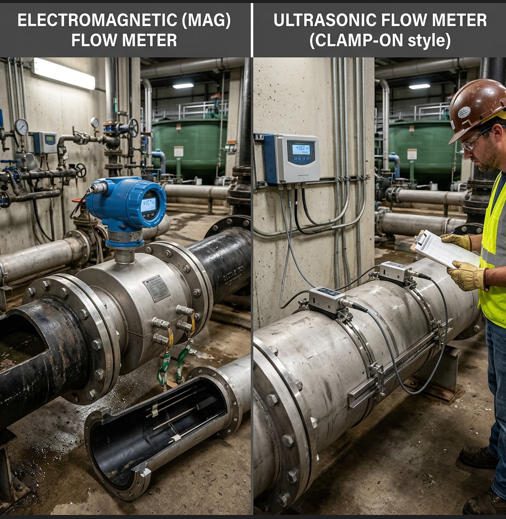
Liquids: DP flow works well for clean, single-phase liquids when the pipe stays full and impulse lines are free of gas pockets. For conductive liquids where low pressure loss is valuable, electromagnetic meters may be preferable.
Gases: Gas density changes with pressure and temperature. If mass flow is needed, compensation becomes important. Low differential pressure at low flow can challenge accuracy.
Steam: Steam DP flow is common, but wet steam, condensate legs, heat tracing, and pressure/temperature compensation must be handled correctly. A saturated-steam header with changing dryness fraction can create errors that a transmitter alone cannot solve.
For broader meter selection across fluid types, see Jade Ant Instruments’ flowmeter sensor selection factors.
Viscosity, Density, and Compressibility Effects
Viscosity affects Reynolds number and discharge coefficient behavior. Density is central to DP flow calculations. Compressibility matters for gases and steam. Any review should confirm whether the flow computer, transmitter, or DCS is using fixed design density or live compensation.
Field insight: Many DP loops are commissioned using design data, then operated for years at a different pressure, temperature, or product grade. The loop may still be repeatable, but its reported flow can gradually become less representative of actual mass or volume flow.
Safety, Compliance, and Standards
Industry Standards and Calibration Requirements
For orifice plates, ISO 5167 is a key reference when geometry and installation conditions fall within its scope. Calibration requirements depend on industry, custody relevance, environmental reporting, safety function, and company quality procedures.
Calibration should include more than a bench check of the transmitter. A robust program verifies transmitter range, manifold condition, impulse-line integrity, primary element condition, and calculation parameters in the control system.
Safety Margins and Explosion-Proof Considerations
In hazardous areas, transmitter approvals must match the area classification. Explosion-proof, flameproof, intrinsically safe, and non-incendive designs are not interchangeable. Engineers should also check process connection ratings, overpressure limits, material compatibility, and maximum operating temperature.
For external product category comparison, Emerson differential pressure flow meters show how major instrumentation suppliers package transmitters, primary elements, and accessories for industrial DP flow applications.
Future Trends and Technology Integration
Smart Instruments and Digital Communications
Smart DP transmitters are moving from simple signal devices toward condition-aware measurement nodes. HART, Foundation Fieldbus, Profibus PA, and industrial Ethernet gateways allow maintenance teams to access diagnostics, configuration history, and abnormal condition alerts.
Jade Ant Instruments has seen buyers increasingly ask for instruments that are easier to commission and easier to verify remotely, especially in water treatment, chemical dosing, and utility monitoring skids where teams manage many measurement points with limited manpower.
Diagnostics, Predictive Maintenance, and Data Analytics
The next step is not just a smarter transmitter; it is smarter interpretation. A DP transmitter may detect unstable differential pressure, but analytics can connect that behavior to pump cavitation, fouling, valve hunting, or process upset. For plants with hundreds of DP loops, even basic exception reporting can reduce unnecessary field rounds.
Still, analytics cannot compensate for poor installation. Digital tools are most valuable when the mechanical measurement foundation is already sound.
Practical Decision Framework for Reviewers and Engineers
Checklist for Evaluating Cost of Ownership
- What accuracy is required at minimum, normal, and maximum flow?
- Is the fluid clean, dirty, corrosive, viscous, wet gas, or two-phase?
- Is permanent pressure loss acceptable over the equipment life?
- Is enough straight pipe available for an orifice plate installation?
- Will density be fixed or compensated with live pressure and temperature?
- Can impulse lines be installed with proper slope, heat tracing, or seals?
- How often can the line be shut down to inspect the primary element?
- Does the hazardous-area rating match the installation zone?
- Can maintenance staff access diagnostics and configuration records?
Guidance for Initial Specification and Vendor Comparison
When comparing vendors, request a complete measurement package rather than a transmitter quote only. The package should include transmitter range, primary element sizing, pressure-loss estimate, installation requirements, material selection, calibration documents, and recommended maintenance intervals.
For flow element alternatives, the flow nozzle meter advantages and disadvantages article is useful when steam or high-velocity service makes a standard orifice plate less attractive.
Case Studies and Real-World Examples
Industry Sector Highlights: Oil & Gas, Chemical, Water Treatment
Oil & gas: DP flow remains common for gas, steam, and high-pressure service because the technology is familiar, robust, and compatible with hazardous-area requirements. The main review points are density compensation, static pressure effects, and impulse-line reliability.
Chemical processing: Corrosion, crystallization, batch variability, and cleaning chemicals often drive material and seal decisions. A remote-seal DP transmitter may solve plugging problems but can slow response and increase temperature-related error.
Water treatment: For clean water, DP flow can work, but pressure loss matters in continuous pumping systems. Many plants compare DP against electromagnetic or ultrasonic meters to reduce pumping energy and maintenance. Jade Ant Instruments’ small-line flow meter comparison shows how DP-based options fit alongside electromagnetic and turbine technologies in compact applications.
Lessons Learned and Best Practices
- Do not size an orifice plate only for maximum flow; check low-flow differential pressure.
- Do not treat transmitter calibration as a substitute for primary element inspection.
- For steam, verify condensate legs and impulse-line elevation before blaming the transmitter.
- For gases, confirm whether reported flow is actual volume, standard volume, or mass flow.
- For liquids, eliminate trapped gas in impulse lines and confirm the pipe remains full.
Summary of Pros and Cons by Technology
PD Transmitter: When It Shines
A PD transmitter is a practical choice for simple pressure-drop monitoring, filter condition tracking, pump differential checks, and non-critical indication. It shines where cost, simplicity, and ease of installation matter more than advanced diagnostics or high turndown.
DP Transmitter: Where It Excels
A smart DP transmitter excels in process-control flow loops, compensated gas or steam measurement, remote monitoring, and applications where diagnostics reduce downtime. It is usually the strongest transmitter choice when the signal affects production, energy balance, or safety-related decisions.
Orifice Plate: Ideal Scenarios and Caveats
An orifice plate is ideal when the plant needs a low-cost, standardized, well-understood primary element and can accept permanent pressure loss. It is less attractive when energy cost is high, straight pipe is limited, the fluid is dirty or erosive, or wide turndown is required.
The best differential pressure flow solution is not selected by transmitter accuracy alone. It is selected by matching the transmitter, primary element, installation geometry, fluid behavior, and maintenance plan to the measurement goal.
If the application is simple pressure-drop monitoring, a PD transmitter can be enough. If the flow signal is used for control, reporting, or compensated gas/steam measurement, a smart DP transmitter is usually easier to justify. If cost and standardization matter and pressure loss is acceptable, an orifice plate remains a proven primary element.
The strongest recommendation is to validate the complete loop under site-specific conditions. Review the process data, size the primary element carefully, check installation constraints, estimate lifecycle cost, and include maintenance technicians in the specification review. In DP flow measurement, real-world reliability is built before commissioning, not after the first troubleshooting call.
Recommended YouTube Video
The following video provides a helpful visual explanation of the differential pressure flow measuring principle, including orifice, nozzle, and Venturi concepts.
FAQs
1. What factors most influence differential pressure flow measurement accuracy?
The biggest factors are transmitter range, primary element geometry, beta ratio, straight-run conditions, pressure tap condition, fluid density, Reynolds number, impulse-line health, and whether pressure/temperature compensation is used.
2. How should I choose between PD and DP transmitters for a given application?
Use a PD transmitter for simple pressure-drop monitoring or non-critical indication. Choose a smart DP transmitter when the measurement affects control, energy accounting, production reporting, diagnostics, or compensated gas and steam flow.
3. When are orifice plates the most appropriate option over transmitters?
An orifice plate is not a replacement for a transmitter; it is a primary element. It is appropriate when you need a standardized restriction to generate differential pressure and can accept the required straight run and permanent pressure loss.
4. Why does an orifice plate cause permanent pressure loss?
The plate forces fluid through a restriction, converting pressure energy into velocity and turbulence. Some pressure is recovered downstream, but a portion is permanently lost, increasing pump or compressor energy demand.
5. Can a smart DP transmitter fix a bad orifice plate installation?
No. Diagnostics and compensation help, but they cannot fully correct distorted flow profiles, damaged plate edges, wrong beta ratio, poor tap placement, or impulse-line installation errors.
6. Is DP flow measurement suitable for steam?
Yes, DP flow is widely used for steam. However, condensate legs, pressure and temperature compensation, wet-steam effects, and proper impulse-line installation must be managed carefully.
7. What is beta ratio in orifice plate flow measurement?
Beta ratio is the orifice bore diameter divided by the pipe internal diameter. It affects differential pressure, permanent pressure loss, Reynolds number behavior, and sensitivity to installation effects.
8. How often should DP flow systems be calibrated or inspected?
The interval depends on criticality and fluid condition. Clean utility service may need periodic verification, while dirty, erosive, corrosive, or steam applications may require more frequent inspection of impulse lines, manifolds, and the primary element.