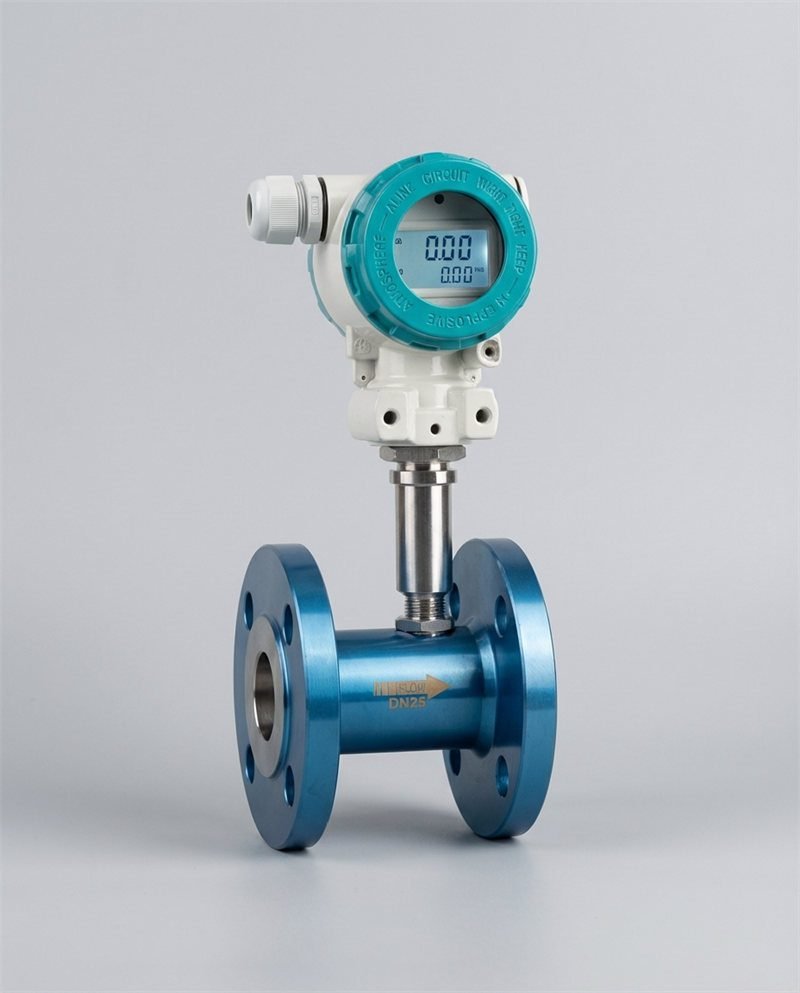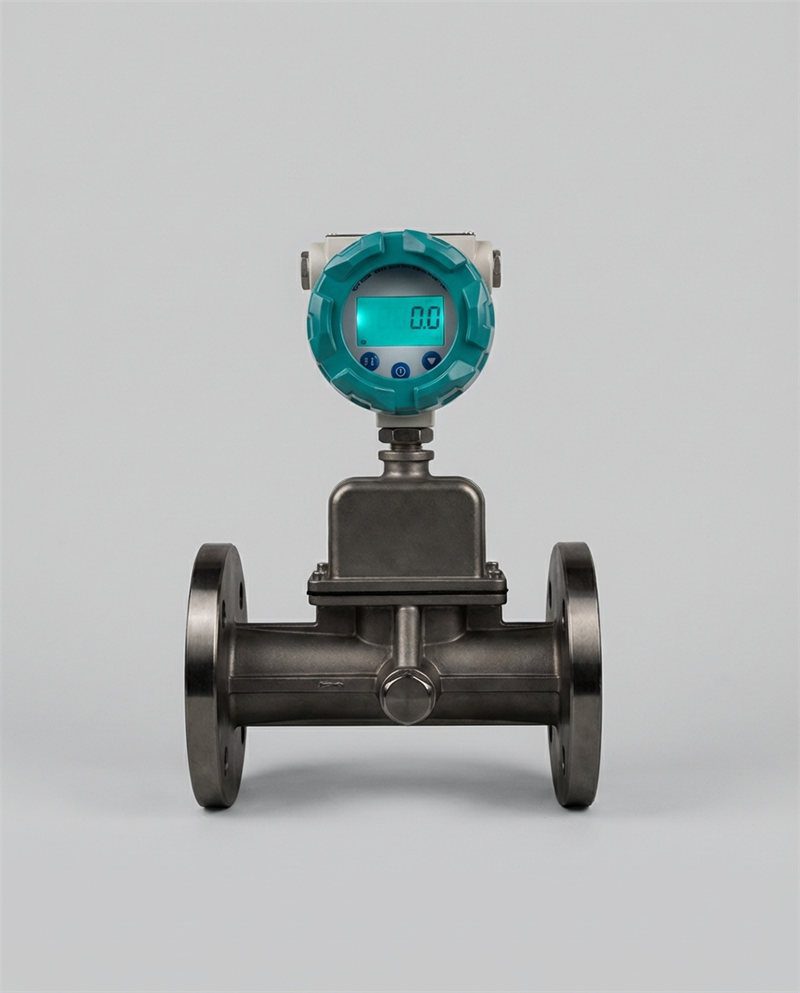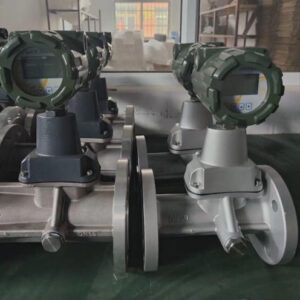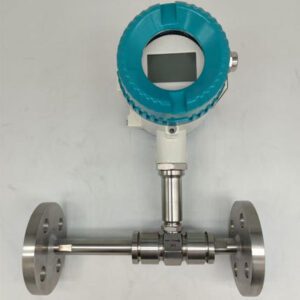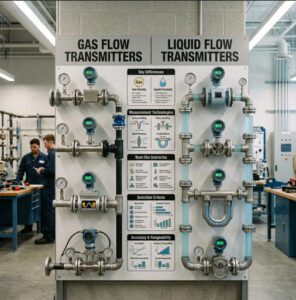
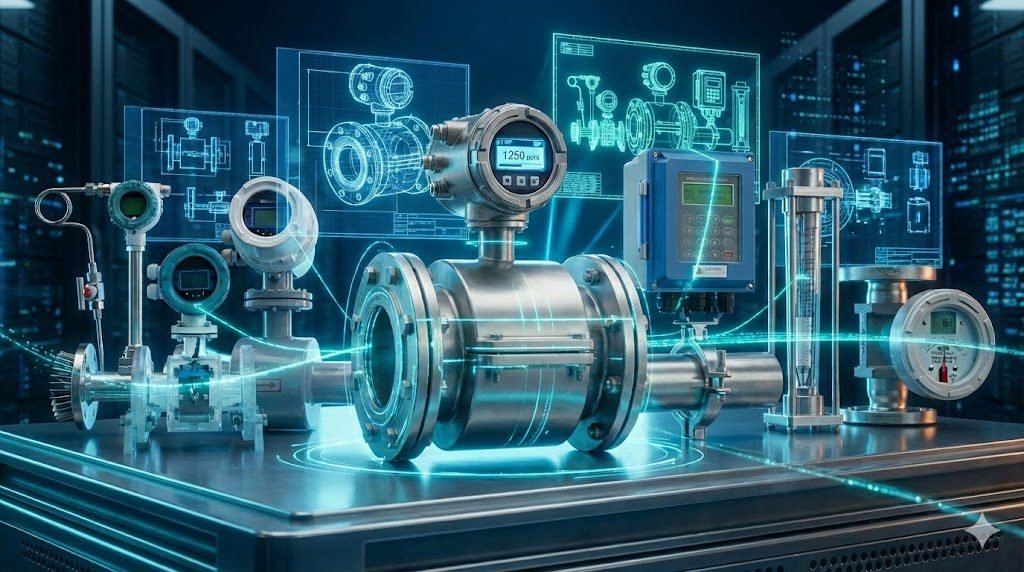
A vortex flow meter measures flow by counting pressure oscillations created when fluid passes a bluff body — no moving parts, no bearings, no rotor. A turbine flow meter measures flow by spinning a mechanical rotor and counting blade rotations — high precision, but entirely dependent on clean fluid and healthy bearings. That single difference in working principle shapes every downstream decision: what fluids you can measure, how often you’ll shut down for maintenance, how much accuracy you’ll get on day one versus year five, and how much the installation will cost you over a decade.
The global flow meter market reached USD 12.14 billion in 2026 (Fortune Business Insights), and the vortex segment alone is valued at USD 473.7 million, growing at a 6.5% CAGR toward USD 834.8 million by 2034 (Research and Markets). Turbine meters remain the workhorse for custody-transfer applications in petroleum, aviation fuel, and clean-water systems — but they’re steadily losing market share in steam, gas, and chemical applications to vortex meters that offer lower total cost of ownership.
This guide walks through both working principles in engineering detail, compares their advantages and disadvantages with real performance data, maps each technology to its strongest applications, and provides a structured selection guide. If you’re an engineer choosing between these two technologies for a new plant or a retrofit, the data here will help you spec the right meter — not just the cheaper one.
Vortex Flow Meter Working Principle
How Vortex Flow Meters Work
A vortex flow meter operates on the von Kármán vortex shedding principle. A non-streamlined obstruction — called a bluff body or shedder bar — is placed across the flow path inside the pipe. As fluid (liquid, gas, or steam) passes around the bluff body, alternating low-pressure vortices form on each side and detach in a repeating pattern known as a Kármán vortex street.
The frequency of vortex shedding is directly proportional to the fluid velocity, governed by the Strouhal number relationship:
f = St × V / d

Where:
  f  = vortex shedding frequency (Hz)
  St = Strouhal number (dimensionless, typically 0.2–0.3 for vortex meters)
  V  = fluid velocity (m/s)
  d  = bluff body width (m)
A piezoelectric, capacitive, or thermal sensor embedded downstream of the bluff body detects each vortex as a pressure or velocity fluctuation and converts it to an electrical pulse. The pulse frequency is then translated to volumetric flow rate. Because the Strouhal number remains constant over a wide Reynolds number range (Re > 10,000 per Emerson’s technical guidelines), vortex meters deliver stable, linear output without recalibration for changes in fluid density, temperature, or pressure — provided the flow remains turbulent.
This is not theoretical. A petrochemical plant in Jiangsu Province ran 24 vortex meters on superheated-steam lines for 6 years without a single sensor failure or recalibration event. The meters — Jade Ant Instruments vortex units with integrated temperature and pressure compensation — tracked within ±0.8% of the reference Coriolis meter on annual spot-checks. The reason: no bearings to wear, no rotor to foul, no mechanical drift.
Advantages of Vortex Flow Meters
| Advantage | Specification / Evidence | Practical Impact |
|---|---|---|
| No Moving Parts | Zero bearings, zero rotors — bluff body + piezo sensor only | Maintenance intervals stretch to 5–10 years; one chemical plant reported $0 in unplanned maintenance over 8 years across 18 vortex meters |
| Multi-Fluid Versatility | Measures liquids, gases, and steam — including wet steam and saturated steam | One meter model covers steam headers, compressed-air lines, and cooling-water loops, reducing spare-parts inventory by 40–60% |
| Wide Temperature Range | Up to 450°C (842°F) with high-temp sensor options | Suitable for superheated steam in power plants, thermal oil in chemical reactors |
| Good Accuracy | ±0.5% to ±1.0% of reading for liquids; ±1.0% to ±1.5% for gas/steam (Re > 30,000) | Meets process-control accuracy for HVAC, chemical dosing, boiler efficiency monitoring |
| Low Pressure Drop | Typically 0.3–1.0 bar (4–15 psi) at rated flow | Reduces pumping energy costs; critical for large-diameter steam and gas lines |
| Long Service Life | 15–20+ years in clean-to-moderate service | Amortized annual cost as low as $80–$150/year for a $1,500 meter |
Disadvantages of Vortex Flow Meters
| Limitation | Technical Detail | Workaround |
|---|---|---|
| Minimum Reynolds Number | Requires Re ≥ 10,000–20,000 for stable vortex shedding; fails at very low velocities | Size down the meter (use a smaller bore) to increase velocity; verify at minimum flow |
| Vibration Sensitivity | Pipe vibration can generate false vortex signals, especially at low flows | Use adaptive digital signal processing (e.g., Emerson Rosemount 8800); install vibration dampers |
| Straight-Run Requirements | Typically 15–20D upstream, 5D downstream | Flow conditioners can reduce upstream to ~10D; budget $1,000–$2,500 for conditioner |
| Not Ideal for Very Viscous Fluids | Fluids above ~30 cP suppress vortex formation | Consider Coriolis or positive-displacement meters for high-viscosity applications |
| Lower Accuracy Than Turbine for Clean Liquids | ±0.5–1.0% vs. turbine’s ±0.25–0.5% on clean water or fuel | Accept for process control; use turbine or Coriolis for custody transfer of clean liquids |
Applications of Vortex Flow Meters
Vortex meters dominate wherever the fluid is hot, dirty, or multi-phase — and wherever minimizing maintenance is a priority. Key application sectors include:
Steam measurement: Saturated and superheated steam in power plants, district heating, and industrial boilers. Vortex meters with integrated T/P compensation calculate mass flow directly, eliminating the need for a separate flow computer in many installations. Sierra Instruments calls vortex meters “the industry standard selection for accurate steam flow measurement.”
Compressed air and industrial gases: Nitrogen, CO₂, natural gas, and compressed air in chemical plants and semiconductor fabs. Vortex meters handle pressure fluctuations without recalibration.
Chemical processing: Acids, alkalis, solvents, and thermal oils up to 400°C. The absence of moving parts means no lubricant contamination risk — critical for pharmaceutical and food-grade processes.
HVAC and building automation: Chilled-water and hot-water energy metering in commercial buildings. Vortex meters’ long-term stability reduces recalibration visits on campus district-energy loops.
At Jade Ant Instruments, vortex flow meters are part of the core product lineup — alongside electromagnetic and turbine meters — and are frequently specified for steam and gas applications across metallurgy, textile, and environmental engineering sectors.

Turbine Flow Meters Principle
How Turbine Flow Meters Work
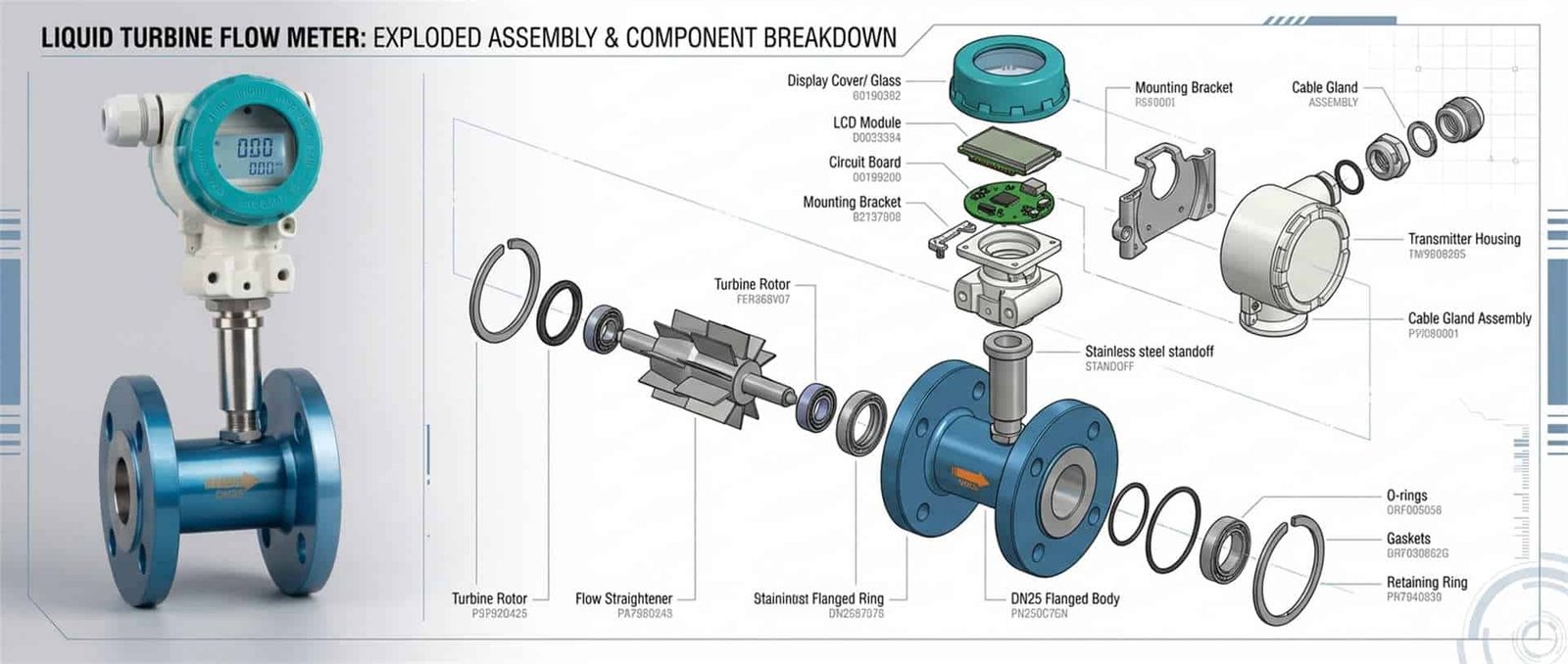
A turbine flow meter uses a multi-bladed rotor mounted axially in the fluid stream. As fluid flows through the meter, it strikes the angled blades and spins the rotor. The rotational speed of the rotor is directly proportional to the volumetric flow rate of the fluid — double the flow, double the RPM.
Rotation is detected by a magnetic pickup coil or Hall-effect sensor mounted outside the flow tube. Each time a rotor blade passes the sensor, it generates an electrical pulse. The pulse frequency is converted to volumetric flow rate using a calibration factor (K-factor) expressed in pulses per unit volume:
Q = f / K

Where:
  Q = volumetric flow rate (e.g., liters/minute)
  f = pulse frequency (Hz)
  K = meter K-factor (pulses/liter), determined by calibration
The K-factor is remarkably stable for a well-manufactured turbine meter operating within its designed viscosity range. Turbines Incorporated reports that their meters maintain K-factor linearity within ±0.25% over a 10:1 turndown when measuring clean hydrocarbons at stable viscosity. This linearity is why turbine meters remain the standard for custody-transfer measurement of aviation fuel, refined petroleum products, and LPG.
The critical dependence, however, is on the bearings. Turbine meters use precision bearings — typically tungsten-carbide ball bearings or ceramic journal bearings — that are in constant contact with the flowing fluid. Any particulate contamination accelerates bearing wear, shifts the K-factor, and degrades accuracy. A fuel-distribution terminal in Rotterdam documented a 0.3% shift in K-factor after just 14 months of service on a diesel line that exceeded the specified 25-micron filtration limit. The bearing kit replacement cost $286 (Seametrics pricing) plus 4 hours of downtime — minor in isolation, but multiplied across 40 meters at the terminal, the annual maintenance budget exceeded $18,000.
Advantages of Turbine Flow Meters
| Advantage | Specification / Evidence | Practical Impact |
|---|---|---|
| Excellent Accuracy on Clean Liquids | ±0.25% to ±0.5% of reading (calibrated); ±1.0% uncalibrated | Meets custody-transfer requirements for petroleum, LPG, aviation fuel per API MPMS Ch. 5 |
| Wide Turndown Ratio | 10:1 standard; up to 30:1 or higher with dual-pickup designs | Handles varying-demand fuel-distribution systems without needing multiple meter sizes |
| Fast Response Time | Responds to flow changes in milliseconds; pulse output tracks instantaneous flow | Ideal for batching, blending, and totalizing applications where every fraction of a liter matters |
| Compact Size | Typically 3–5 pipe diameters in length for the meter body | Fits into tight skid-mounted fuel systems, mobile tanker trucks, and aircraft refueling rigs |
| Lower Initial Cost | $300–$2,500 for standard sizes (DN15–DN150); premium custody-transfer units up to $5,000 | Budget-friendly for multi-point installations on fuel farms and water utilities |
| Proven Pedigree | 60+ years of field data; standardized per API, AGA, ISO 2715 | Universally accepted by custody-transfer authorities and fiscal-metering regulators |
Disadvantages of Turbine Flow Meters
| Limitation | Technical Detail | Workaround |
|---|---|---|
| Moving Parts = Wear | Bearings degrade; rotor blades can chip on particulates. Lifespan: 5–10 years depending on fluid cleanliness | Install upstream strainers (25–75 µm); schedule bearing replacements every 2–5 years; budget $150–$400/kit |
| Clean-Fluid Requirement | Not suitable for fluids with suspended solids, slurries, or viscosities above ~100 cP | Use mag meters for dirty water; use Coriolis for viscous oils |
| Viscosity Sensitivity | K-factor shifts by 1–3% with a 50% change in viscosity; requires viscosity-matched calibration | Calibrate at operating viscosity; use universal viscosity correction (UVC) algorithms |
| Not Suitable for Steam or Gas (generally) | Gas turbine meters exist but are separate product lines; liquid turbines cannot handle two-phase flow | Use vortex meters for steam; use gas-specific turbine designs (e.g., AGA-7 certified) for gas custody |
| Straight-Run Requirements | 10–15D upstream, 5D downstream (varies by manufacturer) | Flow conditioners reduce requirement; some insertion turbines need less |
| Over-Speed Damage Risk | Sudden flow surges can spin rotor beyond design RPM, causing bearing failure | Install flow limiters or bypass valves; ensure operating range stays within rated maximum |
Applications of Turbine Flow Meters
Petroleum custody transfer: Fuel loading racks, pipeline interconnects, and tanker-truck metering. The turbine meter’s ±0.25% accuracy and fast pulse output make it the standard per API Manual of Petroleum Measurement Standards (MPMS) Chapter 5. A Gulf Coast fuel terminal processes 50,000 barrels/day through 12 turbine meters with a combined measurement uncertainty of ±0.15% — verified by prover runs every 30 days.
Water utilities: Clean potable water in treatment plants and distribution systems. Badger Meter turbine meters handle sizes from ¾ inch to 12 inches with ±1.0% accuracy, serving thousands of municipal installations.
Aviation fuel: JET-A1 into-plane fueling where accuracy, fast response, and compact size are non-negotiable. Turbine meters are the default at almost every commercial airport worldwide.
Chemical batch dosing: Low-viscosity solvents, acids, and de-ionized water in pharmaceutical and electronics manufacturing. Pulse output integrates directly into PLC batch controllers for precise volumetric totalizing.
For engineers evaluating turbine meters alongside other liquid-flow technologies, the variable-area vs. turbine vs. electromagnetic comparison on JadeAntInstruments.com provides a side-by-side framework with concrete specification data.

Vortex vs Turbine Flow Meters: Head-to-Head Comparison
Principle Comparison
The fundamental divergence is mechanical vs. fluid-dynamic. A turbine meter converts kinetic energy from the fluid into rotational energy of a mechanical rotor, then reads rotation speed. A vortex meter creates no mechanical motion at all — it reads pressure oscillations from vortex shedding, a phenomenon that occurs naturally when any fluid passes a bluff body at sufficient velocity.
This difference means turbine meters are inferential devices whose accuracy depends on the mechanical condition of the rotor and bearings. Vortex meters are frequency-based devices whose accuracy depends on maintaining stable vortex formation — which requires only that the Reynolds number stays above ~10,000 and that pipe vibration doesn’t overwhelm the vortex signal.
Video: Comparing Turbine Flowmeters and Vortex Flowmeters — Working Principles Explained
Accuracy and Performance
| Parameter | Vortex Flow Meter | Turbine Flow Meter |
|---|---|---|
| Liquid Accuracy | ±0.5% to ±1.0% of reading | ±0.25% to ±0.5% of reading (calibrated) |
| Gas/Steam Accuracy | ±1.0% to ±1.5% of reading | ±0.5% to ±1.0% (gas-specific turbine; not for steam) |
| Repeatability | ±0.1% to ±0.2% | ±0.05% to ±0.1% |
| Turndown Ratio | 10:1 (liquid); 20:1 (gas/steam) | 10:1 to 30:1 |
| Response Time | 0.5–2.0 seconds | Milliseconds (instantaneous pulse output) |
| Accuracy Stability Over Time | Minimal drift — no mechanical wear | K-factor drifts 0.1–0.5%/year as bearings wear |
| Viscosity Sensitivity | Low (operates on velocity, not momentum transfer) | High — K-factor shifts with viscosity changes >30% |
| Maximum Temperature | Up to 450°C (842°F) | Typically up to 200°C (392°F); some to 250°C |
| Maximum Pressure | Up to 250 bar (3,625 psi) | Up to 420 bar (6,000 psi) for custody-transfer designs |
The takeaway: turbine meters win on raw accuracy for clean, low-viscosity liquids — which is why they’re the standard for petroleum custody transfer. Vortex meters win on long-term stability and multi-fluid versatility — which is why they dominate steam, gas, and chemical applications where the fluid is hot, variable, or less than perfectly clean.
Maintenance Needs
Maintenance is where the two technologies diverge most dramatically. A turbine meter has bearings and a spinning rotor — components that wear, chip, and degrade in proportion to flow velocity and fluid quality. A vortex meter has a fixed bluff body and a sealed piezoelectric sensor — components with no mechanical wear mechanism.
5-Year Estimated Maintenance Cost Comparison
Estimated 5-Year Maintenance Cost per Meter (USD)
Vortex (Clean Liquid)
Vortex (Steam/Gas)
Turbine (Clean Liquid)
Turbine (Moderate Dirt)
Includes bearing kits ($150–$400/replacement), calibration ($150–$600/event), strainer cleaning, and downtime labor. Sources: Turbines Inc., Seametrics, Endress+Hauser, field reports (2024–2026)
A turbine meter that costs $4,000 and lasts 15 years runs about $267/year just for the meter itself (Turbines Inc.). Add bearing replacements every 2–3 years ($286/kit), annual calibration checks ($150–$600), and upstream strainer maintenance, and the 5-year maintenance spend reaches $1,200–$2,500 per meter in clean-liquid service. In moderately dirty service, that figure doubles.
A vortex meter of equivalent size costs $1,500–$3,000 upfront but requires virtually no maintenance beyond annual transmitter verification and occasional impulse-line checks for installations with remote-seal configurations. Five-year maintenance runs $200–$600 per meter. The delta becomes significant at scale: a plant running 30 flow meters saves $30,000–$70,000 over five years by choosing vortex over turbine where the application permits.
Application Suitability
Typical Industrial Application Share — Vortex vs Turbine
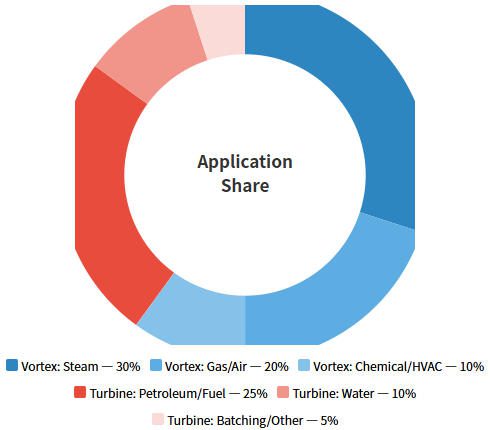
Estimated based on industry reports from Mordor Intelligence, Grand View Research, and field-installation data (2025–2026)
The pie chart above illustrates the complementary nature of these two technologies. Vortex meters own the steam and gas domain (roughly 60% of combined installations), while turbine meters own petroleum custody transfer and clean-water totalization (roughly 40%). There’s minimal overlap — and that’s exactly how it should be. Choosing the right meter for the right application isn’t about which technology is “better” in the abstract; it’s about matching the working principle to the fluid, the accuracy requirement, and the maintenance budget.
Selection Guide
| If Your Application Involves… | Choose This | Why |
|---|---|---|
| Saturated or superheated steam | Vortex | Handles up to 450°C; no bearings to destroy; integrated T/P compensation available |
| Compressed air, nitrogen, CO₂ | Vortex | Stable output regardless of pressure fluctuations; minimal maintenance |
| Petroleum custody transfer (diesel, gasoline, JET-A1) | Turbine | ±0.25% accuracy meets API/AGA requirements; pulse output for totalizing |
| Clean potable water totalization | Turbine | Low cost, compact, proven at municipal scale |
| Chemical solvents, acids, thermal oils (up to 400°C) | Vortex | No moving parts to contaminate product; handles high temperatures |
| Batch dosing of low-viscosity liquids | Turbine | Millisecond response; precise pulse totalizing; compact skid integration |
| Dirty or particle-laden water/fluids | Neither — use electromagnetic | Both vortex and turbine struggle with high solids; mag meters have full-bore, no obstruction |
| HVAC chilled/hot water energy metering | Vortex | Long-term stability (15+ years); no recalibration; low pressure drop |
| LPG or cryogenic liquids | Turbine | Proven in cryogenic service; high accuracy at extreme cold with proper bearing selection |
| Budget-constrained, moderate accuracy (±1–2%) | Vortex | Lower 5-year TCO; fewer spare parts; less downtime |
For a more comprehensive framework covering five decision factors — performance, fluid compatibility, installation, environment, and lifecycle cost — the 5-factor flow meter selection guide on JadeAntInstruments.com provides a structured template that works for both vortex and turbine evaluations.

The vortex flow meter and the turbine flow meter solve fundamentally different measurement problems using fundamentally different physics. The vortex meter reads fluid oscillations from a fixed bluff body — no rotor, no bearings, no mechanical wear — making it the natural choice for steam, gas, compressed air, and high-temperature chemical applications where maintenance access is limited and fluid conditions are variable. The turbine meter spins a precision rotor whose rotation speed tracks flow rate with exceptional accuracy — making it the natural choice for clean-liquid custody transfer, fuel distribution, and volumetric batching where ±0.25% accuracy and fast pulse output are non-negotiable.
These differences in working principle cascade into every practical decision. Vortex meters deliver lower 5-year maintenance costs ($200–$600 vs. $1,200–$5,000+), handle wider temperature ranges (up to 450°C vs. ~200°C), and tolerate moderate fluid impurities without accuracy degradation. Turbine meters deliver tighter accuracy on clean liquids (±0.25% vs. ±0.5%), faster response for batch control, and a compact form factor that fits mobile and skid-mounted applications.
The practical advice is straightforward: don’t default to either technology. Define your fluid, your temperature, your accuracy requirement, and your maintenance budget first. Then match those constraints to the working principle that serves them best. A textile mill measuring boiler steam belongs on vortex meters. An airport fueling station measuring JET-A1 belongs on turbine meters. A plant engineer who puts turbine meters on a steam line because “they’re cheaper up front” will spend the savings — and then some — on bearing kits and unplanned downtime within the first two years.
Both Jade Ant Instruments vortex and turbine flow meters are built to ISO standards with 4–20 mA, pulse, HART, and Modbus outputs. The engineering team provides free sizing assistance, viscosity-compensation guidance, and installation support to help you match the right working principle to your specific line — across metallurgy, chemical, HVAC, textile, and environmental engineering applications in over 50 countries.
Frequently Asked Questions (FAQs)
1. What is the main difference between a vortex flow meter and a turbine flow meter?
A vortex flow meter measures flow by detecting pressure oscillations from vortex shedding around a fixed bluff body — no moving parts. A turbine flow meter measures flow by counting the rotational speed of a mechanical rotor spun by the fluid. The vortex meter depends on stable turbulent flow (Re > 10,000); the turbine meter depends on clean fluid and healthy bearings.
2. Which is more accurate — vortex or turbine?
For clean, low-viscosity liquids, turbine meters are more accurate: ±0.25–0.5% of reading (calibrated) versus ±0.5–1.0% for vortex meters. For gas and steam, vortex meters typically achieve ±1.0–1.5% — and gas-specific turbine meters achieve similar figures. Over time, however, vortex meters maintain their accuracy longer because they have no bearings to wear.
3. Can a vortex flow meter measure steam?
Yes — steam measurement is one of the vortex meter’s strongest applications. With integrated temperature and pressure compensation, a vortex meter can calculate the mass flow of saturated or superheated steam directly. Sierra Instruments calls vortex meters “the industry standard” for steam flow measurement. Turbine meters are not suitable for steam.
4. Why can’t turbine flow meters handle dirty fluids?
Turbine meters rely on precision bearings and a free-spinning rotor. Particles as small as 25–75 µm can accelerate bearing wear, shift the K-factor, and eventually jam the rotor. A fuel terminal in Rotterdam documented a 0.3% K-factor shift after 14 months on a diesel line that exceeded filtration specifications. For dirty or particle-laden fluids, electromagnetic flow meters — which have no moving parts and a full-bore design — are the standard alternative.
5. What is the typical lifespan of each meter type?
Vortex flow meters typically last 15–20+ years with minimal maintenance, because they have no mechanical wear components. Turbine flow meters typically last 5–10 years before needing bearing replacement or a full rebuild, depending on fluid cleanliness and operating hours. With regular maintenance, some turbine meters extend to 15 years of total service life.
6. Which meter type has lower total cost of ownership?
In most applications, vortex meters have lower 5-year TCO despite higher initial cost ($1,500–$3,000 vs. $300–$2,500 for turbine). The savings come from near-zero maintenance costs. However, for clean-liquid custody transfer where turbine accuracy (±0.25%) prevents financial losses on high-value product, the turbine meter’s higher maintenance cost is easily justified by measurement precision.
7. Do vortex flow meters require straight pipe runs?
Yes. Most vortex meters require 15–20 pipe diameters (D) of straight, unobstructed pipe upstream and 5D downstream. This ensures fully developed turbulent flow and stable vortex shedding. Flow conditioners can reduce the upstream requirement to approximately 10D but add $1,000–$2,500 to the installation cost. Jade Ant Instruments notes that vortex and turbine meters are the most sensitive to upstream disturbances among common flow-meter types.
8. Can I use a turbine flow meter for gas measurement?
Yes, but you need a gas-specific turbine meter — not a liquid turbine meter. Gas turbine meters are designed with lighter rotors and optimized blade angles for low-density media. They’re widely used for natural-gas custody transfer under AGA Report No. 7 and ISO 9951. Liquid turbine meters should never be used for gas or steam.
9. What fluids are best measured by each technology?
Vortex meters excel at measuring steam (saturated and superheated), compressed air, nitrogen, CO₂, natural gas, chemical solvents, thermal oils, and hot water. Turbine meters excel at measuring clean, low-viscosity liquids: refined petroleum products (gasoline, diesel, JET-A1), LPG, water, de-ionized water, and light oils below ~100 cP viscosity.
10. Does Jade Ant Instruments manufacture both vortex and turbine flow meters?
Yes. Jade Ant Instruments manufactures electromagnetic, vortex, and turbine flow meters under ISO certification, with 4–20 mA, pulse, HART, and Modbus RS485 communication options. The company provides OEM/ODM customization for non-standard sizes, materials, and connection types, and ships to over 50 countries across metallurgy, chemical, HVAC, textile, and environmental-engineering sectors.
Recommended External References
- Emerson — Learn About Vortex Flow Measurement
- Endress+Hauser — Vortex Flow Measuring Principle
- Turbines Incorporated — How Turbine Flow Meters Work
- Badger Meter — Turbine Flow Meters
- Wikipedia — Kármán Vortex Street
- Jade Ant Instruments — Flow Meter Manufacturer (Vortex, Turbine, Electromagnetic)
- Jade Ant Instruments — Comparing Liquid Flow Measurement Devices and Principles
- Jade Ant Instruments — Comparing Leading Flow Meter Companies
- Jade Ant Instruments — Comparing Leading Flow Monitors for Industrial Use