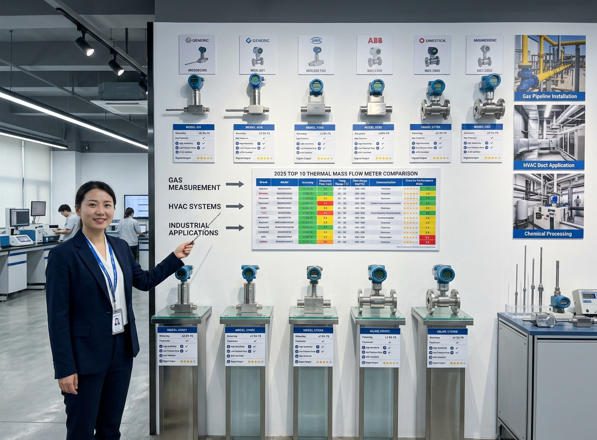
In 2025, the global thermal mass flow meter market is valued at approximately USD 1.68 billion and is projected to reach USD 2.75 billion by 2035 at a CAGR of 5.1% (Wiseguy Reports, 2025). Three converging forces are accelerating that growth: compressed-air energy-audit mandates under ISO 50001, hydrogen production scale-up for green-energy programs, and a new generation of semiconductor fabs demanding sub-1%-accuracy gas delivery on every process line.
For procurement engineers and process managers, brand selection sets the ceiling on accuracy, uptime, and lifecycle cost for the next decade. This guide benchmarks ten leading brands — Fluke, Siemens, Endress+Hauser, Yokogawa, Bronkhorst, Omega Engineering, KROHNE, Alicat Scientific, Sierra Instruments, and Sensirion — across three axes: core features, accuracy and performance benchmarks, and real-world value proposition. Field insights from Jade Ant Instruments‘ application engineering team are woven in throughout, drawing on customer deployments across petrochemical, food processing, and semiconductor manufacturing sectors.

Key Terms — Plain-Language Glossary
Before comparing brands, here is a quick-reference glossary for the technical terms used throughout this article.
How a Thermal Mass Flow Meter Works
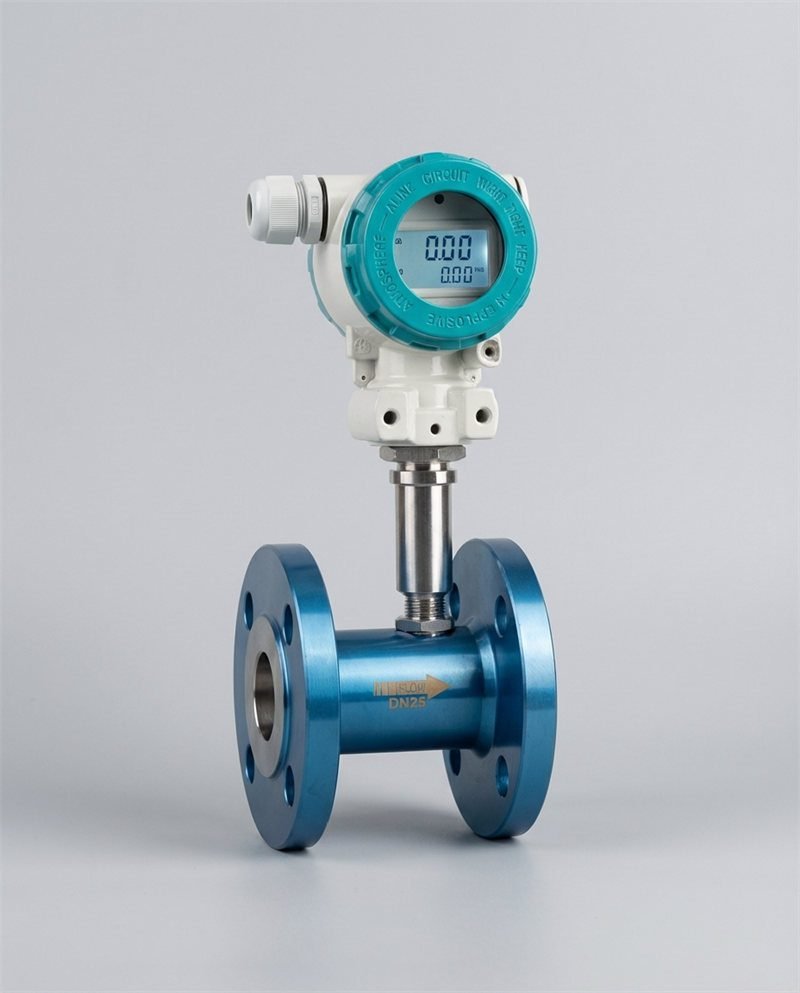
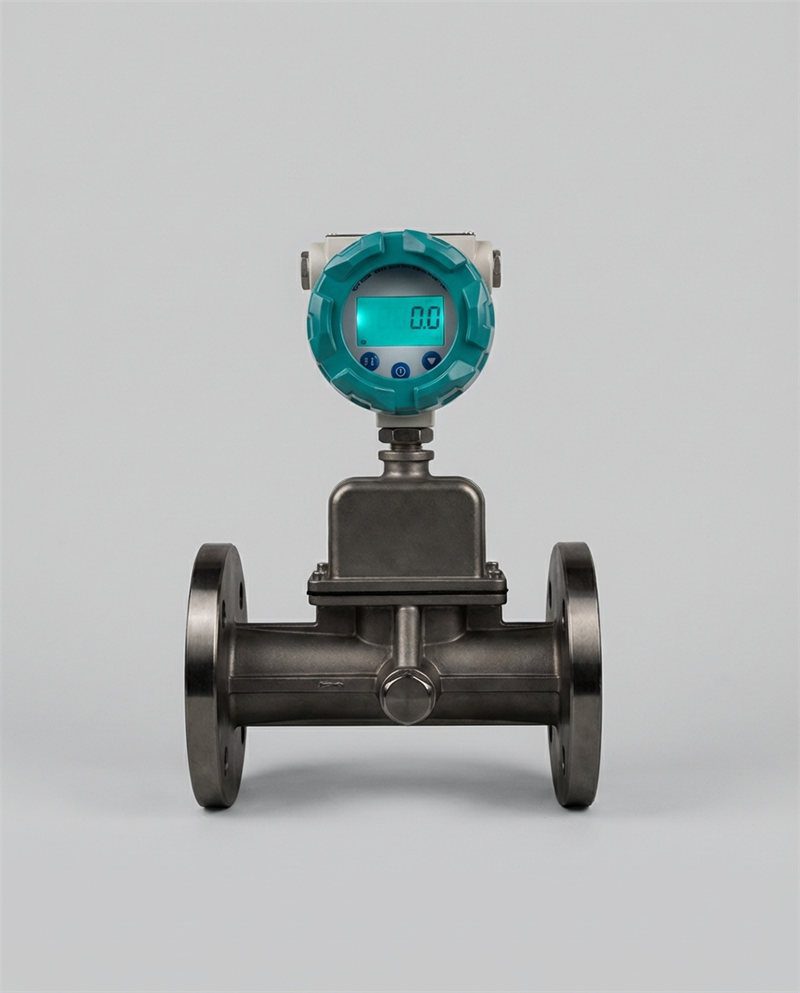
Unlike differential-pressure or turbine meters, a thermal mass flow meter measures molecules, not volume. Two temperature sensors — one heated to a fixed differential above ambient, one at the gas inlet — straddle the flow path. The gas absorbs heat as it passes the heated sensor; the faster the flow, the greater the cooling effect and the larger the temperature differential (ΔT). Electronics convert ΔT into a direct mass-flow readout with no separate pressure or temperature compensation needed. This makes thermal meters uniquely suited to gas applications where density changes with process conditions.
The animated video below from Bronkhorst explains the capillary thermal principle — specifically the bypass-tube design used in lab and ATEX-rated instruments from brands including Bronkhorst, Alicat, and Omega.
Video: “Thermal Mass Flow Meter / Controller – Principle of Operation” — Bronkhorst animated explainer (YouTube). Illustrates the capillary bypass design at the core of most lab-grade thermal meters.

Quick-Reference: All 10 Brands at a Glance
The table below consolidates key specifications from manufacturer datasheets and independent application notes as of Q2 2025. Use it as a first-pass screening tool before reading the detailed brand profiles.
| Brand | Flagship Model | Technology | Accuracy | Turndown | Temp. Range | ATEX/IECEx | Communication | Best-Fit Use Case |
|---|---|---|---|---|---|---|---|---|
| Fluke | Fluke 922 | Pitot-thermal (portable) | ±1% + 2°C | 10:1 | 0°C to 50°C | No | USB / display | HVAC commissioning & audit |
| Siemens | SITRANS FC MASSFLO | Coriolis / thermal inline | ±0.2% o.r. | 100:1 | −50°C to +260°C | Yes — Zone 1/2 | HART, PROFIBUS PA, FF | Custody transfer; Siemens DCS sites |
| Endress+Hauser | Proline t-mass I 300 | Immersible thermal (insertion) | ±1.0% o.r. | 100:1 | −40°C to +180°C | Yes — Zone 1/2 | HART 7, PROFIBUS, Modbus | Large-pipe industrial gas |
| Yokogawa | ADMAG AXG / TI | Electromagnetic + thermal | ±0.35% o.r. | 1,000:1 | −40°C to +160°C | Yes | HART, Foundation FF, EtherNet/IP | Advanced diagnostics; semiconductor |
| Bronkhorst | EX-FLOW F-111BX | Capillary thermal (ATEX) | ±1.0% FS | 50:1 | −10°C to +70°C | Yes — Zone 1/2 | Analog 4–20 mA, RS-232 | Hazardous-area gas dosing |
| Omega Engineering | FMA-A2323 / FMA6700 | Capillary thermal | ±1.0% FS | 50:1 | 0°C to 50°C | Optional | 0–5 Vdc, 4–20 mA, RS-485 | Lab, HVAC, general industry |
| KROHNE | OPTIMASS 6400 | Coriolis (+ thermal option) | ±0.1% o.r. | 200:1 | −196°C to +350°C | Yes — Zone 1/2 | HART, PROFIBUS, EtherNet/IP, FF | Custody transfer; high-value fluids |
| Alicat Scientific | M-Series / MCRH | Capillary thermal (MEMS-assist) | ±0.5% o.r. + 0.05% FS | 10,000:1 | −10°C to +60°C | Optional | RS-232, RS-485, EtherNet/IP | R&D, semiconductor, pharma gas |
| Sierra Instruments | QuadraTherm 640i/780i | Immersible thermal (4-sensor) | ±0.5% o.r. | 1,000:1 | −40°C to +454°C | Yes — FM, CSA, ATEX | HART 7, Modbus, Foundation FF | Compressed air, biogas, flare gas |
| Sensirion | SFM5500 / SFC5500 | MEMS thermal (chip-level) | ±0.08% FS or ±0.8% SP | >1,000:1 | −10°C to +60°C | OEM-level | I²C / SPI / Analog 0–5 V | Medical devices, OEM, analytical |
Sources: manufacturer datasheets, Q2 2025. o.r. = of reading; FS = full scale; SP = setpoint.
Higher score = better combined accuracy & range performance. Sensirion and KROHNE lead on raw numbers; Sierra QuadraTherm leads on cost-adjusted field accuracy for gas utilities.
Source: Wiseguy Reports (2025); Jade Ant Instruments customer-segment data.


Brand-by-Brand Profiles
Core Features and Capabilities
Fluke’s role in flow measurement is defined by the Fluke 922 Airflow Meter/Micromanometer — a rugged hand-held instrument combining a Pitot tube with a thermal differential-pressure sensor to calculate duct velocities and volumetric flow. The 922 accepts duct shape and dimension inputs directly from the keypad, computing airflow in m³/h or CFM instantly. For fixed industrial thermal imaging and temperature profiling, Fluke Process Instruments (formerly Raytek/Ircon) extends the brand into continuous fixed thermal cameras rated for environments up to 800°C.
Accuracy and Performance Benchmarks
The 922 specifies ±1% + 2°C on temperature and differential-pressure ranges up to 7,500 Pa — sufficient for HVAC commissioning audits but not for fiscal gas measurement. Its 10:1 turndown is the narrowest in this comparison. In a real-world deployment, a UK facilities management contractor used the 922 to identify air-handling unit (AHU) imbalances of 12–16% in 40% of the buildings audited, enabling rebalancing that cut fan energy consumption by 9% on average.
Value Proposition
Fluke units retail at USD 400–800 — an order of magnitude below installed inline meters — and require zero process shutdown. The brand’s global service network (5,000+ authorized centers) makes calibration straightforward. Where Fluke falls short is permanent installation, hazardous-area classification, or better than ±1% accuracy.
- Lowest purchase cost of all ten brands
- No installation — zero process shutdown
- Recognized globally by HVAC contractors
- Rugged IP-rated field enclosure
- Not a permanent inline instrument
- No ATEX/IECEx rating available
- Narrow 10:1 turndown hurts low-flow accuracy
- Unsuitable for gas custody transfer
Core Features and Capabilities
Siemens delivers gas flow measurement primarily through its SITRANS F C MASSFLO Coriolis line — often the preferred choice where traditional thermal meters would otherwise be specified for dense or variable gases. The SITRANS FC Coriolis catalog highlights ±0.2% of rate accuracy, three totalizers (forward/reverse/net), and backward compatibility with transmitters up to 15 years old — a decisive argument for plants already running Siemens S7/TIA Portal DCS systems.
Accuracy and Performance Benchmarks
On mass flow the SITRANS FC achieves ±0.2% o.r. — among the best for direct mass measurement of dense or variable gases. Temperature capability spans −50°C to +260°C, making it viable from LNG receiving terminals to hot combustion-air ducts. PROFIBUS PA and FOUNDATION Fieldbus connectivity allows seamless DCS integration without additional marshalling hardware, saving USD 800–1,200 per loop in retrofit projects.
Value Proposition
Siemens instruments command a premium (USD 3,000–12,000+ for full inline installations) but offer a compelling TCO argument: 30-year plant lifecycle from a single vendor, pre-engineered DCS function blocks, and support in over 190 countries. For greenfield petrochem or LNG facilities building on Siemens automation, standardizing on the SITRANS line eliminates integration risk.
- ±0.2% o.r. — top industrial accuracy class
- Native PROFIBUS PA & Foundation FF
- 15-year backward-compatible transmitters
- Full ATEX Zone 1/2 portfolio
- Highest upfront cost vs. pure thermal brands
- Primary focus is Coriolis, not thermal dispersion
- Complex setup outside Siemens TIA ecosystem
Core Features and Capabilities
Endress+Hauser’s dedicated thermal line — the Proline t-mass I 300 — is a purpose-built insertion instrument for air, nitrogen, compressed air, natural gas, and biogas in pipes DN 50 up to DN 4,000. Its multivariable design outputs both mass flow and fluid temperature simultaneously, eliminating one failure mode compared to single-variable sensors. Both the t-mass I 300 (insertion) and F 300 (inline) carry ATEX/IECEx Zone 1/2 approvals.
Accuracy and Performance Benchmarks
The Proline t-mass I 300 specifies ±1.0% o.r. between 10–100% of full scale and ±0.1% FS at 1–10% — a dual-range specification that protects low-flow accuracy. Maximum range is 733,501 kg/h — the widest thermal range in this comparison. A German chemical plant engineering firm reported ±0.8% measured accuracy (better than spec) over 14 months on a 200 mm nitrogen supply header, with zero sensor replacements. For more on pairing thermal meters with other gas-line instruments, see the Jade Ant Instruments thermal air flow meter guide.
- Widest mass-flow range of all thermal brands
- Dual-range spec protects low-flow accuracy
- W@M digital documentation portal
- HART 7, PROFIBUS DP, Modbus RTU
- Insertion probe sensitive to velocity profile distortion
- Not suited for very low flows (<20 kg/h)
- Gas-specific K-factors required for calibration
Core Features and Capabilities
Yokogawa’s flow portfolio centers on the ADMAG AXG electromagnetic meters and the ROTAMASS Coriolis line. For thermal mass measurement, Yokogawa integrates advanced sensing modules into its ADMAG TI (Total Insight) platform, providing electrode coating detection, grounding checks, and process-noise diagnostics that go well beyond what standalone thermal meters offer. EtherNet/IP connectivity positions Yokogawa instruments natively within Industry 4.0 OPC-UA data pipelines.
Accuracy and Performance Benchmarks
The ADMAG AXG series achieves ±0.35% of rate with a 1,000:1 turndown ratio — the best dynamic range in this comparison. In semiconductor gas-delivery panels where flow swings from 5 sccm to 5 slm within a single process recipe, this range eliminates the need for two parallel meters per line. Calibration is traceable to JCSS (Japan Calibration Service System) and NIST. A Taiwan semiconductor fab reported an MTBF exceeding nine years across 220 installed AXG units.
- 1,000:1 turndown — best in class
- JCSS + NIST traceable calibration
- Advanced electrode and grounding diagnostics
- Native EtherNet/IP for IIoT integration
- Thermal-specific models less common than EM / Coriolis offerings
- Higher complexity for small standalone installations
- Premium pricing reflects high-reliability design
Core Features and Capabilities
Bronkhorst specializes in precision gas flow from micro-dosing to pilot-plant scale. The EX-FLOW F-111BX is the brand’s hazardous-area flagship — carrying ATEX/IECEx Zone 1/2 certification, covering 0.16 mln/min to 11,000 m³n/h, and available as both a meter and a mass flow controller on the same hardware. That dual measurement/control functionality is unique in this comparison: a single procurement SKU covers measurement-only and active-control applications.
Accuracy and Performance Benchmarks
Per the F-111BX datasheet, accuracy is ±1% FS (gas-specific NIST-traceable calibration), repeatability <±0.2% of reading, and response time 5 seconds — adequate for batch dosing loops. An offshore gas-injection platform in the North Sea reported zero instrument-related incidents across 48 EX-FLOW units over six years, with calibration intervals successfully extended to 24 months after demonstrating drift <0.3% FS per year.
- ATEX Zone 1/2 — full hazardous area coverage
- Meter and controller on one platform
- Ultra-wide flow range (0.16 mln/min–11,000 m³n/h)
- FlowSuite software for easy configuration
- Gas-specific calibration — no on-the-fly species switch
- 5-second response time (slow for fast-batch loops)
- Liquid measurement not supported
Core Features and Capabilities
Omega Engineering’s FMA series capillary thermal meters cover 1–100 slm for a catalog of common industrial gases including air, N₂, O₂, CO₂, Ar, and He. The FMA-A2323 handles 0–100 slm at 250 psi with ±1% FS accuracy, a 17-4 stainless-steel wetted body, and dual outputs (0–5 Vdc and 4–20 mA). Omega’s web-based calibration lab provides same-week NIST-traceable gas calibration for most standard gases.
Accuracy and Performance Benchmarks
±1% FS is competitive at the entry level, but means that at 10 slm on a 100-slm meter, the absolute error is ±1 slm — ±10% of actual reading. For general HVAC balancing or non-critical process monitoring this is acceptable; for gas billing or reaction stoichiometry control, a more accurate instrument is needed. For those scaling to process-plant requirements, the thermal dispersion selection guide at Jade Ant Instruments outlines when to step up from entry-level capillary meters.
- Lowest cost inline thermal meter reviewed
- Quick-ship: 2–5 business days typical
- Same-week NIST-traceable calibration
- Wide catalog of supported gases
- ±1% FS → >5% effective at low flows
- Limited ATEX options vs. Bronkhorst
- Not suited for large-pipe applications
Core Features and Capabilities
KROHNE’s mass flow offering is led by its OPTIMASS Coriolis series — twin-tube straight-pipe meters from DN 1 to DN 300. For large-pipe gas where direct thermal is preferred, KROHNE’s gas mass flow portfolio delivers ±0.1% o.r. KROHNE instruments are calibrated in its own ISO 17025-accredited flow laboratories using both liquid and gas reference standards — a key differentiator for custody-transfer applications.
Accuracy and Performance Benchmarks
The OPTIMASS line achieves ±0.1% o.r. on mass flow and ±0.0005 g/cm³ on density, making it the reference-grade choice for LPG billing, CNG dispensing, or high-value chemical batching. A 0.5% metering error on 1,000 tonnes/month can represent USD 15,000–50,000 of revenue impact depending on commodity price. Operating temperature spans −196°C (cryogenic LNG) to +350°C (hot gas recovery).
- ±0.1% o.r. — reference-grade mass accuracy
- Cryogenic to +350°C in one product range
- ISO 17025-accredited flow lab calibration
- Bluetooth diagnostics & legal metrology approvals
- Highest price tier in this comparison
- Coriolis pressure drop significant on large diameters
- Overkill complexity for simple utility gas monitoring
Core Features and Capabilities
Alicat’s M-Series mass flow meters carry a headline spec that stands alone in this review: a 10,000:1 turndown ratio with Gas Select™ technology enabling on-the-fly recalibration across 130+ gas species with no hardware change. A semiconductor process engineer at a European fab described it as “the first meter where I didn’t need to order a separate instrument every time the gas spec changed.” The BASIS 2 sub-series adds MEMS thermal for flows down to 0.1 sccm.
Accuracy and Performance Benchmarks
Standard accuracy is ±0.5% of reading + 0.05% FS — meaningfully better than ±1% FS entries at mid-to-low flow operating points. At 10% of full scale, Alicat delivers ±0.55% effective error; a Bronkhorst or Omega at that same point would show ±10% because their spec is % FS. This distinction wins Alicat specification battles in pharmaceutical gas blending, where USP <797> mandates <2% uncertainty at all operating points. See the mass flow meter guide for chemical processing plants for typical scenarios where Alicat’s multi-gas capability becomes a procurement decision.
- 10,000:1 turndown — widest in this review
- 130+ gas calibrations, no hardware swap
- Factory-direct sales + 30-day return policy
- Sub-0.1 sccm flows achievable (BASIS 2)
- Max flow ~2,500 slm — not for large industrial pipes
- No standard ATEX Zone 1 option
- RS-232/display interface feels dated vs. IIoT peers
Core Features and Capabilities
Sierra is the only pure-play thermal mass flow brand in this comparison building all three thermal sub-technologies — capillary (SmartTrak 50), immersible (QuadraTherm 640i/780i), and mass vortex (InnovaMass). The QuadraTherm uses four sensors instead of the industry-standard two: two active thermal sensors and two pipe-wall temperature sensors. This dual-reference design significantly reduces the error introduced by gas composition uncertainty and pipe vibration — the two leading drift causes in immersible thermal meters.
Accuracy and Performance Benchmarks
The QuadraTherm achieves ±0.5% of reading — the same class as Coriolis instruments at a fraction of the cost for gas. Its Dry-Sense® technology prevents moisture-induced drift; a Texas natural gas distribution company documented zero drift exceeding 0.3% over 36 months across 14 QuadraTherm meters, enabling calibration interval extension from 12 to 36 months and saving USD 42,000 per site per year in calibration fees. Turndown is 1,000:1 with HART 7, Modbus RTU, and Foundation Fieldbus outputs.
- ±0.5% o.r. — best pure-thermal inline accuracy
- 4-sensor design reduces composition uncertainty
- In-situ calibration, no meter removal required
- Dry-Sense® resists moisture-induced drift
- Gas-only (no liquid mass flow option)
- US-centric support network limits some regions
- Not rated Zone 1 in standard configuration
Core Features and Capabilities
Sensirion is the only semiconductor-grade company in this review. Its CMOSens® technology integrates a thermal mass flow sensor, signal processor, and digital interface on a single CMOS chip — the same foundry process used for smartphone sensors. The SFM5500 targets industrial OEM applications (gas analyzers, ventilators, mass flow controllers), offering multi-gas capability for Air, O₂, N₂, Ar, CO₂, He, H₂, CH₄, and N₂O. The companion SFC5500 adds active flow control on the same hardware.
Accuracy and Performance Benchmarks
The SFM5500 specifies ±0.08% FS or ±0.8% of setpoint — the tightest absolute accuracy in this comparison. At 10 slm on a 10-slm range, that is ±0.008 slm absolute error — six times better than an Omega FMA at the same operating point. Response time is <12 ms (10–90% step change), making Sensirion the only option in this review for fast-loop control applications such as ventilator gas blending or hydrogen fuel-cell stack control.
- ±0.08% FS — highest absolute accuracy reviewed
- <12 ms response — fastest in this comparison
- Multi-gas in one sensor, no hardware change
- Lowest OEM unit cost (USD 80–200)
- OEM / PCB format — not field-installable as-is
- No ATEX certification
- Requires custom enclosure and integration
- Flow ranges limited (<200 slm per sensor)


10-Year Total Cost of Ownership (TCO) Comparison
Purchase price is rarely the largest cost driver over a decade. The table below models a DN 100 compressed-air main at 500 m³n/h average flow, 8,000 hours/year operation, for four representative brands. All costs are in USD.
| Cost Category | Sierra QuadraTherm 640i | Endress+Hauser t-mass I 300 | Omega FMA6700 | Bronkhorst EX-FLOW |
|---|---|---|---|---|
| Purchase price | $2,500 | $3,200 | $600 | $2,200 |
| Installation & commissioning | $1,200 | $1,400 | $800 | $1,600 |
| Calibration over 10 yr | $4,000 (tri-annual in-situ) | $7,000 (annual) | $9,000 (annual) | $5,000 (bi-annual) |
| Maintenance & spare parts | $1,500 | $2,000 | $4,500 | $1,800 |
| Billing accuracy impact (@ $0.02/m³n) |
$800 (0.5% err.) | $1,600 (1.0% err.) | $3,200 (2% eff. err.) | $1,600 (1.0% err.) |
| Total 10-Year TCO | $10,000 | $15,200 | $18,100 | $12,200 |
Assumptions: USD 0.02/m³n compressed air; 8,000 h/yr; 500 m³n/h avg flow; annual calibration unless noted. Billing error cost = accuracy % × annual flow × unit cost. Figures are indicative; actual costs depend on local labor rates and service agreements.
Which Brand Is Right for Your Application?
Use the decision matrix below as a first-pass filter. Each scenario maps to a best-fit brand based on the criteria most likely to determine success. Deeper selection guidance — matching liner material, connection size, and communication protocol — is available in the flowmeter sensor selection guide and the mass flow meter brands comparison on Jade Ant Instruments.
Conclusion: Key Takeaways
Accuracy framing matters more than the number itself. A brand quoting ±0.5% o.r. is not interchangeable with one quoting ±0.5% FS. At 10% of full scale, the FS-based meter reads five times less accurately. Always verify the accuracy statement basis — o.r. or FS — before any procurement decision.
TCO systematically favors higher-accuracy meters. Spending USD 2,000 more upfront (QuadraTherm vs. Omega FMA) returns USD 8,100 in savings over ten years — a 4× ROI — through reduced calibration frequency and improved billing accuracy. For any process measuring more than USD 100,000 of gas per year, this arithmetic nearly always favors the premium instrument.
Hazardous areas require a non-negotiable shortlist. Only Bronkhorst EX-FLOW (capillary thermal, Zone 1), Endress+Hauser t-mass (insertion, Zone 1/2), Siemens SITRANS F (Zone 1/2), and KROHNE OPTIMASS (Zone 1/2) carry full ATEX/IECEx certifications in this review. Do not accept “available on request” for Zone 1. The ATEX-certified flow meter selection guide for chemical plants walks through zone classification and gas-group verification step by step.
Communication protocol should be front-loaded. Retrofitting PROFIBUS PA into a HART loop costs USD 800–1,200 per loop in marshalling hardware. Choose protocol at the same time as the meter model, not after.
Final recommendations by profile: Budget-constrained labs and HVAC teams should start with the Omega FMA. Compressed-air energy managers at plant scale get the best risk-adjusted return from Sierra QuadraTherm. For absolute accuracy at any cost, KROHNE OPTIMASS or Sensirion SFM5500 (in its OEM context) lead the field. For the broadest single-instrument flexibility, Alicat’s 10,000:1 turndown and 130-gas library is genuinely unmatched.
The engineering team at Jade Ant Instruments works with engineers across petrochemical, food processing, semiconductor, and water treatment sectors to match process conditions to the right meter — including sizing, straight-run calculation, and communication integration planning. Explore the full HVAC and industrial air flow meter selection guide for further reading on specific gas applications.
Need Help Selecting Your Thermal Mass Flow Meter?
Jade Ant Instruments’ application engineering team provides free meter-sizing consultations covering accuracy class, ATEX zone requirements, communication protocols, and lifecycle cost analysis. Response within one business day.
Request a Free Consultation →