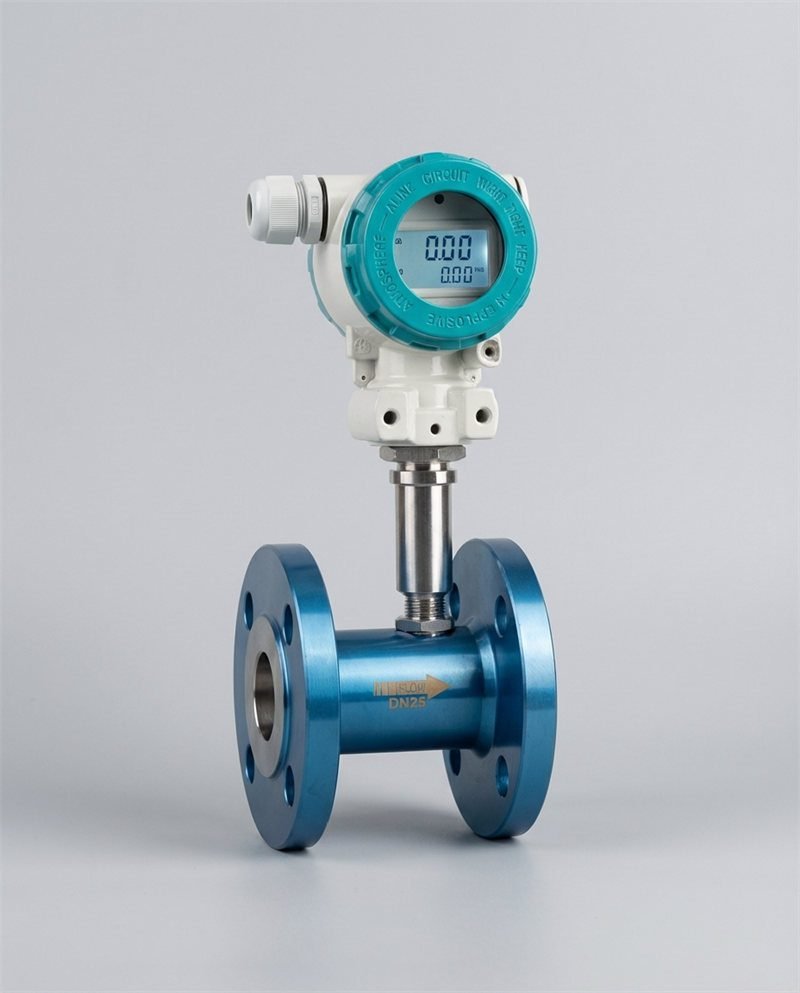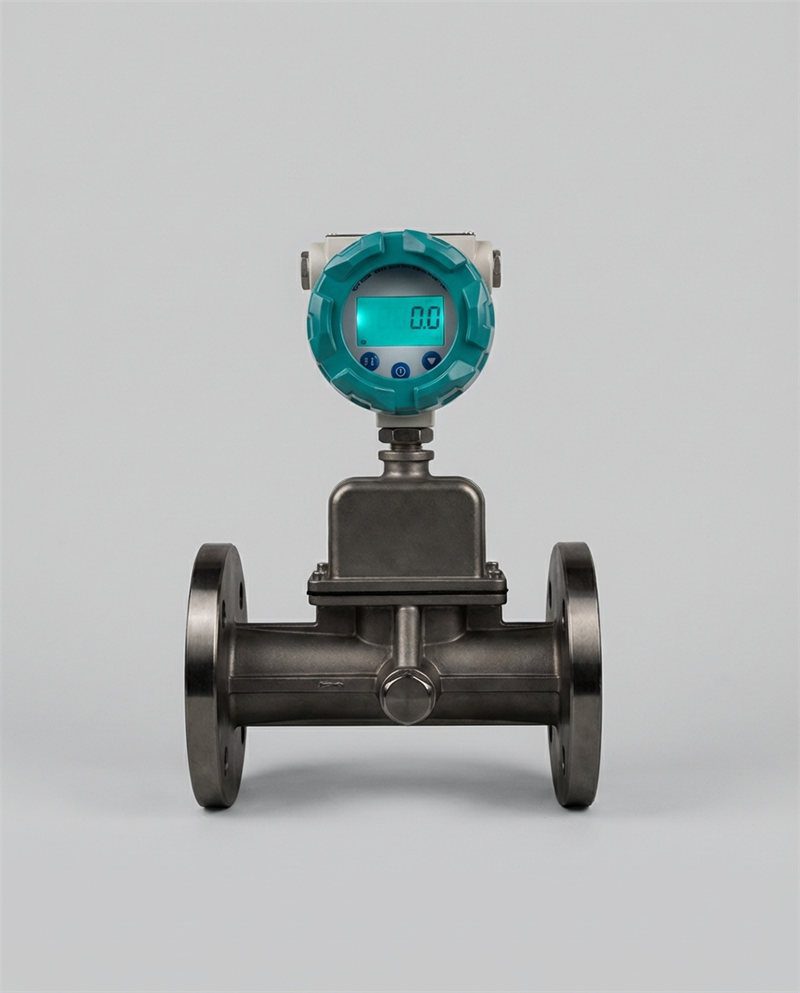
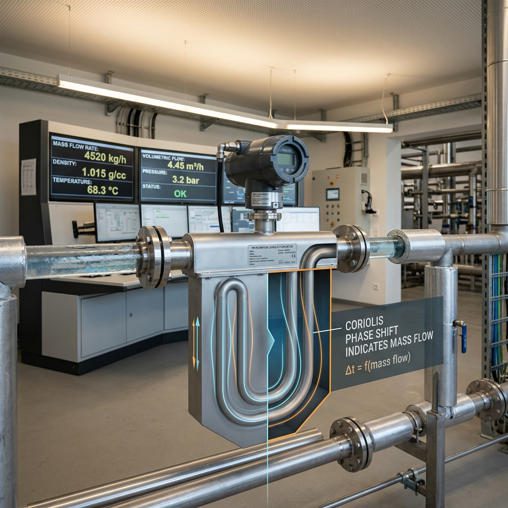
A comprehensive guide to understanding Coriolis principle technology and how vibrating tubes accurately measure fluid mass flow in industrial applications — written for flow instrumentation distributors, agents, and technical sales teams.
Why Coriolis Flow Meters Matter to Your Business
If your team is still explaining Coriolis meters purely as “a mass flow device,” you’re leaving competitive ground on the table. Distributors and agents who can articulate why the physics works — not just que the meter works — consistently win the technical conversations that precede large-ticket purchase orders.
The global Coriolis flow meters market was valued at $1.4 billion in 2025 and is projected to reach $2.41 billion by 2034, expanding at a compound annual growth rate that reflects deepening industrial demand across chemicals, pharmaceuticals, oil & gas, and food production. Your customers are increasingly specifying Coriolis technology for critical process points — and they’re asking harder questions. Understanding the physics behind the spin transforms your sales team from product distributors into trusted technical advisors. That’s the difference between winning the order and losing it to a competitor who “knows the spec sheet better.”
This guide walks you through every layer of Coriolis technology: from 19th-century physics to modern signal processing, from single-tube mechanics to 100:1 turndown ratios, from installation flexibility to 10-year total cost of ownership. Read it. Share it with your team. Use it in every technical conversation.

Section 1: Foundation Principles — Understanding the Coriolis Effect
The Coriolis Effect Explained Simply
Before a single fluid molecule enters a flow meter, the underlying physics that makes the measurement possible has already been doing its work for nearly 200 years. Understanding where Coriolis technology came from — and what it actually does — is the foundation for everything that follows.
Classical Definition and Historical Context
The Coriolis effect is named after French mathematician and engineer Gaspard-Gustave de Coriolis, who published his landmark paper “Sur les équations du mouvement relatif des systèmes de corps” in 1835. His insight was elegant: in a rotating reference frame, a moving object experiences an apparent deflection force perpendicular to its direction of motion. He wasn’t describing flow meters — he was describing the mathematics of rotating machinery and water wheels. But the principle he formalized would eventually become the cornerstone of one of the most accurate measurement technologies in industrial history.
For much of the 19th and early 20th centuries, engineers dismissed the Coriolis force as a curiosity relevant only to large-scale geophysical systems. The intuitive objection was reasonable: if you need a rotating planet to observe the effect in atmospheric systems, how could it possibly be exploited inside a small metal tube in an industrial plant? The breakthrough came when engineers recognized that artificial oscillation — vibrating a tube back and forth at its natural resonant frequency — could simulate the rotating reference frame at a scale small enough to be practical in process measurement equipment. The first commercial Coriolis flow meters appeared in the early 1970s, and the technology has been refined continuously ever since.
Real-World Coriolis Manifestations
The Coriolis effect is most famously visible in Earth’s atmosphere and oceans. Hurricanes rotate counterclockwise in the Northern Hemisphere and clockwise in the Southern Hemisphere because the Coriolis force deflects air masses as they flow toward low-pressure centers. The same principle guides ocean current patterns and plays a role in ballistic trajectory calculations over long distances.
When you explain this to a customer’s process engineer, the connection becomes immediately intuitive: the same physics that steers a Category 5 hurricane is what we’ve miniaturized inside this vibrating tube to tell you exactly how many kilograms of fluid are passing through your pipe per second. That framing — connecting something tangible to something abstract — is far more persuasive than reciting a specification sheet.
A common customer misconception is that the Coriolis effect requires rotation in the conventional mechanical sense. It does not. The oscillating motion of the vibrating tube creates an equivalent rotating reference frame locally, which is sufficient to induce the measurable deflection forces that carry the flow information.
The Mathematical Foundation
The core relationship is expressed through Newton’s second law applied to a rotating system:
Où is the Coriolis force, is the mass of the moving fluid, is the angular velocity of the rotating (oscillating) reference frame, and is the velocity of the fluid moving through the tube.
For practical purposes, what this equation tells us is critical: the Coriolis force is directly proportional to mass. Double the mass flow rate, double the force. The velocity and the angular frequency remain controlled constants in a well-designed meter, leaving mass flow as the only variable. This is why Coriolis technology delivers inherently mass-based measurement — the physics forces it to be.
For your sales conversations, the simplified version is: “The harder the fluid pushes back on the vibrating tube, the more mass is flowing. We measure the push, and we give you the mass.”
Section 2: Vibrating Tube Technology — The Hardware
How Vibrating Tubes Convert Physics Into Measurement
The elegance of Coriolis technology lies in how cleanly it translates an abstract physical principle into a tangible mechanical system. Understanding the hardware helps you answer the installation and reliability questions your customers’ engineers will inevitably raise.
Tube Oscillation Mechanics
Every Coriolis flow meter contains one or more flow tubes that are driven into vibration at their natural resonant frequency — typically in the range of 80 to 1,000 Hz depending on tube geometry, material, and size. This resonant frequency is analogous to a guitar string: the tube is constructed so that it “wants” to vibrate at a specific frequency, and the drive system simply sustains that oscillation with minimal energy input.
The natural frequency of the tube is determined by its stiffness and mass. Here’s where density measurement enters: when a denser fluid fills the tube, the combined mass increases, which lowers the resonant frequency. When a lighter fluid fills the tube, the frequency rises. The transmitter continuously monitors this resonant frequency and uses it to calculate fluid density in real time — a secondary measurement delivered from the same physics, at no additional cost or complexity. A pharmaceutical customer using a Coriolis meter to batch a solvent, for instance, can simultaneously verify that the incoming raw material is the correct grade by checking its density against specification — without adding a separate density meter to the line.
Maintaining consistent vibration is critical to measurement accuracy. Modern Coriolis meters use feedback-controlled electromagnetic drive systems that compensate for changes in tube stiffness due to temperature and ensure that the oscillation amplitude remains stable regardless of what’s flowing through the tube. Frequency stability correlates directly with measurement precision: a meter whose vibration frequency drifts is a meter whose density reading — and therefore whose zero stability — is compromised.

The Two-Tube Design Advantage
Most industrial Coriolis meters use a dual-tube configuration in which two parallel flow tubes are driven in opposite phase — one moving up while the other moves down, like a tuning fork. This symmetrical arrangement provides a critical engineering advantage: external mechanical vibrations that affect both tubes equally cancel out in the differential signal.
In a real plant environment, this matters enormously. A pump running ten meters away creates vibration that travels through the process piping. A compressor startup sends a mechanical shockwave through the skid. A single-tube Coriolis meter would see those disturbances as signal noise, potentially corrupting the mass flow reading momentarily or requiring expensive vibration isolation mounting. A dual-tube design is inherently immune to common-mode vibration because the measurement signal is a difference between the two tube signals — and external vibration affects both tubes identically, canceling in the subtraction.
Single-tube designs do exist and offer advantages in applications where cleanability, low pressure drop, or ultra-low flow sensitivity are paramount — but for general industrial applications, the dual-tube configuration’s superior vibration rejection is why it dominates the installed base.
Material Selection and Performance
The material of the flow tubes directly determines which fluids the meter can handle and how long it will maintain its accuracy specification. The vast majority of industrial Coriolis meters use 316L stainless steel for standard applications. This grade provides excellent corrosion resistance against a wide range of process chemicals, satisfies FDA and EHEDG requirements for food-grade and pharmaceutical service, and offers the mechanical properties needed for reliable resonant vibration over years of continuous operation.
For more aggressive service — chloride-containing fluids, concentrated acids, strong solvents, seawater — manufacturers offer exotic alloy options including Hastelloy C-22 (nickel-chromium-molybdenum alloy, excellent broad-spectrum corrosion resistance), titanium (outstanding resistance to chlorides and oxidizing acids, used extensively in chlor-alkali and marine applications), and duplex stainless steels for high-pressure, moderately corrosive service. The material choice is not merely a corrosion question — it also affects the tube’s elastic modulus, which influences the sensitivity of the phase shift measurement. Matching material properties to measurement requirements is part of what Jade Ant Instruments helps distributors navigate when configuring application-specific solutions for their end customers.
Section 3: Fluid Deflection and Phase Shift Detection
When Fluid Flows — The Physics of Deflection
This is the section where the physics becomes visually compelling. If you can explain phase shift to a process engineer in under two minutes, you’ve passed the technical credibility test that opens the door to the rest of the conversation.
Coriolis Force Acting on Moving Fluid
With the tubes vibrating symmetrically and fluid flowing through them, the Coriolis force acts on every fluid particle in the system. Consider a simplified model: as the tube moves upward during its oscillation cycle, fluid flowing en the meter (entering the tube) is pushed downward by the Coriolis force, while fluid flowing out of the meter (leaving the tube) is pushed upward. These opposing forces create a twisting motion — a deflection — in the tube that did not exist when fluid was stationary.
The magnitude of this deflection is directly proportional to the mass flow rate. A higher mass flow rate means more fluid mass experiencing the Coriolis force during each oscillation cycle, which means a larger twisting deflection. A lower mass flow rate produces a smaller deflection. When flow stops completely, deflection drops to zero — and the meter can be precisely zeroed. This is why Coriolis meters exhibit a true zero that other technologies can only approximate through velocity profile assumptions.
Phase Shift as the Measurement Signal
The twisting deflection manifests as a phase shift between two position sensors — one placed at the inlet side of the tube, one at the outlet side. Without flow, both sensors read the same oscillation cycle: they are perfectly in phase, with zero time difference between the upstream signal peak and the downstream signal peak. When fluid flows, the Coriolis deflection causes the inlet sensor to reach its peak slightly before the outlet sensor (or vice versa, depending on flow direction). The time difference between these two signal peaks is the phase shift, typically measured in microseconds or even nanoseconds.
Où is the measured phase shift (time delay), is a meter-specific constant determined during factory calibration, and is the mass flow rate. The transmitter calculates mass flow by dividing the measured time shift by the calibration constant — a computation that happens hundreds of times per second in modern electronics.
The practical significance for your customers: the measurement is completely independent of fluid properties such as density, viscosity, temperature, or conductivity. A Coriolis meter measuring cooking oil at 30°C gives the same percentage accuracy as it does measuring the same oil at 80°C, despite the dramatic change in viscosity and density. This is fundamentally different from volumetric meters, which require density correction factors that introduce additional uncertainty whenever process conditions deviate from the calibration reference.
The Direct Mass Measurement Advantage
This physics-level independence from fluid properties solves real operational problems that your customers face every day. A dairy plant running both full-fat milk and skim milk through the same flow meter — without changing any meter configuration — gets accurate mass flow of both products simultaneously, because the mass of each fluid pushes back on the vibrating tube in proportion to its actual mass. There’s no need for a look-up table, no density sensor correction, no manual input of specific gravity.
In a chemical batching application tracked by one of our customers in Southeast Asia, switching from a differential pressure flow meter to a Coriolis meter reduced batch-to-batch variance from ±1.8% to ±0.15% — a 12-fold improvement that translated directly into reduced raw material waste and fewer off-spec production runs. That’s the kind of operational data that justifies a Coriolis meter’s price premium in a two-minute CFO conversation.
Section 4: Sensor Technology — Detecting the Invisible
From Deflection to Digital Signal
The phase shift we’re trying to measure is often in the range of 1 to 100 microseconds — an interval so brief that it cannot be detected by any mechanical means. The entire measurement depends on the sophistication of the electronic sensing and signal processing system.
Electromagnetic Sensors and Pickoff Coils
Coriolis flow meters use electromagnetic pickoff coils — essentially miniature velocity sensors — to detect tube motion without any physical contact with the vibrating tube itself. Each pickoff consists of a permanent magnet attached to the vibrating tube and a coil mounted on the fixed meter body. As the tube moves past the coil, it induces a voltage proportional to the tube’s instantaneous velocity. Two pickoff assemblies — one at the inlet side, one at the outlet side — generate two sinusoidal voltage signals whose relative timing encodes the phase shift.
The non-contact nature of this sensing approach is critical for long-term reliability. There are no wear surfaces, no friction points, nothing that degrades with continuous operation. A Coriolis meter that was properly installed and calibrated in 2005 and has been operating in a benign chemical service can still deliver its rated accuracy today — provided the tubes haven’t been fouled or damaged. This is not a theoretical claim; it reflects the experience of hundreds of industrial installations with documented multi-decade operational records.
Coil placement is engineered with precision. The distance between the pickoff positions must be optimized for each tube geometry to maximize signal amplitude while maintaining the linear relationship between phase shift and mass flow across the full operating range. Manufacturers who invest in this optimization deliver meters with better zero stability and lower noise floors — which translates to better low-flow performance for your customers.
Signal Processing and Data Conversion
Modern Coriolis transmitters perform the phase shift calculation using digital signal processors (DSPs) that sample the pickoff signals at rates of 1,000 to 10,000 samples per second. The time difference between the two signal peaks is calculated using sophisticated cross-correlation or zero-crossing algorithms that can resolve time differences smaller than one microsecond with high repeatability.
The processed signal is then converted to engineering units (kg/s, t/h, lb/min, or any configured unit) and made available through the meter’s output interfaces. Most industrial transmitters offer update rates of 50 to 100 Hz — meaning the mass flow reading is refreshed 50 to 100 times per second — which is more than sufficient for batch control and process management applications. For ultra-fast process dynamics (such as rapid injection control in pharmaceutical dosing), some advanced transmitters offer response rates up to 200 Hz.
Temperature Compensation Systems
Temperature has two distinct effects on Coriolis meter performance. First, it changes the elastic modulus (stiffness) of the flow tube material, which shifts the tube’s natural resonant frequency and can introduce a small but systematic error in the density reading if not corrected. Second, thermal gradients along the tube can create stress imbalances that affect zero stability.
All commercial industrial Coriolis meters address these effects through integrated RTD (Resistance Temperature Detector) sensors embedded in or adjacent to the flow tubes. The transmitter uses the real-time temperature measurement to apply continuous corrections to both the flow and density calculations. In practice, this means a well-designed Coriolis meter maintains its rated accuracy across a temperature operating range of -200°C to +400°C (depending on tube material and transmitter specifications) without requiring manual operator intervention. For distributors, this translates to a simple customer message: “The meter compensates for temperature automatically — you don’t need to worry about accuracy drifting with process temperature changes.”
Section 5: Practical Performance Characteristics
What Coriolis Meters Deliver in Real Operations
Understanding the physics is valuable, but your customers ultimately need to know what the numbers look like in practice — on their process, in their plant, across their operating conditions.
Accuracy and Repeatability Specifications
Industrial Coriolis meters are available across a wide accuracy range. Entry-level industrial models typically achieve ±0.5% of rate for mass flow. Mid-range instruments commonly achieve ±0.1% to ±0.2% of rate. Premium calibration options from leading manufacturers — Endress+Hauser’s PremiumCal, for instance — achieve ±0.05% of rate for mass flow under traceable factory calibration conditions. Density accuracy in premium models is typically ±0.0005 g/cm³.
To contextualize these numbers: at a mass flow rate of 10,000 kg/h, a ±0.1% accuracy means the measurement is guaranteed within ±10 kg/h. At ±0.5% (a turbine meter’s typical performance), the uncertainty grows to ±50 kg/h. Over a 24-hour production run, that 40 kg/h difference in measurement uncertainty accumulates to nearly 1 tonne of unaccounted product — which, for a pharmaceutical active ingredient or a specialty chemical, may represent thousands of dollars in inventory discrepancy per day.
The table below summarizes comparative accuracy across major flow meter technologies:
| Technologie | Précision typique | Measures Mass Directly | Viscosity Independence | Moving Parts in Flow |
|---|---|---|---|---|
| Coriolis | ±0.05% – ±0.5% | ✅ Yes | ✅ Yes | ❌ None |
| Magnetic (Magmeter) | ±0.25% – ±1.0% | ❌ No (volumetric) | ✅ Yes | ❌ None |
| Turbine | ±0.5% – ±2.0% | ❌ No (volumetric) | ❌ No | ⚠️ Yes (rotor) |
| Gear (PD) | ±0.1% – ±0.5% | ❌ No (volumetric) | ⚠️ Limited | ⚠️ Yes (gears) |
| Ultrasonic (Transit-Time) | ±0.5% – ±2.0% | ❌ No (volumetric) | ⚠️ Limited at high viscosity | ❌ None |
| Vortex | ±0.5% – ±1.5% | ❌ No (volumetric) | ⚠️ Minimum Reynolds number required | ❌ None |
Flow Range and Turndown Ratio
Rapport de réduction — the ratio between maximum measurable flow and minimum measurable flow while remaining within specification — is one of Coriolis technology’s most significant competitive advantages. Typical industrial Coriolis meters offer turndown ratios of 10:1 to 100:1, with some specialized designs achieving even higher ratios.
To put this in practical terms: a turbine meter with a 10:1 turndown operating at a nominal flow of 50 m³/h can measure accurately down to 5 m³/h. A Coriolis meter with a 100:1 turndown can measure the same pipe accurately down to 0.5 m³/h — an order of magnitude lower — without changing anything about the installation. For processes that experience wide swings in demand (batch processes, seasonal operations, startup conditions), this extended turndown ratio eliminates the need for multiple meter sizes or parallel measurement loops.
For a distributor, this is a powerful sizing conversation. When a customer says “we need to measure between 1 and 80 tons per hour in the same line,” a Coriolis meter is often the only single-instrument answer that doesn’t require a bypass line or a dual-meter installation.
Response Time and Dynamic Performance
Coriolis meters are exceptionally fast compared to many people’s expectations. Most industrial transmitters deliver mass flow updates at 50 to 100 Hz — fast enough to control dosing pumps, respond to batch setpoints, and detect transient flow events. This compares favorably to most magnetic flow meters (typically 25-50 Hz update rates) and significantly outperforms many ultrasonic meters, which can lag in dynamic conditions due to signal averaging requirements.
For process control applications — particularly batch dosing, additive injection, and blend ratio control — the meter’s response speed directly affects the quality of the control loop. A faster-responding meter allows tighter loop tuning, smaller dead bands, and more precise cut-off at batch end. For customers who’ve been living with overshoot on their batch totals, switching from a volumetric meter with slower response to a Coriolis meter is a measurable, immediate quality improvement.
Section 6: Application Advantages — Solving Customer Challenges
Why Coriolis Technology Outperforms Alternatives
The physics advantages we’ve described become commercial advantages when mapped to specific customer problems. Here’s how to frame Coriolis capabilities in terms that resonate with the people who sign purchase orders.
Multi-Phase Flow Measurement
One of the most technically challenging scenarios in process measurement is multi-phase flow — situations where gas bubbles are entrained in a liquid, or where solid particles are suspended in a slurry. Most velocity-based meters (turbine, vortex, ultrasonic) fail in multi-phase conditions because the velocity profile becomes non-uniform and unpredictable.
Coriolis meters measure the total mass deflection of whatever is flowing through the tube. While high levels of free gas can cause signal noise and reduced accuracy in any meter (a fundamental physics limitation), Coriolis technology handles moderate gas entrainment — up to 5-10% void fraction in many designs — far better than turbine or differential pressure alternatives. Advanced transmitter algorithms from leading manufacturers include active compensation for gas fractions, enabling stable measurement in applications like fermentation bioreactors, pump suction conditions, or CIP return lines.
In chemical processing, where reactant streams may contain dissolved gases that come out of solution under pressure drop, this capability saves the cost of a separate gas separation vessel. In food production, where carbonated ingredients flow through the same meter as flat liquids, Coriolis handles the measurement without manual correction factors.
Viscosity-Independent Accuracy
Turbine meters depend on the kinetic energy of moving fluid to rotate a rotor — which means their calibration is sensitive to viscosity changes. A turbine meter calibrated on water at 1 cP will read incorrectly on hydraulic oil at 100 cP without recalibration. Gear meters are better at viscous fluids but introduce mechanical wear. Ultrasonic meters suffer degraded accuracy at high viscosity because the acoustic velocity relationship becomes nonlinear.
Coriolis meters have zero moving parts in the flow stream. The fluid doesn’t need to exert force on a rotor or generate acoustic waves — it simply needs to pass through the vibrating tube and participate in the Coriolis force interaction. A Coriolis meter calibrated at 1 cP will measure a 10,000 cP fluid with the same percentage accuracy. This makes Coriolis the technology of choice for adhesives, polymer melts, heavy fuel oils, corn syrup, and other highly viscous fluids where alternative technologies struggle.
Bidirectional Flow Capability
The phase shift described in Section 3 is a signed quantity — its direction reverses when fluid flow reverses. This means every Coriolis meter is inherently capable of measuring reverse flow with the same accuracy as forward flow, without any mechanical changes, valve additions, or meter replacements.
For custody transfer applications in terminals and storage facilities where product loading and unloading occur at the same point, this eliminates the need for duplicate metering systems. For batch processes with backwash or CIP cycles, the single Coriolis meter handles forward dosing et reverse drain measurement without changing configuration. Removing the check valve that would otherwise be required to prevent reverse flow in a unidirectional meter also reduces pressure drop and eliminates a maintenance point.
Density and Concentration Measurement
Every Coriolis meter delivers real-time density as a secondary measurement — a capability that many customers initially overlook but ultimately find transformative. Because the vibrating tube’s resonant frequency shifts with fluid density, the transmitter can calculate density continuously at the same update rate as mass flow.
This density signal enables several high-value applications:
- Concentration monitoring: For binary fluid mixtures (ethanol/water, sugar syrup/water, acid/water), density has a predictable relationship with concentration. The Coriolis meter can replace a separate refractometer or concentration analyzer in many cases.
- Product identity verification: Incoming raw material can be verified against a known density specification before it enters the process — a critical quality gate in pharmaceutical and specialty chemical production.
- Blend ratio calculation: In real-time blending, tracking the density of the combined stream enables closed-loop control of the blend ratio without a separate analyzer.
One food manufacturer documented reducing their high-fructose corn syrup giveaway by 0.8% — approximately $420,000 per year at their throughput scale — by switching from volumetric flow measurement to Coriolis mass flow measurement with real-time density-based concentration control. That’s a single-installation ROI story that closes deals.
📺 Video: Understanding the Coriolis Flow Measuring Principle
The animation below, produced by Endress+Hauser, is one of the most technically accurate and visually compelling explanations of Coriolis measurement physics available. Share it with your customers’ engineers as a reference resource.
Video: “The Coriolis Flow Measuring Principle” — Endress+Hauser. This animation has been viewed millions of times and remains the industry reference for explaining Coriolis physics to technical audiences.
Section 7: Comparison Framework — Coriolis vs. Alternatives
How Coriolis Stacks Against Other Technologies
Your customers are rarely choosing between types of Coriolis meters — they’re choosing between Coriolis and something else. Equipping your sales team with a structured technology comparison framework is one of the highest-value training investments you can make.
Coriolis vs. Magnetic Flow Meters
Magnetic flow meters — which Jade Ant Instruments also manufactures — measure the voltage induced in a conductive fluid moving through a magnetic field (Faraday’s Law). They’re an excellent technology for clean, conductive liquids in larger line sizes, with no pressure drop and no moving parts. The critical limitation is conductivity dependence: magnetic meters cannot measure hydrocarbons, pure water, acids at certain concentrations, or any non-conductive fluid.
Coriolis meters have no conductivity requirement whatsoever. The physics interacts with fluid mass, not electrical properties. For any application involving non-conductive fluids — fuels, organic solvents, edible oils, polymer solutions — Coriolis is the mass flow measurement answer where magnetic meters are physically impossible.
Additionally, magnetic meters measure volumetric flow and require a separately entered density value (or a density meter) to calculate mass flow. When fluid density changes with temperature or composition — as it does in virtually every real process — the derived mass flow accuracy degrades with the density assumption. Coriolis delivers mass flow directly, with no density assumption required.
Coriolis vs. Turbine and Gear Meters
Turbine meters offer good accuracy (±0.5% or better) at moderate cost for clean, low-viscosity liquids — but they degrade rapidly when viscosity changes, carry rotor-bearing maintenance requirements, and require periodic recalibration as the rotor wears. A typical turbine meter in a clean liquid service requires bearing inspection every 12-18 months and recalibration every 1-2 years.
Over a 10-year lifecycle, the true cost comparison often surprises procurement teams. Consider a single flow point:
| Catégorie de coûts | Turbine Meter (10 yr) | Coriolis Meter (10 yr) |
|---|---|---|
| Initial purchase + installation | $3,500 | $9,000 |
| Calibration (bi-annual) | $4,000 (×5 events) | $1,500 (×2 events) |
| Bearing replacement / maintenance labor | $3,200 | $0 |
| Downtime cost (process impact) | $6,000 | $800 |
| Product loss from measurement error | $8,500 | $1,200 |
| Total 10-Year TCO (estimated) | ~$25,200 | ~$12,500 |
Note: Values are representative estimates for a DN50 (2-inch) industrial application in moderate chemical service. Actual costs depend on fluid, operating conditions, and local labor rates. Use this framework with your own customer data to build site-specific ROI models.
Coriolis vs. Ultrasonic Meters
Ultrasonic meters — particularly clamp-on varieties — offer the compelling advantage of non-invasive installation on existing pipework. They’re often chosen for large-diameter pipes where installing an inline meter would require expensive shutdown and hot-work permitting. However, ultrasonic meters require a fully developed, undisturbed velocity profile to achieve their rated accuracy, which typically means 10-30 pipe diameters of straight, unobstructed pipe upstream and 5-10 diameters downstream. In congested plant layouts, this requirement is often difficult or impossible to satisfy.
Coriolis meters require minimal straight runs — typically 0-5 pipe diameters — because they don’t measure velocity profiles. They measure the direct Coriolis deflection of mass, which is independent of how the flow entered the meter. This installation flexibility can be the deciding factor in retrofit projects where pipe space is constrained.
Ultrasonic meters also struggle with entrained gas, particulates, and highly viscous fluids because these conditions disrupt or scatter the acoustic signal. Coriolis meters handle these conditions substantially better, as described in Section 6.
For a more detailed technical selection guide, see the flow meter selection resources at Jade Ant Instruments.

Section 8: Installation and Integration Considerations
Maximizing Performance Through Proper Implementation
A correctly specified Coriolis meter installed incorrectly will underperform. Equipping your customers — and your own technical support team — with solid installation knowledge protects both product performance and your reputation.
Straight Pipe Run Requirements
This is one of Coriolis technology’s most commercially valuable installation advantages. Because the measurement is based on mass deflection inside the meter body (not on fluid velocity profile characteristics), Coriolis meters are largely insensitive to upstream flow disturbances. Most manufacturers specify 0 to 5 pipe diameters upstream and 0 to 3 pipe diameters downstream. Compare this to magnetic meters (5-10D upstream), vortex meters (10-30D upstream depending on disturbance type), or ultrasonic meters (10-40D upstream).
In retrofit projects — adding flow measurement to an existing plant where pipe runs are already committed — this difference is often the deciding factor. A Coriolis meter that can be installed adjacent to an elbow, pump, or control valve frequently eliminates the need for costly pipe rerouting that would be mandatory for an alternative technology.
Orientation and Mounting Options
Coriolis meters can be installed in horizontal, vertical, and angled orientations. The preferred orientation depends on the tube geometry (curved vs. straight, single vs. dual tube) and the fluid characteristics. General guidance:
- For liquids: Any orientation is typically acceptable. Vertical installation with upward flow direction is preferred for applications with potential gas entrainment, as it promotes self-draining of gas bubbles rather than allowing them to accumulate in the highest point of a U-shaped tube.
- For slurries and viscous fluids: Vertical installation with upward flow prevents solids from settling in the low point of curved tubes during low-flow or no-flow periods.
- For gas service: Horizontal installation is often preferred, as it ensures the tube is always gas-filled and prevents condensate accumulation.
Vibration isolation is another critical installation consideration. Mounting a Coriolis meter on a structure that transmits mechanical vibration from a large pump or compressor directly into the meter body can degrade measurement quality even in a dual-tube design. Consult the manufacturer’s installation guide for specific isolation mounting recommendations when the meter is installed on vibration-prone structures.
Connectivity and Data Integration
Modern industrial Coriolis meters support a comprehensive range of communication protocols:
- Analog 4-20 mA: Universal, compatible with any control system. Typically assigned to the primary variable (mass flow rate), with a second loop available for density or temperature on dual-output transmitters.
- HART (Highway Addressable Remote Transducer): Superimposed on the 4-20 mA loop, enables digital communication for configuration, diagnostics, and secondary variable access without additional wiring.
- Profibus PA / Profibus DP: Standard for Siemens-based automation environments in European process industries.
- Foundation Fieldbus (FF): Common in DCS-based environments, particularly in oil & gas and chemical processing.
- Modbus RTU/TCP: Widely used in water/wastewater and industrial automation for its simplicity and broad controller compatibility.
- EtherNet/IP and PROFINET: Emerging in newer plant designs and IIoT architectures that require high-bandwidth, real-time data access.
For distributors selling into diverse end-user environments, Jade Ant Instruments’ product range supports multiple protocol options that enable seamless integration with both legacy DCS platforms and modern IIoT-ready automation systems. Confirming the correct protocol before order finalization — not after — is one of the most basic but most often missed steps in flow meter sales.
Section 9: Maintenance and Lifecycle Management
Ensuring Long-Term Accuracy and Reliability
The maintenance story around Coriolis meters is one of the strongest arguments you can make in a total-cost-of-ownership conversation. The physics that enables accurate measurement also determines the maintenance burden — and in this case, the news is genuinely good.
Zero Moving Parts — Minimal Maintenance Philosophy
The Coriolis measurement principle involves no bearings, no rotating elements, no sliding seals, no wear surfaces exposed to the fluid stream. The flow tubes vibrate at microscopic amplitudes — fractions of a millimeter — and the sensing pickoffs operate without contact. In clean service applications, a well-installed Coriolis meter may run for 10 to 15 years without requiring any corrective maintenance beyond periodic verification checks.
Contrast this with a turbine meter, which requires bearing inspection every 12-18 months in typical service, rotor replacement when bearing wear degrades accuracy, and complete removal from service for each maintenance event. For a plant with 50 turbine flow points, the annualized maintenance burden — technician time, calibration equipment, spare parts, process shutdown coordination — routinely exceeds the capital cost of the original meters.
For your customers currently operating large turbine or gear meter installations, a phased replacement program with Coriolis meters at the highest-criticality process points typically demonstrates a positive NPV within 3-5 years when all maintenance costs are fully loaded.
Calibration and Verification
Industrial Coriolis meters leave the factory with a calibration certificate traceable to national or international standards (NIST, PTB, NEL, or equivalent). The factory calibration constant from Section 3 is stored in the transmitter’s non-volatile memory and does not drift mechanically — unlike a turbine meter’s calibration, which is compromised by any rotor or bearing wear.
Field verification — confirming that the meter is still performing within its calibration specification without removing it from service — can be performed using:
- Zero verification: Isolating the meter with blocking valves, stopping flow completely, and confirming that the transmitter reads zero ± its specified zero stability. Simple, fast, requires no external equipment.
- Smart meter verification tools: Endress+Hauser’s Heartbeat Technology, Emerson’s Smart Meter Verification (SMV), and equivalent features from other manufacturers perform internal diagnostic tests that verify sensor integrity and electronics function to a documented standard, generating a time-stamped certificate suitable for audit and regulatory compliance.
For regulated industries (pharmaceutical, food, custody transfer), the non-invasive verification capability is not just convenient — it’s often required by QMS (Quality Management System) protocols that demand documented evidence of ongoing measurement integrity without process disruption.
Troubleshooting Common Issues
When a Coriolis meter does exhibit measurement anomalies, the root cause is almost always installation- or process-related rather than meter hardware failure. Common issues and their diagnostic approach:
- Measurement drift (slow, progressive): Most commonly caused by tube fouling — a layer of scale, wax, or biofilm building up on the tube’s interior surface. The added mass shifts the tube’s resonant frequency and changes its elastic response. Diagnostic indicator: the density reading drifts while a separate lab measurement of the actual fluid density is stable. Solution: CIP cleaning cycle, followed by zero verification.
- Signal noise / unstable reading: Usually indicates entrained gas in the fluid. Check upstream conditions — pump cavitation, flashing valves, inappropriate back-pressure. Advanced transmitters with gas void fraction compensation can maintain output stability during transient entrainment events.
- Zero shift (sudden offset): Can result from mechanical pipe stress on the meter body (thermal expansion, improper support), or from a two-phase condition at zero flow. Re-verify mounting, check piping supports, and confirm the zero verification procedure was performed correctly at commissioning.
For the vast majority of Coriolis meters in industrial service, troubleshooting resolves at the installation and process level. Meter hardware replacement is a relatively rare event over a 10-15 year service life.
Section 10: Industry Applications and ROI
Where Coriolis Technology Delivers Maximum Value
Every industry sector has specific applications where Coriolis technology’s combination of capabilities provides an ROI that is difficult or impossible to match with alternative technologies.

Chemical and Pharmaceutical Processing
In chemical production, the combination of mass flow accuracy, density measurement, and bidirectional capability addresses multiple critical requirements simultaneously. Reaction batches specified by mass — rather than volume — eliminate the density correction uncertainty that plagues volumetric meter-based recipes. A pharmaceutical active ingredient batch where each component is dosed to ±0.1% rather than ±0.5% means the final formulation is consistently within specification without out-of-specification retesting and reprocessing.
Regulatory frameworks — FDA’s GMP requirements, ISO 9001 quality system standards, EHEDG hygienic design guidelines for food contact materials — increasingly specify traceable, calibrated, and documented measurement systems. Coriolis meters with digital verification capabilities (like Heartbeat Technology or Smart Meter Verification) generate the audit-ready documentation that compliance teams demand, while minimizing production interruptions.
In the specialty chemical sector, where toll manufacturing agreements specify product transfer by mass, a Coriolis meter that delivers ±0.1% accuracy versus a turbine meter at ±0.5% can mean the difference between a profitable and a break-even contract when product prices are $15-50 per kilogram.
Food and Beverage Production
The food and beverage industry demands instruments that combine measurement accuracy with hygienic design — and Coriolis delivers both. Hygienic (sanitary) Coriolis meters are constructed from 316L stainless steel with electropolished internal surfaces meeting 3-A Sanitary Standards and EHEDG certification. They handle Clean-in-Place (CIP) cycles with high-temperature caustic and acid cleaning solutions without corrosion or measurement drift, provided the correct wetted material is specified.
Specific high-value applications include precise ingredient metering in beverage production (where a 0.3% sugar overcount on a 100-million-liter annual production run costs approximately $180,000 in raw material giveaway), batch-accurate recipe management in sauces and dressings (where each ingredient’s mass is critical to product consistency), and density-based concentration monitoring in dairy processing (cream/fat content verification without a separate fat analyzer).
Oil and Gas Operations
Transfert de garde — the commercial handover of hydrocarbon products between buyer and seller — represents the highest-stakes flow measurement application in any industry. A 0.1% error on a custody transfer metering system handling 10,000 barrels per day of crude oil at $75/barrel represents approximately $2.7 million in annual revenue misallocation. This is why custody transfer meters are certified to international standards (OIML R117, API MPMS Chapter 5.6, ISO 10790) and subject to mandatory periodic verification by regulatory authorities.
Modern Coriolis meters from leading manufacturers carry the certifications required for legal-for-trade and custody transfer applications in major markets. The combination of ±0.05% accuracy, density measurement (enabling automatic volume correction without a separate density meter), bidirectional capability, and non-invasive verification makes Coriolis one of the two primary technologies (alongside Coriolis and Ultrasonic) specified in modern custody transfer station designs.
In additive injection systems — where corrosion inhibitors, drag-reducing agents, or demulsifiers are dosed into a hydrocarbon pipeline at low rates — Coriolis meters’ combination of high turndown ratio and low-flow accuracy makes them the preferred choice over turbine or differential pressure meters.
Water and Wastewater Management
While magnetic flow meters dominate the water and wastewater sector for large-diameter pipeline applications (primarily due to lower cost at large line sizes), Coriolis meters find important niches in chemical dosing applications within water treatment — chlorine dosing, coagulant addition, pH adjustment — where accurate mass-based dosing is needed and the conductivity-dependent magnetic meter cannot handle the chemical stream.
Environmental discharge compliance monitoring increasingly requires documentation of not just flow volume but chemical load — which is mass-based. Facilities discharging treated effluent with specific mass limits for certain contaminants benefit from direct mass flow measurement rather than volumetric measurement with density correction assumptions.
Petrochemical and Refining
In refinery operations, crude oil and process streams simultaneously present multiple measurement challenges: high temperature, high pressure, variable and often unknown density, entrained gas, wax and asphaltene deposition risk, and the need for measurement accuracy that supports both process optimization and internal cost accounting. Coriolis meters address this combination of requirements more comprehensively than any single alternative technology.
For density-sensitive quality verification applications — confirming the gravity of a product stream as it transitions between processing units, or verifying the density of a blended product against specification before it enters tankage — the real-time density output from a Coriolis meter eliminates the need for a separate online density analyzer, which can cost $20,000-$80,000 per measurement point including installation.
Glossary of Key Technical Terms
Coriolis Effect: An apparent deflection force acting on objects moving within a rotating reference frame. Named after Gaspard-Gustave de Coriolis (1835). In flow meters, artificially simulated by vibrating the flow tube.
Phase Shift (Δt): The time difference between upstream and downstream vibration sensor signals. Directly proportional to mass flow rate. Measured in microseconds; converted to mass flow via factory calibration constant.
Resonant Frequency: The natural vibration frequency of the flow tube assembly. Depends on tube geometry, material stiffness, and the mass of the fluid inside. Used to calculate real-time fluid density.
Rapport de réduction: The ratio of maximum to minimum measurable flow within the meter’s accuracy specification. A 100:1 turndown means a meter rated to 100 t/h can also accurately measure 1 t/h.
Zero Stability: The smallest flow rate the meter can distinguish from true zero. Determines measurement uncertainty at very low flow rates. Expressed in absolute units (e.g., ±0.5 kg/h) rather than percentage.
HART Protocol: Highway Addressable Remote Transducer. A digital communication protocol superimposed on the 4-20 mA analog signal, enabling configuration, diagnostics, and secondary variable access without additional wiring.
TCO (Total Cost of Ownership): The comprehensive lifecycle cost of an instrument including purchase price, installation, calibration, maintenance labor, spare parts, and the financial impact of measurement uncertainty.
Custody Transfer: The commercial measurement of a product as it changes ownership. Subject to legal weights-and-measures certification and international standards (OIML, API, ISO).
CIP (Clean-in-Place): A cleaning method where cleaning solutions are circulated through the meter and piping system without disassembly. Requires that wetted materials resist the cleaning chemicals and temperatures specified.
Conclusion: Making Coriolis Technology Your Competitive Advantage
Why Understanding the Physics Strengthens Your Market Position
The flow instrumentation market is not short of product catalogs. What it is short of is distributors and agents who can stand in front of a process engineer, explain why a Coriolis meter will solve their specific problem better than the alternative they’ve been using for ten years — and back it up with physics, not just brochures.
Understanding the Coriolis effect, the mechanics of phase shift measurement, the role of vibration frequency in density detection, and the signal processing chain that converts a microsecond time difference into a mass flow reading — this knowledge positions your team at a different level of the conversation. When your competitor’s representative is explaining accuracy specifications, you’re explaining why those specifications exist and what they mean for the customer’s specific process. When price objections arise, you’re calculating 10-year TCO with the customer’s own maintenance data. When application questions go beyond standard parameters, you have the technical foundation to engage constructively rather than defer to a manufacturer’s technical hotline.
Mastering Coriolis principles allows you to confidently answer complex customer questions in real time, recommend optimal meter configurations for challenging applications, defend the pricing and value proposition with technical credibility, and build long-term partnerships that survive competitive price attacks because the customer trusts your expertise — not just your price.
This is what separates technical advisory sales from commodity distribution. It’s also what delivers the margin resilience that every distributor needs in a maturing market.
Call-to-Action: Ready to Position Your Business as the Coriolis Expert?
Start by exploring the full Jade Ant Instruments product portfolio for the flow meter types your customers need most — including the vortex flow meters et ultrasonic flow meters that often complement Coriolis installations in multi-technology process plant designs.
For a deeper comparison of flow meter technologies across applications, review the leading flow meter manufacturer comparison guide et le Coriolis transmitter selection guide — both designed specifically to help distributors build their technical competency and avoid common specification errors that generate customer complaints.
Ready to discuss specific application challenges your customers are bringing to you? Reach out to our solutions team through www.jadeantinstruments.com — we’re built to support distributors and agents, not to compete with them.
Questions fréquemment posées
1. What exactly is the Coriolis effect, and how does it relate to flow measurement?
The Coriolis effect is an apparent deflection force that acts on objects moving within a rotating reference frame — named after French mathematician Gaspard-Gustave de Coriolis, who described it mathematically in 1835. You can observe it at a planetary scale in the counterclockwise rotation of Northern Hemisphere hurricanes. In a Coriolis flow meter, the rotating reference frame is simulated by vibrating the flow tube at its natural resonant frequency (typically 80-1,000 Hz). As fluid mass moves through the oscillating tube, the Coriolis force causes a measurable twisting deflection — a phase shift between the inlet and outlet of the tube — that is directly proportional to the fluid’s mass flow rate. The measurement is completely independent of the fluid’s density, viscosity, temperature, or conductivity.
2. Why do Coriolis meters measure mass flow instead of volumetric flow?
The physics of the Coriolis force is mass-dependent. The force equation shows that — the deflection force — is directly proportional to , the fluid mass. With oscillation frequency and fluid velocity held constant by the meter’s design, the only variable driving the phase shift signal is mass. The meter thus measures mass flow inherently, without requiring any density input, correction factor, or additional sensor. This is superior to volumetric measurement in virtually all precision applications because mass — unlike volume — doesn’t change when temperature, pressure, or fluid composition changes. A kilogram of product is a kilogram of product regardless of process conditions.
3. How accurate are Coriolis flow meters compared to other technologies?
Industrial Coriolis meters achieve ±0.05% to ±0.5% of rate for mass flow, depending on the model and calibration option. Premium calibration options (such as Endress+Hauser PremiumCal) achieve ±0.05% under traceable factory conditions. By comparison, magnetic flow meters typically achieve ±0.25% to ±1.0% (volumetric), turbine meters ±0.5% to ±2.0% (volumetric), and ultrasonic meters ±0.5% to ±2.0% (volumetric). Since Coriolis meters measure mass directly while others measure volume (requiring density correction), the effective accuracy advantage of Coriolis is even greater in applications where fluid density varies with temperature or composition — which is most real process applications.
4. Can Coriolis meters handle multi-phase flows — gas, liquid, and solids together?
Coriolis meters handle multi-phase flows significantly better than velocity-based technologies (turbine, vortex, ultrasonic) because they measure total mass deflection rather than velocity profiles. Most industrial designs can handle gas void fractions up to 5-10% (moderate entrainment) while maintaining acceptable accuracy, especially with advanced transmitter algorithms that compensate for gas presence. Very high gas fractions (>15-20%) will degrade performance in any Coriolis design — this is a known limitation. For slurries with suspended solids, Coriolis meters with straight tube geometries (which avoid settling pockets) and abrasion-resistant tube materials handle these fluids reliably where turbine meters would suffer rapid wear.
5. What is phase shift, and why is it important in Coriolis measurement?
Phase shift is the time difference — typically measured in microseconds — between the vibration signal detected by the inlet sensor and the signal detected by the outlet sensor of a Coriolis flow tube. When no fluid flows, both sensors are perfectly synchronized (zero phase shift). When fluid flows, the Coriolis force twists the tube, causing one sensor to lead the other in time. The magnitude of this time shift is directly proportional to the mass flow rate: , where is the meter’s factory calibration constant. The transmitter calculates mass flow hundreds of times per second by dividing the measured time shift by . Understanding phase shift is critical because it explains why the measurement is insensitive to flow profile, fluid properties, and upstream disturbances — the signal carries only mass information.
6. Do Coriolis meters require straight pipe runs like other flow technologies?
No — and this is a significant practical installation advantage. Most Coriolis meter manufacturers specify 0-5 pipe diameters upstream and 0-3 pipe diameters downstream, because the measurement is based on in-tube mass deflection rather than the upstream velocity profile. Compare this to vortex meters (10-30D upstream), differential pressure meters (20-40D), and ultrasonic meters (10-40D depending on disturbance type). In retrofit and plant expansion projects — where straight pipe runs are frequently constrained by existing equipment — this reduced installation footprint can mean the difference between a practical installation and an impractical one requiring costly pipe rerouting. For a full selection framework, see Guide de sélection des débitmètres de Jade Ant Instruments.
7. How do Coriolis meters handle fluids with high or varying viscosity?
This is one of Coriolis technology’s strongest advantages over turbine and gear meters. Because the Coriolis measurement interacts with fluid mass — not fluid velocity or kinetic energy — the measurement accuracy is independent of viscosity changes across the full operating range. A turbine meter calibrated at 1 centipoise (cP) water will systematically read incorrectly on a 500 cP oil without recalibration. A Coriolis meter maintains its rated accuracy regardless of whether it’s measuring water at 1 cP or polymer melt at 100,000 cP. This makes Coriolis the default choice for adhesives, heavy fuel oils, corn syrups, polymer solutions, and any other high-viscosity fluid where turbine-based meters’ accuracy is compromised by viscosity effects. For a broader comparison of flow meter technologies by fluid type, see Jade Ant Instruments’ vortex vs. turbine comparison guide.
8. What maintenance does a Coriolis meter require over its service life?
In clean service, a correctly installed Coriolis meter may require essentially zero corrective maintenance over a 10-15 year service life. There are no bearings, no rotating components, no wear surfaces in the flow path. Planned maintenance typically includes: periodic zero verification (isolate, stop flow, confirm zero reading — takes less than 15 minutes without removing the meter from service), density reference checks against lab samples (periodic, as part of general instrument calibration rounds), and internal diagnostics review using the transmitter’s built-in health monitoring tools. In services where fouling, coating, or corrosion is a risk, a CIP cleaning protocol and post-cleaning zero re-verification are recommended. This minimal maintenance burden is the primary driver of Coriolis meters’ favorable TCO compared to turbine and gear meters in critical process applications.
9. Can Coriolis meters measure bidirectional flow, and how does that work?
Yes. When flow direction reverses, the phase shift reverses in sign — the outlet sensor now leads the inlet sensor, where previously the inlet led the outlet. The transmitter detects both the magnitude and the sign of the phase shift, enabling accurate measurement of both forward and reverse flow with identical accuracy specifications, without any mechanical modification to the meter or changes to the installation. This is particularly valuable in: custody transfer terminals where both loading and unloading occur at the same metering point, chemical processes with backwash or regeneration cycles, and any application where flow reversal is a normal operational mode. Bidirectional Coriolis measurement eliminates the need for separate forward and reverse meters, reduces valve count, and simplifies the piping design.
10. How do Coriolis meters perform in extreme temperature and pressure conditions?
Modern Coriolis meters are designed for demanding process conditions. Temperature operating ranges depend on tube material and transmitter design — standard stainless steel meters typically cover -50°C to +200°C (-58°F to +392°F), while exotic alloy versions (Hastelloy, titanium) extend coverage to -200°C (+400°C (-328°F to +752°F), with cryogenic designs available for LNG and cryogenic chemical service. Pressure ratings of 400 bar (5,800 psi) are available in specialized designs. Temperature compensation is continuous and automatic through integrated RTD sensors, maintaining rated accuracy across the full temperature range without operator intervention. In applications combining extreme temperature AND pressure (high-pressure steam injection, high-temperature chemical dosing), always confirm that both conditions are simultaneously covered by the selected model’s combined rating — not just the individual temperature and pressure limits.
11. What digital communication protocols do Coriolis meters support?
Industrial Coriolis meters support the full range of plant communication standards: analog 4-20 mA (universal baseline), HART (digital communication over existing 4-20 mA wiring — the most common upgrade path for legacy systems), Profibus PA and Profibus DP (standard in Siemens-dominated plant environments), Foundation Fieldbus (common in DCS environments, particularly in oil & gas and chemicals), Modbus RTU/TCP (broad industrial automation compatibility, widely used in water/wastewater and utilities), FOUNDATION Fieldbus HSE, EtherNet/IP, and PROFINET (emerging in IIoT-ready plant architectures). Confirming the required protocol during the specification phase — before the purchase order is issued — is critical, as protocol options are usually factory-configured and not field-swappable. The Jade Ant Instruments electromagnetic flow meter selection guide covers protocol selection considerations in the broader context of instrumentation integration.
12. Can Coriolis meters provide secondary measurements beyond mass flow?
Yes — and this multi-variable capability is one of the most underutilized advantages of Coriolis technology. Every Coriolis meter provides real-time fluid density (from the tube’s resonant frequency change) and fluid temperature (from the integrated RTD sensor) simultaneously with mass flow — with no additional hardware, wiring, or installation cost. From density and temperature, many transmitters also calculate and output: volumetric flow rate (for compatibility with legacy volume-based systems), specific gravity (for quality control verification), and concentration (for binary mixtures with known density-vs-concentration relationships, such as ethanol/water, acid/water, or sugar/water). Some advanced models include inline viscosity measurement. This multi-variable capability can replace separate density analyzers, refractometers, or temperature-compensated volume meters, reducing total instrument count and associated maintenance points.
13. How do Coriolis meters compare to magnetic flow meters in total cost of ownership?
Magnetic flow meters (available from Jade Ant Instruments for conductive liquid applications) and Coriolis meters are often initially similar in installed cost for small to mid-range line sizes. Over a 10-year lifecycle, Coriolis meters often deliver lower TCO in applications requiring mass flow accuracy, because: (1) Coriolis eliminates the density correction uncertainty that inflates magmeter-derived mass flow error in variable-density processes; (2) Coriolis meters’ non-invasive verification capability reduces calibration downtime costs; (3) the absence of moving parts means Coriolis meters require no bearing maintenance or rotor replacement. Magnetic meters retain a TCO advantage for large diameter lines (>DN200/8-inch) where Coriolis meters’ physical size and weight become significant installation cost factors. The optimal technology choice is application-specific — use the TCO framework in Section 7 with your customer’s actual operational data for accurate comparison.
14. What industries benefit most from Coriolis flow measurement, and what are the most common applications?
The primary industry markets for Coriolis meters are: chemical processing (batch dosing, reaction mass balance, specialty chemical transfer), pharmaceutical manufacturing (GMP-compliant mass batching, API dosing, solvent recovery), food and beverage production (ingredient metering, concentration monitoring, CIP-compatible sanitary measurement), pétrole et gaz (custody transfer, additive injection, hydrocarbon blending), petrochemical refining (density measurement, multi-phase crude measurement, product quality verification), and water/wastewater (treatment chemical dosing, environmental mass load reporting). Industries with highly accurate mass balance requirements, variable-density fluids, or non-conductive process streams are particularly strong Coriolis markets. For a competitive landscape overview relevant to distributors, review the leading flow meter manufacturers comparison.
15. How should we position Coriolis meters to customers currently using turbine or gear meters?
The most effective positioning sequence for the turbine-to-Coriolis conversation is: (1) Quantify what their current meter is costing them — bearing maintenance labor, recalibration intervals, downtime events, and product loss from measurement inaccuracy. Use the 10-year TCO framework from Section 7 with their actual data. (2) Identify their highest-pain application — typically the measurement point with the most maintenance events, the most product complaints, or the highest value fluid. Propose a single-point Coriolis pilot installation at that point. (3) Document the before-and-after performance — track measurement variance, maintenance events, and any product quality improvements over 6-12 months. The performance evidence from one successful installation is the most powerful sales tool for the next 10 installations at the same customer. For guidance on avoiding common mistakes in Coriolis transmitter selection that could undermine a pilot installation’s success, review this selection guide from Jade Ant Instruments.