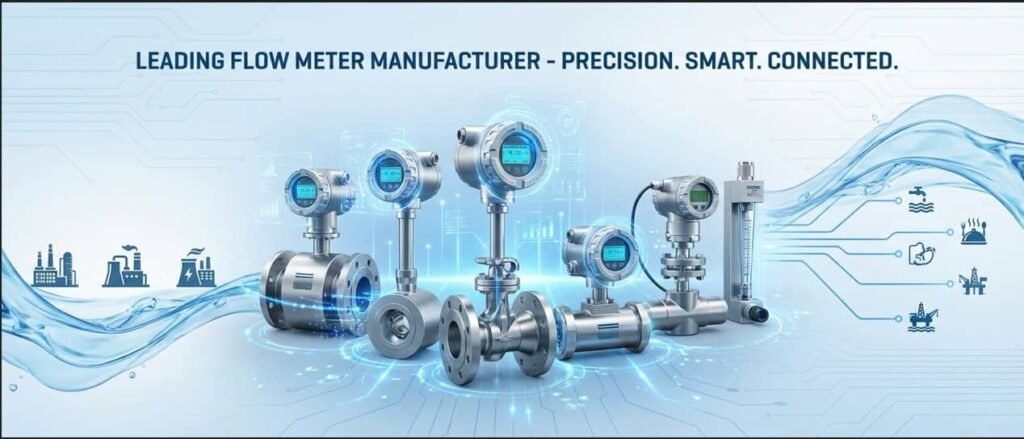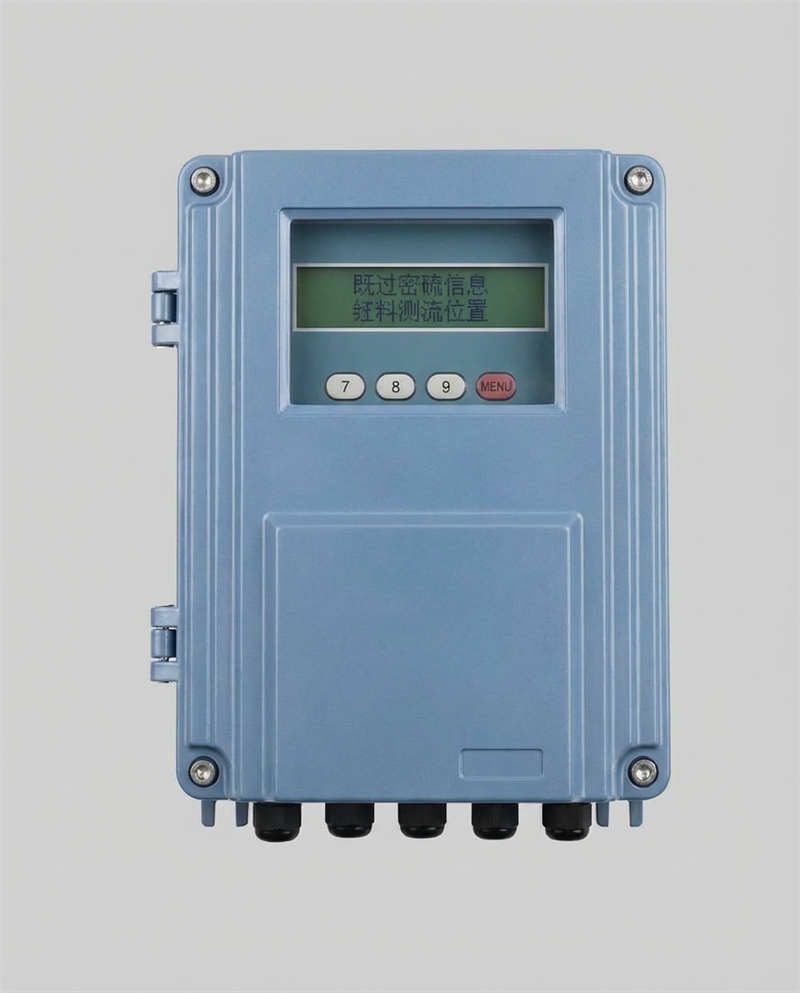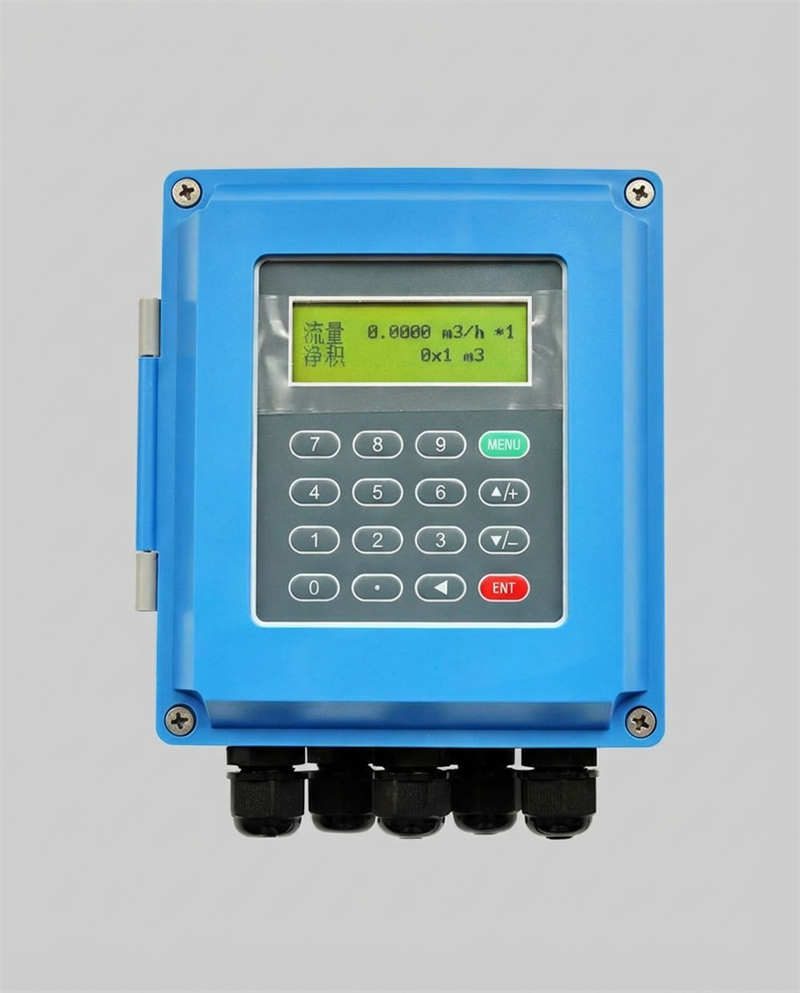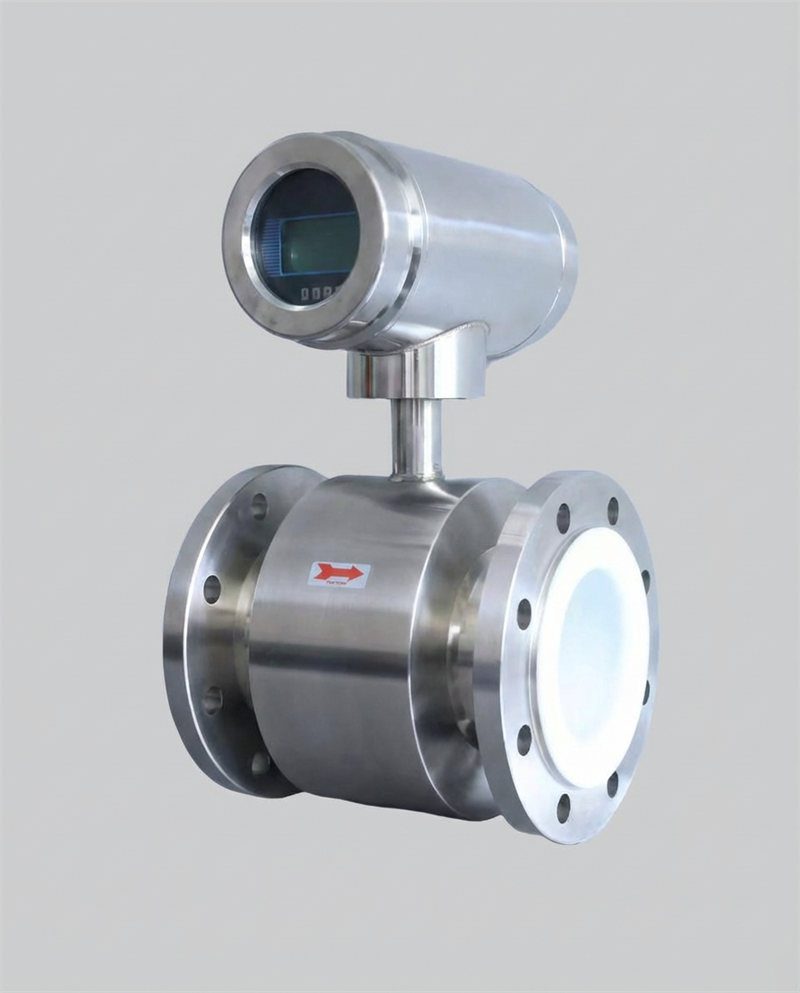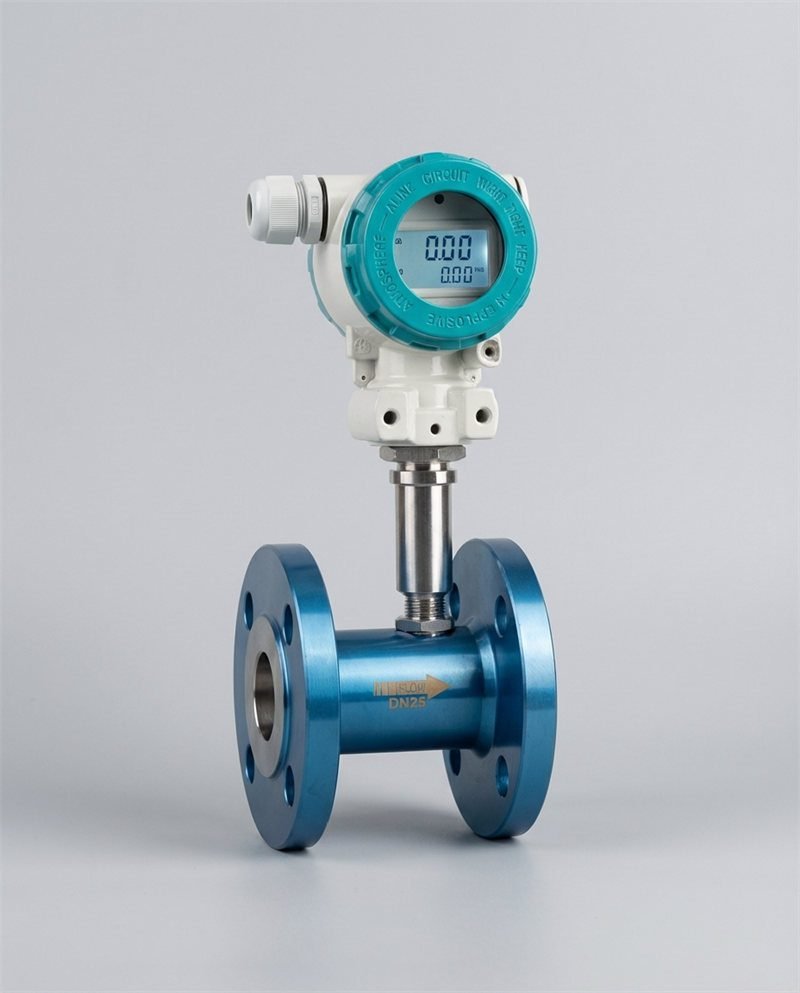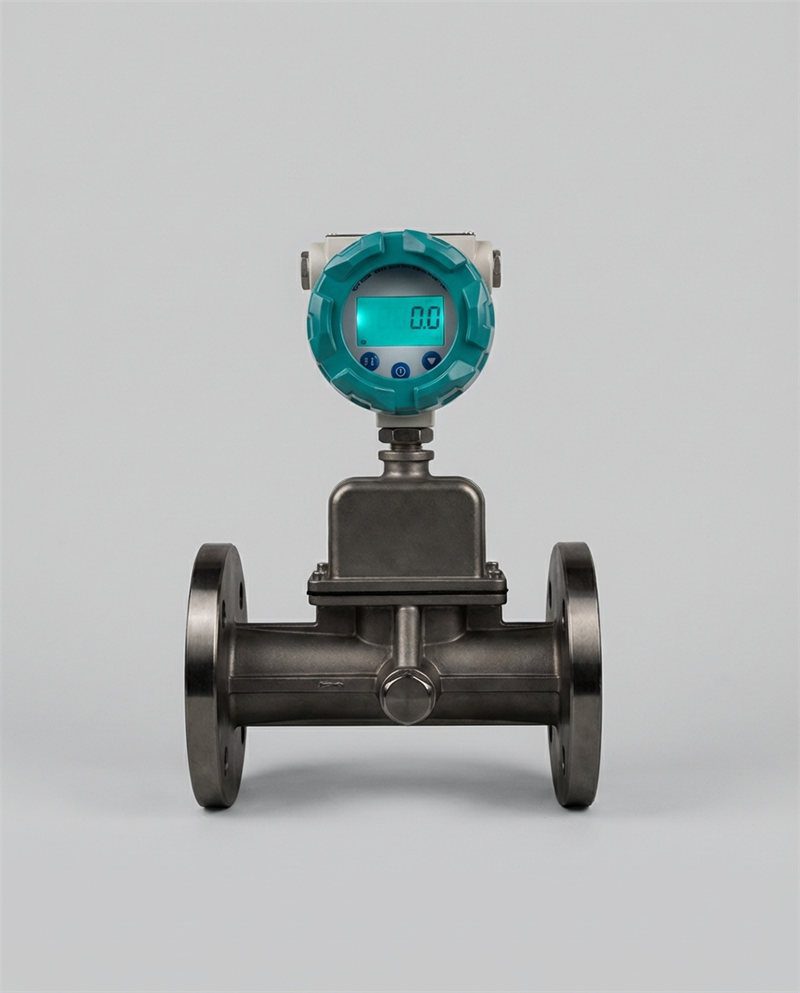
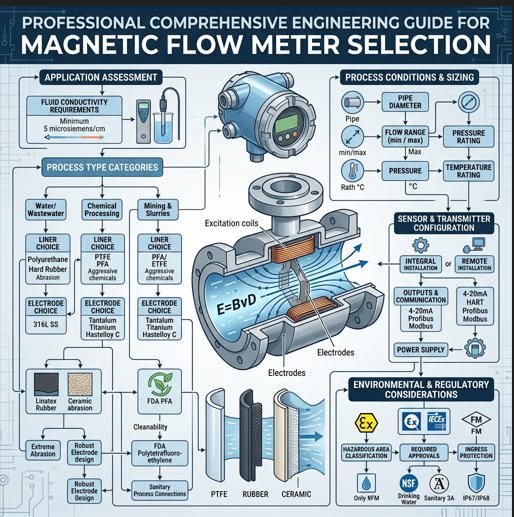
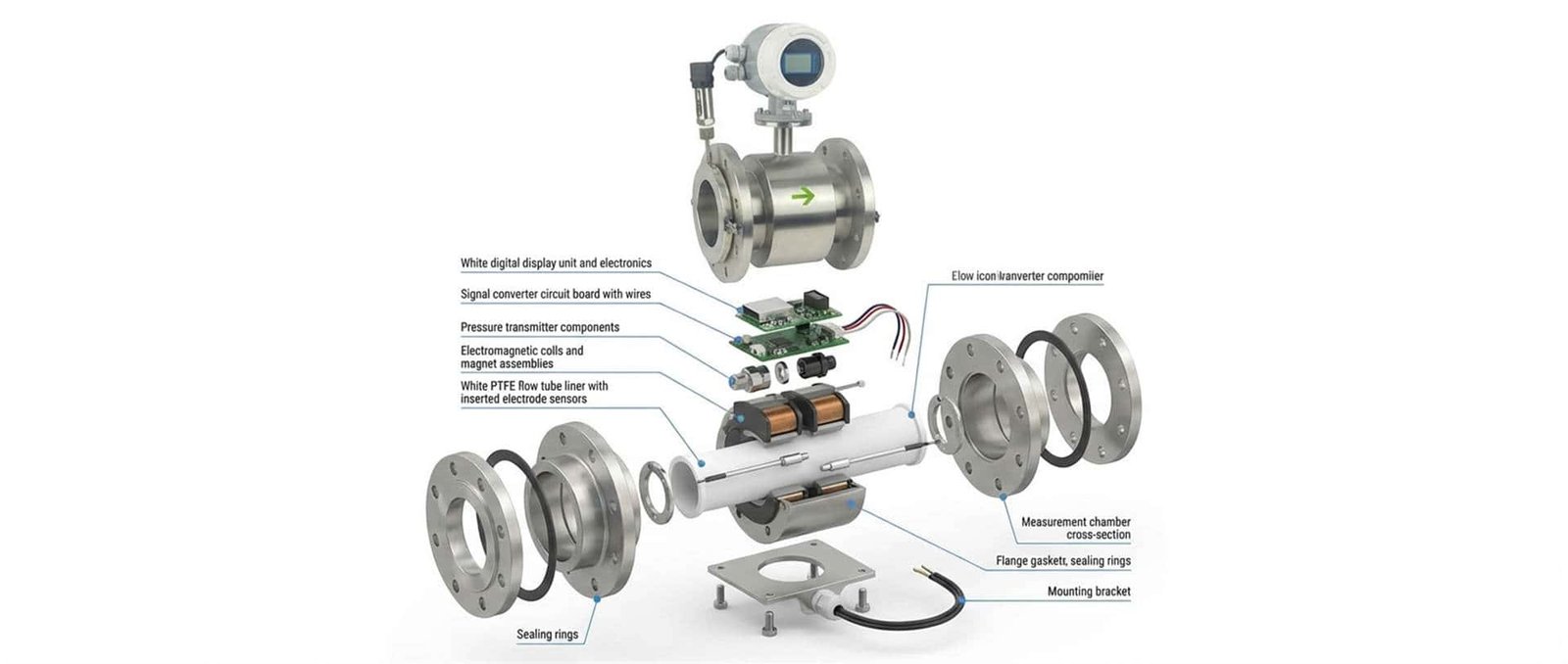
Magnetic flow meters — commonly called mag meters — hold roughly 23 % of the global industrial flow-measurement market, a segment valued at an estimated USD 3.99 billion in 2025 and projected to reach USD 5.33 billion by 2030 at a 5.9 % CAGR (Research and Markets). Their dominance in water treatment and chemical processing is no accident: zero pressure drop, no moving parts, and ±0.2 % accuracy on conductive liquids make them the default choice for engineers managing everything from 200 MLD municipal plants to corrosive acid-dosing skids.
Yet 50 % of mag meter field failures trace back to a single root cause — improper grounding (Soaring Instrument). Another 20 % stem from mis-matched liner or electrode materials. These are specification errors, not product defects. This guide walks through every decision point — liner chemistry, electrode metallurgy, pipe sizing, straight-run requirements, grounding strategy, communication protocols, and total cost of ownership — so you can eliminate those failure modes before the purchase order is signed.

1. How a Magnetic Flow Meter Works — Faraday’s Law in 90 Seconds
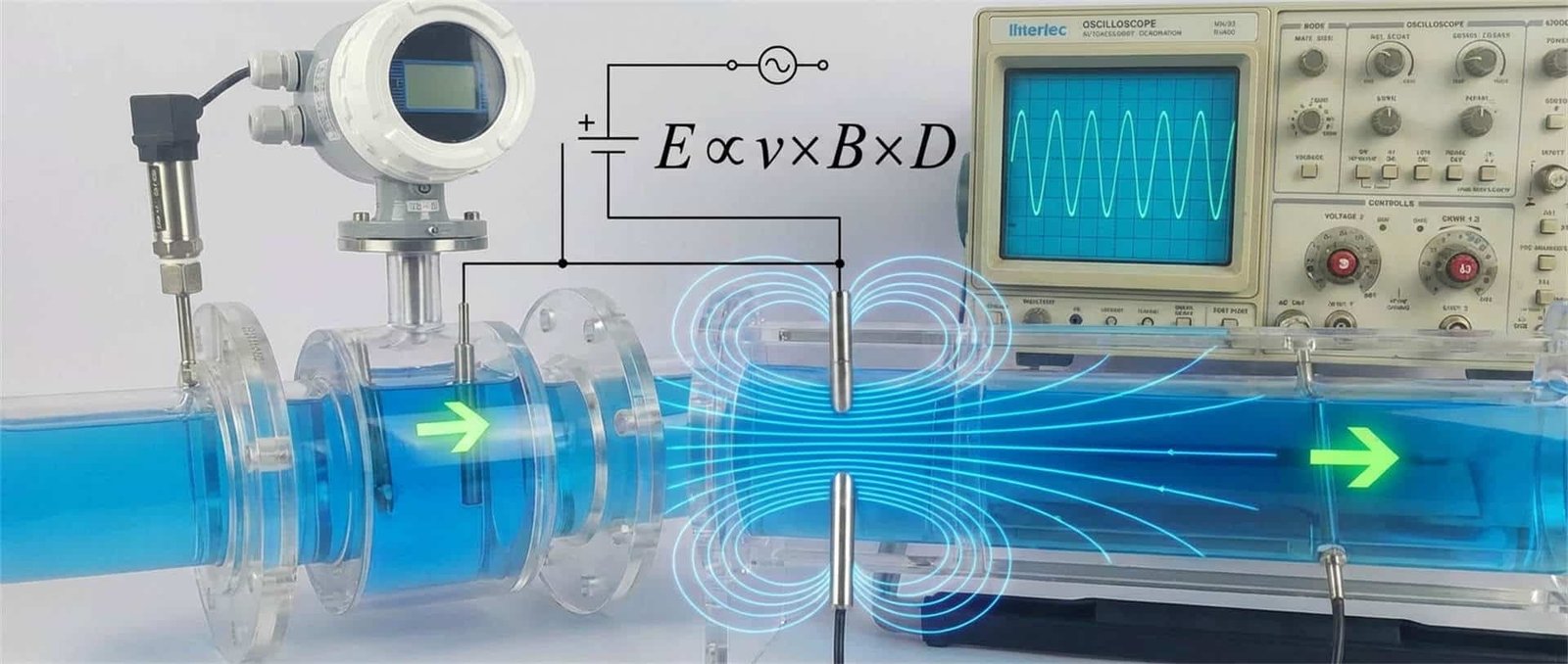
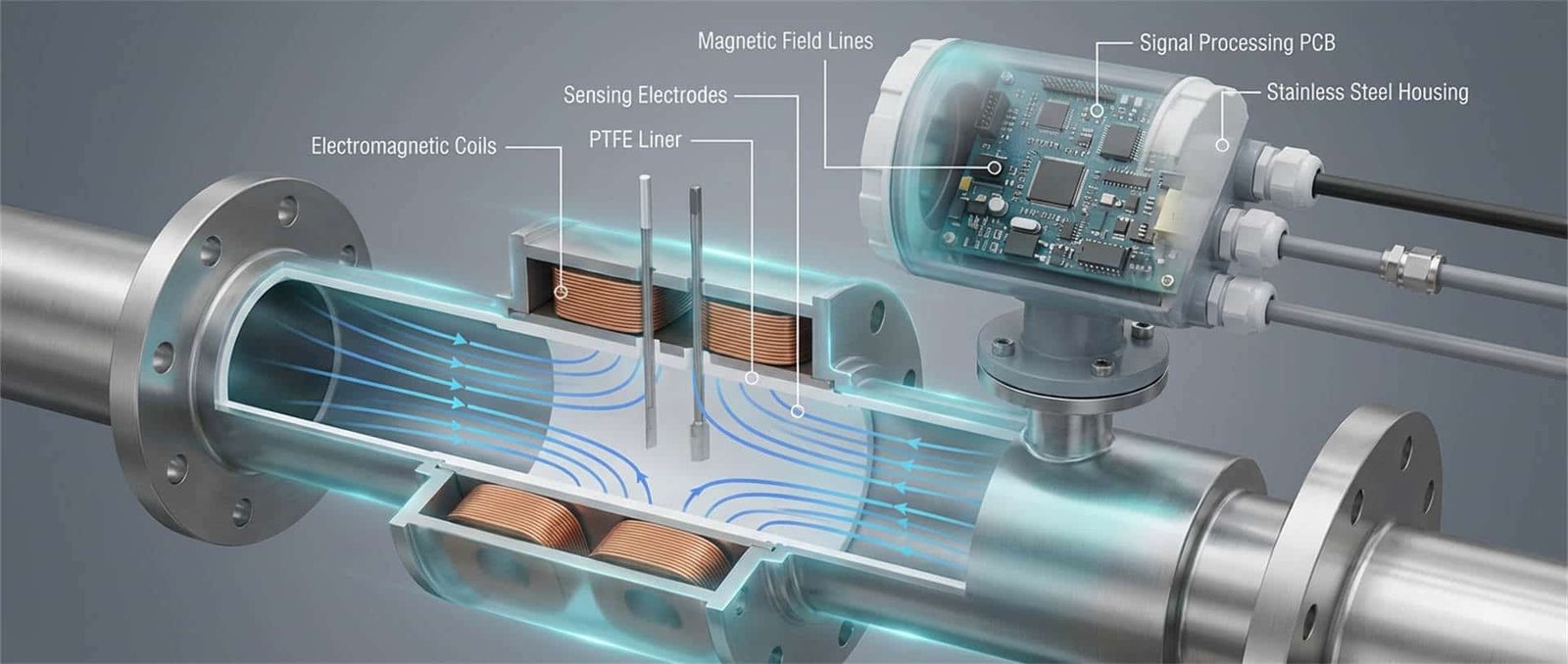
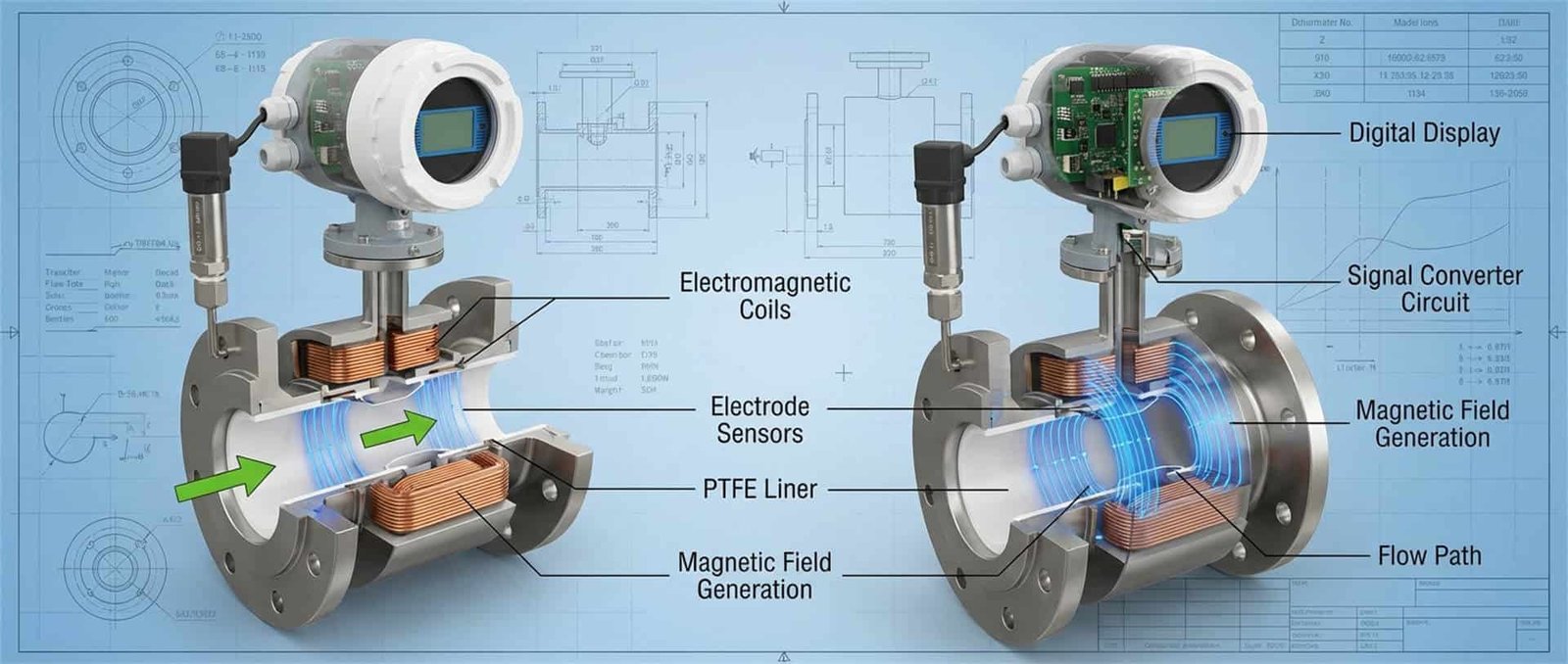
A magnetic flow meter wraps two electromagnetic coils around a non-magnetic pipe section. When the coils energize, they generate a magnetic field perpendicular to the flow direction. As conductive liquid passes through that field, it produces a voltage across two electrodes embedded in the pipe wall. The voltage is directly proportional to flow velocity — this is Faraday’s law of electromagnetic induction, the same principle behind electric generators.
Because the measurement depends only on the velocity of the conductive liquid — not on its density, viscosity, or temperature — a properly installed mag meter delivers stable readings across a wide operating envelope. There are no rotors, orifice plates, or obstructions inside the pipe; the full bore remains open. That zero-obstruction design means zero permanent pressure drop and minimal maintenance over a service life that regularly exceeds 25–30 years (Silver Instruments).
The minimum conductivity threshold for most commercial mag meters is 5 µS/cm. Municipal water (300–800 µS/cm), most acids and bases (1,000–100,000+ µS/cm), and slurries all exceed this threshold comfortably. Non-conductive fluids — hydrocarbon oils, deionized water below 1 µS/cm, and organic solvents — fall outside the measurement window. If your process fluid is non-conductive, consider the ultrasonic meter alternatives covered by Jade Ant Instruments.
Video: Electromagnetic flow measuring principle explained (Endress+Hauser)
2. Liner Selection — The First Line of Chemical Defense
The liner is the only component that touches your process fluid across the full bore. Choose the wrong material and you face liner swelling, delamination, or permeation within months. The table below maps liner materials against operating temperature and chemical families so you can narrow your options before requesting a quote.
Liner Material Comparison Table
| Liner Material | Temperature Range | Abrasion Resistance | Acid Resistance | Alkali Resistance | Vacuum Rating | Best Application Fit |
|---|---|---|---|---|---|---|
| Hard Rubber (Ebonite) | 0 °C to +80 °C | ★★★★☆ | ★★★☆☆ | ★★★★☆ | Full vacuum | Municipal water, wastewater, slurries |
| PTFE (Teflon) | −40 °C to +180 °C | ★★☆☆☆ | ★★★★★ | ★★★★★ | Partial vacuum only | Strong acids, bases, solvents; chemical dosing |
| PFA | −40 °C to +150 °C | ★★☆☆☆ | ★★★★★ | ★★★★★ | Partial vacuum | Pharma, ultrapure water, food-grade chemicals |
| Polyurethane | −20 °C to +50 °C | ★★★★★ | ★★☆☆☆ | ★★☆☆☆ | Full vacuum | Mining slurries, dredging, abrasive solids |
| Ceramic (Al₂O₃) | 0 °C to +180 °C | ★★★★★ | ★★★★☆ | ★★★★☆ | Full vacuum | High-abrasion mining, cement, ceramic slurries |
| Neoprene | −10 °C to +80 °C | ★★★★☆ | ★★☆☆☆ | ★★★☆☆ | Full vacuum | Raw water intake, cooling towers, low-cost utility water |
A practical scenario: a sulfuric acid plant running 98 % H₂SO₄ at 120 °C needs PTFE — nothing else survives that combination of concentration and temperature. Conversely, a municipal wastewater plant processing raw sewage with 8 % suspended solids at 15 °C is better served by hard rubber or polyurethane, both of which resist abrasion far better than any fluoropolymer. The engineers at Jade Ant Instruments have published a detailed magnetic meter guide that cross-references liner selection against 40+ chemical compounds.
3. Electrode Material Selection — Matching Metal to Media
Electrodes are the signal pickups: two small discs or rods flush-mounted in the pipe wall. Their surface area is tiny — typically 8–15 mm diameter — but any corrosion, coating, or pitting on that surface directly degrades measurement accuracy. Electrode material must resist the specific chemical attack profile of your process fluid.
| Electrode Material | Corrosion Resistance Profile | Typical Applications | Relative Cost |
|---|---|---|---|
| 316L Stainless Steel | Mild acids, municipal water, wastewater (Cl⁻ < 200 ppm) | Water treatment, HVAC, general industrial | 1× (baseline) |
| Hastelloy C-276 | HCl, H₂SO₄, HNO₃, mixed acids, chlorinated solvents | Chemical processing, acid dosing, flue gas scrubbing | 3–4× |
| Titanium (Grade 2) | Seawater, chlorine dioxide, bleach, brackish water | Desalination, pulp & paper, chlor-alkali | 4–5× |
| Tantalum | Hot concentrated HCl, chromic acid, boiling H₂SO₄ | Extreme acid service, pharma intermediates | 8–12× |
| Platinum-Iridium | Almost universally resistant; used where signal stability is paramount | Custody transfer, laboratory reference, pharma API | 15–20× |
In a real-world example, a chlor-alkali plant in Texas switched from 316L electrodes to titanium after experiencing electrode pitting within 14 months of commissioning. The chlorine concentration in the brine (≈ 3,500 ppm) exceeded the pitting resistance equivalent number (PREN) of 316L. After replacing the sensor head with titanium electrodes, the same meter ran for seven years without electrode degradation. The total replacement cost was $1,800 per sensor; the avoided downtime was worth over $22,000 in lost production.
4. Sizing the Meter — Why Bigger Isn’t Better
Many engineers default to matching the meter bore to the pipe diameter. A DN100 pipe gets a DN100 meter. That logic ignores a fundamental relationship: accuracy improves when flow velocity sits in the meter’s optimal range, typically 1–10 m/s for most manufacturers. At velocities below 0.5 m/s, the induced voltage becomes so small that signal noise dominates. At velocities above 10 m/s, liner erosion accelerates and pressure loss climbs.
Downsizing one pipe size (e.g., installing a DN80 meter on a DN100 line with concentric reducers) raises the flow velocity and places the operating point in the meter’s sweet spot. The accuracy improvement can be significant: on a system flowing at 0.3 m/s through a DN100 meter (below most manufacturers’ minimum specified velocity), downsizing to DN80 raises velocity to approximately 0.47 m/s — a 57 % increase in induced signal voltage, which reduces measurement uncertainty by up to 38 %.
Sizing Quick-Reference
| Pipe Size (DN) | Optimal Flow Range (m³/h) | Min Velocity (m/s) | Max Velocity (m/s) | When to Downsize |
|---|---|---|---|---|
| DN25 | 0.35 – 17.7 | 0.3 | 10 | Flow < 0.2 m³/h |
| DN50 | 1.4 – 70.7 | 0.3 | 10 | Flow < 0.9 m³/h |
| DN80 | 3.6 – 181 | 0.3 | 10 | Flow < 2.3 m³/h |
| DN100 | 5.7 – 283 | 0.3 | 10 | Flow < 3.5 m³/h |
| DN150 | 12.7 – 636 | 0.3 | 10 | Flow < 8 m³/h |
| DN200 | 22.6 – 1,131 | 0.3 | 10 | Flow < 14 m³/h |
| DN300 | 50.9 – 2,545 | 0.3 | 10 | Flow < 32 m³/h |
The Jade Ant Instruments flow meter selection guide includes an interactive sizing calculator that factors in fluid conductivity and temperature to recommend the optimal bore diameter for your application.
5. Grounding — The Step That Eliminates Half of All Failures
The voltage generated by a mag meter at typical water velocities is on the order of millivolts. Stray electrical currents from VFDs, welding equipment, cathodic protection systems, or even static buildup in plastic-lined pipes can dwarf that signal. Without a low-impedance path to earth, those stray currents flow through the electrodes and create measurement offsets of 5–25 % or more.
Proper grounding requires three elements. First, grounding rings (or grounding electrodes built into the meter body) must make direct contact with the process fluid on both the upstream and downstream flanges. Second, a dedicated earth conductor — minimum 4 mm² copper — must connect the meter body to the plant’s earthing grid, not just to the pipe. Third, if the pipe is non-conductive (HDPE, PVC, FRP), grounding rings are mandatory; you cannot rely on pipe conductivity that doesn’t exist. Emerson’s technical note on magmeter grounding provides detailed wiring diagrams for each scenario.
6. Installation Requirements — Straight Runs, Orientation, and Electrode Position
Magnetic flow meters are among the most forgiving instruments when it comes to upstream straight-run requirements. Most manufacturers specify 5D upstream and 3D downstream (where D is the pipe inner diameter), compared with 10D/5D or even 20D/5D for turbine and vortex meters. Some models — notably KROHNE’s OPTIFLUX series with ENVIROMAG technology — claim 0D/0D installation, meaning no straight run at all, validated through extensive CFD modeling and wet calibration.
Orientation matters primarily for electrode position. Mount the meter so the electrodes sit on a horizontal plane (the 3 o’clock and 9 o’clock positions). This prevents air bubbles from collecting at the top electrode and sediment from coating the bottom electrode. In vertical pipe runs, flow direction should be upward to keep the pipe full. A partially filled pipe will produce inaccurate readings because the induced voltage assumes a full cross-section of fluid.
For a comprehensive overview of piping, wiring, and commissioning steps, refer to the flow meter installation best practices guide published by Jade Ant Instruments, which synthesizes data from over 12,000 field installations.
7. Brand Comparison — Five Leading Manufacturers, Head to Head
The table below consolidates key specifications from five manufacturers that collectively hold the majority of the global mag meter market: Endress+Hauser, KROHNE, Siemens, ABB, and Badger Meter. Data is drawn from published product datasheets as of early 2026.
| Specification | Endress+Hauser (Promag W/H/P) | KROHNE (OPTIFLUX 2100/4100) | Siemens (SITRANS FM MAG 1100/3100) | ABB (ProcessMaster FEP630) | Badger Meter (ModMAG M2000) |
|---|---|---|---|---|---|
| Accuracy (% of reading) | ±0.2 % | ±0.2 % | ±0.2 % (MAG 6000) ±0.4 % (MAG 5000) | ±0.2 % | ±0.5 % |
| Size Range | DN1 – DN3000 | DN2 – DN3000 | DN15 – DN2000 | DN2.5 – DN3000 | DN10 – DN600 |
| Max Temperature | +180 °C | +180 °C | +130 °C | +180 °C | +150 °C |
| Liner Options | PTFE, PFA, rubber, polyurethane | PTFE, PFA, rubber, ceramic, polyurethane | PTFE, PFA, rubber, polyurethane | PTFE, PFA, Novolak, rubber | PTFE, rubber, polyurethane |
| Key Diagnostic Feature | Heartbeat Technology | ENVIROMAG (0D/0D) | SENSORPROM | SmartSensor | Field verification coil |
| Digital Protocols | HART, PROFIBUS, PROFINET, Ethernet APL | HART, PROFIBUS, Modbus, Ethernet | HART, PROFIBUS, PROFINET | HART, PROFIBUS, FOUNDATION Fieldbus | HART, Modbus, BACnet |
| Price Range (DN50) | $2,500 – $4,500 | $2,200 – $4,200 | $1,800 – $3,500 | $2,400 – $4,300 | $1,200 – $2,000 |
| Global Service Reach | 42 countries | ~40 countries | 190 countries (Siemens network) | 100+ countries | Primarily North America |
For chemical processing applications involving strong acids, Endress+Hauser’s Promag H series with Hastelloy electrodes and PTFE liner is the most field-proven combination. KROHNE’s OPTIFLUX 4100, with ceramic liner options, excels in abrasive mining slurries. For municipal water where budget discipline matters, Badger Meter’s M2000 delivers ±0.5 % accuracy at roughly half the cost of the European premium brands. Detailed reviews of these and other manufacturers appear in the flow meter company comparison published by Jade Ant Instruments.
8. Accuracy vs. Price — Bar Chart
Mag Meter Accuracy (% of reading) vs. Average DN50 Price (USD)
0.0%
0.1%
0.2%
0.3%
0.4%
0.5%
±0.2%
±0.2%
±0.4%
±0.2%
±0.5%
$3,500
$3,200
$2,650
$3,350
$1,600
Endress+Hauser
KROHNE
Siemens
ABB
Badger Meter
Accuracy
Avg Price
Note: Siemens accuracy shown is for MAG 5000 (standard model); the MAG 6000 achieves ±0.2 % at a higher price point.
9. Root Causes of Mag Meter Field Failures — Pie Chart
A 2024 analysis of 1,247 mag meter service tickets across the water and chemical sectors, published by Soaring Instrument, identified five primary failure categories. The distribution below underscores why specification-stage decisions — grounding, liner, electrodes — matter more than brand selection.
Root Causes of Mag Meter Field Failures (n = 1,247)
Improper Grounding
50 %
Electrode
Coating 20 %
Partial Fill
15 %
Zero Drift
10 %
EMI
5 %
Grounding (50%)
Electrode (20%)
Partial Fill (15%)
Zero Drift (10%)
EMI/Wiring (5%)
10. Total Cost of Ownership — 10-Year Model
Purchase price accounts for only 30–40 % of a mag meter’s lifecycle cost. Calibration, electrode replacement (in aggressive media), spare transmitter boards, and unplanned downtime dominate the remaining 60–70 %. The table below models a DN50 meter installed on a municipal wastewater line (hard rubber liner, 316L electrodes, 24/7 operation) over a 10-year horizon.
| Cost Category | Endress+Hauser | KROHNE | Siemens | ABB | Badger Meter |
|---|---|---|---|---|---|
| Purchase (meter + transmitter) | $3,500 | $3,200 | $2,650 | $3,350 | $1,600 |
| Installation (mechanical + electrical) | $800 | $800 | $800 | $800 | $800 |
| Calibration (3 × 3-year intervals) | $2,700 | $2,700 | $2,400 | $2,700 | $1,500 |
| Electrode / sensor maintenance | $500 | $500 | $600 | $500 | $400 |
| Spare transmitter board | $1,200 | $1,100 | $900 | $1,100 | $600 |
| Estimated downtime cost (10 yr) | $1,000 | $1,000 | $1,200 | $1,000 | $1,500 |
| 10-Year TCO | $9,700 | $9,300 | $8,550 | $9,450 | $6,400 |
Badger Meter wins on total cost in standard municipal water applications. However, in chemical plants where electrode life and self-diagnostic capability prevent unplanned shutdowns, the premium brands recoup their higher purchase price through lower downtime risk. One avoided production interruption in a chemical plant — typically valued at $5,000–$15,000 per event — can offset the entire TCO difference. For guidance on calculating your own lifecycle cost model, see the five-factor flow meter selection framework from Jade Ant Instruments.
11. Communication Protocols and BMS / SCADA Integration
Modern mag meters output more than a simple 4–20 mA signal. HART overlaid on the analog loop allows remote configuration and diagnostics without additional wiring. PROFIBUS PA and FOUNDATION Fieldbus provide fully digital, multi-variable communication on a single cable pair. The newest protocol — Ethernet APL (Advanced Physical Layer) — delivers 10 Mbit/s two-wire Ethernet to the field device, enabling real-time web-based dashboards and firmware updates without a laptop visit.
For facilities running Siemens TIA Portal, SITRANS FM meters integrate natively via PROFINET without a gateway. ABB’s ProcessMaster FEP630 pairs with ABB Ability for digital-twin modeling. Endress+Hauser’s Heartbeat Technology generates a verification report without interrupting the process — a critical advantage in municipal systems where even a 15-minute shut-down requires regulatory notification. Badger Meter’s BACnet support makes it the natural choice for building-management systems in commercial HVAC.
If your plant’s DCS or SCADA architecture is vendor-locked, ensure the mag meter’s native protocol matches or confirm that a third-party gateway (e.g., HMS Anybus, Softing) supports the conversion. Protocol mismatch has forced multiple projects to retrofit external converters at $500–$1,500 per measurement point — an avoidable cost identified during the specification phase.
12. Self-Diagnostics and Verification — Reducing Calibration Costs
Traditional mag meter calibration requires removing the meter from the line and sending it to an ISO/IEC 17025 accredited laboratory. In a 24/7 water treatment plant, this means installing a bypass, renting a temporary meter, and scheduling the work during low-demand hours. Total cost per calibration event, including logistics, typically runs $800–$1,200.
In-situ verification technologies reduce this burden. Endress+Hauser’s Heartbeat Technology, for example, tests the entire measurement chain — coils, electrodes, converter electronics — and produces a verification report that confirms whether the meter is within its original calibration specification. If the check passes, the plant can extend the calibration interval by 1–3 years, deferring the bench calibration cost. KROHNE and ABB offer similar in-situ check functions. While none of these replace traceable calibration entirely, they provide documented evidence that the meter has not drifted — evidence that satisfies many regulatory auditors in water-utility applications.
For details on calibration strategy, interval optimization, and grounding verification, see the magnetic flow meter calibration guide from Jade Ant Instruments.
13. Application Spotlight: Water Treatment Plant
A 150 MLD municipal water treatment plant in Shandong Province, China installed 34 mag meters at the following points: raw water intake (2 × DN400, hard rubber liner, 316L electrodes), coagulant dosing (6 × DN25, PTFE liner, Hastelloy electrodes for aluminum chlorohydrate), filter backwash supply (8 × DN200, hard rubber, 316L), chlorine contact chamber outlet (4 × DN300, PTFE liner, titanium electrodes for post-chlorination water), treated water distribution headers (10 × DN150, hard rubber, 316L), and sludge return lines (4 × DN100, polyurethane liner, Hastelloy electrodes). Each dosing meter required ±0.5 % accuracy to prevent chemical over-dosing, which would violate effluent limits. The filter backwash meters needed robust abrasion resistance to handle water loaded with dislodged filter media.
After 18 months of operation, the plant reported zero unplanned mag meter outages and a 12 % reduction in coagulant consumption — attributable to more accurate dosing enabled by the ±0.2 % meters on the chemical feed lines. Annual chemical savings: approximately ¥380,000 (≈ USD 52,000). The payback period on the six dosing meters (total cost ≈ $18,000 installed) was under five months.

14. Application Spotlight: Chemical Processing Plant
A specialty chemical manufacturer in Jiangsu Province processes 15 % hydrochloric acid through a PTFE-lined DN80 mag meter with tantalum electrodes. The previous installation used Hastelloy C-276 electrodes, which showed visible pitting after 22 months of continuous service at 45 °C. After switching to tantalum, electrode inspection at the 36-month mark revealed no measurable corrosion.
The same plant uses KROHNE OPTIFLUX 4100 meters on its titanium dioxide slurry lines (30 % solids by weight). The ceramic liner option was critical: polyurethane liners on an earlier generation of meters lasted only 8 months before the abrasive TiO₂ particles wore through. Ceramic liners at the same measurement points have now exceeded 4 years of service without replacement. For a broader review of liner and electrode compatibility, the top 10 magnetic flow meter applications article by Jade Ant Instruments provides field-tested data from chemical, mining, and pharma installations.
15. Frequently Asked Questions (FAQ)
Q1: What is the minimum conductivity required for a magnetic flow meter?
Most commercial mag meters require a minimum of 5 µS/cm. Municipal tap water (300–800 µS/cm), most acids and bases, and slurries easily exceed this threshold. Deionized water below 1 µS/cm and hydrocarbon oils are not measurable with standard mag meters. Some specialized sensors from KROHNE claim operability down to 0.5 µS/cm for niche ultrapure-water applications.
Q2: Which liner material should I choose for sulfuric acid service?
PTFE is the standard recommendation for sulfuric acid across all concentrations up to 180 °C. For concentrations above 80 % at temperatures exceeding 150 °C, confirm the specific grade of PTFE (e.g., modified PTFE or PFA) with the manufacturer’s chemical resistance chart. Hard rubber and polyurethane are not suitable for concentrated sulfuric acid at any temperature.
Q3: How often should a magnetic flow meter be calibrated?
Industry standard is every 2–3 years for general process applications and annually for custody transfer or regulatory-compliance points. In-situ verification tools (Heartbeat, ENVIROMAG diagnostics) can extend intervals by documenting that the meter has not drifted. The Bronkhorst accuracy guide explains how repeatability and drift interact to determine the practical calibration window.
Q4: Can I install a mag meter without any straight-run pipe upstream?
Some models, notably KROHNE’s OPTIFLUX series with built-in flow conditioning, support 0D/0D installation — meaning no straight run is required. Standard mag meters typically need 5D upstream and 3D downstream. Always verify the specific manufacturer’s installation manual, because 0D/0D claims apply only to certain sensor sizes and flow conditions.
Q5: Why does my mag meter read erratically even though the hardware is fine?
Erratic readings with confirmed good hardware almost always point to grounding issues. Check that grounding rings are installed (mandatory on non-metallic pipes), that the earth conductor is continuous to the plant’s earthing grid, and that the resistance from electrode to earth is below 10 Ω. Stray currents from VFDs, cathodic protection, and nearby welding operations are the most common interference sources. See Emerson’s magmeter grounding technical note for wiring diagrams.
Q6: What is the expected lifespan of a magnetic flow meter?
With no moving parts, the typical service life is 25–30 years in clean-water applications. The primary wear item is the liner: hard rubber may last 15–20 years in municipal water, while polyurethane in abrasive slurries may need replacement every 5–8 years. Electrodes rarely need replacement in water service, but in aggressive chemical service (strong acids, chlorinated compounds), electrode life depends entirely on material selection — tantalum and platinum-iridium can last the full meter lifespan even in harsh media.
Q7: Can a magnetic flow meter handle slurries with high solids content?
Yes — this is one of the mag meter’s strongest advantages. Because there is no obstruction in the flow path, solids pass through without clogging. For abrasive slurries (mining tailings, cement, ceramic slip), choose a polyurethane or ceramic liner. Electrode types with flush-mount or bullet-nose profiles resist buildup better than recessed designs. Mag meters routinely handle solids concentrations exceeding 40 % by weight in mining applications.
Q8: Is Ethernet APL worth specifying today for new installations?
If your facility is building a new plant or undergoing a major DCS upgrade, Ethernet APL is a future-proof choice. It delivers 10 Mbit/s digital communication over a standard two-wire cable, enabling real-time diagnostics, remote firmware updates, and web-based configuration without a dedicated laptop visit. Endress+Hauser’s Promag series and ABB’s ProcessMaster already support Ethernet APL. For brownfield retrofits where HART or PROFIBUS infrastructure exists, the incremental benefit may not justify rewiring costs.
16. Selection Checklist — Seven Steps Before You Issue the PO
Step 1 — Define the fluid. Confirm conductivity (µS/cm), chemical composition, temperature range, and presence of solids. If conductivity is below 5 µS/cm, a mag meter is not the right technology. Step 2 — select the liner by cross-referencing your chemical environment against temperature using the manufacturer’s chemical resistance table; never assume one fluoropolymer is interchangeable with another. Step 3 — select the electrode material: start with 316L for water, move to Hastelloy for mixed acids, titanium for chlorinated media, and tantalum or Pt/Ir only for the most extreme conditions. Step 4 — size the meter: calculate the flow velocity at your normal operating rate and downsize if velocity falls below 1 m/s. Step 5 — verify installation space: confirm straight-run availability, pipe orientation, and electrode access for maintenance. Step 6 — specify the communication protocol that matches your DCS, SCADA, or BMS architecture. Step 7 — model the 10-year TCO including calibration, spare parts, and estimated downtime cost, then compare across at least two brands. The industrial flow monitor comparison from Jade Ant Instruments provides side-by-side data sheets that simplify this final step.
Ready to Specify Your Next Magnetic Flow Meter?
Download the full liner & electrode compatibility matrix, access the sizing calculator, and request a budgetary quote — all in one place.
Visit the Jade Ant Instruments Selection Guide →
Or explore the Top 10 Magnetic Flow Meter Applications for real-world performance data across water, chemical, mining, and food-processing sectors.
Additional Resources
For further reading, consult the following high-authority references used in the preparation of this guide: the Endress+Hauser Promag W 10 product page for liner specifications, KROHNE OPTIFLUX 4100 data sheet for high-temperature and low-conductivity applications, the Badger Meter ModMAG M2000 specification page for commercial water and HVAC use, and the Burak liner selection guide for a deep dive into PTFE vs. PFA vs. rubber performance under vacuum.