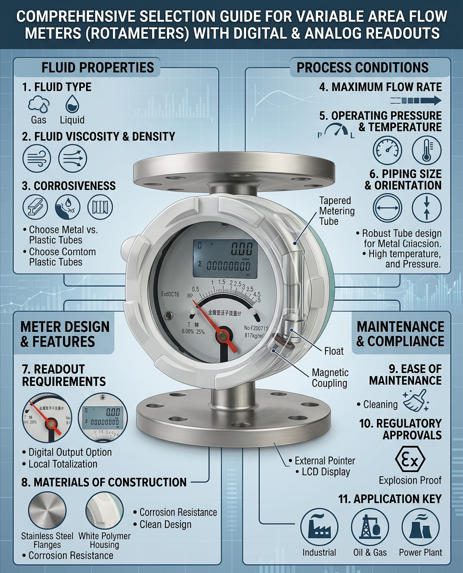
Variable area (VA) flow meters — commonly known as rotameters — remain one of the most widely deployed flow measurement devices in industrial settings worldwide. From chemical dosing lines in water treatment plants to purge gas monitoring in semiconductor fabs, VA meters have earned their place through mechanical simplicity, visual readability, and broad fluid compatibility. According to industry data, the global flow meter market was valued at USD 9.1 billion in 2024, and variable area meters continue to hold a significant share in applications where cost-effective, reliable measurement is required.
This guide is written for process engineers, instrumentation specialists, and procurement teams who need to select the right VA flow meter for a specific application — not just any rotameter off the shelf. We will walk through every critical decision point: operating specifications, material and fluid compatibility, pressure drop implications, sizing calculations, output integration, mounting requirements, calibration strategy, and common selection mistakes that cost thousands in rework.
Whether you are specifying a meter for a new chemical plant or replacing a failing unit on a pharmaceutical clean utility loop, this article provides a field-ready framework. Jade Ant Instruments has compiled this resource from real-world installation data across chemical, water, oil & gas, and food-grade applications to help you avoid the costly trial-and-error approach that plagues too many meter selection projects.
What Is a Variable Area Flow Meter and How It Works
Basic Operating Principle of VA Flow Meters
A variable area flow meter operates on a deceptively simple principle: fluid flowing upward through a tapered tube lifts a float until the upward drag force and buoyancy equal the downward gravitational force of the float. At that equilibrium point, the annular area between the float and the tube wall is proportional to the volumetric flow rate. The float position — read against a calibrated scale — gives an immediate, real-time flow indication without external power.
The physics behind this are rooted in the Bernoulli equation and the balance of forces. As flow increases, the float rises higher in the tapered tube, exposing a larger cross-sectional area for the fluid to pass. The pressure drop across the float remains essentially constant across the measurement range — a characteristic that distinguishes VA meters from differential pressure devices governed by ISO 5167, where the pressure drop varies with flow.
For liquid service, both buoyancy and velocity head contribute to lifting the float. For gas service, buoyancy is negligible, and the float responds almost entirely to velocity head. This difference is critical when sizing: a meter calibrated for water will not read correctly on air without applying the proper conversion factor.
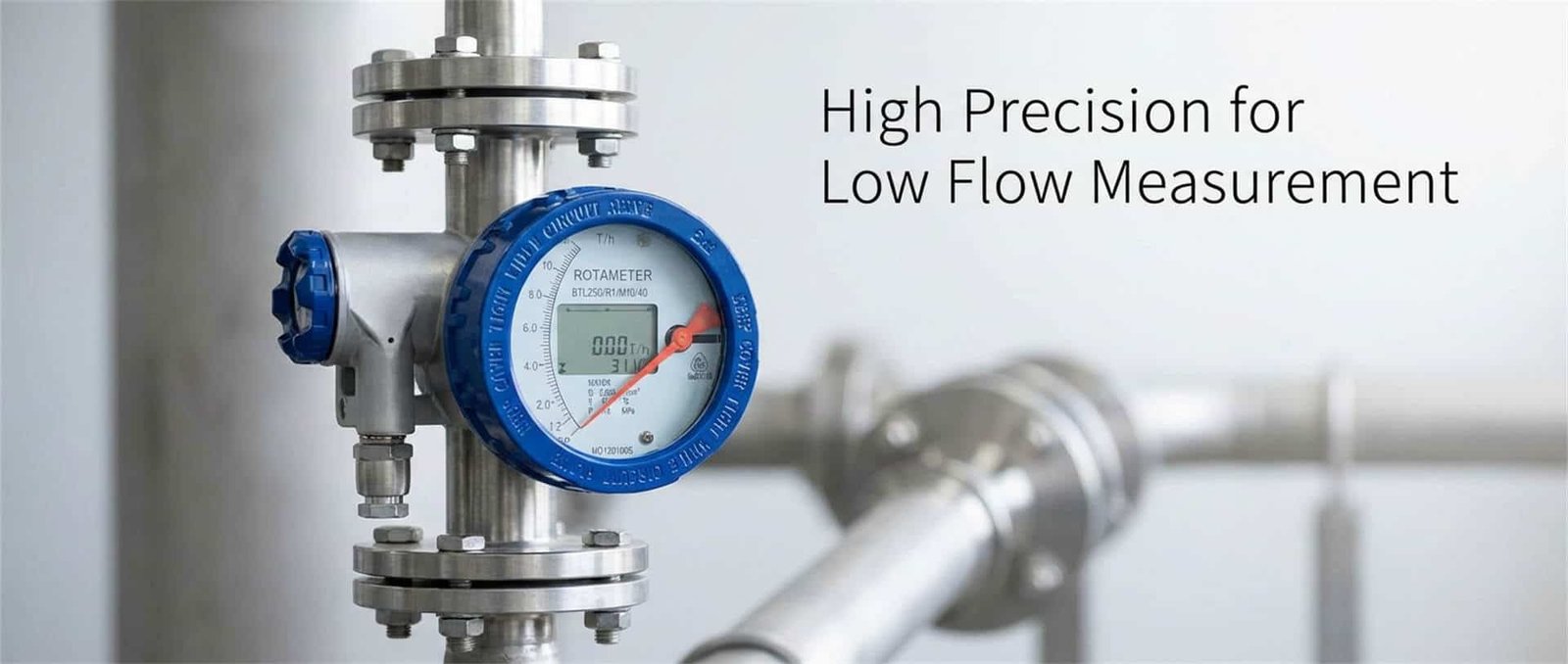
Common Configurations and Flow Ranges
Variable area flow meters come in several distinct configurations, each optimized for different operating conditions. Glass tube rotameters — the most recognizable type — use precision-formed borosilicate glass tubes and are suitable for flows up to approximately 60 GPM (water) or 200 SCFH (air), with pressure ratings typically up to 500 psig for small diameters. Metal tube rotameters use stainless steel, Hastelloy, or Monel tubes with magnetic float followers, extending the operating envelope to 750 psig and 540°C (1,000°F), with flow capacities up to 4,000 GPM water or 1,300 SCFM air. Plastic tube rotameters — typically polycarbonate or acrylic — serve lower-cost applications involving corrosive fluids or deionized water, generally limited to 100 psig and 65°C (150°F).
Beyond the classic rotameter, the VA family includes vane-style meters (spring-opposed vanes responding to flow velocity), piston-type meters (spring-opposed pistons less sensitive to viscosity changes), bypass rotameters (orifice/rotameter combinations for larger pipe sizes), and tapered plug meters (stationary core with a moving piston). The general measurement range for VA meters spans from 0.01 cc/min for precision laboratory instruments up to 4,000 GPM for large industrial metal tube designs — a breadth that few other single-technology families can match.
| Configuration | Tube Material | Max Pressure | Max Temperature | Typical Accuracy | Max Flow (Water) |
|---|---|---|---|---|---|
| Glass Tube Rotameter | Borosilicate Glass | 500 psig (small bore) | 200°C (400°F) | ±1–5% FS | 60 GPM |
| Metal Tube Rotameter | SS 316 / Hastelloy / Monel | 750 psig | 540°C (1,000°F) | ±1–2% FS | 4,000 GPM |
| Plastic Tube Rotameter | Polycarbonate / Acrylic | 100 psig | 65°C (150°F) | ±5% FS | 30 GPM |
| Bypass Rotameter | Glass or Metal | Varies by orifice | Varies | ±5% FS | Large pipe sizes |
| Vane / Piston Type | Metal body | 1,000 psig | 260°C (500°F) | ±2–5% FS | Varies |
Key Specifications to Consider
Size, Range, and Accuracy — How They Impact Measurement
The first specification engineers reach for is typically accuracy — but in VA flow meter selection, the relationship between meter size, measurement range, and accuracy is tightly coupled and frequently misunderstood. Standard industrial rotameters are specified at ±1–2% of full scale (FS) over a 10:1 turndown, while laboratory-grade units can achieve ±0.5% of actual reading (AR) over a 4:1 range. The critical distinction: percent of full scale means error is fixed relative to maximum flow, so at 20% of scale, a ±2% FS meter has an effective error of ±10% of reading. This makes meter sizing — not just meter accuracy class — the dominant factor in real-world measurement performance.
A common field scenario illustrates the point: a pharmaceutical plant specified a DN25 metal tube rotameter rated at 0–100 LPM for a cooling water line that normally runs at 15–25 LPM. The meter’s ±2% FS specification translated to ±2 LPM uncertainty — roughly 8–13% of the actual reading. Downsizing to a DN15 meter rated at 0–30 LPM with the same ±2% FS accuracy reduced uncertainty to ±0.6 LPM, or approximately 2.4–4% of reading. Same accuracy class, dramatically different real-world performance — all driven by proper sizing.
Resolution, Repeatability, and Response Time
Resolution in VA meters is determined by the scale graduation and the observer’s ability to read the float position — typically about 1% of full scale for glass tube designs. Metal tube meters with magnetic followers and pointer indicators offer similar resolution, while models equipped with position transmitters can resolve to 0.5% FS or better.
Repeatability — the meter’s ability to reproduce the same reading at the same flow conditions — is a strength of VA meters. Well-maintained rotameters can achieve repeatability of ±0.25% of actual flow rate, making them suitable for manual flow-setting applications where the operator adjusts a valve while watching the float position. Response time is inherently fast for direct-reading glass tube designs (the float responds within 1–2 seconds), though transmitter-equipped metal tube units may introduce additional signal processing delay of 0.5–3 seconds depending on damping settings.
Fluid Compatibility and Material Selection
Temperature Limits and Chemical Compatibility
Fluid temperature directly affects both the meter body and the measurement. For glass tube rotameters, the practical ceiling is approximately 200°C (400°F), but operating at elevated temperatures substantially derates the pressure rating — a relationship that is roughly linear. At 200°C, the safe working pressure of a standard borosilicate glass tube may drop to 30–50% of its room-temperature rating. Metal tube rotameters extend the envelope to 540°C (1,000°F) with stainless steel construction, and specialty alloys like Hastelloy C-276 or Monel 400 push chemical compatibility into aggressive acid and chloride-bearing environments.
Chemical compatibility failures account for a disproportionate share of VA meter field problems. Wet steam and high-pH water above 90°C can soften borosilicate glass. Caustic soda (NaOH) dissolves glass over time. Hydrofluoric acid etches glass rapidly. These are not theoretical risks — a water treatment plant in the U.S. Midwest documented a case where glass rotameters on a 12% NaOH dosing line required replacement every 4–6 months until the plant switched to PTFE-lined metal tube meters, which have now run for over 3 years without tube degradation.
Wetted Materials Options and Corrosion Considerations
The “wetted parts” of a VA meter include the tube, float, packing/O-rings, and end fittings. Each must be independently compatible with the process fluid. Float materials range from 316 stainless steel (general purpose) through Hastelloy, tantalum (excellent for hot sulfuric acid), sapphire, and carboloy (tungsten carbide — for abrasion resistance). O-ring and packing materials include Buna-N (general hydrocarbons), Viton (high temperature, aggressive chemicals), PTFE (broadest chemical resistance), and Kalrez (extreme chemical/thermal environments).
For applications where even exotic metallurgy is insufficient — such as ultra-pure semiconductor chemicals or highly reactive fluorine gas — all-PTFE or PFA-lined meters provide a fully inert wetted path. Jade Ant Instruments’ flow meter selection methodology systematically evaluates wetted material compatibility against the process fluid’s chemical composition, concentration, and operating temperature before narrowing the technology choice.
| Material | Best For | Avoid With | Max Temp (Approx.) |
|---|---|---|---|
| 316 Stainless Steel | Water, mild acids, general chemicals | Chloride stress cracking, HCl | 540°C |
| Hastelloy C-276 | Strong acids, chlorides, oxidizing media | Dry chlorine gas at high temp | 540°C |
| Tantalum | Hot sulfuric acid, HCl, most acids | HF, strong alkalis, fuming sulfuric | 300°C |
| PTFE / PFA Lining | Ultra-pure fluids, HF, strong alkalis | Molten alkali metals, fluorine at high temp | 260°C |
| Borosilicate Glass | Water, air, mild organics, visual indication | NaOH, HF, wet steam >90°C | 200°C |
Pressure Drop, Flow Range, and Installation Considerations
Impact of Pressure Drop on Process and Energy Use
One of the key advantages of VA flow meters is their relatively constant and predictable pressure drop — typically in the range of 0.1–0.5 bar depending on the meter size, float type, and flow rate. Unlike orifice-plate systems where pressure loss increases with the square of flow, a properly sized VA meter maintains a nearly fixed differential across the float.
However, “low” does not mean “free.” In a petrochemical plant running 24/7, a VA meter creating 0.3 bar pressure drop on a 4-inch cooling water line flowing at 500 GPM translates to approximately 0.75 kW of continuous pumping power — roughly USD 550/year in electricity at average U.S. industrial rates. Over a 10-year service life, that single meter’s pressure drop costs over USD 5,500, often exceeding its purchase price. For energy-conscious facilities, comparing the permanent pressure loss across candidate meters is not optional — it is part of the economic decision. Jade Ant Instruments’ installation best practices guide includes pressure-drop worksheets for precisely this calculation.
Placement, Straight-Run Requirements, and Piping Considerations
VA flow meters have a significant installation advantage over many other technologies: they are largely insensitive to upstream piping disturbances. Unlike electromagnetic, ultrasonic, or vortex meters that can require 10–40 pipe diameters of straight upstream run, a rotameter can be installed directly after a pipe elbow without measurable accuracy degradation. This is because the float integrates the velocity profile across the annular gap, effectively self-averaging the flow.
That said, gravity-operated VA meters (the vast majority of rotameters) must be mounted vertically with flow entering from the bottom. Deviations from true vertical — even 2–3 degrees — introduce systematic reading errors because the float’s equilibrium position shifts. Spring-loaded VA meter designs eliminate this constraint and allow horizontal or angled mounting, but they sacrifice the passive (no-power) advantage of gravity-type units. For installations where headroom is limited, bypass rotameters using an orifice plate in the main line and a small rotameter in a parallel sampling line offer a practical alternative.
Sizing Tips: Calculating Required Flow and Selection
How to Estimate Process Flow and Density for VA Meters
Correct sizing of a VA flow meter requires converting your actual process flow to the meter’s calibration reference — typically water for liquids and air at standard conditions for gases. Manufacturers provide sizing tools, nomographs, or software for this conversion, but the underlying math is straightforward. For liquids, the water-equivalent flow rate is calculated by multiplying the actual volumetric flow by the square root of the ratio of the calibration fluid’s specific gravity to the actual fluid’s specific gravity. For gases, the air-equivalent flow rate requires accounting for both the actual gas density (which depends on molecular weight, temperature, and pressure) and the float material density.
A critical mistake in gas applications is ignoring the operating pressure and temperature. A meter sized for nitrogen at 20°C and 1 bar will read roughly 40% low if the actual operating condition is 3 bar absolute — because the gas density triples, and the float rises less for the same mass flow. Always specify the actual operating conditions, not “standard” conditions, when requesting manufacturer sizing assistance.
Selecting the Meter Range with Safety Margins
The conventional recommendation is to select a meter whose full-scale range places the normal operating flow between 40% and 70% of full scale. This “sweet spot” optimizes the effective accuracy (since FS-based error becomes a smaller percentage of reading at mid-scale) while preserving headroom for flow excursions during startup, cleaning cycles, or process upsets.
Undersizing is dangerous: if the flow occasionally exceeds the meter’s maximum, the float can slam into the top stop, potentially damaging the tube or jamming the float mechanism. Oversizing is wasteful: at 10% of full scale, a ±2% FS meter produces ±20% reading error, making the measurement essentially meaningless for process control. The dual-ball rotameter — using a light float for low-flow indication and a heavy float for high-flow indication — extends the usable range when the process has a very wide flow window. For example, one dual-ball design covers 235–5,000 mL/min in a single tube.
Video: Variable Area Flowmeters – Working Principle, Animation, and Manufacturing (Source: YouTube)
Output Options and Integration with Systems
Analog vs Digital Outputs, Transmitters, and Signaling
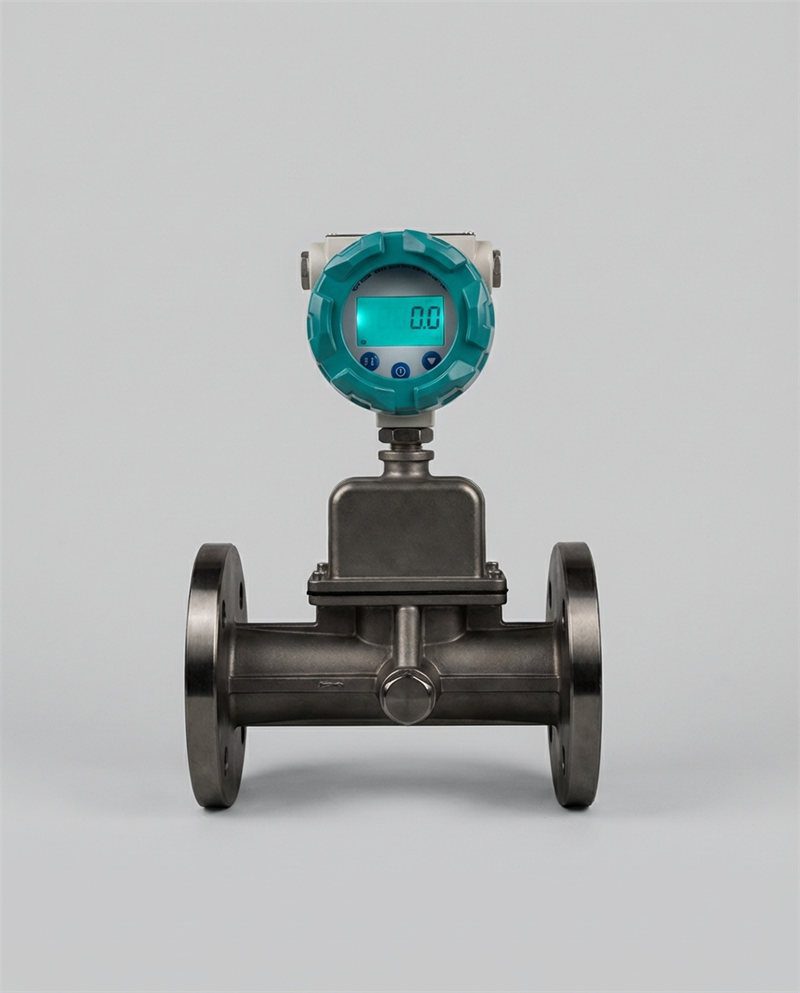
Basic glass tube VA meters are local-indication-only devices — the operator reads the float position visually against the tube scale. When remote indication, data logging, or integration with control systems is required, metal tube rotameters equipped with position transmitters become the standard choice. These transmitters detect the float position through magnetic coupling (the float contains a magnet; an external sensor tracks its vertical movement) and convert it to a standard output signal.
The most common output is 4–20 mA analog, which is universally compatible with PLCs, DCS systems, chart recorders, and panel meters. For digital integration, transmitters are available with HART protocol overlay (on the 4–20 mA signal), enabling remote configuration, diagnostics, and multi-variable data retrieval without additional wiring. Some modern VA transmitters also support Foundation Fieldbus or Profibus PA for full digital bus integration in large plant architectures. Alarm contacts (high/low flow switches) and pulse outputs for totalization are available as additional features on many industrial metal tube rotameters.
Interface Protocols and Electrical Requirements
When specifying transmitter-equipped VA meters for hazardous areas, the protection concept — intrinsically safe (Ex ia/ib), flameproof (Ex d), or non-incendive — determines the permissible wiring methods, barrier types, and power supply characteristics. Intrinsically safe designs are most common for VA transmitters because they allow simpler field wiring and easier maintenance. Power requirements are typically modest: 12–30 VDC loop-powered for 4–20 mA/HART units, with current consumption under 22 mA. For installations in IEC 60079 classified hazardous areas, ensure the complete loop — meter, barrier, cable, and junction box — is certified as a system, not as individual components.
Mounting, Orientation, and Process Connections
Mounting Styles (Panel, Inline, Sanitary, etc.)
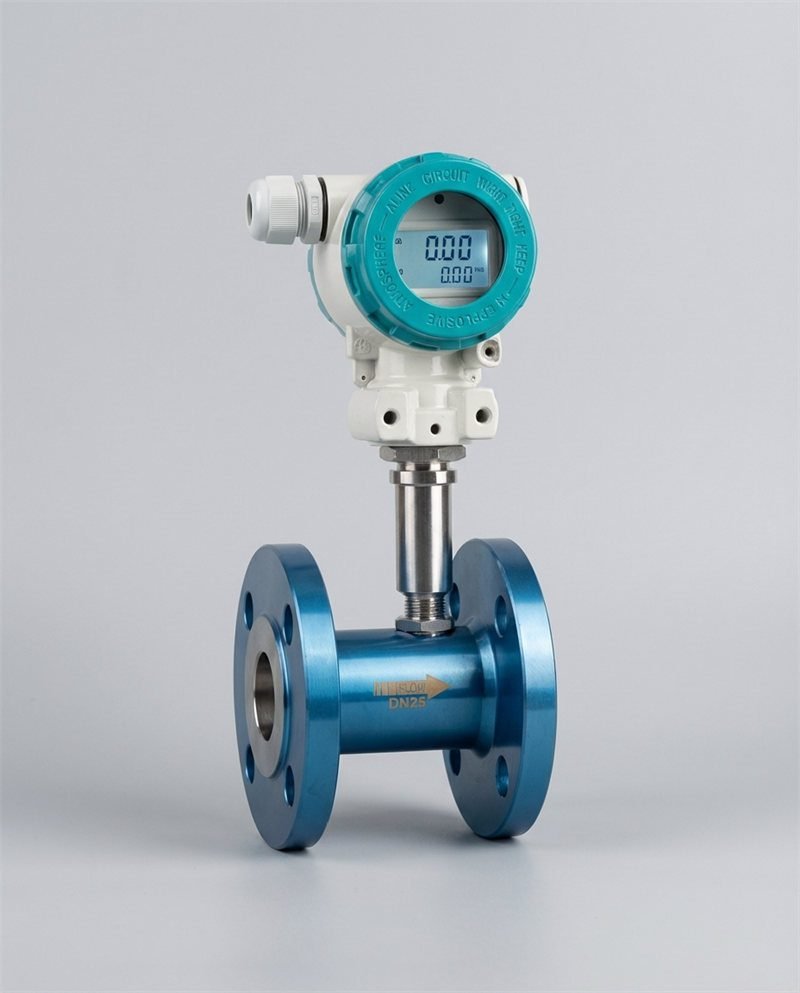
VA flow meters are available in a wider variety of mounting configurations than most engineers realize. Panel-mount rotameters — compact units with rear-threaded connections — are designed for integration into control panels, gas distribution manifolds, and analytical instrumentation racks. Inline models with flanged, threaded (NPT/BSP), or compression fittings install directly into the process piping. Sanitary/hygienic versions with tri-clamp connections and electropolished surfaces meet the requirements of 3-A Sanitary Standards for food, beverage, and pharmaceutical applications, where cleanability and material traceability are mandatory.
For applications requiring measurement of multiple streams — common in chemical dosing, gas blending, and laboratory setups — multi-tube rotameter stations mount up to six individual meters in a single frame with a shared inlet/outlet manifold, reducing footprint and simplifying piping.
Orientation and Bonding/Grounding Considerations
Gravity-type rotameters must be mounted within ±1° of true vertical for rated accuracy. In practice, this means using a plumb reference during installation — not eyeballing. Even well-intentioned installations on skid-mounted systems can develop tilt if the skid’s leveling feet settle unevenly over time. Spring-loaded designs relax this requirement and permit mounting at any angle, including horizontal and inverted, making them suitable for applications where vertical mounting is physically impossible.
For metal tube meters with electronic transmitters, proper grounding is essential to prevent signal noise and measurement drift. The meter body should be electrically bonded to the process piping and the plant’s ground grid. In plastic piping systems (common in chemical and semiconductor plants), dedicated grounding straps or conductive fittings may be required. The Jade Ant Instruments datasheet guide includes a section on verifying grounding requirements from manufacturer documentation.
Calibration, Maintenance, and Reliability Factors
Calibration Frequency and Drift Considerations
VA flow meters are inherently stable devices — there are no electronics to drift in basic glass tube designs, and the mechanical calibration is set by the fixed geometry of the tube taper and the float dimensions. Laboratory rotameters calibrated to ±0.5% AR can maintain that performance for years if the tube and float remain clean and undamaged. Industrial units typically require recalibration every 12–24 months, though the interval depends heavily on the process fluid’s fouling tendency.
The general guideline from Fluke’s calibration best practices states that the calibration standard should be at least four times more accurate than the device under test. For a ±2% FS rotameter, that means using a reference standard accurate to ±0.5% or better. Calibration is typically performed using a gravimetric (weigh tank) or volumetric (positive displacement prover) method for liquids, and a bell prover or reference mass flow controller for gases. In-situ verification is impractical for most VA meters — they must be removed from service for bench calibration.
Maintenance Practices and Diagnostics
The most common maintenance issues with VA flow meters are float contamination (coating, scaling, or particulate buildup), tube fogging or staining (reducing readability in glass designs), and O-ring/packing degradation (causing leaks). A proactive maintenance program includes periodic visual inspection of the float and tube (every 3–6 months in fouling-prone services), O-ring replacement on a condition-based or fixed schedule (annually for PTFE; every 6 months for Buna-N in aggressive services), and verification of the zero reading (float should rest at or below the zero mark with no flow).
One often-overlooked diagnostic: if a rotameter’s reading has gradually drifted upward over time without a corresponding process change, the float may have been eroded by abrasive particles, reducing its mass and causing it to ride higher for the same flow. This is particularly common in slurry-adjacent applications where trace solids pass through. Weighing the float against its original specification weight is a quick and definitive diagnostic. For mission-critical applications, Jade Ant Instruments recommends maintaining a spare float and tube assembly to minimize downtime during calibration or repairs.
Selection Workflow and Common Pitfalls Checklist
Step-by-Step Evaluation Process
An effective VA flow meter selection follows a structured workflow that prevents the most expensive mistakes — those discovered after installation. The process below reflects the decision logic used across 12,000+ meter installations documented by Jade Ant Instruments.
Step 1: Define the process fluid. Document the fluid name, phase (liquid/gas), specific gravity or molecular weight, viscosity at operating temperature, chemical composition, and any particulate content. If the fluid is a mixture, document the composition range.
Step 2: Establish operating conditions. Record the normal, minimum, and maximum values for flow rate, pressure, and temperature. Do not use design-basis maximums as the primary sizing input — use the actual normal operating window.
Step 3: Determine the measurement purpose. Is the meter for visual indication only, manual flow setting, remote monitoring, or closed-loop control? This determines whether a basic glass tube, a metal tube with transmitter, or a transmitter-only (no local indication) configuration is appropriate.
Step 4: Evaluate material compatibility. Cross-reference the fluid chemistry, concentration, and temperature against wetted material options for the tube, float, O-rings, and end fittings. When in doubt, request a formal compatibility review from the manufacturer.
Step 5: Size the meter. Convert the process flow to the meter’s calibration reference (water-equivalent or air-equivalent), then select a meter range that places the normal operating flow at 40–70% of full scale.
Step 6: Specify outputs and mounting. Choose the connection type (flanged, threaded, tri-clamp), mounting orientation (vertical, horizontal, panel), output signal (local only, 4–20 mA, HART, pulse), and hazardous area classification if applicable.
Step 7: Validate pressure drop. Confirm that the meter’s pressure drop at maximum flow is acceptable within the system’s available differential pressure. This is especially critical for gravity-feed systems and low-pressure gas applications.
VA Flow Meter Application Distribution by Industry
Water & Wastewater (22%)
Pharmaceutical (18%)
Oil & Gas (15%)
Food & Beverage (10%)
Other (5%)
Common Mistakes to Avoid in VA Flow Meter Selection
After reviewing hundreds of field failure reports, the following seven mistakes account for the majority of VA flow meter problems that could have been prevented at the selection stage:
Mistake 1: Sizing based on pipe size instead of flow rate. A DN50 pipe does not automatically require a DN50 meter. The meter size should be determined by the actual flow range, and reducers should be used when the optimal meter size differs from the pipe size.
Mistake 2: Ignoring viscosity effects. VA meters are “relatively insensitive” to viscosity — but this tolerance has limits that vary by float shape and meter size. Small ball-float rotameters are the most viscosity-sensitive. If the process fluid’s viscosity exceeds the manufacturer’s published limit for the selected float, readings must be corrected or a different float/meter combination selected.
Mistake 3: Specifying glass tubes in unsafe environments. If tube breakage could release hazardous fluids or create a safety incident, metal tube meters with magnetic followers are mandatory — regardless of the cost differential.
Mistake 4: Forgetting to account for gas density at operating conditions. A rotameter calibrated for air at standard conditions will read low on compressed gases and high on lighter-than-air gases if no density correction is applied.
Mistake 5: Installing gravity-type meters off-vertical. Even 3° of tilt causes measurable reading error. Use a spirit level during installation and recheck periodically on skid-mounted systems.
Mistake 6: Neglecting downstream backpressure for gas meters. Gas VA meters require a minimum backpressure (typically at least twice the meter’s pressure drop) to ensure the float responds to mass flow rather than just velocity. Without adequate backpressure, readings become unreliable.
Mistake 7: Selecting based on purchase price alone. A USD 150 plastic rotameter that fails every 6 months in a corrosive service costs far more over 5 years than a USD 800 PTFE-lined metal tube meter that runs maintenance-free.
Root Causes of VA Flow Meter Field Failures (%)
Wrong
Sizing
Material
Mismatch
Install
Error
Fouling /
Scaling
Gas Density
Ignored
Other
VA Flow Meter Selection Worksheet (Copy to Excel)
| Parameter | Your Value | Units | Notes |
|---|---|---|---|
| Fluid Name | — | Include concentration if applicable | |
| Fluid Phase | Liquid / Gas | Specify if two-phase possible | |
| Specific Gravity (liquid) or MW (gas) | SG / g/mol | At operating temp & pressure | |
| Viscosity | cP | At operating temperature | |
| Normal Flow Rate | GPM / LPM / SCFM | Typical operating flow | |
| Minimum Flow Rate | GPM / LPM / SCFM | Startup / turndown | |
| Maximum Flow Rate | GPM / LPM / SCFM | Peak / upset condition | |
| Operating Temperature | °C / °F | Normal and max | |
| Operating Pressure | psig / bar | Normal and max | |
| Required Accuracy | % FS or % AR | Specify basis | |
| Output Signal Required | — | Local / 4–20mA / HART / Pulse / Alarm | |
| Mounting Orientation | — | Vertical / Horizontal / Panel | |
| Hazardous Area Classification | — | Zone / Division / Gas Group / T-Class | |
| Process Connection | — | NPT / Flanged / Tri-Clamp / Compression |
Selecting the right variable area flow meter comes down to three interdependent decisions: matching the meter’s specifications to your actual process conditions (not design maximums), ensuring full material compatibility across every wetted component, and sizing the meter so that normal operating flow falls in the 40–70% range where effective accuracy is strongest. Every other consideration — outputs, mounting style, calibration interval — flows from getting these three fundamentals right.
Before placing an order, validate your selection by reviewing the manufacturer’s datasheet against your completed selection worksheet (Table 3 above), requesting a formal compatibility statement for your specific fluid and conditions, and confirming that the pressure drop at maximum flow is within your system’s available differential. For critical applications, request test data or a trial installation before committing to a fleet purchase.
The most efficient next step: create a shortlist of two or three candidate meters, then engage directly with manufacturers for application-specific sizing, compatibility confirmation, and delivered pricing. Jade Ant Instruments’ engineering team offers free sizing assistance and can provide a detailed quotation package — including GA drawings, material certificates, and calibration scope — within 48 hours of receiving your completed specification form at www.jadeantinstruments.com.

Frequently Asked Questions (FAQs)
What distinguishes a variable area flow meter from other flow meters?
A variable area flow meter measures flow by allowing the fluid to lift a float inside a tapered tube — the float position directly indicates the flow rate. Unlike electromagnetic or turbine flow meters that produce electronic signals from the start, a VA meter provides inherent visual indication without requiring external power. This passive operating principle makes it uniquely suitable for applications where electrical power is unavailable, where fail-safe visual monitoring is needed alongside electronic systems, or where budget constraints favor a lower-cost mechanical instrument. The constant pressure-drop characteristic also differentiates it from orifice-plate systems, where pressure loss varies with the square of flow.
How do I determine the appropriate meter range for my process?
Start by documenting three flow values: your minimum operating flow (startup, low-load, or night-shift conditions), normal operating flow, and maximum expected flow (including upset or cleaning-cycle peaks). Then select a meter whose full-scale rating places your normal flow between 40% and 70% of full scale. This ensures the effective accuracy at normal operation is acceptably tight (since VA meters are rated as % of full scale, not % of reading), while still accommodating flow excursions without bottoming or topping out the float. For gas applications, remember to convert flow rates to the meter’s calibration reference conditions — typically air at 20°C and 1.013 bar — before selecting the range.
How often should VA flow meters be calibrated in continuous service?
The recommended calibration interval depends on the application severity. For clean-fluid services (water, air, inert gases) with stable operating conditions, a 24-month interval is common across many industrial plants. For fouling-prone or corrosive services, 12 months or less is advisable. Some pharmaceutical and FDA-regulated processes require 6-month verification cycles. Between formal calibrations, a quick zero check — confirming the float rests at or below zero with no flow — can catch gross failures early. If your process data shows consistent drift direction over successive calibrations, that pattern itself is diagnostic: upward drift often indicates float erosion, while downward drift can indicate tube fouling or scale buildup that narrows the annular gap.
What installation considerations most impact accuracy and longevity?
Three installation factors dominate field performance. First, verticality: gravity-type VA meters must be within ±1° of true vertical; every degree of tilt introduces systematic bias that cannot be calibrated out because it varies with flow rate. Second, cleanliness: while VA meters are somewhat self-cleaning (the fluid scouring between float and tube wall), installing a strainer or filter upstream of the meter in particulate-laden services dramatically extends calibration stability and tube clarity in glass designs. Third, backpressure: for gas applications, maintaining adequate downstream pressure (a minimum of 2× the meter’s internal pressure drop) ensures the float responds to mass-flow-proportional forces rather than compressible-flow anomalies. Jade Ant Instruments’ installation best practices guide provides detailed requirements for each of these factors.
Can a variable area flow meter handle corrosive or high-purity fluids?
Yes — with the right material configuration. All-PTFE or PFA-lined metal tube meters with sapphire floats and Kalrez O-rings can handle concentrated acids (including hydrofluoric acid), strong alkalis, and ultra-pure semiconductor chemicals. For deionized water applications (where metal ion contamination must be minimized), all-plastic construction with no metal wetted parts is available. The key is specifying every wetted component independently: the tube material, float material, O-ring/packing material, and end-fitting material must each be compatible with the specific fluid at the specific operating temperature and concentration. A compatibility review by the manufacturer — or by referencing resources like the CPC chemical compatibility database — should be part of every specification for aggressive-fluid applications.
What is the typical accuracy of a variable area flow meter?
Industrial VA meters typically achieve ±1–2% of full scale over a 10:1 turndown range. Laboratory-grade units can reach ±0.5% of actual reading over a 4:1 range. Purge and bypass designs are less accurate, typically ±5% of full scale. The critical point that many engineers miss: “full scale” accuracy means the absolute error (in engineering units) is constant across the range. At 50% of scale, a ±2% FS meter has an effective accuracy of ±4% of reading — acceptable for most process monitoring. At 10% of scale, the effective accuracy degrades to ±20% of reading — unacceptable for any meaningful measurement. This is why proper sizing is arguably more important than the accuracy class printed on the datasheet.
Do variable area flow meters require electrical power?
Basic glass tube and metal tube rotameters with local indication operate entirely on the force of gravity — no external power is required. This makes them ideal for remote locations, safety-critical backup measurements, and explosion-hazard zones where minimizing electrical energy is beneficial. However, if you need remote signal output (4–20 mA, HART, pulse), alarm contacts, or digital communication, the transmitter module does require power — typically 12–30 VDC loop-powered, drawing under 22 mA. Some modern transmitter designs offer battery-powered wireless options for locations where running signal cable is impractical.
Can VA flow meters be used for steam measurement?
Metal tube VA meters can measure steam flow in certain applications, particularly low-flow saturated or superheated steam lines where other technologies (vortex, DP) are not practical due to minimum velocity requirements. The meter must be rated for the steam temperature and pressure, and the float/tube materials must handle the thermal cycling and potential condensate formation. However, for larger steam mains and applications requiring compensated mass-flow output, vortex or differential pressure meters are generally preferred due to their wider rangeability and integrated temperature/pressure compensation capabilities.
What is the difference between % FS and % AR accuracy specifications?
Percent of Full Scale (% FS) means the maximum error is a fixed amount regardless of the actual reading — for example, ±2% FS on a 0–100 LPM meter means ±2 LPM at every point on the scale. Percent of Actual Reading (% AR) means the error scales proportionally with the measurement — ±2% AR at 50 LPM means ±1 LPM, while at 10 LPM it means ±0.2 LPM. The % AR specification is substantially more favorable at low flows, which is why it is associated with higher-grade (and higher-cost) instruments. When comparing meters from different manufacturers, always confirm which accuracy basis is being quoted — mixing up % FS and % AR in a specification can lead to selecting an under-performing meter or overpaying for unnecessary precision.
How do I choose between a glass tube and a metal tube VA meter?
The decision matrix is straightforward: if the application requires visual float observation, the fluid is non-hazardous upon tube breakage, operating conditions stay within glass limits (approximately 200°C / 500 psig for small bores), and cost minimization is a priority — choose glass. If any of the following apply — hazardous fluid, high pressure or temperature, remote signal output required, outdoor or vibration-prone installation, or regulatory requirement for contained measurement — choose metal tube. In practice, chemical plants increasingly default to metal tube rotameters for process lines and reserve glass tube designs for utility monitoring (cooling water, instrument air, nitrogen purge) where the safety risk of breakage is minimal. For specific guidance on your application, Jade Ant Instruments’ 5-factor selection guide walks through this decision in detail.