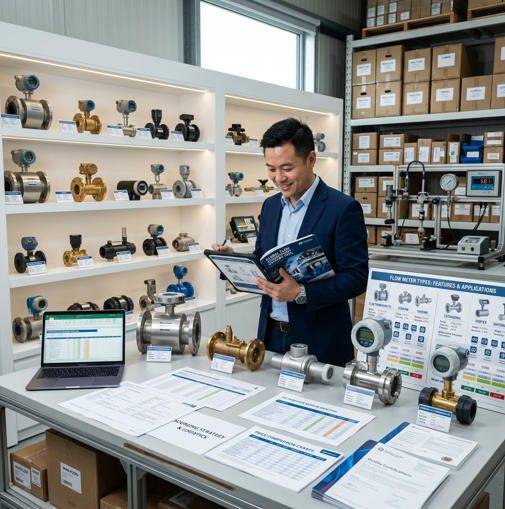
B2B Distributor Guide Flow Meter Selection Instrumentation
When a new distributor first walks into a customer site and gets asked, “Which flow meter should we use for our steam header — vortex or orifice plate?”, the wrong answer doesn’t just lose a sale. It loses a relationship. In a market where the same piping contractor works with dozens of suppliers, your technical credibility is the product you’re really selling.
This guide is written exclusively for flow meter distributors, agents, and resellers — not for end users, not for engineers designing systems from scratch, but for the B2B professionals whose job is to match a customer’s application to the right product, submit a competitive quote, and close the deal with confidence. By the time you finish reading, you’ll understand the six major flow meter technologies well enough to qualify every inquiry, explain the trade-offs without oversimplifying, and build a sourcing strategy that protects your margins.
That last number deserves emphasis: half of all flow meter field failures occur because the wrong product was specified — incorrect liner material, mismatched electrode, undersized bore, or wrong technology for the fluid. For a distributor, this means technical competence is not a nice-to-have. It is margin protection.
The Flow Meter Market in 2026: What Every Distributor Needs to Know
The global flow meter industry crossed USD 11 billion in 2025 and is on a trajectory to reach USD 12.6 billion by 2029 according to MarketsandMarkets. The growth is not uniform across technologies. Smart electromagnetic and vortex meters with digital communication (HART, Modbus, Ethernet APL) are gaining share at the expense of legacy differential-pressure orifice-plate assemblies. Meanwhile, ultrasonic clamp-on meters are opening new retrofit markets in water utilities and district heating where pipe cutting is not an option.
For distributors, three macro trends are reshaping the demand mix:
1. Decarbonization & Energy Monitoring. ISO 50001 energy management systems are being mandated in manufacturing, utilities, and commercial buildings across China, Europe, and Southeast Asia. Every ISO 50001 implementation requires a steam or compressed-air sub-metering point — and vortex meters are the default specification. A single industrial park retrofitting 80 boiler-house steam lines represents a purchase order in the $160,000–$480,000 range.
2. Water Infrastructure Investment. China’s “Water Security” initiative, India’s Jal Jeevan Mission, and Southeast Asia’s municipal water expansion programs are driving hundreds of millions of dollars in new electromagnetic flow meter installations through 2030. DN100–DN400 mag meters at wastewater treatment plants and water distribution networks are a high-volume, repeatable SKU for regional distributors.
3. Process Digitalization. Distributors who can deliver flow meters with HART or Modbus communication, and help customers integrate readings into SCADA systems, command 15–25% price premiums over commodity analog-output suppliers. Technical service capability is becoming a differentiator in distributor selection.
Industrial pipeline instrumentation at a chemical processing facility. Flow meters on steam, water, and chemical lines represent the core addressable market for B2B distributors.
The Six Core Flow Meter Technologies: A Distributor’s Decision Framework
A distributor who understands the why behind technology selection can close technical objections in the field without consulting a product manager. Here is how each technology works, where it excels, and — critically — where it fails.
1. Electromagnetic Flow Meters (Mag Meters)
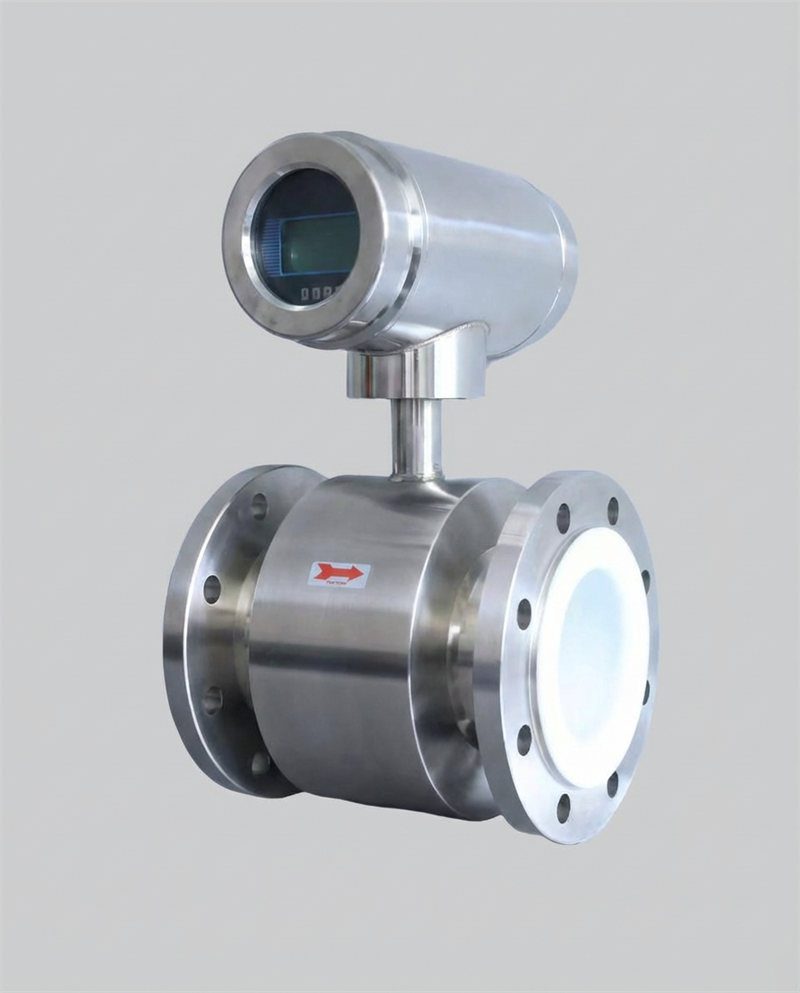
A mag meter applies Faraday’s law of electromagnetic induction: two coils generate a magnetic field across the pipe bore, and as conductive liquid flows through, an induced voltage proportional to velocity is picked up by two flush-mounted electrodes. There are no moving parts, no obstruction to flow, and zero permanent pressure drop. With a properly specified liner and electrode material, service life routinely exceeds 25 years.
The hard rule: mag meters only work on conductive fluids — minimum 5 µS/cm. Municipal water (300–800 µS/cm), most acids, alkalis, and slurries pass this threshold easily. Hydrocarbon oils, deionized water below 1 µS/cm, and organic solvents do not. Sending a mag meter quote for a customer measuring transformer oil is a credibility loss from which you may not recover.
The two specification decisions that most often determine field success are liner material (the polymer that contacts the process fluid) and electrode material (the metal that picks up the induced signal). The table in Section 4 covers both in detail. For a deep dive, Jade Ant Instruments’ electromagnetic flow meter selection guide provides a liner-electrode pairing tool based on over 40 chemical compounds.
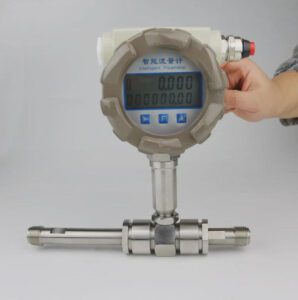
2. Vortex Flow Meters
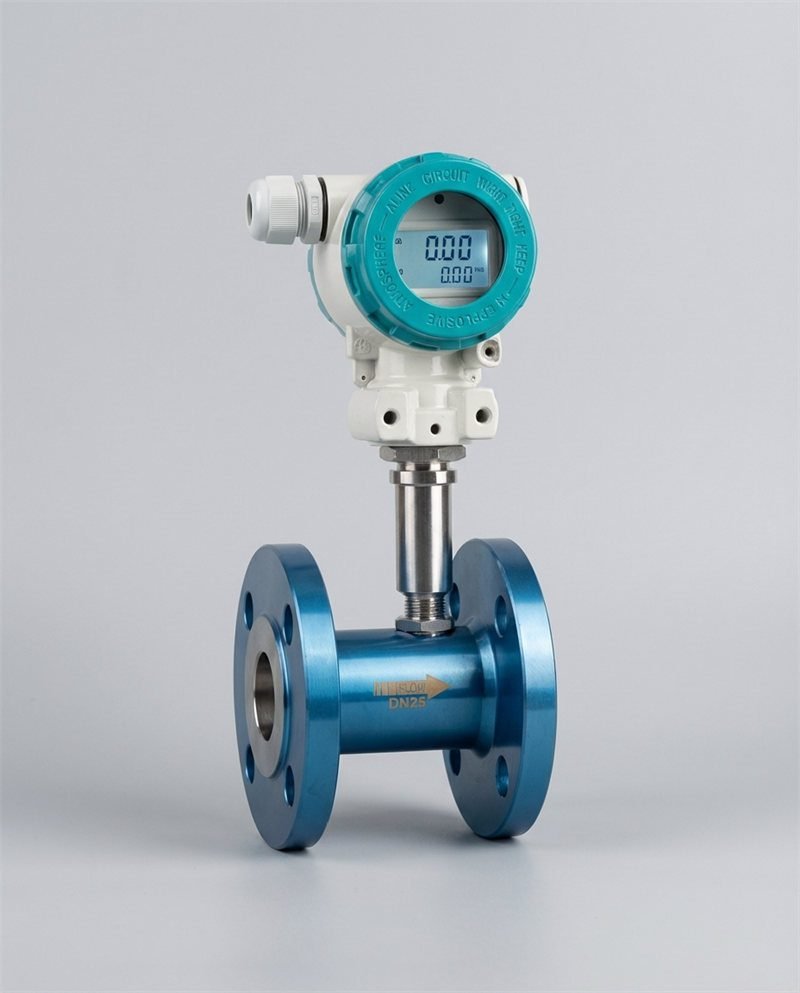
A vortex meter places a bluff body (shedder bar) in the flow path. Fluid passing around it creates alternating vortices downstream — a phenomenon called the von Kármán vortex street — at a frequency directly proportional to flow velocity (the Strouhal equation: f = St × V / d). A piezoelectric or capacitive sensor counts the vortices. With no impulse lines, no moving parts, and a measurement principle that is unaffected by fluid temperature or pressure changes, vortex meters are the dominant technology for steam, compressed gas, and hot liquids.
The critical limitation is the Reynolds number floor. Vortex shedding becomes unstable below approximately Re = 10,000, which corresponds to roughly 0.5–0.8 m/s fluid velocity in most industrial applications. This means vortex meters are not suitable for high-viscosity fluids or applications with very low flow velocities. When a customer’s steam header runs at 30% of design capacity during low-demand periods, verify that minimum velocity stays above the threshold — or downsize the meter bore to compensate.
For a full technical breakdown including brand comparison and TCO model, see the vortex flow meter selection guide for steam and gas applications.

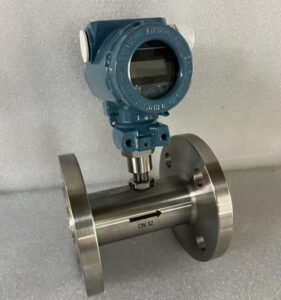
A vortex flow meter installed on a high-temperature steam header. Replacing legacy orifice plate assemblies with vortex meters is one of the fastest-growing distributor revenue opportunities in the energy sector.
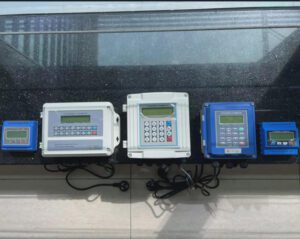
3. Ultrasonic Flow Meters
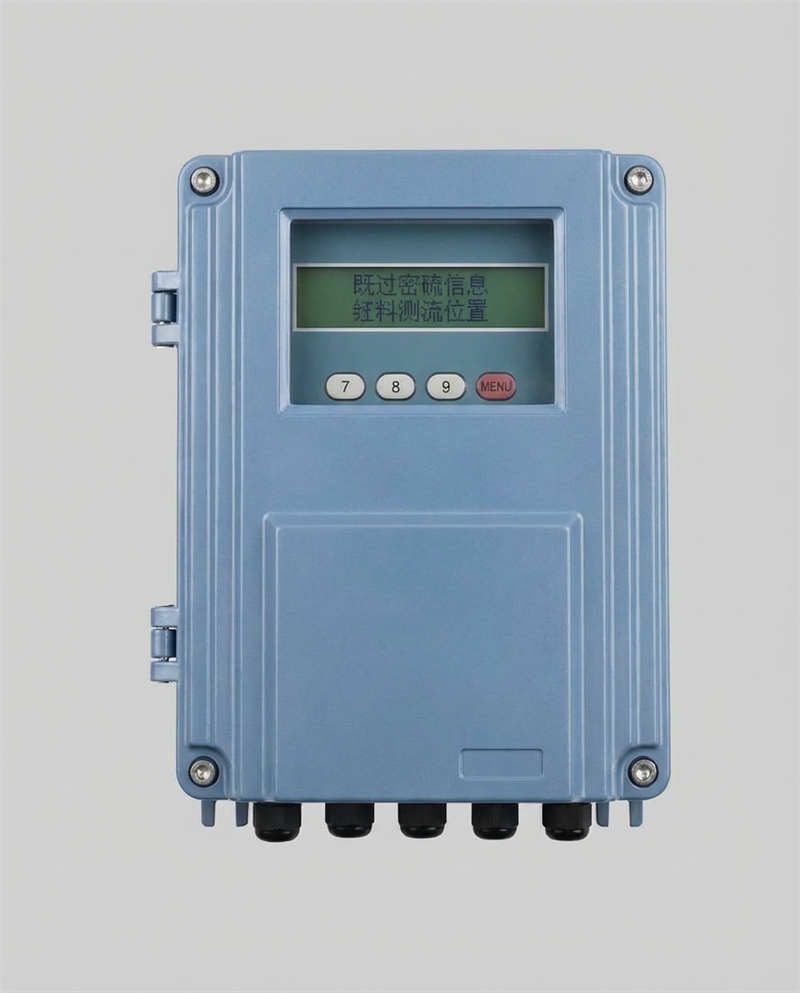
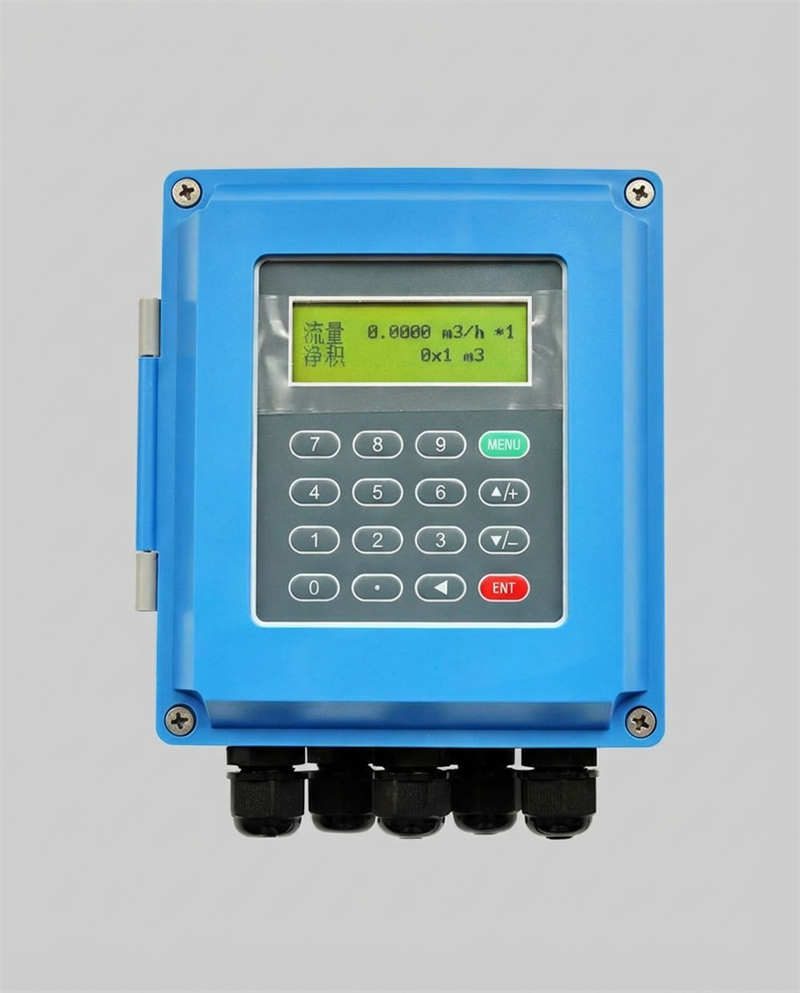
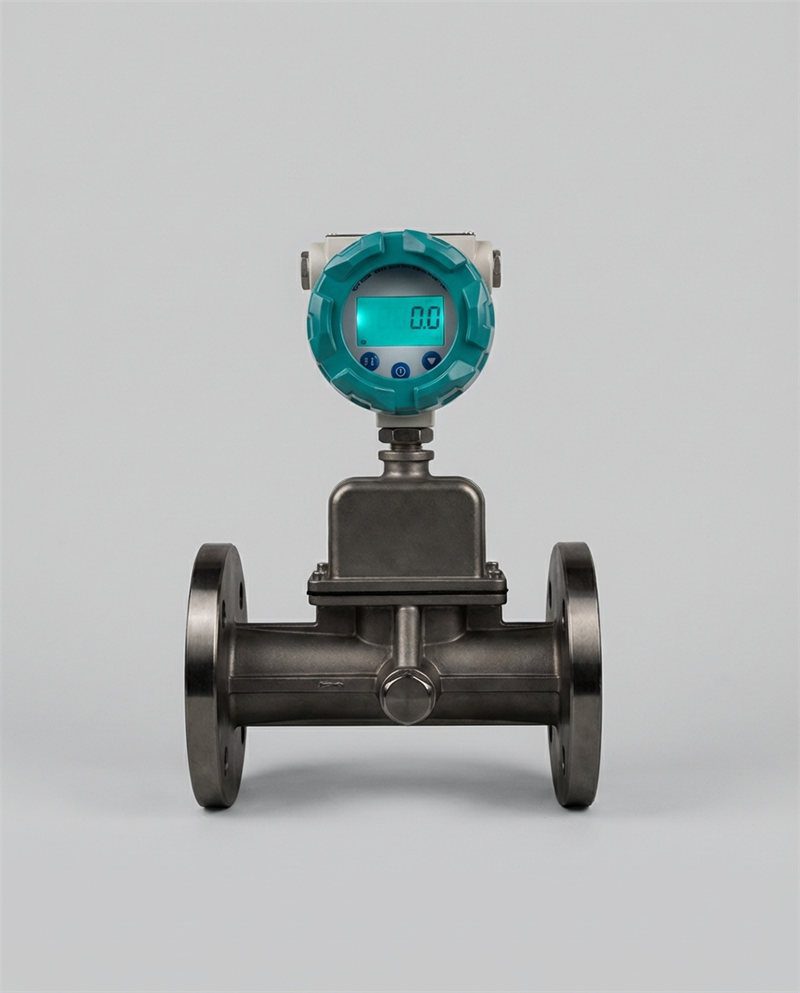
Ultrasonic meters measure the transit-time difference between ultrasonic pulses sent upstream and downstream through the flowing liquid. That time difference is proportional to flow velocity. The defining commercial advantage — particularly for clamp-on models — is that the transducers mount on the outside of the pipe: no cutting, no welding, no process shutdown.
This makes clamp-on ultrasonic meters the go-to solution for retrofit projects, rental applications, and customers who cannot afford a production interruption. A water utility with 200 km of distribution mains and no budget for excavation and re-pipe is a natural ultrasonic customer. Inline ultrasonic meters (wetted transducers) deliver higher accuracy (±0.5% to ±1%) and are appropriate for permanent installations where process shutdown is acceptable.
The limitation: ultrasonic meters require acoustically conductive liquid. Entrained gas bubbles, high solids content (above ~3%), or very viscous fluids attenuate the signal and degrade accuracy. They also require clean pipe walls — scale or internal coating can scatter the beam. For non-conductive clean liquids where mag meters are excluded, inline ultrasonic is often the correct specification. Explore ultrasonic flow meter selection tips for more fluid-matching criteria.
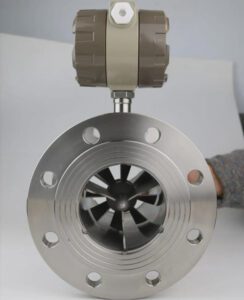
4. Turbine Flow Meters
A turbine meter places a multi-bladed rotor in the flow path. The fluid spins the rotor at a speed proportional to flow velocity, and a pickup coil or Hall-effect sensor counts blade passages. The result: excellent accuracy (±0.25–0.5%) on clean, low-viscosity liquids at relatively low cost.
The trade-off is mechanical wear. The rotor bearings are the life-limiting component. In clean water service, a well-maintained turbine meter lasts 8–15 years. In fluids with suspended solids or abrasive particles, bearing life collapses to 2–4 years. Turbine meters are also sensitive to flow profile disturbances and require 10–15 pipe diameters of straight run upstream. They are the right choice for custody-transfer metering of clean fuels, light oils, and low-particulate liquids where the accuracy premium over vortex is worth the maintenance commitment.
For a head-to-head comparison with variable area meters, the turbine vs. electromagnetic vs. variable area comparison article covers the cost-accuracy trade-off in detail.
5. Coriolis Mass Flow Meters
Coriolis meters measure mass flow directly — not inferred from velocity and density — by vibrating a tube through which the fluid flows and measuring the phase shift caused by the Coriolis force. Accuracy is exceptional: typically ±0.1% on mass flow, with simultaneous density measurement (±0.0005 g/cm³). For custody-transfer billing of high-value fluids — LNG, pharmaceutical intermediates, food ingredients sold by mass — Coriolis is the only specification.
The limitation for most distributor portfolios is cost. A DN50 Coriolis meter typically runs $4,000–$14,000 — four to ten times the cost of an equivalent electromagnetic or vortex meter. Additionally, larger bore sizes (DN80+) become extremely expensive and heavy. Coriolis is a specialist tool for high-value applications, not a general-purpose product line for volume distribution.
6. Thermal Mass Flow Meters
Thermal meters measure gas flow by detecting the heat dissipated from a heated element into the gas stream. The faster the gas flows, the more heat is carried away. This principle works at very low flow rates and delivers mass flow output without pressure compensation — making thermal meters the dominant technology for compressed air, nitrogen, and natural gas sub-metering in factories.
The critical limitation: thermal meters only work on gases (and a limited range of vapors). They are not suitable for liquids or steam. They also require a stable gas composition — a change in the specific heat capacity of the gas (for example, switching from air to CO₂-enriched air) will cause reading errors unless the meter is recalibrated. For factory compressed-air energy management, thermal meters paired with a Modbus data logger are a high-demand SKU. See the thermal air flow meter comparison guide for 2026 for an overview of constant-temperature versus constant-power designs.
Watch: How to Choose the Right Flow Meter for Your Application
▲ A practical walkthrough of flow meter technology selection across liquid, gas, and steam applications. Recommended pre-sales training for new distributor sales engineers.
Side-by-Side Technology Comparison: What to Quote for Which Customer
The table below distills the most commercially relevant specifications for each technology. Use this as your first-pass qualification tool when a customer inquiry comes in — map the fluid, temperature, accuracy requirement, and budget against the columns, and you can narrow the recommendation to one or two technologies before picking up the phone.
| Технологии | Suitable Fluids | Точность | Движущиеся детали | Max Temp. | Подготовка номера ко сну | Approx. DN50 Price (USD) | Лучшее приложение |
|---|---|---|---|---|---|---|---|
| Электромагнитный | Conductive liquids ≥5 µS/cm | ±0.2–0.5% | Нет | 180°C (std) | Up to 1000:1 | $800–$4,000 | Water, wastewater, chemical dosing, slurries |
| Vortex | Liquid, gas, steam | ±0.75–1.5% | Нет | 450°C | 10–30:1 | $1,000–$3,000 | Steam, compressed gas, hot oil |
| Ультразвуковой (накладной) | Clean liquid, limited gas | ±1–2% | Нет | 120°C | 100:1 | $600–$2,500 | Retrofit, no-shutoff water, HVAC energy |
| Турбина | Clean liquid, clean gas | ±0.25–0.5% | Yes (rotor + bearing) | 250°C | 10–30:1 | $800–$3,000 | Fuel metering, custody transfer, clean water |
| Кориолис | Liquid, gas, slurry (small bore) | ±0.05–0.1% | Нет | 400°C | 80–100:1 | $4,000–$14,000 | High-value custody transfer, pharma, LNG |
| Thermal | Gas only | ±1–2% | Нет | 300°C | 50–100:1 | $700–$2,500 | Compressed air, N₂, natural gas sub-metering |
Sources: Emerson, Endress+Hauser, KROHNE, Инструменты "Нефритовый муравей published datasheets; Engineering ToolBox. Prices are indicative 2025–2026 list prices for DN50 standard flanged configurations.
Accuracy vs. Cost: The Distributor’s Value Positioning Chart
One of the most common customer objections is: “Why should I pay more for an electromagnetic meter when a turbine meter is half the price and has the same accuracy?” The answer lies in total cost of ownership — not just purchase price. But you first need to internalize how accuracy and price relate across technologies so you can frame the conversation correctly.
Flow Meter Accuracy vs. Approximate DN50 List Price (USD) — Six Technologies
Bar length represents approximate average DN50 list price (USD). Accuracy range shown beside each bar. Coriolis price anchored at $9,000 average for visualization scaling. Sources: manufacturer datasheets, 2025–2026 pricing.
Modern process control rooms rely on HART and Modbus-connected flow meters for real-time monitoring. Distributors who can help customers with protocol integration command 15–25% price premiums over commodity suppliers.
Industry Application Matrix: Which Technology for Which Customer
Most distributor sales calls come industry-first: “I have a water treatment plant customer” or “I need flow meters for a petrochemical refinery.” The matrix below maps from industry and fluid type to the primary and alternative technology recommendation — so you can make a defensible first recommendation before knowing all the technical details.
| Industry Segment | Typical Fluid | Primary Technology | Alternative | Key Distributor Opportunity |
|---|---|---|---|---|
| Municipal Water & Wastewater | Treated water, raw sewage, sludge | Электромагнитный | Ультразвуковой | High volume, DN100–DN400; repeatable SKU; tenders driven by price per accuracy |
| Химическая обработка | Acids, alkalis, solvents, chemical solutions | Electromagnetic (PTFE/Hastelloy) | Coriolis (dosing) | High ASP; liner/electrode upsell; strong after-sales service revenue |
| Производство электроэнергии | Superheated & saturated steam, boiler feedwater | Вихрь (многомерный) | DP averaging pitot (large DN) | Large orifice-plate retrofit pipeline; ISO 50001 compliance drives urgency |
| Oil & Gas Upstream | Natural gas, flare gas, condensate | Vortex / Turbine | Ultrasonic (custody) | ATEX/IECEx certification required; higher ASP; long sales cycle |
| Продукты питания и напитки | Process water, CIP steam, product liquids | Electromagnetic (hygienic) | Coriolis (custody dosing) | 3A/EHEDG certification required; shorter DN range; fast replacement cycle |
| Pharmaceutical | WFI, purified water, clean steam | Coriolis / Electromagnetic (sanitary) | Ультразвуковой | Highest ASP segment; FDA/GMP audit trail requirements; service contracts |
| Mining & Minerals | Slurry, tailings water, process water | Electromagnetic (PU or ceramic liner) | None (vortex unsuitable) | Liner replacement cycle = recurring revenue; high-abrasion expertise builds loyalty |
| HVAC & Building Services | Chilled water, heating water, compressed air | Ultrasonic / Thermal (for air) | Электромагнитный | Retrofit-friendly clamp-on; BACnet integration; growing ESG-driven metering demand |
| Pulp & Paper | Stock flow, white water, bleach solution | Электромагнитный | Vortex (steam lines) | Corrosive media expertise (titanium electrodes for bleach) differentiates from generalists |
| Factory Utilities | Compressed air, nitrogen, CO₂ | Thermal Mass Flow Meter | Vortex (at line pressure) | Factory energy audits; sub-metering to ISO 50001; fast-growing SKU in manufacturing sector |
Global Flow Meter Market Share by Technology (2025)
Understanding market share by technology helps distributors prioritize product line investments. The electromagnetic and differential pressure segments together account for over 45% of total market value — but differential pressure is in structural decline as vortex and ultrasonic replace legacy orifice plates. Distributors building their portfolio in 2025–2030 should weight their investment toward electromagnetic, vortex, and ultrasonic, with thermal as a growing niche.
Global Flow Meter Market Share by Technology — 2025 (% of Revenue)
Sources: MarketsandMarkets Flow Meter Report 2024–2029; Fortune Business Insights Flow Meter Market 2025–2034; Jade Ant Instruments market analysis. Electromagnetic share includes insertion-type mag meters.
Distributor Margins, Sourcing Strategy, and OEM/ODM: The Business Side
Technical competence wins the specification. Sourcing strategy determines whether winning the specification is actually profitable. Most distributor principals in the instrumentation sector operate on gross margins of 25–45%, with higher margins achievable through private-label (OEM/ODM) sourcing and technical service add-ons.
Understanding OEM vs. ODM in Flow Meter Sourcing
OEM (Original Equipment Manufacturer) sourcing means you purchase a meter manufactured to an existing design and sell it under either the manufacturer’s brand or your own. The factory controls the design. Your leverage is in volume and exclusivity negotiation.
ODM (Original Design Manufacturer) sourcing means the factory produces a meter to your specification — your label, your model numbers, your firmware, your calibration certificates. The investment is higher (tooling, minimum order quantities of typically 50–200 units per SKU), but the payoff is a defensible product line that your customers cannot easily price-shop online.
The decision rule is straightforward: if you are selling into project-driven markets where the end customer specifies the product by brand (water utilities, large EPC contractors), OEM sourcing under the original brand gives you access to those tenders. If you are selling into industrial MRO, OEM integrators, or small-to-medium factories where the purchasing decision is price-performance, ODM private-label sourcing protects your margin from internet price comparison.
Инструменты "Нефритовый муравей supports both models — OEM supply of their ISO 9001-certified electromagnetic, vortex, turbine, and ultrasonic meters as branded product, and ODM customization including custom enclosures, firmware, communication protocols, and calibration documentation for distributors building a private-label instrumentation range.
Distributor Margin Model: Direct Brand vs. OEM vs. ODM
| Sourcing Model | Example: DN100 EM Flow Meter | Typical Buy Price (USD) | Typical Sell Price (USD) | Gross Margin % | Price Sensitivity | Reorder Complexity |
|---|---|---|---|---|---|---|
| Premium Brand Reseller (Endress+Hauser, KROHNE) |
Promag W / OPTIFLUX 2100 | $2,100–$2,800 | $2,800–$3,800 | 20–30% | High (customer can compare online) | Low (standard distributor agreement) |
| Mid-tier OEM Brand (Jade Ant Instruments) |
Jade Ant EM, DN100, PTFE/316L | $380–$580 | $750–$1,200 | 35–50% | Medium (less price visibility online) | Medium (manufacturer direct or regional stocking) |
| Private Label ODM (Your Brand, Custom) |
Your brand, DN100, custom label | $350–$520 | $900–$1,500 | 50–65% | Low (no online price comparison) | High (MOQ, lead-time management) |

Quality control and calibration at an ISO 9001-certified flow meter manufacturing facility. Traceable calibration certificates are the minimum requirement for OEM sourcing to be accepted by industrial end customers.
The 7-Step Pre-Sales Qualification Checklist
Every flow meter inquiry, regardless of size or urgency, should be qualified against these seven questions before a product recommendation is made. Skipping even one of these steps can result in a returned product, a warranty dispute, or — worst of all — a failed installation at the customer site.
- What is the fluid? — Identify the fluid name, conductivity (µS/cm), chemical composition, pH, and percentage of suspended solids. This single data point determines which technologies are eligible and which liner and electrode materials are required for mag meters.
- What is the operating temperature and pressure? — Maximum operating temperature determines liner material compatibility (e.g., hard rubber maximum 80°C vs. PTFE to 180°C) and whether the meter needs a high-temperature certification. Maximum pressure must be matched to the meter’s rated pressure class (PN10, PN16, PN40, ANSI Class 150/300).
- What is the pipe size and required flow range? — Pipe diameter (DN) does not always equal meter bore — downsizing is often required to keep velocity in the optimal measurement range (1–10 m/s for mag meters). Confirm both the normal operating flow rate and the minimum expected flow rate to verify turndown compliance.
- What accuracy level is required? — Differentiate between process control (±1–2% is usually adequate), billing/allocation (±0.5%), and custody transfer (±0.2% or better with third-party certification). The accuracy requirement determines which technology and which grade of meter is appropriate, and prevents over-specification on non-critical measurement points.
- Is there adequate straight-pipe run available? — Vortex meters need 15–25D upstream; turbine meters 10–15D; mag meters typically 5D. Walk the installation if possible or ask for a plant sketch. Insufficient straight run is the #1 cause of field accuracy complaints — and it is always the distributor’s problem to solve post-installation.
- What output signal and communication protocol does the customer’s control system require? — 4–20 mA analog, pulse output, HART, Modbus RTU/TCP, PROFIBUS PA, or Foundation Fieldbus? Specifying a meter with the wrong protocol results in expensive converter hardware and delays. Confirm the DCS or PLC vendor and model to determine protocol compatibility before quoting.
- Are there any approvals or certifications required? — ATEX/IECEx for hazardous areas, SIL 2 for safety-instrumented systems, 3A/EHEDG for food and pharma, OIML or MID for legal-for-trade metering. These requirements narrow the supplier shortlist dramatically and often make price secondary to certification availability.
This checklist can be turned into a one-page customer intake form — either digital (Google Form / CRM intake) or printed for field sales visits. Distributors who document these seven data points for every inquiry close more deals on the first quote and experience fewer post-installation returns.
Electromagnetic Flow Meter Deep Dive: Liner & Electrode Selection for Distributors
Because electromagnetic flow meters represent over 30% of market revenue and the single largest SKU category for most industrial distributors, the ability to specify liner and electrode materials correctly is a core sales competency — not a back-office engineering function.
Сайт liner is the polymer sleeve inside the meter bore that contacts the process fluid. It must resist the chemical attack, temperature, and abrasion of the specific application. A single liner failure on a 15% hydrochloric acid line can cost $25,000 in emergency replacement and lost production. The electrodes are the signal pickups — small metal discs flush-mounted in the liner wall. Corrosion, coating, or pitting on an electrode surface directly degrades accuracy, and the failure mode is often gradual and invisible until the meter has been misreading for months.
| Liner Material | Max Temp. | Abrasion Resistance | Acid Resistance | Alkali Resistance | Vacuum Service | Лучшее приложение |
|---|---|---|---|---|---|---|
| Hard Rubber (Ebonite) | +80°C | Хорошо | Mild acids only | Хорошо | Full vacuum | Municipal water, sewage, mild slurry |
| PTFE (Teflon) | +180°C | Бедный | All concentrations | All concentrations | Partial vacuum only | Strong acids, bases, solvents, chemical dosing |
| PFA | +150°C | Бедный | Превосходно | Превосходно | Partial vacuum | Pharma, ultrapure water, food-grade chemicals |
| Polyurethane | +50°C | Превосходно | Poor (acids) | Fair | Full vacuum | Mining slurries, dredging, abrasive solids |
| Ceramic (Al₂O₃) | +180°C | Превосходно | Превосходно | Превосходно | Full vacuum | High-abrasion mining, cement, ceramic slurries |
| Neoprene | +80°C | Хорошо | Ограниченный | Fair | Full vacuum | Raw water intake, cooling towers, low-cost utility |
| Electrode Material | Corrosion Profile | Best Applications | Relative Cost (316L = 1×) |
|---|---|---|---|
| 316L Stainless Steel | Mild acids, water (Cl⁻ <200 ppm) | Water treatment, HVAC, general industrial | 1× |
| Hastelloy C-276 | HCl, H₂SO₄, HNO₃, chlorinated solvents | Chemical processing, acid dosing, FGD scrubbing | 3–4× |
| Titanium (Grade 2) | Seawater, chlorine dioxide, bleach, brackish water | Desalination, pulp & paper, chlor-alkali | 4–5× |
| Tantalum | Hot concentrated HCl, chromic acid, boiling H₂SO₄ | Extreme acid service, pharma intermediates | 8–12× |
| Platinum-Iridium | Universal resistance; maximum signal stability | Custody transfer, lab reference, pharma API | 15–20× |
A real-world example: a chlor-alkali plant running concentrated brine (~3,500 ppm Cl⁻) experienced electrode pitting on 316L sensors within 14 months. After switching to titanium electrodes (cost: $1,800 per sensor head), the same meters ran for 7 years without electrode replacement — avoiding $22,000 per location in downtime and maintenance costs. The electrode upsell from 316L to titanium was a $1,800 conversation that protected a $22,000 asset. That is the distributor value-add in one sentence.
For a full liner-electrode chemical compatibility reference covering over 40 process fluids, see the Jade Ant Instruments electromagnetic flow meter selection and sizing guide.
Cross-section of an electromagnetic flow meter highlighting the liner and electrode assembly. Correctly specifying these two components prevents 50–70% of all field failures in chemical and industrial water applications.
10-Year Total Cost of Ownership: The Number That Closes Deals
When a customer balks at the price premium for an electromagnetic meter over a simpler DP orifice plate, the correct response is not to discount — it is to build a 10-year TCO model in front of them. Purchase price accounts for only 30–40% of a flow meter’s lifecycle cost. Calibration, maintenance labour, spare parts, and — most importantly — unplanned downtime dominate the remaining 60–70%.
The table below models a DN100 electromagnetic meter on a municipal wastewater line (hard rubber liner, 316L electrodes, 24/7 continuous operation) versus a DP orifice plate assembly on the same line, over a 10-year operating horizon. Unplanned downtime is costed at $3,000 per event (a conservative estimate for a process water utility; chemical plant downtime is typically $10,000–$25,000 per event).
| Категория затрат | Electromagnetic Flow Meter (DN100) | DP Orifice Plate (DN100) |
|---|---|---|
| Purchase price (meter + transmitter) | $1,200–$2,500 | $600–$1,200 |
| Installation (mechanical + electrical) | $800 | $1,200 (impulse lines + manifold) |
| Calibration (3× over 10 years) | $1,800 | $900 (orifice replacement counts as recalibration) |
| Routine maintenance (impulse lines, orifice inspection) | $300 (sensor check only) | $4,500 (avg. 1.5 impulse-line calls/yr × $300 × 10 yr) |
| Spare parts (transmitter board, orifice plate replacements) | $800 | $1,400 (avg. 2 orifice replacements over 10 yr) |
| Pressure-drop energy cost (10 yr @ $0.10/kWh) | $0 (zero pressure drop, full bore) | $3,200 (permanent 0.8 bar ΔP on DN100 at 50 m³/h) |
| Estimated unplanned downtime (10 yr) | $1,500 (0.5 events × $3,000) | $6,000 (2 events × $3,000) |
| 10-Year TCO Total | $6,400–$7,700 | $17,800–$18,400 |
The electromagnetic meter costs 2–3× more at the time of purchase. Over 10 years, it costs less than half the total ownership cost of the orifice plate. The gap is driven almost entirely by impulse-line maintenance (which disappears with an inline meter) and permanent-pressure-drop energy costs. This model, presented to a procurement manager responsible for 40 measurement points, represents a $400,000+ cost avoidance argument — not a price objection.
Digital Communication Protocols: The Value-Add That Elevates Your Offering
Flow meters that output only a 4–20 mA analog signal are becoming a commodity. The distributor who can explain — and deliver — digital communication protocols becomes a technical partner rather than a catalogue supplier. Here is what each protocol means for your customers.
| Протокол | What It Delivers | Common DCS/PLC Integration | Идеально подходит для | Availability |
|---|---|---|---|---|
| 4–20 mA + HART | Analog flow value + digital diagnostic overlay on the same 2-wire cable. Remote configuration, multi-variable output (flow + temp + pressure), device status. | Universal — all DCS/PLC vendors support HART multiplexers | Brownfield retrofits; plants with existing 4–20 mA wiring infrastructure | All modern flow meters |
| Modbus RTU/TCP | Full digital communication over RS-485 or Ethernet. Complete register map access: flow rate, totalization, alarm status, diagnostics, configuration. | Any PLC with RS-485/Ethernet port (Siemens, Allen-Bradley, Mitsubishi, etc.) | Factory automation, SCADA integration, data logger connectivity | Standard on mid-tier and premium meters |
| PROFIBUS PA | Fully digital, intrinsically safe, multi-drop fieldbuses for process plants. Supports device-level diagnostics per NAMUR NE107. | Siemens PCS7, ABB 800xA, Honeywell Experion | Chemical/refinery plants with existing PROFIBUS infrastructure | Premium brands (E+H, KROHNE, Siemens) |
| Foundation Fieldbus | Peer-to-peer digital communication; function blocks execute control logic at the device level. Highest integration depth with DCS. | Honeywell Experion, Emerson DeltaV, Yokogawa CENTUM | Greenfield process plants; large-scale DCS architectures | Premium brands only |
| Ethernet APL | 10 Mbit/s two-wire Ethernet to field devices. Real-time web dashboards, remote firmware updates, digital twin data. Intrinsically safe (Zone 0/1). | All major DCS vendors (adoption growing 2024–2027) | New greenfield plants; digital transformation programs | Latest models from E+H, KROHNE, Emerson |
Protocol mismatch has forced multiple projects to install external protocol converters at $500–$1,500 per measurement point — a cost that appears as a budget overrun after the purchase order is signed, and that always gets traced back to the distributor’s specification. Asking the customer’s DCS vendor and model number during qualification takes 30 seconds and prevents this outcome entirely.
Sourcing Partner Spotlight: Why Distributors Work with Jade Ant Instruments
For distributors building a multi-technology flow meter portfolio, the sourcing partner selection matters as much as the product itself. The manufacturer’s responsiveness on technical inquiries, the flexibility of OEM/ODM customization, and the reliability of ISO-traceable calibration documentation determine whether you can deliver professional proposals and back them up post-installation.
Инструменты "Нефритовый муравей manufactures electromagnetic, vortex, turbine, ultrasonic, thermal, and rotameter flow meters from an ISO 9001-certified facility. Their distributor model is built specifically for B2B resellers: OEM product supply under their brand with traceable calibration certificates accepted by industrial quality management systems, and ODM customization for distributors building private-label ranges. Communication protocols include 4–20 mA, HART, Modbus RS-485/TCP, and pulse output as standard; PROFIBUS PA and Foundation Fieldbus are available on selected models.
The commercial proposition is straightforward: for applications requiring process-control-grade accuracy (±0.5% for mag meters, ±1.0–1.5% for vortex meters), Jade Ant’s ISO-certified meters deliver equivalent measurement performance to premium European brands at 35–65% lower acquisition cost. For distributors managing competitive tenders in water utilities, chemical plants, or factory energy metering — where accuracy requirements are process-grade rather than custody-transfer — this cost differential translates directly into either margin improvement or competitive pricing advantage.
You can explore the full flow meter manufacturer comparison guide to understand where Jade Ant’s products sit relative to global brands across accuracy, feature set, and application suitability.
Ready to Build Your Flow Meter Product Line?
Jade Ant Instruments supports distributors and agents with OEM/ODM supply, technical pre-sales support, and traceable ISO calibration documentation — across electromagnetic, vortex, ultrasonic, turbine, thermal, and rotameter flow meters.
Request a Distributor Quotation →Key Terms Glossary for Flow Meter Distributors
Frequently Asked Questions (FAQ)
The following questions are commonly asked by distributors, project engineers, and procurement managers. They are designed to answer real pre-sales and post-sales inquiries comprehensively.
Q1: What is the most important factor when selecting a flow meter for a chemical plant application?
The single most important factor is fluid compatibility with the wetted materials — specifically the liner material and electrode material for electromagnetic meters, or the body and wetted sensor material for other technologies. A specification error here cannot be compensated by brand or accuracy class. For example, a PTFE liner with Hastelloy C-276 electrodes is required for 15% hydrochloric acid at 45°C; using 316L stainless electrodes in the same application will result in visible pitting within 14–22 months, causing gradual measurement drift and eventual instrument failure. Always cross-reference the specific chemical, concentration, and temperature against the manufacturer’s resistance table before quoting.
Q2: Can an electromagnetic flow meter measure steam?
No. Electromagnetic flow meters require a minimum fluid conductivity of 5 µS/cm and work only on liquids. Steam, compressed gas, and non-conductive hydrocarbons are outside the operating principle of magnetic induction flow measurement. For steam measurement, the correct technology is a vortex flow meter — preferably a multivariable model with integrated temperature and pressure compensation for accurate mass flow output. The vortex flow meter guide for steam and gas applications covers the full selection process.
Q3: What is the difference between a clamp-on ultrasonic flow meter and an inline ultrasonic flow meter?
A clamp-on ultrasonic meter mounts transducers on the outside of the pipe wall — no pipe cutting, no process shutdown, no contact with the fluid. This makes it ideal for retrofit applications, temporary measurements, and installations where shutdown is not feasible. Accuracy is typically ±1–2% of reading under good conditions, degrading if the pipe has internal scale, non-uniform wall thickness, or high acoustic noise. An inline ultrasonic meter inserts wetted transducers directly into the fluid, achieving ±0.5–1% accuracy in a permanent installation. For a distributor, clamp-on meters are a fast, low-barrier entry point with customers who have never measured flow on a particular line — and they frequently create follow-on opportunities for permanent inline installation once the customer validates the value of the measurement.
Q4: How do I explain total cost of ownership to a customer who only wants to compare purchase prices?
Build the TCO model using numbers from their own operations. Three cost categories resonate with procurement managers who control maintenance budgets: (1) Impulse-line maintenance — if the customer currently operates DP orifice plates, ask how many service calls per year they make on impulse lines. At $300 per call, 4 calls per year × 10 years = $12,000 per measurement point that disappears with an inline electromagnetic meter. (2) Energy cost of permanent pressure drop — a DN100 orifice plate at typical water flow consumes roughly $3,200 in pump energy over 10 years at standard industrial electricity rates. (3) Unplanned downtime — ask the customer what a 4-hour production stoppage costs. On most industrial sites, the answer is $5,000–$25,000. One avoided downtime event more than pays for the price premium of a premium-grade electromagnetic meter over a DP instrument. For full model parameters, refer to the 5-factor flow meter selection framework.
Q5: What communication protocol should I specify for a customer integrating with a Siemens PCS7 DCS?
For Siemens PCS7, the native protocol is PROFIBUS PA — specifying a PROFIBUS PA-compatible flow meter enables full integration into the DCS without a protocol converter, with NAMUR NE107-compliant diagnostic status signals visible in the process control layer. If PROFIBUS PA is not available in the required product configuration, HART with a HART multiplexer (e.g., Siemens SITRANS AW200) provides an acceptable alternative for analog-plus-diagnostics integration. Modbus RTU is appropriate for PLC-level SCADA integration (e.g., Siemens S7-300/400 with Modbus TCP module) but is not the preferred protocol for PCS7 DCS environments. Always confirm with the customer’s DCS engineer which fieldbus segment the measurement point will be assigned to before finalizing the specification.
Q6: What minimum straight-pipe run is required for each flow meter technology?
The straight-pipe run requirement — measured in pipe diameters (D) upstream of the meter inlet — varies significantly by technology and directly affects installation planning. Electromagnetic meters: typically 5D upstream, 2–3D downstream; some models certified for shorter runs. Vortex meters: 15–25D upstream depending on upstream disturbance type (single elbow = 15D; two elbows in different planes = 25D); 5D downstream. Turbine meters: 10–15D upstream, 5D downstream. Coriolis meters: virtually zero (measurement is mass-based and insensitive to flow profile). Ultrasonic inline: 10D upstream, 5D downstream. The single most common cause of distributor post-installation complaints is insufficient straight run — and in most cases, the installation site was never physically verified before the meter was ordered. Make straight-run verification a non-negotiable part of your pre-sales process.
Q7: How does a thermal mass flow meter differ from a vortex flow meter for measuring compressed air?
Both technologies can measure compressed air, but they work differently and suit different application profiles. A thermal mass flow meter measures the heat dissipated from a heated sensor element into the gas stream — the output is directly proportional to mass flow rate (kg/h or Nm³/h) without requiring pressure compensation. This makes it ideal for factory energy monitoring at low-to-medium flow rates, with excellent low-flow sensitivity and a wide turndown ratio (50–100:1). It works best on clean, dry compressed air and requires recalibration if the gas composition changes. A vortex flow meter measures volumetric flow rate based on vortex shedding frequency and requires a pressure sensor (in a multivariable configuration) to convert volumetric to mass flow. It is better suited for higher flow rates at line pressure (above ~1 m/s) and handles wet or slightly contaminated compressed air better than thermal sensors. For factory sub-metering (monitoring individual machine air consumption), thermal meters are the dominant choice. For main compressor-house metering or high-pressure distribution headers, vortex meters are more robust. See the thermal air flow meter comparison for 2026 for a detailed technical breakdown.
Q8: What certifications should I require from a flow meter manufacturer before recommending them to customers?
At a minimum, require ISO 9001:2015 quality management certification — this confirms the manufacturer operates a documented quality system with traceable calibration and controlled production processes. For specific applications: ATEX / IECEx for any meter installed in a hazardous area (oil & gas, chemical plants with flammable atmospheres); SIL 2 (IEC 61508) for meters used in safety-instrumented systems; MID (Measuring Instruments Directive) or OIML for legal-for-trade billing meters (fiscal metering of water, gas, or heat); 3A Sanitary or EHEDG for food, beverage, and pharmaceutical applications. Manufacturers who cannot provide traceable factory calibration certificates referencing a national standards laboratory (e.g., NIST, PTB, NIM) should not be specified for industrial custody-transfer or quality-critical applications, regardless of price.
Q9: Is it worth building a private-label (ODM) flow meter product line as a distributor?
For distributors selling primarily into industrial MRO, OEM integrators, or manufacturing accounts where the customer specifies based on performance rather than brand name, private-label ODM sourcing can increase gross margins from 25–35% (typical for branded resale) to 50–65% on the same end-customer sell price. The investment threshold is approximately 50–200 units per SKU for initial tooling and calibration setup, with lead times of 6–12 weeks from a well-organized manufacturer. The critical success factor is choosing a manufacturer who can provide ISO 9001-certified production, traceable calibration to national standards, and technical documentation (installation manuals, CE/UKCA declarations, HART/Modbus register maps) under your brand name. Without this documentation package, private-label meters cannot be sold into industrial accounts with quality management systems. Jade Ant Instruments supports full ODM customization including label, model numbering, firmware, and documentation for qualified distributors.
Q10: How should a distributor handle a customer complaint about a flow meter reading incorrectly after installation?
Follow a structured diagnostic sequence before escalating to the manufacturer. Step 1 — Verify the installation: confirm the pipe is always full at the measurement point (partial fill causes up to 50% reading errors on mag meters), check straight-pipe run compliance, and verify the electrode orientation (horizontal for mag meters). Step 2 — Check grounding: on electromagnetic meters, measure electrode-to-earth resistance; values above 10Ω indicate a grounding problem. Grounding issues cause approximately 50% of all electromagnetic meter field complaints. Step 3 — Confirm the fluid parameters match the specification: has the process fluid changed (conductivity, chemistry, temperature)? A newly installed ion exchange system upstream can drop water conductivity below the 5 µS/cm threshold. Step 4 — Check for interference: variable-frequency drives (VFDs) installed near the meter after commissioning are a common source of electromagnetic interference causing erratic readings. Step 5 — Verify the meter’s zero output: close isolation valves and check that the meter reads zero with no flow. A non-zero reading at zero flow indicates electrode coating or an unstable zero calibration. Resolving 80% of field complaints at Steps 1–3 without a service call demonstrates the technical value-add that separates professional distributors from catalogue suppliers.
Final Word: Technical Competence Is the Product
The flow meter market rewards distributors who can do more than ship a box. When a water treatment plant procurement manager has three supplier quotes for the same DN200 electromagnetic meter within $80 of each other, the decision comes down to which distributor asked the right questions about liner chemistry, which one flagged the grounding risk on their existing HDPE piping, and which one provided a 10-year TCO comparison that turned a $300 price premium into a $40,000 cost-avoidance argument.
The six technologies covered in this guide — electromagnetic, vortex, ultrasonic, turbine, Coriolis, and thermal — each have a specific domain where they deliver superior value. The distributor’s job is not to sell one technology, but to match the right technology to each customer’s specific operating conditions, budget, and system requirements. That process starts with the seven-question qualification checklist, runs through liner/electrode selection and straight-pipe verification, and ends with a TCO model that makes the price conversation irrelevant.
For manufacturers who support distributors with the technical depth to execute this process — traceable calibration, flexible OEM/ODM configurations, pre-sales engineering support, and a full multi-technology product portfolio — the relationship becomes a growth partnership rather than a transactional supplier arrangement. That is the model that Инструменты "Нефритовый муравей is built around, and it is the model that the most successful flow meter distributors operate on.
Start Your Technical Consultation with Jade Ant Instruments
Free technical pre-sales support for distributors. OEM and ODM supply. ISO 9001-certified electromagnetic, vortex, ultrasonic, turbine, and thermal flow meters. Customized product configurations with your brand documentation.
Contact the Distributor Team →