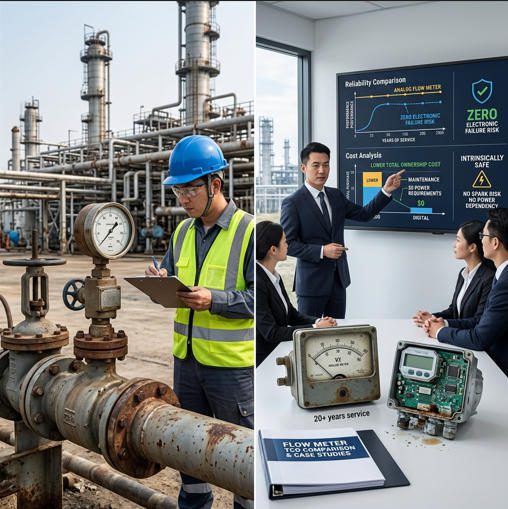
The Hidden Benefits of Analog Flow Meters:
Why Simplicity Still Wins
Why leading industrial facilities continue choosing analog flow meters over complex digital alternatives — a comprehensive guide for flow instrumentation distributors and agents.

At first glance, the flow instrumentation market looks like it is moving in one direction: toward digital sensors, wireless telemetry, and cloud-connected analytics. Yet, when you visit a grassroots chemical plant in Texas, a water treatment facility in Southeast Asia, or an offshore oil platform in the North Sea, you consistently find rows of analog flow meters running without fault — some of them 20 years old or older.
The global flow meter market reached 11 миллиардов долларов США в 2025 году, and the analog segment alone is forecast to reach USD 4.4 billion by 2035 at a steady CAGR of approximately 7%. (GMI Insights, 2025). That is not a dying technology — it is a resilient market segment that rewards distributors and agents who understand when и why to recommend it.
This guide is written specifically for B2B flow meter distributors and agents. You will find concrete data, application scenarios, regulatory references, and a distributor-specific strategy framework — everything you need to strengthen client relationships and close more competitive bids.
1. The Reliability Advantage: Why Analog Flow Meters Outperform in Critical Applications
Mechanical Simplicity as a Foundation for Dependability
The mechanical principle behind a rotameter (also called a variable-area flow meter) has not changed since its invention in 1908. A conically tapered tube, a float, and gravity — that is the entire measurement mechanism. There are no microprocessors to crash, no firmware to patch, and no sensor fusion algorithms to go wrong. In instrumentation, fewer components almost always translate directly to fewer failure points.
Consider a refinery in South Korea that has operated the same stainless-steel positive displacement flow meters on a glycol dosing line since 2001. In 24 years, the total maintenance spend on that line has been two seal replacements at approximately USD 85 each. The comparable digital Coriolis meter installed on an adjacent line required three transmitter board replacements ($1,400 each), one software license renewal, and a full recalibration at year 12 — a total additional cost exceeding USD 7,200.
Proven Track Record in Extreme Conditions
Digital flow meters deliver outstanding performance when operating conditions stay within a relatively narrow envelope. Step outside that envelope — extreme heat, severe vibration, corrosive chemical exposure, or sustained electromagnetic interference — and the reliability gap between analog and digital widens rapidly.
All-metal variable area flow meters from manufacturers such as KOBOLD are rated for service up to 390°F (approximately 200°C) without any electronics. Specialist designs for high-temperature steam service routinely handle temperatures beyond 400°C. Turbine meters built from Hastelloy or titanium alloys operate effectively in concentrated hydrofluoric acid environments where digital transmitter enclosures would fail within months. In environments saturated with electromagnetic interference — such as large variable-frequency drive (VFD) motor installations — purely mechanical analog meters are completely immune to signal corruption.
Maintenance and Longevity: The Total Cost of Ownership Argument
A turbine flow meter priced at USD 4,000 with a 15-year service life costs approximately USD 267 per year of service. A comparable digital system initially priced at USD 7,500 but requiring annual software subscriptions, periodic transmitter replacements, and specialized calibration reduces its value proposition significantly on a per-year basis. (Turbines Incorporated TCO Analysis).
For distributors, understanding this mathematics transforms your conversation from a price negotiation into a value discussion. When you can demonstrate that an analog meter solution delivers lower total cost over a 10-year horizon, you reframe the purchase decision entirely — and your margin holds.
2. Independence from Electrical Power: A Critical Advantage Often Overlooked

The Power Dependency Problem in Digital Systems
When a client installs a digital electromagnetic flow meter, the purchase price is just the beginning of the electrical cost. The meter requires a 24 VDC power supply, cable tray from the nearest distribution panel, a conduit run, cable entry and gland fittings rated for the area classification, and termination in a control room DCS or PLC input card. In a greenfield installation, this electrical infrastructure can add USD 1,200–USD 3,500 per measurement point depending on distance and area classification.
On a brownfield platform with 40 analog measurement points to upgrade, the electrical infrastructure cost alone can exceed the cost of the meters themselves — before a single bolt has been turned. And once that infrastructure is in place, it is vulnerable: a power surge from a nearby lightning strike, a brownout during load shedding, or a facility-wide emergency shutdown will take every digital meter offline simultaneously.
Analog Meters: True Operational Independence
A standard glass-tube rotameter requires zero electrical power to display a live flow rate. The float responds to hydraulic force — that is all. During Hurricane Harvey in 2017, several Texas Gulf Coast chemical plants with battery backup systems lost power for up to 72 hours. Operators reported that purely mechanical flow indicators remained functional throughout, allowing manual process monitoring and safe shutdown procedures to proceed without interruption.
This operational independence is not merely a convenience; in many safety cases it is a regulatory requirement. Independent Protection Layer (IPL) analysis under IEC 61511 often mandates that at least one flow monitoring point must be independent of shared power and signal infrastructure. An analog meter with a local indicator satisfies this requirement without complex engineering justification.
Cost Implications of Power Infrastructure
| Статья расходов | Analog Flow Meter | Digital Flow Meter | Примечания |
|---|---|---|---|
| Instrument purchase (2-inch process) | USD 300–1,800 | USD 1,200–4,500 | Rotameter / turbine vs. electromagnetic / vortex |
| Electrical supply run (25 m) | USD 0 | USD 800–2,200 | Cable, conduit, glands, termination labor |
| Area classification compliance | No electronics — no approval needed | IS barrier or Zener barrier required in Zone 1/2 | IS barrier cost: USD 180–600 per channel |
| UPS / backup power | USD 0 | USD 200–1,200 shared allocation | Battery runtime cost amortized across points |
| Annual energy consumption | USD 0 | USD 18–48/yr (3–8W continuous) | Based on USD 0.12/kWh industrial rate |
| 10-Year electrical OPEX | USD 0 | USD 180–480 | Energy only; excludes cable maintenance |
Table 1. Comparative electrical infrastructure costs per measurement point. Figures are representative ranges for process plant installations in industrial economies.
3. Cost-Effectiveness: The Economic Case for Analog Flow Meters
Initial Capital Investment Comparison
The purchase price differential between analog and digital flow meters varies by technology type, but a consistent pattern emerges: analog meters cost 30–50% less at point of purchase across comparable pipe sizes and application classes. A 2-inch stainless steel rotameter suitable for chemical dosing can be sourced for USD 400–900. The equivalent 2-inch electromagnetic flow meter — often the first alternative proposed — runs USD 1,400–3,200 in the same specifications.
For a distributor quoting 40 measurement points on a new water treatment facility, this differential is USD 40,000–USD 96,000 in capital cost alone, before installation. When a municipal procurement committee is working to a strict budget cap, this arithmetic often decides the outcome — and the distributor who can make that case confidently wins the project.
10-Year Total Cost of Ownership Analysis
| Категория затрат | Rotameter (Analog) | Turbine (Analog/Hybrid) | Electromagnetic (Digital) | Coriolis (Digital) |
|---|---|---|---|---|
| Покупная цена | 400–900 долларов США | 800–2 500 долларов США | USD 1,400–4,000 | 4 000–12 000 долларов США |
| Installation (labor + materials) | USD 200–600 | 400–900 долларов США | 800–2 500 долларов США | USD 1,500–4,500 |
| Electrical infrastructure | USD 0 | USD 0–800 | USD 800–2,200 | USD 1,000–2,800 |
| Annual calibration (per event) | 80–200 долларов США | USD 150–400 | 300–800 долларов США | USD 600–1,800 |
| 10-yr maintenance & parts | USD 200–600 | USD 600–1,800 | USD 1,200–3,600 | USD 2,400–7,000 |
| Software / firmware licenses | USD 0 | USD 0 | USD 0–1,200 | USD 500–2,500 |
| Training (technician days) | 0.5 days | 1 day | 2–3 days | 3–5 days |
| 10-Year TCO Estimate | 1 200–2 800 долларов США | USD 2,400–7,200 | USD 5,500–14,500 | USD 10,000–31,600 |
Table 2. Indicative 10-year Total Cost of Ownership per measurement point, 2-inch process pipe, standard industrial application. Figures based on published industry benchmarks. See Flowmeters UK TCO analysis и Pokcenser Tech maintenance cost comparison.
Hidden Costs of Digital System Adoption
Several cost categories do not appear on a digital meter quotation but materialize during and after project commissioning. Cybersecurity infrastructure is increasingly non-negotiable: IEC 62443 compliance for industrial IoT devices requires network segmentation, firmware update management, and vulnerability monitoring. For a 40-point digital meter installation feeding a SCADA system, the annual cybersecurity compliance overhead can reach 8 000–25 000 долларов США depending on the plant’s regulatory environment.
Software licensing is another category that surprises clients. Several leading digital flow meter manufacturers charge annual fees for advanced diagnostics software, OPC-UA server licenses, or historian integration — charges that do not appear in the initial equipment purchase but accumulate significantly over a 10-year plant life.
4. Simplicity as a Competitive Advantage in Complex Industrial Operations

The Paradox of Technological Complexity
There is a well-documented phenomenon in industrial automation where the complexity of a measurement solution begins to exceed the complexity of the process it monitors. A chemical plant using rotameters for cooling water control loops — where flow accuracy of ±3% is perfectly adequate — does not benefit from installing Coriolis meters with 22-parameter configuration menus and Modbus TCP output cards. It benefits from installing a solution that an operator can troubleshoot in 10 minutes with a flashlight and a flathead screwdriver.
Operational excellence research consistently shows that equipment simplicity correlates with lower unplanned downtime. Systems with fewer decision points and less configurability fail less frequently and are restored faster when they do fail. For a distributor, this is a compelling quality-of-service argument: recommending the simplest adequate technology is not a cost-cutting compromise — it is professional engineering judgment.
User-Friendly Operation and Reduced Training Requirements
A new operator at an analog meter installation can be fully trained to read, inspect, and interpret local indicators in approximately half a day. The same operator requires 2–3 days of structured training to configure, troubleshoot, and interpret diagnostic codes on a modern digital electromagnetic flow meter. In facilities with high turnover, seasonal workforces, or operations in developing markets where instrument engineering expertise is scarce, this training gap translates directly into measurement errors and operational incidents.
Jade Ant Instruments’ comprehensive flow meter selection guide for engineers explicitly addresses the training and operational readiness factor as one of five core selection criteria — recognizing that the best meter for a given application is the one the operations team can actually use effectively.
Operational Efficiency Through Simplification
Faster Installation
Typical rotameter installation takes 1–2 hours. Digital electromagnetic meter installation including electrical termination averages 6–10 hours per point.
Shorter Downtime
Replacing a float seal in an analog meter: 45 minutes. Replacing a digital transmitter board and reconfiguring: typically 4–8 hours including loop checks.
Simple Spares Inventory
A single set of O-rings and a float serves a rotameter for 5+ years. Digital systems require model-specific transmitter boards with 8–20-week lead times.
Minimal Documentation
Analog meters require a calibration certificate and installation record. Digital systems add device configuration backups, firmware revision control, and cybersecurity audit logs.
5. Industry-Specific Applications Where Analog Meters Dominate
▶ Video: Overview of industrial flow meter types and their applications — including where variable-area and positive displacement meters remain the preferred choice.
Oil and Gas Sector: Remote Operations and Extreme Conditions
Offshore platforms represent one of the most demanding environments for any instrumentation. Space is constrained, weight is critical, humidity is constant, vibration is significant, and area classification requirements (typically Zone 1 IEC 60079) impose strict limits on electrical devices. Mechanical turbine flow meters and positive displacement meters have operated on platforms in the North Sea, the Gulf of Mexico, and Southeast Asian waters for decades, delivering reliable hydrocarbon measurement without the electrical infrastructure burden that digital systems require.
Remote pipeline monitoring stations in desert or arctic environments — where the nearest electrician may be 200 km away — rely on analog turbine meters paired with simple battery-powered pulse transmitters. This architecture has demonstrated measurement availability rates above 99.6% across multi-year deployments in environments ranging from −40°C in Siberia to +65°C ambient in the Arabian Peninsula.
For specialized offshore and high-pressure applications, manufacturers such as Hoffer Flow Control supply custom turbine meters rated for subsea hydrocarbon service — demonstrating that the analog measurement principle scales to the most demanding applications in the industry.
Химическое и фармацевтическое производство
Hazardous area classifications under ATEX (the European standard) and IECEx (the international equivalent) create a significant cost burden for electrical instrumentation in Zone 1 and Zone 2 areas. An ATEX Zone 1 certified digital electromagnetic meter costs approximately USD 2,800–6,500 in certified configuration. An inherently safe analog rotameter with no electrical components operates in the same zone without any certification surcharge — because there is nothing to certify.
For information on ATEX-certified flow meter options including certified analog designs, the ATEX flow meter guide on Jade Ant Instruments provides a comprehensive breakdown of zone classifications, group and category designations, and the practical cost implications for instrumentation engineers.
Water and Wastewater Treatment Facilities
Municipal water authorities typically operate within tight capital budgets approved by elected councils. When a water board in the Philippines is budgeting a new 200-point flow monitoring system across a distribution network, a 40% capital cost reduction from choosing analog variable-area meters over digital electromagnetic meters translates to USD 200,000–400,000 in freed capital — potentially funding an additional pump station or reservoir upgrade. The accuracy specification for most distribution monitoring applications (±2–3%) is met comfortably by quality analog meters.
Continuous operation is another critical requirement in water treatment. Analog meters continue measuring during power outages, maintenance shutdowns of adjacent electrical systems, and control room upgrades — without requiring any restart procedure or re-zeroing. This operational continuity characteristic is increasingly cited in municipal tender specifications as an advantage analog meters hold over digital alternatives.
Производство продуктов питания и напитков
Stainless steel analog flow meters with FDA-compliant elastomers and NSF/ANSI 169 certification are extensively used in beverage filling lines, dairy CIP (Clean-In-Place) circuits, and food ingredient dosing systems. Their washdown durability — specifically the ability to withstand high-pressure hot water spray at 85°C — is a practical requirement that many digital sensors handle poorly without expensive waterproofing upgrades.
Hygiene compliance is straightforward with all-metal analog designs: the wetted components are a tube and a float. There are no signal cables, junction boxes, or transmitter housings to seal against moisture ingress during washdown. For a beverage plant running CIP cycles every 8 hours, this translates to measurably fewer instrument-related hygiene non-conformances.
Mining and Aggregate Processing
Mining process water lines carry abrasive particles that destroy meter internals within months if the wrong technology is selected. In slurry applications, the standard recommendation is a magnetic flow meter for its no-obstruction bore. However, in clean process water monitoring lines at remote mine sites — water supply, dewatering circuits, reagent addition — analog turbine meters with tungsten carbide bearings have demonstrated service lives exceeding 8 years in documented deployments at copper concentrators in Chile and gold mines in West Africa.
6. Technical Specifications That Matter: What B2B Buyers Need to Know

Flow Range, Accuracy, and Turndown Ratio
Коэффициент понижения напряжения is a critical specification that determines whether a meter can handle the full operating range of a process. Variable-area rotameters typically offer a 10:1 turndown, meaning they measure accurately from 10% to 100% of rated flow. Positive displacement meters achieve 10:1 to 25:1 turndown, making them well-suited for applications with wide flow variation.
Accuracy for quality analog meters ranges from ±0.5% to ±2% of full scale depending on meter type and calibration. Positive displacement meters calibrated with a reference standard routinely achieve ±0,51 TP3T чтения. For custody transfer applications in oil and gas, this meets the accuracy requirements of API Chapter 5 measurement standards — with no digital electronics required.
Material Compatibility and Construction Options
Material selection is often the deciding factor in analog meter longevity. The major construction options and their primary applications are as follows. 316L stainless steel covers the broadest range of industrial applications including food-grade, pharmaceutical, and moderately corrosive chemical service. Hastelloy C-276 handles strong acids including hydrochloric and sulfuric acid. PVDF (Polyvinylidene fluoride) provides excellent resistance to chlorine and other halogens in water treatment. Titanium is specified for seawater service and applications involving hydrofluoric acid at dilute concentrations.
Key certification standards for wetted materials include NSF/ANSI 61 for drinking water contact, 3-A Sanitary Standard 28-06 for dairy applications, and FDA 21 CFR compliance for food-contact elastomers. For a complete guide to selecting the right meter specification for your clients, the Руководство по выбору расходомеров Jade Ant Instruments covers wetted material compatibility, pressure ratings, and temperature envelopes in a format designed for quick distributor reference.
Output Options and Integration Capabilities
The common misconception is that analog meters cannot integrate with modern control systems. In practice, a mechanical turbine meter can be fitted with a smart transmitter providing 4–20 mA output, pulse output for totalization, and even HART (Highway Addressable Remote Transducer) communication — all while retaining the mechanical measurement element and its reliability characteristics. This hybrid approach preserves the core benefit of analog measurement while enabling data collection in modern SCADA environments.
For a detailed breakdown of output signal options and their suitability for different control architectures, the Iconprocon output signal selection guide provides a clear reference covering pulse, 4–20 mA, relay, voltage, and RS-485 options.
7. Regulatory Compliance and Safety Certifications
Industry Standards and Compliance Requirements
Regulatory compliance for analog flow meters draws on a well-established body of international standards. ISO 4064 governs meters for cold potable water and hot water, specifying accuracy classes (Class 1, 2, and 3) that define permissible errors across the measuring range — directly applicable to turbine and positive displacement meters in water utilities. ISO 4185 addresses measurement of liquid flow in closed conduits using weighing methods, providing traceability for calibration. OIML R 117 (International Recommendation) covers measuring instruments for fluids other than water, including petroleum products and chemicals.
For distributors, understanding which standard applies to a given tender is a practical commercial skill. A municipal water authority in Europe will reference ISO 4064 and the European Measuring Instruments Directive (MID). A petroleum custody transfer installation in the Middle East will reference API MPMS Chapter 5. Knowing these frameworks demonstrates technical credibility and helps position your product offering correctly against specification requirements.
Hazardous Area Classifications and ATEX/IECEx Compliance
Analog meters offer a structurally unique compliance advantage in explosive atmospheres. Because a standard mechanical rotameter or turbine meter has no electrical components, it does not require ATEX or IECEx certification for the measurement element itself. Only when a transmitter or indicator with electrical components is added does hazardous area certification become relevant — and the engineer can then choose an intrinsically safe transmitter as a separate, lower-cost component rather than purchasing an entirely ATEX-certified smart meter.
This separation of concerns — inherently safe mechanical primary element plus separately certified electrical secondary element — is a genuine compliance engineering advantage. For distributors serving petrochemical, pharmaceutical, or solvent processing industries, understanding this architecture allows you to offer compliance-assured solutions at materially lower cost than fully certified digital alternatives. The KOBOLD hazardous area standards guide provides a clear reference for ATEX group and category designations as they apply to flow instrumentation.
8. Comparison Analysis: Analog vs. Digital Flow Meters
| Performance Criterion | Rotameter (Analog) | Turbine / PD (Analog) | Electromagnetic (Digital) | Coriolis (Digital) |
|---|---|---|---|---|
| Типичная точность | ±1–2% FS | ±0.25–0.5% RD | ±0.2–0.5% RD | ±0.05–0.1% RD |
| Коэффициент понижения напряжения | 10:1 | 10:1 – 25:1 | 30:1 – 100:1 | 100:1+ |
| Power requirement | None (visual) | None (visual) / 24 VDC (output) | 24 VDC required | 24 VDC required |
| Max. temperature | Up to 200°C | Up to 300°C+ | −20°C to 150°C (standard) | −200°C to 350°C (specialty) |
| EMI / RFI resistance | Complete immunity (no electronics) | Complete immunity (no electronics) | Shielding required | Shielding required |
| ATEX Zone 1 compliance | Inherently safe (no certificate needed) | Inherently safe (primary element) | Certified unit required (+30–50% cost) | Certified unit required (+40–60% cost) |
| Installation complexity | Low (1–2 hr) | Low-Medium (2–4 hr) | Medium-High (6–10 hr) | High (8–16 hr) |
| Remote monitoring | Add transmitter | Add transmitter | Native (4–20mA, HART, Modbus) | Native (4–20mA, HART, Modbus) |
| Slurry / solids tolerance | Low (float can stick) | Low-Medium (bearing wear) | High (no obstruction) | Medium (plugging risk) |
| 10-Year TCO (2″ pipe) | 1 200–2 800 долларов США | USD 2,400–7,200 | USD 5,500–14,500 | USD 10,000–31,600 |
| Expected service life | 15–25 лет | 15–25 лет | 10–15 лет | 10–15 лет |
| Training requirement | 0.5 days | 1 day | 2–3 days | 3–5 days |
Table 3. Head-to-head comparison: Analog vs. digital flow meters across 12 performance criteria. Data compiled from published manufacturer specifications and industry benchmark studies.
Based on published market segmentation data for variable-area and mechanical flow meter applications. Source: GMI Insights flow meter market analysis, 2025.
Decision Framework for Distributors and Agents
The following decision logic helps you match the right technology to the right application in a client discovery conversation. If the answer is Да to any of the first four questions, analog is a strong primary candidate.
Is electrical infrastructure absent, limited, or expensive to add?
Remote sites, offshore platforms, agricultural irrigation, and mine dewatering lines — Analog is the default choice.
Is the environment hazardous (Zone 1 / Zone 2 / Div. 1 / Div. 2)?
Analog primary elements are inherently safe — no zone certification required. Add a certified transmitter only if data output is needed.
Is the accuracy requirement ±1–2% or looser?
Process monitoring, utility loops, safety indication — rotameter or turbine provides sufficient accuracy at far lower cost.
Is the maintenance team limited in instrument engineering expertise?
Analog meters require no configuration tools, no firmware updates, and minimal training — reducing operational risk significantly.
Is real-time SCADA integration or mass flow measurement required?
Analog alone is insufficient — consider a hybrid solution (turbine or rotameter with 4–20 mA transmitter) or a full digital meter for high-accuracy custody transfer.
9. Emerging Hybrid Solutions: Combining Analog Reliability with Digital Convenience
Analog Meters with Digital Output Capabilities
The hybrid approach — retaining the mechanical measurement element while adding an electronic signal converter — is increasingly the chosen strategy for facilities modernizing their instrumentation estates without wholesale meter replacement. A turbine flow meter from 2002 can be fitted with a modern 2-wire loop-powered transmitter, providing a calibrated 4–20 mA signal to the plant DCS while the mechanical display continues to serve operators on round inspection. The meter’s core reliability remains unchanged; the data collection capability is simply added on top.
This strategy is particularly valuable for distributors. When a client’s budget does not accommodate full digital replacement, or when their engineering team is risk-averse about replacing proven equipment, a hybrid upgrade proposal demonstrates technical sophistication and preserves the relationship — while generating incremental revenue from the transmitter sale and associated installation work.
Retrofit and Upgrade Strategies
Successful hybrid retrofit follows a three-phase sequence. In the first phase, existing analog meters are audited for mechanical condition and flow accuracy — meters within calibration tolerance are retained; those outside are replaced with modern equivalents. In the second phase, smart transmitters with local digital indicators are mounted onto selected meters based on SCADA integration priority (high-value fluids, safety-critical loops, billing points). In the third phase, the data is validated against the mechanical display to confirm transmitter calibration before the SCADA signal is accepted as the primary measurement.
For detailed guidance on flow meter communication protocols including 4–20 mA, HART, and Modbus options for analog-to-digital integration, the Turbines Incorporated communication protocols guide provides a practical engineering reference that you can share directly with client instrumentation engineers.
IoT and Remote Monitoring Integration
Non-intrusive wireless transmitters — such as those using clamp-on piezoelectric sensors or magnetic pulse pick-ups — can now extract flow data from many existing analog meters without process shutdown or flow interruption. Combined with low-power wide-area network (LPWAN) protocols such as LoRaWAN or NB-IoT, these transmitters deliver real-time flow data to cloud dashboards at installation costs well below a full smart meter replacement.
For a production facility with 80 analog meters where budget permits upgrading only 20 to full digital, this approach creates a tiered monitoring architecture: 20 fully integrated digital meters on critical loops, 40 analog meters with smart wireless transmitters on secondary loops, and 20 pure-mechanical meters on utility monitoring points. The result is a cost-optimized instrumentation strategy that Jade Ant Instruments’ engineering team regularly helps distributors develop for their clients — see the comprehensive flow meter selection framework for the technical decision criteria used in this process.
10. Strategic Positioning for Distributors and Agents: Capturing Market Opportunities
Building Product Knowledge and Expertise
The most effective distributors in the flow instrumentation market are not product brochure distributors — they are application engineers who happen to also sell meters. When your client’s process engineer calls with a problem — “we have cavitation in our chemical injection line,” or “our existing meter won’t survive the washdown cycle” — your ability to diagnose the application correctly and recommend the right technology (analog, digital, or hybrid) determines whether you win a recurring account or lose it to a more technically credible competitor.
Investing in application training across the five key sectors covered in this guide — oil and gas, chemical, water treatment, food and beverage, and mining — creates a genuine, durable competitive advantage. For a structured starting point, Jade Ant Instruments’ guide to reading flowmeter datasheets is a practical technical resource suitable for onboarding new sales engineers.
Developing Customer Relationships and Trust
Consultative selling in flow instrumentation means asking before proposing. The eight questions that distinguish a trusted advisor from a commodity vendor are: (1) What fluid? (2) What pipe size? (3) What flow range? (4) What accuracy requirement? (5) What is the electrical infrastructure? (6) Is the area hazardous? (7) What are the maintenance team capabilities? (8) What is the budget — per-unit or per-point lifetime? With the answers to these eight questions, you can build a one-page solution proposal that a client’s engineering team can present to procurement — and win the bid before a competitor has submitted a price list.
Marketing and Sales Strategies
Position analog meters not as budget alternatives, but as precision-matched technology solutions. The framing matters: a rotameter is not the “cheap option” — it is the correct specification for a process where mechanical simplicity, power independence, and 25-year service life deliver lower total cost of ownership than any digital alternative. Clients who understand this framing become advocates who recommend you to colleagues across their organization.
Content marketing around documented case studies — real installations with real service life data — outperforms generic product literature by a significant margin. If your manufacturer partner can provide anonymized field reliability reports, publish them. If you have clients willing to provide testimonials, document them. In B2B industrial instrumentation, evidence-based marketing closes deals that brochures cannot.
Inventory Management and Supply Chain Optimization
Analog meter inventory management benefits from the technology’s standardization. Because rotameter tube sizes, flange specifications, and float materials follow ISO and DIN standards, stocking a well-chosen range of 15–25 SKUs covers the majority of field replacement requirements across most industrial markets. The equivalent digital meter inventory requires stocking model-specific transmitter boards, configuration cables, and software keys that can number in the hundreds of SKUs.
High-velocity analog meter SKUs typically include: 1/4-inch through 2-inch rotameters in borosilicate glass and stainless steel, positive displacement oval-gear meters in 1/2-inch through 2-inch stainless steel, and turbine meters in 1-inch through 4-inch stainless steel with pulse output. Building a supplier relationship with a manufacturer such as Инструменты "Нефритовый муравей — an ISO-certified manufacturer offering electromagnetic, vortex, and turbine flow meters with verified production capacity — provides the supply chain reliability that B2B distributors require to make credible lead-time commitments to their clients.
Why the Future Still Includes Analog Flow Meters
The narrative that industrial instrumentation is transitioning entirely to digital, smart, and IoT-connected systems is incomplete. The full picture is more nuanced and more commercially valuable to understand: analog flow meters continue to outperform digital alternatives across a defined set of applications that represents hundreds of millions of dollars in annual procurement globally.
Reliability without electronics, operational independence from power infrastructure, 15–25 year service lives, lower total cost of ownership across a 10-year horizon, inherent safety in hazardous areas, and minimal training requirements — these are not the characteristics of an obsolete technology. They are the characteristics of a mature, optimized solution that continues to be correctly specified when the application demands them.
For distributors and agents, the opportunity is clear: develop application-level expertise in analog meter selection, build a consultative sales process grounded in 10-year TCO analysis, and position yourself as the advisor who recommends the right technology — not just the newest or the most expensive. That positioning builds the client relationships that generate repeat business, referrals, and long-term revenue stability in the USD 9.1 billion global flow meter market.
📖 Quick Reference Glossary
- Turndown Ratio (Rangeability)
- The ratio of maximum to minimum measurable flow rate at which a meter maintains its stated accuracy. A 10:1 turndown meter reads accurately from 10% to 100% of full scale. Example: a rotameter rated for 10–100 L/min has a 10:1 turndown.
- Rotameter (Variable Area Flow Meter)
- A flow meter consisting of a vertically oriented tapered tube and a float. As flow increases, the float rises until the upward hydraulic force equals the float’s weight. The float’s position indicates instantaneous flow rate. No power required for visual indication.
- Positive Displacement (PD) Meter
- A meter that measures flow by trapping discrete volumes of fluid and counting the number of volumes that pass. Gears, pistons, or lobed rotors are common mechanisms. High accuracy (±0.25%) at low flow rates; preferred for viscous fluids and custody transfer.
- Total Cost of Ownership (TCO)
- The sum of all costs associated with a measurement system over its service life, including purchase, installation, electrical infrastructure, calibration, maintenance, spare parts, training, software, and decommissioning.
- ATEX / IECEx
- ATEX (EU Directive 2014/34/EU) and IECEx (international) are standards certifying equipment as safe for use in explosive atmospheres. Zone 1 areas require Ex-rated equipment where ignitable gas is likely during normal operation. Zone 2 applies where ignitable gas is only likely during abnormal conditions.
- 4–20 mA Current Loop
- The industrial standard for transmitting an analog measurement signal over a two-wire circuit. 4 mA represents 0% of measurement range; 20 mA represents 100%. The current loop is largely immune to resistive voltage drop in long cable runs — a key advantage in large process plants.
- HART Protocol
- Highway Addressable Remote Transducer — a digital communication protocol superimposed on the 4–20 mA current loop. Allows two-way digital communication with smart transmitters for configuration, diagnostics, and additional measurement variables without interrupting the primary 4–20 mA signal.
- Independent Protection Layer (IPL)
- A risk reduction measure in functional safety (IEC 61511) that must operate independently of other safety and process control systems. A local analog indicator qualifies as an IPL because it does not share power, signal, or logic with digital control systems.
Часто задаваемые вопросы
Ready to Strengthen Your Market Position?
Download our comprehensive Analog Flow Meter Specification Guide for B2B Distributors or schedule a technical consultation with our flow instrumentation specialists to develop a tailored analog meter solution strategy for your distribution business.
Explore Jade Ant Instruments View Flow Meter Selection Guide