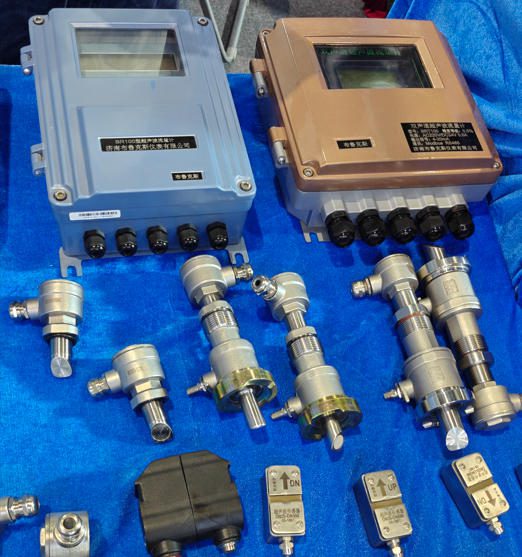
Stop Guessing on Flow Meter Specifications — Use This Simple Decision Tree to Confidently Recommend the Right Solution to Your Customers Every Time

The right meter recommendation starts with asking the right questions — not with checking what’s in stock.
Why Your Team Needs This Decision Tree
The Problem Your Distributors and Agents Face Every Day
Picture this: a procurement manager at a municipal water authority calls your sales rep and says, “We need a flow meter for a 200mm line measuring treated water — what do you recommend?”
Your rep knows you carry electromagnetic meters. They also know the customer seems price-sensitive. They quote the electromagnetic meter because it’s what they remember last, not because they systematically worked through the application. The customer installs it, and six months later they call back with a complaint — not because the meter was wrong, but because nobody asked about the pipe material, the installation space, or whether the fluid sometimes runs at 5% of the design flow rate.
That scenario costs you a replacement unit, an engineer’s day, and — worst of all — the customer’s confidence.
This is the daily reality for flow meter distributors and agents. Technical jargon creates friction. Unclear specifications lead to wrong recommendations. And the gap between what your engineers know and what your sales team communicates in the field is where customer returns are born.
A wrong flow meter selection can cost a single facility $847,000 — not from a defective product, but from a specification error that nobody caught during the sales conversation.
How This Guide Solves Your Real-World Challenge
This guide is not written for engineers. It is written for the people on your team who talk to customers every day without an engineering degree — your sales representatives, your account managers, your regional agents. It gives them a structured thinking tool that transforms the specification conversation from a moment of uncertainty into a confident recommendation.
Work through it once with your team. Then print the one-page checklist at the end and put it in every sales vehicle, every sample case, and every customer meeting folder.
The Five Core Flow Meter Categories (Without the Engineering Degree)
You don’t need to understand the physics of every flow meter technology to recommend the right one. You need to understand what each type is good at, where it struggles, and the two or three questions that tell you which one fits the customer’s application.
Turbine Meters — When You Need Simplicity and Reliability
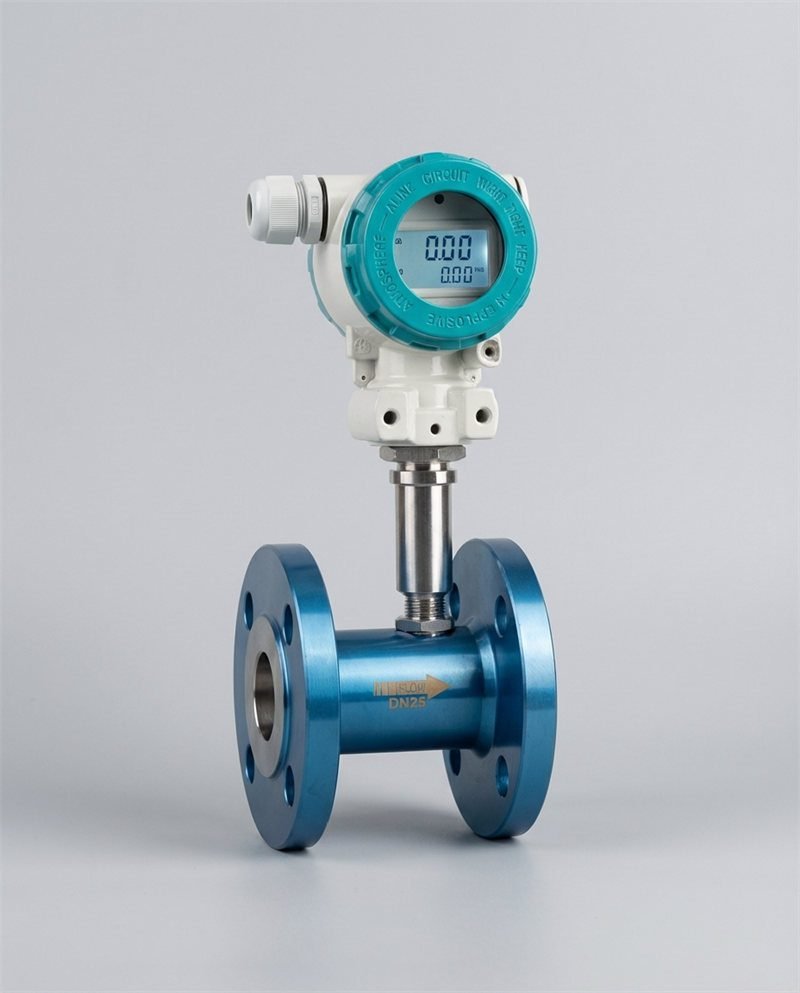
A turbine meter works exactly the way it sounds: a multi-bladed rotor spins in the flow stream, and the rotational speed corresponds to the flow rate. Simple, proven, and cost-effective.
Best for customers who prioritize cost-effectiveness. Turbine meters typically run $300–$1,200 for standard liquid applications, making them one of the most affordable accurate meter options on the market. For customers who measure clean liquids — light petroleum products, clean water, low-viscosity chemicals — and who need a reliable, well-understood technology, a turbine meter is often the sensible recommendation.
Common applications your distributors sell into. Turbine meters dominate in custody transfer for petroleum products, in blending systems for clean oils, and in food and beverage lines handling thin, clean liquids. They are the standard recommendation for compressed gas measurement in lower-accuracy industrial applications, and they’re widely used in chemical dosing systems where the fluid is compatible with the rotor materials.
The positioning conversation with a customer: “Turbine meters are the reliable workhorse of flow measurement — proven technology, lower price point, easy to service. They work best when your fluid is clean and the flow rate stays reasonably consistent. If that matches your application, this is your most cost-effective accurate option.”
For a detailed technical comparison of turbine versus other velocity-based meters, the Vortex vs. Turbine Flow Meter Guide from Jade Ant Instruments covers the working principles in plain language.
Electromagnetic Meters — The Versatile Workhorse for Your Portfolio
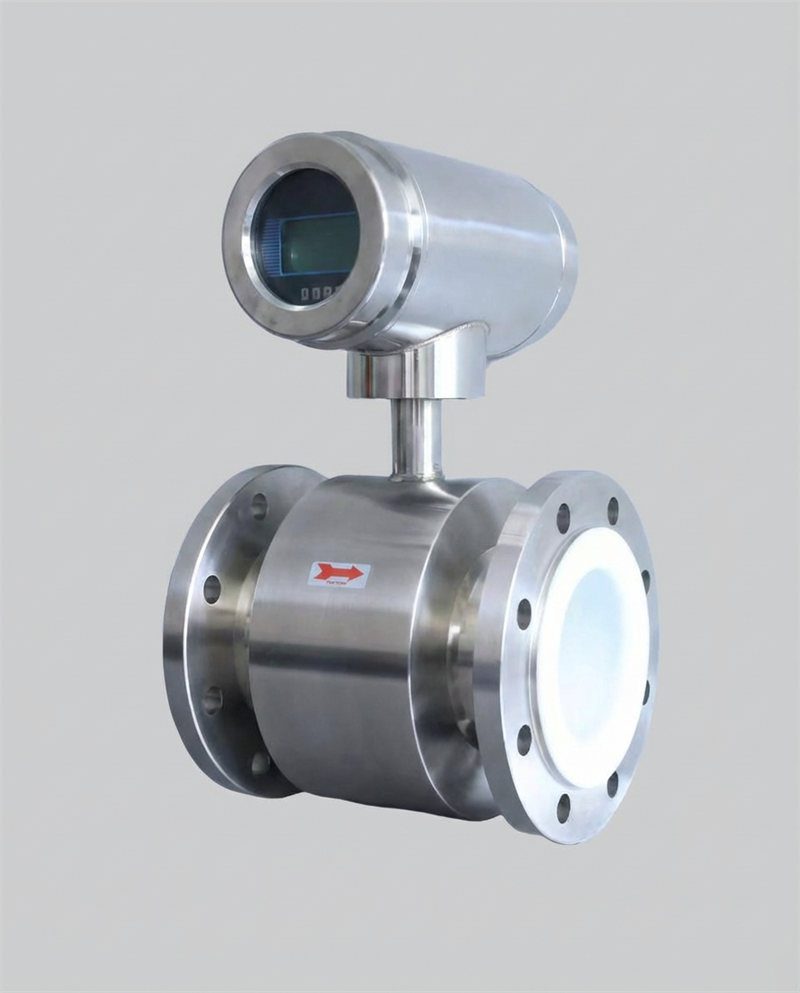
An electromagnetic meter (also called a magmeter or mag meter) has no moving parts. It measures flow by applying a magnetic field across the pipe and measuring the voltage generated by the conductive fluid moving through that field. The faster the fluid moves, the higher the voltage. Clean, direct, and maintenance-light.
Why your agents should recommend these for conductive liquids. The key word is “conductive.” Any liquid that conducts electricity — water, wastewater, most aqueous chemical solutions, slurries, pulp, food products — is a candidate for an electromagnetic meter. The technology’s strengths are considerable: no pressure drop (the measurement doesn’t obstruct the flow), no moving parts to wear out, excellent performance with dirty or particle-laden fluids, and accuracy that holds across a wide flow range.
Real-world scenarios where EM meters outperform alternatives. At a water treatment plant handling activated sludge, a turbine meter would clog within weeks. An EM meter handles the same application without missing a beat, year after year. In a chemical plant measuring sodium hydroxide solution, the EM meter’s PTFE-lined bore and Hastelloy electrodes withstand what would destroy most alternatives. The Top 10 Applications for Magnetic Flow Meters covers these use cases with specific industry context.
The one limitation to communicate upfront: electromagnetic meters do not work with non-conductive fluids. Hydrocarbons, oils, pure water below 5 µS/cm — the meter simply won’t measure them. This is not a drawback; it’s a selection criterion. Ask about the fluid first.
Coriolis Meters — When Accuracy Becomes the Selling Point
A Coriolis meter (named after the Coriolis effect) measures mass flow — not just volume, but actual mass — by detecting the tiny twisting force a moving fluid exerts on a vibrating tube. It simultaneously measures density. It is the most accurate flow measurement technology in industrial use, typically achieving ±0.1–0.2% of reading, independent of fluid properties.
How to explain precision to non-technical procurement managers. The business language that lands: “A Coriolis meter doesn’t just measure how much fluid passes through — it measures the actual mass of that fluid, regardless of temperature, pressure, or what’s in the mix. If you’re paying for a chemical by weight, billing customers by mass, or your process depends on getting the ratio exactly right, this is the meter that protects you from expensive surprises.”
The ROI conversation your customers need to hear. A Coriolis meter for a 2-inch line costs $5,000–$15,000. That price is harder to justify until you quantify what imprecision costs. In a specialty chemical plant running 200 batches per year at $18,000 average value, a 2% measurement error compounds into $72,000 in raw material waste and potential off-spec product per year. The Coriolis meter pays for itself inside 18 months — and that’s before considering the compliance documentation value. The Coriolis vs. PD Meters accuracy and cost guide from Jade Ant Instruments provides the numbers for this conversation.
Ultrasonic Meters — The Non-Invasive Solution Your Customers Are Asking About
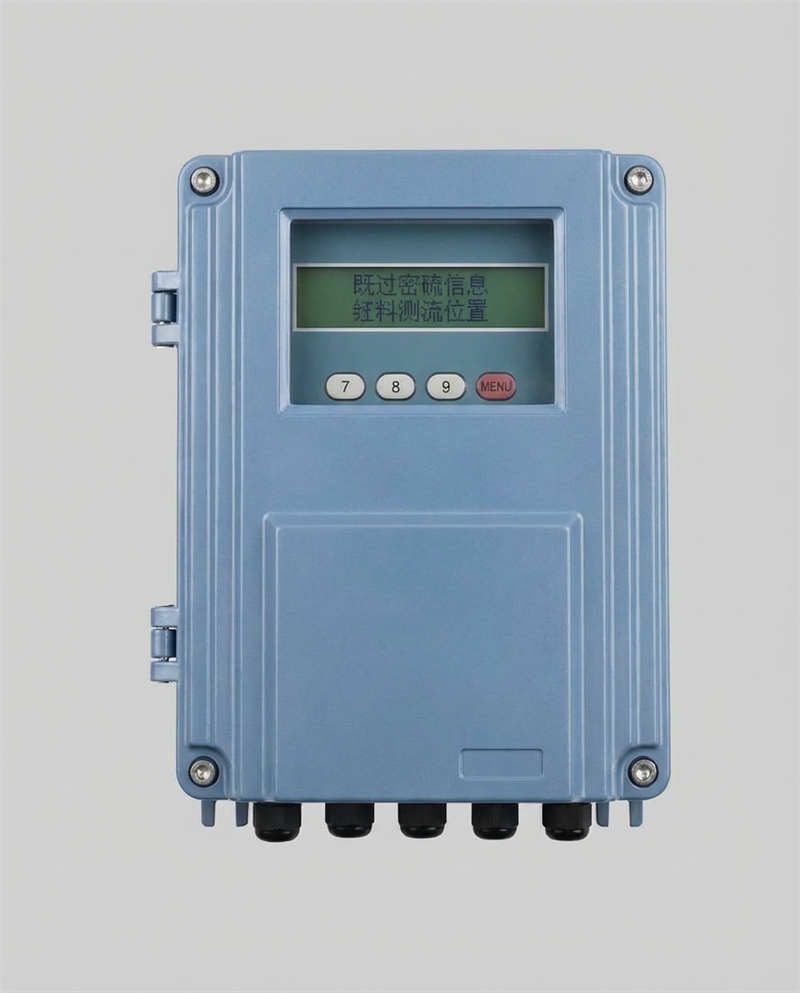
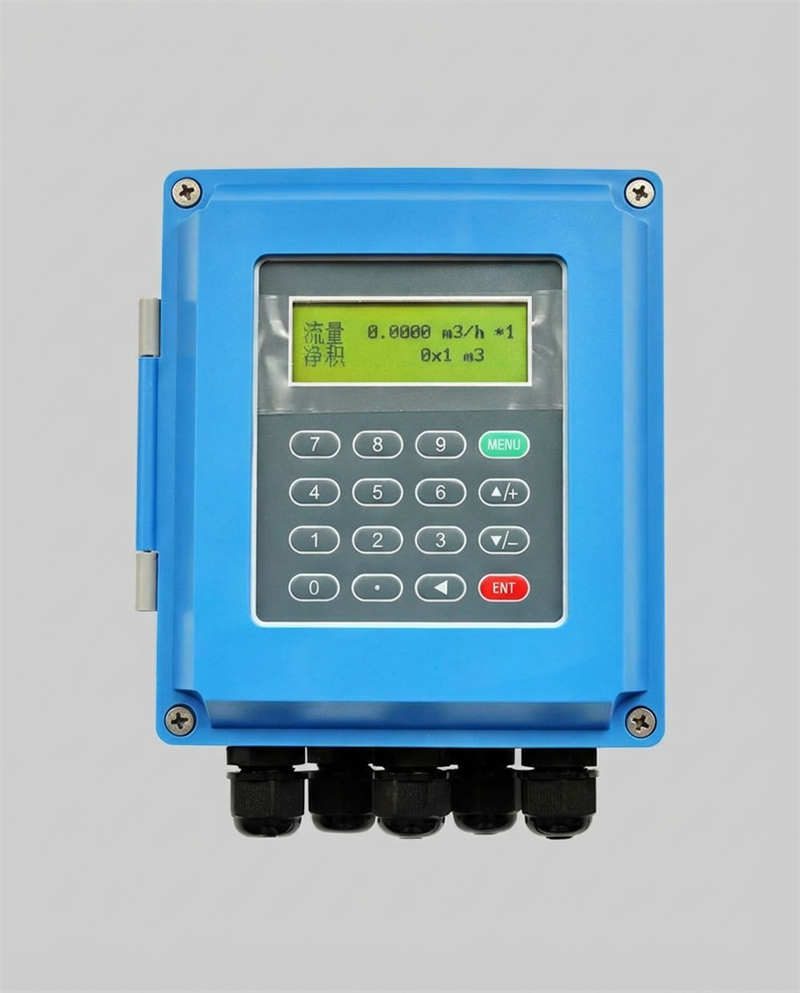
Ultrasonic meters measure flow by transmitting sound pulses through the fluid and measuring how the flow speed changes the time it takes those pulses to travel upstream versus downstream. Clamp-on versions attach to the outside of an existing pipe — no cutting, no shutdown, no process interruption.
Why retrofit and upgrade projects favor this technology. When a customer says “we need to add flow measurement to an existing line — but we can’t shut the process down,” the ultrasonic clamp-on meter is often your answer. The installation requires no pipe modification, no valve isolation, no production loss. A technician clamps two transducers onto the outside of the pipe, runs a cable to the transmitter, and the meter is measuring flow within hours.
Positioning ultrasonic meters as the premium retrofit option. The business case: a 12-hour production shutdown at a food processing plant costs $40,000–$80,000 in lost output. A clamp-on ultrasonic meter installation that avoids that shutdown pays for itself before the engineer signs the purchase order. For technical depth on ultrasonic applications across industries, the Top 8 Ultrasonic Flow Meter Industrial Applications guide covers the positioning in detail.
The limitation to state clearly: clamp-on ultrasonic performance depends heavily on pipe material, pipe wall condition, and fluid cleanliness. It works best on homogeneous, bubble-free liquids. On rough cast iron pipes, on slurries, or on gas-entrained liquids, accuracy can degrade. Always qualify the pipe condition before recommending a clamp-on solution.
Positive Displacement Meters — The Niche Player You Shouldn’t Overlook
A positive displacement meter (PD meter) traps precise, known volumes of fluid and counts them. Think of it as a highly accurate mechanical counter. It excels with viscous, slow-moving, or high-value fluids where capturing every drop matters.
Industries where PD meters dominate. PD meters are the standard in custody transfer for high-value liquid hydrocarbons (engine oil, lubricants, fuel oil), in dispensing applications for viscous food products (syrup, honey, sauces), and in chemical batching where precision volumes must be accurately totalized. They perform well when the fluid viscosity is moderate to high and when the flow rate is relatively steady.
How to identify when a customer actually needs this solution. Three signals: the customer is measuring a viscous liquid, the customer needs very high accuracy for custody transfer or batching, and/or the customer has a relatively low, steady flow rate. If all three apply, PD is a serious contender. If flow rates are highly variable or the fluid is dirty, look elsewhere.
The Decision Tree Framework — Your Step-by-Step Recommendation Tool
This five-step framework is the core of this guide. Work through every step before recommending any meter. Skipping even one step is where expensive returns originate.
Step 1 — Ask About the Fluid: What Are We Actually Measuring?
The simple questions that eliminate 60% of wrong recommendations. Start here, every time, without exception:
- “What fluid are you measuring — liquid, gas, or steam?”
- “What’s the fluid’s name, and if it’s a mixture, what’s the approximate composition?”
- “Is the fluid conductive? Does it contain solids or particulates?”
- “Does the fluid’s composition or viscosity change with temperature or between batches?”
These four questions eliminate incompatible technologies before you’ve said a word about products. A non-conductive fluid eliminates electromagnetic meters immediately. A high-viscosity fluid eliminates turbine and vortex meters from the shortlist. A variable-composition gas mixture changes the entire conversation about thermal and turbine meters.
How to translate technical fluid properties into plain language. When a customer says “we’re measuring a mild caustic solution,” what they mean is sodium hydroxide (NaOH) at some concentration — conductive, moderately corrosive, and likely requiring PTFE-lined wetted components. You don’t need to know organic chemistry to navigate this; you need to ask “what’s the concentration?” and reference a compatibility table. Keep one laminated in your sales kit.
Step 2 — Understand the Application: Where Does This Meter Go to Work?
Why application context matters more than you think. The same fluid in two different applications can require two different meter technologies. Water being metered for billing in a municipal distribution system has different requirements than water being used as a cooling agent in a pharmaceutical plant — even though the fluid is identical.
The questions:
- “Is this meter for billing, custody transfer, process control, or general monitoring?” — This determines the accuracy class you need to recommend.
- “What industry is this? Are there regulatory requirements for the measurement?” — FDA, EPA, API, and ISO standards each impose measurement requirements that affect technology selection.
- “Is there any safety requirement? Is the installation area classified as hazardous?” — ATEX or IECEx certification requirements immediately narrow the technology and transmitter options.
Red flags that signal a customer needs a different meter type. If a customer says “we’re measuring a slurry” and you have only turbine meters on the quote, stop. If a customer says “it’s a gas at variable pressure” and you’re about to quote a volumetric meter without temperature/pressure compensation, stop. These are moments where asking one more question saves months of trouble.
Step 3 — Determine the Flow Range: Is This a Trickle or a Torrent?
How to help customers estimate flow rates without engineering calculations. Many customers can’t tell you their flow rate in cubic meters per hour — but they can tell you things that let you estimate it: pipe size, pump model number, how long it takes to fill a known tank. A 3-inch pump on a municipal water line typically moves 20–80 m³/hour. That’s enough to size a meter.
The minimum flow rate is the most critical number. Many meters maintain their stated accuracy only above a minimum threshold — typically 5–10% of the meter’s rated maximum. An electromagnetic meter rated to 100 m³/hour is not delivering its stated ±0.5% accuracy at 3 m³/hour. Ask:
- “What is the lowest flow rate you ever need to measure accurately?”
- “What happens during startup or standby — is there any flow at all, or is it zero?”
Why oversizing or undersizing creates expensive problems. Oversizing (a 100 m³/hour meter on a 5 m³/hour application) degrades low-flow accuracy. Undersizing (a 50 m³/hour meter on a line that peaks at 80 m³/hour) risks mechanical damage from over-range velocities. Neither failure is a manufacturing defect. Both are specification errors.
The target: the meter’s normal operating flow should sit between 30% and 80% of the meter’s rated maximum. This zone gives you the best accuracy while keeping a buffer for flow surges.
Step 4 — Assess Installation Constraints: What Space and Access Do We Have?
Pipe diameter, straight-run requirements, and other practical limitations. Every velocity-based flow meter — turbine, vortex, electromagnetic, and single-path ultrasonic — requires a minimum length of undisturbed, straight pipe upstream and downstream of the meter to allow the flow profile to stabilize. This is expressed as a multiple of pipe diameter (D). A typical electromagnetic meter requires 10D upstream and 5D downstream; a turbine meter may need 15D upstream.
The key question before quoting: “How much straight pipe is available upstream and downstream of where the meter will be installed? Are there elbows, valves, pumps, or pipe reducers nearby?”
If the answer is “there’s a 90-degree elbow 2 pipe diameters upstream,” a standard electromagnetic meter will underperform and the customer will blame the meter. The real fix is either a flow conditioner, a technology that is less sensitive to installation (Coriolis, for example), or redesigning the piping.
How to identify when installation complexity affects your recommendation. A clamp-on ultrasonic meter solves the “we can’t cut the pipe” problem. A Coriolis meter solves the “we have no straight run” problem. Knowing which technology solves which constraint lets you turn installation obstacles into premium recommendations.
Step 5 — Define the Budget Reality: Aligning Expectations With Costs
How to have the price conversation without losing credibility. Lead with the cost of the wrong decision, not the cost of the right one. When a procurement manager balks at a $12,000 Coriolis meter after getting used to $800 turbine meters, the conversation that reframes the decision is:
“I understand — it’s a significant difference in upfront cost. Here’s the thing though: this application involves measuring [chemical X] for billing purposes. At your throughput, a 1% measurement error runs to about $X per year in unrecovered costs. The Coriolis meter eliminates that exposure and pays for the price difference in [timeframe]. Would you like me to run through the calculation?”
When to recommend premium solutions versus cost-effective alternatives. The decision rule is simple: match the accuracy requirement to the application’s financial or regulatory stakes. A garden-center irrigation monitor doesn’t need a Coriolis meter. A pharmaceutical batch reactor does. The risk of recommending down is always higher than the risk of recommending up — because a customer who bought too cheap and experienced a failure will remember that conversation, and so will every colleague they mention it to.
The Visual Decision Tree — Your Go-To Sales Tool

A printed, laminated decision tree in your team’s hands transforms specification conversations from guesswork into structured consultations.
The Complete Flow Meter Decision Tree
Use this flowchart to guide every specification conversation. Print it. Laminate it. Put it in every sales bag.
START HERE │ ▼ Q1: Is the fluid LIQUID or GAS/STEAM? │ ├─ GAS/STEAM ──────────────────────────────────────────────► Go to Gas/Steam Path (below) │ └─ LIQUID ──────────────────────────────────────────────────► Continue │ ▼ Q2: Is the liquid CONDUCTIVE? (Water, wastewater, acids, bases, food liquids = YES) (Hydrocarbons, oils, ultrapure water = NO) │ ├─ NO ──► Q3: Is viscosity HIGH (>50 cP)? │ │ │ ├─ YES ──► POSITIVE DISPLACEMENT or CORIOLIS │ └─ NO ──► TURBINE (clean), CORIOLIS (accuracy-critical), ULTRASONIC │ └─ YES ─► Q4: Does fluid contain SOLIDS or ABRASIVES? │ ├─ YES ──► ELECTROMAGNETIC (full-bore, hard liner) └─ NO ──► Q5: What is ACCURACY REQUIREMENT? │ ├─ ±0.5% or better ──► ELECTROMAGNETIC or CORIOLIS ├─ ±1-2% acceptable ──► ELECTROMAGNETIC └─ General monitoring ──► ELECTROMAGNETIC or TURBINE
GAS/STEAM PATH: Q6: Is this STEAM or GAS? │ ├─ STEAM ──► VORTEX (dry steam), DP with orifice plate (any steam, standard) └─ GAS ──► Q7: Is MASS FLOW required (custody transfer, billing)? │ ├─ YES ──► CORIOLIS or THERMAL MASS └─ NO ──► VORTEX, TURBINE (clean dry gas), THERMAL MASS (compressed air)
UNIVERSAL: Can the pipe be CUT or is SHUTDOWN possible? │ ├─ NO ──► CLAMP-ON ULTRASONIC (liquid, non-abrasive, homogeneous) └─ YES ──► Continue with above paths
How to Use the Flowchart in Real-World Sales Conversations
Positioning this tool as a confidence-builder for your sales team. The flowchart is not a crutch — it’s a conversation guide. The value is not that it replaces knowledge; it’s that it ensures your team asks the right questions in the right order. A rep who works through this chart during the customer call is demonstrating systematic thinking, which customers read as competence and professionalism.
How to walk customers through the decision process without overwhelming them. You don’t show the customer the full chart and ask them to follow the branches. You use it internally to guide your questions. From the customer’s perspective, they’re having a natural conversation about their application. From your perspective, you’re systematically eliminating incompatible technologies and converging on the right recommendation.
Key Decision Points Your Customers Will Face (And Your Answers)
The “conductive vs. non-conductive” question that stumps most procurement teams. When you ask a procurement manager whether their fluid is conductive, they often stare blankly. Rephrase it: “Is this a water-based liquid or an oil/hydrocarbon-based liquid?” Water-based = conductive = electromagnetic meter is a viable option. Oil-based = not conductive = electromagnetic meter will not work.
For borderline cases (very low conductivity water, demineralized water), the practical test is electrical conductivity in µS/cm (microsiemens per centimeter). Most electromagnetic meters require a minimum of 5–20 µS/cm. If your customer can share a water quality report, the specific conductance figure settles the question in seconds.
Why “accuracy requirements” matter more to some industries than others. Here is the spectrum to keep in mind:
| アプリケーション・タイプ | Required Accuracy | Consequence of Error |
|---|---|---|
| General process monitoring | ±2–5% | Inefficiency, wasted material |
| Process control | ±0.5–1% | Off-spec product, batch failure |
| Custody transfer / billing | ±0.1–0.25% | Financial loss, regulatory violation |
| Pharmaceutical batch | ±0.1–0.5% | FDA non-compliance, product recall |
Connecting the accuracy number to the financial or regulatory consequence is what makes the specification conversation meaningful to a non-technical buyer.
How to Customize the Decision Tree for Your Specific Customer Segments
Adapting recommendations for water utilities versus chemical plants. A municipal water utility’s procurement team cares primarily about two things: compliance with their regulatory measurement requirements, and total cost of ownership over a 15–20 year asset life. They will accept a higher upfront price for a proven, low-maintenance technology. Electromagnetic meters are the dominant choice in this sector for exactly those reasons.
A chemical plant’s procurement team, by contrast, is more likely to be driven by accuracy requirements tied to product quality and raw material cost. The conversation is faster when you open with: “What does a 1% flow error cost you in this process per year?” — because chemical plants have that number.
Why one size doesn’t fit all in your distributor network. Different industries have different procurement cultures, different regulatory drivers, and different technical languages. The agent selling into the oil and gas sector needs to speak API standards and intrinsic safety certifications. The agent selling into food and beverage needs to know 3A sanitary standards and CIP-compatible liner materials. Tailor the decision tree entry point to the industry you’re serving.
Common Application Scenarios — Real Situations Your Customers Bring to You
Scenario 1 — The Water Treatment Plant Upgrade
A municipal water authority needs to replace aging turbine meters on their distribution mains — 150mm and 200mm diameter pipes carrying treated potable water. Budget is a concern. They’re asking for a “reliable upgrade.”
What this customer actually cares about (spoiler: it’s not precision). Reliability and long service life matter most. These meters will be in the ground for 20 years with minimal maintenance intervention. The water is clean, conductive, and consistent. Accuracy at ±0.5% is required for billing compliance, but the primary failure mode they’ve experienced with the old turbines is bearing wear from particles.
The meter recommendation that solves their real problem. Full-bore electromagnetic meters with rubber liner and 316L stainless electrodes. No moving parts eliminates the bearing failure mode entirely. The 20-year service life is well-documented for quality electromagnetic meters in potable water service. The price premium over turbines ($1,800–$3,500 vs. $600–$1,200 per unit) is offset by the elimination of maintenance callouts — which at a municipal labor rate of $85/hour and an average of two callouts per meter per year, recovers the price difference in under three years.
について Jade Ant Instruments Electromagnetic Flow Meter Selection Guide covers the specific liner and electrode selection for potable water service.
Scenario 2 — The Chemical Processing Facility Needing Accuracy
A specialty chemical manufacturer runs a batch reactor where two gas-phase reactants are mixed in a 70/30 molar ratio. The ratio must be held within ±2%. They’ve been using thermal mass flow meters and are experiencing unexplained batch yield variability.
Why this customer will pay premium prices for the right solution. Each batch produces $14,000–$18,000 of finished product. A 3% measurement error on the gas ratio translates directly into off-spec product. In a plant running 200 batches per year, even 5 failed batches per year costs $70,000–$90,000 in rework and scrap — before accounting for the regulatory documentation exposure.
How to position Coriolis meters as the only acceptable answer. The thermal mass meter’s Achilles heel in this application is gas composition sensitivity. When the ratio shifts between batch types, the meter’s calibration basis is wrong. A Coriolis meter measures mass flow directly, using inertial forces that are independent of gas composition. It doesn’t need to “know” what’s in the pipe — it measures the mass of whatever is flowing, period. For a $15,000 Coriolis investment against $70,000+ annual loss exposure, the ROI conversation writes itself.
For a full case study of what happens when the wrong meter is specified in exactly this type of application, the Chemical Plant $847K Case Study from Jade Ant Instruments provides every detail.
Scenario 3 — The Retrofit Project With Space Constraints
A food processing plant wants to monitor cooling water flows in their chiller system. The pipes are 250mm stainless steel, the fluid is treated clean water, the system cannot be shut down during the busy production season, and there is no straight pipe run available — a pump sits 3 diameters upstream of the planned measurement point.
When ultrasonic becomes the hero your customer didn’t expect. Clamp-on ultrasonic meters solve both problems simultaneously: no shutdown required (the transducers clamp to the outside of the existing pipe) and zero pipe modification. On clean, homogeneous water in a stainless steel pipe, clamp-on ultrasonic performance is excellent — typically ±1–2% on a well-executed installation.
How to explain non-invasive measurement in business terms. “We can install this during your production run — no shutdown, no pipe cutting, no process interruption. The transducers mount to the outside of your existing pipe and the meter starts reading within hours of installation. At your production volume, avoiding a 12-hour shutdown to install an inline meter saves approximately $X in output. That saving alone funds a significant portion of the meter’s cost.”
について Turbine vs. Ultrasonic Flow Meter for Chemical Plants guide provides the technical comparison and positioning data your team needs for this conversation.
Scenario 4 — The Budget-Conscious Facility Manager
A maintenance manager at a bottling plant calls and says, “I just need something cheap to roughly monitor the water flow coming into the building — it doesn’t need to be fancy, we’re not billing anyone.”
Why recommending the cheapest option loses customers long-term. The immediate temptation is to quote the least expensive meter in your catalog and close the sale. Resist this. A meter installed in a marginal application without even basic specification review fails in ways that cost more than the meter’s purchase price. The replacement cost, the investigation time, and — most damagingly — the customer’s conclusion that “your meters aren’t reliable” all flow from that shortcut.
The value conversation that builds loyalty instead. “For general building-level water monitoring on a conductive supply, a compact electromagnetic meter at [price] gives you reliable readings for 10+ years with no maintenance. The variable area rotameter is cheaper upfront, but requires periodic float cleaning and recalibration. Over three years, the total cost is actually similar — and the EM meter gives you a 4–20mA output you can connect to your BMS if you ever want to.”
Customers who receive this level of guidance — even on a small sale — remember it. They come back for the larger applications with the expectation of the same quality of advice.
Scenario 5 — The Industry-Specific Challenge (Oil & Gas, Food & Beverage, Pharmaceuticals)
A distributor in the oil and gas sector gets an inquiry for flow metering in a produced water handling system. The fluid is saline water mixed with trace hydrocarbons, at elevated temperature (90°C), and the installation is in an ATEX Zone 1 classified area.
Why one industry’s best practice is another’s compliance nightmare. A standard electromagnetic meter with rubber liner and standard transmitter would physically work with this fluid — the conductivity is high, the flow is consistent. But rubber liners have a temperature limit of approximately 70–80°C. The installation area’s ATEX Zone 1 classification requires a meter with certified explosion-proof or intrinsically safe transmitter. A recommendation that ignores these constraints doesn’t just result in a poor installation — it creates a potential safety and compliance liability for your customer.
How to navigate regulatory and safety requirements in your recommendations. The trigger questions for any industrial application: “Is the installation area classified as hazardous? If so, what Zone or Division?” そして “Are there any applicable industry standards we need to meet — API, ISO, FDA, ATEX?” These questions, asked before the quote goes out, demonstrate technical awareness and protect both parties from costly compliance corrections post-installation.
Resources like the Yokogawa Flow Meter Selection Guide provide ATEX and hazardous area classification references that supplement your standard recommendation process.
Specification Translation — Making Technical Data Understandable

Understanding what a specification actually means in the field — not just on the datasheet — is the difference between a confident recommendation and an expensive return.
Accuracy Ratings: What ±0.5% Actually Means for Your Customer
How to explain measurement uncertainty without sounding like an engineer. Drop the percentage. Use a dollar value. If a customer pumps 10,000 liters of a chemical worth $2.50/liter per day, their daily throughput is worth $25,000. A meter with ±1% accuracy could be misreading by $250 per day — $91,250 per year. A meter with ±0.5% accuracy cuts that exposure to $45,625. The difference in meter cost is often $500–$2,000. The ROI calculates in seconds.
When accuracy differences matter enough to change the recommendation. Upgrade the accuracy specification when: the measured fluid is being used for billing or custody transfer; the process depends on precise stoichiometry (chemical reactions, blending); or regulatory documentation is tied to the measurement. Keep the standard specification for general monitoring, energy management in non-critical systems, and applications where only trends matter rather than absolute values.
Repeatability vs. Accuracy: Why Your Customers Get These Confused
The simple explanation that finally makes sense.
- 精度 = how close the meter reads to the truth. If the actual flow is 100 L/min and the meter reads 99 L/min, the error is 1%. Accuracy is how right you are.
- 再現性 = whether the meter reads the same value every time under the same conditions, regardless of whether that value is “right.” If the meter always reads 99 L/min when the actual flow is 100 L/min, it has perfect repeatability but 1% accuracy error.
How this distinction affects long-term customer satisfaction. In process control applications, repeatability matters more than absolute accuracy — because the control system responds to changes in the reading, not to its absolute value. A controller trying to hold a flow setpoint doesn’t care whether 100 L/min reads as 98.5 L/min or 101 L/min — it cares that the reading is stable and consistent. When a customer complains “the meter gives different readings every time for the same flow,” that’s a repeatability problem. When they say “it always reads low,” that’s an accuracy problem. These have different causes and different solutions.
Pressure Drop and Installation Impact: Why Your Installer Keeps Complaining
What pressure drop really costs your customer. Pressure drop (the reduction in fluid pressure as it passes through a meter’s internal obstruction) is an ongoing energy cost. An orifice plate on a 100mm line carrying 30 m³/hour of water creates approximately 0.2–0.5 bar of pressure loss. To maintain system pressure downstream, the pump must work harder. At a continuous pump power cost of 0.5 kW (in this example), running 8,760 hours per year at $0.12/kWh, the annual energy cost of that pressure drop is $525/year. Over 15 years, that’s $7,875 — more than the cost of switching to a full-bore electromagnetic meter with near-zero pressure drop.
How to factor installation complexity into your recommendations. Meters with higher pressure drop require either upsized pumps (capital cost) or acceptance of reduced downstream pressure (performance impact). When specifying a differential-pressure meter, orifice plate, or any positive-displacement or turbine type, ask your customer: “What is the maximum pressure drop you can accept at this point? And what does it cost you to pump an extra 0.3 bar?”
Response Time and Data Logging: When These Features Actually Matter
Industries where fast response is critical versus nice-to-have. A pharmaceutical batch reactor filling a vessel to an exact weight needs a meter that responds to flow changes in under one second — because a 500ms lag at high flow rates translates to overfill errors. A municipal distribution main meter recording daily totals for billing purposes can have a 10-second response time with no consequence. Ask: “Does your system need to react to flow changes in real time, or is this about accumulating totals over time?”
How to identify if a customer needs advanced data capabilities. The signal is usually a question about connectivity: “Can it talk to our PLC?” または “Does it log historical data?” Modern electromagnetic and Coriolis transmitters with HART or Modbus connectivity provide remote diagnostics, data logging, and integration with SCADA systems. This is a premium feature that energy management, pharmaceutical, and food production customers actively value — and will pay for.
The Confidence Conversation — Positioning Yourself as the Expert
Avoiding the “We Don’t Know” Moment
What to say when a customer asks a technical question you can’t answer. Honesty is always the right policy — but honesty doesn’t mean uncertainty. The professional response to a question outside your immediate knowledge is: “That’s a detail I want to get exactly right for your application — let me confirm the specification and come back to you within 24 hours.” Then confirm, and come back within 24 hours. Reliability in follow-through is what builds technical credibility, not instant recall of every specification.
How to maintain credibility while being honest about knowledge gaps. Customers don’t expect omniscience. They expect competence and honesty. A distributor who says “I don’t know, but I’ll find out and get back to you today” is more trustworthy than one who guesses confidently. The rep who never says “I don’t know” without immediately following up is the one customers stop calling.
Building Trust Through Transparent Recommendations
Why recommending against your highest-margin product sometimes wins customers for life. A customer needs a simple flow monitor for a non-critical cooling water line. Your highest-margin item in that pipe size is a Coriolis meter at $14,000. The right answer is an electromagnetic meter at $2,200. Recommending the right answer — transparently — creates a customer who trusts you with their next specification conversation, which might be for 20 Coriolis meters in a pharmaceutical plant expansion.
How to frame honest advice as added value. “I could quote you our Coriolis meter for this application — it’s excellent — but for general cooling water monitoring without billing requirements, it would be overspecified and you’d pay for capabilities you won’t use. The electromagnetic meter covers exactly what you need here, and the budget difference can go toward [the next project they mentioned].” That sentence earns more loyalty than any product brochure.
Handling the “Our Previous Supplier Recommended Something Different” Objection
How to respectfully challenge bad recommendations. Never attack the previous supplier directly. Ask questions instead: “That’s worth understanding — can you tell me what the previous recommendation was based on? What application data did they have at the time?” In most cases, one of two things emerges: either the previous recommendation was made without complete application data (which you’ve now gathered), or there’s a legitimate reason for both approaches (which you can acknowledge while explaining why yours is better suited to their current requirements).
The diplomatic way to position your expertise as superior. “Both approaches can work for certain applications — the difference is that based on what you’ve told me about your flow range and accuracy requirements, [technology X] gives you [specific advantage] that [technology Y] doesn’t. Let me show you why that matters for your situation.” You’re not saying the previous supplier was wrong. You’re saying you have better, more complete information — which is true if you’ve done the specification work properly.
Common Mistakes Your Distributors Make (And How to Avoid Them)
Mistake 1 — Recommending Based on What You Have in Stock
Why inventory shouldn’t drive technical recommendations. Every experienced distributor knows this happens. The customer calls, the rep glances at the inventory system, and the recommendation skews toward what’s available to ship today. This is understandable under time pressure. It is also the fastest route to a customer return, a reputation problem, and a lost account.
How to build a recommendation process that serves customers first. Create a clear internal policy: the recommendation is determined by the application, not by inventory. Once the right meter type is identified, check stock. If the right meter isn’t in stock, provide a lead time with confidence — and explain why waiting two weeks for the correct meter is better than shipping the wrong one tomorrow. Most customers respect that logic when it’s explained clearly.
Mistake 2 — Underestimating the Importance of Installation Support
Why post-sale support is where distributor relationships are won or lost. The meter works in the lab. It fails in the field — not because the product is defective, but because the installation had an unqualified 90° elbow three pipe diameters upstream, the pipe wasn’t full during commissioning, or the grounding wasn’t done correctly. These failures are not your customer’s fault if you didn’t warn them.
How to position installation expertise as a key differentiator. Include a brief installation checklist with every shipment. For significant orders, offer a commissioning check call 48 hours after installation date. The Flow Meter Installation Best Practices Guide from Jade Ant Instruments is a resource you can share with customers or use as the basis for your own application-specific documentation. Installation support that prevents a field failure is worth more to a customer than any discount.
Mistake 3 — Ignoring Total Cost of Ownership
Why the cheapest upfront price often costs customers more over time. A turbine meter for a dirty water application costs $600. An electromagnetic meter for the same application costs $2,200. The turbine’s bearing wears out in approximately 2 years when exposed to particle-laden water, requiring replacement plus installation labor ($400 + $600 = $1,000 per intervention). After 10 years: turbine total cost ≈ $600 + (5 × $1,000) = $5,600. Electromagnetic meter total cost over 10 years: $2,200 (no service required). The “expensive” meter is $3,400 cheaper over its service life.
| メーターの種類 | Purchase Price | Annual Maintenance | 10-Year TCO |
|---|---|---|---|
| Turbine (dirty water) | $600 | $500 (bearing, calibration) | $5,600 |
| Electromagnetic (dirty water) | $2,200 | $80 (verification only) | $3,000 |
| Coriolis (custody transfer) | $12,000 | $400 (calibration) | $16,000 |
| Ultrasonic clamp-on (retrofit) | $4,500 | $150 (battery, calibration) | $6,000 |
How to frame higher-priced recommendations as smart investments. “The lower price today comes with a higher 10-year cost — here’s why.” Show the math. Customers who see the calculation don’t feel sold; they feel advised.
Mistake 4 — Failing to Ask About Future Expansion Plans
Why today’s application is just the beginning of the conversation. A customer installing a single metering point today may be planning five more in the same facility within 18 months. A customer choosing a meter for a 150mm line may be installing the same technology across a pipeline network at 300mm and 400mm sizes in two years. If you don’t ask about future plans, you miss the opportunity to become the preferred supplier for the expansion — and you miss the chance to design a recommendation that standardizes the technology across the whole facility.
How scalability becomes your next upsell opportunity. Ask: “Are there other measurement points in this facility that might need similar metering in the next couple of years?” If the answer is yes, the conversation shifts from a single-unit sale to a facility-wide standardization discussion. That’s where real distributor relationships are built.
Mistake 5 — Not Following Up on Performance After Installation
Why post-installation support builds repeat business. A 30-day follow-up call costs three minutes. A customer who receives that call — “Just checking in to make sure the meter commissioned cleanly and the readings look right to you” — has a quantifiably different relationship with their distributor than one who received only a delivery note.
How to create a follow-up process that strengthens customer relationships. At the point of order confirmation, schedule a follow-up call in your CRM for 30 days after the expected delivery date. Use this script: “Hi [name], this is [your name] from [company]. The [meter model] you ordered should have been installed a few weeks ago — I wanted to check in and make sure everything went smoothly. Are the readings looking as expected?” That question, asked consistently, catches 90% of installation-related problems while they are still easy to resolve.
Practical Tools for Your Sales Team
The One-Page Decision Tree Checklist Your Reps Can Print and Carry
The full decision tree earlier in this guide is the reference document. This is the field version — everything your rep needs in a customer meeting, on one page, without looking like they’re reading from a script.
Pre-Qualification Checklist — Print and Laminate
Application Basics
- Fluid type: liquid / gas / steam
- Fluid name and (if applicable) composition
- Conductive? Yes / No / Unknown
- Clean or particle-laden?
Flow Parameters
- Minimum flow: _______ (units: ______)
- Normal operating flow: _______
- Maximum / peak flow: _______
- Pipe size (internal diameter): _______
Operating Conditions
- Temperature range (min/max): _______
- Pressure range (min/max): _______
- Outdoor / indoor / hazardous area?
Accuracy and Output
- Accuracy required: ±_______% (billing / process control / monitoring)
- Output signal needed: 4–20 mA / pulse / Modbus / HART
- Data logging required? Yes / No
インストール
- Straight pipe available upstream: _______ × D
- Pipe can be cut? Yes / No (if No → consider clamp-on ultrasonic)
- Shutdown possible for installation? Yes / No
- Existing pipe material: _______
Recommendation triggers:
- Non-conductive liquid → NOT electromagnetic → turbine / Coriolis / ultrasonic
- No pipe cut possible → clamp-on ultrasonic
- Highest accuracy, any fluid composition → Coriolis
- Dirty / abrasive conductive liquid → electromagnetic
- High viscosity, precise batching → PD meter
- Budget monitoring, clean liquid → turbine
The Email Template for Documenting Recommendations
How to send professional recommendations that protect you and guide customers.
Use this template within 24 hours of every meaningful specification conversation:
Subject: Flow Meter Recommendation — [Customer Name] — [Application Location]
Hi [Name],
Thank you for the application discussion today. To confirm the details I based my recommendation on:
Application: [description] Fluid: [name, concentration, conductivity note] Flow range: [min] to [max] [units], typical [typical flow] Operating conditions: [temperature range], [pressure range] Installation: [pipe size], [orientation], [straight run available] Accuracy requirement: [±X% for billing / process control / monitoring]
Based on these parameters, I recommend: [Meter model, size, specification]
Key reasons: [2–3 bullet points explaining the match]
This recommendation assumes: [list key assumptions — e.g., fluid composition is stable, straight run as described, no ATEX requirement]
If any of these parameters change before ordering, please let me know so we can verify the recommendation remains correct.
Best regards, [Name]
Why written recommendations reduce misunderstandings and returns. This email takes 10 minutes to write. It creates a professional record that documents your reasoning, protects you if parameters change without notification, and signals to the customer that they are dealing with a technically rigorous organization. Customers who receive this level of documentation rarely return meters citing “wrong specification.”
The Customer Questionnaire That Gathers the Right Information
Why asking the right questions upfront saves time and prevents errors. A structured questionnaire sent before a quotation call ensures you receive the information you need in written form — which is more accurate than verbal descriptions and easier to reference when writing the recommendation.
Standard Flow Meter Application Questionnaire:
| Field | Customer Input |
|---|---|
| Industry / facility type | |
| Fluid being measured | |
| Approximate fluid composition | |
| Min / normal / max flow rate | |
| Operating temperature (min/max) | |
| Operating pressure (min/max) | |
| Pipe size (internal diameter) | |
| Pipe material | |
| Straight run upstream (pipe diameters) | |
| Straight run downstream (pipe diameters) | |
| Installation: can pipe be cut? | Yes / No |
| Shutdown available for installation? | Yes / No |
| Required measurement accuracy | |
| Output signal type | |
| Hazardous area classification? | |
| Regulatory compliance requirements? | |
| Target budget range (optional) |
How to make this questionnaire feel helpful rather than bureaucratic. Frame it: “To make sure I recommend exactly the right meter the first time — and save both of us the back-and-forth — I use a short application form. It takes about five minutes and prevents the most common causes of mis-specification.” Most customers appreciate the care. Those who resist it are usually the ones whose vague verbal descriptions create the most returns.
The Specification Comparison Sheet for Side-by-Side Analysis
How to present options without overwhelming procurement teams. When a customer is choosing between two technologies — say, electromagnetic versus clamp-on ultrasonic for a retrofit application — a side-by-side comparison sheet gives them the information to make an informed decision without needing to understand the underlying physics.
| 仕様 | Electromagnetic (Inline) | Ultrasonic (Clamp-on) |
|---|---|---|
| 精度 | ±0.3–0.5% of reading | ±1–2% of reading |
| Pressure drop | Near zero | Zero (external mount) |
| インストール | Pipe cut required, shutdown needed | No pipe cut, no shutdown |
| Installation time | 4~8時間 | 2~4時間 |
| Suitable fluids | Conductive liquids only | Homogeneous, bubble-free liquids |
| Moving parts | なし | なし |
| Approx. purchase price | $1,800–$3,500 | $3,500–$6,000 |
| 10-year maintenance cost | $800–$1,200 | $1,500–$2,000 |
| Best for | New installations, dirty water, high accuracy | Retrofits, no-shutdown requirement, large pipes |
Why transparency in comparisons builds confidence. Customers who understand the trade-offs make better decisions — and they don’t second-guess their choice afterward, because they understood why they made it. Distributors who provide this level of clarity don’t lose customers to competitors who offer a lower price; they lose customers to competitors who offer better clarity. Be that competitor.
Training Your Team to Use This Decision Tree Effectively
How to Roll Out This Framework Across Your Distributor Network
Why adoption requires more than just sending a document. You can email this guide to every sales rep in your network. Most of them will read the first two sections and file it. Adoption requires two additional elements: a brief training session that walks through the framework with real examples from your actual customer base, and a follow-up mechanism that reinforces usage in the first 30 days.
How to make your team excited about using this tool. Connect the framework directly to their commercial interest. Show them: “With this framework, the percentage of orders that come back for returns drops. Here’s what that means for your monthly commission.” Or: “With this framework, you have a reason to re-open conversations with accounts that went quiet after a failed recommendation — because now you can go back with a better process.” Practical benefit drives adoption. Abstract quality improvement does not.
Role-Playing Scenarios That Build Confidence
Real conversations your team will actually have with customers. The best training is practice with realistic scenarios — not invented examples, but actual customer situations from your recent order history. Here are three role-play scenarios to run with your team:
Role-Play 1: The Budget Customer Customer: “I just need something cheap for water monitoring.” Challenge: Work them through the TCO conversation and arrive at the right recommendation without letting price drive the technology selection.
Role-Play 2: The Technical Customer Who Knows More Than Your Rep Customer: “We need a custody-transfer-grade Coriolis for our LPG dosing system, certified to OIML R 117.” Challenge: Handle the technical detail confidently, identify any application gaps, and demonstrate that your team adds value beyond just quoting a product number.
Role-Play 3: The Objecting Customer Customer: “Our previous supplier gave us turbine meters for this application and they worked fine.” Challenge: Respectfully gather the application data, identify why the turbines “worked fine” or didn’t, and make a case for the improved recommendation based on what you’ve learned.
How to practice without it feeling like training. Frame these as “application review sessions” rather than training exercises. Use real customer accounts (anonymized), real product questions, and real objections from your CRM. The difference between a rep who hesitates on a specification question and one who answers confidently is usually a dozen of these conversations — practiced before they happened with a real customer.
Measuring Success — Tracking Improved Recommendations
Metrics that matter. Track these four numbers monthly:
| Metric | Target | How to Measure |
|---|---|---|
| Return rate (wrong meter) | < 2 per 100 units shipped | Returns log, coded by reason |
| First-contact resolution | > 80% of spec calls resolved correctly | CRM tracking, follow-up results |
| Customer reorder rate | > 75% within 12 months | Account purchase history |
| Average order value per account | Trend upward | Revenue per account, monthly |
How to celebrate wins and learn from mistakes. When a rep works through the decision framework correctly and wins an account they previously would have lost — or prevents a return they previously would have handled — make that story visible across the team. Specific, concrete examples of the framework working are more motivating than any abstract quality metric.
Industry-Specific Guidance — Because One Size Never Fits All

Each industry brings its own regulatory requirements, maintenance culture, and performance expectations — understanding these drives better recommendations and stronger customer relationships.
Water and Wastewater Utilities — The Regulatory-Heavy Decision
Why compliance requirements drive recommendations in this sector. Municipal water utilities operate under regulatory frameworks (in the US, AWWA standards; in Europe, MID compliance; in many markets, local metering regulations) that specify minimum accuracy requirements, meter test intervals, and documentation procedures. Any recommendation that doesn’t acknowledge these requirements risks creating a compliance problem for the customer.
The most common metering standard for custody transfer water applications in regulated markets is OIML R 49, which defines meter accuracy classes for water meters used in billing. Familiarity with this standard — knowing what Class C (±2%) versus Class B (±3%) means, and when each applies — is a meaningful differentiator for a distributor in this sector.
How to navigate the “lowest bid” mentality while maintaining quality. Water utility procurement is often driven by public tender processes where lowest-price compliant bid wins. Your competitive advantage is demonstrating that your recommendation is technically compliant and that the 10-year total cost of ownership — including maintenance and replacement — is lower than the cheaper alternative. Many water authorities have accounting frameworks that explicitly incorporate lifecycle costing in procurement decisions; know which ones your customers use.
Oil and Gas — Where Reliability and Safety Override Everything
Why redundancy and fail-safes matter in hazardous environments. In oil and gas, a meter failure is not just an accuracy problem — it’s a potential safety event. A meter that loses signal on a high-pressure gas line can trigger emergency shutdown procedures, costing tens of thousands per hour in production deferral. For this reason, many oil and gas operators require redundant metering, regular meter proving (comparing meter output against a certified reference), and ATEX/IECEx certified equipment as non-negotiable starting conditions.
How to position premium solutions as necessary, not optional. In this sector, the question is never “do we need this quality?” — it’s “can we justify not having it?” Frame every premium specification as risk mitigation: “The certified ATEX transmitter costs $X more. It’s the difference between a compliant installation and one that requires rectification before operations can begin. In this sector, rectification costs more than the equipment.”
について Coriolis vs. Magnetic vs. Turbine vs. Ultrasonic Guide from Jade Ant Instruments covers custody transfer and oil and gas application requirements in detail.
Food and Beverage — The Sanitary and Accuracy Balance
Why cleaning protocols and material compatibility dominate the conversation. Food and beverage plants clean their process lines regularly using CIP (Clean-In-Place) procedures — high-temperature, high-pressure washes with caustic and acid cleaning agents. Any flow meter installed in a food process line must withstand these cleaning cycles repeatedly without degrading. Standard industrial meters are not designed for CIP service. Sanitary meters with specific liner materials (PFA, FDA-approved silicone), polished wetted surfaces, and tri-clamp process connections are required.
How to recommend meters that meet both regulatory and operational needs. 3-A Sanitary Standards and EHEDG (European Hygienic Engineering and Design Group) guidelines specify the requirements for hygienic flow measurement. Electromagnetic meters with PFA liners and platinum electrodes, or Coriolis meters with stainless 316L product contact surfaces and pharmaceutical-grade surface finish (Ra ≤ 0.8 µm), are the standard recommendations. The price premium over standard industrial meters is real — and so is the regulatory exposure of specifying the wrong one.
Pharmaceutical and Chemical Processing — The Precision Imperative
Why batch traceability and measurement accuracy are non-negotiable. FDA 21 CFR Part 11 requires that electronic records used in pharmaceutical manufacturing accurately represent the processes they document. A flow meter generating batch records must be calibrated, verified, and traceable to recognized standards. Any systematic measurement error embedded in these records creates an audit finding that can halt production — and the cost of a production halt in a pharmaceutical facility starts at $50,000/hour.
How to justify Coriolis and advanced meters in this space. The conversation is not about the meter’s price — it’s about the cost of measurement failure. “In a pharmaceutical batch process, a 1% flow error on a $200,000 batch is a $2,000 quality risk per batch. At 500 batches per year, that’s $1,000,000 in annual risk exposure. The Coriolis meter that eliminates that exposure at ±0.1% accuracy costs $15,000 and pays for itself in the first week of prevented risk.” This calculation always makes sense to a quality-conscious pharmaceutical procurement team.
HVAC and Building Systems — The Efficiency-Focused Customer
Why energy monitoring is becoming a key selling point. Building owners and facility managers face increasing pressure to document and reduce energy consumption — from sustainability commitments, from energy efficiency regulations, and from tenants and investors who expect ESG reporting. Flow measurement in HVAC systems provides the data foundation for this documentation: how much chilled water is consumed by each zone, how efficiently heat exchangers are operating, and where the largest energy savings opportunities lie.
How to position flow measurement as part of the sustainability conversation. The upgrade conversation in HVAC is rarely about replacing a failed meter — it’s about adding measurement capability that didn’t exist before, to enable energy optimization. “Once you have accurate flow measurement across your chiller loops, you can identify which zones are over-served and right-size your pump speeds — facilities that do this systematically typically find 15–25% energy savings within the first year. The metering installation pays for itself before the next annual energy review.”
Clamp-on ultrasonic meters are particularly well-positioned in HVAC retrofits — no shutdown, no pipe cutting, clean technology compatible with the building environment, and increasingly available with IoT connectivity for integration with building management systems.
Conclusion: Your Path to Confident, Profitable Recommendations
How This Decision Tree Transforms Your Sales Process
This guide began with a scenario most distributors recognize immediately: a vague customer inquiry, a quick recommendation based on inventory or habit, and the downstream problems that follow. The decision tree in this guide is the structural solution to that problem.
From guessing to confident recommendations. When your rep works through the five-step framework — fluid, application, flow range, installation constraints, budget — before making any recommendation, the guesswork disappears. The recommendation that emerges is not a hunch. It is a logical conclusion from a defined set of application parameters. Your rep can explain it, document it, and stand behind it.
From technical confusion to clear conversations. The translation tools in Section 5 — accuracy in dollar terms, repeatability versus accuracy in plain language, pressure drop as an energy bill — convert technical specifications into business outcomes. A procurement manager who doesn’t know what ±0.5% means does know what $45,000 per year in measurement-related risk exposure means. That is the language that makes decisions.
From lost customers to loyal relationships. The follow-up protocols, the recommendation documentation emails, the post-installation check calls — each of these is a small investment with a large return. Customers who feel consistently supported, informed, and proactively consulted do not switch suppliers for a 5% price discount. They stay, they expand, and they refer.
The Next Step — Implementing This Framework Today
How to start using this immediately with your next customer inquiry. Take the one-page checklist from Section 8. Print five copies. Before your next customer specification call, have it in front of you. Work through every checkbox during the conversation. Send the recommendation documentation email afterward. Do this for your next 10 orders. Review the results.
Why consistency in recommendations builds your reputation. A distributor known for “always asking the right questions” and “never recommending the wrong meter” does not win that reputation by accident. They win it by having a systematic process that they apply consistently, for every customer, for every order, without exception.
The competitive advantage you gain by being the knowledgeable distributor. In a market where customers can source any flow meter from any supplier globally, the commodity brokers compete on price and lose on margins. The knowledgeable distributors compete on expertise and build businesses that price competition cannot touch. This decision tree, applied consistently, is the beginning of that expertise.
📥 Download Your Complete Decision Tree Kit
Get the printable one-page flowchart, the pre-qualification checklist, the customer questionnaire, and the recommendation email template — everything your team needs to start making confident, defensible flow meter recommendations from the next customer call onward.
Visit jadeantinstruments.com to access the full selection guide and connect with the Jade Ant Instruments technical support team for application-specific guidance.
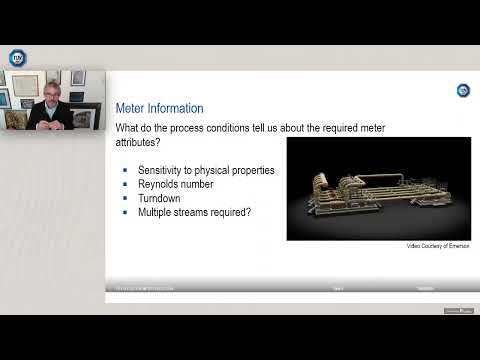
Watch: Flow Meter Selection Explained for Non-Engineers
This webinar covers the same flow meter selection framework covered in this guide — ideal for sharing with your sales team as a training resource or sending to a customer who wants to understand the decision logic before a specification call.
主要用語集
| Term | Plain-Language Definition |
|---|---|
| 精度 | How close a meter’s reading is to the true flow value, expressed as ±% of reading or ±% of full scale |
| 再現性 | How consistently a meter gives the same reading under unchanged conditions, regardless of absolute accuracy |
| Turndown ratio | The ratio of maximum to minimum measurable flow while maintaining stated accuracy (e.g., 40:1 means accurate from 100 m³/h down to 2.5 m³/h) |
| Pressure drop | The reduction in fluid pressure as it passes through a meter — an ongoing energy cost for systems with pumps |
| Full scale | The maximum flow rate a meter is rated to measure at its stated accuracy |
| % of reading | Accuracy expressed as a percentage of whatever value is being measured — better for wide flow ranges |
| % of full scale | Accuracy expressed as a percentage of the meter’s maximum — can mean poor accuracy at low flows |
| Conductive | A fluid that can conduct electricity — required for electromagnetic meter operation (minimum ~20 µS/cm) |
| Wetted materials | All meter components that contact the fluid — must be chemically compatible with the fluid |
| Straight run | Undisturbed, straight pipe required upstream and downstream of a meter for accurate flow profiling |
| ATEX/IECEx | Certification standards for electrical equipment in potentially explosive atmospheres |
| Custody transfer | Measurement of fluid for billing or financial settlement — requires the highest accuracy and regulatory compliance |
| 4–20 mA | Standard analog electrical signal used to transmit flow measurement to control systems (4 mA = zero flow, 20 mA = full scale) |
| HART | Digital communication protocol layered on the 4–20 mA signal, enabling remote configuration and diagnostics |
| Modbus | Digital communication protocol used for connecting flow meters to PLCs and SCADA systems |
よくある質問
FAQ 1: How do I know if I need a ±0.5% or ±1% accurate meter?
The honest answer is that most applications don’t need premium accuracy — but a small number of applications absolutely do, and getting this wrong is expensive. The rule: if the meter reading is used for billing, custody transfer, regulatory reporting, or directly controls the quality of a product formula, you need ±0.5% or better. For those applications, an error of even 1% can mean thousands of dollars per year in unrecovered costs or compliance exposure. For general process monitoring, energy tracking, or indication-only applications, ±1–2% is entirely adequate and costs significantly less. The follow-up questions to ask your customer: “Who sees this reading? What decision gets made based on it? What happens if the meter reads 1% high for six months?” Those answers tell you what accuracy class is actually needed.
FAQ 2: What’s the difference between a turbine meter and a gear meter?
Both are mechanical meters that measure flow by counting discrete volumes, but the operating principle differs. A turbine meter uses a spinning rotor — the rotor speed corresponds to flow rate, producing a continuous analog-like output. It performs best with clean, low-viscosity liquids at moderate to high flow rates. A gear meter (positive displacement) traps precise, known volumes of fluid between meshing gear teeth, counting exactly how much passes through with each rotation. Gear meters perform better with viscous liquids (lubricants, oils, syrups) and at lower flow rates, because the gear geometry is less affected by viscosity than a turbine rotor. For a customer measuring light mineral oil in a lubrication system: gear meter. For a customer measuring clean water at high flow rates: turbine. The key question: “What is the fluid viscosity?”
FAQ 3: Can I use an electromagnetic meter for non-conductive liquids?
No — and this is one of the most important hard rules in flow meter selection. An electromagnetic meter relies on the fluid’s electrical conductivity to generate the voltage signal it measures. Non-conductive fluids (petroleum hydrocarbons, pure water below ~5 µS/cm, most oils, organic solvents) produce no voltage signal, and the meter reads zero regardless of actual flow. If you try to use an electromagnetic meter on a non-conductive fluid, you don’t get an inaccurate reading — you get no reading at all, or a random noise signal. For non-conductive clean liquids, consider turbine meters (for lower viscosity) or Coriolis meters (for higher accuracy or variable viscosity). For non-conductive viscous liquids, positive displacement meters are often the best fit.
FAQ 4: How much straight pipe do I really need before and after the meter?
This matters more than most distributors realize — and the answer varies by technology. As a practical reference:
| メーターの種類 | Upstream Straight Run | Downstream Straight Run |
|---|---|---|
| Turbine meter | 10–15 × pipe diameter (D) | 5D |
| Electromagnetic meter | 5–10D | 3–5D |
| Vortex meter | 15~20D | 5D |
| Coriolis meter | 0–2D (nearly none required) | 0–2D |
| Clamp-on ultrasonic | 10–20D | 5–10D |
These are minimum values from undisturbed straight pipe upstream of the measurement point. Elbows, partially open valves, pump discharges, and reducers all count as disturbances that require additional straight run. When a customer doesn’t have the required straight run, the options are: relocate the meter, add a flow conditioner (which reduces the straight run requirement), or select a technology with lower straight-run sensitivity (Coriolis is the most forgiving).
FAQ 5: Will an ultrasonic clamp-on meter work on my existing pipe?
Usually yes — but the answer depends on three conditions your customer needs to verify. First, the pipe material: clamp-on ultrasonic works well on metal pipes (steel, stainless, cast iron) and most plastics (PVC, PE, PVDF). It struggles on heavily corroded pipe walls, concrete-lined pipes, and pipes with thick rubber or foam insulation that blocks acoustic signal. Second, the fluid: ultrasonic measures by sending sound waves through the fluid. Homogeneous, bubble-free liquids (water, clean chemicals, clean oils) work well. Slurries, highly aerated liquids, or fluids with entrained gas scatter the acoustic signal and degrade accuracy. Third, the pipe wall condition: a pipe with heavy internal scaling or deposits will attenuate the signal. For a clean stainless pipe carrying treated water — excellent. For a 40-year-old cast iron distribution main with internal corrosion — test before committing to a permanent installation.
FAQ 6: What’s the real cost of pressure drop in my system?
This is one of the most consistently under-calculated costs in flow meter selection. The formula: Annual energy cost = (Pressure drop × Flow rate × Operating hours × Energy cost) ÷ Pump efficiency. As a worked example: a 100mm orifice plate meter with 0.3 bar pressure drop on a 20 m³/hour continuous water line, running 8,760 hours/year at $0.12/kWh with an 80% efficient pump:
Power consumed by pressure drop = (0.3 bar × 100,000 Pa/bar × 20/3600 m³/s) ÷ 0.80 = ~208 W
Annual energy cost = 0.208 kW × 8,760 h × $0.12 = $218/year
Over 15 years: $3,270 — more than the cost of the orifice plate assembly. Switching to a full-bore electromagnetic meter (near-zero pressure drop) recovers that cost continuously. For large pipes (300mm+) at high flow rates, this calculation generates numbers in the thousands of dollars per year, which can easily justify a premium meter selection on energy savings alone.
FAQ 7: How often does a flow meter need calibration?
The calibration interval depends on the application’s financial and regulatory stakes. As a practical guide:
- Custody transfer / billing meters: Every 6–12 months, or as specified by the applicable standard (OIML R 49 for water meters, API MPMS for petroleum, etc.)
- Process control meters (critical): Every 12–24 months
- Process monitoring (non-critical): Every 2–3 years
- General monitoring / indication only: Every 3–5 years or on observed drift
Technologies without moving parts (electromagnetic, ultrasonic, Coriolis) tend to drift more slowly than mechanical technologies (turbine, PD, variable area) — which is one reason their longer calibration intervals contribute to lower total cost of ownership. Always check the specific regulatory requirements that apply to your customer’s application before quoting an interval.
FAQ 8: Can I switch from one meter type to another without changing my pipe?
Sometimes yes, sometimes no — and understanding which scenario you’re in prevents expensive surprises. Clamp-on ultrasonic meters install without any pipe modification; they’re the universal retrofit answer where accuracy requirements are met. Replacing an inline meter with another inline meter of the same connection type and size is straightforward — but only if the new technology fits the same pipe space and has the same or shorter straight-run requirement. Switching from a PD meter (which can be compact) to a Coriolis meter (which is longer) may require piping modification. Switching from a turbine meter with minimal straight run to a vortex meter that requires 15D upstream definitely requires piping or flow conditioner addition. The positioning opportunity: “Before we talk about replacement, let me understand exactly what’s there now and what constraints we’re working with — that determines which technologies are feasible and which ones would need piping work.”
FAQ 9: What happens if I choose the wrong meter type?
The consequences range from “annoying and expensive” to “serious regulatory problem,” depending on the application. In a non-critical monitoring application, the wrong meter means inaccurate readings that nobody notices for months — until a process problem is traced back to measurement error. In a billing application, the wrong meter means financial exposure — either undercharging customers or overpaying for raw materials, compounded by every day the error goes undetected. In a regulatory application, the wrong meter can mean compliance violations, audit findings, and in serious cases, regulatory fines. In all cases, the earlier the error is caught, the cheaper the fix. The most expensive wrong meter selections are those that go undetected for a year or more — which is exactly why the 30-day post-installation follow-up call in Section 7 is so valuable.
FAQ 10: How do I explain flow meter technology to my executive team?
Lead with business outcomes, not technical specifications. The frame that resonates with decision-makers:
“A flow meter is how we know how much of [resource] is being used, transferred, or billed. The accuracy of that measurement directly affects [revenue, cost, or compliance]. We’re spending $X on flow measurement now. For an additional $Y, we can achieve [specific benefit: ±0.5% billing accuracy, elimination of batch failures, regulatory compliance, energy monitoring for sustainability reporting]. The ROI on that investment is [specific period] based on [specific savings].”
Executive teams don’t need to understand Coriolis versus turbine. They need to understand risk and return. Your job is to translate between the technical decision and the business outcome — which is exactly what the specification framework in this guide enables you to do.
FAQ 11: What’s the difference between mass flow and volumetric flow?
Volumetric flow measures the volume of fluid passing a point per unit time (liters per minute, cubic meters per hour). The problem: the same volume of a gas at different pressures or temperatures contains very different amounts of material. At high pressure, a liter of gas is much denser than at low pressure — and if you’re measuring by volume, you might be selling more or less than you think.
Mass flow measures the actual mass of material passing a point per unit time (kilograms per hour, tonnes per day). Mass doesn’t change with temperature or pressure. This is why custody transfer for gases, chemical reactions, and pharmaceutical formulations use mass flow — because it corresponds directly to the actual quantity of material, regardless of process conditions. Coriolis meters measure mass flow directly. Thermal mass flow meters measure mass flow for gases. Most other meter types measure volumetric flow and require temperature/pressure compensation to convert to mass.
FAQ 12: Why does my meter read differently at different temperatures?
For volumetric meters (turbine, electromagnetic, vortex, ultrasonic), the reading represents the volume of fluid at operating conditions. As temperature changes, most liquids expand or contract — so the same mass of fluid occupies a different volume. A turbine meter measuring hot oil at 80°C will read a higher volume than one measuring the same mass of oil at 20°C, because the hot oil has expanded. For gases, temperature effects are even more pronounced — a gas at 60°C occupies nearly 15% more volume than the same mass at 20°C at the same pressure.
The solution depends on what the customer actually needs to measure. If they need mass (actual quantity of material), temperature compensation is required — or a mass flow meter should be specified. If they need volume at standard conditions (the common reference for gas sales), a temperature/pressure compensator converts operating volume to standard conditions. If they need operating volume (for flow control purposes), the raw reading may be appropriate without compensation. Clarifying this during the specification conversation prevents the customer’s report of “inconsistent readings” that are actually physically correct but misleading without context.
FAQ 13: Can I install a flow meter horizontally versus vertically?
Most meter types can be installed in any orientation — but with conditions. For electromagnetic meters, the standard preferred orientation is horizontal with the electrodes on the horizontal axis (3 o’clock and 9 o’clock positions), not top and bottom. Bottom electrodes accumulate sediment; top electrodes are exposed when the pipe isn’t full. Horizontal installation with side-positioned electrodes avoids both problems. Vertical installation with upward flow is often ideal for dirty liquids — it naturally purges air and prevents sediment accumulation at the sensor. Vertical installation with downward flow risks emptying the meter body during low-flow periods and should generally be avoided.
For Coriolis meters, many designs can be installed in any orientation, but the manufacturer’s guidance on specific model orientation requirements must be followed — some designs are sensitive to gravity-induced zero offset in certain orientations. Clamp-on ultrasonic meters require that the measurement section be completely full of fluid; avoid installation at high points where air can accumulate.
FAQ 14: What’s the lifespan of a typical flow meter?
The realistic picture, based on industrial service data:
| メーターの種類 | Expected Service Life | Key Wear Factors |
|---|---|---|
| 電磁 | 15-25年 | Liner chemical attack, electrode coating |
| コリオリ | 10–20 years | Tube corrosion, fatigue (high vibration) |
| Turbine (clean fluid) | 7–15 years | Bearing wear, rotor erosion |
| Ultrasonic (inline) | 15~20年 | Transducer coating, cable degradation |
| Positive displacement | 5–12 years | Gear wear, seal degradation |
| Clamp-on ultrasonic | 10~15年 | Transducer coupling aging, cable |
| Variable area (glass) | 10+ years | Float fouling, glass breakage risk |
These ranges assume proper installation, appropriate fluid compatibility, and regular verification. Meters exposed to incompatible fluids, excessive temperatures, or installation vibration typically operate at the lower end of these ranges. Meters on clean, compatible fluids in stable conditions routinely exceed the upper range. When a customer is planning a facility with a 20-year asset life horizon, the choice of technology affects whether they’re specifying a meter they’ll replace once or not at all.
For application-specific flow meter recommendations, technology comparisons, and distributor support resources, visit jadeantinstruments.com. The complete flow meter selection guide provides the engineering framework behind every recommendation in this decision tree.