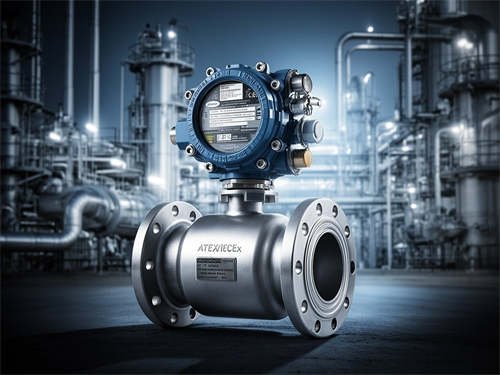
كيفية اختيار عداد تدفق الغاز المناسب لتطبيقك

هذا الدليل موجه للأشخاص الذين يقومون بتصميم أنظمة قياس الغاز أو تحديد مواصفاتها أو توزيعها أو صيانتها. ويهدف إلى التخلص من التخمين عند اختيار جهاز القياس في البيئات الصناعية وبيئات المرافق العامة المعقدة.
1. لماذا يُعد اختيار عداد تدفق الغاز المناسب أمرًا مهمًا في التطبيقات الصناعية
نادرًا ما يتعطل عداد تدفق الغاز في اليوم الأول. فالعطل يظهر بعد عدة أشهر. ويبدأ محرك التوليد المشترك للكهرباء والحرارة (CHP) في محطة الغاز الحيوي في التعرض لتقلبات في السرعة لأن العداد لا يستطيع رصد التدفقات المنخفضة ليلاً. يُظهر فحص الهواء المضغوط وجود هواء “مفقود” من طراز 12% لا يستطيع أحد العثور عليه. ويشير مفتش المرافق إلى وجود عداد فوترة لم يُعتمد أبدًا للاستخدام المالي.
تبدأ كل هذه المشكلات تقريبًا في مرحلة تحديد المواصفات. لم يقم أحد بتصنيع جهاز القياس بشكل سيئ؛ بل تم اختياره ببساطة لمهمة غير مناسبة.
يؤدي سوء الاختيار إلى خسارة مالية من ثلاث نواحٍ:
- عدم كفاءة النظام. يوجد مقياس كبير الحجم في الحد الأدنى من نطاقه، حيث تنخفض الدقة بشكل كبير. فالمقياس الذي يُظهر انخفاضًا كبيرًا في الضغط يجعل الضاغط أو المنفاخ يعمل بجهد أكبر كل ساعة على مدار سنوات.
- مخاطر الامتثال. لا يجوز استخدام عداد لا يحمل الموافقة المالية الصحيحة (سواءً كانت وفقًا لمعايير NMI أو MID أو OIML أو AGA) في إعداد الفواتير. كما لا يجوز قانونًا إدخال عداد لا يحمل شهادة ATEX أو IECEx إلى منطقة من الفئة 1.
- ارتفاع تكلفة دورة الحياة. غالبًا ما تصل تكلفة عمليات إعادة المعايرة، واستبدال المحامل، والتوقفات غير المخطط لها، والطاقة المهدرة إلى ضعف أو ثلاثة أضعاف سعر الشراء.
تواجه كل مجموعة من عملائنا تحديات مختلفة. يحتاج مصنعو المنصات الجاهزة (OEM) إلى عدادات مدمجة يمكن دمجها بسلاسة ولا تتسبب في استدعاءات للضمان. أما مقاولو EPC ومتكاملو الأنظمة، فيحتاجون إلى عدادات تعمل من المحاولة الأولى وتتواصل مع نظام التحكم. أما مشغلو المرافق البلدية، فيحتاجون إلى عدادات تعمل لسنوات في المحطات غير المأهولة.
الرسالة الأساسية لهذا الدليل بسيطة: دع التطبيق هو الذي يحدد الاختيار، وليس السعر. غالبًا ما يكون العداد الأرخص في ورقة عرض الأسعار هو الأغلى في الميزانية العمومية.
2. فهم التطبيق الخاص بك: أساس اختيار مقياس التدفق
يجب أن تفهم هذه العملية قبل أن تتمكن من مقارنة تقنيات العدادات. وهناك خمسة متغيرات تلعب الدور الأكبر في ذلك.
المتغيرات الخمسة التي تحدد اختيار طراز 80%
| متغير | ما الذي يجب أن تسأله | لماذا هذا مهم؟ |
|---|---|---|
| نوع الغاز | الغاز الطبيعي، الغاز الحيوي، الهواء المضغوط، N₂، O₂، H₂، CO₂، غاز الشعلة؟ | بعض أجهزة القياس (الحرارية، والموجات فوق الصوتية) حساسة لتركيبة الغاز. أما الأجهزة الأخرى (كوريوليس، والتوربينية) فهي أقل حساسية بكثير. |
| ضغط التشغيل | الحد الأدنى، العادي، الحد الأقصى (بار غ) | تتغير كثافة الغاز مع تغير الضغط. ويُشكل الغاز ذو الضغط المنخفض تحديًا لمقاييس الدوامة ومقاييس كوريوليس. |
| درجة الحرارة | نطاق العملية ودرجة الحرارة المحيطة | وهذا يؤثر على متطلبات التعويض، ومواد الختم، ومواصفات الأجهزة الإلكترونية. |
| نطاق التدفق | الحد الأدنى، القيمة العادية، الحد الأقصى (Nm³/h أو kg/h) | يحدد هذا معدل خفض الطاقة الذي تحتاجه. وهو المتغير الذي غالبًا ما يُساء تقديره. |
| حجم الأنبوب | DN، الجدول الزمني، المواد، المسار المستقيم المتاح | يحدد هذا الخيار بين عدادات المياه المدمجة في الأنابيب وعدادات المياه المُركبة بشكل منفصل، ويحدد تكلفة التركيب. |
التعريف: Nm³/h (متر مكعب قياسي في الساعة). وهذا هو حجم الغاز بعد تعديله وفقًا لظروف مرجعية، وعادةً ما تكون عند 0 درجة مئوية و1.01325 بار. ويتيح لك ذلك مقارنة تدفقات الغاز بشكل عادل حتى عند تغير ضغط الخط. ويحتوي المتر المكعب الواحد من الهواء عند ضغط 7 بار g على كمية من الغاز تزيد بنحو ثمانية أضعاف عن تلك الموجودة في المتر المكعب الواحد عند الضغط الجوي.
التحديات التي تواجه شركات تصنيع المنصات المتحركة وشركات التكامل
تُعد عمليات التحديث والتوسيع السبب الرئيسي لأخطاء الاختيار. وفيما يلي ثلاثة أنماط نلاحظها مرارًا وتكرارًا:
- التدفق التصميمي مقابل التدفق الفعلي. قد يتم تصميم وحدة معالجة لتدفق يبلغ 1,000 نيوتن متر مكعب/ساعة، لكنها تعمل بمعدل يتراوح بين 250 و400 نيوتن متر مكعب/ساعة خلال معظم فترة عمرها التشغيلي. أما العداد المصمم لتدفق التصميم، فيقضي عمره التشغيلي في الجزء السفلي من نطاقه، حيث يكون التدفق ضعيفًا.
- مواصفات النسخ واللصق. يُعاد استخدام عداد كان يعمل على منصة غاز طبيعي بضغط 6 بار في منصة غاز حيوي بضغط 30 مليبار. وقد تصبح ظاهرة انفصال الدوامات غير مستقرة عند هذه الكثافة المنخفضة للغاز.
- مساحة تركيب صغيرة. غالبًا ما لا تترك منصات التثبيت المصنعة من قبل الشركات المصنعة للمعدات الأصلية (OEM) سوى 3–5 أضعاف قطر الأنبوب (D) من الأنبوب المستقيم. وتحتاج العديد من أجهزة القياس إلى 15–20 ضعف قطر الأنبوب (D) لتحقيق دقتها المقدرة.
استقرار العمليات والبيئة
اسأل عن مدى استقرار العملية. فقد يؤدي التدفق النبضي في اتجاه مجرى التيار بعد الضواغط الترددية أو المنافيخ ذات الفصوص الدوارة إلى ارتفاع قراءات عدادات التوربين بنسبة تصل إلى عدة في المائة.
ثم انظر إلى البيئة المحيطة. هل الموقع مصنف كمنطقة خطرة؟ هل جهاز القياس موجود في الهواء الطلق عند درجة حرارة −30 درجة مئوية أم تحت أشعة الشمس المباشرة في الصحراء؟ هل سيتعرض للمكثفات أو الغبار أو الاهتزازات؟ هذه الأسئلة تساعد في تصفية الخيارات قبل حتى أن يُطرح موضوع الدقة.
نظرة ثاقبة على القطاع: يتحول خلط الهيدروجين في شبكات الغاز الطبيعي من مرحلة المشاريع التجريبية إلى مرحلة التطبيق الفعلي في أجزاء من أوروبا والمملكة المتحدة وأستراليا. وينبغي على المشغلين الذين يحددون اليوم عدادات مخصصة لفترة خدمة تتراوح بين 15 و20 عامًا أن يستفسروا مباشرةً من الموردين عن أداء هذه العدادات مع خليط الهيدروجين. وقد تحتاج العدادات الحرارية والموجات فوق الصوتية إلى معايرة أو تهيئة خاصة بالغاز عند تغير تركيبة الخليط.
3. معايير الاختيار الحاسمة: الدقة، والتكرار، وانخفاض الضغط، ونسبة التدرج
الدقة مقابل قابلية التكرار
الدقة هو مدى قرب القراءة من التدفق الفعلي. التكرار وهي مدى دقة العداد في إعطاء نفس القراءة في ظل الظروف نفسها، مرارًا وتكرارًا.
إليك مثالاً بسيطاً. تخيل لاعب سهام يضرب دائماً نفس النقطة، على بعد بوصتين إلى اليسار من مركز الهدف. هذا اللاعب يتمتع بدرجة عالية من التكرار، لكنه يفتقر إلى الدقة. والمعايرة هي التي تنقل مجموعة الإصابات إلى مركز الهدف.
كلاهما مهم، ولكن في سياقات مختلفة:
- نقل الحيازة (الفوترة بين المشتري والبائع) تتطلب كلا الأمرين، مدعومين بشهادة معايرة قابلة للتتبع. إن حدوث خطأ قدره 1% في خط أنابيب ينقل $2 مليون من الغاز سنويًّا يعني وصول $20,000 إلى الطرف الخطأ.
- التحكم في العمليات (نسبة الموقد، المزج، حلقات PID) تولي أهمية قصوى للتكرار. يمكن لوحدة التحكم أن تعمل بشكل جيد مع انحراف ثابت صغير. لكنها لا تستطيع العمل مع قراءة متقلبة.
انتبه إلى التفاصيل الدقيقة: “تعد ”±1% من القراءة“ و”±1% من النطاق الكامل» مواصفات مختلفة تمامًا. فعند تدفق يبلغ 10% من النطاق الكامل، قد يختلف مقياس ذو نطاق كلي يبلغ ±1% بمقدار ±10% عن القراءة الفعلية.
انخفاض الضغط وتصميم وحدة متحركة موفرة للطاقة
فقدان الضغط الدائم هو الضغط الذي لا يستعيده الغاز أبدًا بعد مروره عبر العداد. ويجب أن يعوضه الضاغط أو المنفاخ.
لنأخذ خط غاز طبيعي بقطر DN150 يعمل بضغط 4 بار غازي ويضخ 5,000 نيوتن متر مكعب/ساعة. تتطلب الخسارة الدائمة البالغة 150 مليبار عبر صفيحة الفتحة حوالي 6 كيلوواط من طاقة الضغط الإضافية. على مدار 8,000 ساعة تشغيل بمعدل $0.075/كيلوواط ساعة، فإن ذلك يعادل حوالي $3,600 سنويًا، كل عام. ولا تضيف عدادات الموجات فوق الصوتية ذات القطر الكامل وعدادات الحرارة المُدرجة أي خسارة دائمة تقريبًا.
نسبة خفض الطاقة للأحمال المتغيرة
نسبة التخفيض هو نسبة التدفق الأقصى الدقيق إلى التدفق الأدنى الدقيق. فالعداد ذو نسبة 100:1 والمصمم لمعدل تدفق يبلغ 1,000 نيوتن متر مكعب في الساعة يحافظ على دقته حتى معدل تدفق يبلغ 10 نيوتن متر مكعب في الساعة. أما العداد ذو نسبة 4:1 فيفقد دقته عند انخفاض معدل التدفق عن 250 نيوتن متر مكعب في الساعة.
يُعد نطاق التعديل العالي عاملاً بالغ الأهمية لمحطات الغاز الحيوي (حيث يتقلب إنتاج خزان التخمير تبعًا للمواد الخام والموسم)، والتحكم في الشعلات (القدرة المنخفضة مقابل القدرة العالية)، وشبكات الهواء المضغوط (أحمال التسرب خلال الليل وعطلات نهاية الأسبوع مقابل الإنتاج الكامل).
قيم إرشادية للنماذج الصناعية القياسية. ويعتمد نطاق التعديل الفعلي على الحجم والضغط وكثافة الغاز والشركة المصنعة.
إرشادات لفرق الصيانة والإصلاح والعمليات (MRO)
ينبغي على فرق الصيانة والإصلاح (MRO) طرح ثلاثة أسئلة قبل إصدار أمر الشراء:
- هل تحتوي على أجزاء متحركة؟ فالمحامل والدوارات تتعرض للتآكل. أما التصميمات التي لا تحتوي على أجزاء متحركة (الحرارية، الدوامية، فوق الصوتية، كوريوليس، ذات الفتحة) فعادةً ما تستغرق فترات أطول بين زيارات الصيانة.
- هل يمكن التحقق من ذلك دون الحاجة إلى إزالة الجهاز؟ تساعد أنظمة التشخيص المدمجة أو فحوصات نقطة الصفر على تجنب إيقاف التشغيل والذهاب إلى مختبر المعايرة.
- كيف يبدو الانحراف؟ اطلب من المورد بيانات ميدانية عن تغير المعايرة بعد مرور 12 و24 شهراً، لا تكتفِ فقط بدقة القياس في اليوم الأول.
4. تحليل مقارن لـ 10 تقنيات لعدادات تدفق الغاز
4.1 الضغط التفاضلي (لوحة الفتحة)

و لوحة الفتحة وهي عبارة عن صفيحة رقيقة بها فتحة دقيقة، مثبتة بين شفتين. يتسارع الغاز عبر الفتحة ويؤدي إلى حدوث فرق في الضغط (DP). يقوم جهاز قياس فرق الضغط بقراءة هذا الفرق، ثم يقوم جهاز حساب التدفق بتحويله إلى معدل التدفق.
- المزايا: مقبولة عالميًا وموحدة (ISO 5167، تقرير AGA رقم 3). لا حاجة إلى جهاز معايرة لأن التدفق يُحسب بناءً على الشكل الهندسي. تكلفة منخفضة للأجهزة.
- العيوب: نسبة تخفيض منخفضة (حوالي 3–4:1 لكل جهاز إرسال). فقدان ضغط دائم مرتفع. تتطلب مسارات مستقيمة طويلة. تنخفض الدقة عند تآكل حافة الصفيحة أو اتساخها.
- الاستخدام المثالي: الغاز الطبيعي ذو القطر الكبير الذي يُنص على معاييره في العقود، والغاز عالي الحرارة أو عالي الضغط.
- مطابقة مع مواصفات الشركة المصنعة للمعدات الأصلية (OEM): متوسطة. فهي تحتاج إلى لوحة، وجهاز إرسال، وخطوط نبضية، وغالبًا ما تحتاج إلى جهاز حساب التدفق، مما يعني وجود المزيد من الأجزاء التي يجب دمجها.
- الصيانة: افحص اللوحة سنويًّا للتأكد من عدم وجود تآكل في الحواف، وتحقق من عدم وجود انسداد أو تسرب في خطوط النبضات، وتأكد من ضبط جهاز الإرسال على الصفر.
4.2 مقاييس التدفق الكتلي الحراري
A مقياس التدفق الكتلي الحراري يقيس كمية الحرارة التي ينقلها الغاز المتحرك بعيدًا عن جهاز استشعار مُسخَّن. فكلما زاد عدد جزيئات الغاز المارة، زادت كمية التبريد. وبالتالي، فإن جهاز القياس يقرأ التدفق الكتلي مباشرةً، دون الحاجة إلى تعويض منفصل للضغط أو درجة الحرارة.
- المزايا: نطاق ضبط واسع (عادةً ما يكون 100:1). انخفاض ضغط منخفض جدًّا. حساسية ممتازة عند التدفق المنخفض. تتناسب الطرز المُدرجة مع الأنابيب الكبيرة بتكلفة منخفضة.
- العيوب: تم معايرته لمزيج غازي محدد، لذا فإن أي تغييرات في التركيب تؤدي إلى تغير القراءة. وتسبب قطرات السائل على المستشعر ارتفاعات زائفة في القراءة.
- الاستخدام المثالي: عمليات تدقيق الهواء المضغوط، والغاز الحيوي، وغاز غرفة التخمير، وغاز الشعلة، وهواء احتراق الموقد. لدينا مقياس التدفق الكتلي الحراري للغاز غالبًا ما يتم تحديده لهذه التطبيقات.
- مطابقة مع مواصفات الشركة المصنعة للمعدات الأصلية (OEM): ممتاز. إنه جهاز صغير الحجم، ويؤدي جميع المهام، ويوفر مخرجات بتيار 4–20 مللي أمبير، ونبضات، ومودبوس.
- الصيانة: Clean the sensor periodically in dirty gas. Re-check gas calibration if the process gas changes.
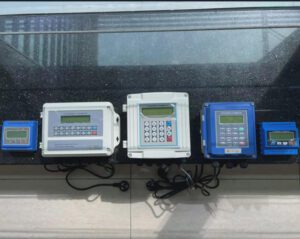
4.3 Ultrasonic Flow Meters (Transit-Time)

Transit-time meters send sound pulses across the pipe, with the flow and against it. A pulse traveling with the flow arrives slightly sooner. The time difference gives the gas velocity.
- المزايا: No moving parts and essentially zero pressure loss in full-bore designs. Wide turndown. Rich diagnostics such as speed of sound, gain, and path-by-path velocity. Multipath meters are the benchmark for large custody transfer.
- العيوب: High upfront cost for multipath inline meters. Sensitive to pulsation noise from pressure-reducing valves. Low-pressure gas weakens the acoustic signal.
- الاستخدام المثالي: Transmission and distribution custody transfer, large-bore process gas, and bidirectional storage lines. The AGA Report No. 9 overview from ASGMT explains the performance requirements for fiscal use.
- مطابقة مع مواصفات الشركة المصنعة للمعدات الأصلية (OEM): Good for larger skids. It has digital outputs and needs a little more commissioning expertise.
- الصيانة: Low. Trend the diagnostics and verify speed of sound against a gas composition calculation.
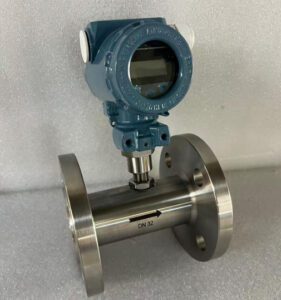
4.4 Vortex Shedding Flow Meters

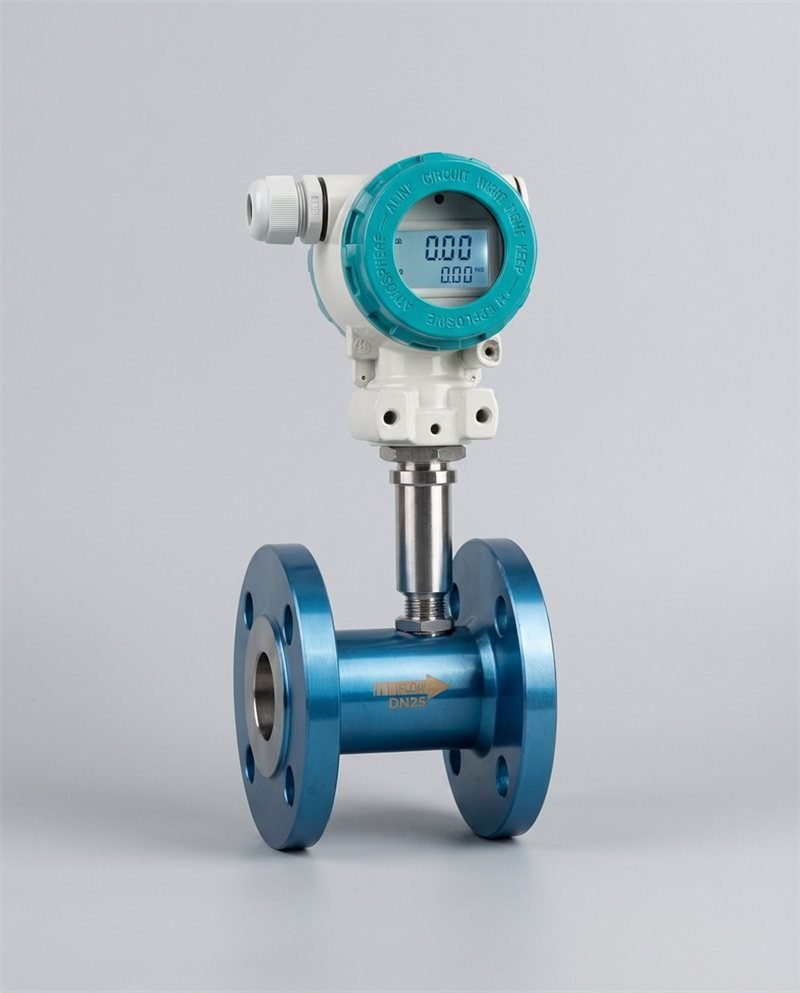
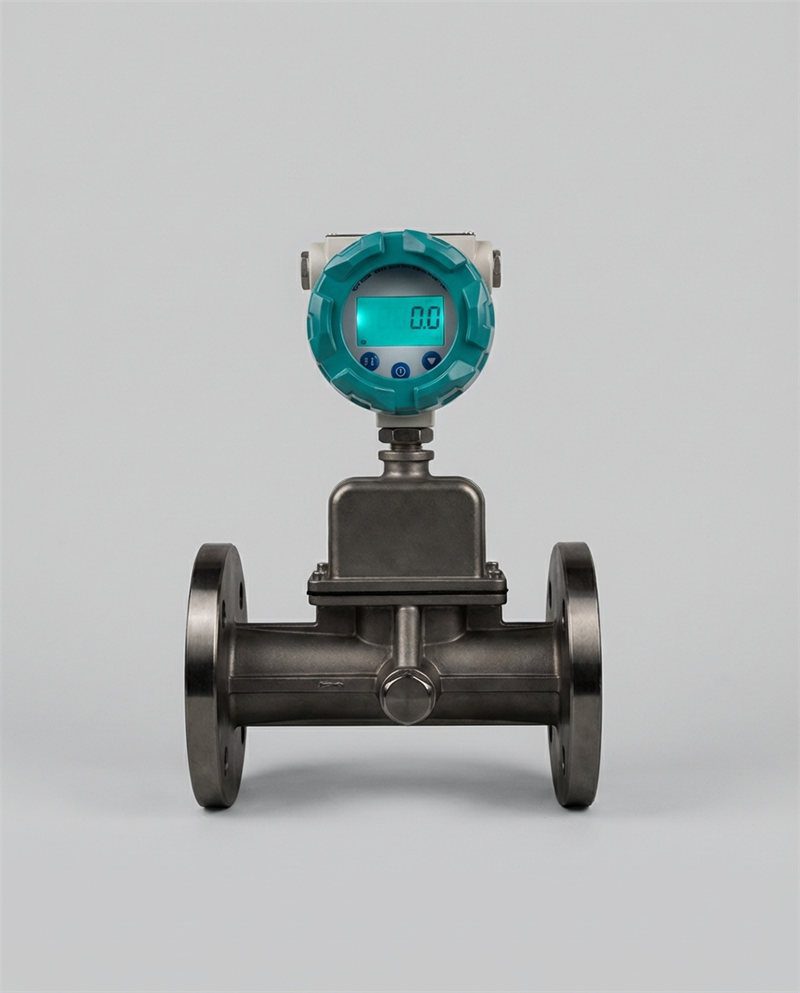
A bluff body in the pipe sheds swirling eddies, first on one side and then the other. This is the Kármán vortex street effect. The shedding frequency rises in step with velocity.
- المزايا: No moving parts, handles steam and gas, and is robust at high temperatures. Built-in temperature and pressure compensation makes it a practical one-box solution.
- العيوب: Needs a minimum velocity, so it goes blind at very low flow. Sensitive to pipe vibration. Needs 15–30D of upstream straight run.
- الاستخدام المثالي: Plant utilities, steam, compressed air mains, and nitrogen headers. See our vortex flow meter with integrated T/P compensation.
- مطابقة مع مواصفات الشركة المصنعة للمعدات الأصلية (OEM): Good. It comes in standard flanged or wafer sizes.
- الصيانة: Low. Check the sensor for fouling and review vibration if readings get noisy at low flow.
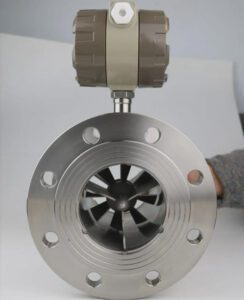
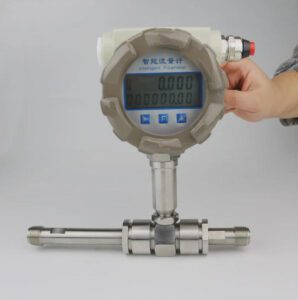
4.5 Turbine Flow Meters
A bladed rotor spins in the gas stream at a speed proportional to velocity.
- المزايا: High accuracy on clean, steady gas. Proven for fiscal use under AGA Report No. 7. Fast response and a moderate price.
- العيوب: Bearings wear. Over-reads in pulsating flow. Damaged by debris and liquid slugs. Needs upstream filtration.
- الاستخدام المثالي: Clean natural gas distribution and industrial metering. Our gas and steam turbine flow meter line covers these duties.
- مطابقة مع مواصفات الشركة المصنعة للمعدات الأصلية (OEM): Good. It gives a standard pulse output.
- الصيانة: Moderate. Lubricate bearings (on some models), check the rotor, and recalibrate every 1–3 years.
4.6 Coriolis Mass Flow Meters

Gas flows through vibrating tubes. The mass flow creates a tiny twist in the tubes, and sensors measure it. Coriolis is the only common technology that measures mass directly, whatever the gas composition.
- المزايا: Very high accuracy (±0.35–0.5% for gas on many models). Unaffected by composition changes. No straight run needed.
- العيوب: Expensive. Heavy in larger sizes. Practical size limits (usually DN150 and below for gas). Noticeable pressure drop at low line pressure.
- الاستخدام المثالي: CNG and hydrogen dispensers, specialty gas blending, and high-value gas where composition varies.
- مطابقة مع مواصفات الشركة المصنعة للمعدات الأصلية (OEM): Excellent for compact dispensing skids.
- الصيانة: Low. Verify zero in the field and use the tube health diagnostics.
4.7 Diaphragm Meters (Low-Flow Utility Use)

Flexible diaphragms fill and empty measuring chambers of known volume. Every cycle counts a fixed amount of gas.
- المزايا: Very wide turndown (a G4 meter covers roughly 0.04–6 m³/h, or 150:1). Needs no power. Very low cost per point. Accepted for billing almost everywhere.
- العيوب: Low pressure only (usually below 0.5 bar). Bulky for the flow they handle. Not suitable for process control.
- الاستخدام المثالي: Residential, small commercial, and light industrial billing.
- مطابقة مع مواصفات الشركة المصنعة للمعدات الأصلية (OEM): Limited. Pulse or smart-module add-ons are available.
- الصيانة: Nearly none. Utilities replace or sample-test by population.
4.8 Rotary Meters
Two figure-eight lobes rotate and trap fixed volumes of gas. This is positive displacement at higher pressures and flows than diaphragm meters.
- المزايا: High accuracy and wide turndown. No straight-run requirement. Compact for commercial and industrial billing.
- العيوب: Can stall and block flow if debris jams the lobes. Needs filtration and correct lubrication. Slight noise and pulsation.
- الاستخدام المثالي: Commercial and industrial gas billing from about 16 to 1,000 m³/h.
- مطابقة مع مواصفات الشركة المصنعة للمعدات الأصلية (OEM): Moderate. It’s heavy but has a small footprint.
- الصيانة: Change the oil, check differential pressure across the meter (a rising DP warns of wear), and keep the filter clean.
4.9 Variable Area (Rotameter)

A float rises in a tapered tube until the gas flow balances its weight. You read the flow from a scale.
- المزايا: Very cheap. Needs no power. Instant visual indication. Metal-tube versions add a 4–20 mA output.
- العيوب: Low accuracy (±2–5% of full scale). Must be mounted vertically. Calibrated for one gas at one pressure.
- الاستخدام المثالي: Purge gas, analyzer sample lines, and local indication on OEM machines.
- مطابقة مع مواصفات الشركة المصنعة للمعدات الأصلية (OEM): Excellent for simple indication.
- الصيانة: Clean the tube and float, and check for sticking.
4.10 Pitot Tube Meters
A pitot tube, or its multi-port averaging version, senses the difference between impact pressure and static pressure across the pipe.
- المزايا: Low permanent pressure loss. Hot-tap insertion without shutdown. Cheap in very large ducts.
- العيوب: Low turndown. Weak signal at low velocity. Ports plug in dirty gas.
- الاستخدام المثالي: Large air ducts, combustion air, and stack flow.
- مطابقة مع مواصفات الشركة المصنعة للمعدات الأصلية (OEM): Good for large ductwork.
- الصيانة: Purge ports on dirty service and check transmitter zero.
Side-by-side summary
| التكنولوجيا | Typical Accuracy (Gas) | تجهيز السرير | فقدان الضغط | Moving Parts | Relative Cost | Best Fit |
|---|---|---|---|---|---|---|
| Orifice plate | ±0.6–2% of rate | 3–4:1 | عالية | لا يوجد | Low (element) | Standardized large-bore NG |
| الكتلة الحرارية | ±1–1.5% of reading | 100:1 | Very low | لا يوجد | منخفض – متوسط | Compressed air, biogas, flare |
| الموجات فوق الصوتية (متعددة المسارات) | ±0.1–0.5% (calibrated) | 50–100:1 | لا شيء | لا يوجد | عالية | Custody transfer, large pipes |
| الدوامة | ±1% of reading | 20–30:1 | متوسط | لا يوجد | متوسط | Utilities, steam, air mains |
| التوربينات | ±0.5–1% | 10–30:1 | متوسط | نعم | متوسط | Clean NG distribution |
| كوريوليس | ±0.35–0.5% | 20–100:1 | Medium–High | لا يوجد | Very high | CNG, H₂, specialty gas |
| الحجاب الحاجز | Class 1.5 | 150:1 | منخفضة | نعم | Very low | Residential billing |
| Rotary | ±0.5–1% | 30–160:1 | منخفضة | نعم | متوسط | Commercial billing |
| Rotameter | ±2–5% FS | 10:1 | منخفضة | Float | Very low | Purge, local indication |
| Pitot/averaging pitot | ±1–2% | 3–10:1 | Very low | لا يوجد | منخفضة | Large ducts |
Figures are indicative. Always confirm against the datasheet for the model and size you’re considering.
5. Technology Match: Aligning Meter Types with Industry-Specific Needs
OEM equipment and skid-mount manufacturers
OEMs care about three things: space, integration, and a low warranty-return rate. A compact all-in-one meter with built-in compensation removes a flow computer from the bill of materials. Calibration flexibility also matters. One mechanical design that can be factory-configured for air, N₂, or natural gas simplifies your inventory.
Common match: Thermal mass meters for burner and air skids, vortex meters for utility skids, and Coriolis meters for dispensing.
A burner OEM we work with standardized on one insertion thermal model across three skid sizes. They cut their meter part numbers from nine to three and removed separate P/T transmitters from every skid.
EPC contractors and system integrators
For EPC and integration teams, the hidden cost is commissioning hours. Look for these:
- A native بروتوكول HART over 4–20 mA for asset management systems
- Modbus RTU/TCP register maps delivered with the documentation, based on the open Modbus specification
- DD/DTM files ready before site acceptance testing
- Clear straight-run and orientation drawings for the piping designers
Common match: Vortex meters for plant utilities, ultrasonic meters for large headers, and orifice plates where the client standard demands them.
Municipal utilities
Unmanned stations need meters that survive without supervision. Look for weather-rated enclosures, battery or low-power options, and legal-metrology approval. Examples include NMI (Australia), MID (Europe), or pattern approval based on OIML recommendations such as R 137.
Common match: Diaphragm and rotary meters for billing, ultrasonic meters for district metering, and thermal meters for digester gas at wastewater plants.
Industrial terminals and MRO companies
For terminals and MRO teams, uptime is everything. Ask for spare part lead times, published MTBF figures, and diagnostics that separate “the meter is failing” from “the process changed.”
Definition: MTBF (Mean Time Between Failures). This is the average operating time between failures. An MTBF of 100,000 hours means that, across a large population of meters, failures average about once every 11 years per device.
Common match: No-moving-parts technologies that report their own health.
Instrument importers and distributors
Distributors sell trust along with hardware. Your supplier needs to back you up with multi-region certificates (ATEX, IECEx, and local approvals), English and local-language manuals, application support, and training. The gas flow meter selection guide written for distributors from Jade Ant Instruments covers the needs-assessment questions to ask before quoting.
6. Installation, Calibration, and Environmental Considerations
The most common installation mistakes
- Too little straight run. A meter installed 3D after a double elbow reads a swirled, distorted profile. Errors of 2–5% are common with vortex, turbine, and single-path ultrasonic meters.
- Wrong orientation. Rotameters must be vertical. Some vortex meters need the transmitter head positioned so condensate doesn’t collect at the sensor in wet gas.
- Temperature and pressure compensation gaps. A volumetric meter reading actual m³/h without P/T correction can be 20–30% off the standard-volume figure the accounting team expects.
- Poor grounding and cable routing. VFD noise can put phantom pulses on turbine and vortex signals.
Typical straight-run requirements
| التكنولوجيا | Upstream | Downstream | ملاحظات |
|---|---|---|---|
| Orifice plate | 20–40D | 5–8D | Flow conditioner can reduce this |
| الدوامة | 15–30D | 5D | 30D after two elbows in different planes |
| التوربينات | 10–20D | 5D | Add filtration upstream |
| Thermal (insertion) | 15–20D | 5D | Profile-sensitive at a single point |
| الموجات فوق الصوتية (متعددة المسارات) | 10–20D | 3–5D | Fewer paths need more straight run |
| كوريوليس | 0D | 0D | Mount stress-free |
| Rotary / diaphragm | 0D | 0D | Filter upstream |
D = pipe inside diameter. For a DN100 line, 20D is about 2 meters.
Best practices for low noise and long-term accuracy
- Use shielded twisted-pair cable, ground it at one end only, and keep it separate from VFD power cables.
- Install pulsation dampers or move the meter away from reciprocating compressors.
- Put the meter downstream of pressure-reducing valves only if there’s enough distance. Valve noise can swamp ultrasonic signals.
- Record an “as-found” baseline of diagnostics at commissioning so later drift is easy to spot.
Hazardous area certifications
In oil and gas plants, chemical sites, and biogas facilities, the electrical certification matters as much as the accuracy.
- ATEX: The EU framework for equipment in explosive atmospheres. The ATEX directive defines equipment categories that line up with zones.
- IECEx: The international scheme, accepted in many countries outside the EU. You can check certificates on the IECEx certification portal.
- FM / CSA / UL: Required for North American Class/Division areas.
Definition: Zone 1. This is an area where an explosive gas atmosphere is likely during normal operation. Zone 1 meters typically carry an Ex d (flameproof) or Ex ia/ib (intrinsically safe) rating, such as Ex d IIC T6 Gb.
For more detail on acoustic meters in dangerous services, see our article on ultrasonic meters for hazardous fluid monitoring.
7. Lifecycle Cost Analysis: Beyond the Initial Purchase Price
The Total Cost of Ownership (TCO) model
TCO = Purchase + Installation + Calibration + Maintenance + Energy Loss + Downtime + End-of-Life Replacement
For most industrial gas meters, the purchase price is only 25–40% of the 10-year cost.
This is an indicative split for a mid-size mechanical meter in general industrial service. Your mix will vary with duty and location.
Case example: ultrasonic vs. orifice in a natural gas distribution skid
Scenario: A DN150 natural gas distribution skid runs at 4 bar g, carries an average flow of 5,000 Nm³/h, and operates 8,000 hours a year.
| Cost Item (5 Years) | Orifice Plate System | Inline 2-Path Ultrasonic |
|---|---|---|
| Purchase + installation (plate, meter tube, DP transmitter, flow computer vs. meter + electronics) | $9,500 | $22,000 |
| Maintenance (plate inspection, impulse lines, transmitter checks) | $9,000 | $2,000 |
| Energy loss (150 mbar permanent loss, ~48,000 kWh/yr at $0.075) | $18,000 | ~$0 |
| Downtime (2 plate change-outs with bypass operation) | $4,000 | $0 |
| Field verification (diagnostic review) | $0 | $1,500 |
| 5-year total | $40,500 | $25,500 |
The ultrasonic meter costs $12,500 more upfront but saves about $15,000 over five years. That leaves out a bigger lever: measurement uncertainty. This line moves about 40 million Nm³ a year. If better turndown and diagnostics cut the unaccounted-for gas by just 0.2%, that’s another 80,000 Nm³ a year recovered.
ROI justification for continuous processes
A higher-cost meter usually pays back when three conditions are true:
- The process runs more than 6,000 hours a year.
- The gas is valuable, or the meter feeds billing or emissions reporting.
- A shutdown to service the meter is expensive or hard to schedule.
Simple payback = extra upfront cost ÷ annual savings. In the example above, $12,500 ÷ about $3,000 a year gives a payback of roughly 4 years, based on operating savings alone. Many of our EPC clients use a 3-year payback as the approval threshold for continuous-duty plants.
8. Smart Features and Digital Integration for Industry 4.0 Readiness
Digital diagnostics and predictive maintenance
Modern meters can report on their own condition. Examples include signal gain on ultrasonic paths, sensor resistance drift on thermal probes, and shedding signal quality on vortex meters.
Definition: Predictive maintenance. This means servicing equipment based on its measured condition rather than a fixed calendar. Instead of pulling a meter every 12 months “just in case,” you pull it when a diagnostic trend says it’s needed.
A water utility customer that monitors digester gas at three treatment plants moved from annual meter removals to trend-based checks. That cut site visits per meter from four a year to one, and they caught a wet-sensor problem weeks before it would have affected CHP fuel reporting.
IIoT compatibility
Definition: IIoT (Industrial Internet of Things). These are field devices that share data over networks with cloud or edge platforms for analytics.
For system integrators and utility SCADA teams, check for these features:
- Modbus TCP or Ethernet-based protocols on the device, or via a gateway
- Data logging with timestamps, so records survive communication outages
- Wireless options (4G, NB-IoT, LoRaWAN) for remote stations with no cabling budget
- Cybersecurity basics: password-protected configuration and write protection
Future-proofing
Specify meters that allow field firmware updates, multiple output options on one device (4–20 mA plus pulse plus Modbus), and gas-table updates for future blends such as hydrogen in natural gas. A meter that can’t be reconfigured tends to become a stranded asset when the process changes.
نظرة ثاقبة على القطاع: Emissions reporting rules for methane and CO₂ keep tightening in many regions. Flare gas and vent gas meters that once served as rough indicators increasingly need defensible accuracy, audit trails, and traceable calibration. That shift favors meters with self-diagnostics and logged data.
9. 10-Point Evaluation Checklist for Buyers
Use this checklist before any request for quotation (RFQ) goes out. It works for OEMs, EPCs, distributors, MRO teams, and utilities alike.
- Define gas type and composition. Include moisture, H₂S, particulates, and how much the composition varies.
- Confirm operating pressure and temperature range. Give minimum, normal, and maximum values, not just the design values.
- Determine minimum and maximum flow rates. Use logged data where possible, and include night and startup flows.
- Set required accuracy and repeatability. Say whether the meter is for billing, reporting, or control.
- Check pipe size and installation constraints. Note the available straight run, orientation, and access for removal.
- List output signal and communication needs. For example: 4–20 mA, pulse, HART, Modbus RTU/TCP, or wireless.
- List required approvals. For example: ATEX, IECEx, SIL, NMI, MID, OIML, or AGA-based requirements.
- Plan maintenance access and the recalibration interval. Decide on in-situ verification vs. lab calibration.
- Confirm power availability. Loop-powered, 24 VDC, AC, or battery for remote sites.
- Compare lifecycle cost with budget constraints. Put the 5- or 10-year TCO beside the purchase price.
| Checklist Item | Your Value | Notes / Source |
|---|---|---|
| Gas type & composition | ||
| Pressure range (bar g) | ||
| Temperature range (°C) | ||
| Flow range (Nm³/h or kg/h) | ||
| Accuracy / repeatability | ||
| Pipe size & straight run | ||
| Output & protocol | ||
| Approvals | ||
| Maintenance & calibration | ||
| الطاقة | ||
| Budget / TCO target |
Tip: Copy this table into Excel and send it with your RFQ. A complete sheet usually cuts quote turnaround in half and avoids “assumed” values that cause mismatches later.
If you want a second opinion on a completed sheet, the application engineers at Jade Ant Instruments can review it and point out risks before you commit. Send your application data to our engineering team.
Watch: A practical flow meter selection walkthrough
https://www.youtube.com/watch?v=zQOlIZE49O0
This video walks through liquid, gas, steam, and mass flow selection logic. It’s a good primer to share with purchasing or project teams before a technical review.
Glossary of Key Terms
| Term | Plain-English Meaning | Quick Example |
|---|---|---|
| نقل الحيازة | Measurement that decides a payment between two parties | Gas utility billing a factory |
| نسبة التخفيض | Max accurate flow ÷ min accurate flow | 100:1 means 1,000 down to 10 Nm³/h |
| التكرار | Same reading under the same conditions | ±0.2% repeatability for a burner loop |
| فقدان الضغط الدائم | Pressure the gas never recovers after the meter | 150 mbar across an orifice |
| Straight run | Clear straight pipe before and after the meter | 20D = 2 m on DN100 |
| Nm³/h | Gas volume at reference conditions | Lets you compare 2 bar and 8 bar flows |
| Compensation | Correcting volume for pressure and temperature | Vortex with built-in P/T sensors |
| Insertion meter | Probe inserted through a fitting into a large pipe | Thermal probe in a DN600 air duct |
| Ex d / Ex ia | Flameproof / intrinsically safe protection types | Zone 1 meter labeled Ex d IIC T6 |
| AGA 3 / 7 / 10 | Orifice / turbine / speed-of-sound standards | AGA 10 checks ultrasonic diagnostics |
10. FAQs: Expert Answers to Real-World Buyer Concerns
1. What is the most accurate gas flow meter for custody transfer applications?
For large pipelines, flow-calibrated multipath ultrasonic meters are the current benchmark, with uncertainty around ±0.1–0.3% after calibration. For smaller, high-value flows with changing composition, Coriolis meters give about ±0.35–0.5% mass accuracy. Turbine and rotary meters are still widely approved for mid-size billing. The “right” answer also depends on which standard your contract or regulator names. Our overview of custody transfer compliance and ROI for natural gas goes deeper.
2. Can thermal mass flow meters measure wet or dirty gases?
With limits. Dust and dry particulates are manageable with periodic sensor cleaning. Liquid droplets are the real problem, because water hitting the heated sensor causes sudden cooling and false high readings. For saturated biogas, use a condensate trap and moisture knockout upstream, plus a sensor designed for wet gas service. Our article on thermal meters in biogas and renewable energy digesters covers practical setups.
3. How does gas composition affect flow measurement accuracy?
It depends on the principle. Thermal meters depend on the gas’s heat properties, so a methane swing from 55% to 65% in biogas can shift the reading by several percent unless the meter is compensated. Ultrasonic meters rely on the speed of sound. Orifice and vortex meters need correct density. Coriolis meters measure mass directly and are least affected. Always give suppliers a realistic composition range, not a single value.
4. What are the advantages of ultrasonic over turbine meters in high-flow applications?
Ultrasonic meters have no moving parts to wear, no pressure loss, wider turndown, and diagnostics that show whether the meter is healthy without removing it. In large pipes (DN200 and above), they also avoid the damage a turbine rotor can suffer from debris or overspeed. Turbines still win on upfront cost in mid sizes and on tolerance to some valve noise.
5. When should I choose Coriolis over thermal for mass flow measurement?
Choose Coriolis when the gas composition varies, when you need the highest accuracy, or when the gas is at high pressure, as with CNG and hydrogen dispensing. Choose thermal when the pipe is large, the pressure is low, the pressure drop must be minimal, or the budget matters. Thermal is also far more practical above DN100. For a deeper look at thermal control options, see thermal mass flow controllers compared with conventional meters.
6. How do I compensate for pressure and temperature variations in my readings?
Either use a meter with built-in P/T compensation (common on vortex and turbine meters) or add pressure and temperature transmitters feeding a flow computer. Mass-based meters like thermal and Coriolis don’t need this step for mass output. For natural gas fiscal work, the flow computer also applies a compressibility calculation such as AGA 8.
7. Are there flow meters that don’t require straight pipe runs?
Yes. Coriolis, rotary, and diaphragm meters need essentially no straight run. Multipath ultrasonic meters and flow conditioners can greatly shorten the requirement for other types. This is often the deciding factor on tight OEM skids.
8. What maintenance is required for vortex shedding meters in industrial settings?
Very little. Inspect the bluff body and sensor for fouling or erosion every 1–3 years, check the process connection gaskets, and review signal quality if low-flow readings get unstable, which usually points to vibration. Our complete vortex meter guide for steam and gas includes a troubleshooting section.
9. Can I integrate a flow meter with my existing PLC/SCADA system?
Almost always. The 4–20 mA and pulse outputs work with any PLC. HART adds diagnostics over the same wires. Modbus RTU/TCP lets you read totals, alarms, and diagnostics directly. Ask the supplier for the register map before purchase so your integrator can prepare the tags ahead of time.
10. How do I verify the calibration of a gas flow meter in the field?
The options include comparing against a reference meter installed in series, using the meter’s built-in verification (zero checks, sensor resistance, speed of sound compared with calculated values), or sending the meter to an accredited lab. For fiscal meters, follow the interval set by your regulator or contract. For process meters, trend the diagnostics and verify when drift appears.
11. What is the typical lifespan of a diaphragm gas meter in municipal applications?
Diaphragm meters typically serve 15–25 years. Many utilities replace or sample-test them by population based on local legal-metrology rules. Service life shortens when the gas is dirty or wet.
12. Are there explosion-proof flow meters suitable for Zone 1 environments?
Yes. Look for ATEX or IECEx marking with equipment protection level Gb or better, such as Ex d IIC T6 Gb or Ex ia IIC T4 Ga. Make sure the gas group (IIA, IIB, IIC) and temperature class match your area classification. Hydrogen needs IIC.
13. How does turndown ratio impact performance in variable-load processes?
If your flow drops below the meter’s minimum, readings become inaccurate or drop to zero. In a burner or digester, that means poor fuel-to-air ratio control and missing gas totals. Size the meter so normal operation sits at 30–70% of its range, and check that the lowest real flow stays above the meter’s minimum.
14. What are the key differences between AGA 3, AGA 7, and AGA 10 standards?
AGA Report No. 3 covers orifice meters: plate design, meter tubes, and flow calculation. AGA Report No. 7 covers turbine meters for natural gas. AGA Report No. 10 isn’t a meter standard at all. It calculates the speed of sound in natural gas from its composition, and it’s widely used to cross-check ultrasonic meter diagnostics. AGA 9 is the ultrasonic meter standard.
15. Can a single flow meter handle both high and low flow rates in biogas recovery systems?
Often yes, if you choose a high-turndown technology. Thermal mass meters with 100:1 or wider turndown are the common choice for digester and landfill gas. When the range is extreme, for example during startup and flaring, some plants install two meters in parallel with automatic switchover. For more selection logic, read our breakdown of 2026 thermal air meter types.
Final Takeaway
Choosing the right gas meter doesn’t mean finding the “best” technology. It means matching a measurement principle to a real process: its gas, its pressure, its flow swings, its installation limits, and its compliance rules. Start with the checklist, run the TCO numbers, and involve your supplier’s engineers early.
For more technical articles, browse the Jade Ant Instruments flow measurement blog. Or start at the Jade Ant Instruments flow meter manufacturer homepage to see the full gas and steam measurement range.