Most guides about flow meter manufacturers read like a product catalog: here is Brand A, here is Brand B, here is a table. That approach looks comprehensive on paper, but it rarely helps a project engineer sitting in front of a technical bid evaluation (TBE) spreadsheet at 9 PM, trying to justify why one supplier deserves the contract over another.
This article takes a different path. Instead of listing brands and hoping you connect the dots, it gives you a weighted scoring framework — the same kind of structured evaluation matrix that procurement teams in oil and gas, water utilities, and chemical plants use to turn subjective “brand preference” into defensible, auditable decisions. You will walk away with a reusable scoring template, real-world failure scenarios that illustrate why each criterion matters, and enough manufacturer-specific data to populate your first draft immediately.
Along the way, we reference practical resources from Jade Ant Instruments — a manufacturer whose portfolio spans electromagnetic, vortex, turbine, and ultrasonic flow meters — as well as external references from industry standards bodies and major vendors, so the framework is grounded in both theory and trade reality.
Why “Best Brand” Is the Wrong Starting Question
A 2017 analysis in Pumps & Systems found that the most common mistakes in flow meter selection are not about picking the wrong brand — they are about overlooking fluid properties, ignoring installation constraints, and failing to account for historic failure modes in the same service. A Yokogawa white paper similarly identifies five recurring selection errors, most of which are application-level mistakes, not vendor-level ones (Yokogawa PDF).
The implication is clear: the right question is not “Which manufacturer is best?” but rather “Which manufacturer scores highest against my specific project requirements?” That framing naturally leads to a weighted evaluation matrix — and that is exactly what we will build in this guide.
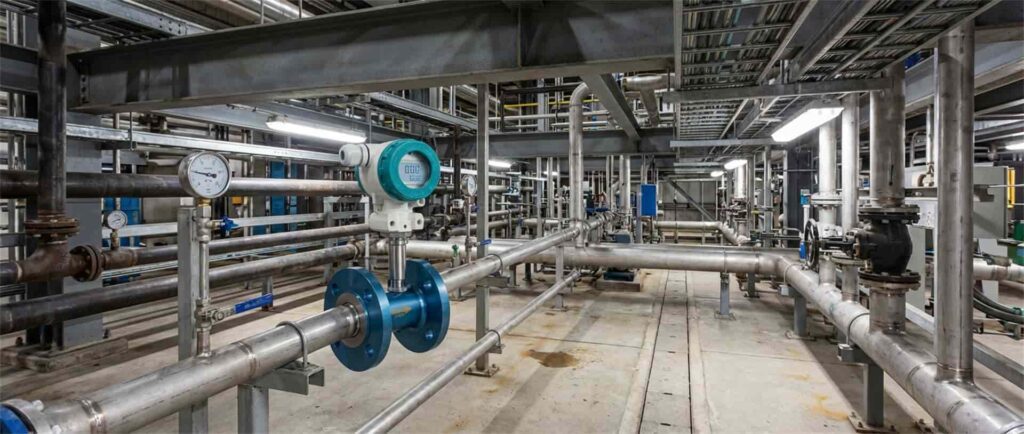
Industrial piping environment where flow meters are evaluated and deployed. Source: Pexels / jiawei cui (free to use).
Video: How to Select a Flow Meter (Decision Framework)
Before building the scoring matrix, this short video from the National Engineering Laboratory offers a concise overview of the decision logic behind flow meter selection:
Video: Selection of Flow Meters by Dr. Norman Glen, National Engineering Laboratory. Watch on YouTube
The 6-Pillar Scoring Framework
The framework below organizes manufacturer evaluation into six pillars. Each pillar carries a suggested weight, but you should adjust these based on your project’s priorities — a custody-transfer metering skid in a refinery will weight accuracy and verification far more heavily than a utility monitoring point in a commercial HVAC loop.
Manufacturer Evaluation Scorecard
| Pillar | What It Measures | Suggested Weight | Scoring Criteria (1–5) | Why It Matters |
|---|---|---|---|---|
| 1. Technology Fit | Does the vendor offer the right measurement principle for your fluid? | 25% | 5 = purpose-built product family; 1 = principle available but no dedicated model | Mismatched technology is the #1 root cause of field failures |
| 2. Accuracy & Verification | Stated accuracy, repeatability, turndown — plus in-situ verification capability | 20% | 5 = ±0.1% with built-in verification; 1 = ±2% with no verification tooling | Accuracy erodes over time; verification proves it hasn’t |
| 3. Integration & Connectivity | Protocol support (HART, Modbus, Ethernet), NAMUR NE107, DCS/PLC compatibility | 15% | 5 = multi-protocol with NE107 + OPC UA; 1 = 4–20 mA only | Poor integration multiplies commissioning time and limits diagnostics |
| 4. Total Cost of Ownership | Purchase + installation + calibration + energy (pressure drop) + downtime risk over 5 years | 20% | 5 = lowest 5-year TCO with evidence; 1 = cheapest CAPEX but high hidden costs | The cheapest meter often becomes the most expensive project |
| 5. Service & Supply Chain | Local calibration labs, spare parts, lead time, warranty, training | 10% | 5 = local depot + 24/7 support + 3-year warranty; 1 = import-only, no local service | A meter you can’t calibrate locally is one you’ll eventually abandon |
| 6. Industry Track Record | Proven installations in your industry, certifications (ATEX, SIL, 3-A, EHEDG), references | 10% | 5 = documented reference sites in your vertical; 1 = general-purpose only | Industry experience predicts real-world performance better than lab specs |
Table: The 6-pillar manufacturer evaluation scorecard. Adjust weights to match your project priorities.
For a complementary checklist that maps fluid properties to technology routes before you begin scoring vendors, the Flow Meter Selection Guide by Jade Ant Instruments is a practical first step.
Pillar 1: Technology Fit — Start with the Fluid, Not the Brand
Over 90% of vortex flowmeter failures can be traced to improper installation or application mismatch, according to a 2025 analysis by AST Meters. For electromagnetic meters, Soaring Instrument found that 50% of measurement errors originate from improper grounding alone — not from the sensor or transmitter itself.
Fluid-to-Technology Mapping Table
| Your Fluid Scenario | Best-Fit Technology | Accuracy Envelope | Manufacturers with Deepest Portfolio |
|---|---|---|---|
| Clean conductive liquid (water, acids, slurries) | Electromagnetic | ±0.2% to ±0.5% | Endress+Hauser, Emerson, ABB, KROHNE, Siemens, Jade Ant |
| High-value liquid or gas requiring mass flow | Coriolis | ±0.05% to ±0.1% | Emerson (Micro Motion), Endress+Hauser, Yokogawa, KROHNE |
| Non-conductive liquid or retrofit (no pipe cutting) | Ultrasonic (clamp-on) | ±0.5% to ±2.0% | Siemens, KROHNE, Badger Meter, Jade Ant |
| Steam, gas, or clean liquid with wide flow range | Vortex | ±0.75% to ±1.5% | Yokogawa, Siemens, Emerson, Endress+Hauser |
| Gas or steam in legacy plant with DP infrastructure | Differential Pressure | ±1.0% to ±2.0% | Emerson, Honeywell, Yokogawa, ABB |
| Clean hydrocarbon or fuel metering | Turbine | ±0.15% to ±0.5% | Badger Meter, Jade Ant, various |
Table: Map your fluid scenario to the best-fit technology, then find the manufacturers with the deepest product portfolios.
Pillar 2: Accuracy & Verification — Day-One Specs vs. Year-Five Reality
Every manufacturer publishes impressive accuracy numbers. The critical question is: how do you prove the meter is still accurate two years after installation, without shutting down the process?
This is where in-situ verification technology separates tier-one vendors from the rest. The major verification ecosystems are:
- Endress+Hauser — Heartbeat Technology
- Emerson — Smart Meter Verification (SMV)
- KROHNE — OPTICHECK Master
- Siemens — SITRANS Verificator
- ABB — Ability SRV500

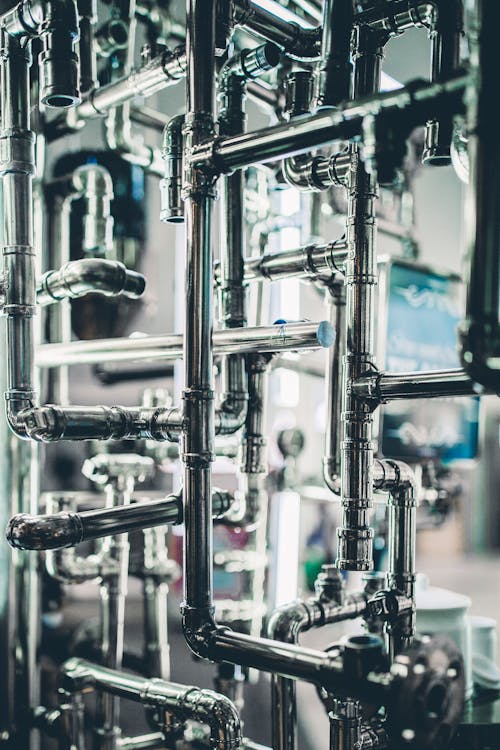
Close-up of industrial factory piping — where flow meter accuracy verification matters most. Source: Pexels (free to use).
Pillar 3: Integration & Connectivity — The Hidden Project Killer
A flow meter that measures perfectly but cannot communicate with your DCS is a flow meter that creates manual data entry, transcription errors, and maintenance blind spots. Protocol selection is not an IT decision — it is an operational architecture decision.
Evaluate whether the manufacturer supports NAMUR NE107 — a standard that classifies device self-diagnostic status into four categories (Failure, Function Check, Out of Specification, Maintenance Required). Endress+Hauser’s NE107 overview is the clearest public explanation available.
Pillar 4: Total Cost of Ownership — The 5-Year Truth
A Control Engineering analysis stated plainly: “Flowmeter selection decisions based on the lowest price often result in the highest installed cost.” Purchase price accounts for only 30–38% of a typical 5-year total cost of ownership.
5-Year Total Cost of Ownership Breakdown (Bar Chart)
Bar Chart: Purchase price is only about one-third of total 5-year lifecycle cost. Sources: Control Engineering, industry project data.
When evaluating manufacturers for cost, request a 5-year TCO estimate that includes all five categories — not just a unit price. Suppliers like Jade Ant Instruments that offer competitive CAPEX alongside responsive engineering support can shift the TCO curve significantly in your favor for standard industrial and water applications.
Pillar 5: Service & Supply Chain — Can You Get Help at 2 AM?
Flow meters are installed in hot pipes, corrosive services, wet vaults, vibrating skids, and hard-to-reach pipe racks. When something goes wrong, the question is not “Who has the best data sheet?” but “Who picks up the phone?” An often-overlooked resource: Jade Ant Instruments’ guide to flow meter distributor selection mistakes highlights common service-related pitfalls.

Aerial view of an industrial facility with pipelines — where service quality and spare parts availability are critical. Source: Pexels (free to use).
Pillar 6: Industry Track Record — Show Me Your References
Ask for documented reference installations in your specific sector. Certifications matter too: ATEX/IECEx for hazardous areas, SIL 2/3 for safety instrumented systems, EHEDG and 3-A for food and beverage, and GMP for pharmaceuticals (Endress+Hauser’s pharmaceutical page is a good example).
Global Flow Meter Market Revenue by Region (Pie Chart)
The global flow meter market is valued at approximately USD $8.93 billion in 2026 (Mordor Intelligence):
Pie Chart: Global flow meter market revenue by region (2026). Asia-Pacific is the fastest-growing segment. Sources: Fortune Business Insights, The Business Research Company.
Manufacturers with strong APAC supply chains — including Chinese manufacturers like Jade Ant Instruments — can offer lead-time and logistics advantages for projects in this region.
Putting It All Together: A Worked Scoring Example
Imagine evaluating three manufacturers for a municipal water utility project: 50 electromagnetic flow meters across DN50–DN600, 4–20 mA + HART required, ±0.5% accuracy, 10-year lifecycle.
| Pillar | Weight | Vendor A (Global Premium) | Vendor B (Regional) | Vendor C (Jade Ant Instruments) |
|---|---|---|---|---|
| Technology Fit | 25% | 5 (dedicated water mag family) | 4 (general-purpose mag) | 4 (ISO-compliant mag meters) |
| Accuracy & Verification | 20% | 5 (±0.2%, built-in verification) | 3 (±0.5%, no in-situ verification) | 4 (±0.5%, standard diagnostics) |
| Integration | 15% | 5 (HART + NE107 + OPC UA) | 3 (HART only) | 4 (HART + Modbus RS485) |
| Total Cost of Ownership | 20% | 3 (high CAPEX, excellent longevity) | 4 (moderate CAPEX) | 5 (competitive CAPEX, good longevity) |
| Service & Supply Chain | 10% | 5 (local depot, 24/7 support) | 3 (limited local inventory) | 4 (responsive factory support) |
| Industry Track Record | 10% | 5 (thousands of water references) | 3 (general industrial only) | 4 (growing water install base, ISO 4064) |
| Weighted Total | 100% | 4.50 | 3.40 | 4.25 |
Table: Worked scoring example. Vendor C (Jade Ant profile) scores competitively on TCO and service, narrowing the gap with premium brands.
Three Real-World Failure Scenarios
Scenario 1: The Grounding Disaster (Water Utility)
A facility installed 30 electromagnetic flow meters but did not follow grounding specifications. Within six months, 18 meters showed erratic readings caused by electromagnetic interference through ungrounded flanges. Pillar 1 should have included an installation-readiness check, and Pillar 5 should have evaluated commissioning supervision. Reference: Zero Instrument grounding guide.
Scenario 2: The Oversized Coriolis (Chemical Plant)
An engineer specified a Coriolis meter sized to match the pipe diameter (DN100) rather than the actual flow rate. The meter operated at 15% of its range, where zero stability dominated the error budget — measurement error exceeded 5%. Pillar 2 would have flagged turndown requirements. Reference: ISA — Selecting and Sizing Flowmeters.
Scenario 3: The Integration Nightmare (Oil Refinery)
A project team selected a high-accuracy vortex meter from a niche manufacturer, only to discover during commissioning that it did not support Foundation Fieldbus — the protocol their DCS required. Replacement cost $40,000 plus three weeks of delay. Pillar 3 would have eliminated this vendor at the shortlist stage.

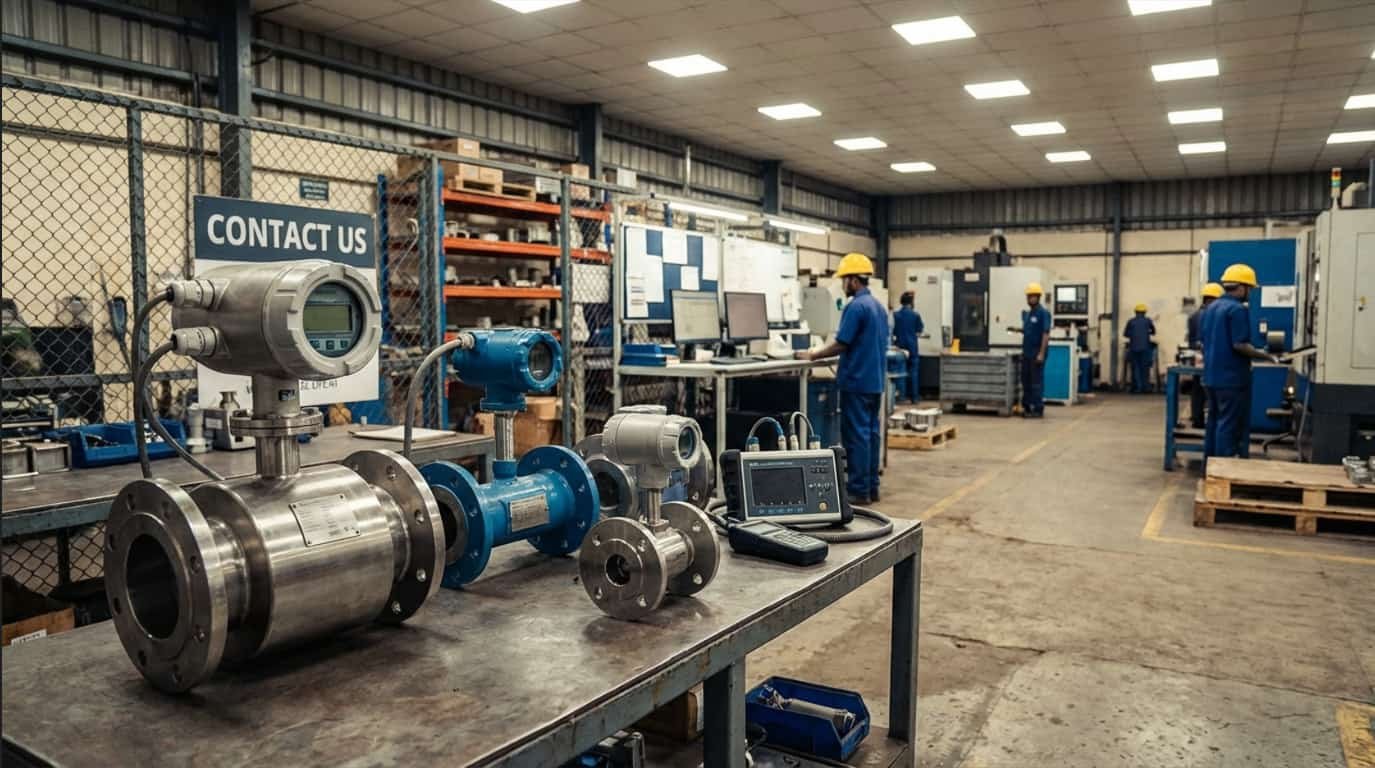
Industrial manufacturing workshop — where flow meters are produced and tested. Source: Pexels (free to use).
Adapting the Framework by Industry
| Industry | Increase Weight On | Decrease Weight On | Key Standard / Certification |
|---|---|---|---|
| Oil & Gas (Custody Transfer) | Accuracy (30%), Track Record (15%) | TCO (15%) | API MPMS, AGA 9, ISO 5167 |
| Water & Wastewater | TCO (25%), Service (15%) | Accuracy (15%) | AWWA C751, ISO 4064 |
| Chemical Processing | Technology Fit (30%), Integration (20%) | Track Record (5%) | IEC 61508 (SIL), ATEX/IECEx |
| Food & Beverage | Track Record (20%), Technology Fit (25%) | TCO (15%) | EHEDG, 3-A, FDA 21 CFR |
| Pharmaceuticals | Accuracy (25%), Track Record (20%) | TCO (10%) | GMP, FDA, EU Annex 15, GAMP 5 |
Table: Recommended weight adjustments by industry. Validate with your project’s risk register.

Oil and gas applications demand the highest accuracy and verification standards. Source: Pexels / Pixabay (free to use).
From Brand Preference to Defensible Decisions
The global flow meter market is projected to reach USD $19.46 billion by the early 2030s (Fortune Business Insights). The challenge is no longer finding a good meter; it is proving that the meter you selected is the right meter for your specific project.
The 6-pillar scoring framework converts subjective brand loyalty into weighted, evidence-based evaluation. Download it, adapt the weights for your industry, populate it with manufacturer data, and you will have a technical bid evaluation that your engineering manager, procurement team, and plant operations team can all defend.
For projects where competitive pricing, flexible configuration, and responsive support are decisive factors, Jade Ant Instruments offers electromagnetic, vortex, turbine, and ultrasonic flow meters backed by ISO-certified manufacturing. Contact their team for a consultation tailored to your requirements.
Frequently Asked Questions (FAQ)
1. What is the most important criterion when evaluating flow meter manufacturers?
Technology fit — matching the measurement principle to your specific fluid properties — is the single most impactful criterion. A Coriolis meter will fail in a partially-filled pipe, and an electromagnetic meter won’t work on non-conductive hydrocarbons. See the Jade Ant Instruments selection guide for structured fluid-to-technology mapping.
2. How should I weight accuracy versus total cost of ownership?
For custody transfer or regulatory reporting, weight accuracy at 25–30%. For utility monitoring or general process control, weight TCO at 20–25% and accept moderate accuracy (±0.5% to ±1.0%). The 6-pillar framework allows flexible weight adjustments per project.
3. What is NAMUR NE107 and why should I require it?
NAMUR NE107 classifies field device diagnostics into four categories: Failure, Function Check, Out of Specification, and Maintenance Required. It gives your maintenance team a uniform health language across all instrument brands, reducing alarm confusion and training burden.
4. Can I use the same evaluation framework for both liquid and gas flow meters?
Yes — the six pillars apply universally. However, technology fit criteria differ: gas applications favor vortex, ultrasonic (multi-path), thermal mass, or DP meters, while liquids lean toward electromagnetic, Coriolis, or ultrasonic.
5. How does Jade Ant Instruments compare with global brands on verification?
Jade Ant Instruments offers standard diagnostics and output monitoring. For advanced in-situ verification (Heartbeat, SMV, OPTICHECK), global brands hold an advantage. For standard applications where periodic lab calibration is the norm, Jade Ant’s competitive CAPEX and responsive support deliver strong TCO performance.
6. What is the typical price range for different flow meter technologies?
Electromagnetic: $500–$15,000. Coriolis: $3,000–$25,000+. Ultrasonic (clamp-on): $800–$20,000. Vortex: $1,000–$8,000. Turbine: $300–$5,000. DP systems: $1,500–$10,000. Always evaluate 5-year TCO rather than purchase price alone.
7. How do I evaluate a manufacturer’s service capability before signing?
Request: nearest calibration lab location and turnaround time, spare parts stocking policy, emergency support SLA, training program availability, and at least three reference contacts in your industry and region. See Jade Ant’s distributor mistakes guide for pitfalls to avoid.
8. Is there an ISO standard for flow meter selection?
No single “selection” standard exists, but relevant ones include ISO 20456:2017 (electromagnetic), ISO 5167 (differential pressure), ISO 4064 (water meters), and ISO 17089 (ultrasonic). Industry standards like AWWA C751, API MPMS, and AGA 9 also govern selection.
9. What are the biggest TBE mistakes for flow meters?
The top five: comparing unit prices without TCO analysis, accepting accuracy specs without checking turndown ratio, ignoring protocol compatibility until commissioning, not requesting industry-specific references, and failing to include installation supervision in the scope.
10. How is the flow meter market expected to grow?
The market is projected to grow from $8.93 billion in 2026 to $11.33 billion by 2031 (Mordor Intelligence), with some estimates reaching $19–20 billion by the early 2030s — driven by IoT integration, water infrastructure, and digital transformation.