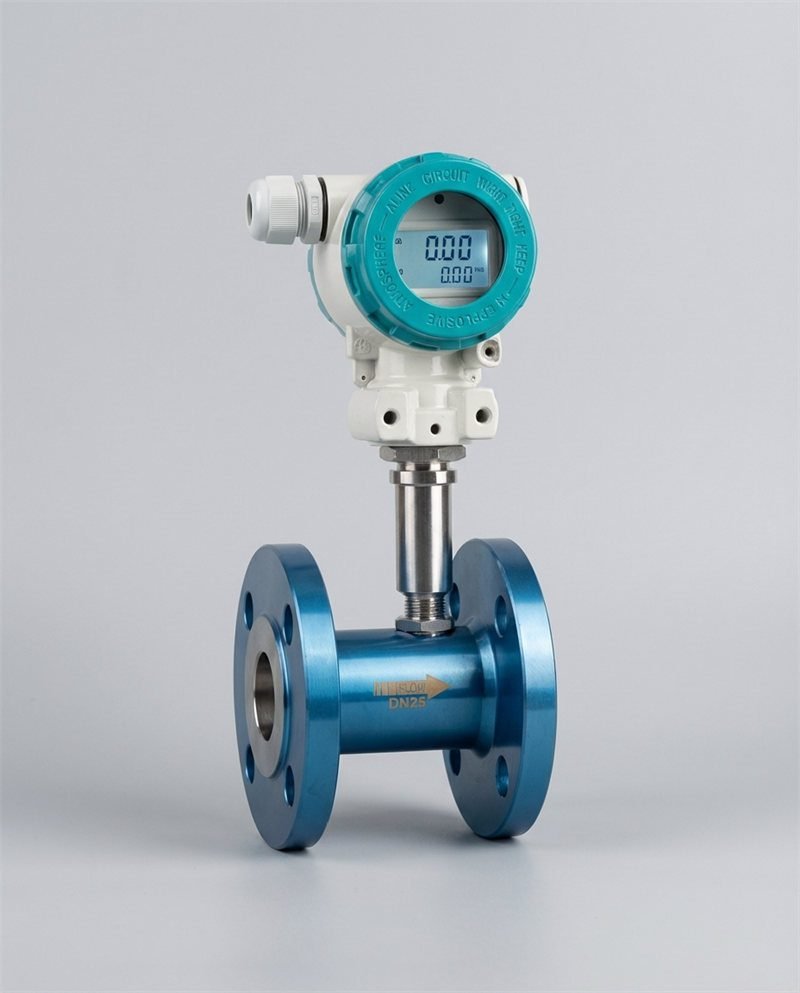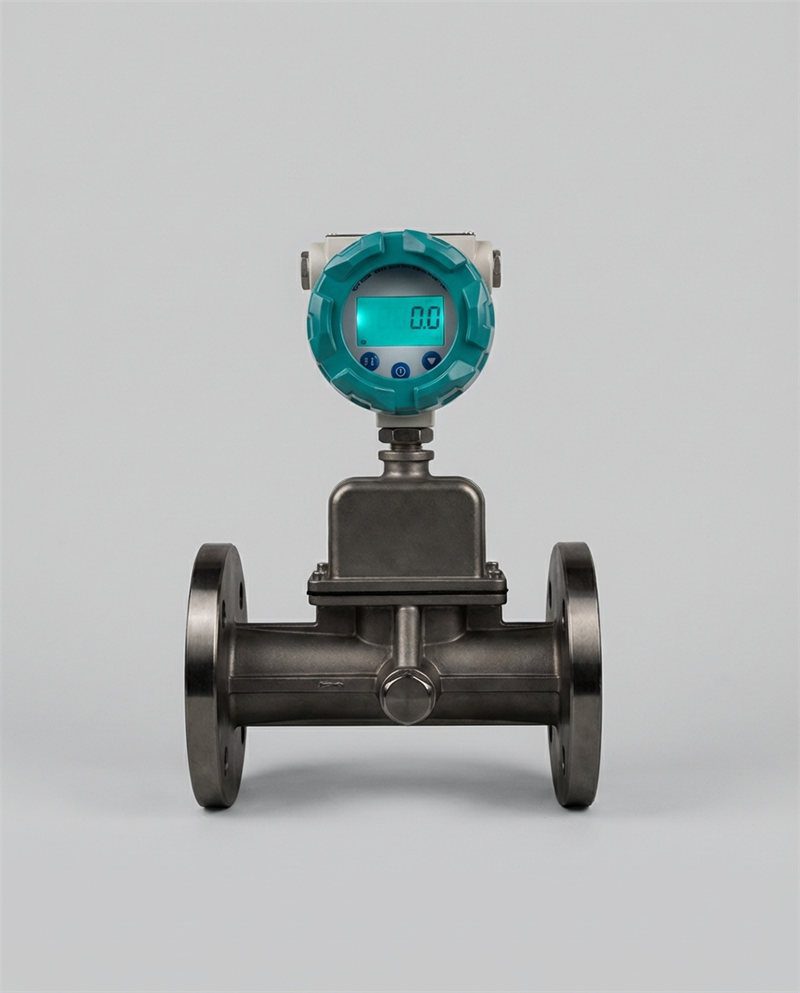
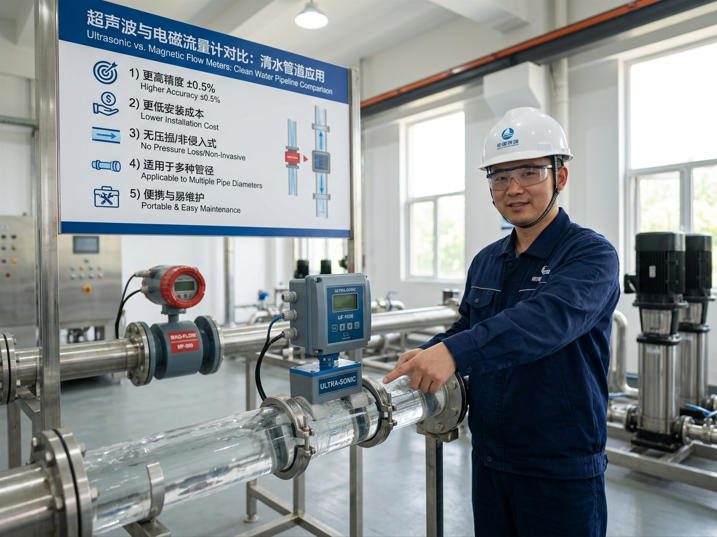
Accurate flow measurement in clean water systems is not a luxury — it is the foundation of operational efficiency, regulatory compliance, and cost control. Whether the application is a municipal water distribution network serving 200,000 residents, a pharmaceutical purified water loop running 24/7, or a commercial HVAC chilled water system conditioning a 50-story office tower, the meter technology chosen for the job directly determines how reliably flow data reaches the control system, how frequently technicians must intervene, and how much budget disappears into maintenance, calibration, and replacement cycles over the next decade.
Two technologies dominate the clean water metering landscape: ultrasonic flow meters (primarily transit-time) and electromagnetic (magnetic) flow meters. Both are static meters — no moving parts in the flow path — and both deliver accuracy sufficient for most water applications. However, they operate on fundamentally different physical principles, and those differences create measurable advantages in specific scenarios.
This article examines five specific advantages that ultrasonic meters hold over magnetic meters in typical clean water pipeline applications. These are not theoretical preferences; they are engineering differences rooted in physics, validated by field data, and quantified in maintenance records, accuracy specifications, and total cost of ownership models. The analysis also addresses where magnetic meters remain the stronger choice — because responsible meter selection requires understanding both sides of the comparison.
Introduction to Clean Water Flow Measurement Needs
Purpose of Metering in Water Networks
Flow metering in clean water networks serves four overlapping purposes: billing and revenue protection (every unmeasured cubic meter is unrecoverable revenue), process control (maintaining treatment chemical dosing ratios, pump speeds, and pressure setpoints), leak detection and non-revenue water reduction (a UK utility reduced non-revenue water by 12% within 18 months of deploying continuous flow monitoring across its distribution network), and regulatory compliance (meeting abstraction license conditions, discharge permit limits, and reporting obligations under frameworks like the EU Water Framework Directive).
The meter technology must be matched to the water quality, pipe material, flow range, installation constraints, and lifecycle cost expectations of the specific application. A meter that performs flawlessly on treated municipal water may fail within months on high-purity deionized water — not because of a manufacturing defect, but because the underlying measurement principle requires a fluid property (electrical conductivity) that the water no longer possesses.
Key Performance Criteria to Compare Meters
The comparison between ultrasonic and magnetic meters for clean water should be evaluated across these criteria: accuracy and repeatability across the operating flow range, sensitivity to fluid properties (conductivity, temperature, pressure), maintenance burden and long-term reliability, installation flexibility (including retrofit capability), total cost of ownership over 10+ years, and compatibility with the specific water type in the pipeline. The five advantages detailed in the following sections address each of these criteria with data.
Basic Principles: Ultrasonic vs Magnetic
How Ultrasonic Meters Work (Transit-Time / Doppler Concepts)
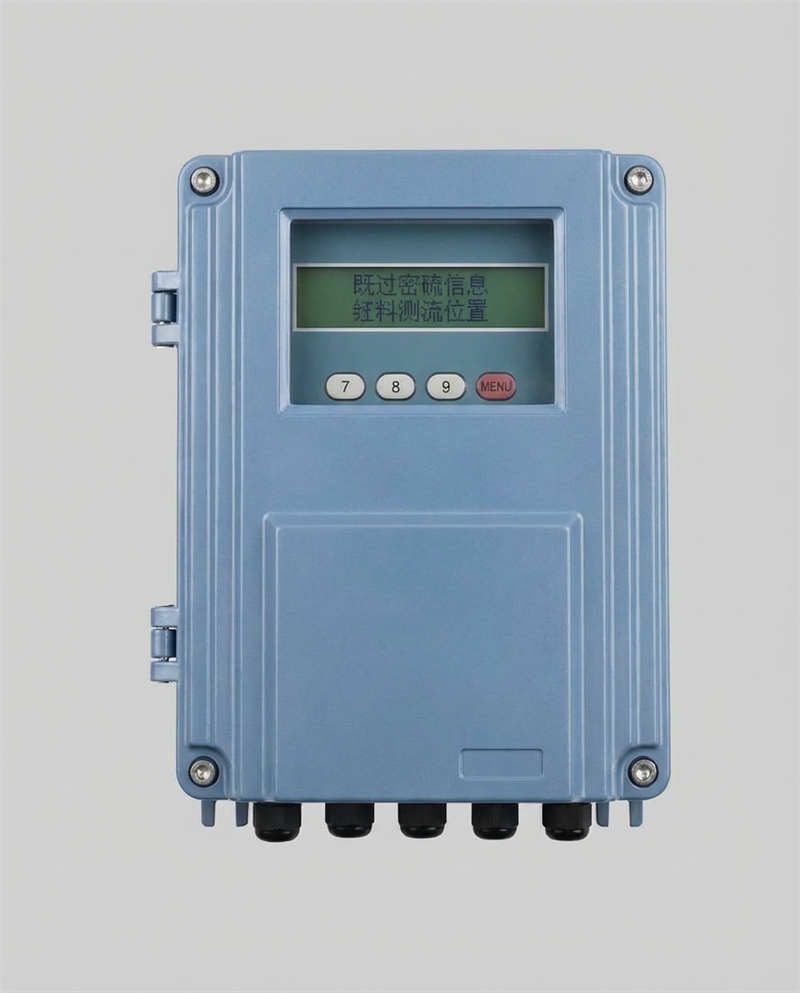
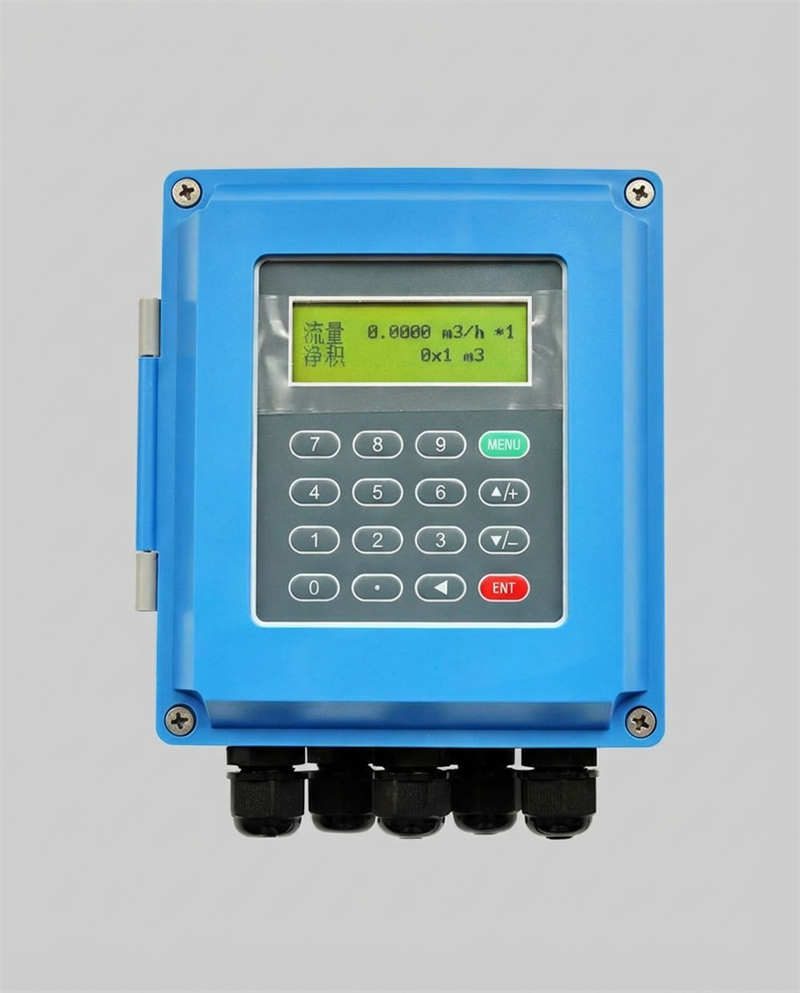
Transit-time ultrasonic flow meters use a pair of transducers positioned diagonally across the pipe. Each transducer alternately transmits and receives ultrasonic pulses. The downstream pulse (traveling with the flow) arrives at the receiving transducer faster than the upstream pulse (traveling against the flow). The meter calculates the time difference (Δt) between these two transit times and converts it into fluid velocity using the pipe geometry and transducer angle. Volumetric flow rate follows from velocity multiplied by the pipe cross-sectional area.
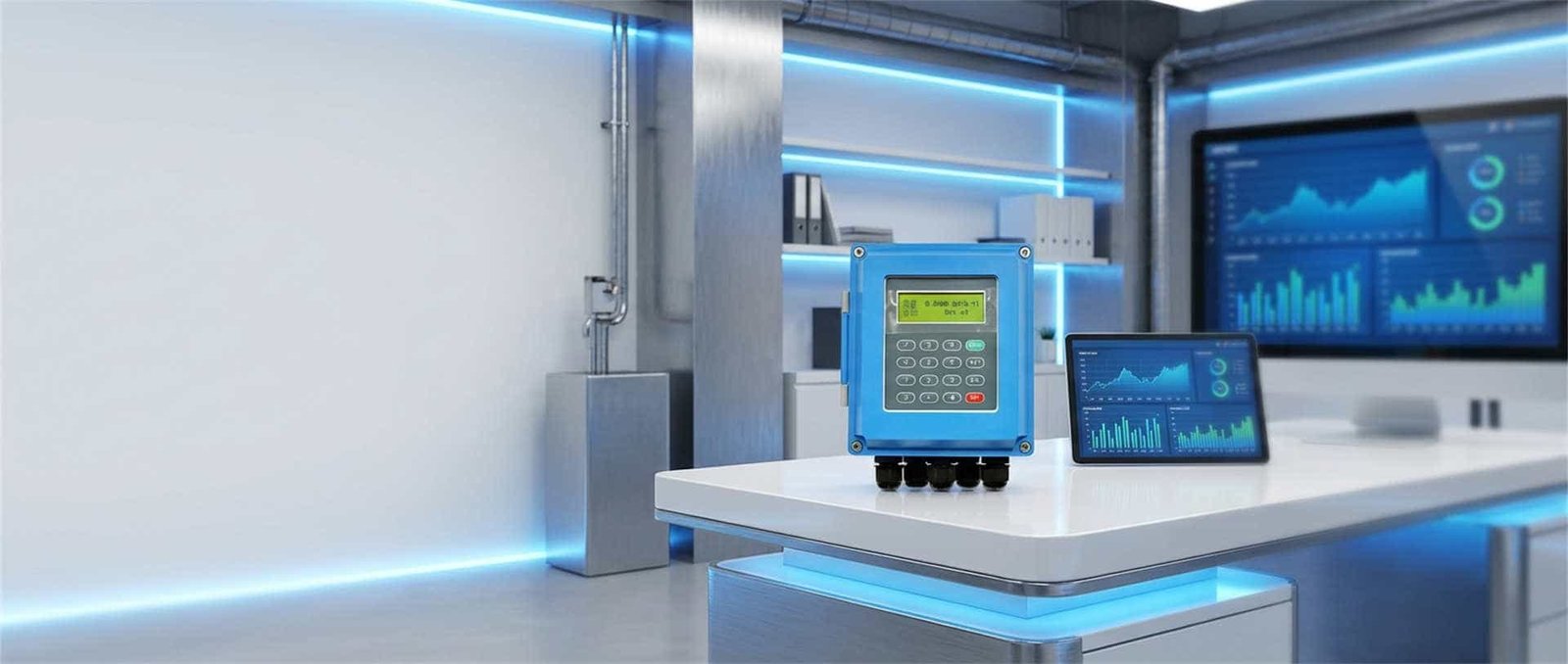
The measurement depends only on the speed of sound through the fluid and the time-of-flight differential — it does not require the fluid to have any particular electrical property. This is the foundational reason why ultrasonic meters work on virtually any clean liquid: treated municipal water, deionized water, purified water (WFI), chilled water with glycol, condensate, and even non-conductive fluids like hydrocarbons. Jade Ant Instruments’ ultrasonic water flow meter selection guide provides detailed specifications for transit-time meters across these fluid types.
Doppler ultrasonic meters — a related but distinct technology — measure the frequency shift of ultrasonic pulses reflected off particles or bubbles in the fluid. They require suspended solids or entrained gas to function, which makes them unsuitable for clean water. This article focuses exclusively on transit-time ultrasonic meters, which are the relevant comparison point against magnetic meters for clean water service.
How Magnetic Meters Work (Electromagnetic Principle)
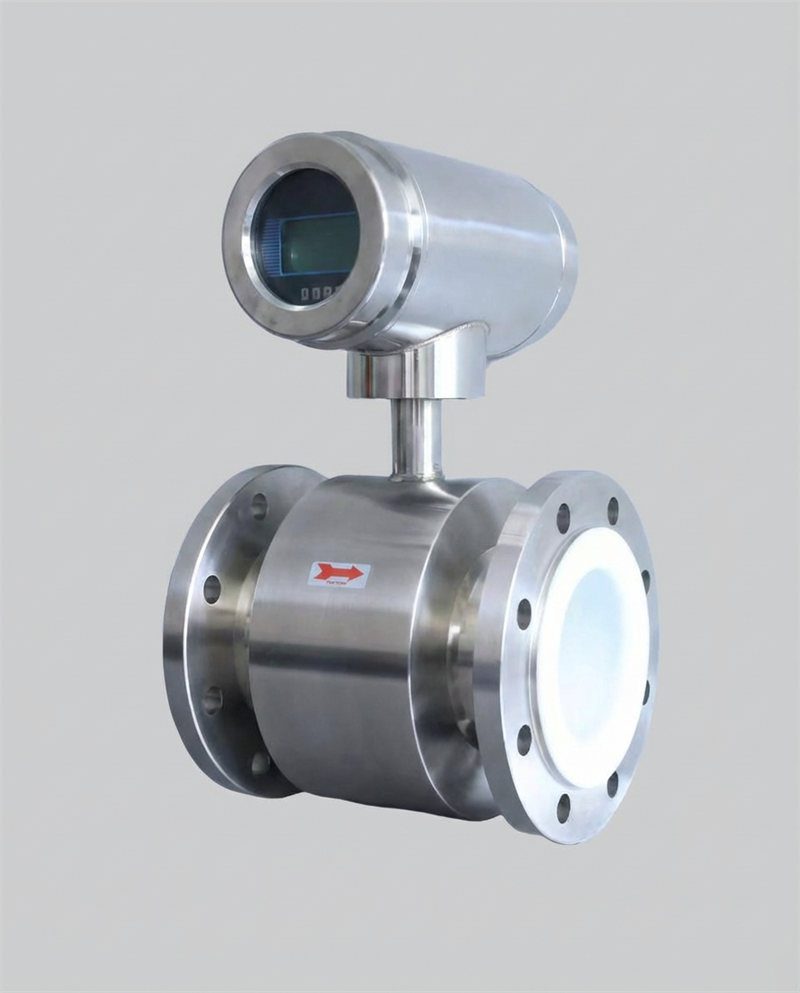
Electromagnetic flow meters apply Faraday’s law of electromagnetic induction: when a conductive fluid flows through a magnetic field, it generates a voltage proportional to the flow velocity. Two electromagnetic coils create the magnetic field across the pipe bore, and two electrodes embedded in the pipe wall detect the induced voltage. The meter converts this voltage into a flow measurement.
The critical requirement is that the fluid must be electrically conductive — typically a minimum of 5 µS/cm for standard commercial magnetic meters (Yokogawa AXF specification). Municipal tap water (300–800 µS/cm) easily exceeds this threshold. However, deionized water (0.05 µS/cm), reverse-osmosis permeate (1–10 µS/cm), and high-purity pharmaceutical water (typically <1.3 µS/cm at 25°C per USP requirements) fall below it — making magnetic meters unusable on these clean water types without specialized low-conductivity sensor variants that compromise accuracy.
Watch: Electromagnetic vs Ultrasonic Flow Meter Comparison
Video credit: Comparison between electromagnetic and ultrasonic flow meters covering working principles, applications, and selection criteria.
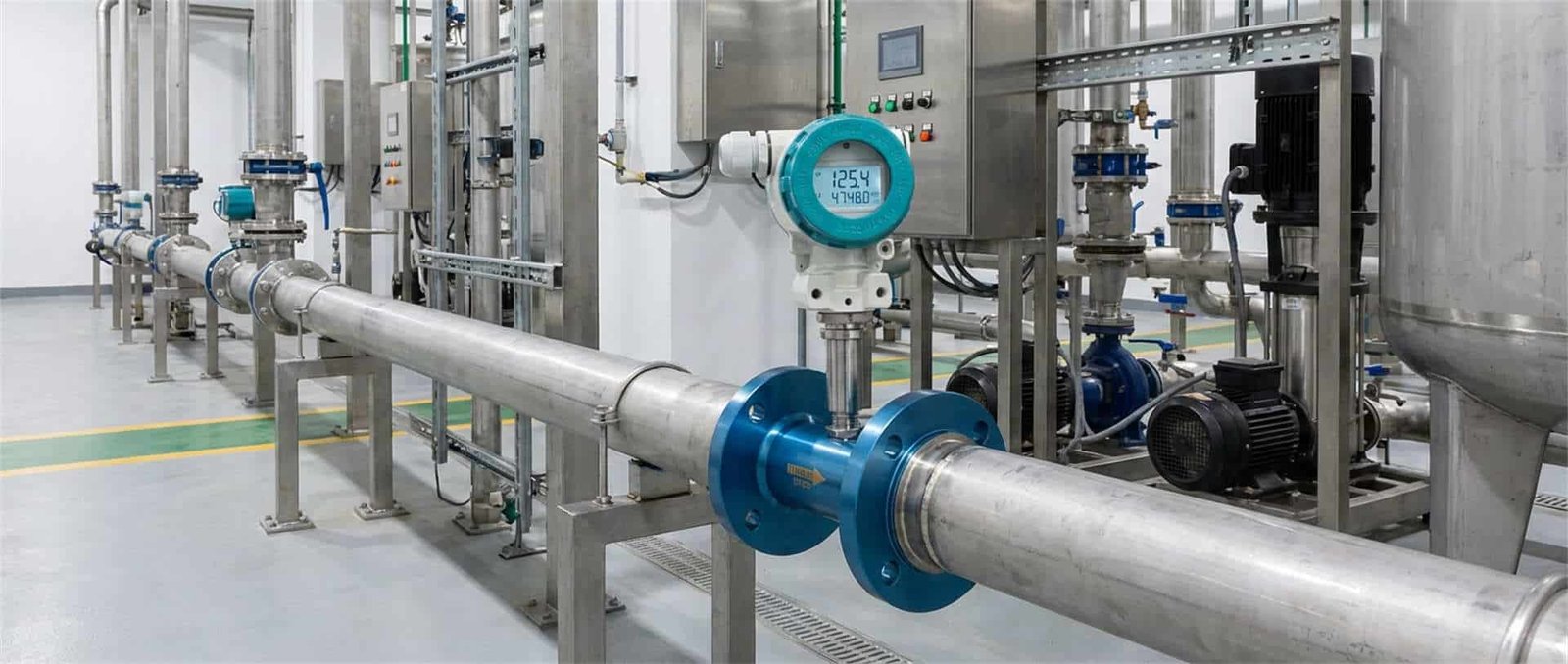
Advantage 1 — No Moving Parts and Reduced Wear
Impact on Maintenance and Reliability
Both ultrasonic and magnetic flow meters are classified as static meters — neither has rotating impellers, gears, or pistons in the flow path. However, the nature of their internal components creates different wear profiles over time.
Magnetic meters require wetted electrodes that maintain direct contact with the process fluid, and an internal liner (PTFE, hard rubber, polyurethane, or ceramic) that protects the pipe body from corrosion. While these components have no moving parts, they are subject to electrochemical degradation, coating buildup, and liner deterioration — particularly in water with elevated chloride content, variable pH, or residual disinfectant chemicals. A 2024 analysis of 1,247 magnetic meter service tickets found that 20% of field failures were caused by electrode coating or fouling, and an additional 15% by issues related to internal liner condition (Soaring Instrument field failure analysis).
Ultrasonic meters — particularly clamp-on configurations — have zero wetted components. The transducers mount on the outside of the pipe, and the ultrasonic signal passes through the pipe wall and fluid without any physical contact. There are no electrodes to coat, no liners to degrade, and no internal surfaces to foul. Even inline ultrasonic meters, where transducers are mounted in contact with the fluid, use inert materials (stainless steel, titanium, or ceramics) that resist the mild chemistry of clean water far more effectively than magnetic meter electrode/liner combinations.
Long-Term Operational Benefits in Clean Water Pipelines
The maintenance difference becomes financially significant over multi-year operating periods. A municipal water authority in the UK compared maintenance records across 180 inline ultrasonic meters and 220 magnetic meters installed in the same distribution network over a 7-year period. The magnetic meters required 2.3 maintenance interventions per meter over the period (primarily electrode cleaning and zero-point verification), while the ultrasonic meters required 0.4 interventions per meter (primarily firmware updates and signal quality checks). At an average intervention cost of £450 (labor, travel, and downtime), the difference amounted to approximately £385 per meter over 7 years — or roughly £67,000 across the 220 magnetic meter fleet.
Advantage 2 — Superior Compatibility with Clean Water
Wetted-Material Considerations and Corrosion Resistance
Clean water is not a single, uniform fluid. The term encompasses a spectrum from heavily mineralized well water to ultrapure semiconductor-grade water, and the meter technology must be compatible with the specific water chemistry in the pipeline. This is where ultrasonic meters hold a decisive advantage.
Magnetic meters require the measured fluid to have electrical conductivity above 5 µS/cm. Standard treated municipal water (300–800 µS/cm) meets this requirement comfortably, and magnetic meters perform well in that environment. However, an increasingly large share of clean water applications involve water types that fall below this threshold:
| Water Type | Typical Conductivity (µS/cm) | Magnetic Meter Compatible? | Ultrasonic Meter Compatible? |
|---|---|---|---|
| Municipal tap water | 300 – 800 | Yes | Yes |
| Softened water | 200 – 600 | Yes | Yes |
| Reverse osmosis permeate | 1 – 20 | Marginal (below 5 µS/cm = unreliable) | Yes |
| Deionized (DI) water | 0.05 – 1.0 | No | Yes |
| Water for Injection (WFI) | 0.5 – 1.3 | No | Yes |
| Semiconductor ultrapure water | 0.055 | No | Yes |
| Condensate return | 0.5 – 50 | Depends on conductivity | Yes |
| Chilled water (glycol mix) | 50 – 500 | Usually yes | Yes |
Sources: Conductivity values from Yokogawa magnetic meter specifications and published water quality standards. Ultrasonic compatibility data from Jade Ant Instruments ultrasonic flow meter technical specifications.
Ultrasonic transit-time meters are completely independent of fluid conductivity. They measure the time-of-flight of sound waves through the liquid — a physical property that exists in every liquid regardless of its ionic content. This means a single ultrasonic meter technology can cover the entire clean water spectrum, from high-conductivity municipal supply water to ultrapure semiconductor rinse water, without any compromise in measurement principle.
Biofouling Resistance and Cleaning Implications
In clean water systems that carry residual organic matter (cooling water loops, raw water intakes, water reuse systems), biological growth on wetted surfaces is a persistent maintenance concern. Magnetic meter electrodes are particularly vulnerable: even a thin biofilm layer of 0.1–0.3 mm on the electrode surface can attenuate the induced voltage signal, causing measurement drift of 2–5% that is indistinguishable from a flow change without independent verification.
Clamp-on ultrasonic meters eliminate this failure mode entirely because no meter component contacts the fluid. Inline ultrasonic meters, while wetted, present smooth stainless steel or titanium surfaces with far less tendency to accumulate biofilm than the mixed-material interfaces (electrode/liner junction) of magnetic meters. A pharmaceutical plant in Singapore reported that its inline ultrasonic meters on a purified water loop required zero cleaning interventions over 4 years, while magnetic meters on the same loop required quarterly electrode cleaning to maintain accuracy within specification.
Advantage 3 — Higher Accuracy and Stable Performance Across Flow Regimes
Accuracy, Turndown Ratio, and Repeatability in Clean Water
Under ideal installation conditions, both technologies deliver comparable accuracy. Modern magnetic meters typically specify ±0.2% to ±0.5% of reading; transit-time ultrasonic meters specify ±0.5% to ±1.0% of reading for inline configurations and ±1.0% to ±2.0% for clamp-on configurations. On paper, magnetic meters appear to have an accuracy advantage.
In practice, the comparison is more nuanced. Accuracy specifications assume specific installation conditions — straight pipe runs, full pipe, stable conductivity (for mag meters), and no interference. When these conditions degrade (and they frequently do in real-world installations), the two technologies respond differently.
| Parameter | Ultrasonic (Inline Transit-Time) | Ultrasonic (Clamp-On) | Magnetic (Standard) |
|---|---|---|---|
| Accuracy (% of reading) | ±0.5% to ±1.0% | ±1.0% to ±2.0% | ±0.2% to ±0.5% |
| Repeatability | ±0.15% to ±0.3% | ±0.2% to ±0.5% | ±0.1% to ±0.2% |
| Turndown ratio | Up to 200:1 | Up to 100:1 | Up to 1000:1 |
| Minimum velocity | 0.01 m/s (inline); 0.03 m/s (clamp-on) | 0.03 m/s | 0.01 m/s (signal-limited below 0.3 m/s) |
| Conductivity dependency | None | None | Requires ≥5 µS/cm; accuracy degrades below 20 µS/cm |
| Zero-point stability | Excellent (no electrode drift) | Excellent | Subject to zero drift from electrode coating or grounding issues |
| Response to air bubbles | Signal disruption (detectable via diagnostics) | Signal disruption | Reading spike (may not be flagged as error) |
The key distinction is zero-point stability. Magnetic meters are susceptible to zero drift — a gradual offset in the baseline reading caused by electrode coating, stray electrical currents, or grounding degradation. In a clean water system with low flow velocities (common during nighttime demand troughs), zero drift of even 0.5% can create apparent “phantom flow” that distorts consumption data and leak detection algorithms. Ultrasonic meters do not have electrodes and are therefore immune to electrode-related zero drift — their zero-point stability is inherent to the time-of-flight measurement principle.
Sensitivity to Flow Profile and Installation Effects
Both technologies are sensitive to flow profile distortion caused by upstream elbows, valves, and reducers, but they respond to these disturbances differently. Magnetic meters require 5 pipe diameters (5D) of straight run upstream and 3D downstream — relatively modest compared to other meter types. Ultrasonic meters typically require 10–20D upstream and 5D downstream for single-path configurations, though multi-path designs (3-path or 5-path) can reduce this to 5D upstream by sampling the velocity profile across multiple chordal positions.
For installations where straight-run space is limited — which is the majority of retrofit scenarios — clamp-on ultrasonic meters can be positioned at various locations along the pipe and tested for signal quality before permanent mounting. If the initial position shows profile distortion effects, the meter can be moved at zero cost (no pipe cutting, no downtime). A magnetic meter in the same situation is fixed in place after installation, and correcting a poor installation location requires cutting and re-welding pipe.
Accuracy and Turndown Ratio Comparison
Accuracy (% of Reading) and Turndown Ratio: Ultrasonic vs Magnetic
Lower = Better Accuracy
Accuracy (% of Reading)
±0.75%
Ultrasonic
Inline
±1.5%
Ultrasonic
Clamp-On
±0.35%
Magnetic
Turndown Ratio
200:1
Ultrasonic
Inline
100:1
Ultrasonic
Clamp-On
1000:1
Magnetic
Ultrasonic Inline
Ultrasonic Clamp-On
Magnetic
Note: Magnetic meters show the best lab accuracy (±0.2–0.5%) and widest turndown (up to 1000:1). However, in clean water applications with low conductivity, electrode fouling, or grounding issues, field accuracy can degrade significantly. Ultrasonic meter accuracy is independent of fluid electrical properties.
Advantage 4 — Better Measurement Under Temperature and Pressure Variations
Temperature Compensation and Its Impact on Reading Stability
Clean water pipeline temperatures fluctuate seasonally and operationally — from near-freezing raw water in winter to 60–80°C in hot water distribution loops, and potentially 2–8°C in chilled water systems. Temperature affects both meter technologies, but through different mechanisms and with different consequences for reading stability.
In ultrasonic meters, temperature changes affect the speed of sound through the fluid, which directly influences the transit-time measurement. However, this effect is well-characterized and predictable: the speed of sound in water varies approximately 2.4 m/s per °C across the 0–100°C range. Modern transit-time meters incorporate real-time temperature compensation — either from an integrated temperature sensor or from an external RTD/thermocouple input — that corrects for this variation continuously. The Jade Ant Instruments ultrasonic flowmeter supports three-channel 4–20 mA analog input for external temperature and pressure transmitters, enabling simultaneous compensation.
In magnetic meters, temperature changes affect the fluid conductivity (conductivity increases approximately 2% per °C for most aqueous solutions) and the liner dimensional stability (PTFE expands more than the metal pipe body, potentially creating gaps or stress at the liner-to-pipe interface). While the conductivity change does not directly affect measurement in high-conductivity water, it becomes significant when operating near the minimum conductivity threshold — a scenario that arises in RO permeate, condensate return, and pharmaceutical water systems. A 10°C temperature drop in RO permeate with baseline conductivity of 8 µS/cm can reduce conductivity below 5 µS/cm, pushing the meter outside its reliable operating envelope.
Pressure Effects and How Ultrasonic and Magnetic Meters Respond Differently
Pressure changes in clean water pipelines are typically modest (municipal distribution: 3–8 bar; industrial: up to 25 bar; HVAC: 2–10 bar). Neither ultrasonic nor magnetic meters require pressure compensation for volumetric flow measurement in liquid service, because liquid density is effectively incompressible at these pressures.
However, pressure transients — sudden changes from pump starts/stops, valve operations, or water hammer events — affect the two technologies differently. Ultrasonic meters can detect transient pressure waves as momentary changes in transit time, which may appear as brief flow spikes in the data. Well-designed meters filter these transients digitally. Magnetic meters are largely immune to pressure transients (the voltage signal depends on velocity, not pressure), but they are vulnerable to cavitation caused by local pressure drops below the fluid’s vapor pressure — a condition that can occur downstream of partially closed valves or at high-elevation points in the pipeline. Cavitation introduces vapor bubbles that disrupt the induced voltage signal and can cause erratic readings.

Advantage 5 — Installation Flexibility and Non-Invasive Options
Non-Invasive (Clamp-On) vs Inline Installations
This is the single most operationally impactful advantage of ultrasonic technology over magnetic technology in clean water service. Ultrasonic meters are available in three installation configurations — clamp-on, insertion, and inline — while magnetic meters are available only as inline devices that require pipe cutting and process shutdown for installation.
Clamp-on ultrasonic meters mount on the outside of the existing pipe. No cutting, no welding, no draining, no contamination risk, no shutdown. A technician with the correct transducer set and coupling compound can install a clamp-on meter on a DN100 pipe in under 45 minutes. The meter can be moved to a different location, a different pipe, or even a different facility with zero material waste. For temporary measurements — flow surveys, energy audits, system balancing — clamp-on is the only practical option.
Magnetic meters require cutting the pipe, inserting the meter body with flanged or wafer connections, aligning and torquing the bolts, and — critically — ensuring proper electrical grounding between the meter, the pipe, and the earth bus. Installation time for a DN100 magnetic meter, including pipe preparation, meter mounting, electrical wiring, and commissioning, is typically 4–8 hours with a two-person crew and requires a full process shutdown.
| Installation Factor | Ultrasonic (Clamp-On) | Ultrasonic (Inline) | Magnetic (Inline Only) |
|---|---|---|---|
| Pipe cutting required | No | Yes | Yes |
| Process shutdown required | No | Yes | Yes |
| Installation time (DN100) | 30–60 minutes | 4–6 hours | 4–8 hours |
| Crew size | 1 technician | 2 technicians + welder | 2 technicians + welder + electrician |
| Grounding rings needed | No | No | Yes (mandatory on non-metallic pipes) |
| Contamination risk | Zero | Minimal (controlled cut) | Minimal (controlled cut) |
| Relocatable | Yes (fully portable) | No (fixed installation) | No (fixed installation) |
| Suitable for temporary measurement | Ideal | No | No |
| Pipe material compatibility | Metal, plastic, lined, concrete | Depends on meter body material | Requires non-magnetic pipe section |
Field Installation Ease and Commissioning Considerations
Commissioning a clamp-on ultrasonic meter involves entering pipe parameters (outer diameter, wall thickness, material, liner if applicable), applying couplant between the transducer faces and the pipe, mounting the transducers at the spacing distance calculated by the meter, and verifying signal quality. If signal quality is below threshold, the technician repositions the transducers — a 5-minute adjustment, not a 5-hour pipe rework.
Commissioning a magnetic meter involves verifying electrical connections, confirming grounding integrity (resistance from electrode to earth below 10 Ω), running a zero-point calibration with the pipeline full of static water, and configuring the transmitter output. The grounding verification step alone accounts for a disproportionate share of commissioning issues: as noted earlier, 50% of all magnetic meter field failures trace to improper grounding.
For retrofit projects where existing pipelines cannot be shut down, or where the meter will be moved between multiple measurement points (flow surveys, system balancing, temporary monitoring), clamp-on ultrasonic technology is the only viable choice. Jade Ant Instruments offers ultrasonic flow meters in clamp-on (DN32–1000 mm), insertion (DN50–6000 mm), and inline (DN15–1200 mm) configurations, with IP68 sensor protection for installations in wet or submerged environments.

Complementary Considerations: Maintenance and Lifecycle
Calibration Frequency and Drift Management
Both ultrasonic and magnetic flow meters benefit from periodic calibration to verify that the measurement remains within specification. However, the calibration requirements and drift characteristics differ between the technologies.
Magnetic meters are subject to zero drift — a gradual shift in the baseline reading caused by changes in electrode surface condition, liner properties, or grounding impedance. Zero drift is cumulative and may not be detected without periodic verification. Industry practice calls for zero-point verification every 6–12 months and full calibration against a traceable reference every 2–3 years (Fluke calibration best practices guide). In-situ verification technologies like Endress+Hauser’s Heartbeat can extend intervals by documenting that the meter remains within specification without a full calibration.
Ultrasonic meters are not subject to electrode-related zero drift (they have no electrodes). Their primary calibration concern is the stability of the transducer acoustic properties over time and temperature cycling. In practice, transit-time ultrasonic meters demonstrate very stable calibration — a study of 40 inline transit-time meters in a UK water network showed average drift of less than 0.3% over 5 years without recalibration. Clamp-on meters require periodic verification that the couplant layer between transducer and pipe has not degraded, but this is a 10-minute field check, not a laboratory calibration event.
Spare Parts, Serviceability, and Lifecycle Planning
Magnetic meter spare-parts requirements include replacement electrodes (for aggressive media applications), liner repair kits, transmitter boards, and grounding rings. Inline ultrasonic meter spare parts include replacement transducers and transmitter electronics. Clamp-on ultrasonic meters require transducer replacement (rare — typical lifespan exceeds 15 years) and coupling compound/pads.
The lifecycle expectation for both technologies in clean water service is 15–25 years, with magnetic meters at the longer end when properly specified (correct liner and electrode materials) and ultrasonic meters offering more predictable performance throughout the lifecycle due to the absence of wetted components subject to chemical attack.
Cost and Total Cost of Ownership Implications
Capital Expenditure (CAPEX) vs Operating Expenditure (OPEX)
Purchase price comparisons between ultrasonic and magnetic meters depend heavily on pipe size, accuracy class, and installation type. The table below presents representative 2025–2026 pricing for DN100 clean water applications:
| Cost Category | Ultrasonic (Clamp-On) | Ultrasonic (Inline) | Magnetic (Inline) |
|---|---|---|---|
| Meter purchase price | $1,500 – $4,000 | $2,500 – $6,000 | $2,000 – $5,000 |
| Installation labor + materials | $200 – $500 | $1,500 – $3,000 | $1,800 – $3,500 |
| Process downtime cost | $0 | $500 – $5,000 | $500 – $5,000 |
| Calibration (3 events over 10 yr) | $900 – $1,500 | $1,500 – $2,700 | $2,400 – $3,600 |
| Maintenance (10 yr cumulative) | $300 – $600 | $500 – $1,000 | $1,200 – $2,500 |
| Grounding components | $0 | $0 | $100 – $400 |
| 10-Year TCO Range | $2,900 – $6,600 | $6,500 – $12,700 | $8,000 – $20,000 |
Pricing data compiled from distributor quotations, manufacturer list prices, and TCO analysis methodology from RS Hydro. Downtime cost varies dramatically by application — a 4-hour shutdown in a pharmaceutical water system can cost $15,000+, while a residential building shutdown may cost $50. Jade Ant Instruments offers factory-direct pricing for both ultrasonic and electromagnetic meters.
Longevity, Replacement Costs, and Downtime Impact
The most significant cost differentiator is not the meter purchase price — it is the installation and downtime cost. For a clamp-on ultrasonic meter, the total installed cost is essentially the meter price plus one hour of technician time. For an inline magnetic meter, the total installed cost includes the meter price, pipe cutting and welding, flanges or couplings, grounding hardware, electrical wiring, and the cost of shutting down and restarting the water system. In a hospital, data center, or continuous-process manufacturing facility, a 4-hour water system shutdown can generate indirect costs (rescheduled procedures, lost production, emergency water supply) that dwarf the meter price.
Total Cost of Ownership Breakdown: Clamp-On Ultrasonic vs Magnetic (DN100, 10 Years)
10-Year TCO Breakdown Comparison
Clamp-On Ultrasonic
Total: ~$4,500
Magnetic (Inline)
Total: ~$12,000
Purchase Price
Installation + Downtime
Calibration
Maintenance
Installation and downtime costs dominate the magnetic meter TCO, especially in applications where process shutdown carries significant operational or financial consequences. Clamp-on ultrasonic meters eliminate these costs entirely.
Recommendations for Selection in Clean Water Pipelines
Decision Criteria by Pipeline Size, Flow Range, and Water Quality
The selection between ultrasonic and magnetic meters for clean water should follow a structured decision process based on three primary criteria:
Water conductivity: If the water conductivity is reliably above 20 µS/cm (provides margin above the 5 µS/cm minimum), both technologies are viable. If conductivity falls below 20 µS/cm at any point during operation (seasonal variation, blending with RO permeate, temperature drops), ultrasonic is the safer choice. If conductivity is below 5 µS/cm (DI water, WFI, ultrapure water), ultrasonic is the only standard option.
Installation constraints: If the pipeline can be shut down and cut for meter installation, both inline ultrasonic and magnetic meters are options. If the pipeline cannot be shut down, or if the measurement is temporary, clamp-on ultrasonic is the only option. For very large pipe diameters (DN500+), clamp-on ultrasonic avoids the extremely high cost and weight of large-bore magnetic meters.
Accuracy requirement: If the application demands ±0.2% accuracy (custody transfer, fiscal metering), magnetic meters or multi-path inline ultrasonic meters are the appropriate technologies. For process monitoring, energy sub-metering, leak detection, and system balancing where ±1% accuracy is adequate, clamp-on ultrasonic delivers the best value.
Quick Guidelines to Choose Ultrasonic Over Magnetic in Typical Clean Water Scenarios
| Scenario | Choose Ultrasonic When… | Consider Magnetic When… |
|---|---|---|
| Pharmaceutical purified water | Conductivity <5 µS/cm; cannot use mag meter at all | N/A — mag meter not viable |
| HVAC chilled water | Retrofit; no shutdown possible; ±1–2% accuracy sufficient | New construction with piping designed for inline meter |
| Municipal water distribution | Large pipes (DN300+); audit/survey measurements; DMA flow monitoring | Permanent fiscal metering where ±0.2% accuracy justifies installation cost |
| Semiconductor ultrapure water | Conductivity 0.055 µS/cm; only ultrasonic works | N/A — mag meter not viable |
| Building water sub-metering | Multiple measurement points; non-invasive preferred; budget-constrained | Single permanent meter with high accuracy requirement |
| Condensate return | Variable conductivity; temperature swings; small pipes | If conductivity is consistently above 20 µS/cm |
| Temporary flow survey | Always — clamp-on is the only practical option | N/A — mag meter requires permanent installation |
For applications where both technologies are viable, the Jade Ant Instruments flow meter selection guide provides a structured decision framework that factors in fluid properties, pipe conditions, accuracy requirements, and lifecycle economics to recommend the optimal technology for each measurement point.
Conclusion and Best-Practice Summary
Recap of the 5 Key Advantages
Across typical clean water pipeline applications, ultrasonic flow meters offer five measurable advantages over magnetic meters:
1. Reduced maintenance burden — no wetted electrodes to coat, no liners to degrade, and no grounding systems to maintain. Field data from a 7-year UK utility study showed 83% fewer maintenance interventions for ultrasonic meters compared to magnetic meters in the same network.
2. Universal water compatibility — transit-time measurement is independent of fluid conductivity, making ultrasonic meters the only standard option for DI water, WFI, ultrapure water, and low-conductivity condensate — water types where magnetic meters cannot function.
3. Stable accuracy without zero drift — no electrode-related drift means more reliable readings during low-flow periods, more trustworthy minimum night flow data for leak detection, and longer intervals between calibration events.
4. Temperature and pressure resilience — predictable, compensatable response to temperature changes without the conductivity-threshold risk that affects magnetic meters operating near 5 µS/cm.
5. Installation flexibility — clamp-on configuration enables zero-downtime installation, portability, and retrofit capability that magnetic meters cannot match. This advantage alone can save $2,000–$15,000 per installation point in shutdown-sensitive facilities.
Final Recommendations for Engineers and Operators
The ultrasonic option offers tangible benefits in maintenance, water compatibility, accuracy stability, environmental resilience, and installation flexibility for clean water pipelines, making it the stronger choice over magnetic meters in many scenarios. However, this is not a blanket recommendation. Magnetic meters retain advantages in specific situations: very low flow velocities where their wider turndown ratio provides better resolution, applications requiring ±0.2% fiscal-grade accuracy without multi-path ultrasonic investment, and conductive-water installations where grounding is properly engineered from the outset and electrode maintenance is built into the preventive maintenance program.
The final takeaway: assess your specific pipeline conditions — water quality (especially conductivity), installation constraints (can you cut the pipe?), accuracy requirement (monitoring vs fiscal metering), and lifecycle budget — then select the technology that matches those conditions, not the one that matches a general preference. For engineering support on ultrasonic meter sizing, pipe compatibility assessment, and installation planning, Jade Ant Instruments’ 5-factor selection framework provides a structured approach that prevents specification errors before they reach the purchase order.
Frequently Asked Questions (FAQ)
1. What are the five key advantages of ultrasonic meters over magnetic meters for clean water?
The five key advantages are: (1) reduced maintenance — no wetted electrodes or liners to degrade; (2) universal compatibility with all clean water types, including deionized and ultrapure water below 5 µS/cm conductivity where magnetic meters cannot function; (3) zero drift-free accuracy — no electrode-related baseline drift; (4) better measurement stability under temperature and pressure variations; and (5) installation flexibility, including clamp-on non-invasive installation that requires no pipe cutting, no shutdown, and no contamination risk. See the Jade Ant Instruments ultrasonic meter selection guide for detailed specifications.
2. How do temperature and pressure variations affect ultrasonic vs magnetic meters?
Temperature changes affect ultrasonic meters by altering the speed of sound through the fluid — approximately 2.4 m/s per °C in water. Modern transit-time meters compensate for this automatically using integrated or external temperature sensors. Temperature affects magnetic meters by changing fluid conductivity (approximately 2% per °C for aqueous solutions) and causing differential thermal expansion between the liner and pipe body. Pressure changes have minimal direct effect on either technology in liquid service, but pressure transients (water hammer, pump starts) can cause momentary measurement artifacts in ultrasonic meters that are filtered digitally.
3. Can ultrasonic meters be retrofitted into existing clean water networks without downtime?
Yes — clamp-on ultrasonic meters mount externally on the existing pipe with no cutting, drilling, or process interruption. A single technician can install a clamp-on meter in 30–60 minutes while the pipeline remains in full operation. This makes clamp-on ultrasonic technology the only viable option for retrofit applications, temporary flow surveys, and installations where process shutdown is operationally or financially unacceptable. Jade Ant Instruments’ clamp-on ultrasonic meters cover pipe sizes from DN32 to DN1000 mm with IP68-rated sensors.
4. What maintenance planning is typical for ultrasonic meters in clean water applications?
For clamp-on ultrasonic meters, routine maintenance consists of annual signal quality verification (a 10-minute field check), couplant condition inspection every 1–2 years, and battery replacement every 3–5 years for battery-powered models. For inline ultrasonic meters, add transducer face inspection every 2–3 years and full calibration verification every 3–5 years. These intervals are significantly longer than the typical magnetic meter maintenance cycle, which requires zero-point verification every 6–12 months, electrode cleaning as needed (quarterly to annually in biofouling-prone systems), and full calibration every 2–3 years. The Fluke calibration best practices guide provides detailed methodology for both technologies.
5. When is clamp-on ultrasonic measurement preferred over inline installation?
Clamp-on is preferred when: the pipeline cannot be shut down (hospitals, data centers, continuous production); the measurement is temporary (flow audits, energy surveys, system balancing); the pipe is very large (DN500+ where inline meters are extremely expensive and heavy); the pipe carries a fluid that must not be contaminated (pharmaceutical, semiconductor); the budget does not support pipe modification costs; or the meter may need to be relocated to different measurement points over time. Inline installation is preferred when: ±0.5% or better accuracy is required for permanent fiscal metering, and when the installation is planned into new construction where pipe cutting is part of the standard build sequence.
6. Do ultrasonic meters work on all pipe materials?
Transit-time ultrasonic meters (clamp-on) work on most common pipe materials: carbon steel, stainless steel, copper, cast iron, ductile iron, PVC, HDPE, PP, fiberglass, and concrete. The transducers must be matched to the pipe material and wall thickness to optimize signal transmission. Heavily corroded pipes with unpredictable wall thickness, pipes with internal air pockets or heavy scale deposits, and certain lined pipes (thick rubber lining, concrete-lined steel) can attenuate the ultrasonic signal and reduce accuracy. Inline ultrasonic meters eliminate pipe material concerns because the transducers are in direct contact with the fluid.
7. What accuracy can clamp-on ultrasonic meters achieve vs magnetic meters?
Under proper installation conditions, clamp-on ultrasonic meters typically achieve ±1.0% to ±2.0% of reading, while magnetic meters achieve ±0.2% to ±0.5% of reading. However, magnetic meter accuracy assumes stable conductivity above 5 µS/cm, proper grounding, clean electrodes, and a correctly functioning liner — conditions that degrade over time in real installations. When electrode fouling, grounding issues, or low conductivity are present, magnetic meter field accuracy can degrade to ±2–5% or worse, potentially falling below clamp-on ultrasonic performance. For the highest accuracy requirements, multi-path inline ultrasonic meters achieve ±0.15% to ±0.5%, rivaling the best magnetic meters without any conductivity dependency.
8. How does fluid conductivity affect the choice between ultrasonic and magnetic meters?
Fluid conductivity is the single most decisive factor. Magnetic meters require a minimum of 5 µS/cm and perform best above 20 µS/cm. Municipal tap water (300–800 µS/cm) works well with both technologies. Deionized water (0.05–1.0 µS/cm), RO permeate (1–20 µS/cm), and pharmaceutical Water for Injection (0.5–1.3 µS/cm) are below the magnetic meter threshold — ultrasonic is the only viable option for these fluids. If your water conductivity fluctuates seasonally or varies between sources, ultrasonic meters provide consistent performance regardless of conductivity changes.
9. What is the expected lifespan of ultrasonic vs magnetic meters in clean water?
Both technologies are designed for 15–25 year service lives in clean water. Magnetic meters can achieve the upper end of this range (25+ years) when the correct liner and electrode materials are selected for the specific water chemistry. Ultrasonic meters, particularly clamp-on types with no wetted components, have fewer degradation pathways and often maintain their performance characteristics closer to original specifications throughout the entire lifecycle. The primary wear item for clamp-on ultrasonic meters is the coupling compound between transducer and pipe, which is inexpensive and easy to renew.
10. Can ultrasonic meters integrate with SCADA and building management systems?
Yes. Modern ultrasonic flow meters support standard industrial communication protocols including 4–20 mA analog output, RS-485 Modbus RTU, HART, and pulse output. The Jade Ant Instruments ultrasonic flowmeter outputs via RS-485 Modbus and 4–20 mA simultaneously, with optional three-channel analog input for temperature and pressure transmitters — enabling direct integration with SCADA platforms (Ignition, WinCC, Wonderware), building management systems (BACnet via gateway), and IoT platforms for remote monitoring and alerting.