In industrial plants, a “good enough” flow reading can quietly turn into off-spec batches, unplanned shutdowns, or compliance headaches.
That’s why Coriolis mass flow meters have become the go-to choice when you need direct mass flow measurement, dependable density data,
and robust repeatability across changing process conditions.
INTRODUCTION
Start with a direct list of top Coriolis mass flow meter models for industrial use, referencing leading manufacturers (Emerson, Endress+Hauser, KROHNE, Yokogawa, Azbil, Kobold).
If you’re evaluating Coriolis mass flow meters for industrial service, these product families show up repeatedly across chemical,
oil & gas, food & beverage, and pharmaceutical facilities due to their maturity, global support networks, and application coverage:
- Emerson (Micro Motion) — widely deployed Coriolis flow and density meters for demanding process and custody-transfer style applications. Emerson overview.
- Endress+Hauser (Proline Promass) — strong focus on high accuracy, diagnostics, and broad temperature ranges (example: Promass F 300). Promass F 300 page.
- KROHNE (OPTIMASS) — Coriolis mass flowmeters positioned for high accuracy and difficult multiphase / gas fraction conditions depending on model. KROHNE Coriolis lineup.
- Yokogawa (ROTAMASS) — ROTAMASS Total Insight series with clear published accuracy figures for liquids and gases. ROTAMASS TI product page.
- Azbil (Admass RC111) — Admass Coriolis mass flowmeter family for industrial measurement use cases. Azbil Admass RC111 page.
- KOBOLD — Coriolis meters and switches including low-flow and high-pressure models (e.g., industrial dosing and chemical service). KOBOLD Coriolis category.
Highlight the importance of accuracy and reliability in industrial applications.
Accuracy and reliability are not “nice-to-haves” in industrial flow measurement—they are the difference between stable yield and drift,
between confident batching and constant rework. Coriolis meters are often selected specifically because they can measure mass flow directly
and provide density/temperature data as part of the same instrument package, reducing the number of measurement assumptions you’re forced to make.
Vendors and engineering references frequently cite Coriolis as a top-choice for repeatable high accuracy and broad turndown.
For example, DwyerOmega notes Coriolis meters provide “0.1–2% of rate inaccuracy” and can offer wide rangeability depending on design
and application constraints. [Source]
Guide readers to expect practical selection advice and a comparison of features.
In the sections below, you’ll get (1) a quick refresher on how Coriolis meters work, (2) where they create the most value in industrial plants,
(3) a buyer-oriented checklist for selecting a meter that fits your process realities, and (4) a structured comparison approach you can reuse
when you request quotes. We’ll also include a practical table mindset and visual charts (HTML-based) to help you communicate tradeoffs internally.
Throughout the article, we’ll reference how teams typically approach instrument selection and lifecycle ownership—because accuracy is only useful
when you can keep it in-spec over time. One widely cited perspective is that Coriolis meters are frequently used as a reference for checking other
meters due to their accuracy; Emerson notes liquid mass flow accuracy of 0.10% is common and 0.05% is readily available in many cases.
[Source]
We also work with customers who want a single supplier to help with selection, integration, and commissioning. If you’re comparing options or
want application guidance, you can start at
Jade Ant Instruments
and map your requirements to a shortlist before engaging manufacturers.
(We’ll mention “Jade Ant Instruments” naturally where it helps, not as a distraction.)
Coriolis Mass Flow Meter Basics
Principle of Coriolis Flow Meter
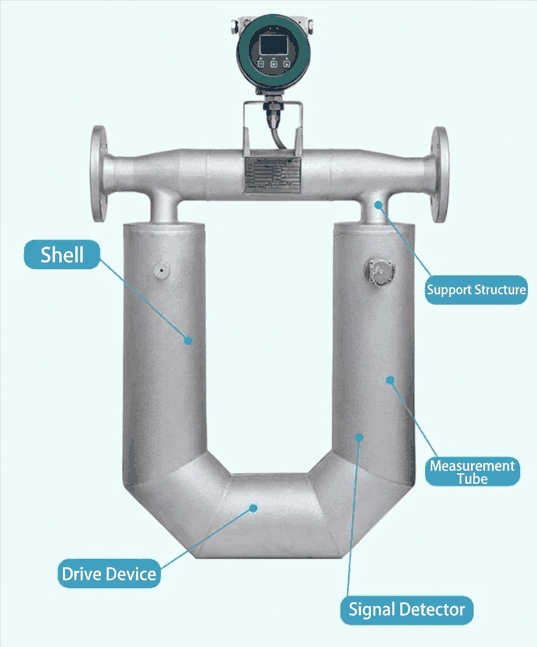
A Coriolis mass flow meter measures mass flow by observing how a vibrating flow tube is affected when fluid moves through it.
In simple terms: the meter drives the tube(s) into controlled vibration; as fluid flows, Coriolis forces cause a phase shift or “twist”
in the vibration pattern. Sensors pick up that change and the transmitter converts it to mass flow. Because the measurement is rooted
in inertial forces rather than inferred from velocity profiles, Coriolis meters can provide highly repeatable mass flow results,
and often density (from vibration frequency) plus temperature (from an RTD).
If you want a quick visual refresher, Endress+Hauser’s explainer video provides an accessible animation of the measuring principle.
watch on YouTube.
Why “direct mass flow” matters
Many conventional meters fundamentally measure volume flow and then require compensation to estimate mass flow. If density varies
(temperature shifts, concentration changes, entrained gas, batch-to-batch variability), your inferred mass flow can wander.
With Coriolis, mass flow is measured directly, and density is often available as a separate output—this is one reason Coriolis is preferred
for recipe control, blending, and custody-like accounting in process industries.
Endress+Hauser describes Coriolis as a direct method for measuring mass with high accuracy (typically ±0.1%). [Source]
Signal processing and vibration immunity
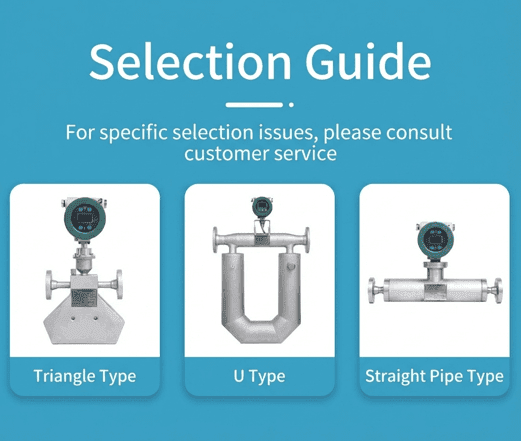
In real plants, vibration, pulsation, and mounting stress can degrade signal quality. This is where the mechanical design (single vs dual tube,
straight vs curved), mounting approach, and transmitter algorithms start to matter. Some manufacturers highlight anti-vibration mechanisms and
fast signal processing as core differentiators—especially for installations near rotating equipment or on skids.
The practical takeaway: the “principle” is consistent, but field performance depends heavily on sizing, installation, and diagnostics strategy.
Advantages in Industrial Use
Coriolis meters earn their place in industrial measurement for a few repeatable advantages:
High accuracy potential
Premium models across major brands publish very low mass flow measurement error figures, sometimes down to ±0.05% in certain configurations.
For example, Endress+Hauser’s Promass F 300 page lists mass flow measurement error ±0.05% (PremiumCal). [Source]
Density + temperature from one instrument
When you need mass balance, concentration checks, or product identification, density output is extremely valuable—and often underused.
Many Coriolis deployments unlock process insights simply by trending density against batches.
Reduced straight-run requirements
Compared with some DP or velocity-based meters, Coriolis installations can be more forgiving about upstream/downstream straight lengths,
though you still need to manage mounting, vibration, and two-phase conditions.
Strong diagnostics ecosystem
Modern transmitters include verification and health indicators that support predictive maintenance and audit trails, helping keep reliability high.
Quick note from the field (expert quote)
“Coriolis meters are extremely accurate. In fact, a Coriolis meter is often used as a standard for checking other flow-meters.
A liquid mass flow accuracy of 0.10% is common, and 0.05% is readily available.”
— Emerson, Coriolis: The Direct Approach to Mass Flow Measurement
[Source]
That statement reads like marketing, but it mirrors what many instrumentation teams do in practice: when the process can justify the cost,
they buy certainty—then use it to de-risk everything from blending to custody-like tracking.
Visual: typical value drivers (illustrative weighting)
Every plant has a different definition of “best,” but procurement discussions often center on a handful of value drivers.
The charts below are illustrative to help structure stakeholder conversation (adjust weights for your site).
- ■ Process data gathering (40%)
- ■ Meter sizing & model shortlist (25%)
- ■ Integration planning (20%)
- ■ Procurement & lead-time alignment (15%)
Industrial Importance
Applications of Mass Flow Meter
The “best” Coriolis meter is the one that matches your application profile. In industrial plants, Coriolis mass flow measurement shows up
most often in applications where mass balance, batching, blending, or product quality is tied directly to profitability.
Typical high-impact applications include:
- Batching & recipe control — direct mass flow reduces density-compensation errors and improves repeatability.
- Blending and additive injection — density output can help detect wrong material, temperature shift, or concentration drift.
- Loading/unloading and inventory transfer — mass-based tracking is often more aligned to commercial accounting than volumetric flow.
- High-viscosity liquids — Coriolis can excel where velocity-profile assumptions break down.
- Sanitary processing — hygienic designs and cleanability are critical in food, beverage, and pharma service.
Practical industrial reliability: what teams really care about
In day-to-day plant life, “reliability” can mean different things: stability over time, minimal drift, resistance to vibration,
clean start-ups, and the ability to diagnose issues without pulling the meter. This is where established product families
often justify their premium—because they come with proven installation guidance and diagnostic features learned from large installed bases.
Where Jade Ant Instruments fits into the workflow
Many engineering teams don’t want to start from a blank page. A practical approach is to define the process envelope (flow range, density range,
temperature/pressure, materials, hazardous area, communication protocol), then shortlist 2–3 meter families before formal RFQ.
If you’re building your shortlist and want a single place to organize requirements and compare options, start at
www.jadeantinstruments.com
and use it as your internal “spec hub” while you coordinate with OEMs.
Coriolis vs Other Flow Meters
Coriolis is not always the cheapest or simplest, but it can be the most straightforward when you truly need mass flow and density.
For contrast, consider what you trade when choosing other technologies:
| Meter Type | Best at | Typical limitations | When Coriolis is preferred |
|---|---|---|---|
| Coriolis | Direct mass flow + density | Cost, weight, two-phase sensitivity | Batching, blending, mass balance, density-critical processes |
| Magnetic (Magmeter) | Conductive liquids, low pressure drop | Not for non-conductive fluids (e.g., hydrocarbons) | When fluid is non-conductive or mass flow is required |
| Differential Pressure (Orifice/DP) | Simple, well-known standards | Pressure loss, density compensation, turndown limits | When density varies or turndown must be high |
| Ultrasonic | Large line sizes, low pressure drop | Profile assumptions, installation sensitivity | When direct mass flow/density is more important than minimal pressure loss |
Importantly, Coriolis accuracy statements from major manufacturers are often compelling on paper. For example, KROHNE’s OPTIMASS 6400 page
highlights “high accuracy (±0.05% flat)” for certain operating envelopes. [Source]
Yokogawa’s ROTAMASS Total Insight page publishes “Mass flow for liquids up to ±0.1%” and “Mass flow for gas up to ±0.35%” (model-dependent).
[Source]
These numbers help you estimate performance—but the real selection work is matching the meter to your process conditions.
Selection Criteria for Coriolis Mass Flow Meter
Accuracy and Reliability
Start by defining what “accuracy” means in your plant: rate accuracy at operating flow, repeatability for control, or totalized accuracy for
inventory/batching. Then translate it into a measurable acceptance plan (factory calibration, on-site verification, proving strategy).
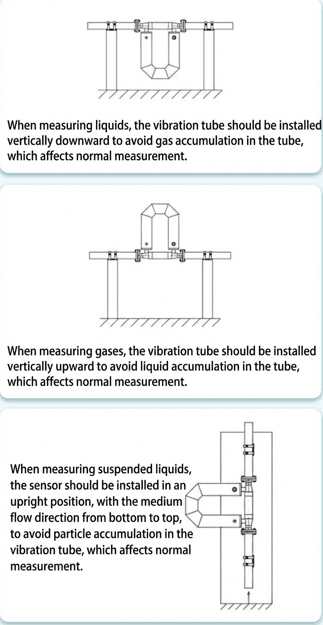
Coriolis meters can be extremely accurate, but they are still instruments—mounting stress, two-phase flow, entrained gas, and vibration can all
degrade performance if the application is misfit.
Use published specs as guardrails, not guarantees
Published specs can help narrow the field. For instance, Endress+Hauser lists mass flow measurement error ±0.05% for Promass F 300 under PremiumCal.
[Source]
KROHNE’s OPTIMASS 6400 highlights ±0.05% flat accuracy for certain services. [Source]
Use these specs to shortlist—then validate with process data and installation constraints.
Reliability checklist (field reality)
- Mounting and vibration environment (near pumps, compressors, skids)
- Presence of entrained gas or potential two-phase conditions
- Thermal cycling and piping stress management
- Diagnostics/verification capabilities and how your team will actually use them
Fluid Compatibility
Fluid compatibility is more than “will the wetted material corrode.” Consider viscosity range, abrasiveness, shear sensitivity,
temperature extremes, and whether the process includes solvents or cleaning chemicals. Coriolis meters are offered in various tube materials,
but your selection should follow your corrosion/compatibility standards and CIP/SIP requirements where applicable.
Density and temperature: hidden compatibility variables
Density measurement is valuable, but density range and stability requirements vary by fluid. Some product lines explicitly describe density ranges
and accuracy; verify that your expected density window (including temperature swings) is within the meter’s published capability and your control needs.
Maintenance Needs
Coriolis meters generally have few moving parts, but they still require a lifecycle plan: startup checks, zero verification strategy,
periodic calibration or proving (if required), and cleaning practices. If your plant is maintenance-constrained, prioritize:
(1) diagnostics that reduce troubleshooting time, and (2) vendor support infrastructure in your region.
Plan for fouling, coating, and cleaning cycles
In sticky or coating services, you may see apparent density drift over time. The right approach could be:
cleaning protocol + verification trend monitoring rather than frequent meter removal. Build these assumptions into your TCO.
Integration Options
Integration can make or break commissioning speed. Confirm required outputs (mass flow, density, temperature), totalizer needs,
and communications (HART, Modbus, fieldbus, Ethernet-based protocols) early. Also consider how your plant historian and asset management
tools will capture diagnostics.
Integration “gotchas” you can avoid
- Power and grounding practices on skids vs fixed installations
- Hazardous area approvals (and lead time)
- Preferred control system blocks and alarm mapping for diagnostics
- Remote electronics requirements (temperature, vibration, access)
If you want a fast internal alignment document for your team, it’s often helpful to centralize requirements and comparisons in one place.
You can anchor your internal spec workflow to
www.jadeantinstruments.com
so engineering, operations, and procurement are reading from the same checklist.
Top Coriolis Flow Meter Models
Below is a practical, industrial-focused tour of widely recognized Coriolis meter families. The goal isn’t to crown a single “winner,”
but to help you map model strengths to your process envelope, plant standards, and lifecycle expectations.
Emerson Micro Motion
Where it tends to fit best
Emerson’s Micro Motion line is commonly short-listed for demanding process measurement, including applications that emphasize repeatability,
robust transmitter ecosystem, and proven field history. In accuracy discussions, Emerson also publishes a frequently quoted statement that Coriolis
meters are “often used as a standard for checking other flow-meters,” with liquid mass flow accuracy of 0.10% being common and 0.05% readily available.
[Source]
Specification cue you can use during RFQ
In the Micro Motion ELITE product data sheet, Emerson lists example accuracy figures such as “standard volume flow accuracy is ±0.22% of rate”
for certain small sensor models (CMFS007, CMFS010, CMFS015). That’s a useful reminder that published accuracy varies by model size and configuration,
so you should always request the exact sensor + transmitter + calibration option combination in writing during quotation.
[Source]
Recommended use case patterns
- Batching & blending where repeatability matters more than absolute “headline” accuracy
- Density-driven quality (concentration inference, product identification checks)
- High reliability programs where diagnostics and verification workflows reduce downtime
Endress+Hauser Promass
What stands out
Endress+Hauser’s Promass portfolio is frequently selected for high-accuracy measurement and broad applicability across industries.
Endress+Hauser’s learning center describes Coriolis as a “direct method of measuring mass” with high accuracy (typically ±0.1%).
[Source]
Concrete published accuracy example
The Proline Promass F 300 product page lists mass flow measurement error of ±0.05% (PremiumCal), plus a broad temperature range and large nominal diameters.
If your business case is built on “measurable yield improvement,” having a clear published reference like this helps justify premium meter selections internally.
[Source]
High-capacity accuracy reference
For higher-capacity use cases, Endress+Hauser notes the four-tube Promass X provides premium accuracy (0.05%) for highest capacity in on- and offshore applications.
[Source]
KROHNE OPTIMASS
Strength theme: accuracy + resilience across challenging conditions
KROHNE positions OPTIMASS for advanced process environments, and publishes clear “headline” values for specific models. For example,
OPTIMASS 6400 is described as offering high accuracy (±0.05% flat) and suitability for cryogenic to high temperature media (-200…+400°C / -328…+752°F).
[Source]
Low-flow dosing reference
If your application is dosing or low-flow measurement, KROHNE’s OPTIMASS 3400 is positioned specifically for that niche and highlights
high accuracy (±0.1%) for gases and liquids above stated thresholds.
[Source]
Yokogawa ROTAMASS
Strength theme: transparent accuracy figures + multivariable measurement
Yokogawa’s ROTAMASS Total Insight product page highlights “Mass flow for liquids up to ±0.1%” and “Mass flow for gas up to ±0.35%”
(model/configuration dependent). This transparency makes it easier to set stakeholder expectations—especially when your project team includes
both controls engineers and process owners.
[Source]
Brochure note on accuracy tiers
The Rotamass TI brochure mentions specifications that can state mass flow accuracy of 0.2%, 0.1% or even 0.05% of reading under reference calibration conditions
(depending on configuration and output type). This is a helpful reminder to confirm the exact “accuracy class” or option selected during ordering.
[Source]
Azbil Coriolis
Strength theme: reliable industrial measurement + published high-accuracy claims
Azbil’s Admass Coriolis mass flowmeter (RC111) is a recognized option for liquid and gas measurement. A published product PDF for the RC111 states that
actual flow calibration using a weighing method can guarantee a high-accuracy reading within ±0.2% of indicated value (as described in the document).
That kind of statement can be useful when your plant QA group needs traceability language.
[Source]
Kobold Mass Flow Meter
Strength theme: breadth of industrial offerings (including low-flow)
KOBOLD’s Coriolis line includes practical models that fit dosing/low-flow and general industrial service. For instance, the HPC is described as a compact
dual-measuring-tube Coriolis design engineered for low flow measurement.
[Source]
For broader flow ranges, KOBOLD also describes the TMU series as a rugged design built for mass flow measurements of liquids and gases in chemical,
petrochemical, and oil & gas applications.
[Source]
Quick reality check: known disadvantages to plan for
Coriolis meters can be premium-priced and physically heavier than many other technologies. KOBOLD’s own educational article notes typical disadvantages:
they are “arguably the most expensive,” can be “large and heavy,” require inline installation (no insertion), and are “not good for dual-phase media.”
That’s not a deal-breaker—just an engineering constraint you should plan around.
[Source]

[Source]
If you want help building a shortlist and translating process constraints into a clean RFQ specification, a common approach is to centralize your selection notes and
purchasing checklist in one internal hub. Many teams do that through a vendor-neutral reference page at
www.jadeantinstruments.com
so engineering, maintenance, and procurement align on the same decision criteria.
Model Features
This section summarizes feature “themes” that matter in real industrial ownership: cleanability, pressure resilience, viscous performance,
and multivariable outputs. The key is to convert these into requirements you can test, verify, and maintain over time.
Sanitary Applications
Sanitary Coriolis deployments are typically judged on cleanability, documentation, and repeatability across CIP/SIP cycles. Even when two meters have similar accuracy,
the right hygienic design (surface finish, drainability, approvals) can reduce downtime and contamination risk.
In regulated environments, the “best” meter is often the one your QA team can defend during audits—especially if density measurement is used for quality checks.
Practical tip: treat cleanability as an uptime KPI
If you’re in food, beverage, or pharma, involve your sanitation or validation teams early. A meter that is easy to clean and verify can outperform a slightly “more accurate”
alternative that causes frequent interventions.
High-Pressure Options
High-pressure service pushes you to confirm not only pressure rating, but also how mounting stress affects stability.
In skid-based injection systems and high-pressure chemical dosing, small mechanical stress changes can shift zero stability and amplify measurement uncertainty.
For low flow at high pressure, compact designs like KOBOLD’s HPC are often evaluated because they are engineered for low flow measurement with a compact dual-tube design.
[Source]
Checklist: confirm these before you buy
- Maximum process pressure with appropriate safety margin
- Wetted material compatibility (including cleaning chemicals)
- Temperature + pressure combined envelope (not separate specs)
- Mounting / support requirements to minimize stress-induced drift
Viscous Fluid Measurement
Viscous fluids (resins, syrups, heavy hydrocarbons) can make some flow technologies struggle due to changing velocity profiles and pressure loss.
Coriolis meters often remain attractive because they measure mass directly and can provide density that correlates with product composition.
For “viscous/aggressive/shear-sensitive” services, KROHNE describes OPTIMASS 7400 as a Coriolis mass flowmeter for advanced process applications with high accuracy (±0.1%).
[Source]
Practical tip: plan for coating and density drift
In viscous or coating service, density trending can be a powerful early warning. If density slowly drifts while upstream lab results remain stable,
you may be seeing coating buildup or process temperature changes. A maintenance plan that includes verification and cleaning can protect long-term performance.
Multivariable Capabilities
Multivariable capability is one of the “quiet wins” of Coriolis meters: mass flow, density, and temperature from a single instrument package.
This reduces instrument count, simplifies wiring and integration, and can improve troubleshooting because you’re interpreting a coherent data set.
Yokogawa describes ROTAMASS Total Insight as providing very high accuracy for measuring liquids and gases, aligning with this multivariable measurement approach.
[Source]
Rangeability note for planning low-flow performance
For applications with wide turndown, it helps to understand rangeability constraints. OMEGA Engineering notes Coriolis meters can provide “0.1–2% of rate inaccuracy”
over a mass flow range up to 100:1, with curved tube designs often offering wider rangeability than straight tube designs.
[Source]
Comparison Table
The table below is designed to be “Excel-friendly”: you can copy/paste it into a spreadsheet to build an internal comparison scorecard.
Values are intentionally described in vendor-language terms and cite published references where possible; always validate with the exact model code and calibration option.
| Brand / Family | Example published accuracy reference | Strength themes | Best-fit applications (common) | Notes / Caveats |
|---|---|---|---|---|
| Emerson Micro Motion (ELITE) | ELITE datasheet notes for certain models: standard volume flow accuracy ±0.22% of rate [Source] | Strong installed base, process + density measurement, robust ecosystem | Batching, blending, density-driven quality, challenging process environments | Accuracy varies by model/calibration; confirm exact option in RFQ |
| Endress+Hauser Promass (F 300) | Promass F 300: mass flow measurement error ±0.05% (PremiumCal) [Source] | High accuracy references, broad portfolio, strong documentation footprint | Quality-critical processes, broad industrial coverage, high-capacity lines | Validate installation constraints & diagnostics workflow during commissioning |
| KROHNE OPTIMASS (6400 / 3400) | OPTIMASS 6400: high accuracy (±0.05% flat), -200…+400°C [Source] OPTIMASS 3400: high accuracy (±0.1%) for low flow/dosing [Source] | Wide coverage from low-flow dosing to advanced process; temperature range highlights | Cryogenic/high-temp processes, dosing, complex conditions (model-dependent) | Use correct model for gas fraction / process disturbances |
| Yokogawa ROTAMASS Total Insight | Liquids up to ±0.1%, gases up to ±0.35% (published on product page) [Source] Brochure mentions 0.2%, 0.1% or even 0.05% of reading under reference calibration conditions (config-dependent) [Source] | Clear published performance references; multivariable measurement mindset | General industrial, quality trending via density, mixed liquid/gas portfolios | Confirm “accuracy tier” option; don’t assume brochure max applies to all |
| Azbil Admass (RC111) | RC111 PDF mentions weighing-method calibration and accuracy within ±0.2% of indicated value (per document) [Source] | Traceability-friendly messaging; industrial measurement for liquids/gases | Process measurement where calibration language matters for QA/traceability | Validate local support coverage and integration preferences |
| KOBOLD (HPC / TMU) | HPC described as compact dual-tube design engineered for low flow measurement [Source] TMU described as rugged design for liquids/gases in chemical, petrochemical, oil & gas [Source] | Practical industrial lineup including low-flow niche | Dosing/low-flow, general process measurement, skid systems | Keep in mind known Coriolis disadvantages (cost, size/weight, two-phase sensitivity) [Source] |
Quick visual: how teams often score options (illustrative)
You can adapt the simple charts below to your internal weighting model (accuracy, integration, service, TCO).
- ■ Meter + transmitter (45%)
- ■ Install/commission (25%)
- ■ Maintenance & verification (20%)
- ■ Downtime risk buffer (10%)
Choosing the Right Coriolis Mass Flow Meter
Selection is easier when you treat it like a small engineering project with a documented decision record.
Below is a practical guide aligned with how industrial teams actually buy, install, and own flow meters.
Process Assessment
Step 1: define your process envelope (not “normal conditions”)
Capture min/normal/max flow, density range, viscosity range, temperature and pressure extremes, and any two-phase risk.
If entrained gas is possible (pump cavitation, flashing, startup aeration), document it explicitly—because two-phase sensitivity is a known Coriolis constraint.
KOBOLD notes Coriolis meters are generally not good for dual-phase media, and that’s exactly the kind of detail that should appear in your internal risk register.
[Source]
Step 2: translate “accuracy” into a measurement plan
Decide whether you care about instantaneous rate accuracy, repeatability for control, or totalized mass for inventory/batch.
For example, if your improvement case depends on a published premium accuracy like Promass F 300 (±0.05% PremiumCal),
define how you will verify and maintain that level over time (proving, verification, zero checks).
[Source]
Step 3: plan for rangeability and low-flow performance
If your process spends meaningful time at low flow, rangeability becomes the difference between a stable reading and a noisy number.
OMEGA notes Coriolis meters can provide up to 100:1 rangeability in some cases, with curved tubes often offering wider rangeability than straight tubes.
[Source]
Cost Considerations
Total cost of ownership (TCO) beats unit price
Coriolis meters can be expensive up front. But in many plants, the real economic value comes from fewer off-spec batches, faster reconciliation,
and fewer “mystery” losses. If density is part of your quality logic, that can become a value multiplier.
Emerson’s framing of Coriolis meters being used as a standard for checking other meters is a useful way to explain this to non-instrument stakeholders:
you’re buying measurement confidence, not just a sensor.
[Source]
When lower-cost alternatives are rational
If you only need volumetric flow of a conductive liquid and density is irrelevant, a magmeter might be a better business choice.
If you need very large line sizes with minimal pressure loss, ultrasonic may win. Coriolis is most justified when mass flow and density reduce uncertainty
in a way you can convert to dollars.
Support and Service
Serviceability is part of “accuracy”
A meter that is theoretically accurate but constantly out of service is worse than a slightly less accurate instrument that runs reliably.
Evaluate:
- Lead time and spare parts availability
- Local calibration / proving support options
- Commissioning tools and documentation quality
- Training availability for your maintenance team
Practical workflow recommendation
To keep selection organized, many buyers build a “meter decision pack” with: process envelope, hazardous area classification, communications requirements,
verification plan, and vendor quotes. If you want a central landing point for your selection workflow, start at
www.jadeantinstruments.com
and structure your internal links/anchors around your plant standards and typical application pages.
(You can then plug in the specific model families above as your shortlist.)
Summarize the standout features of the top Coriolis mass flow meter models.
The strongest Coriolis meter families share a common promise—direct mass flow measurement with high repeatability—yet they differentiate on how they handle
real plant constraints. Endress+Hauser publishes clear premium accuracy references such as Promass F 300 at ±0.05% (PremiumCal).
[Source]
KROHNE highlights OPTIMASS 6400 as high accuracy (±0.05% flat) with cryogenic to high temperature capability (-200…+400°C / -328…+752°F).
[Source]
Yokogawa publishes straightforward accuracy references (liquids up to ±0.1%, gases up to ±0.35%) for ROTAMASS Total Insight,
and its brochure reminds buyers that accuracy tiers can vary by option (0.2%, 0.1%, even 0.05% of reading under reference conditions).
[Source]
[Source]
Emerson’s Micro Motion ELITE references model-specific accuracy values in its datasheets (e.g., ±0.22% volume flow accuracy for certain small sensors),
and supports the broader “measurement confidence” narrative with widely cited expert statements about Coriolis being used as a standard for checking other meters.
[Source]
[Source]
Reinforce the importance of matching meter selection to industrial needs, such as accuracy, compatibility, and maintenance.
The real win is alignment: selecting the meter whose accuracy spec is credible in your installation, whose materials match your fluid compatibility rules,
and whose diagnostics and verification approach your team will actually use. Also be honest about Coriolis constraints: cost, size/weight, inline installation,
and sensitivity to dual-phase conditions are well documented in industry educational materials.
[Source]
Offer actionable recommendations for buyers, including consulting manufacturers and considering future scalability.
Action plan you can execute this week:
- Lock the process envelope (min/normal/max flow, density, viscosity, temperature/pressure extremes, two-phase risk).
- Shortlist 2–3 families that publish credible specs for your conditions (don’t mix models across wildly different size classes).
- Ask for a written accuracy statement tied to your exact model code, calibration option, and installation assumptions.
- Define verification and maintenance before purchase (who does it, how often, and what “pass/fail” looks like).
- Plan integration early (protocols, diagnostics mapping, historian tags, asset management tooling).
Strong call to action
If you want to move from “research” to a clean shortlist and RFQ-ready spec, start by documenting your process envelope and selection criteria at
Jade Ant Instruments
.
Then bring that structured checklist into manufacturer discussions so you get quotes that are truly comparable—not just brochures side-by-side.
FAQ
1) What is a Coriolis mass flow meter best used for?
It’s best when you need direct mass flow measurement (not inferred from volume), and when density/temperature data helps batching, blending, quality checks,
or mass balance reconciliation.
2) How accurate are Coriolis meters in real industrial plants?
Accuracy depends on model, calibration option, and installation quality. Some manufacturers publish premium values (e.g., ±0.05% for specific Promass configurations),
while general references note broad inaccuracy ranges depending on design and conditions. Always request a written accuracy statement tied to your exact configuration.
[Source]
[Source]
3) What are the main disadvantages of Coriolis flow meters?
Common disadvantages include higher cost, larger size/weight, inline installation requirements, and reduced suitability for dual-phase media.
[Source]
4) Can a Coriolis meter measure density and temperature too?
Many Coriolis meters output density (from tube vibration frequency) and temperature (via RTD), making them useful for concentration inference and quality trending.
5) How do I choose between Emerson Micro Motion and Endress+Hauser Promass?
Start with your application: accuracy needs, temperature/pressure, diagnostics expectations, integration standards, and local service.
Compare published references (e.g., Promass F 300 ±0.05% PremiumCal; Micro Motion ELITE model-specific values) and validate with your RFQ.
[Source]
[Source]
6) Which Coriolis meter works well for low-flow dosing?
Look for models positioned specifically for low flow and dosing, such as KROHNE OPTIMASS 3400, or compact low-flow designs like KOBOLD HPC.
Confirm minimum flow, turndown, and accuracy at your operating point.
[Source]
[Source]
7) How do I handle entrained gas or two-phase conditions?
First, identify whether two-phase is occasional (startups) or continuous. If it’s continuous, consider whether Coriolis is appropriate or whether you need a different
measurement strategy. If it’s occasional, work with manufacturers on installation, degassing, and operational controls to mitigate errors.
As a baseline, note that educational materials caution Coriolis performance in dual-phase media.
[Source]
8) Do Coriolis meters require straight pipe runs?
Compared to many velocity-based technologies, Coriolis often needs less straight run, but still requires good mounting, full tubes, and minimized stress and vibration.
Follow the manufacturer’s installation manual for your exact model.
9) What signals should I integrate into DCS/PLC besides mass flow?
In many plants, density and temperature are underutilized. Consider alarming on density drift, tracking verification status/diagnostics, and totalizing mass for batch reports.
This approach can improve troubleshooting and quality traceability.
10) What’s the fastest way to shortlist the right Coriolis meter?
Create a one-page process envelope, a must-have integration list, and a verification plan. Then shortlist 2–3 families and request written configuration-specific quotes.
If you want an organized starting point, use www.jadeantinstruments.com
as your internal selection hub and link your spec checklist to your procurement workflow.
External Link Ideas (for credibility & SEO)
- Emerson Coriolis measurement overview:
https://www.emerson.com/en-us/automation/measurement-instrumentation/flow-measurement/coriolis-flow-meters - Endress+Hauser Coriolis measuring principle (learning center):
https://www.endress.com/en/support-overview/learning-center/flow-measuring-principle-coriolis - KROHNE Coriolis mass flowmeters product family:
https://www.krohne.com/en-us/products/flow-measurement/flowmeters/coriolis-mass-flowmeters - OMEGA Engineering Coriolis accuracy/rangeability explainer:
https://sea.omega.com/ph/technical-learning/understanding-how-does-a-coriolis-flow-meter-work.html - Yokogawa ROTAMASS Total Insight product page:
https://www.yokogawa.com/us/solutions/products-and-services/measurement/field-instruments-products/flow-meters/coriolis-flow-meters/rotamass-total-insight-coriolis-mass-flow-and-density-meters/ - KOBOLD educational article on Coriolis pros/cons:
https://koboldusa.com/articles/type-of-flow-meters/all-about-coriolis-flow-meters/