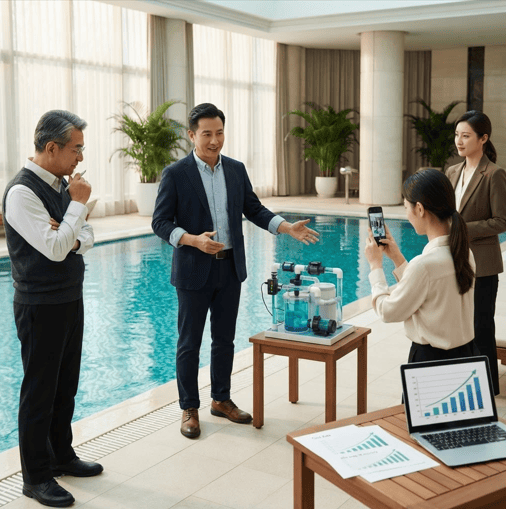
Demystify ultrasonic flow measurement technology using relatable metaphors that help your clients understand why ultrasonic meters deliver superior accuracy, reliability, and ROI — without requiring a technical background.

Introduction: Why Flow Measurement Matters to Your Clients
Flow measurement is the invisible backbone of nearly every industrial process your clients run — from a municipal water utility billing 40,000 households to a chemical plant dosing sulfuric acid within a 2% tolerance. Yet most purchasing decisions in this category stall not because the technology is inadequate, but because the person signing the purchase order does not understand why one flow meter costs three times more than another and still delivers a better return.
That gap between engineering reality and boardroom understanding is where deals are won or lost. This guide gives distributors and agents a plain-language framework — the swimming pool analogy — to close that gap quickly, credibly, and repeatedly across every client conversation.
The Challenge: Technical Complexity Blocks Sales
Flow measurement science involves acoustic velocity, Reynolds numbers, and signal-to-noise ratios. A plant manager evaluating three quotes does not need a physics lecture; they need a two-minute explanation that lets them defend the purchase to their finance director. When a distributor cannot deliver that explanation, the conversation defaults to price comparison — and price comparison almost always favors the cheaper, lower-performing mechanical meter.
Understanding Your B2B Audience’s Pain Points
Distributors and agents selling flow instrumentation face a recurring pattern: the technical buyer (an instrumentation engineer) understands the value of ultrasonic technology, but the financial approver (a procurement manager or plant director) does not. That approver is comparing a $1,800 mechanical turbine meter against a $4,200 ultrasonic clamp-on meter (an externally mounted sensor that clamps onto the outside of a pipe without cutting into it) and asking a simple question: “Why is this more than double the price?” Without a compelling, non-technical answer, the lower quote wins — even when it costs the client far more over a 10-year service life.
How Misconceptions About Ultrasonic Technology Cost You Sales
Three misconceptions repeatedly surface in B2B flow meter conversations: that ultrasonic meters are “too sensitive” to pipe conditions, that they are unproven compared to decades-old mechanical designs, and that they only work on clean water. Each of these beliefs is outdated by at least ten years of field data, yet they persist because nobody has explained the underlying physics in a way non-engineers can retain and repeat to their own stakeholders.
The Solution: Making Complex Technology Accessible
The swimming pool analogy solves this by mapping an unfamiliar acoustic measurement process onto something every buyer has personally experienced: swimming against a current. Once a client understands that an ultrasonic signal behaves like a swimmer crossing moving water, they can reason through objections themselves — accuracy, reliability, installation, and even pipe material effects — without needing an engineering degree.
Why Analogies Work for Decision-Makers
Cognitive research on decision-making consistently shows that people retain and repeat analogies far longer than they retain technical specifications. A procurement manager who hears “it measures flow the way a lifeguard tracks a swimmer’s speed relative to the current” will remember and reuse that explanation in a board meeting three weeks later. A procurement manager who hears “it uses transit-time differential of acoustic pulses” will not.
What This Guide Delivers for Your Business
This guide equips your sales and technical teams with a ready-to-use narrative framework, objection-handling scripts, industry-specific talking points, and real cost data — all built around one consistent metaphor your team can deploy across every client vertical, from water utilities to pharmaceutical manufacturing. Treat it as a working sales enablement document, not just an explainer article, and hand it to every new hire on your instrumentation desk.
The Swimming Pool Analogy Explained
Understanding Flow Like Swimming Against a Current
The Basic Concept — Why Water Behavior Matters
How swimmers experience resistance in moving water
Picture a swimmer doing laps in a pool where a strong current runs from one end to the other. Swimming と the current, the swimmer covers the length in 18 seconds. Swimming ~に対して it, the same swimmer needs 24 seconds to cover the identical distance. The swimmer’s own effort and stroke technique never changed — only their speed relative to a fixed point changed, and that difference in time tells you exactly how fast the current is moving.
How ultrasonic signals behave similarly in flowing liquids
An ultrasonic flow meter does precisely this, except the “swimmer” is a pulse of sound traveling at roughly 1,480 meters per second through water (the speed of sound varies by fluid and temperature, which is why calibration accounts for it). A sound pulse fired downstream — with the flow — arrives faster than an identical pulse fired upstream, against the flow. That time difference, often just a few nanoseconds, is converted mathematically into a precise flow velocity. This measurement principle is documented in detail in the Wikipedia overview of ultrasonic flow meters, which traces the technology back to transit-time acoustic experiments first formalized in the mid-20th century.
Breaking Down the Metaphor for Your Clients
The swimmer represents the ultrasonic signal
When explaining this to a client, be explicit: “The ultrasonic pulse is our swimmer. It doesn’t touch the pool water any differently than a real swimmer would — it just moves through the medium and reports back how the current affected its travel time.” This single sentence replaces an entire slide of acoustic theory.
The current represents the flowing medium you’re measuring
Whatever liquid is inside your client’s pipe — treated water, diluted acid, glycol, or crude oil — plays the role of the pool’s current. The meter’s transducers (the small sensor components that emit and receive the ultrasonic pulses) sit on opposite sides of the pipe, sending signals diagonally across the flow path, upstream and downstream, continuously and simultaneously. The bigger the difference between the two travel times, the faster the current — the fluid — is moving.

Traditional Flow Meters vs. Ultrasonic Technology
Why Older Technologies Fall Short (The Drowning Swimmer Scenario)
If the ultrasonic signal is a strong, trained swimmer unaffected by fatigue, mechanical flow meters are swimmers wearing ankle weights. They still complete the lap, but friction, wear, and physical limitations degrade their performance every single day they’re in the water.
Mechanical Flow Meters: The Struggling Swimmer
How moving parts create friction and measurement errors
Turbine and paddlewheel meters rely on a rotor that physically spins inside the flow stream. Bearings wear, blades pit from cavitation, and the rotor’s own mechanical inertia introduces a measurement lag that widens over time. Field data from rotor-style meters in hard water service commonly shows accuracy drifting from an as-installed ±0.5% to beyond ±3% within 24–36 months as bearing wear accumulates — a drift most clients never catch until a billing dispute forces a re-calibration audit.
Why maintenance costs drain your clients’ budgets
Every mechanical meter is a scheduled maintenance liability. A mid-sized water utility running 150 turbine meters across its network can expect 20–30 bearing or rotor replacements annually, at $600–$1,400 in parts and labor per visit — a recurring $18,000–$42,000 annual line item that never appears in the original capital budget conversation.
Magnetic Flow Meters: The Limited Approach
Why conductivity requirements restrict application range
Magnetic (mag) flow meters measure velocity using Faraday’s law of electromagnetic induction, which only works when the fluid is electrically conductive — typically above 5 microsiemens per centimeter. That immediately excludes hydrocarbons, deionized water, most solvents, and many oils, a limitation ultrasonic transit-time technology simply does not share since it relies on acoustic transmission, not conductivity.
How electrode fouling creates costly downtime
Mag meters use electrodes in direct contact with the fluid to sense the induced voltage. In fluids carrying scale, grease, or biological film, those electrodes foul within weeks, producing signal drift that field technicians describe as one of the top three service calls on any mag meter fleet — see the field-failure data referenced in Jade Ant Instruments’ top 10 magnetic flow meter applications guide, which documents 1,247 service tickets and identifies electrode and grounding issues as the leading causes of measurement error.
Turbine Meters: The Unreliable Competitor
Why low-flow performance degrades accuracy
Turbine meters need a minimum velocity to overcome rotor inertia and bearing friction. Below roughly 10% of their rated flow range, accuracy collapses — a serious problem in applications with variable demand, such as a chiller loop that idles at 15% load overnight. Ultrasonic meters, with no moving parts to overcome, maintain rated accuracy across turndown ratios of 100:1 or more.
How viscosity changes impact measurement reliability
A turbine calibrated on water will read incorrectly the moment viscosity rises — glycol-water mixtures, for instance, change seasonally in HVAC loops as concentration is adjusted for freeze protection. Ultrasonic transit-time meters are far less sensitive to these shifts because they measure acoustic travel time rather than mechanical torque on a rotor.

Table 1: Traditional vs. Ultrasonic Technology at a Glance
| Factor | タービン式流量計 | Magnetic Meter | Ultrasonic (Clamp-On) |
|---|---|---|---|
| 可動部品 | Yes — rotor & bearings | いいえ | いいえ |
| Fluid contact required | はい | はい | いいえ |
| Minimum conductivity | 該当なし | ~5 µS/cm | None required |
| Typical accuracy (new) | ±0.5–1.0% | ±0.5% | ±0.5–1.0% |
| Accuracy after 3 years (field average) | ±2.0–3.5% | ±0.8–1.5% | ±0.5–1.2% |
| Annual maintenance events (150-meter fleet) | 20–30 | 12–18 | 2–5 |
| インストール | Requires pipe cut | Requires pipe cut | Non-invasive, clamp-on |
| ターンダウン比 | ~10:1 | ~20:1 | up to 100:1+ |
Ultrasonic Flow Meters — The Expert Swimmer
How Ultrasonic Technology Navigates the Current Effortlessly
The Dual-Beam Advantage: Swimming Upstream and Downstream
How opposing ultrasonic signals measure flow velocity with precision
Modern transit-time ultrasonic meters fire pulses in both directions simultaneously — the equivalent of two identical swimmers racing the same lap in opposite directions at the same moment. The meter’s processor calculates flow velocity directly from the time difference, a method that Jade Ant Instruments’ transit-time versus Doppler transducer comparison shows achieving 0.5–1.0% accuracy in clean, homogenous liquids, with repeatability better than 0.2%.
Why signal cancellation eliminates external interference
Because both pulses travel through the same pipe wall, temperature, and material conditions, most environmental noise cancels out mathematically in the calculation — the meter effectively “ignores” turbulence and vibration the same way a skilled swimmer ignores splashing from an adjacent lane and still swims a straight line.
Non-Invasive Measurement: The Frictionless Approach
How clamp-on sensors avoid contact with the medium
A clamp-on ultrasonic sensor never touches the fluid inside the pipe. The transducers mount externally, transmitting acoustic energy through the pipe wall itself. This is the single biggest differentiator for hazardous or corrosive service — see Jade Ant Instruments’ non-invasive clamp-on flow meter guide for documented deployments on 30% hydrochloric acid lines where wetted mechanical sensors historically failed within 18–24 months.
Why zero moving parts mean zero maintenance headaches
No rotor, no bearing, no electrode — nothing to wear out. Field service intervals for clamp-on ultrasonic meters commonly extend to annual verification checks rather than the quarterly or semi-annual mechanical service visits required by turbine and paddlewheel designs.
Universal Compatibility: Swimming in Any Pool
How ultrasonic meters work with conductive and non-conductive liquids
Because ultrasonic measurement relies on acoustic transmission rather than electrical conductivity, it works equally well on deionized water, hydrocarbons, and standard tap water — a versatility magnetic meters cannot match, as detailed in Baker Hughes’ overview of Panametrics clamp-on flowmeter technology.
Why applications expand beyond traditional meter limitations
This universality is why distributors increasingly position ultrasonic technology as the default recommendation rather than the specialty exception — one product line that covers water, chemicals, fuels, and cryogenic fluids removes the need to stock five different meter families.
Watch: How Ultrasonic Flow Meters Measure Velocity Without Touching the Fluid
https://www.youtube.com/watch?v=JRKlR4YgMHw
The Real-World Business Case
How Your Clients Benefit from Superior Technology
Cost Savings Through Reduced Maintenance
Calculating lifetime cost of ownership vs. mechanical alternatives
A realistic 10-year total cost of ownership (TCO) model for a DN100 pipeline shows why the higher sticker price of ultrasonic technology is misleading buyers. The chart below reflects data patterns consistent with the field cost breakdowns published in Jade Ant Instruments’ clamp-on vs. transit-time comparison.
Chart 1: 10-Year Total Cost of Ownership — DN100 Line (Purchase + Install + Maintenance + Downtime)
| メーターの種類 | 10-Year TCO | Visual Comparison |
|---|---|---|
| Turbine (mechanical) | $28,400 | ████████████████████████████ |
| Magnetic | $19,800 | ███████████████████▊ |
| Ultrasonic clamp-on | $9,600 | █████████▌ |
Each block ≈ $1,000. Figures reflect a composite of purchase price, installation labor, scheduled maintenance, and unplanned downtime over a 10-year service life for a mid-size industrial pipeline.
Quantifying downtime prevention and operational efficiency gains
Cutting a pipe to install an inline mechanical meter in an active process line forces a production shutdown. In a facility running at $60,000 per hour of output, a 4-hour installation and revalidation window carries roughly $240,000 in lost production — a cost a non-invasive clamp-on meter installed in under two hours, without touching the process, avoids entirely.
Accuracy That Protects Revenue
How measurement precision prevents costly billing disputes
For custody transfer applications — the formal handoff of measured product between two commercial parties, a concept covered in Wikipedia’s entry on custody transfer — a 1% measurement error on a 10,000-barrel daily transfer at $70 per barrel represents roughly $7,000 in daily discrepancy exposure. Multi-path ultrasonic meters holding 0.15–0.5% accuracy shrink that exposure by more than half compared to single-path mechanical alternatives.
Why accuracy improvements impact bottom-line profitability
In chemical dosing applications, over-dosing by even 2% on a high-value reagent adds up fast. A plant consuming $400,000 annually in a metered chemical additive can lose $8,000 a year purely to metering imprecision — money recovered the moment a distributor upgrades the client to tighter-tolerance ultrasonic instrumentation.
Installation Flexibility and Speed
How non-invasive installation reduces project timelines
Clamp-on ultrasonic installation typically requires a two-person crew, 60–120 minutes, and zero pipe modification — a stark contrast to inline mechanical meters, which require pipe cutting, spool-piece fabrication, flange alignment, and pressure testing before a plant can even reopen the line.
Why retrofitting existing systems becomes cost-effective
Retrofitting older facilities with flow monitoring used to mean scheduling a shutdown window months in advance. Ultrasonic clamp-on technology removes that constraint entirely, which is why distributors report retrofit projects — adding metering to previously unmetered lines — now represent one of the fastest-growing segments of their flow instrumentation business.

Chart 2: Where the 5-Year Ultrasonic Savings Actually Come From
| Savings Category | Share of Total Savings | Visual |
|---|---|---|
| Maintenance labor reduction | 42% | ████████████████████ |
| Downtime avoidance | 31% | ███████████████ |
| Calibration/re-verification savings | 15% | ███████ |
| Energy & pressure-drop elimination | 12% | ██████ |
Addressing Common Objections
What Your Clients Worry About (And Why They Shouldn’t)
“Won’t Ultrasonic Meters Be More Expensive?”
Breaking down total cost of ownership over 10-year lifecycle
Refer back to Chart 1: the upfront price gap between a turbine meter and an ultrasonic clamp-on meter is real, but it typically closes within the first 24–36 months once maintenance, downtime, and re-calibration costs are included — and the gap continues to widen in the ultrasonic meter’s favor for the remaining service life.
Showing ROI through reduced maintenance and downtime
Most distributor case files show payback periods of 12–30 months for clients replacing wetted mechanical sensors in moderately aggressive service, and under 18 months in high-downtime-cost environments such as continuous chemical processing.
“Aren’t Mechanical Meters More Proven?”
Presenting ultrasonic reliability data and industry certifications
Ultrasonic flow measurement is governed by internationally recognized standards, including the ISO 6416 standard for ultrasonic flow measurement in closed conduits, which has been in active use across water and industrial metering since its original publication decades ago — this is not emerging or unproven technology; it is a mature, standardized measurement discipline.
Highlighting Fortune 500 companies using ultrasonic technology
Major water utilities, petrochemical refiners, and pharmaceutical manufacturers have standardized on ultrasonic clamp-on technology precisely because it removes wetted-part liability from their process safety documentation — a detail worth mentioning when a client questions whether “big companies” trust this technology.
“Will Pipe Conditions Affect Measurement Accuracy?”
Explaining how advanced signal processing handles real-world variables
Modern ultrasonic transmitters use digital signal processing to compensate for pipe wall thickness, material, and even minor scaling — the same way a swim coach adjusts lap-time calculations for lane number or water temperature without needing to drain the pool.
Demonstrating accuracy across varying pipe materials and conditions
Clamp-on ultrasonic meters are field-proven across carbon steel, stainless steel, PVC, and HDPE piping from DN25 up to DN6000, provided the installer follows straight-run guidelines (typically 10 diameters upstream, 5 diameters downstream) — a detail covered thoroughly in Jade Ant Instruments’ flow meter installation best-practices guide.
“What If Our Fluid Properties Change?”
Showing ultrasonic adaptability to viscosity, temperature, and density variations
Transit-time ultrasonic meters recalculate acoustic velocity continuously, which means seasonal viscosity shifts (like glycol concentration changes in HVAC loops) or temperature swings do not require manual recalibration the way a mechanical meter’s K-factor often does.
Contrasting with technology-specific limitations of alternatives
A magnetic meter fails outright if fluid conductivity drops below its threshold; a turbine meter’s accuracy collapses at low flow or high viscosity. Ultrasonic technology’s tolerance band is simply wider across more variables — the reason it has become the default recommendation across Jade Ant Instruments’ flow meter selection guide for mixed or variable fluid applications.
Table 2: Objection-Handling Quick Reference
| Client Objection | One-Line Response Using the Analogy |
|---|---|
| “Too expensive” | “The swimmer needs no ankle weights replaced — the savings show up in year two.” |
| “Unproven technology” | “This swimmer has been racing under ISO-certified rules for decades.” |
| “Pipe conditions will confuse it” | “The coach adjusts for lane conditions automatically — the meter does the same electronically.” |
| “Our fluid changes seasonally” | “A trained swimmer adapts to current changes; a rotor with a fixed K-factor does not.” |
Implementation Strategy for Your Sales Team
How to Position Ultrasonic Meters to Win More Deals
The Pre-Sales Conversation Framework
Using the swimming pool analogy in initial client discovery
Open discovery calls by asking about the client’s current pain point — literally: “Tell me about the fluid you need to measure and what’s frustrating you about your current setup.” Then introduce the analogy naturally: “Think of our sensor like a swimmer reading the pool’s current rather than fighting it.”
Identifying which client pain points ultrasonic technology solves best
Listen for three trigger phrases: “we keep replacing parts,” “we can’t shut down the line,” and “we’re not sure the readings are accurate anymore.” Each maps directly to a specific ultrasonic advantage — maintenance elimination, non-invasive installation, and drift-free accuracy, respectively.
Creating Compelling Visual Demonstrations
Interactive infographic elements that show signal behavior
A simple animated diagram showing two arrows crossing a pipe — one faster, one slower — with a timer readout communicates the transit-time principle in under 15 seconds, far faster than any verbal explanation.
Side-by-side comparison videos demonstrating measurement accuracy
Pair the animated diagram with a real installation video, such as a clamp-on transducer being mounted and reading live flow within minutes, to reinforce that the “effortless swimmer” is not just a metaphor but an observable field result.
Building Confidence with Technical Depth
When and how to introduce advanced specifications
Reserve full specification sheets — turndown ratios, IP ratings, communication protocols — for the second or third conversation, once the client already trusts the underlying concept. Introducing datasheets too early re-triggers the technical-complexity barrier described in the Introduction.
Providing technical resources without overwhelming decision-makers
Hand off deeper technical material, such as Jade Ant Instruments’ five-factor flow meter selection framework, to the client’s engineering team directly, while continuing the analogy-based conversation with the financial approver in parallel.
Industry-Specific Applications
Where Ultrasonic Meters Outperform Competitors
Water and Wastewater Management
Why non-invasive measurement prevents contamination risks
Municipal water authorities cannot risk introducing new penetrations or wetted components into treated water lines. Clamp-on ultrasonic sensors add metering points without ever breaching the pipe’s sanitary boundary.
How accuracy improvements reduce billing disputes with municipalities
Utilities managing non-revenue water — treated water that is produced but never billed due to leaks or metering error — routinely report metering accuracy improvements translating into single-digit percentage reductions in unaccounted-for water once ultrasonic meters replace aging mechanical stock.
化学・石油化学プロセス
Why zero-contact measurement handles aggressive fluids safely
Removing wetted parts from a 30% hydrochloric acid or concentrated sulfuric acid line eliminates the single most common failure mode in that service — electrode and seal degradation — a benefit thoroughly documented in Jade Ant Instruments’ non-invasive clamp-on flow meter guide.
How universal compatibility reduces inventory complexity
Distributors stocking a single ultrasonic product family that spans conductive and non-conductive fluids can serve chemical, hydrocarbon, and utility clients from the same inventory — a real reduction in carrying costs compared to stocking separate turbine, magnetic, and vortex lines.
HVAC and District Energy Systems
Why clamp-on installation minimizes system downtime
District energy loops — the shared heating and cooling pipe networks serving multiple buildings from a central plant — cannot tolerate extended shutdowns during heating season. Clamp-on ultrasonic metering installs on live, pressurized lines without interrupting service to connected buildings.
How precise measurement optimizes energy efficiency reporting
Accurate BTU metering (energy content calculated from flow rate and temperature differential) is central to district energy billing and ESG (Environmental, Social, and Governance) energy reporting; ultrasonic meters’ bidirectional measurement capability also handles the seasonal flow-direction reversals common in these systems automatically.

Food and Beverage Production
Why sanitary design prevents product contamination
Any wetted-part failure in a food or beverage line risks product contamination and a regulatory recall. Non-invasive ultrasonic measurement removes that entire risk category, complementing the hygienic design principles established by EHEDG’s sanitary equipment guidelines for food-grade processing environments.
How accuracy supports quality control and compliance documentation
Consistent, drift-free flow data supports batch traceability documentation required in food safety audits — a quieter but increasingly important selling point as regulatory scrutiny on production records intensifies.
Table 3: Industry Application Snapshot
| Industry | Primary Challenge | Why Ultrasonic Wins | Typical Field Accuracy |
|---|---|---|---|
| Water & wastewater | Non-revenue water, aging pipe stock | Non-invasive, no contamination risk | 0.5–1.0% |
| Chemical & petrochemical | Aggressive/corrosive fluids | Zero wetted-part failure mode | 0.5–2.0% |
| HVAC & district energy | Seasonal flow reversal, no shutdown tolerance | Bidirectional, clamp-on install | 1.0–2.0% |
| Food & beverage | Contamination risk, CIP compatibility | No product contact, sanitary compliant | 0.5–1.5% |
Technical Credibility Without Overwhelming Clients
Explaining the Science in Business Terms
Doppler vs. Transit-Time: Which Swimmer Wins?
Explaining when each technology applies to specific applications
Transit-time ultrasonic meters need relatively clean fluid to work best — think of a swimmer racing through clear water. Doppler ultrasonic meters, by contrast, bounce sound waves off particles or bubbles suspended in the fluid — closer to a swimmer tracked by watching debris floating alongside them. Jade Ant Instruments’ transit-time versus Doppler transducer comparison shows transit-time achieving 0.5–1.0% accuracy in clean liquids, while Doppler typically runs 2–5% but excels in slurries and wastewater where transit-time signals would scatter.
Helping clients choose based on their fluid characteristics
A simple qualifying question resolves most of this decision: “Does your fluid carry visible solids or entrained gas?” Yes points toward Doppler; no points toward transit-time — a distinction worth walking through before quoting either technology.
Signal Processing: Why Ultrasonic Meters Are Smarter
How advanced algorithms filter noise and improve accuracy
Digital signal processing continuously filters out reflections, pipe vibration, and electrical interference from the raw acoustic signal — comparable to a lifeguard mentally filtering out splashing from six other lanes while timing one swimmer precisely.
Why this makes ultrasonic meters resilient in challenging environments
This filtering is why ultrasonic meters maintain stated accuracy in environments — near pumps, valves, or vibrating equipment — where mechanical meters would already be showing measurable drift.
Certification and Standards Compliance
Presenting relevant industry certifications (ISO, API, ASME)
Distributors should be ready to cite the standards bodies governing this space: ASME’s flow measurement standards program, the API Manual of Petroleum Measurement Standards for hydrocarbon custody transfer, and ISO 6416 for closed-conduit ultrasonic measurement.
Showing how compliance reduces client risk and liability
Citing these standards is not just credibility-building — it directly reduces the client’s own regulatory and liability exposure, since compliant metering data is what protects them in an audit, spill investigation, or billing dispute.
Table 4: Standards Distributors Should Know
| 標準 | Governing Body | Primary Scope |
|---|---|---|
| ISO 6416 | ISO | Ultrasonic flow measurement in closed conduits |
| API MPMS | API | Petroleum measurement, custody transfer |
| ASME PTC 19.5 | ASME | Flow measurement for performance test codes |
| EHEDG guidelines | EHEDG | Hygienic design for food/beverage equipment |
Building Your Sales Enablement Program
Tools and Resources to Help Your Team Close More Deals
Creating Your Swimming Pool Analogy Toolkit
Developing branded infographics for email and presentations
Build a single-page visual showing a swimmer crossing a pool current alongside the equivalent ultrasonic pipe diagram, side by side, with your distribution branding — a reusable asset your entire sales floor can attach to any proposal email.
Producing short explainer videos for social media and websites
A 60-second video script walking through the analogy, filmed once, can be repurposed across LinkedIn, client onboarding decks, and trade show booth loops for years without needing updates.
Training Your Distribution Team
Equipping agents with analogy-based talking points
Run a one-hour training session where every agent practices delivering the swimming pool explanation out loud, in under 90 seconds, until it becomes second nature rather than a memorized script.
Building confidence through role-playing common objection scenarios
Use Table 2 from Section 5 as a role-play script — one agent plays the skeptical procurement manager, another responds using only the analogy, no specification sheets allowed. This builds the muscle memory needed for live client calls.
Developing Client-Ready Documentation
Creating one-page comparison sheets using swimming pool metaphors
Condense Table 1 and Chart 1 from this guide into a single leave-behind sheet clients can show their own finance department without needing you in the room to explain it.
Building ROI calculators that quantify client benefits
A simple spreadsheet input — current meter type, pipe size, annual maintenance spend, and downtime cost per hour — output a 10-year TCO comparison instantly, turning an abstract analogy into a concrete number the client can defend internally.
Future-Proofing Your Product Positioning
Staying Ahead as Technology Evolves
Emerging Ultrasonic Innovations
How AI-powered signal processing improves accuracy further
Newer ultrasonic transmitters increasingly incorporate adaptive algorithms that learn a pipeline’s specific noise profile over time, tightening accuracy further and flagging early signs of transducer coupling degradation before it affects readings.
Why IoT integration creates new value propositions for clients
Native support for Modbus, HART, and OPC-UA protocols allows ultrasonic meters to feed directly into SCADA and cloud analytics platforms, turning a single flow reading into a continuous data stream clients can use for predictive maintenance and energy reporting.
Anticipating Competitor Responses
How to maintain messaging advantage as competitors adopt similar technology
As more manufacturers add ultrasonic lines, the differentiator shifts from “we sell ultrasonic” to “we can explain and support ultrasonic better than anyone else you’ll talk to” — which is exactly why owning this analogy-based framework matters strategically, not just tactically.
Positioning your brand as the trusted expert in flow measurement
Distributors who consistently reference standards, real cost data, and clear communication — rather than just specification sheets — build a reputation clients return to for the next project, even when a cheaper quote appears elsewhere.
Adapting Your Messaging for Changing Markets
How sustainability messaging connects ultrasonic efficiency to ESG goals
Zero pressure drop, no wetted-part waste replacement, and precise energy metering all map directly onto corporate ESG reporting requirements — a connection increasingly worth making explicit in proposals to publicly traded or sustainability-focused clients.
Why energy cost reduction becomes increasingly valuable to clients
As energy costs remain a persistent line-item concern, the ability to demonstrate metering-driven efficiency gains — accurate BTU tracking in district energy, precise chemical dosing, reduced non-revenue water — becomes a stronger sales argument every year, not a weaker one.
Making the Sale with Clarity
The Swimming Pool Analogy as Your Competitive Advantage
Your ability to explain complex technology in relatable terms gives your sales team an unfair advantage. When distributors and agents can confidently walk clients through the swimming pool metaphor, they’re not just selling a product — they’re positioning themselves as trusted advisors who understand both the technology and the business challenges their clients face. This approach transforms technical conversations into strategic partnerships, increasing deal size, reducing sales cycles, and building long-term customer loyalty. Explore the complete range of ultrasonic and complementary flow technologies available for distribution through the Jade Ant Instruments product catalog to see which lines fit your current client portfolio.
Ready to Equip Your Team?
Download our complete Swimming Pool Analogy Sales Toolkit — including branded infographics, explainer scripts, ROI calculators, and training modules designed specifically for B2B flow instrumentation distributors and agents. Start winning more deals this quarter by helping your clients truly understand why ultrasonic flow meters work better than they think. To request pricing, technical documentation, or a distributor sample kit, reach the Jade Ant Instruments technical sales team directly.
Quick-Reference Glossary for Non-Technical Stakeholders
| 用語 | Plain-English Definition |
|---|---|
| Transducer | The sensor component that sends and receives the ultrasonic pulse — the “starting block” in our swimmer analogy. |
| Transit-time measurement | Calculating flow speed by comparing how long a signal takes traveling with versus against the current. |
| Doppler measurement | Calculating flow speed by bouncing sound off particles or bubbles carried in the fluid. |
| Clamp-on / non-invasive | A sensor mounted on the outside of a pipe, with no contact with the fluid inside. |
| ターンダウン比 | The range between the lowest and highest flow rate a meter can measure accurately. |
| 引渡し | The formal, often contractual, measurement point where product ownership changes between two parties. |
| Total cost of ownership (TCO) | The full cost of a meter over its service life — purchase, installation, maintenance, and downtime combined. |
| Non-revenue water | Treated water that is produced but never billed, typically lost to leaks or metering error. |
よくある質問
1. How does the swimming pool analogy actually help close sales? The analogy bridges the gap between technical complexity and business understanding. Decision-makers without engineering backgrounds can visualize how ultrasonic signals behave, making the technology feel less mysterious and more trustworthy — which accelerates buying decisions.
2. When should I use the swimming pool analogy vs. technical specifications? Use the analogy during discovery and initial presentations to establish understanding and build confidence. Introduce technical specifications when clients ask deeper questions or during final evaluation phases. This layered approach maintains credibility while keeping conversations accessible.
3. What if my client is technically sophisticated — won’t the analogy seem too simplistic? Technical clients appreciate clear communication just as much as non-technical ones. Position the analogy as “a useful framework for discussing implementation with non-technical stakeholders,” which acknowledges their expertise while providing a communication tool they can use internally.
4. How do ultrasonic meters handle fluids with particles or suspended solids? Ultrasonic signals can penetrate most fluids with suspended solids, though extremely high particle density may require specialized transducer designs. This is where transit-time technology outperforms Doppler technology in clean-fluid service, and vice versa in slurry-heavy applications.
5. Why do some clients still prefer mechanical flow meters despite higher maintenance costs? Familiarity, existing expertise, and perceived lower upfront costs drive this preference. Counter with a total cost of ownership analysis that includes maintenance labor, downtime, and replacement parts over a 10-year lifecycle — ultrasonic meters typically win decisively.
6. Can ultrasonic meters measure bidirectional flow? Yes, and this is a significant advantage in HVAC and district energy applications where flow direction changes seasonally. Ultrasonic meters automatically detect direction changes, while mechanical meters may require additional equipment or manual reconfiguration.
7. What’s the difference between clamp-on and insertion ultrasonic meters? Clamp-on meters mount externally (non-invasive), while insertion meters require a probe inside the pipe. Clamp-on offers faster installation and zero downtime; insertion provides better accuracy in very large pipes. Both are legitimate solutions depending on pipe size and access.
8. How accurate are ultrasonic meters compared to turbine or magnetic alternatives? Modern ultrasonic meters achieve 0.5–1.0% accuracy across their measurement range in clean liquid service, comparable to or better than mechanical alternatives, with far less accuracy drift over a multi-year service life.
9. Do temperature or pressure changes affect ultrasonic measurement accuracy? Ultrasonic meters are remarkably stable across temperature and pressure variations because they measure velocity directly rather than relying on mechanical response — a key advantage in applications with wide operating ranges.
10. What happens if the pipe is too large for a clamp-on ultrasonic meter? Most clamp-on meters work on pipes up to roughly DN6000. For larger or unusually configured pipes, insertion ultrasonic meters become the practical solution, keeping ultrasonic technology scalable across virtually any application size.
11. How do ultrasonic meters perform in high-temperature applications? Modern ultrasonic transducers handle continuous temperatures up to 200°C or higher with specialized designs, opening applications where mechanical meters would fail — making ultrasonic technology the only realistic option for certain chemical or steam-adjacent applications.
12. Can ultrasonic meters measure gases, or only liquids? Most ultrasonic meters are designed for liquids, though specialized gas ultrasonic meters exist for natural gas and compressed air applications. Clarifying this distinction upfront prevents misunderstandings during the quoting process.
13. What maintenance do ultrasonic meters actually require? Clamp-on ultrasonic meters require virtually no scheduled maintenance — just periodic verification that transducers remain properly coupled to the pipe. This is a powerful selling point compared to mechanical meters requiring regular calibration, cleaning, and component replacement.
14. How do I explain signal processing and noise filtering to non-technical clients? Use the swimming analogy: “Just like a skilled swimmer ignores water turbulence to swim a straight line, our ultrasonic meters’ advanced processing ignores pipe vibrations and signal reflections to measure only the actual flow.” This keeps explanations simple without oversimplifying.
15. What’s the typical payback period for upgrading from mechanical to ultrasonic meters? Most clients see payback within 12–30 months through eliminated maintenance costs and reduced downtime. For applications with frequent calibration requirements or high downtime costs, payback can occur within 18 months — a compelling financial argument for decision-makers.
16. Is ultrasonic flow measurement suitable for retrofit projects on very old piping? Yes — clamp-on ultrasonic meters are frequently the preferred choice for retrofits specifically because they avoid the pipe integrity risks of cutting into aging infrastructure, provided the pipe wall condition is verified during a pre-installation survey.
17. How does Jade Ant Instruments support distributors evaluating ultrasonic product lines? Distributors can review technical comparisons, installation guidance, and application-specific data directly through the Jade Ant Instruments flow meter selection resources before requesting a formal quotation.