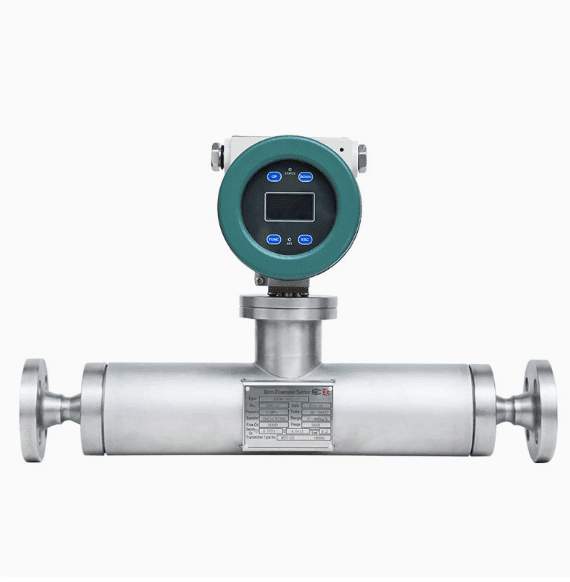
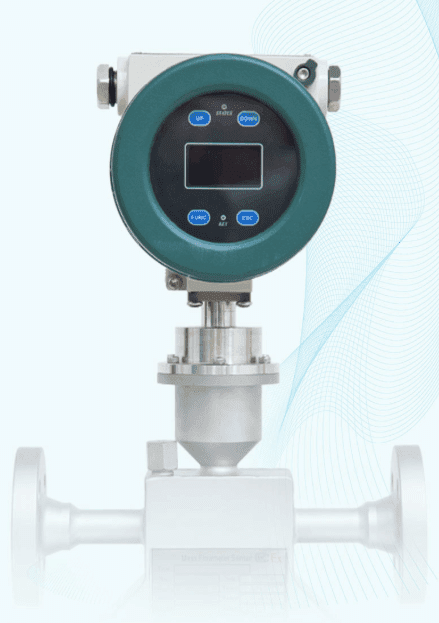
Choosing the wrong Coriolis flow transmitter can cost your operation far more than the price of the instrument itself. A mismatched meter leads to inaccurate mass flow readings, premature sensor corrosion, chronic maintenance issues, and — in custody transfer applications — direct financial losses that compound with every batch. With Coriolis meters ranging from $3,000 to over $25,000 per unit, the stakes of getting the selection wrong are painfully high.
Even experienced process engineers and procurement specialists can overlook critical factors during selection. The Coriolis flow transmitter is one of the most capable instruments in the flow measurement world — delivering ±0.1% accuracy, simultaneous mass flow, density, and temperature measurement — but that capability only materializes when the right meter is matched to the right application. Miss a detail on fluid chemistry, undersize the meter for your flow range, ignore the installation environment, or skip the communication protocol check, and you are buying problems rather than solutions.
This article outlines the most common mistakes professionals make when selecting a Coriolis flow transmitter and provides actionable tips to avoid each one. Whether you’re specifying a meter for a new chemical processing line, upgrading a custody transfer station, or evaluating options for a food-grade batching system, use this guide as a checklist. At Jade Ant Instruments, we’ve helped engineers across industries navigate these decisions — and the mistakes described here are the ones we see most often.
Overlooking Fluid Compatibility
Fluid Properties
The first and most consequential mistake is failing to fully characterize the process fluid before selecting a meter. A Coriolis transmitter’s measuring tubes are in direct contact with the fluid — every property of that fluid matters. Viscosity affects the pressure drop across the meter and can influence accuracy at low flow rates. Density affects the meter’s resonant frequency and, if it changes significantly during operation, may require advanced signal processing to maintain accuracy. Corrosiveness, abrasiveness, and the presence of entrained solids or gas all have the potential to damage the sensor or degrade measurement quality.
Temperature and pressure of the fluid are equally critical. A meter specified for ambient-temperature water will not survive high-temperature thermal oil or cryogenic liquid nitrogen. Process fluids that polymerize, crystallize, or coat surfaces over time can foul the vibrating tubes and shift the zero point — a problem that is difficult to detect without advanced diagnostics and that leads to gradually worsening measurement errors. Before contacting any vendor, document the full range of fluid properties your meter will encounter, including worst-case conditions during startup, shutdown, and cleaning cycles.
Material Selection
Once you understand the fluid, you must match it to the right wetted materials. The most common wetted materials for Coriolis flow meters are 316L stainless steel (suitable for a wide range of non-aggressive fluids), Hastelloy C-22 (for corrosive acids, chlorides, and aggressive chemicals), and tantalum (for the most severe corrosion applications, such as hot sulfuric acid or hydrochloric acid). Some specialized applications require Alloy 400 (Monel), titanium, or nickel.
The mistake is assuming that 316L stainless steel is “good enough” for every application — or worse, not checking wetted materials at all. A single incompatible material component can lead to stress corrosion cracking, pitting, or catastrophic tube failure. Always cross-reference your fluid chemistry against the manufacturer’s corrosion guide. Manufacturers like Emerson (Micro Motion) and Endress+Hauser publish detailed corrosion resistance data for each material option. If your fluid is not listed, request a formal compatibility assessment before ordering. When advising customers on material selection, the engineering team at Jade Ant Instruments always recommends starting with the fluid chemistry datasheet rather than the meter datasheet.
| Wetted Material | Compatible Fluids | Not Recommended For | Relative Cost |
|---|---|---|---|
| 316L Stainless Steel | Water, oils, mild chemicals, food products, clean gases | Strong acids (HCl, H₂SO₄), high-chloride environments | $ |
| Hastelloy C-22 | Corrosive acids, chlorine-bearing chemicals, aggressive solvents | Fluorine gas, molten metals | $$ |
| Tantalum | Hot sulfuric acid, hydrochloric acid, extreme corrosives | Fluorine gas, strong alkalis at high temperature | $$$ |
| Alloy 400 (Monel) | Hydrofluoric acid, seawater, brackish water | Oxidizing acids, sulfur compounds | $$ |
| Titanium | Seawater, chlorine dioxide, bleach, wet chlorine gas | Dry chlorine gas, red fuming nitric acid | $$–$$$ |
Note: Always verify compatibility with the specific fluid concentration, temperature, and pressure. This table provides general guidance only.
Ignoring Flow and Process Conditions
Flow Rate and Turndown Ratio
One of the most common sizing errors is selecting a Coriolis meter based solely on the pipe diameter rather than the actual flow rate. Coriolis meters often have internal tubes that are significantly smaller than the process piping — a 2-inch meter might have internal tubes equivalent to a 1-inch pipe. If you simply match pipe size to meter size, you may end up with an oversized meter operating at the bottom of its range, where accuracy degrades significantly.
Coriolis meters offer impressive turndown ratios — typically 80:1 to 100:1 — meaning a meter rated for 200 GPM maximum can still deliver accurate readings at 2 GPM. However, this assumes proper sizing. The correct approach is to size the meter based on your normal operating flow rate, ensuring it falls in the upper third to middle of the meter’s range for optimal accuracy, while verifying that your maximum and minimum flow rates both fall within the meter’s specified range.
Pressure drop is the other half of the sizing equation. A smaller meter produces higher velocity through the measuring tubes, which improves accuracy — but it also creates more pressure drop. In gravity-fed systems or low-pressure applications, excessive pressure drop can cause cavitation, two-phase flow, or simply insufficient downstream pressure. According to Emerson’s best practices for Coriolis meter selection, the goal is to select the smallest meter that delivers acceptable pressure drop at maximum flow rate while maintaining your required accuracy at minimum flow rate.
Temperature and Pressure
Every Coriolis meter has defined operating limits for fluid temperature and line pressure. Exceeding these limits — even temporarily during startup transients, sterilization cycles, or upset conditions — can damage the sensor, void the warranty, or create safety hazards. Specifying a meter for normal operating conditions without considering excursion conditions is a mistake that has caused numerous field failures.
Temperature also affects measurement accuracy. The Young’s modulus of the measuring tube material changes with temperature, which affects the tube’s stiffness and, consequently, the Coriolis force generated by a given mass flow rate. Modern transmitters include temperature compensation algorithms, but these have limits — and their effectiveness depends on the temperature sensor being properly installed and the compensation coefficients being correctly configured for the specific sensor model. For high-temperature or cryogenic applications, always verify that the meter is not just rated for the temperature but is specifically designed and calibrated for it.
Impact of Sizing Errors on Coriolis Meter Performance (Bar Chart)
╔═══════════════════════════════════════════════════════════════════════════╗
║  IMPACT OF SIZING ERRORS ON CORIOLIS METER PERFORMANCE                   ║
║  (Estimated Accuracy Degradation by Error Type)                          ║
╠═══════════════════════════════════════════════════════════════════════════╣
║                                                                           ║
║  Oversized meter              ████████████████████ 5–10× rated error     ║
║  (operating at <10% range)                                               ║
║                                                                           ║
║  Excessive pressure drop      ████████████████ Cavitation → total loss   ║
║  (causing two-phase flow)                                                 ║
║                                                                           ║
║  Temperature exceedance       ████████████ 2–5× rated error              ║
║  (beyond compensation range)                                              ║
║                                                                           ║
║  Correct sizing               █ Within ±0.1% rated spec                  ║
║  (normal operating range)                                                 ║
║                                                                           ║
║  Note: Proper sizing is the single most impactful decision               ║
║  for Coriolis meter accuracy after fluid compatibility.                  ║
╚═══════════════════════════════════════════════════════════════════════════╝
Neglecting Pipe Size and Connections
Sizing the Flow Transmitter Coriolis
As mentioned above, Coriolis meter sizing is not synonymous with pipe sizing. The meter’s internal tube diameter is determined by the flow rate and pressure drop requirements — not by the process pipe diameter. It is common and often advisable to install a Coriolis meter that is one or even two sizes smaller than the process pipe, using concentric reducers to transition between the pipe and the meter flanges.
However, this approach must be executed carefully. Abrupt transitions (eccentric reducers, sharp expansions) can create turbulence and pressure recovery issues. The meter manufacturer’s sizing tools should be used to verify that the selected meter size provides acceptable pressure drop, adequate signal-to-noise ratio at minimum flow, and sufficient measurement tube velocity across the expected operating range. Most major manufacturers offer online or downloadable sizing tools for this purpose.
Process Connections
Coriolis flow meters are available with a variety of process connection types: ASME flanges, DIN flanges, tri-clamp (sanitary) connections, NPT threads, and welded ends. The mistake is ordering the wrong connection type, the wrong pressure rating, or the wrong face finish — any of which can require costly field modifications, adapter spools, or complete reorders.
Sanitary applications (food, beverage, pharmaceutical) typically require tri-clamp connections with surface finishes of 0.8 µm Ra or better to meet 3-A Sanitary Standards or EHEDG guidelines. High-pressure oil and gas applications may require ASME Class 300, 600, or even 900 flanges. Chemical applications may need lined or coated flanges to prevent gasket compatibility issues. Verify the exact connection specification against your piping isometric drawing before placing the order — and confirm the face-to-face dimension to ensure the meter physically fits into the available space. Jade Ant Instruments’ flow meter selection guide includes connection compatibility considerations to help prevent these errors.
Underestimating Installation Needs
Space and Orientation
Coriolis flow meters — particularly the U-tube and bent-tube designs that dominate the market — are physically larger and heavier than most other meter types for the same pipe size. A 3-inch Coriolis meter can weigh 50–100 kg or more, and its footprint may extend significantly beyond the pipe centerline. Failing to account for this in the piping layout is a surprisingly common error that leads to last-minute design changes, custom supports, or forced compromises in meter location.
Orientation matters as well. For liquid measurement, the preferred installation is with flow going upward through a vertical pipe section, which ensures the measuring tubes remain completely filled and allows entrained gas to pass through rather than accumulating. Horizontal installation is acceptable for most designs, but the meter should be oriented with the measuring tubes below the pipeline centerline (for U-tube designs) to facilitate self-draining and prevent gas accumulation. Installation with downward flow in a vertical pipe is generally not recommended because it can result in partially filled tubes and inaccurate readings. According to DwyerOmega’s Coriolis installation guide, vertical upward flow is the most desirable configuration.
Vibration and Piping
Coriolis flow meters work by measuring the tiny phase shift in the vibration of their measuring tubes — and they are, by design, highly sensitive vibrating instruments. External vibration from pumps, compressors, or other rotating equipment can interfere with the meter’s drive signal and measurement signal, causing noise, zero drift, or outright measurement failure. This is one of the most underestimated installation factors.
The solution is to isolate the meter from vibration sources as much as possible. Do not mount the meter directly on a pump discharge or compressor outlet without adequate pipe length and supports between the vibration source and the meter. The piping on both sides of the meter should be properly supported — the meter should not carry the weight of the piping, and the piping should not transmit vibration to the meter. Flexible hoses or expansion joints between the vibration source and the meter can help, but they must not create a “soft” mechanical connection that allows the meter to oscillate on the piping.
While Coriolis meters are often marketed as requiring “zero straight pipe runs” (unlike differential pressure or ultrasonic meters), the piping around the meter still matters. Significant flow disturbances — partially open valves, two-phase flow, flashing — should be managed upstream of the meter. Proper drainage and venting must be planned to avoid gas pockets in horizontal installations.
Watch: How to Install a Coriolis Flow Meter
Video credit: Emerson — How to Install a Micro Motion Coriolis Meter
Overlooking Accuracy Requirements
Accuracy Specifications
Coriolis meters are capable of extraordinary accuracy — ±0.1% of reading for liquids, ±0.35% to ±0.5% for gases — but these headline numbers come with conditions. The rated accuracy applies within a specific flow range, at a specific calibration temperature and pressure, with a specific fluid type, and after a proper zero calibration. Outside these conditions, actual accuracy can be significantly worse than the datasheet number.
The mistake is treating the rated accuracy as a guaranteed performance number across all operating conditions. In reality, accuracy degrades at low flow rates (near the low-flow cutoff), at temperatures far from the calibration temperature, with two-phase flow (gas in liquid or liquid in gas), and when the meter’s zero point has drifted. Understanding the difference between “accuracy of reading” (which scales with the measured value) and “zero stability” (which is a fixed absolute error) is essential. At low flows, zero stability dominates the total error — a meter with ±0.1% accuracy and a zero stability of 0.05 kg/h will have much larger percentage error at a flow rate of 1 kg/h than at 1,000 kg/h.
Application Demands
Different applications have vastly different accuracy requirements. Custody transfer of crude oil or refined products may demand ±0.1% or better, verified by regular proving against a calibrated prover. Chemical batching may require ±0.5% for consistent product quality. Wastewater monitoring may only need ±2%. Specifying (and paying for) ±0.1% accuracy when your application only needs ±1% is a waste of capital. Conversely, specifying a lower-cost meter with ±0.5% accuracy for a custody transfer point can result in significant financial exposure.
Match the meter’s accuracy specification to the actual requirement of the application, including any regulatory or contractual accuracy mandates. If you are unsure what accuracy your application requires, the Jade Ant Instruments Coriolis flow meter pros and cons guide provides practical context for how accuracy translates to real-world performance.
Forgetting Calibration and Maintenance
Calibration Frequency
Coriolis flow meters are often perceived as “install and forget” instruments because they have no moving parts and maintain their calibration well over time. While this is true relative to mechanical meters like turbine or positive displacement meters, it does not mean calibration can be ignored entirely. Calibration drift can occur due to tube erosion (in abrasive service), corrosion, mechanical stress from thermal cycling or pressure fluctuations, and changes in the electronic transmitter over time.
Industry best practice recommends calibration verification at least annually for general process applications and more frequently (every 6 months or per batch) for custody transfer, fiscal metering, and regulated pharmaceutical applications. The Fluke calibration best practices guide recommends establishing calibration intervals based on historical data — start with annual calibration and adjust the interval based on observed drift trends.
Many modern Coriolis transmitters include meter verification diagnostics (such as Emerson’s Smart Meter Verification or Endress+Hauser’s Heartbeat Technology) that can confirm the meter’s structural integrity and calibration status in situ, without removing the meter from service. Specifying a transmitter with these capabilities can dramatically reduce the cost and disruption of calibration verification.
Maintenance Planning
While Coriolis meters have low maintenance requirements compared to mechanical meters, they are not maintenance-free. Planning for maintenance means budgeting for periodic calibration checks, allocating space and isolation valves for removing the meter when full calibration is required, training operators on transmitter diagnostics and zero verification procedures, and establishing a spare parts strategy for critical installations.
The most commonly neglected maintenance task is zero verification and re-zeroing. A Coriolis meter’s zero point can drift due to changes in tube coating, fluid property shifts, or mechanical stress — and zero error directly affects accuracy at all flow rates. Most manufacturers recommend performing a zero verification after installation, after any piping modification, and at each scheduled maintenance interval. This simple procedure takes minutes and can prevent significant measurement errors.
| Activity | General Process | Custody Transfer | Pharmaceutical |
|---|---|---|---|
| Zero verification | Every 6 months | Monthly or per proving schedule | Per batch / campaign |
| In-situ meter verification | Annually | Quarterly | Every 6 months |
| Full wet calibration | Every 2–5 years | Annually (or per regulation) | Annually |
| Visual inspection | Annually | Every 6 months | Per maintenance schedule |
| Transmitter firmware update | As released | After validation | After change control approval |
Ignoring Cost Factors
Initial Price vs. Total Cost
Coriolis flow meters carry the highest initial purchase price of any common flow meter technology. A basic unit for small pipe sizes starts around $3,000, while large-diameter meters with exotic materials and advanced transmitters can exceed $25,000. Facing this sticker shock, some buyers choose a smaller, cheaper, or lower-specification meter to reduce the capital expenditure — a decision that often costs far more in the long run.
The initial purchase price typically represents only 25–35% of the total cost of ownership over a 10–15 year meter lifecycle. The remaining 65–75% comes from installation (piping modifications, reducers, supports, wiring), commissioning (configuration, calibration verification, integration testing), calibration and maintenance (annual checks, periodic wet calibration, spare parts), energy costs (pressure drop through the meter requires pumping energy), and downtime costs (if the meter fails or drifts and the process must be stopped for repair or recalibration).
The cheapest meter on the price quote is almost never the cheapest meter over its lifetime. A properly sized, correctly specified Coriolis meter from a reliable manufacturer delivers lower total cost through fewer failures, longer calibration intervals, better accuracy (which reduces product giveaway or loss), and lower maintenance demands.
Long-Term Value
Evaluate Coriolis meter investments on a lifecycle basis. A meter with ±0.1% accuracy that costs $15,000 more than a ±0.5% alternative may pay for itself in months if it reduces product giveaway by 0.4% on a high-value custody transfer point. A meter with built-in verification diagnostics may cost 15% more upfront but eliminates the need for annual removal and wet calibration — saving $5,000–$10,000 per calibration event in labor, downtime, and logistics.
When comparing vendors, request total cost of ownership estimates that include all lifecycle costs. Jade Ant Instruments’ manufacturer comparison guide includes lifecycle cost considerations alongside technical specifications to help buyers make informed decisions.
Coriolis Flow Meter — Total Cost of Ownership Breakdown (Pie Chart)
╔═══════════════════════════════════════════════════════════════════════╗
║   CORIOLIS FLOW METER — TOTAL COST OF OWNERSHIP (10-YEAR LIFECYCLE)  ║
╠═══════════════════════════════════════════════════════════════════════╣
║                                                                       ║
║               ████████████████████                                    ║
║           ████      Purchase        ████                              ║
║         ██          Price              ██                            ║
║       ██            30%                  ██                          ║
║      ██                                   ██                         ║
║      █     ████████████████                █                         ║
║      ██   █ Installation  █               ██                         ║
║       ██  █     20%       █             ██                           ║
║         ██████████████████            ██                             ║
║           ████ Calibration 20%   ████                                ║
║               █████ Energy 15% ██                                    ║
║                    ████████████                                       ║
║              Maintenance 10%                                          ║
║              Downtime/Misc 5%                                         ║
║                                                                       ║
║  ████ Purchase Price (30%)                                           ║
║  ████ Installation & Commissioning (20%)                             ║
║  ████ Calibration & Verification (20%)                               ║
║  ████ Energy Cost — Pressure Drop (15%)                              ║
║  ████ Maintenance & Spare Parts (10%)                                ║
║  ████ Downtime & Miscellaneous (5%)                                  ║
╚═══════════════════════════════════════════════════════════════════════╝
Note: Percentages are approximate and vary significantly by application, meter size, and operating conditions.
Not Understanding Coriolis Type Flow Meter Principles
How Coriolis Meters Work
A Coriolis flow meter exploits the Coriolis effect — the apparent deflection of a moving object within a rotating reference frame. In the meter, one or two measuring tubes are vibrated at their natural resonant frequency by a driver coil. When fluid flows through the vibrating tubes, the Coriolis force causes the tubes to twist — the inlet side lags behind the outlet side (or vice versa). Sensors at the inlet and outlet of the tubes detect the phase shift between the two signals, and this phase shift is directly proportional to the mass flow rate.
Simultaneously, the resonant frequency of the vibrating tubes changes with the density of the fluid inside them — a denser fluid reduces the resonant frequency. This allows the meter to measure density and, with the integrated temperature sensor, to derive volumetric flow rate, concentration, and other calculated variables.
Understanding this principle is essential for avoiding selection mistakes because it explains why Coriolis meters are sensitive to entrained gas (gas bubbles change the effective density and dampen the vibration), why vibration isolation matters (external vibration interferes with the drive and measurement signals), and why tube geometry affects accuracy (straight tubes, U-tubes, and omega-shaped tubes each have different sensitivity characteristics and application strengths).
Selecting the Right Meter Type
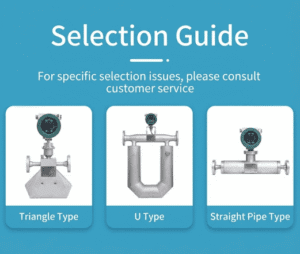
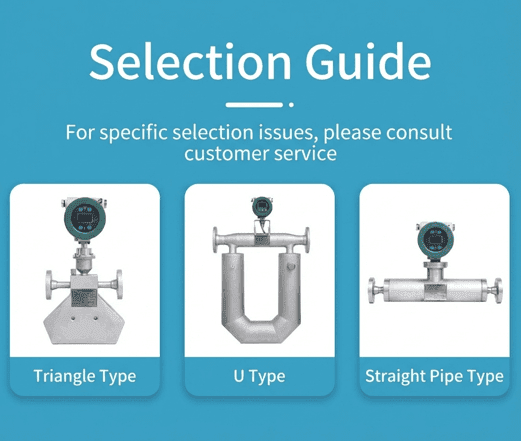
Coriolis meters come in several tube geometries, each with distinct trade-offs. Bent-tube (U-tube, omega, or delta) designs offer higher sensitivity, better zero stability, and easier draining but have a larger footprint, higher pressure drop, and more susceptibility to installation effects. Straight-tube designs are more compact, easier to install, and easier to clean (important for sanitary applications) but may have slightly lower sensitivity and higher susceptibility to thermal effects.
For sanitary applications in food, beverage, and pharmaceutical industries, straight-tube designs with tri-clamp connections are often preferred because they are fully drainable and cleanable. For high-accuracy custody transfer, bent-tube designs with proven long-term stability may be preferred despite their larger size. For high-pressure gas applications, specific sensor designs optimized for gas density and flow dynamics are required. Selecting the wrong tube geometry for the application is a mistake that is difficult to correct after installation.

Overlooking Communication and Integration
System Compatibility
A Coriolis transmitter is only useful if it can communicate its measurement data to the control system, historian, safety system, or other devices in your plant’s automation architecture. The most common communication protocols for Coriolis transmitters include 4–20 mA analog output (universal but limited to a single variable), HART (superimposed digital communication on the 4–20 mA signal, allowing access to multiple variables and diagnostics), Modbus RTU/TCP (serial or Ethernet-based digital communication), PROFIBUS PA/DP (common in European and process industry installations), Foundation Fieldbus (used in advanced DCS environments), and EtherNet/IP or PROFINET (increasingly common in modern facilities).
The mistake is assuming that every transmitter supports every protocol or that the protocol can be changed in the field. Many Coriolis transmitters are ordered with a specific communication board, and changing the protocol after delivery may require a board swap, a factory return, or purchasing a new transmitter entirely. Before ordering, confirm: which protocol does your control system use? Does the transmitter model you’ve selected support it natively? If you need multiple outputs (e.g., 4–20 mA for the DCS and Modbus for a local display), does the transmitter offer dual outputs?
Data Output Options
Beyond the communication protocol, consider which variables you need transmitted and how. A Coriolis meter can typically output mass flow rate, volumetric flow rate, density, temperature, and totalized flow — but the number of simultaneous outputs and their update rates depend on the protocol and transmitter configuration. For custody transfer, you may need a pulse output for batch totalization that is directly compatible with a flow computer. For process control, you may need a fast-response analog or digital output for closed-loop control.
Alarm outputs, status indicators, and diagnostic data access are also important considerations. Modern transmitters can report sensor health, drive gain, tube coating detection, and other diagnostic parameters — but only if the communication infrastructure supports the data exchange. Planning the data architecture at the specification stage, rather than discovering compatibility issues during commissioning, saves significant time and frustration.
Disregarding Vendor Support
Technical Support
The sophistication of Coriolis flow measurement means that vendor technical support is not optional — it is an essential component of a successful installation. From initial sizing and configuration to commissioning, troubleshooting, and periodic calibration, you will need access to knowledgeable support engineers who understand your application and the specific meter you’ve installed.
Evaluate potential vendors on the availability and quality of their technical support: do they offer phone, email, and on-site support? Are response times guaranteed by SLA? Do they have application engineers who specialize in your industry (oil and gas, chemical, food and beverage, pharmaceutical)? Can they support the specific transmitter model and firmware version you’ll be using? Some suppliers offer 24/7 global support; others operate business-hours-only in limited regions. For critical applications, the difference between a 2-hour and 2-day response time can translate directly into lost production and revenue.
Training and Warranty
Operator and maintenance technician training is one of the most overlooked elements of a Coriolis meter investment. Without proper training, operators may not know how to perform zero verification, interpret diagnostic messages, or recognize symptoms of measurement problems. Maintenance technicians may be unable to troubleshoot wiring issues, configure communication parameters, or perform in-situ meter verification.
Warranty terms vary significantly between manufacturers and even between product lines from the same manufacturer. Standard warranties may range from 1 year to 5 years, with extended warranties available at additional cost. Pay attention to what the warranty covers (sensor only, or sensor and transmitter?), what conditions void the warranty (improper installation, unauthorized modification, exposure to incompatible fluids), and what the warranty remedy includes (repair, replacement, or credit). A longer warranty from a financially stable manufacturer provides real risk reduction on a high-value capital instrument.
At Jade Ant Instruments, we emphasize vendor support as a critical selection criterion, not an afterthought. Our flow meter distributor selection guide details what to look for in a supplier relationship to ensure long-term success.

Selecting a Coriolis flow transmitter is a multi-dimensional engineering decision that touches fluid chemistry, process conditions, mechanical design, digital integration, commercial strategy, and long-term operational planning. The mistakes outlined in this guide — overlooking fluid compatibility, ignoring flow and process conditions, neglecting pipe size and connections, underestimating installation needs, overlooking accuracy requirements, forgetting calibration and maintenance, ignoring cost factors, not understanding the measurement principle, overlooking communication compatibility, and disregarding vendor support — represent the most common paths to a failed or underperforming Coriolis installation.
A thorough evaluation process that addresses each of these factors will dramatically improve the probability of selecting the right meter the first time. Use the tables, checklists, and decision frameworks in this article as a starting point. For complex applications — high temperature, aggressive chemistry, multi-phase flow, custody transfer, or safety-critical service — consult with experts who have deep experience in Coriolis technology.
If you need personalized guidance on Coriolis flow transmitter selection, sizing tools, or application engineering support, the team at Jade Ant Instruments is ready to help. Request a consultation or quote today.
Frequently Asked Questions (FAQ)
1. What is the most common mistake when selecting a Coriolis flow transmitter?
The most common mistake is incorrect sizing — specifically, choosing a meter based on the pipe diameter rather than the actual flow rate. Coriolis meters often have internal tubes significantly smaller than the process pipe, and oversized meters operating at the bottom of their range deliver significantly degraded accuracy. Always size based on your normal operating flow rate, not the pipe size. For guidance, see the Jade Ant Instruments flow meter selection guide.
2. How do I choose the right wetted material for my Coriolis meter?
Start by documenting the complete fluid chemistry, including concentration, temperature, and any trace contaminants. Cross-reference this data against the manufacturer’s corrosion guide for each available material option. For mild to moderately corrosive fluids, 316L stainless steel is often sufficient. For aggressive acids and chloride-bearing chemicals, Hastelloy C-22 is the standard choice. For extreme corrosion applications (hot sulfuric acid, HCl), tantalum may be required. When in doubt, request a formal material compatibility assessment from the manufacturer.
3. Does a Coriolis meter need straight pipe runs like other flow meters?
Coriolis meters have minimal upstream and downstream straight pipe requirements compared to differential pressure, ultrasonic, or electromagnetic meters. Most manufacturers state that no straight pipe runs are required for accuracy. However, proper piping practices are still important: avoid installing the meter immediately downstream of a partially open valve (which can cause cavitation), ensure the piping is supported so it does not transmit vibration to the meter, and verify that the meter can be fully drained if needed.
4. How often should a Coriolis flow meter be calibrated?
For general process applications, annual in-situ meter verification and full wet calibration every 2–5 years is a common practice. For custody transfer and fiscal metering, annual full calibration (or more frequent proving) is typically required by regulation or contract. For pharmaceutical applications, calibration frequency is determined by the validation protocol and GMP requirements. Many modern transmitters offer built-in verification diagnostics that can extend the interval between full wet calibrations by confirming the meter’s health in situ.
5. Why are Coriolis flow meters so expensive compared to other technologies?
Coriolis meters are expensive because of the precision engineering required: the measuring tubes must be manufactured to extremely tight tolerances, the materials (especially exotic alloys like Hastelloy and tantalum) are costly, the electronic transmitter contains sophisticated digital signal processing, and each meter is individually calibrated at the factory against a traceable reference standard. However, the total cost of ownership is often competitive with or lower than less expensive meter types because Coriolis meters require minimal maintenance, have long calibration intervals, and deliver the highest accuracy — reducing product giveaway and measurement-related financial losses.
6. Can a Coriolis meter handle two-phase flow (gas and liquid)?
Standard Coriolis meters struggle with two-phase flow because entrained gas changes the effective density in the measuring tubes, dampens the vibration, and can cause measurement errors or complete signal loss. Some advanced transmitters (such as Emerson’s Micro Motion with Advanced Phase Measurement) include algorithms designed to handle moderate amounts of entrained gas — but performance is degraded compared to single-phase operation. If your application involves regular two-phase flow, discuss this with the manufacturer before selection and expect reduced accuracy compared to single-phase specifications.
7. What communication protocol should I specify for my Coriolis transmitter?
The protocol should match your existing automation infrastructure. If your plant uses a DCS with 4–20 mA/HART inputs, specify HART. If you use Modbus RTU for field devices, specify Modbus. If your facility is migrating to industrial Ethernet, consider EtherNet/IP or PROFINET. The key is to confirm compatibility before ordering — protocol changes after delivery can be costly and time-consuming.
8. What is zero stability and why does it matter?
Zero stability is the fixed measurement error (in absolute flow units, e.g., kg/h) that exists regardless of the actual flow rate. It represents the minimum flow the meter can distinguish from zero flow. At high flow rates, zero stability is negligible compared to the flow rate. At low flow rates, it dominates the total error. For example, a meter with ±0.1% accuracy and 0.05 kg/h zero stability delivers ±0.1% error at 100 kg/h but ±5% error at 1 kg/h. If your application involves low flow rates, zero stability is more important than the headline accuracy percentage.
9. How heavy are Coriolis flow meters and does weight matter for installation?
Coriolis meters are among the heaviest flow meter types. A 2-inch meter typically weighs 25–50 kg; a 4-inch meter can weigh 100–200 kg or more. This weight must be supported by the piping system or dedicated meter supports — the piping should not sag or stress under the meter’s weight, and the meter should not carry the weight of adjacent piping. In elevated or suspended installations, structural analysis may be required. Always check the weight specification and plan the support structure before installation.
10. Where can I get expert help selecting a Coriolis flow transmitter for my specific application?
For personalized application engineering support, Jade Ant Instruments provides consultation on Coriolis flow meter selection, sizing, material compatibility, and system integration. You can also reference detailed manufacturer resources from Emerson Micro Motion and Endress+Hauser. For international standards, consult ISO 10790, which provides guidance on the selection, installation, and use of Coriolis meters.