

A practical comparison guide showing installation costs, downtime, maintenance requirements, and ROI for different deployment methods across various industrial applications — designed to help B2B distributors and agents make informed recommendations to their clients.
Every recommendation you make to a client starts with a question they might not even know to ask: “Which installation method actually costs less over time?”
For ultrasonic flow meters, that question is more consequential than most. The difference between recommending an inline spool-piece versus a clamp-on external system is not simply a matter of price tags — it can mean the difference between a client absorbing a week of unplanned process downtime or running a live installation in under an hour. It can mean a five-year maintenance bill of $2,000 versus $8,000. It can mean winning a project because your recommendation justified the investment, or losing follow-on business because the selected meter underperformed in its real-world environment.
As a distributor or agent in the flow measurement industry, your value is not just product supply — it is application intelligence. Clients rely on you to translate technical specifications into business outcomes they actually care about: operational continuity, capital efficiency, regulatory confidence, and a measurable return on every instrument investment.
The global ultrasonic flow meter market is projected to grow from USD 2.18 billion in 2026 to USD 3.56 billion by 2034, driven largely by industrial demand for smarter, lower-maintenance measurement solutions. Within this expansion, the inline-versus-clamp-on decision sits at the center of nearly every project discussion.
This guide arms you with the cost data, performance benchmarks, industry-specific ROI frameworks, and client-ready communication tools you need to make that recommendation confidently — and correctly — every time.
1. Understanding Inline vs. Clamp-On Ultrasonic Flow Meters
What Are Inline Ultrasonic Flow Meters?
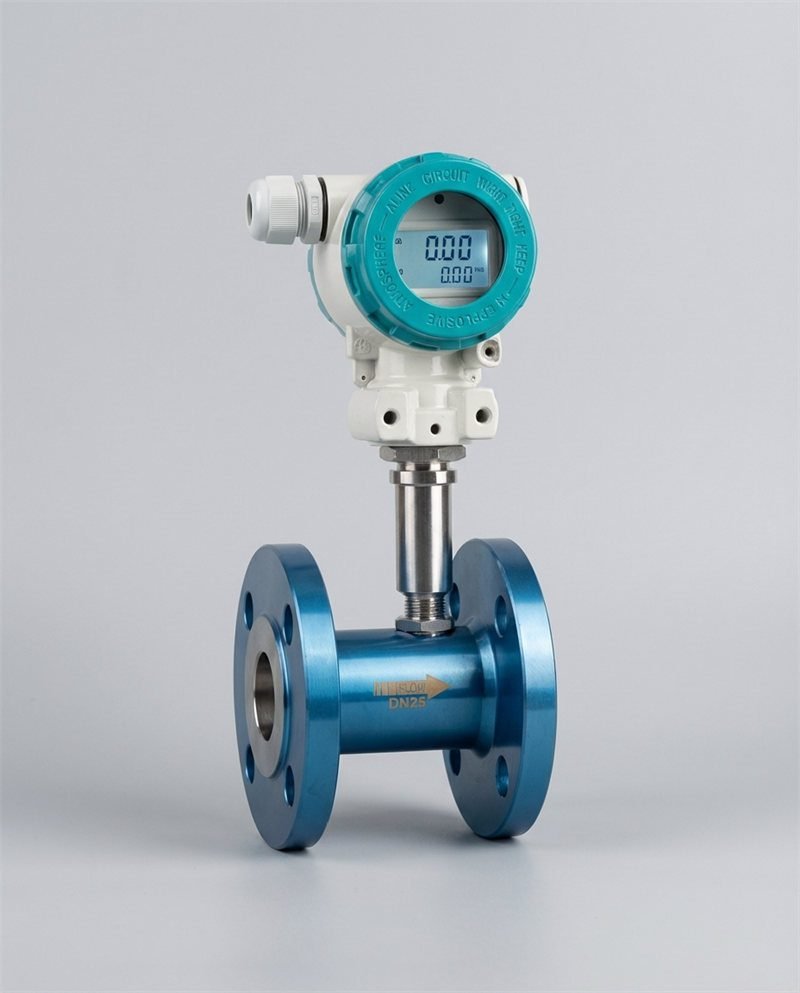
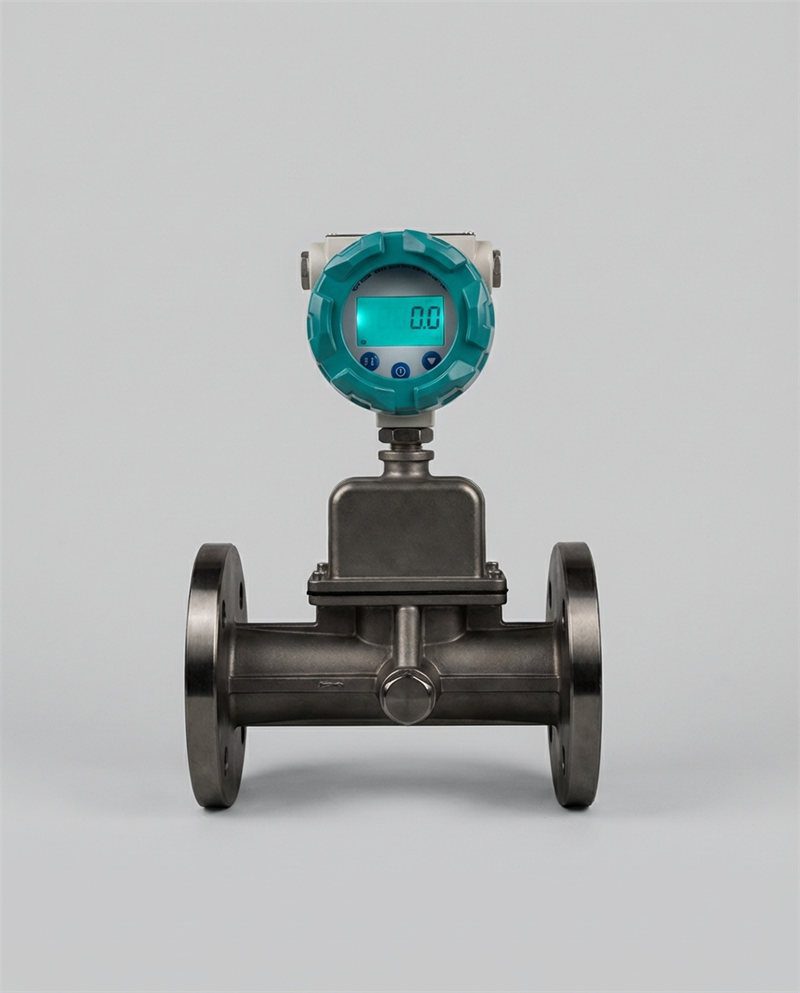
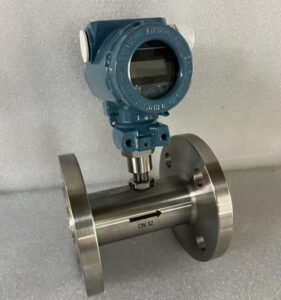
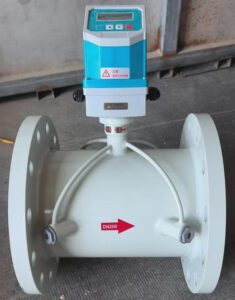
An inline ultrasonic flow meter — also known as a spool-piece meter — is a pre-fabricated pipe section with integrated ultrasonic transducers (piezoelectric sensors) machined directly into its body. Installing it requires cutting out a section of the existing pipe and flanging or welding the meter into place. Because the acoustic path geometry is precisely defined at the factory, inline meters deliver the highest available accuracy: typically ±0.15% to ±0.5% of reading for multi-path configurations and ±0.5% to ±1.0% for single-path models.
This method is inherently invasive — the process must be isolated, drained, and restarted — but the payoff is a permanently installed, calibrated instrument with NIST-traceable accuracy documentation and long-term measurement stability. Multi-path inline meters, which use four to eight ultrasonic chords crossing the pipe at different positions, can even compensate for swirling or asymmetric flow profiles caused by upstream elbows or valves, making them reliable even in imperfect piping layouts.
Typical industries where inline meters are specified include oil and gas custody transfer, pharmaceutical batch documentation, municipal water revenue metering, and chemical plant critical process control — any application where measurement error carries a direct financial or regulatory penalty.
What Are Clamp-On Ultrasonic Flow Meters?
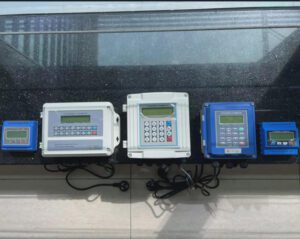
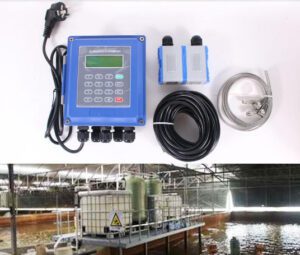
A clamp-on ultrasonic flow meter attaches its transducers to the outside of an existing pipe using mounting rails, chains, or adhesive fixtures. No pipe cutting. No process shutdown. No contact with the fluid inside. The transducers transmit ultrasonic pulses through the pipe wall and fluid, and the meter calculates flow velocity from the difference in transit time between upstream and downstream pulses.
Installation by a single technician on a known pipe typically takes under an hour. The meter can be repositioned, removed, or redeployed on a different measurement point without any mechanical intervention to the process. This portability makes clamp-on instruments uniquely valuable for energy audits, temporary commissioning verification, and rolling surveys across large facility networks.
Typical accuracy is ±1.0% to ±2.0% for single-path models and ±0.5% to ±1.0% for dual-path systems — more than adequate for monitoring, submetering, efficiency optimization, and most non-fiscal applications.
Key Differences at a Glance
| Parameter | Inline (Spool-Piece) | Clamp-On (External) |
|---|---|---|
| Installation Method | Pipe cut-in; process shutdown required | External mount; zero process interruption |
| Typical Accuracy | ±0.15% – ±1.0% (multi-path) | ±0.5% – ±2.0% (single/dual-path) |
| Turndown Ratio | Up to 400:1 | Up to 100:1 – 150:1 |
| Pipe Compatibility | Any; materials defined at factory | Metal, PVC, HDPE; not for corroded or air-gap-lined pipes |
| Process Fluid Contact | Yes (wetted transducers) | No (non-invasive) |
| Portability | Fixed; permanent installation | Portable or fixed; re-deployable |
| Calibration Method | NIST-traceable wet-flow factory cal | Factory dry-cal; field verification recommended |
| Primary Use Case | Fiscal metering, regulatory compliance | Monitoring, energy auditing, retrofit, temporary |
Glossary — Key Terms Used in This Guide:
- Transit-Time (TT): Measurement principle measuring the difference in ultrasonic pulse travel time upstream vs. downstream. Requires clean, particle-free liquid.
- Doppler: Measures frequency shift of ultrasonic signals reflected off suspended particles. Used in dirty fluids, slurries, wastewater.
- Multi-Path Meter: Inline meter using 4–8 ultrasonic beams at different pipe positions. Achieves highest accuracy by averaging across the full flow profile.
- Turndown Ratio: The range of flow the meter can measure accurately. 100:1 means the meter is accurate from 1% to 100% of its maximum rated flow.
- CapEx / OpEx: Capital Expenditure (purchase and installation) vs. Operating Expenditure (ongoing maintenance, calibration, personnel).
- NIST Traceability: Calibration linked to national measurement standards, providing legally defensible accuracy documentation.
- IP Rating: Ingress Protection rating for dust and water resistance (e.g., IP67 = dustproof and immersion-resistant to 1 m).
2. Installation Costs: A Detailed Breakdown
Inline Installation Expenses
Inline meter installation is a multi-trade operation. For a DN100 (4-inch) process line in an existing facility, the cost structure breaks down as follows:
The meter itself — depending on path count and calibration tier — ranges from $3,000 to $20,000. But for distributors advising clients on total budget, the hardware price is rarely the largest line item. Pipe modification work (cutting, flanging or butt-welding, gaskets, bolting) typically adds $4,000 to $10,000 in labor and materials on a typical retrofit. Process isolation requires draining, depressurizing, and locking out the affected section, which generates $2,000 to $6,000 in coordination, safety permitting, and labor overhead. Pressure testing and post-installation commissioning — including functional verification of signal quality and calibration confirmation — adds another $1,500 to $3,000.
Add the cost of process downtime (quantified separately in Section 3), and the total installed cost of a DN100 inline meter in an operating facility routinely reaches $15,000 to $25,000 — even when the instrument price alone was $5,000. For larger diameter pipes (DN300+), that installed cost can exceed $50,000 when custom spool fabrication, crane lifts for heavy components, and extended outage periods are factored in.
Clamp-On Installation Expenses
Clamp-on installations follow a fundamentally different cost model. The meter and transducers cost $1,500 to $7,000 depending on channel count, accuracy class, and communication options. Installation labor for a single point by a qualified technician — including surface preparation, transducer mounting, cable routing, and commissioning — typically runs $500 to $1,500. Acoustic couplant (gel or solid-state pad) is a minor but ongoing consumable cost. No pipe modification, no welding, no pressure test.
Total installed cost for a clamp-on meter on a DN100 steel pipe in an existing plant: $2,000 to $8,500. That is 3 to 5 times lower than an equivalent inline installation in the same retrofit scenario.
Cost Comparison by Application Type
| Pipe Size | Clamp-On Total Installed Cost | Inline Total Installed Cost | Cost Multiplier |
|---|---|---|---|
| Small (DN25–DN50 / 1–2 inch) | $1,800 – $4,500 | $8,000 – $18,000 | 3.5× – 5× |
| Medium (DN80–DN150 / 3–6 inch) | $2,500 – $8,500 | $12,000 – $28,000 | 3× – 4.5× |
| Large (DN200–DN300 / 8–12 inch) | $3,500 – $12,000 | $20,000 – $55,000 | 4× – 6× |
| Very Large (DN400+ / 16+ inch) | $5,000 – $18,000 | $35,000 – $100,000+ | 5× – 7× |
Sources: Flowell Corporation installation cost data, BCST Group pricing analysis, Jade Ant Instruments field project data.
Industry Insight: One pattern consistently seen across distributor sales cycles is that clients anchor on instrument purchase price and underestimate installation cost. Presenting the full installed-cost comparison — not just catalog prices — is one of the highest-value things you can do for a client early in the project. It often shifts the recommendation entirely.

3. Downtime Impact and Operational Disruption
Inline Installation Downtime
Installing an inline meter in an operating plant means stopping the process. For most industrial applications, that shutdown window needs to be planned, permitted, and coordinated with production scheduling — which means inline installations in continuous-process plants often cannot happen on demand. They are bundled into scheduled maintenance shutdowns or turnarounds, sometimes delaying the measurement project by months.
When an inline installation does proceed, the process shutdown duration depends on pipe size and site complexity. For DN50–DN100 pipes with accessible flanged connections, experienced crews complete cut-in, installation, and recommissioning in 4 to 8 hours. For DN200+ pipes requiring welded connections, scaffold access, or insulation removal and reinstatement, that window extends to 12 to 48 hours or more.
In emergency scenarios — instrument failure with no hot-standby — inline meter replacement means process downtime until the replacement spool piece arrives and is installed. If a specialty meter requires a lead time of 8 to 12 weeks, the operational consequence of that failure is severe.
Clamp-On Installation Downtime
Clamp-on meters require zero process downtime for installation, repositioning, or replacement. The process runs at full capacity while a technician applies couplant, slides the transducer rail into position, and confirms signal quality. A failed clamp-on transducer can be swapped in under 15 minutes without special permits, pipe isolation, or mechanical trades involvement.
This live-installation capability is not just a convenience — it is a strategic advantage in high-continuity environments. Pharmaceutical batch processing plants, food production lines, chemical reactors, and municipal water systems all have varying tolerance for unplanned interruption. For many of these facilities, even a 4-hour unplanned shutdown carries costs in the tens of thousands of dollars per event.
Calculating True Downtime Costs
To quantify downtime cost for client ROI presentations, use the following framework:
For a manufacturing facility generating $40 million in annual revenue on 6,000 operating hours:
A 12-hour inline installation shutdown at this facility costs $60,000 in lost production — before accounting for labor overtime, safety permitting, and restart costs. By contrast, a clamp-on installation on the same point costs zero in downtime.
Industry-specific downtime valuations from field data:
| Industry | Typical Hourly Downtime Cost | Notes |
|---|---|---|
| Oil & Gas Processing | $15,000 – $80,000/hr | Throughput-dependent; includes regulatory notification costs |
| Pharmaceutical Manufacturing | $10,000 – $50,000/hr | Plus batch loss, revalidation costs |
| Food & Beverage Production | $5,000 – $30,000/hr | Includes perishable waste, line cleaning restart |
| Chemical Processing | $8,000 – $40,000/hr | Plus hazardous material management costs |
| Water/Wastewater Utilities | $1,000 – $8,000/hr | Including regulatory reporting obligations |
| HVAC Commercial Buildings | $500 – $3,000/hr | Comfort impact, SLA penalty exposure |
Hidden Cost of Extended Shutdowns: When a shutdown runs over schedule — a welding inspection failure, a gasket leak, a delayed crane — each additional hour multiplies cost. Budget models that use only the “planned” downtime window routinely underestimate true shutdown cost by 30–50%.
4. Maintenance Requirements and Long-Term Costs
Inline Meter Maintenance Obligations
Inline meters are factory-calibrated with NIST-traceable accuracy documentation, but that calibration is not permanent. Over time, deposit buildup on transducer windows — from scaling minerals, biofilm, or polymerizing process chemicals — attenuates the acoustic signal and shifts accuracy. In hard-water systems, visible calcium carbonate deposits on transducer ports develop within 18 to 24 months of installation without water treatment. Scheduled cleaning requires process isolation and mechanical disassembly.
Formal recalibration for fiscal-grade inline meters typically requires removing the spool piece and returning it to an accredited calibration laboratory — a process that generates both direct costs (lab fees of $1,500 to $4,000 per event) and indirect costs (replacement meter or process bypass during the calibration period). Recalibration intervals for regulatory applications are commonly 1 to 3 years.
Clamp-On Meter Maintenance Obligations
Clamp-on meters have no wetted components and no internal surfaces exposed to the process fluid — which eliminates the most common inline maintenance trigger. The primary ongoing maintenance item is acoustic couplant. Standard silicone-based gel degrades in 12 to 24 months in outdoor or elevated-temperature environments; solid-state coupling pads last 5 years or more. A couplant inspection and refresh takes one technician under 30 minutes and requires no process interruption.
Transducer wear is minimal because the sensors are encased in rugged IP67 or IP68 enclosures and never contact the fluid. Mean time between failures (MTBF) for quality clamp-on transducers exceeds 100,000 hours — over 11 years of continuous operation. When a transducer does fail, field replacement is performed without tools, without a work permit, and without process isolation.
Maintenance Cost Projections: 5-Year Model
| Cost Category | Clamp-On (5-Year, DN100) | Inline (5-Year, DN100) |
|---|---|---|
| Scheduled Calibration Verification | $1,000 (2 field checks) | $3,500 (lab recalibration + logistics) |
| Couplant / Transducer Window Maintenance | $300 (gel refresh ×2) | $800 (window inspection, cleaning) |
| Unplanned Maintenance Events (est.) | $400 (transducer swap, no downtime) | $2,000 (isolation, disassembly, recommissioning) |
| Labor Hours (total 5-yr) | 6 – 12 hrs | 24 – 48 hrs |
| 5-Year Maintenance Total | $1,700 – $2,500 | $6,300 – $9,500 |
Representative mid-range estimates for DN100 process metering applications. Regulated or fiscal-grade applications will show higher costs for both types due to more frequent calibration requirements.
Preventive vs. Reactive Maintenance Economics: Operators who implement condition-based maintenance — using the meter’s own signal quality diagnostics to trigger maintenance only when needed — typically reduce maintenance labor costs by 25 to 35% versus fixed-schedule programs. Modern meters from suppliers like Jade Ant Instruments include real-time diagnostic outputs that support this approach.
5. ROI Analysis Across Industrial Applications
Water and Wastewater Treatment Facilities
Water utilities represent the largest single application segment for ultrasonic flow meters globally, accounting for approximately 40% of unit shipments. The measurement needs span a wide range: clean potable water in distribution mains, treated effluent at plant discharge, return activated sludge in biological treatment, and thickened sludge in digesters.
For clean water monitoring — distribution network audit metering, pump station efficiency tracking, district metering area submetering — clamp-on transit-time meters are the dominant technology. A municipal utility deploying clamp-on audit meters across 20 distribution network measurement points achieves installed costs of $50,000 to $170,000 versus an equivalent inline program at $250,000 to $550,000. If the audit program identifies 5% distribution loss reduction generating $300,000 per year in recovered revenue, the clamp-on program delivers ROI in under 7 months.
For revenue metering at district boundaries and pump station discharge — where billing accuracy has direct financial consequence — inline multi-path meters provide the ±0.15% to ±0.5% accuracy required for defensible billing and regulatory compliance. Recommended deployment: Clamp-on for network monitoring and energy efficiency; inline for fiscal metering points only.
Payback Period: Clamp-on monitoring program: 6 to 18 months. Inline fiscal metering: 2 to 4 years.
HVAC and Chilled Water Systems
Building energy sub-metering in large commercial, institutional, and industrial facilities is one of the fastest-growing clamp-on application segments. HVAC systems in large buildings — chilled water loops, condenser circuits, hot water heating systems — require flow measurement for energy accounting, chiller efficiency optimization, and demand-based control. Accurate flow measurement in these systems typically reduces energy consumption by 6 to 12% annually by identifying inefficient pump operation, thermal stratification, and coil fouling.
A 500,000-square-foot commercial building spending $800,000 per year on HVAC energy can recover $48,000 to $96,000 annually through optimized operation enabled by accurate sub-metering. A clamp-on metering program covering six key measurement points at $4,000 to $8,000 per installed point costs $24,000 to $48,000 in total — delivering full payback in 6 to 12 months. Zero shutdown required. Installation during normal building operation.
Recommended deployment: Clamp-on transit-time in virtually all HVAC and chilled water sub-metering scenarios.
Payback Period: 6 to 15 months for energy optimization applications.
 Non-invasive clamp-on installation on chilled water lines — no pipe penetration, no refrigerant loss, operational from day one.
Chemical and Pharmaceutical Processing
These industries share two non-negotiable requirements: measurement accuracy sufficient for process control, and zero risk of product contamination or process disruption from meter installation. Both drive strongly toward clamp-on for monitoring and utility circuit measurement.
In pharmaceutical manufacturing, any modification to a wetted piping component triggers GMP revalidation — a process involving engineering documentation, laboratory validation, regulatory submission, and potentially weeks of production suspension. A clamp-on meter that measures through the existing validated pipe wall without touching the product simply does not create this burden. This is not a minor convenience; pharmaceutical clients have repeatedly reported validation savings of $30,000 to $150,000 per measurement point versus equivalent inline meter installations.
For critical process control where inline accuracy (±0.2% to ±0.5%) is genuinely required — API metering in drug synthesis, batch volumetric documentation under FDA 21 CFR Part 11 — inline meters are specified. But the number of measurement points where this level of precision is truly necessary is smaller than most initial project scopes assume. A robust pre-project audit, like those supported by the application engineering team at Jade Ant Instruments, typically identifies 60 to 75% of proposed inline points that can be served equally well by clamp-on instruments.
Recommended deployment: Clamp-on for utility monitoring, CIP circuit verification, and non-critical process streams; inline for batch documentation and critical process control only.
Payback Period: Clamp-on: 3 to 12 months. Inline for critical points: 2 to 5 years.
Oil and Gas Operations
Oil and gas presents the most demanding measurement environment — high pressures (up to 1,500 psig or more), extreme temperatures, hazardous ATEX-classified areas, and custody-transfer requirements where a 0.1% measurement error on a 100,000-barrel-per-day pipeline represents 100 barrels per day of unaccounted product. At $75 per barrel, that is $7,500 per day — $2.7 million per year — from a single poorly calibrated measurement point.
Inline multi-path meters meeting API MPMS Chapter 5.8 are the only technology accepted for fiscal-grade custody transfer in this environment. The capital intensity is justified: a $25,000 multi-path spool piece that eliminates $500,000 per year in custody-transfer disputes pays back in under 2 weeks of operation.
However, the same oilfield or refinery has hundreds of non-fiscal measurement points — produced water injection, pump performance monitoring, heat exchanger flow balance, utility water — where clamp-on transit-time meters deliver perfectly adequate performance at a fraction of the cost. A large refinery running 400 non-fiscal measurement points with clamp-on meters instead of inline instruments saves $12 million to $35 million in installation costs on a greenfield project.
Recommended deployment: Inline multi-path for all custody transfer and fiscal metering; clamp-on for all monitoring and non-fiscal points.
Payback Period: Inline custody transfer: under 3 months at high throughput. Clamp-on monitoring: 4 to 12 months.
Food and Beverage Manufacturing
Food and beverage plants must balance three competing requirements: sanitary integrity (no contamination of product), process continuity (production lines cannot stop for instrumentation work), and verifiable measurement for batch records and CIP validation. Clamp-on meters satisfy all three simultaneously.
For product-contact measurement where inline is unavoidable — volumetric dosing of ingredients, product transfer between vessels — hygienic inline spool-piece meters with polished bore, full-bore design, and 3-A Sanitary Standards compliance are specified. These are significantly more expensive than standard industrial inline meters: a DN50 sanitary ultrasonic spool piece costs $6,000 to $14,000, versus $2,000 to $4,000 for an equivalent industrial-grade model.
For all utility and CIP circuit monitoring — rinse water flow, clean-in-place chemical flow, cooling water, compressed air drying circuits — clamp-on meters eliminate any contamination risk while providing the flow data needed for process optimization.
Recommended deployment: Clamp-on for all non-product-contact measurement; hygienic inline only where product contact is unavoidable and batch accuracy is documented.
Payback Period: 8 to 18 months for utility and CIP monitoring programs.
6. Hidden Costs You Shouldn’t Overlook
Regulatory Compliance and Documentation
Inline meters come with factory calibration certificates traceable to national measurement standards — a built-in compliance advantage for applications governed by ISO, API, OIML, or FDA regulations. But that certificate has an expiration date. Recalibration programs for regulated applications require documented procedures, qualified personnel, and accredited laboratory services. Over a 5-year period, compliance documentation costs for an inline meter in a regulated application — including recalibration, records management, and audit preparation — can add $3,000 to $8,000 per meter beyond the basic maintenance costs already covered.
Clamp-on meters used in non-fiscal applications carry a lighter compliance burden, but field verification procedures (comparison against a reference meter, or in-situ checks using the meter’s diagnostics) must still be documented to satisfy quality management systems requirements.
System Integration and Compatibility
Inline meters typically require 20 to 40% more integration engineering time than clamp-on meters for equivalent applications. This includes signal output wiring, SCADA/DCS integration testing, P&ID updates, and commissioning documentation. In a large plant with a centralized control system, integration engineering at $100 to $150 per hour for a complex inline meter installation can add $5,000 to $15,000 per point that is invisible in a simple meter price comparison.
Modern clamp-on meters support the same digital communication protocols as inline instruments — HART, Modbus RTU/TCP, Profibus, EtherNet/IP — and integrate into existing SCADA and building management systems with equivalent data quality. The Jade Ant Instruments industrial applications guide covers protocol compatibility in detail across common industrial DCS platforms.
Training and Personnel Development
Clamp-on meters are designed for rapid deployment by instrumentation technicians without specialist training. Most suppliers offer commissioning guides, mobile apps for transducer spacing calculation, and on-device diagnostics that walk operators through installation steps. Practical training for a new technician: 4 to 8 hours of guided installation practice.
Inline multi-path meters in custody-transfer or process control applications require comprehensive training covering calibration procedures, diagnostics interpretation, integration with process safety systems, and regulatory documentation. Typical technician competency development: 16 to 40 hours of formal training plus supervised commissioning experience. At $80 to $120 per technician hour, that training investment represents $1,280 to $4,800 per person — multiplied across a maintenance team.
Contingency Planning and Risk Mitigation
For inline meters in critical process applications, most plant engineers specify a spare spool piece — or at minimum, a pre-approved alternative meter that can be expedited. Holding that spare carries inventory cost, and its absence creates schedule risk when a meter fails unexpectedly. Clamp-on transducers, by contrast, are smaller, lighter, less expensive, and more universally applicable — a single spare transducer pair can serve as backup for multiple meter installations of the same pipe size.
7. Performance Metrics and Accuracy Considerations
Measurement Accuracy Standards
The accuracy comparison between clamp-on and inline meters is frequently misrepresented in product literature. Catalog accuracy specifications describe performance under ideal laboratory conditions — known pipe dimensions, steady fully-developed flow, controlled temperature. Real industrial installations consistently show accuracy degradation from three sources: pipe wall condition, flow profile distortion from upstream fittings, and installation technique.
Under real field conditions:
| Application | Clamp-On (Single-Path) | Clamp-On (Dual-Path) | Inline (Single-Path) | Inline (Multi-Path) |
|---|---|---|---|---|
| HVAC Chilled Water | ±1.5% – ±2.0% | ±0.8% – ±1.2% | ±0.5% – ±0.8% | ±0.15% – ±0.4% |
| Water Distribution | ±1.0% – ±1.8% | ±0.6% – ±1.0% | ±0.4% – ±0.8% | ±0.15% – ±0.5% |
| Chemical Process | ±1.2% – ±2.0% | ±0.7% – ±1.2% | ±0.5% – ±1.0% | ±0.2% – ±0.5% |
| Oil & Gas Custody | Not accepted for fiscal use | Supplemental only | ±0.5% – ±1.0% | ±0.15% – ±0.25% |
| Pharmaceutical | ±1.0% – ±1.5% | ±0.6% – ±1.0% | ±0.3% – ±0.7% | ±0.15% – ±0.3% |
Industry Insight: The critical question for distributors is not “which meter is more accurate?” but “how much accuracy does this application actually require?” A 1.5% error in HVAC sub-metering has negligible operational consequence. A 0.3% error in API custody transfer represents millions of dollars of annual measurement uncertainty. Matching accuracy specification to application need — rather than defaulting to the highest-accuracy option — is where distributors create genuine value.
Reliability and Uptime
Both inline and clamp-on ultrasonic meters carry no moving parts — the fundamental reliability advantage of ultrasonic technology over mechanical meters. MTBF for quality instruments exceeds 100,000 hours. The system availability difference emerges not from the meters themselves, but from repair time when they do fail. A failed clamp-on transducer: online replacement in under 15 minutes. A failed inline spool piece: process isolation, drain-down, replacement procurement (possibly with lead time), reinstallation, and recommissioning — potentially days to weeks of degraded measurement.
Data Quality and SCADA Integration
Both technologies support real-time 4–20 mA analog output, pulse output for totalization, and digital protocols (HART, Modbus, Profibus, EtherNet/IP) for integration with SCADA, DCS, and building management systems. High-end instruments add onboard data logging with non-volatile memory storing up to 12 months of historical data, event logs, and diagnostic records — supporting compliance documentation without relying on external data infrastructure.
The latest generation of clamp-on meters from quality suppliers includes IIoT-ready firmware with secure MQTT or OPC-UA connectivity, enabling direct integration with cloud-based plant analytics platforms. This capability — historically available only on high-end inline custody-transfer meters — is now standard on mid-range clamp-on instruments, making the data quality gap between the two technologies narrower than ever.
8. Implementation Timeline and Project Management
Inline Installation Timeline
A typical inline meter retrofit project in an operating industrial plant follows this sequence:
The project planning and engineering phase — P&ID review, pipe inspection, spool piece dimensional survey, procurement specification — typically requires 2 to 4 weeks before any purchase order is raised. Spool-piece procurement lead times for standard sizes run 4 to 8 weeks; custom sizes or exotic materials can extend to 16 to 20 weeks. Installation and commissioning in a scheduled outage window: 1 to 3 days including safety permitting, isolation, mechanical work, electrical connection, and initial commissioning. Post-installation documentation and calibration certificate issuance: 1 to 2 weeks. Total project duration: 8 to 28 weeks from project authorization to validated operational status.
Clamp-On Installation Timeline
Equipment acquisition for standard clamp-on meters from stock: 1 to 2 weeks (many sizes available from regional inventory). Site survey and installation preparation: 2 to 4 hours by one technician. Installation and commissioning: 1 to 4 hours per measurement point, with no process interruption. Immediate operational readiness: the meter is live and reading within hours of technician arrival. Total project duration: 1 to 3 weeks from authorization to operational status.
This timeline compression is not trivial. In a competitive bidding environment, a distributor who can offer clients “measurement operational in two weeks” versus “eight to twenty weeks” is delivering a tangible competitive advantage — particularly for energy projects with performance-based contracts or process optimization initiatives with defined ROI timelines.
Accelerating ROI Through Faster Deployment
For an HVAC optimization project generating $8,000 per month in energy savings, a 12-week deployment acceleration (clamp-on vs. inline) generates:
That $24,000 of additional value — entirely captured by faster deployment — does not appear in any product specification sheet, but it is real and quantifiable for client proposals.
9. Client Scenarios and Recommendation Framework
Here is a practical video overview of clamp-on ultrasonic flow meter installation principles and best practices, relevant to many of the scenarios below:

How to Install and Use a Clamp-On Ultrasonic Flow Meter — Step-by-step installation guide including transducer placement, parameter configuration, and signal verification.
Scenario 1: Budget-Conscious Small Operations
A food processing SME with a single production line wants to monitor cooling water and CIP rinse flow to reduce water consumption. Budget is limited to $15,000 for the entire instrumentation program covering five measurement points.
With $15,000, an inline program would cover at best two measurement points — leaving 60% of the facility unmeasured. A clamp-on program at $2,500 to $4,000 installed per point covers all five points within budget, delivers real-time data across the entire utility circuit, and generates enough flow data to identify optimization opportunities within the first month of operation. Recommended: Clamp-on across all five points. Expected water savings: 8–15% of utility cost within 6 months.
Scenario 2: Large Industrial Facilities with Multiple Measurement Points
A chemical plant with 40 measurement points across cooling water, process feed streams, and utility circuits is undertaking an energy and water audit program. Of the 40 points, 6 involve critical process streams requiring ±0.5% accuracy for batch documentation; the remaining 34 are monitoring-grade applications.
The optimal strategy is a hybrid deployment: inline multi-path meters for the 6 critical points ($12,000 to $18,000 each, fully installed), and clamp-on transit-time meters for the 34 monitoring points ($3,500 to $6,000 each). Total program cost: approximately $190,000 to $312,000 versus $750,000 to $1.2 million for an all-inline program. The 34 clamp-on points are installed over 3 weeks without any process disruption; the 6 inline points are bundled into the next scheduled 5-day turnaround. Recommended: Hybrid deployment. Estimated savings versus all-inline: $450,000 to $800,000 in installed cost.
Scenario 3: Temporary or Portable Monitoring Needs
An engineering consultancy is conducting a 6-week facility energy audit for a large hospital, covering steam condensate return, chilled water distribution, and domestic hot water circuits. No permanent installation is required — the client needs accurate flow data during the audit period and a final report.
A portable clamp-on meter kit covering DN25 to DN200 pipe diameters can be deployed and relocated across 50+ measurement points during the audit period. The same instrument that measures the chilled water main on day 1 is repositioned to the domestic hot water return on day 8. One instrument delivers data from the entire facility. Recommended: Portable clamp-on. Purchase cost: $4,000 to $8,000 for the audit kit — reusable across all future audit projects.
 A portable clamp-on meter kit can survey an entire facility’s flow measurement points in days — the most cost-effective tool for energy audits and commissioning verification.
Scenario 4: High-Precision Critical Applications
A natural gas distribution company needs to install custody-transfer metering at 8 district gate stations to comply with national billing regulations and AGA 9 accuracy standards. Measurement error of ±0.5% in either direction affects millions of dollars in annual billing.
Inline multi-path meters meeting AGA 9 or equivalent national standards are the only appropriate technology for this application. The investment is fully justified by the financial consequence of billing inaccuracy: at an annual throughput value of $50 million per station, a 0.3% improvement in billing accuracy represents $150,000 per station per year — paying back a $25,000 installed meter cost in under 2 months. Recommended: Inline multi-path, AGA 9 compliant. No alternative is appropriate for fiscal-grade custody transfer.
Scenario 5: Legacy System Retrofitting
A water utility built in the 1980s has 25 electromagnetic flow meters that are failing progressively due to electrode fouling and aging electronics. The pipes range from DN80 to DN600. Budget and operational reality make a full simultaneous replacement program impossible — the utility can afford 3 to 5 shutdowns per year, each covering 2 to 4 meter replacements.
Clamp-on ultrasonic meters can be deployed on failing electromagnetic meter points as interim or permanent replacements without requiring any process shutdown. For DN80 to DN300 pipes in reasonable condition, clamp-on transit-time performance is adequate for distribution monitoring. For DN400 to DN600 large-diameter mains, clamp-on accuracy may be sufficient for routine monitoring; the utility can schedule inline replacements on the largest-diameter, highest-consequence points over a 3-year turnaround program. Recommended: Clamp-on immediate deployment for operational continuity; phased inline replacement for high-value large-diameter fiscal points over 3 years.
10. Building Your Recommendation Strategy
Needs Assessment Framework
Every client engagement should begin with a structured assessment that answers seven questions before any product recommendation is made:
- What is the fluid being measured — clean liquid, dirty/aerated liquid, slurry, or gas? (Determines transit-time vs. Doppler)
- What accuracy is operationally required — and what happens if that accuracy is not met? (Determines inline vs. clamp-on eligibility)
- Can the process be shut down for installation, and if so, for how long? (Defines the practical installation window)
- What is the pipe material, diameter, wall thickness, and surface condition? (Determines clamp-on signal viability)
- Are there regulatory or fiscal measurement requirements that mandate certified accuracy? (May mandate inline regardless of cost)
- What is the total budget, including installation, commissioning, and integration? (Full TCO scope)
- What is the timeline for measurement to be operational? (Deployment timeline constraint)
Clients who cannot answer questions 1 through 3 confidently need a site survey before any specification is prepared. Recommending an instrument before these fundamentals are confirmed is the most common cause of costly mis-specifications that damage client relationships.
Comparative Analysis Tools
Use the following ROI calculation template in client proposals:
5-Year Financial Projection Model (per measurement point, DN100 retrofit):
| Year | Clamp-On Cumulative Cost | Inline Cumulative Cost | Clamp-On Net Advantage |
|---|---|---|---|
| Year 0 (Installation) | $5,500 | $18,000 | $12,500 |
| Year 1 (+ Maintenance) | $6,000 | $19,500 | $13,500 |
| Year 2 | $6,800 | $21,200 | $14,400 |
| Year 3 (+ Recalibration) | $8,000 | $24,500 | $16,500 |
| Year 4 | $8,600 | $26,000 | $17,400 |
| Year 5 | $9,500 | $28,500 | $19,000 |
Inline costs include downtime cost ($8,000 per scheduled maintenance shutdown). Clamp-on assumes no operational interruption for any maintenance activity.
Client Communication Best Practices
Translate technical performance into business language in every proposal. Instead of “clamp-on meters achieve ±1.5% accuracy,” say: “At your current water consumption of 500,000 m³ per year at $1.20 per m³, a 1.5% accuracy meter creates a maximum billing uncertainty of $9,000 per year — well within your operational budget tolerance.” Conversely, “At your current custody-transfer volume of 2 million barrels per year at $75 per barrel, a 0.3% measurement improvement recovers $450,000 annually — 18 months of cost recovery in the first year alone.”
Data-led proposals consistently outperform specification-led proposals in competitive distributor environments. Clients remember financial outcomes, not accuracy percentages.
Follow-Up and Support Systems
Post-installation, schedule a 30-day and 90-day performance check with every clamp-on installation — not because the meters require it, but because these touchpoints generate the client confidence and real-world performance data that become the foundation of your next project recommendation. If signal quality has degraded, it is almost always an early-stage couplant issue that resolves in 30 minutes — addressed proactively before the client notices any measurement drift. For clients operating the Jade Ant Instruments product range, remote diagnostic data available through digital communication protocols enables virtual check-ins without site visits.

Making the Right Choice for Your Clients
The inline-versus-clamp-on decision is never resolved by the specification sheet. It is resolved by the intersection of three realities: what the application genuinely requires in terms of accuracy and regulatory compliance, what the installation environment genuinely allows in terms of process interruption and pipe condition, and what the client’s financial model genuinely supports in terms of capital and operating expenditure.
For the majority of retrofit, monitoring, and energy optimization applications, clamp-on transit-time meters deliver superior total economics — lower installed cost, zero downtime, minimal maintenance, rapid deployment, and adequate accuracy. The 3 to 6× cost differential between installed clamp-on and installed inline systems is not a small rounding error; it is the difference between a project that funds itself in 6 months and one that requires 4 years of operational savings to justify the capital.
For fiscal metering, regulatory-mandated accuracy, and high-pressure custody-transfer applications, inline multi-path meters remain the only appropriate technology — and their higher cost is justified by the financial consequence of measurement uncertainty at those points.
The highest-performing distributors and agents in the flow measurement industry make this distinction consistently and confidently. They do not default to the most expensive option to minimize complaint risk, nor do they underspecify to minimize upfront client cost. They make application-specific recommendations supported by data — and then deliver on those recommendations with reliable supply, competent commissioning support, and ongoing technical partnership.
That is the foundation of a durable B2B relationship in instrumentation. And it starts with knowing, precisely and completely, which setup saves your client the most money.
Call to Action
Ready to Build Your Competitive Advantage in Flow Measurement?
- 📊 Download our comprehensive ROI calculator — quantify inline vs. clamp-on economics for any application in minutes
- 🔬 Request a consultation with our flow meter specialists — application-specific recommendations backed by field data
- 📚 Access our detailed case study library — real-world ROI data from water, oil & gas, chemical, and pharmaceutical deployments
- 🤝 Join our B2B partner webinar series on ultrasonic flow measurement — live technical training for distributors and agents
Frequently Asked Questions
1. What is the typical cost difference between inline and clamp-on ultrasonic flow meter installation?
Inline systems typically cost 3 to 6 times more in total installed cost compared to clamp-on systems in retrofit scenarios. A DN100 clamp-on installation runs $2,000 to $8,500 all-in; an equivalent inline retrofit totals $12,000 to $25,000 when pipe work, isolation, commissioning, and downtime are included. Inline meters may carry better long-term calibration stability and fiscal-grade accuracy, but in monitoring applications, this premium rarely delivers proportional operational value. Always calculate total installed cost — not just hardware price — before making a recommendation.
2. How much production downtime can we expect with inline meter installation?
Inline installation typically requires 4 to 8 hours of process shutdown for DN50–DN100 pipes with flanged connections, and 12 to 48 hours for larger pipes requiring welded connections, scaffold access, or insulation management. In continuous-process industries, this shutdown must be bundled into a scheduled maintenance window — which may be months away from the project authorization date. Clamp-on installation requires zero process downtime for any size of pipe.
3. Are clamp-on meters as accurate as inline meters for critical applications?
Modern single-path clamp-on meters achieve ±1.0% to ±2.0% accuracy under real field conditions; dual-path models achieve ±0.5% to ±1.0%. Inline multi-path meters achieve ±0.15% to ±0.5%. For the majority of monitoring, HVAC, and non-fiscal process applications, clamp-on accuracy is entirely adequate. For fiscal metering, custody transfer, or regulatory compliance applications, inline meters provide the accuracy, NIST-traceable calibration documentation, and recognized standards compliance that clamp-on instruments cannot match. The question is always: what does your application actually require?
4. What maintenance costs should we budget for over a five-year period?
Clamp-on systems typically accumulate $1,700 to $2,500 in five-year maintenance costs for a DN100 installation, including couplant maintenance, signal verification, and one recalibration check. Inline systems in the same application typically require $6,300 to $9,500, including scheduled process isolation for transducer window inspection, laboratory recalibration, and replacement material costs. For regulated industries (pharmaceutical, fiscal metering), both numbers increase due to documentation requirements and more frequent calibration intervals.
5. Can clamp-on meters be installed on all types of pipes?
Clamp-on transit-time meters work best on clean metallic pipes (carbon steel, stainless steel, copper) and thermoplastic pipes (PVC, HDPE, PP) in good external condition. They cannot be reliably used on pipes with air-gap linings (unbonded rubber or PTFE liners), heavily corroded pipe walls with more than 15% wall thickness variation, concrete pipes with significant signal attenuation, or pipes with significant external insulation that cannot be removed. A pipe condition survey before specification prevents costly post-installation remediation. The Jade Ant Instruments clamp-on selection guide provides a detailed compatibility checklist.
6. How does the installation method affect regulatory compliance in our industry?
Both methods can meet regulatory requirements, but inline meters carry a significant practical advantage: factory calibration certificates traceable to NIST (or equivalent national standards) are universally accepted by regulatory auditors as primary accuracy documentation. Clamp-on meters in regulated applications require more detailed field verification protocols and may face additional scrutiny during compliance audits unless site-specific calibration verification is documented. For FDA-regulated pharmaceutical applications, API-regulated oil and gas custody transfer, and OIML-governed utility metering, confirm the specific regulatory acceptance criteria for each meter type with the relevant authority before specifying.
7. What is the typical payback period for each installation type?
Clamp-on systems in monitoring and energy optimization applications typically achieve full ROI within 6 to 18 months. HVAC sub-metering programs generating 8 to 12% energy savings commonly pay back in under 12 months. Inline systems for fiscal and custody-transfer metering pay back within months at high throughput volumes — a $25,000 custody-transfer meter recovering $500,000 per year in billing accuracy improvement pays back in under 3 months. For inline meters in monitoring-grade applications, payback typically extends to 3 to 5 years due to the higher capital cost without proportionally higher operational benefit.
8. Are there applications where one method is clearly superior to the other?
Yes. Clamp-on is clearly superior for: temporary monitoring, portable energy audits, retrofit on pipes that cannot be shut down, applications where product purity prohibits pipe penetration (pharmaceutical, food), and any scenario where cost per measurement point is a binding constraint. Inline is clearly superior for: fiscal and custody-transfer metering, high-pressure applications above 100 bar, applications governed by AGA, API, or OIML accuracy standards, and batch documentation where NIST-traceable calibration records are legally required.
9. How do environmental factors affect the performance of each meter type?
Temperature extremes affect both equally from a fluid measurement standpoint. Clamp-on meters are additionally sensitive to external pipe surface conditions — frost, condensation, or industrial contamination on the pipe wall between the transducer and coupling gel can degrade signal quality. In outdoor or aggressive-environment installations, enclosure protection (IP67/IP68 rated transducers) and weatherproofing of the coupling gel are essential. Inline meters are less sensitive to external environmental factors but require proper insulation in cryogenic or high-temperature applications to protect electronics.
10. What training is required for operating staff with each system type?
Clamp-on systems require 4 to 8 hours of practical training for technicians to achieve confident installation, commissioning, and basic troubleshooting competency. Most modern instruments include installation wizards, mobile apps for transducer spacing calculation, and built-in signal quality indicators that guide the technician through the process. Inline systems in process control or fiscal metering applications require 16 to 40 hours of formal training covering integration with process control systems, calibration procedures, regulatory documentation, and safety permitting for maintenance access.
11. Can we upgrade from clamp-on to inline meters later without major system modifications?
Yes, but upgrading from clamp-on to inline requires a process shutdown, pipe modification (cutting and flanging), and mechanical installation of the spool piece. If a future upgrade is anticipated during initial system design, specifying flanged bypass connections or pre-installed isolation valves at clamp-on measurement points reduces future upgrade cost by 20 to 30% by eliminating the need for hot work during the conversion. This is a practical design consideration worth raising with clients during initial project planning.
12. How do the two methods compare for temporary versus permanent installations?
Clamp-on meters are ideal for temporary installations: portable, re-deployable across multiple pipe sizes with the same instrument, no pipe modification required, and no removal costs at project end. Inline meters are designed and costed for permanent service — their higher installation investment makes economic sense only when the measurement point will be operational for the full meter life (10+ years). Using an inline meter for a temporary monitoring requirement wastes 80% of its installed cost value.
13. What are the warranty and support differences between inline and clamp-on systems?
Quality inline meters from established manufacturers typically include 2 to 5 year warranties covering electronics and wetted components, with comprehensive technical support including on-site commissioning assistance and calibration laboratory backing. Clamp-on meters commonly carry 1 to 3 year warranties on electronics and 1 to 2 year warranties on transducers, reflecting their field-replaceable design. Both warranty types are supported by Jade Ant Instruments’ B2B partner program, which includes regional technical support and replacement component inventory for rapid response.
14. How does system integration complexity affect total implementation costs?
Inline meters require 20 to 40% more integration engineering time than clamp-on meters for equivalent applications, due to P&ID update requirements, process safety documentation, SCADA integration testing with process isolation verification, and compliance documentation generation. In large plant projects, integration engineering at $100 to $150 per hour can add $5,000 to $15,000 per inline measurement point beyond the cost of hardware and installation. Clamp-on meters with digital communication outputs integrate into existing SCADA systems with comparable data quality at significantly lower engineering overhead.
15. Which option provides better flexibility for future system expansion?
Clamp-on meters offer substantially better flexibility for adding measurement points to an existing system. A new measurement point on any accessible pipe can be added in hours without process interruption. Expanding an inline system requires procuring a new spool piece (4 to 12 weeks lead time), scheduling a process shutdown, and completing mechanical installation — for each additional point. In facilities where measurement requirements evolve over time — common in chemical plants, water networks, and commercial buildings — the lower expansion cost of clamp-on systems is a significant long-term advantage.
This article was prepared by the technical team at Jade Ant Instruments, a leading manufacturer and supplier of electromagnetic, ultrasonic, vortex, and turbine flow meters. For distributor and agent partnership enquiries, technical consultation, or product specifications, visit www.jadeantinstruments.com.
Additional resources: Turbines Inc. inline vs. clamp-on comparison | Baker Hughes clamp-on flow meter technical whitepaper | BCST Group 2026 pricing guide