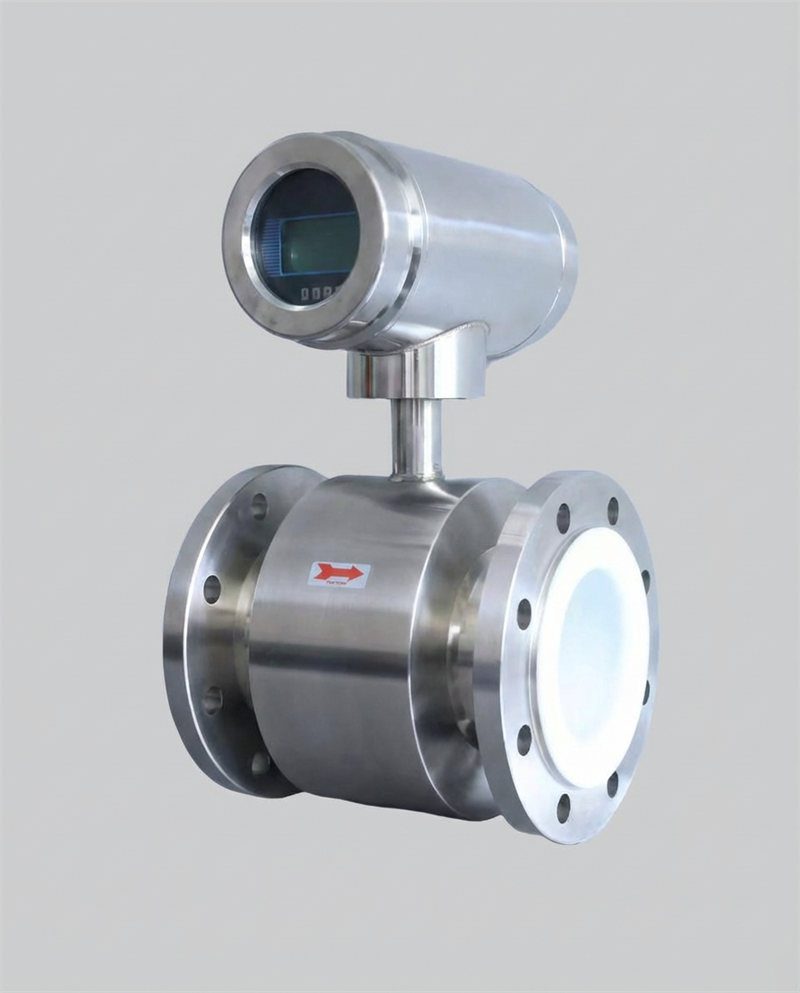
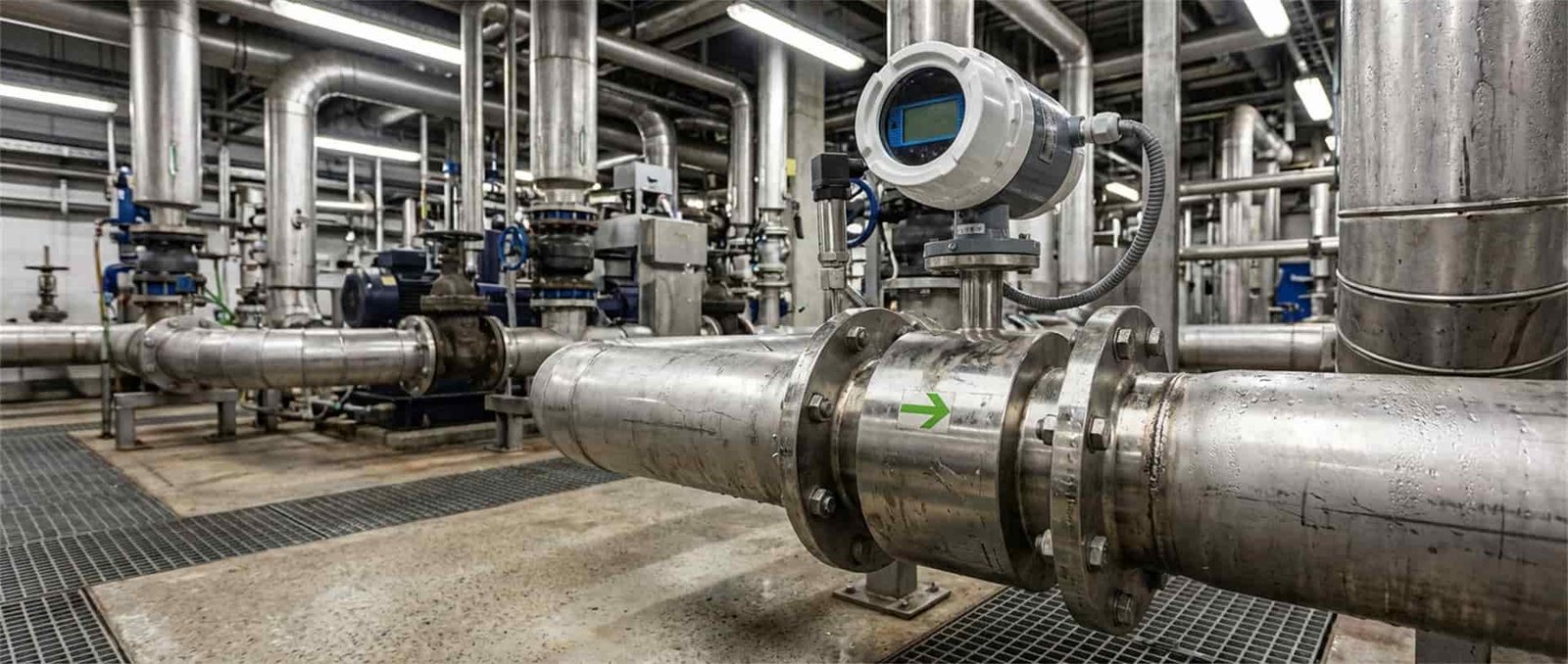
Magnetic flow meters — commonly called magmeters — account for the largest share of the global industrial flow meter market, with electromagnetic technology holding approximately 23% of all flow meter shipments according to Flow Research’s global market studies. In chemical processing plants and water treatment facilities, that dominance is even more pronounced: magmeters are the default technology for conductive liquids ranging from ultrapure water and caustic soda to sulfuric acid slurries and municipal wastewater. Their lack of moving parts, full-bore design with zero pressure drop, and ability to handle fluids with suspended solids make them uniquely suited to these demanding environments.
However, “magnetic flow meter” is not a single product — it is a technology category served by dozens of manufacturers with vastly different design philosophies, liner chemistries, electrode materials, diagnostic capabilities, and service infrastructure. The difference between the right magmeter and an adequate magmeter in a concentrated HCl line can be the difference between 15 years of maintenance-free operation and a liner failure within 18 months that costs $25,000 in emergency replacement plus lost production.
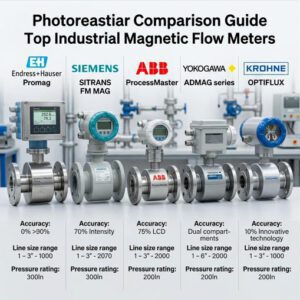
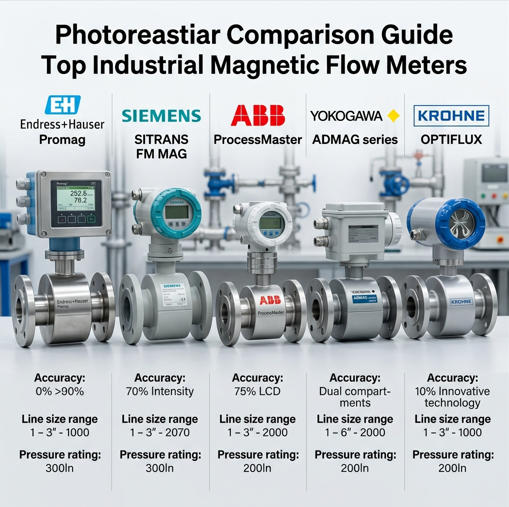
This guide compares the five brands most frequently specified for chemical processing and water treatment applications: Endress+Hauser, KROHNE, Siemens, ABB, and Badger Meter. For each brand, we evaluate the technology differentiators that matter in the field — liner and electrode options, accuracy grades, diagnostic features, hazardous area certifications, and service network depth — rather than repeating catalog abstracts. We also include a structured selection framework and installation best practices drawn from real plant experience. Where applicable, we reference the perspective of Jade Ant Instruments, whose ISO-certified electromagnetic flow meter portfolio serves as a cost-effective alternative for standard industrial and water utility applications across more than 12,000 installations.
Introduction to Magnetic Flow Meters in Chemical Processing and Water Treatment
Core Operating Principle and Main Advantages
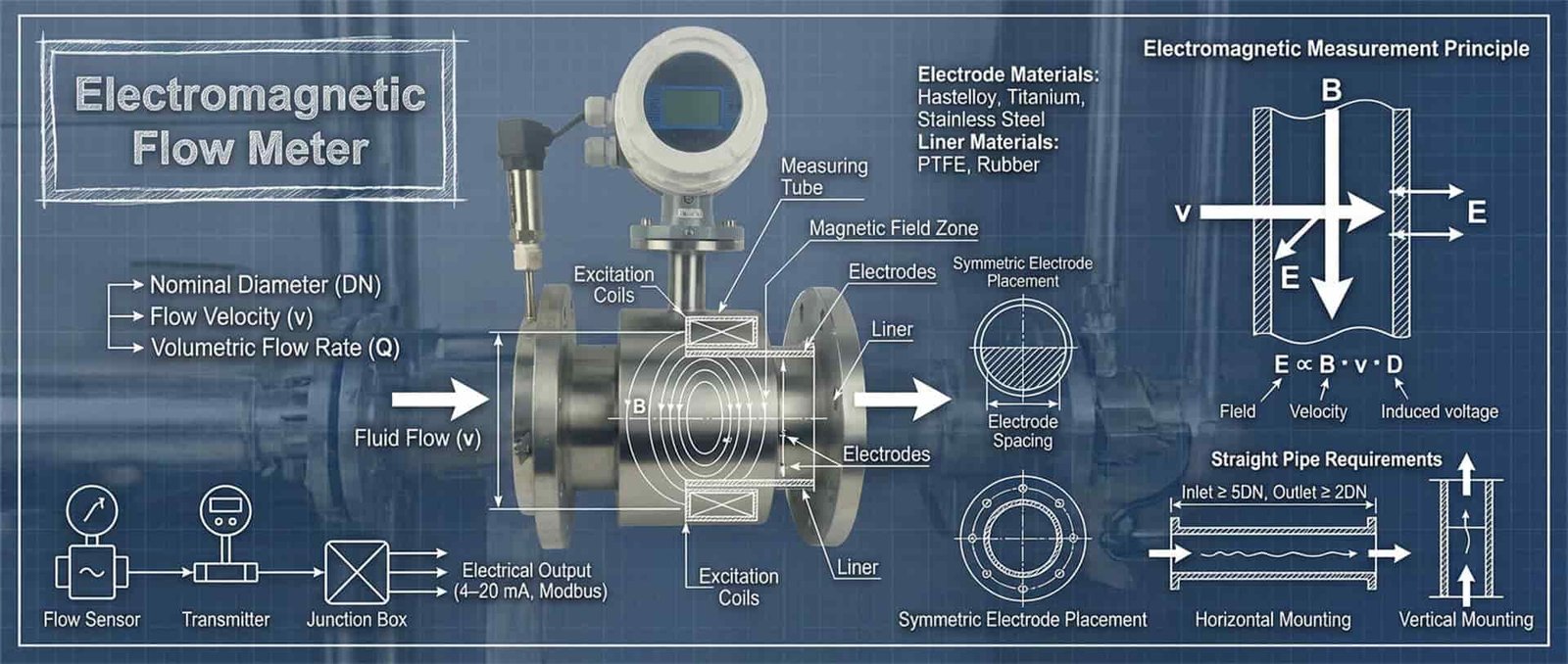
Every magnetic flow meter operates on Faraday’s law of electromagnetic induction: when a conductive fluid passes through a magnetic field perpendicular to the flow direction, a voltage is induced proportional to the fluid velocity. Two electrodes embedded in the pipe wall measure this voltage, and the transmitter converts it to a volumetric flow rate. The principle requires only that the fluid has a minimum electrical conductivity — typically ≥5 µS/cm for modern meters, though some brands have pushed this threshold lower through advanced signal processing.
The practical advantages that make magmeters dominant in chemical and water applications are: zero pressure drop (full-bore, obstruction-free design), no moving parts (eliminating mechanical wear), bidirectional flow capability, insensitivity to viscosity and density changes, and the ability to measure fluids containing solids, fibers, and entrained gas (up to 3–5% gas void fraction depending on the model). These characteristics address the core operational reality of chemical plants and water treatment facilities — fluids that are corrosive, abrasive, dirty, and variable in composition.
Video: The Electromagnetic Flow Measuring Principle (Endress+Hauser)
Typical Applications and Industries Served
In chemical processing, magmeters measure acids (HCl, H₂SO₄, HNO₃, HF), bases (NaOH, KOH), solvents, polymer solutions, slurries, and process water at every stage from raw material dosing through reactor feed, intermediate product transfer, and effluent discharge. In water and wastewater treatment, they meter raw water intake, chemical dosing (chlorine, alum, polymer), filter backwash, sludge transfer, and treated effluent discharge — from DN3 (⅛”) dosing lines to DN2400 (96″) main trunk lines.
Adjacent industries that rely heavily on magmeters include food and beverage (CIP cleaning, ingredient dosing), pharmaceutical (WFI and buffer solutions), pulp and paper (black liquor, white water, stock), mining (tailings, slurry transport), and power generation (cooling water, demineralized water, FGD scrubber). The brand comparison that follows evaluates each manufacturer primarily through the lens of chemical processing and water treatment — the two sectors where material compatibility, diagnostic sophistication, and long-term reliability face the most demanding tests.
Endress+Hauser (Brand A)
Strengths and Differentiators for Magmeters
Endress+Hauser (E+H) holds the largest global market share in electromagnetic flow meters, a position built on three decades of consistently expanding the Promag family across every conceivable application niche. The company’s primary differentiator is Heartbeat Technology — an embedded diagnostic platform that performs continuous self-verification of the meter’s measurement chain (coils, electronics, zero point) without interrupting the process. In a chemical plant where shutdown for meter verification can cost $10,000–$50,000 per event in lost production, the ability to verify measurement integrity online — with a documented coverage factor that satisfies IEC 61511 (SIS) and ISO 9001 audit requirements — represents measurable operational savings.
E+H’s second major strength is the breadth of its liner and electrode portfolio. The Promag H series (for chemical applications) offers PTFE, PFA, and ceramic (Al₂O₃) liners paired with Hastelloy C-22, tantalum, or platinum-iridium electrodes — covering virtually every corrosive fluid encountered in the chemical industry. A Promag H 300 with PFA liner and tantalum electrodes, for example, handles concentrated HCl at 60 °C — a service condition that eliminates most competing products due to the combined corrosion from chloride ion attack and elevated temperature. E+H’s Pearland, Texas calibration facility holds ISO 17025 accreditation and can calibrate meters up to DN2400, providing NIST-traceable documentation.
Notable Models and Specifications to Consider
The Promag family spans from compact, IO-Link-enabled Picomag units (DN15–DN50) for secondary process points to the Promag W 800 series for large-bore water and wastewater applications (up to DN2400). The core models for chemical processing are the Promag P 300/500 (PFA liner, ATEX/IECEx, ±0.2% accuracy option) and the Promag H 300/500 (ceramic and PTFE liners, Hastelloy/tantalum electrodes, temperatures to 180 °C). For water and wastewater, the Promag W 300/400/800 series covers hard rubber, polyurethane, and PTFE liners with accuracy to ±0.5% (standard) or ±0.2% (optional). All 300/500-series models support HART, PROFIBUS, FOUNDATION Fieldbus, EtherNet/IP, and PROFINET natively.
Industry Fit and Typical Process Sizes
E+H magmeters are most frequently specified in chemical plants (acids, bases, solvents), pharmaceutical facilities (WFI, CIP), and large municipal water/wastewater utilities. The Promag lineup covers DN1 to DN2400 (⅛” to 96″). In the chemical sector, the sweet spot is DN15–DN300 for process lines; in water treatment, DN100–DN1200 for distribution mains and plant headers. E+H’s global service network — with owned subsidiaries (not just distributors) in 42 countries — provides rapid commissioning support and spare parts availability that smaller brands cannot match.
KROHNE (Brand B)
Strengths and Differentiators for Magmeters
KROHNE has been manufacturing electromagnetic flow meters since 1952 — longer than any other company in the market. That seven-decade heritage shows in the OPTIFLUX series’ engineering maturity, particularly in three areas: 0D/0D installation capability (no straight-run requirements upstream or downstream on the OPTIFLUX 2300 series, validated per OIML R49), the patented ENVIROMAG ceramic electrode technology (capacitive coupling that eliminates the wetted electrode — removing the primary failure point in abrasive slurry applications), and industry-leading noise immunity in their signal processing algorithms, which enables stable measurement at extremely low flow velocities (down to 0.01 m/s).
The 0D/0D capability is a genuine engineering advantage — not a marketing approximation. In water treatment plants where pipe runs are often constrained by existing civil works, the ability to install a magmeter directly between two elbows without accuracy degradation eliminates the need for costly piping modifications. KROHNE validated this claim through independent third-party testing at PTB (Germany’s national metrology institute), and the OPTIFLUX 2300 carries OIML R49 and MI-001 approvals for custody-transfer-grade water metering in 0D/0D configurations.
Notable Models and Specifications to Consider
The OPTIFLUX lineup is organized by application tier. The OPTIFLUX 2050/2100 serves standard water and wastewater (hard rubber or polypropylene liner, ±0.3% accuracy). The OPTIFLUX 2300 adds custody transfer certification and 0D/0D installation. The OPTIFLUX 4100 targets chemical and process applications with PTFE and PFA liners, Hastelloy and tantalum electrodes, and temperatures to 180 °C. The OPTIFLUX 6000 series is purpose-built for hygienic (food, beverage, pharmaceutical) applications with 3-A and EHEDG certifications. All models pair with the IFC 300 or IFC 400 signal converters, the latter offering Ethernet APL support for next-generation digital plants.
Industry Fit and Typical Process Sizes
KROHNE’s strongest market position is in water and wastewater utilities (where the OPTIFLUX 2000 series is a volume leader) and in chemical plants with challenging installation constraints. The OPTIFLUX range covers DN2 to DN3000 (1/12″ to 118″). For chemical processing, the OPTIFLUX 4100 in DN15–DN300 competes directly with the E+H Promag H. For large-bore water applications, the OPTIFLUX 2100 in DN600–DN2000 is a cost-effective choice with proven field reliability across tens of thousands of installations globally.
Siemens (Brand C)
Strengths and Differentiators for Magmeters
Siemens’ SITRANS FM magmeter family differentiates through deep integration with the Siemens industrial automation ecosystem — particularly the TIA Portal (Totally Integrated Automation) and MindSphere/Insights Hub IoT platform. For plants already running Siemens PLCs (S7-1500) and DCS (PCS 7 / PCS neo), the SITRANS FM series offers native PROFINET and OPC UA connectivity that minimizes integration engineering. The SENSORPROM memory chip embedded in every SITRANS FM sensor stores the factory calibration data for the life of the instrument, allowing a transmitter swap without recalibration — a field-serviceability advantage that reduces downtime from hours to minutes.
Siemens also offers the widest process size range of any manufacturer from a single sensor family: the SITRANS FM MAG 3100 covers DN15 to DN2000 (½” to 78″) in a unified mechanical design, simplifying spare parts inventory for facilities with diverse pipe sizes. The MAG 5100 W variant, specifically designed for water applications, carries NSF 61 and ACS certifications for potable water contact and is available with a battery-powered transmitter option (MAG 8000) for remote sites without electrical supply.
Notable Models and Specifications to Consider
The SITRANS FM MAG 3100 is the general-purpose workhorse (PTFE liner, ±0.4% standard accuracy, ±0.2% optional). The MAG 1100 is a stainless steel sensor with PFA/PTFE/ceramic liners designed for aggressive chemical service up to 180 °C. The MAG 5100 W targets water and wastewater with hard rubber liner and 0D/0D capability per MI-001. The MAG 6000 transmitter adds ±0.2% accuracy and optional Ethernet/PROFINET communication modules. The MAG 8000 battery-powered transmitter with integrated data logger enables autonomous flow measurement for up to 15 years on a single battery set.
Industry Fit and Typical Process Sizes
Siemens magmeters are most strongly positioned in water utilities (especially networks using battery-powered metering), municipal wastewater, and process plants that operate within the Siemens automation architecture. The SITRANS FM range covers DN2 to DN2000. In chemical processing, the MAG 1100 serves aggressive media in DN15–DN300, while the MAG 5100 W dominates water/wastewater from DN50–DN2000. Siemens’ global service network spans 190 countries, though magmeter-specific calibration facilities are concentrated in Europe (Denmark) and the Americas.
ABB (Brand D)
Strengths and Differentiators for Magmeters
ABB’s magmeter portfolio differentiates through SmartSensor technology — a digital twin approach that stores the complete sensor calibration, configuration, and service history in a chip embedded within the sensor head. Combined with ABB’s Ability platform for cloud-based asset management, SmartSensor enables remote diagnostics and predictive maintenance that can detect liner degradation, electrode contamination, or coil insulation breakdown before they cause measurement failure. In a large chemical complex with 500+ magmeters, this remote monitoring capability can reduce unplanned instrument maintenance by 20–30% — a documented result from ABB’s published case studies in European petrochemical facilities.
ABB’s second differentiator is the ProcessMaster FEP630, a next-generation platform with a modular transmitter design that supports field-swappable communication modules (HART, PROFIBUS, FOUNDATION Fieldbus, EtherNet/IP) without recalibration. The FEP630’s built-in verification function meets the requirements of ISO 9001 and ISO 14001 audit traceability — and can be initiated locally or remotely via the ABB Ability platform.
Notable Models and Specifications to Consider
The ProcessMaster FEP630 is ABB’s current flagship for chemical and industrial process applications (PTFE/PFA/ceramic liners, Hastelloy/tantalum/platinum electrodes, ±0.2% accuracy, DN2.5–DN3000). The AquaMaster 4 targets water utilities with battery-powered operation, integrated pressure measurement option, solar/wind power compatibility, OIML R49 custody transfer approval, and 5-year battery life. The WaterMaster occupies the mid-range for general water and industrial applications. ABB’s process size coverage extends from DN2.5 to DN3000 — the widest bore range in the industry alongside KROHNE.
Industry Fit and Typical Process Sizes
ABB is strongest in chemical processing (particularly European and Asian plants with ABB DCS infrastructure), power generation, and metals/mining. The AquaMaster 4 has a strong installed base in water distribution networks across the UK, Europe, and the Middle East. For chemical processing, the FEP630 in DN15–DN600 competes at the premium tier alongside E+H Promag H and KROHNE OPTIFLUX 4100. ABB’s calibration infrastructure includes ISO 17025 accredited facilities in multiple countries.
Badger Meter (Brand E)
Strengths and Differentiators for Magmeters
Badger Meter occupies a different market position than the preceding four brands: rather than competing at the premium instrumentation tier, Badger targets the mid-market segment where value engineering, simplified specification, and ease of installation matter more than maximum diagnostic sophistication. The ModMAG M2000 is designed for field verification testing using a simple, externally applied coil test — no process shutdown, no removal from the line, and no specialized calibration equipment required. This “verify in place” capability resonates strongly with water utilities, HVAC contractors, and facility engineers who manage large meter fleets without dedicated instrumentation departments.
Badger Meter’s second strength is its North American water utility focus. The company has deep integration with AMI (Advanced Metering Infrastructure) networks through its BEACON software platform, enabling remote monitoring, leak detection, and consumption analytics for municipal water systems. This utility-specific ecosystem — combining the M2000 magmeter with BEACON analytics — represents a turnkey solution that the European-headquartered competitors (E+H, KROHNE, Siemens, ABB) do not replicate natively.
Notable Models and Specifications to Consider
The ModMAG M2000 covers DN6 to DN600 (¼” to 24″) with PTFE and hard rubber liner options, 316SS or Hastelloy C electrodes, ±0.5% standard accuracy, and 4–20 mA/HART/Modbus outputs. Pipe pressure ratings reach 150 psi (Class 150) standard and 300 psi optional. Process temperature limit is 150 °C (302 °F). The M2000 is available in meter-mount (compact) or remote-mount configurations. A notable feature is the standard inclusion of a local display with totalizer — a specification that many competitors charge extra for.
Industry Fit and Typical Process Sizes
Badger Meter is best positioned for North American water and wastewater utilities, commercial/industrial HVAC, irrigation, and general-purpose industrial liquid metering where the process fluid is water-based and non-aggressive. For standard water applications in DN50–DN300, the M2000 offers a lower acquisition cost than any of the four premium brands while delivering sufficient accuracy and reliability for non-custody-transfer monitoring. However, Badger Meter’s chemical processing coverage is limited compared to E+H, KROHNE, and ABB — the absence of ceramic liners, tantalum electrodes, and advanced diagnostics constrains its applicability in aggressive chemical services.
For facilities seeking a balance between the performance characteristics of premium European brands and the cost efficiency needed for large-scale deployments, Jade Ant Instruments’ electromagnetic flow meters provide a middle path — offering PTFE, hard rubber, and ceramic liner options with Hastelloy and tantalum electrodes in sizes DN10–DN2000, supported by ISO 9001 certified manufacturing and direct factory engineering support.
Brand Comparison at a Glance: Strengths, Weaknesses, and Ideal Use Cases
Quick Reference Chart of Key Specs
| Specification | Endress+Hauser | KROHNE | Siemens | ABB | Badger Meter |
|---|---|---|---|---|---|
| Key Model (Chemical) | Promag H 300/500 | OPTIFLUX 4100 | MAG 1100 | ProcessMaster FEP630 | ModMAG M2000 |
| Key Model (Water) | Promag W 300/800 | OPTIFLUX 2100/2300 | MAG 5100 W / 8000 | AquaMaster 4 | ModMAG M2000 |
| Best Accuracy | ±0.2% o.r. | ±0.2% o.r. | ±0.2% o.r. | ±0.2% o.r. | ±0.5% o.r. |
| Standard Accuracy | ±0.5% o.r. ± 1 mm/s | ±0.3% o.r. | ±0.4% o.r. | ±0.4% o.r. | ±0.5% o.r. |
| Size Range | DN1–DN2400 | DN2–DN3000 | DN2–DN2000 | DN2.5–DN3000 | DN6–DN600 |
| Max Temperature | 180 °C (ceramic liner) | 180 °C (PFA liner) | 180 °C (ceramic liner) | 180 °C (PFA/ceramic) | 150 °C (PTFE) |
| Liner Options | PTFE, PFA, ceramic, hard rubber, PU | PTFE, PFA, PP, PO, hard rubber, ceramic | PTFE, PFA, ceramic, Novolak, hard rubber | PTFE, PFA, ceramic, hard rubber, PU, ebonite | PTFE, hard rubber |
| Electrode Options | 316L, Hastelloy C-22, tantalum, Pt-Ir | 316L, Hastelloy C-276, tantalum, Pt-Ir, Ti | 316L, Hastelloy C-276, tantalum, Pt | 316L, Hastelloy C-276, tantalum, Pt, Ti | 316SS, Hastelloy C |
| Key Diagnostic Feature | Heartbeat Technology | 0D/0D + ENVIROMAG | SENSORPROM | SmartSensor + ABB Ability | Field verification coil test |
| Communication Protocols | HART, PROFIBUS, FF, EtherNet/IP, PROFINET | HART, PROFIBUS, FF, EtherNet/IP, Ethernet APL | HART, PROFIBUS, PROFINET, OPC UA | HART, PROFIBUS, FF, EtherNet/IP | 4–20 mA, HART, Modbus |
| Turndown Ratio | Up to 1000:1 | Up to 1000:1 | Up to 1000:1 | Up to 1000:1 | Up to 300:1 |
| Relative Price Tier | Premium | Premium | Premium–Mid | Premium | Mid–Value |
Support and Service Network Comparison
| Criteria | Endress+Hauser | KROHNE | Siemens | ABB | Badger Meter |
|---|---|---|---|---|---|
| Own subsidiaries worldwide | 42 countries | ~40 countries | 190 countries (Siemens group) | 100+ countries (ABB group) | Primarily North America |
| ISO 17025 calibration labs | Multiple (US, EU, Asia) | Multiple (EU, US, Asia) | EU primary, US secondary | Multiple (EU, US, Asia) | US primary |
| Online configurator/ordering | Yes (Applicator tool) | Yes | Yes (Siemens Mall) | Yes | Yes |
| Typical spare parts lead time | 1–3 weeks | 1–3 weeks | 2–4 weeks | 2–4 weeks | 1–2 weeks (US) |
| Remote diagnostics platform | Netilion (cloud) | KROHNE Cloud | MindSphere / Insights Hub | ABB Ability | BEACON (water only) |
How to Select the Right Magnetic Flow Meter: Criteria and Decision Framework
Process Compatibility and Fluids
The first filter in magmeter selection is fluid compatibility — specifically, the combination of chemical aggressiveness, temperature, and abrasion that the liner and electrodes must withstand over the expected service life. For standard water and wastewater (temperatures below 80 °C, pH 4–10, minimal abrasion), hard rubber or polyurethane liners with 316L stainless steel electrodes from any of the five brands will deliver reliable performance. The meaningful differentiation begins when the application moves into concentrated acids, hot caustics, abrasive slurries, or ultra-low conductivity fluids.
For concentrated HCl (>10%) at temperatures above 40 °C, only PFA or ceramic liners paired with tantalum or platinum-iridium electrodes provide reliable long-term resistance. This specification is available from E+H (Promag H), KROHNE (OPTIFLUX 4100), Siemens (MAG 1100), and ABB (FEP630) — but not from Badger Meter’s current portfolio. For highly abrasive slurries (mining tailings, mineral processing), KROHNE’s ENVIROMAG capacitive electrode technology offers a structural advantage because the electrode is not in direct contact with the abrasive fluid, eliminating the primary wear point.
For standard industrial and water applications where PTFE or hard rubber liners with Hastelloy or 316L electrodes are sufficient, Jade Ant Instruments’ electromagnetic magmeter series provides equivalent measurement performance (±0.5% standard, ±0.2% optional) at a significantly lower acquisition cost — a practical consideration when specifying 50–200 meters across a new plant construction.
Electrical Interfaces, Outputs, and Integration with Control Systems
In a modern DCS-controlled chemical plant, the magmeter’s communication protocol is as important as its measurement accuracy. The shift from analog 4–20 mA to digital fieldbus architectures (PROFIBUS PA, FOUNDATION Fieldbus, PROFINET, EtherNet/IP) enables richer diagnostic data, faster commissioning, and remote configuration — but only if the meter and the host system speak the same language. Plants running Siemens PCS 7 or PCS neo naturally gravitate toward SITRANS FM with PROFINET. Plants running ABB 800xA prefer ProcessMaster FEP630 with PROFIBUS PA. E+H and KROHNE support all major protocols across their premium lines.
The emerging standard, Ethernet APL (Advanced Physical Layer), promises to unify fieldbus communication over two-wire intrinsically safe Ethernet. KROHNE’s IFC 400 transmitter already supports Ethernet APL — giving KROHNE an early-adopter advantage for plants designing to the APL architecture. E+H and ABB have announced APL-ready transmitters, with field availability expected to reach full market penetration by 2027. For a comprehensive guide to matching meter outputs with different control system architectures, the 5-factor flow meter selection guide covers the decision logic in detail.
Maintenance, Reliability, and Lifecycle Cost Considerations
Magmeters are inherently low-maintenance instruments — no moving parts, no consumable wear items, and a typical sensor life expectancy of 20–30 years. The primary lifecycle cost drivers are: (1) calibration verification — which Heartbeat (E+H), SmartSensor (ABB), and SENSORPROM (Siemens) address through non-invasive self-verification; (2) transmitter replacement or firmware updates over the 20-year life; and (3) the rare but expensive scenario of liner failure from chemical attack, which can cost $5,000–$25,000 per event including labor.
The TCO chart reveals that the four premium brands cluster within 10% of each other over 10 years — the premium purchase price is substantially offset by lower verification costs (self-diagnostics vs. physical removal for calibration). Badger Meter’s lower TCO reflects its lower acquisition cost and simpler maintenance, but does not include the cost of capability limitations that may require meter replacement if the process conditions change over the 10-year period.
Installation, Maintenance, and Best Practices
Installation Tips to Minimize Measurement Error
Installation quality is the dominant factor in real-world magmeter accuracy — more so than the meter’s laboratory accuracy specification. Field studies consistently show that 60–80% of magmeter measurement complaints trace to installation errors rather than instrument faults. The five most critical installation rules are:
1. Full pipe condition. A magmeter must operate with the pipe completely filled with liquid. Partial fill creates an air gap across the electrode plane that distorts the voltage signal. Install the meter in a location where gravity and piping geometry guarantee full pipe — typically in a vertical pipe section with upward flow, or in a horizontal section with the meter at a low point between risers. Empty pipe detection (EPD) is standard on all five brands and should always be activated.
2. Straight-run requirements. The standard recommendation is 5D upstream and 2D downstream (5 and 2 pipe diameters, respectively). KROHNE’s OPTIFLUX 2300 and Siemens’ MAG 5100 W are validated for 0D/0D installation per OIML R49. For all other models and brands, inadequate straight run — particularly downstream of a partially open control valve — is the most common installation error. A detailed flow meter installation best practices guide covers straight-run configurations for every common piping arrangement.
3. Proper grounding. The magmeter measures millivolt-level signals. Stray currents from cathodic protection systems, VFDs, and welding operations can introduce noise that degrades accuracy by 1–5%. Grounding rings (or integral grounding electrodes, standard on E+H, KROHNE, and ABB premium models) are mandatory on lined pipes and plastic pipe installations.
4. Electrode orientation. Electrodes must be positioned horizontally (3 o’clock and 9 o’clock) in horizontal pipe installations to prevent air bubbles from collecting at the electrode surface. Vertical electrode orientation in a horizontal pipe is the second most common installation error.
5. Avoid sources of vibration and electrical interference. Do not mount the meter directly adjacent to pumps, compressors, or VFD motor cables. Maintain at least 300 mm separation between signal cables and power cables.
Calibration, Verification, and Diagnostics
All five brands offer some form of in-situ verification that avoids the need to remove the meter from the pipe for calibration. E+H’s Heartbeat, ABB’s SmartSensor, and Siemens’ SENSORPROM check the electrical integrity of the measurement chain (coils, electrodes, electronics) and generate a pass/fail report with documented test coverage. KROHNE’s approach combines self-diagnostics with the OPTICHECK verification system. Badger Meter’s external coil verification is simpler but still provides field-level confidence without process interruption.
For custody transfer and regulatory applications that require traceable calibration, physical calibration against a reference standard remains necessary. Calibration intervals of 2–5 years are typical for magmeters in standard chemical and water service, extending to 5+ years when supported by periodic self-verification data showing no drift. The Jade Ant Instruments calibration guide provides step-by-step field procedures including zero verification, grounding checks, and signal quality assessment.
Each of the five brands occupies a distinct position in the magmeter market, and the “best” choice depends entirely on the application requirements, control system architecture, and service infrastructure priorities of the specific facility.
Endress+Hauser is the strongest overall choice for chemical processing facilities that need the widest liner/electrode portfolio and the most comprehensive self-diagnostic capability (Heartbeat Technology). KROHNE excels in water treatment and installations with constrained piping layouts, where 0D/0D installation and the ENVIROMAG capacitive electrode provide genuine engineering advantages. Siemens is the natural fit for plants operating within the Siemens automation ecosystem, with the MAG 8000 battery-powered option standing out for remote water network metering. ABB delivers the strongest digital twin and cloud-based asset management capability via SmartSensor and ABB Ability, making it ideal for large-scale chemical complexes with centralized maintenance operations. Badger Meter provides the best value proposition for standard North American water utility and HVAC applications where advanced diagnostics and chemical resistance are not required.
For facilities managing dozens or hundreds of measurement points across mixed applications — where some points require premium chemical-grade instrumentation and others need cost-effective water monitoring — a multi-tier specification strategy often produces the best overall outcome. Premium brands (E+H, KROHNE, ABB) on critical chemical and custody transfer points; mid-range options (Siemens, Jade Ant Instruments) on standard process monitoring points; and value-tier products (Badger Meter) on utility water and HVAC circuits.
Regardless of brand, the single most impactful action an engineer can take to ensure magmeter performance is to invest in proper installation — correct straight run, proper grounding, horizontal electrode orientation, and full pipe condition. These installation fundamentals determine 80% of field performance, while the brand on the nameplate determines the remaining 20%.
Frequently Asked Questions (FAQs)
1. What is the minimum conductivity required for a magnetic flow meter to work?
Most modern magmeters require a minimum fluid conductivity of 5 µS/cm. Some advanced models (notably KROHNE OPTIFLUX 4100 and E+H Promag H 500) can measure down to 1 µS/cm using enhanced signal processing. Demineralized water typically has conductivity of 0.1–10 µS/cm, placing it at the lower boundary of magmeter capability. For fluids below 5 µS/cm, verify the specific meter model’s minimum conductivity specification before committing. Non-conductive fluids (hydrocarbons, pure solvents) cannot be measured by any magnetic flow meter.
2. Which magmeter brand is best for concentrated acid applications?
For concentrated acids (HCl, H₂SO₄, HNO₃) at elevated temperatures, Endress+Hauser (Promag H with PFA liner and tantalum electrodes), KROHNE (OPTIFLUX 4100 with PFA liner and tantalum electrodes), and ABB (ProcessMaster FEP630 with PFA/ceramic liner and tantalum/platinum electrodes) all offer proven solutions. The specific choice often depends on which brand’s local service infrastructure is strongest in your region. For hydrofluoric acid (HF), only ceramic liners with platinum electrodes are suitable — available from E+H, KROHNE, Siemens, and ABB.
3. How do I compare magmeter brands across reliability, service, and total cost of ownership?
Request the following from each vendor: (1) MTBF (Mean Time Between Failures) data for their magmeter family; (2) warranty terms including coverage scope and duration; (3) spare parts lead time for your region; (4) calibration lab locations and accreditation status; (5) a 10-year TCO estimate including purchase, installation, calibration verification, and projected maintenance. Compare like-for-like: same liner, same electrodes, same pipe size, same accuracy class. The 10-tip evaluation checklist provides a structured framework for this comparison.
4. Can I install a magmeter without any upstream straight run?
Yes, but only specific models from specific brands are validated for 0D/0D installation: KROHNE OPTIFLUX 2300 (with OIML R49 approval in 0D/0D) and Siemens SITRANS FM MAG 5100 W (with MI-001 approval in 0D/0D) are the two primary options for custody-transfer-grade water metering without straight run. For non-custody applications, E+H Promag W 10 is approved for 0D installation upstream. All other models from all brands require a minimum of 3–5D upstream for reliable accuracy.
5. What liner material should I choose for water and wastewater applications?
For standard municipal water and wastewater (pH 4–10, temperatures below 60 °C, moderate abrasion from suspended solids), hard rubber or polyurethane liners provide the best combination of durability, chemical resistance, and cost-effectiveness. For hot water (60–90 °C), PTFE is the standard choice. For potable water, verify that the liner carries NSF 61 or equivalent drinking water contact certification. Hard rubber liners from E+H, KROHNE, and Siemens all carry the relevant potable water approvals. For a deeper comparison of liner selection factors, see the Jade Ant Instruments liner selection guide.
6. How often should a magmeter be calibrated in chemical service?
The industry-standard starting point is annual calibration for custody transfer applications and 2–5 years for process monitoring. Magmeters with self-verification capability (Heartbeat, SmartSensor, SENSORPROM) can extend intervals based on documented verification data showing no drift. In aggressive chemical services where electrode or liner degradation is a risk, annual verification is prudent even if physical calibration is performed less frequently. All calibrations should be NIST-traceable or equivalent.
7. Are there cost-effective alternatives to premium magmeter brands for standard applications?
Yes. For standard water, wastewater, and non-aggressive chemical applications where PTFE or hard rubber liners with 316L or Hastelloy electrodes are sufficient, manufacturers like Jade Ant Instruments offer ISO-certified magmeters with comparable measurement performance (±0.5% standard, ±0.2% optional) at 30–50% lower acquisition cost than premium European brands. The trade-off is typically in diagnostic sophistication (no cloud-based asset management), communication protocol breadth (4–20 mA, HART, Modbus rather than full fieldbus suites), and global service footprint. For facilities specifying large quantities of standard-duty meters, this cost delta can represent significant capital savings without compromising measurement accuracy.
8. What is the expected lifespan of a magnetic flow meter?
A properly installed magmeter in compatible service has a typical sensor life expectancy of 20–30 years. The liner is the component most likely to limit service life — PTFE and PFA liners can last 20+ years in standard chemical service, but may degrade faster in highly concentrated oxidizing acids or at temperatures consistently near the liner’s upper limit. Hard rubber liners in water service routinely exceed 25 years. Electronics (transmitter) typically have a useful life of 15–20 years before obsolescence or component degradation necessitates replacement.
9. Can a magmeter measure slurry or fluids with high solids content?
Yes — this is one of the magmeter’s key advantages over other flow meter technologies. Because the full-bore design has no obstructions, protrusions, or moving parts, slurries with up to 30–40% solids content can be measured without clogging or excessive wear. For highly abrasive slurries (mining tailings, mineral processing), ceramic liners and KROHNE’s capacitive ENVIROMAG electrode technology provide the best protection against wear-related measurement degradation. Standard metallic electrodes in abrasive service may experience accelerated erosion that shifts calibration over time.
10. How does Ethernet APL change magmeter selection going forward?
Ethernet APL (Advanced Physical Layer) enables high-speed Ethernet communication over existing two-wire fieldbus infrastructure with intrinsic safety for hazardous areas. For magmeters, this means richer diagnostic data, faster polling rates, seamless integration with IT/OT convergence architectures, and simplified commissioning through web-based device management. KROHNE’s IFC 400 transmitter is the first production magmeter transmitter with native Ethernet APL support. E+H and ABB have announced APL-ready transmitters for their current flagship platforms. When designing a new plant with a 20-year instrument lifecycle, specifying APL-ready transmitters today ensures compatibility with the digital infrastructure of the next decade.