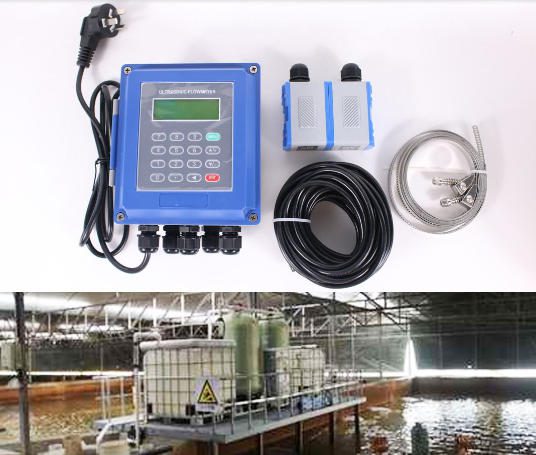
This guide is written exclusively for OEM equipment and skid-mount manufacturers, instrument distributors and importers, EPC and system integrators, industrial terminal and MRO companies, and municipal and utility operators. If you need flow measurement in water or wastewater applications to work reliably, cost-effectively, and without shutting down your process — keep reading.
1. The Cost of Conventional Flow Measurement
Most plants do not lose money on bad meters. They lose money on the wrong meters.
A turbine flow meter selected for a municipal wastewater lift station will clog with solids in weeks. A magnetic flow meter installed on a glass-lined pipe fails within months when the liner chips and the electrode signal drifts. A paddle wheel specified for a paper mill effluent line gets coated in fiber and reads 15% low — quietly sending inaccurate billing data for a full quarter before anyone notices.
These are not hypothetical scenarios. They are the everyday reality that OEM engineers, EPC project managers, MRO teams, and utility operators deal with constantly. And they all share the same root cause: intrusive flow measurement in applications that demand something better.
The hidden costs of intrusive flow meters stack up fast. Maintenance teams spend hours each month cleaning, recalibrating, or replacing sensors that were never designed for the fluid conditions they face. EPCs absorb change orders caused by unexpected pipe modifications on site. Municipal utilities watch non-revenue water climb above 20% — partly because inaccurate flow data masks the leaks they cannot find.
Ultrasonic flow meters offer a fundamentally different approach. By measuring flow through the pipe wall — without cutting, welding, or interrupting the process — they eliminate the root causes of most intrusive meter failures. The global ultrasonic flow meter market reflects this shift: valued at USD 2.22 billion in 2026 and growing at a 5.7% CAGR toward USD 3.27 billion by 2033, according to Coherent Market Insights.
Transit-time models — which hold 63.9% of the ultrasonic market — now achieve ±0.5% accuracy in clean liquids and ±1.0% in mixed slurries, matching the performance of inline magnetic meters in many water and wastewater applications. And because there are no moving parts, no wetted sensors, and no pipe penetrations, the lifecycle cost picture changes dramatically.
This guide breaks down exactly how ultrasonic technology solves the pain points each customer segment faces, what the real performance data looks like, and how to select, integrate, and sell the right solution for every application. Jade Ant Instruments works with OEMs, EPCs, distributors, MRO teams, and utilities across more than 30 countries — and the insights in this article come directly from those application environments.
2. The Core Problem: Pain Points Across the Water & Wastewater Ecosystem
No two customers experience flow measurement pain the same way. Understanding the specific friction each segment faces is what separates a useful product recommendation from a generic catalog pitch.
OEMs and Skid-Mount Manufacturers
Space is the first constraint on any skid. A compact water treatment skid for a food processing plant may have 400mm between the pump outlet and the filtration module — not enough room for the 5D upstream straight-run requirement of a full-bore magnetic meter. OEM engineers then face an uncomfortable choice: redesign the skid geometry (adding cost and delivery time) or accept a flow measurement compromise.
Maintenance access is the second constraint. When the skid ships to a site in Malaysia or Nigeria, the OEM’s service team is not there. If the flow meter requires periodic electrode cleaning or liner inspection, the end user either skips it or calls for expensive on-site support. Either outcome damages the OEM’s reputation.
Clamp-on ultrasonic meters resolve both constraints. They mount externally, require no straight-run modification in many configurations, and have zero maintenance needs after installation.
EPCs and System Integrators
EPC projects live and die by the schedule. A $12M wastewater treatment upgrade budgeted for 14 weeks of commissioning does not have room for a 3-week delay caused by incorrect pipe sizing that forces inline meter replacement in the field.
The most common EPC flow meter problem is discovering late in construction that the specified inline meter requires pipe modifications — cutting, flanging, and re-welding — that were not in the original scope. Each modification adds days, triggers safety reviews, and generates change orders. In hazardous or confined-space environments, those delays multiply.
Clamp-on ultrasonic meters are designed for exactly this scenario. They install on existing pipe without modification, which means commissioning teams can verify flow measurement on the same day they arrive on site.
Муниципальные и коммунальные предприятия
A mid-sized municipal water authority in Southeast Asia was billing customers based on flow data from aging turbine meters installed in the 1990s. Over time, the meter rotors degraded. Measured flow dropped. The utility continued charging based on underread data while water losses — both physical leaks and meter error — climbed above 30% of total system output. That gap between water produced and water billed is called non-revenue water (NRW), and it represents direct financial loss.
Badger Meter’s municipal case study documents how a growing Midwestern municipality replaced insertion turbine meters in its wastewater lift stations with ultrasonic transit-time meters — improving diagnostic accuracy, reducing pump failure incidents, and restoring confidence in flow data across the network.
The problem for most municipal utilities is not that they lack awareness of better technology. It is that they cannot afford to shut down water or wastewater service for days while inline meters are installed. Non-invasive installation is not a convenience for utilities. It is a prerequisite.
Дистрибьюторы и импортеры медицинского оборудования
A distributor selling conventional turbine or paddle wheel meters into water and wastewater applications generates post-sale support calls — a lot of them. Turbine bearings wear, paddle wheels foul, and calibration drifts. Each service call costs the distributor time and goodwill, and ultimately erodes margins on future orders.
Ultrasonic meters change that equation. No moving parts means no wear failure. No wetted sensors means no fouling. Distributors who transition their water and wastewater product lines to ultrasonic technology consistently report fewer service callbacks and stronger repeat purchase cycles from the same customers.
Industrial MRO Teams
In a paper mill, effluent lines carry suspended fiber, pigments, and filler compounds. Any sensor that makes contact with the process stream — turbine rotors, paddle wheels, insertion probes — accumulates coating within weeks. MRO teams schedule quarterly cleaning cycles that require line isolation and partial process shutdown. Each cycle takes four to six hours per meter location.
For a plant with 20 monitored effluent points, that is 80 to 120 maintenance hours per quarter — labor that adds no production value. Clamp-on ultrasonic meters eliminate that maintenance cycle entirely, because there is nothing in the process stream to coat.
3. How Ultrasonic Technology Works — Without Breaking the Pipe
Understanding the technology at a practical level makes it far easier to select the right type and to explain the value to a customer who is skeptical of “non-invasive” measurement claims.
There are two ultrasonic measurement principles used in water and wastewater applications: transit-time and Doppler.
Transit-Time: The Workhorse for Clean to Moderately Loaded Flows
Transit-time — sometimes called “time-of-flight” — works by sending paired ultrasonic pulses through the flowing liquid. One pulse travels in the same direction as the flow (downstream), and one travels against it (upstream). Because sound travels faster with the current than against it, the downstream pulse arrives first.
The meter calculates the difference in arrival times — often measured in nanoseconds — and converts it into flow velocity using the pipe geometry. The formula is straightforward:
$$\Delta t = t_{upstream} – t_{downstream}$$
$$v = \frac{D \cdot \Delta t}{2 \cdot L \cdot \cos\theta}$$
Where D is the pipe inner diameter, L is the path length between transducers, and θ (theta) is the angle of the ultrasonic beam relative to the pipe axis.
Definition: A piezoelectric transducer is a device that converts electrical energy into ultrasonic (high-frequency sound) pulses, and vice versa. In clamp-on meters, these transducers are mounted on the outside of the pipe and send pulses through the pipe wall and into the fluid without any pipe penetration.
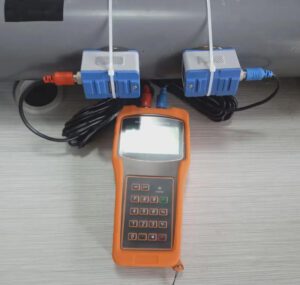
In clamp-on configuration, the transducers are strapped or clamped to the outside of the pipe. The ultrasonic signal passes through the pipe wall, through the fluid, and is received by the opposite transducer. No cutting, no welding, no process interruption.
Transit-time works best when the liquid is clean or carries only light particulate (generally less than 2–3% suspended solids by volume). Above that threshold, suspended particles scatter and attenuate the ultrasonic signal, reducing measurement reliability.
Doppler: Built for High-Solids and Aerated Flows
Doppler ultrasonic meters work on a different principle. Instead of measuring transit-time differences, they transmit a continuous ultrasonic beam into the fluid and measure the frequency shift (the Doppler effect) of signals reflected back by suspended particles or air bubbles in the flow.
Definition: Сайт Doppler effect is the change in frequency of a wave (in this case, ultrasound) as the source or reflector moves relative to the receiver. A Doppler flow meter uses this frequency shift to calculate the velocity of the particles — and therefore the fluid — moving through the pipe.
Doppler meters require a minimum concentration of reflective particles or bubbles to function — typically 25 parts per million or greater. This makes them the correct choice for activated sludge, raw sewage, mining slurries, and industrial effluent. They do not work reliably in clean water, where transit-time is the better option.
Why External Mounting Changes Everything
The key operational advantage of clamp-on ultrasonic meters — for both transit-time and Doppler configurations — is that the transducers never contact the process fluid. This means:
- No pressure taps, no flanges, no welding: installation on live pipe is possible and safe.
- No wetted sensor surfaces to corrode, coat, or wear.
- No risk of process contamination — critical for potable water and food-grade applications.
- Meters can be moved to different pipe locations for temporary flow surveys or commissioning verification.
For OEMs, this means skid integration without field pipe modification. For EPCs, it means commissioning in hours rather than days. For utilities, it means retrofitting 50 pump stations without a single service interruption.
4. Accuracy You Can Trust — Even in the Dirtiest Applications
The most common objection to ultrasonic flow meters from engineers who have used intrusive meters for years is accuracy. “Can a meter that sits on the outside of the pipe really match what’s happening inside?”
The data says yes — with appropriate technology selection.
Transit-Time Accuracy in Water Applications
In clean water and treated effluent, transit-time clamp-on meters achieve ±0.5% to ±1.0% of reading under steady-state conditions when properly installed with adequate straight-run pipe. That is within the accuracy specification of most magnetic flow meters used for water billing and process control.
A peer-reviewed 2024 study published in MDPI Machines examined transit-time ultrasonic meter performance in water pipeline monitoring applications, finding that advanced signal processing algorithms now compensate for temperature variation, pipe wall roughness, and partial signal attenuation — maintaining measurement consistency above 98% in controlled municipal water environments.
For comparison:
| Технологии | Типичная точность | Wetted Parts | Installation Method |
|---|---|---|---|
| Transit-time ultrasonic (clamp-on) | ±0.5%–±1.0% | Нет | External, live pipe |
| Magnetic (inline) | ±0.2%–±0.5% | Liner + electrodes | Inline, pipe modification |
| Turbine (inline) | ±0.25%–±0.5% | Rotor + bearings | Inline, pipe modification |
| Paddle wheel | ±1.0%–±3.0% | Paddle in flow | Inline, insertion |
| Doppler ultrasonic (clamp-on) | ±1.0%–±3.0% | Нет | External, live pipe |
For most process control, flow monitoring, and non-revenue water tracking applications, ±1.0% accuracy is entirely adequate. Custody transfer — where tight metrological accuracy is legally required — is the one area where inline magnetic meters or Coriolis meters are preferred, though inline transit-time ultrasonic meters certified to AWWA and ISO standards can qualify for water custody transfer when properly installed.
Doppler Performance in High-Solids Wastewater
Doppler meters in raw sewage and activated sludge typically achieve ±2%–±3% of reading under stable flow conditions. That is less precise than transit-time in clean water, but it is far more reliable than any intrusive meter that clogs, coats, or loses calibration in the same environment.
The municipal lift station case from Badger Meter — referenced earlier — is instructive. The facility achieved greater than 98% measurement consistency after switching from mechanical meters to ultrasonic, primarily because the non-invasive meters did not degrade in the presence of grease, rags, and suspended solids that regularly fouled their predecessors.
Low-Flow and Bidirectional Scenarios
In gravity-fed sewer lines and open-channel inlet structures, flow velocities can drop below 0.1 m/s during off-peak periods. Advanced transit-time meters with optimized signal processing detect flows as low as 0.01 m/s — enabling infiltration and inflow monitoring that was previously impossible without expensive area-velocity sensors.
Bidirectional flow — common in surge tanks, tidal outfalls, and pump-and-treat return lines — is handled natively by transit-time meters, which measure the upstream and downstream pulse difference regardless of flow direction. No additional valve or sensing element is required.
5. Zero Downtime Installation and Retrofitting: A Game-Changer for Projects and Maintenance

Installation is where the non-invasive advantage becomes undeniable in dollar terms.
By the Numbers: Installation Time Comparison
| Installation Method | Typical Duration | Shutdown Required? | Pipe Modification? | Typical Installation Cost |
|---|---|---|---|---|
| Clamp-on ultrasonic | 20–45 minutes | Нет | Нет | $200–$600 labor |
| Inline magnetic (flanged) | 4-8 часов | Да | Yes (cutting + flanging) | $1,500–$4,000+ |
| Insertion turbine | 3–6 hours | Yes (hot-tap or shutdown) | Yes (drilling + fitting) | $800–$2,500 |
| Insertion paddle wheel | 2-4 часа | Да | Yes (drilling + fitting) | $500–$1,500 |
A clamp-on transit-time meter can be installed on a live, pressurized pipe in under 30 minutes by a single technician. No hot work permits. No confined space entry for welding. No isolation valve operation. No service interruption.
For OEM Skid Manufacturers
When a water treatment OEM integrates flow measurement into a compact skid, the flow meter’s installation footprint is a direct engineering constraint. An inline magnetic meter requires flanged connections, grounding rings, and five pipe diameters of straight run upstream. On a 1200mm × 800mm skid, that geometry is often impossible without redesigning the entire pipework layout.
Clamp-on sensors mount on the outside of the existing pipe, requiring only access to the pipe surface and sufficient straight-run — often achievable in configurations where inline meters cannot fit. Jade Ant Instruments has supported OEM customers in reducing skid footprint by 15–20% by substituting clamp-on ultrasonic meters for flanged inline designs, while maintaining equivalent accuracy for process control applications.
The integration of remote transmitters — mounted on a DIN rail or panel, connected to the transducers by signal cable up to 10 meters — simplifies control panel wiring and allows the transmitter to be located outside a potentially hazardous or wet zone.
For EPC Projects
Consider a wastewater treatment upgrade project involving 18 existing pump stations, all constructed with Schedule 40 PVC piping in nominal sizes between DN100 and DN250. The original specification called for flanged magnetic meters at each station. During site survey, the EPC team discovered that 11 of the 18 stations had inadequate straight-run upstream of the proposed meter location — a result of the cramped layout in the original pump station design.
Replacing each inline installation with a clamp-on ultrasonic meter eliminated the need for pipe modification at those 11 stations. At an average pipe modification cost of $3,200 per station (including cutting, flanging, gaskets, bolting, pressure testing, and labor), that decision avoided approximately $35,200 in unplanned cost — and, more importantly, prevented a 3-week schedule delay that would have triggered liquidated damages under the project contract.
This is the kind of specific, quantifiable benefit that converts a skeptical EPC project manager into a long-term ultrasonic meter advocate.
For Municipal Utilities: Retrofitting Without Service Disruption
Municipal water and wastewater utilities operate under public service obligations. A water authority cannot tell 200,000 residents that drinking water service will be interrupted for three days while inline flow meters are installed at pumping stations.
Clamp-on ultrasonic meters make large-scale, network-wide meter upgrades operationally feasible for the first time. A utility can retrofit 50 pump stations over a 6-month period without issuing a single boil-water advisory or wastewater overflow notice, because every installation is completed on live pipe, with no process interruption.
Сайт pumps and wastewater operations article from Pumps & Systems notes that a growing number of municipal wastewater departments are finding ultrasonic transit-time meters to be the practical solution for lift stations precisely because of this live-installation capability.
6. Lower Total Cost of Ownership (TCO): The Financial Case for Non-Invasive Meters
Purchase price is the number that wins a budget approval meeting. Total cost of ownership is the number that determines whether the decision was actually right.
For flow meters in water and wastewater service, the 10-year TCO comparison between clamp-on ultrasonic and inline magnetic meters is consistently favorable to ultrasonic — often dramatically so.
10-Year TCO Comparison: DN100 Municipal Water Application
The following table models a single flow measurement point on a DN100 (4-inch) municipal water main, comparing a clamp-on transit-time ultrasonic meter against a standard inline magnetic meter.
| Категория затрат | Ультразвуковой зажим | Inline Magnetic |
|---|---|---|
| Meter purchase (installed) | $1,800–$3,500 | $2,500–$5,000 |
| Installation labor | $300–$600 | $1,500–$3,500 |
| Pipe modification (cutting, flanging) | $0 | $800–$2,500 |
| Annual calibration / verification | $0–$200/yr | $300–$500/yr |
| Electrode / liner inspection (5-yr) | $0 | $400–$800 |
| Scheduled maintenance labor (10-yr) | $0–$500 | $2,000–$4,000 |
| Process downtime (per maintenance event) | $0 | $500–$2,000+ |
| 10-Year TCO (estimated) | $2,100–$4,800 | $8,000–$18,300 |
Note: Process downtime costs vary significantly by application. Municipal water authorities with redundant flow paths have lower downtime exposure than single-line industrial applications.
The range is wide because site conditions vary. But even in the best-case scenario for the magnetic meter — a well-maintained, redundant municipal system where downtime cost is minimal — the clamp-on ultrasonic meter achieves lower or comparable 10-year TCO. In industrial and single-line applications where every maintenance event causes production loss, the gap widens sharply.
Data from Jade Ant Instruments’ inline versus clamp-on cost guide shows that clamp-on ultrasonic meters deliver 60–70% lower 10-year maintenance costs in typical water and wastewater service, with payback on the price premium over conventional meters achieved in under 18 months in most industrial applications.
The Maintenance Cost Nobody Budgets For
The most underestimated cost in conventional flow meter operation is not the scheduled maintenance. It is the unscheduled maintenance — the 2:00 AM call because a turbine rotor seized in a lift station and the plant is overflowing, or the meter calibration drift that went undetected for six months and is now causing billing disputes with the water authority.
Ultrasonic meters with built-in diagnostics detect and flag signal quality degradation before it becomes a measurement failure. The operator gets an alert. They can schedule a site visit at a convenient time. They do not get a surprise shutdown.
ROI Calculation Preview
For a distributor positioning clamp-on ultrasonic meters to a municipal utility managing 30 pump stations currently equipped with aging turbine meters:
$$\text{Annual Maintenance Savings} = 30 \times $1,800 = $54,000\text{ per year}$$
$$\text{Total Meter Investment (30 stations)} = 30 \times $3,200 = $96,000$$
$$\text{Simple Payback Period} = \frac{$96,000}{$54,000} = \approx 21\text{ months}$$
This calculation uses conservative maintenance cost estimates. In applications with higher labor rates or more frequent maintenance cycles, payback can be achieved in 12 to 15 months.
7. Future-Proofing Infrastructure: Digital Integration and Smart Monitoring

A flow meter that only measures flow is becoming obsolete. Every major water and wastewater infrastructure upgrade now includes some degree of digital integration — SCADA connectivity, remote monitoring, predictive maintenance, or IIoT data logging.
Modern ultrasonic flow meter transmitters are built for this environment from the start.
Standard Output Signals
Every commercial-grade ultrasonic flow meter transmitter provides at minimum:
- 4–20 mA analog output: The universal industrial signal. Compatible with any PLC, DCS, or SCADA input card without special configuration. Carries flow rate proportional to current.
- Импульсный выход: Provides a digital pulse per unit volume — used for totalizing flow and connecting to energy management systems.
- Digital display: Local readout of instantaneous flow rate, totalized volume, fluid velocity, signal quality, and diagnostic codes.
These three outputs cover the majority of water and wastewater integration needs at existing facilities.
HART, Modbus, and Industrial Protocols
For facilities with digital communication infrastructure, higher-tier ultrasonic transmitters provide:
- HART (Highway Addressable Remote Transducer): Overlays digital data on the 4–20 mA signal. Enables remote configuration, diagnostics, and multi-variable data transmission without additional wiring.
- Modbus RTU/TCP: The most widely used protocol in water and wastewater SCADA systems. Connects meters directly to industrial computers, RTUs, and HMI systems over RS-485 or Ethernet.
- PROFIBUS DP: Common in European EPC and process industry installations.
- Ethernet/IP or EtherNet APL: Emerging as the protocol of choice for next-generation smart water networks and IIoT-enabled utility management systems.
For EPCs designing new wastewater treatment facilities, specifying transmitters with both 4–20 mA and Modbus from the outset costs little more than basic analog-only models but provides significant future flexibility. When the utility later upgrades its SCADA platform or adds cloud-based monitoring, the meters are already compatible.
Built-In Diagnostics: The Smart Advantage
Modern ultrasonic transmitters continuously self-monitor and report on measurement quality parameters, including:
- Signal strength indicator (SSI): Measures the amplitude of the received ultrasonic signal. A declining SSI indicates degraded pipe wall coupling (couplant drying out) or pipe scaling — before measurement accuracy is affected.
- Signal quality index (SQI): Evaluates signal waveform consistency. An irregular SQI can indicate aerated flow, entrained gas, or turbulent installation conditions.
- Empty pipe detection: Alerts when the pipe is not full — preventing false zero-flow or overflow readings in gravity sewer and open-channel applications.
- Velocity profile assessment: Some multi-path meters analyze the velocity profile across the pipe cross-section, detecting asymmetric flow patterns caused by upstream bends or partially open valves.
These diagnostics give MRO teams the information to act proactively — instead of waiting for a meter to fail and then troubleshooting the cause after the fact.
IIoT Integration for Utilities and EPCs
For utility operators deploying cloud-connected monitoring across distributed infrastructure, ultrasonic meters with wireless or Ethernet output connect directly to IIoT platforms for real-time flow monitoring, automated leak detection algorithms, and data-driven capital planning.
A case study documented by ICPDAS in 2025 showed that remote monitoring of ultrasonic flow meters via 4–20 mA and Modbus RS-485, connected to cloud-based dashboards, allowed a water authority to identify three previously undetected leakage zones within 60 days of system commissioning — reducing physical inspection costs by an estimated 40%.
Сайт Jade Ant Instruments ultrasonic water flow meter selection guide covers output signal selection for specific integration scenarios, including heat meter configurations that combine flow measurement with temperature sensors for energy billing in district heating and cooling systems.
8. Global Applications and Success Stories
The following case examples are representative of real-world application patterns across the customer segments this guide addresses. Data reflects typical project outcomes documented across the industry.
Case 1 — OEM: Modular Water Treatment Skid Integration
A European OEM manufacturing compact reverse osmosis water treatment skids for industrial customers needed a flow measurement solution for their DN50 and DN80 product water outlets. The skid design required a flow meter with a total installation length of less than 180mm and no wetted components that could leach into the treated water stream.
Inline magnetic meters were eliminated from consideration because the required straight-run could not be achieved within the skid footprint. Clamp-on transit-time ultrasonic meters — with transducers mounted externally on the existing stainless-steel piping — met all three requirements: compact mounting, no wetted parts, and ±1.0% accuracy for flow monitoring and system performance validation.
The OEM reported that eliminating the flanged inline meters reduced the skid build time by approximately 6 hours per unit, and eliminated a recurring warranty issue with magnetic meter liner damage during transport and commissioning.
Case 2 — EPC: Wastewater Treatment Upgrade, $12M Project
An EPC contractor managing a municipal wastewater treatment facility expansion in Southeast Asia specified inline magnetic meters at 18 flow measurement points throughout the new and upgraded infrastructure. During site survey, the project engineering team identified that 11 of the 18 meter locations lacked the required straight-run pipe due to the original plant layout — a common problem in retrofit projects.
Switching to clamp-on ultrasonic meters at those 11 locations eliminated an estimated $350,000 in unplanned pipe modification costs (cutting, flanging, isometric drawing revisions, NDT testing, and pressure certification). The commission timeline was maintained without issuing a single change order related to flow measurement.
As documented by Jade Ant Instruments’ magnetic versus ultrasonic flow meters for wastewater comparison, one plant in a similar scenario avoided $4,200 in pipe-cutting costs alone at a single measurement point — illustrating how those savings compound across a multi-point project.
Case 3 — Municipal Utility: 30% Improvement in Leak Detection
A regional water authority managing 340 km of distribution mains was experiencing non-revenue water (NRW) losses averaging 28% of total production — well above the industry benchmark of 15%. The utility had installed conventional turbine meters at 45 district metered area (DMA) boundaries, but meter wear over 8–12 years of service meant that flow data at many boundary points was unreliable.
Replacing the turbine meters with clamp-on ultrasonic meters — installed on live mains without service interruption — restored accurate flow data at all 45 DMA boundaries within 90 days. With accurate boundary flow data, the utility’s leak detection team identified previously hidden active leakage zones that had been masked by meter underreading.
The result: a 30% reduction in calculated NRW within 12 months of the meter replacement program, translating to approximately 2.1 million liters per day of recovered water revenue.
As Badger Meter documents in its NRW reduction resources, accurate flow measurement at system boundaries is the single most impactful first step in any non-revenue water reduction program.
Case 4 — Industrial MRO: Paper Mill Effluent Lines
A pulp and paper mill in Canada was operating flow measurement at 22 effluent monitoring points using insertion electromagnetic probes. In the mill’s mixed effluent — carrying fiber, filler, and pigment concentrations up to 4% suspended solids — the probe electrodes accumulated coating within 6 to 8 weeks, causing calibration drift of 8–12%. The mill’s environmental compliance team was scheduling quarterly cleaning of all 22 points, consuming 90–110 labor hours per cycle.
After converting 15 of the 22 points to clamp-on Doppler ultrasonic meters (selected because the suspended solids concentration exceeded the transit-time reliability threshold of 2–3%), the mill eliminated the quarterly cleaning cycle at those locations. Annual maintenance labor for those 15 points dropped from approximately 60 hours to zero.
At a fully loaded labor cost of $85 per hour, that represents $5,100 per year in direct maintenance labor savings — plus the indirect benefit of eliminating 15 instances per year of line isolation and process disruption.
9. Choosing the Right Ultrasonic Solution: Matching Technology to Your Needs
Selecting the wrong type of ultrasonic meter for a specific application is almost as costly as selecting the wrong technology altogether. This section provides the decision framework used by Jade Ant Instruments’ application engineering team.
Step 1: Choose Between Transit-Time and Doppler
| Condition | Transit-Time | Doppler |
|---|---|---|
| Clean water (drinking water, RO permeate) | ✅ Ideal | ❌ Insufficient reflectors |
| Lightly loaded effluent (<2% solids) | ✅ Reliable | ✅ Works, lower accuracy |
| Mixed slurry (2–10% solids) | ⚠️ Signal attenuation risk | ✅ Designed for this |
| Activated sludge / raw sewage | ❌ Signal blocked | ✅ Ideal |
| Aerated or gas-entrained liquids | ❌ Signal blocked | ✅ Works on bubbles |
| Bidirectional flow | ✅ Native capability | ⚠️ Less accurate in reverse |
| Low flow (<0.1 m/s, gravity sewer) | ✅ With advanced DSP | ⚠️ Minimum velocity required |
Definition: DSP (Digital Signal Processing) refers to the computational algorithms inside the meter’s transmitter that filter noise, compensate for temperature variation, and extract the true flow signal from a complex ultrasonic waveform. Higher-tier meters with advanced DSP handle low-flow, aerated, and partially attenuated signals that basic meters cannot process reliably.
Step 2: Assess Pipe Material and Condition
Clamp-on ultrasonic meters transmit sound through the pipe wall before it enters the fluid. The pipe material determines how much of the signal is transmitted versus reflected or absorbed.
| Pipe Material | Transit-Time Performance | Примечания |
|---|---|---|
| Carbon steel | ✅ Отлично | Standard couplant, V-configuration |
| Stainless steel | ✅ Отлично | Ideal for food/pharma applications |
| Cast iron (new) | ✅ Good | Verify wall thickness |
| Cast iron (tuberculated/graphitized) | ⚠️ Reduced — test first | Heavy pitting absorbs signal |
| HDPE | ✅ Good with correct coupling | Use Z-configuration for large OD |
| PVC | ✅ Good | Verify SDR rating for wall thickness |
| Cement-lined steel | ⚠️ Reduced | Cement attenuates signal; verify SSI |
| Lined GRP/FRP | ⚠️ Test required | Multi-layer pipe reduces signal |
| Rubber-lined steel | ❌ Difficult | Rubber absorbs ultrasound |
Key rule: Pipe material must be homogeneous and free of major internal deposits for transit-time meters to deliver rated accuracy. A pipe that looks sound externally may have heavy tuberculation internally — detectable only by signal quality readings after transducer installation.
Сайт Jade Ant Instruments clamp-on ultrasonic meter guide includes pipe material compatibility reference tables covering more than 20 common pipe materials and linings used in water and wastewater infrastructure.
Step 3: Determine the Correct Meter Configuration
- V-configuration (single-bounce): Both transducers on the same side of the pipe, with the ultrasonic beam reflecting off the opposite inner wall. Used for smaller pipes (DN15–DN200) and liquid-filled pipes in good condition.
- Z-configuration (direct): Transducers on opposite sides of the pipe, with the ultrasonic beam crossing the pipe diameter directly. Used for larger pipes (DN200+), pipes with heavy internal lining, or applications where V-configuration yields insufficient signal strength.
- Multi-path (inline): Multiple transducer pairs at different positions across the pipe cross-section, averaging the velocity profile. Delivers the highest accuracy — within ±0.5% — for billing, custody transfer, or regulatory compliance applications.
Step 4: Pipe Size Compatibility
| Nominal Pipe Size | Typical Technology | Configuration | Typical Flow Range |
|---|---|---|---|
| DN15–DN50 (½”–2″) | Inline transit-time | Direct wetted | 0.003–12 m³/h |
| DN50–DN200 (2″–8″) | Clamp-on transit-time | V or Z | 0.3–800 m³/h |
| DN200–DN600 (8″–24″) | Clamp-on transit-time | Z | 10–6,000 m³/h |
| DN600–DN3000 (24″–120″) | Clamp-on multi-path | Z-multipath | 100–100,000+ m³/h |
| Any size, high solids | Clamp-on Doppler | V or Z | Velocity 0.3–10 m/s |
Step 5: Confirm Straight-Run Requirements
Clamp-on meters, like all velocity-based flow meters, require a minimum length of straight, undisturbed pipe upstream and downstream of the transducer location to produce a developed, symmetric velocity profile.
Typical minimum requirements:
- 10D upstream / 5D downstream (where D = pipe diameter) from bends, valves, pumps, or pipe diameter changes
- 15D–20D upstream after two out-of-plane bends or a partially closed control valve
- 5D upstream / 3D downstream with profile conditioner installed
For distributors and application engineers: the most common clamp-on meter installation mistake is underestimating straight-run requirements. A meter installed 3D downstream of a 90-degree elbow will read 5–15% low due to swirl in the velocity profile. Always verify straight-run during the pre-sale site assessment.
For Distributors: Technical Differentiation and Selection Support
Distributors who can perform a credible, structured site assessment — covering fluid type, solids concentration, pipe material, pipe size, and straight-run — before recommending an ultrasonic meter earn a level of customer trust that a catalog sale cannot provide.
Jade Ant Instruments provides application engineers who support distributors with site-specific meter selection, configuration recommendations, and product validation. The ultrasonic versus magnetic flow meters — five key advantages guide is a useful distributor reference for clean water applications where both technologies are technically viable and the differentiator is TCO and installation practicality.
10. The Path Forward: Adoption, Support, and Scalability
The decision to adopt ultrasonic flow measurement at scale — whether for a 3-unit OEM skid order or a 50-station municipal retrofit — requires a supplier relationship that goes beyond product supply.
What Meaningful Vendor Support Looks Like
Not all ultrasonic flow meter suppliers operate the same way. The questions that distinguish genuine application support from catalog sales are:
- Does the supplier provide a site survey checklist and review the pipe material, condition, and installation geometry before shipping?
- Is calibration certification (NIST-traceable or equivalent) available and documented with each unit?
- Does the supplier offer on-site commissioning support or guided remote installation for first-time installations?
- Is there a local technical contact in the distributor’s territory for post-sale technical questions?
- Does the supplier maintain a stock of transducer couplants, mounting fixtures, and spare transmitter components?
Jade Ant Instruments’ flow meter selection and application guide outlines the pre-order information the application team uses to validate product selection — a process that has measurably reduced post-installation technical support calls compared to specification-only sales.
Calibration and Certification
For applications where flow data feeds a billing system, regulatory compliance report, or environmental discharge permit, calibration traceability is not optional. It is a legal requirement.
Clamp-on ultrasonic meters can be factory-calibrated against NIST-traceable water flow standards and shipped with a multi-point calibration certificate. For installations at sites with existing calibrated reference meters, field verification — comparing the clamp-on meter reading to the reference — can confirm accuracy without removing any equipment from service.
Для AWWA and ISO standards for water custody transfer, inline multi-path transit-time meters certified to the applicable standard are available for applications where the regulatory authority requires it.
Scalability: From One Skid to City-Wide Infrastructure
One of the operational strengths of clamp-on ultrasonic technology is that it scales without architectural change. The same transducer technology that measures flow on a DN50 OEM skid pipe also measures flow on a DN1200 transmission main. The same Modbus communication protocol that connects a single meter to a panel PLC also connects 300 meters across a city-wide water network to a central SCADA server.
This means that a distributor who establishes a successful supply relationship with a single OEM customer — building 20 skids per year — has the product and supplier relationship in place to address that same OEM’s municipal utility customer when they need to retrofit 40 pump stations. The product scales. The relationship scales.
Immediate Next Steps
For distributors and agents evaluating ultrasonic flow meters for water and wastewater applications:
- Request a product and application briefing from Jade Ant Instruments — covering available transit-time and Doppler models, pipe size range, output options, and calibration documentation.
- Identify two to three existing customers in your portfolio who are currently using turbine or paddle wheel meters in water or wastewater service. Run the 10-year TCO comparison for their specific application. The numbers will make the case.
- Use the flow meter technology comparison guide to position ultrasonic technology accurately against the magnetic and turbine meters your customers are already familiar with.
Visit Инструменты "Нефритовый муравей to access the full product catalog, request technical datasheets, or connect with an application engineer for your region.
📺 Video: Doppler vs Transit-Time Ultrasonic Flow Meters Explained
Understanding both technologies in 10 minutes — a practical explainer for engineers, distributors, and project managers.
▶️ Watch: Doppler vs Transit Time — Ultrasonic Flow Meters
Глоссарий основных терминов
| Term | Plain-Language Definition |
|---|---|
| Transit-time | An ultrasonic measurement method that calculates flow velocity by measuring the time difference between pulses sent with and against the flow direction. Best for clean liquids. |
| Doppler | An ultrasonic measurement method that measures the frequency shift of signals reflected off suspended particles or bubbles. Best for slurries and wastewater with solids. |
| Накладной | A meter that mounts externally on the pipe. No pipe cutting or welding required. Sensors never contact the fluid. |
| Piezoelectric transducer | A device that converts electrical energy into ultrasonic (high-frequency sound) pulses and vice versa. The sensing element of an ultrasonic flow meter. |
| 4–20 mA | The standard analog electrical signal for industrial process measurement. 4 mA = zero flow; 20 mA = full-scale flow. Universal and compatible with all control systems. |
| Modbus | A digital communication protocol widely used in industrial SCADA systems. Allows multiple meters to connect to a single network and report flow data digitally. |
| NRW (Non-Revenue Water) | The volume of water produced by a utility that is not billed to customers — due to leaks, meter errors, or unauthorized use. Accurate flow measurement is the first tool for reducing it. |
| TCO (Total Cost of Ownership) | The complete cost of operating a piece of equipment over its lifetime, including purchase, installation, maintenance, calibration, energy, and downtime. |
| SSI (Signal Strength Indicator) | A diagnostic parameter in ultrasonic meters that measures the amplitude of the received ultrasonic signal. Used to verify installation quality and detect pipe wall or coupling degradation. |
| DMA (District Metered Area) | A defined zone in a water distribution network with controlled and measured inflows and outflows. Used for leak detection and NRW management. |
| SCADA | Supervisory Control and Data Acquisition. The software and hardware system used by utilities and plants to monitor and control industrial processes remotely. |
| IIoT | Industrial Internet of Things. The use of networked sensors, meters, and cloud platforms for real-time monitoring and data-driven decision-making in industrial applications. |
Часто задаваемые вопросы (FAQ)
1. How accurate are ultrasonic flow meters in wastewater with high suspended solids?
Transit-time meters achieve ±0.5%–±1.0% accuracy in mixed slurries up to approximately 2–3% suspended solids by volume. Above that threshold, Doppler ultrasonic meters are the correct choice, delivering ±2%–±3% accuracy in activated sludge, raw sewage, and high-solids industrial effluent. Either performance level is adequate for environmental compliance monitoring and process control — and both significantly outperform fouled mechanical meters that have lost calibration entirely.
2. Can clamp-on meters work on lined or non-metallic pipes?
Yes, with the right approach. PVC, HDPE, and unlined stainless-steel pipes are generally excellent candidates for clamp-on transit-time meters. Cement-lined steel and GRP (glass-reinforced plastic) pipes can work if the lining is uniform and undamaged — signal strength testing after transducer placement will confirm. Rubber-lined pipes are the most challenging case, as rubber absorbs ultrasound effectively. Heavily tuberculated cast iron is also problematic. A pre-installation signal quality test is always recommended before committing to clamp-on measurement on aged or composite-material pipes.
3. Do ultrasonic meters require recalibration over time?
Clamp-on ultrasonic meters have no moving parts and no wetted components that wear or degrade. In the absence of a physical change to the pipe, fluid, or transducer coupling, the measurement principle remains stable indefinitely. For regulatory compliance applications, annual field verification against a reference meter confirms ongoing accuracy without removal or laboratory calibration. Factory recalibration is typically required only every 3–5 years, or following physical damage or transducer replacement.
4. What is the installation time compared to inserting a magnetic flow meter?
A clamp-on ultrasonic meter can be installed on a live pipe by a single technician in 20–45 minutes. An inline flanged magnetic meter requires process isolation, pipe cutting, flange preparation, gasket fitting, bolted connection, pressure testing, grounding ring installation, and signal wiring — typically 4 to 8 hours minimum, plus engineering time for isometric drawing revision. In a busy industrial facility, the difference between a same-day installation and a week-long shutdown planning process has real business value.
5. How do ultrasonic meters handle very low flow rates in gravity sewers?
Advanced transit-time meters with digital signal processing (DSP) algorithms can detect flow velocities as low as 0.01 m/s — well below the threshold of most mechanical meters. This makes them suitable for gravity sewer infiltration and inflow (I/I) monitoring, where understanding low-velocity flows during dry weather conditions is critical for capacity planning and regulatory reporting. Doppler meters require a minimum velocity of approximately 0.1–0.3 m/s to maintain reliable reflector detection.
6. Are ultrasonic meters suitable for OEM skid integration and compact installations?
Yes — and this is one of the strongest advantages for OEM customers. Clamp-on transducers mount on the outside of existing pipe and connect to a compact remote transmitter via signal cable. The transmitter can be DIN-rail mounted inside the control panel, completely separated from the wet zone. This arrangement eliminates the need for flanged piping connections in the skid layout, reduces the skid build time, and removes a potential leak point from the wet side of the skid.
7. Can I retrofit ultrasonic meters into existing systems without stopping flow?
Yes. This is the defining capability of clamp-on ultrasonic technology. Transducers are installed on the outside of a live, pressurized pipe using a couplant gel and a clamping fixture — no valve operation, no hot work, no pressure relief required. For utilities, this means network-wide meter replacements can proceed continuously without planned service interruptions.
8. What output signals do ultrasonic meters provide for SCADA integration?
Standard output signals include 4–20 mA analog (for flow rate), pulse output (for totalizing volume), and a relay output (for high-flow alarm or empty-pipe detection). Digital communication options include HART (overlaid on the 4–20 mA loop), Modbus RTU (RS-485), Modbus TCP (Ethernet), PROFIBUS DP, and Ethernet/IP. For IIoT platforms, some transmitters support wireless communication via WirelessHART or LoRaWAN. The correct protocol selection depends on the existing SCADA infrastructure — Modbus RTU is the most universally compatible choice for water and wastewater applications.
9. How do ultrasonic meters perform in bidirectional flow scenarios?
Transit-time meters natively measure flow in both directions with equal accuracy — the same transit-time calculation that detects downstream flow also detects upstream flow when the direction reverses. Flow direction is indicated on the digital display and transmitted via the 4–20 mA and pulse outputs with directional sign convention. This is particularly valuable in pump-and-treat systems, tidal outfall lines, and pressure zone interconnections where flow direction changes based on system demand.
10. Do air bubbles or pipe scale affect measurement accuracy, and how do modern meters handle this?
Entrained air is the most common cause of transit-time signal degradation. Modern meters include empty-pipe detection and signal quality diagnostics that alert the operator when aeration is affecting the measurement. Some meters compensate for minor aeration using signal averaging algorithms. For heavily aerated flows — such as downstream of a turbine pump without an air relief valve — Doppler meters are the correct technology choice, as they use the air bubbles as reflectors rather than treating them as interference. Pipe scale and light internal deposits generally do not affect clamp-on measurement if the pipe wall itself remains intact and the deposit is non-attenuating.
11. What maintenance is required for long-term operation of clamp-on ultrasonic meters?
Scheduled maintenance requirements are effectively zero for a correctly installed clamp-on meter. No cleaning cycles, no moving part replacement, no wetted sensor inspection. The only periodic maintenance item is checking the transducer couplant every 2–3 years in outdoor installations where UV exposure or temperature cycling can degrade the coupling gel. In climate-controlled indoor environments, verified installations have maintained rated accuracy for 10 or more years without any maintenance intervention.
12. How do distributors benefit from selling ultrasonic versus conventional meters?
The business case for distributors is compelling on three levels. First, fewer post-sale service callbacks — no fouling, no wear, no calibration drift from mechanical degradation. Second, stronger customer retention — a customer who gets 10+ years of reliable performance from a Jade Ant Instruments ultrasonic meter does not shop for alternatives at the next purchasing cycle. Third, a meaningful technical differentiation story that justifies a higher average selling price than commodity paddle-wheel or turbine meter alternatives. The leading flow meter manufacturers comparison provides distributors with competitive positioning data across the major technology categories.
13. Can ultrasonic meters be used for custody transfer and regulatory compliance in water reuse applications?
Yes, with appropriate product selection and certification. Inline multi-path transit-time meters certified to AWWA C750 (for water meters) or ISO 4064 (for water meters) meet the metrological requirements for custody transfer in treated water reuse and potable water billing applications. Clamp-on meters are used for non-revenue water monitoring and zone metering where regulatory certification is not required but high accuracy is still needed. For environmental discharge permit compliance, clamp-on Doppler or transit-time meters with documented calibration certificates are accepted by environmental agencies in most jurisdictions — confirm with the relevant authority having jurisdiction (AHJ) before specifying.
14. What pipe sizes are compatible with ultrasonic flow meters?
Inline ultrasonic meters cover DN15 to DN300 (½” to 12″). Clamp-on ultrasonic meters extend from DN25 to DN3000 (1″ to 120″), making them the only practical technology for flow measurement on large-diameter transmission mains and aqueducts where inline installation would be prohibitively expensive or impossible. The Jade Ant Instruments flow meter decision guide provides pipe size recommendations alongside technology selection for each application category.
15. Is technical support available for complex installations or challenging applications?
Yes. Application complexity — unusual pipe materials, confined-space installations, high-solids slurry measurement, very large pipe diameters, or IIoT integration requirements — is exactly where experienced supplier application support matters most. Jade Ant Instruments provides pre-order application review, installation commissioning guidance, and post-installation performance verification for technically demanding projects. Distributors handling OEM, EPC, or large municipal accounts can request joint site surveys and customer-facing technical presentations. Contact the Jade Ant Instruments application team through the main product and contact page to discuss specific project requirements.
This article was written exclusively for OEM equipment and skid-mount manufacturers, instrument distributors and importers, EPC and system integrators, industrial MRO teams, and municipal water and wastewater operators. It is a working technical reference — not a marketing brochure. Every figure cited, every case pattern described, and every technology recommendation made here reflects the realities of water and wastewater flow measurement in real-world industrial and municipal environments.