For instrument engineers and plant managers, selecting the wrong level transmitter can result in inaccurate inventory data, unplanned shutdowns, and maintenance bills that dwarf the original purchase price. The question “Which level transmitter should I install?” has no universal answer — because radar, ultrasonic, and hydrostatic pressure sensors each solve different problems under different constraints.
Here is the short version: radar level transmitters deliver the highest accuracy (±1–3 mm) and the widest environmental tolerance, making them the default choice for high-value or harsh-condition tanks. Ultrasonic level transmitters cost less up front and work reliably in clean, ambient-temperature applications such as municipal water tanks. Hydrostatic (submersible) pressure sensors remain unmatched in deep wells, open channels, and installations where foam, vapor, or turbulence would blind non-contact technologies.
This guide walks through the operating principles, measurable strengths and weaknesses, cost data, and field-tested application scenarios for all three types — so you can match the technology to your specific process conditions, not the other way around. Where applicable, we also reference solutions from Jade Ant Instruments, whose ISO-certified manufacturing and OEM/ODM capabilities have served process industries across 10+ sectors.

Level Transmitter Principles
Radar Level Transmitter Basics
A radar level transmitter emits electromagnetic microwave pulses — typically at 6 GHz, 26 GHz, or 80 GHz — downward toward the liquid surface. When the pulse hits the surface, part of its energy reflects back to the antenna. The transmitter’s onboard processor measures the time-of-flight (ToF) of that round trip and converts it into a distance reading. Because electromagnetic waves travel at the speed of light and are largely unaffected by temperature, pressure, or gas composition, radar transmitters maintain measurement stability across a wide range of process conditions.
Two sub-technologies dominate the market. Pulsed (ToF) radar sends discrete microwave bursts and times their return. Frequency-Modulated Continuous Wave (FMCW) radar sweeps a continuous signal across a frequency band and calculates level from the frequency difference between the transmitted and reflected signals. FMCW units generally achieve higher resolution (down to ±0.5 mm in custody-transfer applications), but pulsed radar units are simpler and more cost-effective for general-purpose use.
Higher-frequency transmitters (80 GHz) produce a narrower beam angle — as tight as 3°–4° — which reduces false echoes from tank walls, agitators, and internal structures. This is why 80 GHz units have become the standard for tanks with complex internals or small nozzle connections.
Ultrasonic Level Transmitter Basics
An ultrasonic level transmitter operates on a similar time-of-flight principle, but substitutes sound waves (typically 20–200 kHz) for electromagnetic waves. The transducer emits an acoustic pulse toward the liquid surface, and the electronics measure the elapsed time until the echo returns. Because the speed of sound in air varies with temperature (approximately 0.17% per °C), most ultrasonic transmitters include a built-in temperature sensor to compensate — though rapid temperature gradients or stratified gas layers can still introduce errors of 0.5–1% or more.
Sound waves also attenuate in vacuum, high-pressure environments, or atmospheres with certain gas compositions (e.g., CO₂-rich or helium-rich). This means ultrasonic transmitters require a gaseous medium between the transducer and the liquid surface, and their effective range decreases as environmental conditions become more extreme.
Hydrostatic Pressure Sensors Overview
Hydrostatic level measurement is one of the oldest and most straightforward approaches. A pressure sensor — usually a piezoresistive or ceramic capacitive element — is submerged at the bottom of the tank or mounted at a known height on the tank wall. It measures the pressure exerted by the liquid column above it. Because pressure is proportional to liquid height (P = ρ × g × h), the transmitter converts this pressure reading into a level value.
The critical variable is liquid density (ρ). If density changes — due to temperature shifts, concentration variations, or a different product being loaded — the level reading drifts unless the system is recalibrated or density-compensated. In applications where the liquid is well-characterized and consistent (such as a municipal water reservoir), hydrostatic sensors deliver reliable accuracy at ±0.25–0.5% of full scale with minimal complexity.

Pros and Cons of Each Level Transmitter
Radar Level Transmitter Advantages & Drawbacks
Advantages: Radar’s defining strength is environmental immunity. Electromagnetic waves pass through vacuum, pressurized atmospheres (up to 160 bar in some models), temperature extremes (−40 °C to +450 °C with proper antenna design), and vapor-filled headspaces without degradation. In a 2023 Emerson field study, plants that switched from ultrasonic to radar saw a 60% reduction in level measurement deviations caused by ambient temperature swings. Radar transmitters also require zero re-calibration after installation in most cases — the speed of light is constant regardless of the gas above the liquid.
Modern 80 GHz radar units achieve accuracy of ±1 mm in ideal conditions and ±2–3 mm in standard industrial environments. They handle foam (up to Class III), condensation on the antenna, and coating buildup far better than ultrasonic alternatives. Guided-wave radar (GWR) variants can even measure interface levels between two immiscible liquids, such as oil over water — a capability neither ultrasonic nor hydrostatic sensors offer non-invasively.
Drawbacks: The upfront cost, while dropping sharply in recent years, remains higher than ultrasonic for basic applications. Radar performance can degrade on liquids with very low dielectric constants (εr < 1.5), such as certain light hydrocarbons and solvents, though GWR largely solves this. Installation in tanks with heavy internal obstructions (multiple agitators, heating coils) may require careful antenna selection and false-echo mapping.
Ultrasonic Level Transmitter Advantages & Drawbacks
Advantages: Ultrasonic transmitters remain the most cost-effective non-contact option for straightforward applications. A competent industrial ultrasonic unit can be purchased for $500–$2,000, compared to $1,000–$4,000 for equivalent radar models. Setup is generally simple — mount the transducer above the tank, enter the tank height, and the unit begins reading. In clean water and wastewater applications at ambient temperature, ultrasonic transmitters routinely achieve ±0.25% of range accuracy and can operate reliably for 10–15 years with minimal maintenance.
Their acoustic nature also makes them suitable for open-channel flow measurement when paired with a flume or weir — a common configuration in municipal treatment plants. Power consumption is typically lower than radar, and battery-powered ultrasonic units exist for remote or solar-powered installations.
Drawbacks: Sound wave propagation depends heavily on the medium it travels through. Dust, heavy vapor, foam, and turbulent surfaces scatter or absorb the acoustic pulse, producing erratic readings or complete signal loss. A temperature change of 30 °C in the headspace can shift the reading by 1–2% unless the compensation algorithm is fast enough. Vacuum or pressurized conditions above approximately 3 bar are generally outside the operating envelope. One flow compliance manager quoted in a Water Online industry survey noted: “Dust, foam, and cobwebs can present problems for ultrasonic instruments, and accuracy can be affected by wind, temperature, and snow in outdoor tanks. Radar doesn’t have these limitations.”
Hydrostatic Level Transmitter Pros & Cons
Advantages: Hydrostatic sensors are the simplest to understand and install. A submersible probe drops to the bottom of the tank; a flange-mounted unit bolts to a sidewall nozzle. There are no beam angles to calculate, no false echoes to map, and no blanking distances to account for. They are inherently immune to foam, vapor, dust, and surface turbulence — because they measure pressure at the bottom, not echoes from the top. Cost can be as low as $200–$800 for a standard submersible probe, making them the most budget-friendly option for deep-tank and well applications.
In water and wastewater treatment — where liquid density is effectively constant and tank depths can exceed 20 meters — hydrostatic sensors are a proven workhorse. A well-maintained submersible probe in a clean-water application can remain accurate within ±0.25% of full scale for 5–10 years. Field engineers at Jade Ant Instruments have documented installations in municipal water treatment plants where hydrostatic probes have operated continuously for over 7 years without recalibration, requiring only periodic diaphragm cleaning.
Drawbacks: The contact nature of hydrostatic sensors means the sensing diaphragm is constantly exposed to the process liquid. Corrosive chemicals, abrasive slurries, and biological fouling can degrade the diaphragm over time. Density changes directly affect accuracy — if you pump a different product into the same tank, the level reading will be wrong unless you recalibrate for the new specific gravity. The vent tube in the cable (required to reference atmospheric pressure) can become clogged in dusty or humid environments, causing drift. Submersible probes are also more difficult to inspect and replace than top-mounted non-contact instruments.

Level Transmitter Comparison Table
The following table summarizes the key specifications and operational characteristics of all three technologies side by side. Use it as a quick-reference during your selection process.
| Parameter | Radar | Ultrasonic | Hydrostatic |
|---|---|---|---|
| Measurement Principle | Electromagnetic waves (microwave) | Sound waves (acoustic) | Liquid pressure (P = ρgh) |
| Contact / Non-Contact | Non-contact (or contact for GWR) | Non-contact | Contact (submersible or flange) |
| Typical Accuracy | ±1 mm to ±3 mm | ±3 mm to ±0.25% of range | ±0.25% to ±0.5% of full scale |
| Measurement Range | Up to 70 m (non-contact); 30 m (GWR) | Up to 10–15 m typical | Up to 200 m (water column) |
| Operating Frequency | 6 GHz / 26 GHz / 80 GHz | 20–200 kHz | N/A (pressure-based) |
| Temperature Range | −40 °C to +450 °C | −40 °C to +85 °C | −20 °C to +120 °C |
| Pressure Rating | Vacuum to 160 bar | Atmospheric to ~3 bar | Up to 100 bar |
| Foam Tolerance | High (up to Class III) | Low — foam absorbs sound | Immune — measures from below |
| Vapor / Condensation | Minimal impact | Significant impact | No impact |
| Density Sensitivity | Not affected | Not affected | Directly affected |
| Typical Cost (USD) | $1,000 – $4,000 | $500 – $2,000 | $200 – $800 |
| Maintenance Level | Low | Low to Medium | Medium (diaphragm cleaning) |
| Typical Lifespan | 15–20 years | 10–15 years | 5–10 years (media-dependent) |
| Output Options | 4-20 mA, HART, Modbus, Profibus | 4-20 mA, HART, RS-485 | 4-20 mA, RS-485, Voltage |
Cost Comparison: Radar vs Ultrasonic vs Hydrostatic
The bar chart below visualizes the typical cost range (in USD) for each level transmitter technology, illustrating how radar prices have converged toward ultrasonic over recent years.
Radar
Ultrasonic
Hydrostatic
Figure: Typical instrument cost range (USD) per technology — does not include installation or commissioning.
Global Level Transmitter Market Share by Technology (Estimated 2025)
The level transmitter market was valued at approximately USD 3.4 billion in 2025. The pie chart below shows estimated market share by technology type, based on aggregated data from Fortune Business Insights, MarketsandMarkets, and Mordor Intelligence reports.
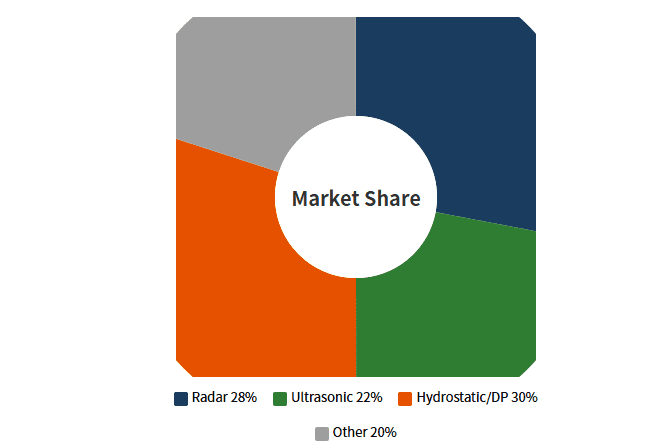
Sources: Fortune Business Insights, MarketsandMarkets, Mordor Intelligence (estimated data).
Best Applications for Each Level Transmitter
Radar Level Transmitter Use Cases
Radar excels where environmental or process variability would compromise other technologies. In oil and gas terminals, non-contacting 80 GHz radar units measure crude oil levels in pressurized storage tanks operating at 3–6 bar and 80–120 °C — conditions that would cause ultrasonic signals to attenuate beyond usable range. Guided-wave radar is the technology of choice for LPG and propane spheres where the low dielectric constant of light hydrocarbons weakens free-space radar reflections.
In chemical processing, radar handles sulfuric acid, caustic soda, and solvent tanks that produce heavy vapor blankets. A petrochemical refinery in East Texas documented a 45% reduction in manual tank gauging labor after retrofitting 120 tanks from ultrasonic to 80 GHz radar — the primary driver being elimination of false readings caused by hydrocarbon vapor layers.
Food and beverage applications such as milk silos, sugar syrup tanks, and cooking oil storage also benefit from radar’s ability to ignore foam and condensation on the antenna, which are common byproducts of CIP (Clean-in-Place) cycles.
Ultrasonic Level Transmitter Use Cases
Ultrasonic transmitters deliver strong ROI in applications where the medium is clean, the environment is ambient, and the budget is tight. Municipal water and wastewater treatment plants are the single largest user base — open-channel flow measurement over Parshall flumes, raw water reservoir monitoring, and effluent tank level detection are daily workhorses for ultrasonic technology.
Rainwater harvesting and irrigation systems, particularly in remote locations, use battery-powered ultrasonic units because their low power consumption (often under 1 W) extends battery life to 3–5 years. General-purpose chemical totes and IBC containers in warehouses — where temperature is controlled and headspace is clean air — are another sweet spot for ultrasonic. A water utility in the Midwest U.S. reported running the same ultrasonic transmitters on 38 potable-water standpipes for 12 years with only routine transducer face cleaning every 18 months.
Hydrostatic Applications
Hydrostatic sensors dominate in groundwater monitoring wells and deep municipal water reservoirs where depths exceed 20 m. Neither radar nor ultrasonic can practically measure a column that deep inside a narrow well casing — a submersible probe simply drops down on its cable and reads pressure. River and lake stage monitoring for flood warning systems is another entrenched application, with probes anchored in stilling wells providing continuous data to SCADA systems.
In chemical tank farms handling aggressive acids (HCl, HF, H₂SO₄), PVDF- or PTFE-housed hydrostatic probes are often selected because the foam, mist, and condensation inside these tanks would defeat ultrasonic, and the corrosive atmosphere attacks all but the most specialized radar antennas. Jade Ant Instruments supports process plants in selecting the appropriate transmitter housing materials — including PTFE, 316 SS, and Hastelloy options — to ensure compatibility with the specific chemical environment.
Watch: Radar vs Ultrasonic Level Measurement — Technology Comparison
How to Choose the Right Level Transmitter
Liquid Type & Properties
Start by characterizing the liquid. What is its dielectric constant? Liquids with a high dielectric constant (water = 80, acids = 50–80) produce strong radar reflections and are well-suited to non-contact radar. Low-dielectric liquids (light hydrocarbons εr = 1.5–2.0) may require guided-wave radar or hydrostatic measurement instead. If the liquid foams during filling or agitation, eliminate ultrasonic from contention — foam absorbs sound and produces unstable echoes. If density varies by more than 3–5% during normal operation, hydrostatic sensors will drift unless you implement real-time density compensation.
Tank & Installation Factors
Tank geometry matters. Tall, narrow tanks with limited nozzle space favor 80 GHz radar with its narrow beam angle. Open-top tanks or channels are natural fits for ultrasonic. Tanks deeper than 15 m with bottom-access ports benefit from submersible hydrostatic probes. Also consider whether the tank has internal structures — baffles, agitators, heating coils — that could generate false radar echoes. If retrofitting an existing tank, evaluate available process connections: radar and ultrasonic typically require a top-mounted nozzle (1.5″–4″ NPT or flange), while hydrostatic requires a bottom or sidewall connection — or simply a cable route from the top through which to lower a submersible probe.
Environmental Considerations
Outdoor installations in climates with wide temperature swings (e.g., −30 °C winters, +45 °C summers) strongly favor radar, which is unaffected by ambient temperature. Ultrasonic performance degrades in high-wind, dusty, or snowy conditions — ice buildup on the transducer face is a common winter failure mode in northern installations. Hazardous-area classifications (ATEX, IECEx, Class I Div 1/2) are available across all three technologies, but ensure the specific model you select carries the required certification.
Accuracy & Maintenance
Define your accuracy requirement in absolute terms. If you need ±1–3 mm (e.g., custody transfer, high-value product), radar is the only viable non-contact option. If ±5 mm or ±0.25% of span is acceptable (e.g., process control, overflow prevention), ultrasonic or hydrostatic both qualify. On the maintenance side, non-contact technologies (radar, ultrasonic) inherently require less ongoing attention than contact sensors. However, ultrasonic transducers need periodic face cleaning in dirty environments, while hydrostatic probes need diaphragm inspection and vent-tube purging. Radar, once commissioned, is genuinely install-and-forget in the majority of installations.
Cost Factors
Evaluate total cost of ownership (TCO), not just the purchase price. A $500 ultrasonic transmitter that needs to be replaced every 5 years due to transducer corrosion in a chemical headspace is more expensive over a 15-year lifecycle than a $1,500 radar unit that runs untouched for 15+ years. Include commissioning labor, calibration frequency, spare parts, and downtime costs in your TCO model. Jade Ant Instruments provides TCO calculators and application engineering support to help plants compare instrumentation options on a lifecycle basis, not just on initial sticker price.
Quick Decision Framework
| If Your Application Has… | Recommended Technology | Why |
|---|---|---|
| High temperature or pressure | Radar | EM waves unaffected by process conditions |
| Heavy foam, vapor, or mist | Radar or Hydrostatic | Ultrasonic signals are absorbed by foam/vapor |
| Clean water at ambient conditions | Ultrasonic | Cost-effective, proven, and simple |
| Deep wells or narrow casings (>15 m) | Hydrostatic | Submersible probes reach where top-mount can’t |
| Custody transfer / high-value inventory | Radar (FMCW) | ±0.5 mm accuracy achievable |
| Remote / solar-powered site | Ultrasonic | Low power draw (<1 W), battery-operated models available |
| Variable-density liquids | Radar or Ultrasonic | Density changes do not affect non-contact measurement |
| Highly corrosive acid tank with mist | Hydrostatic (PTFE/PVDF housing) | Immune to headspace conditions, chemical-resistant materials |

There is no single “best” level transmitter — only the best fit for a specific set of process conditions, environmental factors, accuracy requirements, and budget constraints. Radar has earned its growing market share through unmatched environmental immunity, ±1–3 mm accuracy, and sharply falling prices that now start around $1,000 for a quality 80 GHz unit. Ultrasonic remains the pragmatic, cost-effective choice for ambient-temperature, clean-liquid applications where its $500–$2,000 price point delivers excellent value. Hydrostatic continues to own the deep-tank, well-monitoring, and open-channel segments where contact measurement and pressure-based simplicity outperform any top-mounted alternative.
For new installations in environments with temperature swings, vapor, or foam — and wherever lifecycle cost matters more than purchase price — radar is the recommended default. For clean-water utilities on tight capital budgets, ultrasonic delivers proven reliability. For deep wells and corrosive chemical sumps, hydrostatic is the tested standard. Whichever technology you select, ensure you evaluate it on total cost of ownership over a 10–15-year horizon, not just the day-one invoice.
If you need application engineering support or want to discuss OEM/ODM instrumentation solutions, Jade Ant Instruments‘ technical team is available to help match the right measurement technology to your specific process — across flow, pressure, and level measurement applications. Contact Jade Ant Instruments →
Frequently Asked Questions (FAQ)
1. What is the main difference between radar and ultrasonic level transmitters?
The fundamental difference is the signal type. Radar level transmitters emit electromagnetic (microwave) pulses that travel at the speed of light, while ultrasonic level transmitters emit acoustic (sound) pulses that travel at the speed of sound in air. This distinction means radar performance is unaffected by temperature, pressure, gas composition, or vacuum — whereas ultrasonic accuracy depends on a stable, gaseous medium between the transducer and the liquid surface. In practical terms, radar works reliably in more extreme and variable conditions, while ultrasonic is best suited for clean, ambient-temperature applications.
2. Which level transmitter is most accurate — radar, ultrasonic, or hydrostatic?
Radar level transmitters generally offer the highest absolute accuracy: ±1 mm to ±3 mm in standard industrial conditions, and down to ±0.5 mm with FMCW custody-transfer models. Ultrasonic transmitters typically achieve ±3 mm or ±0.25% of range. Hydrostatic sensors are specified as ±0.25% to ±0.5% of full scale, which translates to larger absolute error on tall liquid columns. For example, ±0.5% on a 10 m tank equals ±50 mm — far less precise than radar’s ±2 mm on the same tank.
3. Can radar level transmitters work in tanks with foam?
Yes. Radar transmitters — particularly 80 GHz models — can measure through light to moderate foam (classified up to Class III). The electromagnetic pulse penetrates the foam layer and reflects off the denser liquid surface beneath. Heavy, aerated foam (Class IV+) can still attenuate the signal, in which case guided-wave radar or hydrostatic measurement is recommended. Ultrasonic transmitters, by contrast, reflect off the top of the foam layer and cannot see through it.
4. How much does a radar level transmitter cost compared to ultrasonic?
As of 2025–2026, a quality industrial radar level transmitter (80 GHz, non-contact) typically costs between $1,000 and $4,000 depending on range, certification (ATEX/IECEx), and communication protocol. Ultrasonic transmitters for equivalent range cost $500 to $2,000. The price gap has narrowed significantly — radar instruments that cost $4,000 five years ago are now available for $1,000–$1,200, according to data published by Emerson. Hydrostatic probes remain the least expensive option at $200–$800.
5. When should I use a hydrostatic level sensor instead of radar or ultrasonic?
Choose hydrostatic when: (a) the measurement point is a deep well, borehole, or narrow casing where top-mounted sensors cannot achieve the required range; (b) the tank headspace is filled with heavy foam, corrosive mist, or condensation that would degrade non-contact signals; (c) the liquid density is known and stable; or (d) the budget is constrained and the application is straightforward (e.g., clean water, wastewater). Hydrostatic probes are also preferred in environments with extreme electromagnetic interference (EMI) where radar signals could be disrupted.
6. Do ultrasonic level transmitters work in vacuum conditions?
No. Ultrasonic level transmitters require a gaseous medium (air or other gas) to propagate sound waves. In vacuum or near-vacuum conditions, there is insufficient gas density for the acoustic pulse to travel, and the transmitter will fail to produce a reading. For vacuum vessels, radar is the correct technology — electromagnetic waves propagate without any medium.
7. What maintenance do radar level transmitters require?
In most installations, radar level transmitters are effectively maintenance-free after commissioning. There are no moving parts, no consumable elements, and no recalibration requirement under normal conditions. Occasional inspection may be needed if the antenna becomes coated with product buildup (more likely with GWR probes in sticky media), but 80 GHz non-contact units with drip-off lens designs minimize even this. Many plants report 15+ years of operation without any maintenance intervention.
8. Can I use an ultrasonic level transmitter outdoors in cold climates?
Ultrasonic transmitters can operate outdoors, but cold-climate performance requires attention. Ice and snow buildup on the transducer face is the primary failure mode — it blocks the acoustic signal entirely. Temperature swings between day and night can also cause measurement drift if the compensation algorithm is slow. For outdoor installations in climates with sustained freezing temperatures, radar is the more robust choice. If ultrasonic is selected, use a heated transducer housing and ensure the temperature sensor provides fast-response compensation.
9. What is guided-wave radar (GWR) and when is it better than non-contact radar?
Guided-wave radar sends electromagnetic pulses along a physical probe (rod or cable) that extends into the liquid. The pulse reflects at the point where the probe contacts the liquid surface. GWR is preferred for: liquids with very low dielectric constants (εr < 1.5) that produce weak free-space reflections; interface measurement between two liquids (e.g., oil/water); and small tanks or narrow nozzles where a non-contact beam might hit the walls. The trade-off is that GWR is a contact method — the probe is exposed to the process media and may require cleaning or replacement in fouling or corrosive services.
10. How does Jade Ant Instruments support level transmitter selection?
Jade Ant Instruments provides application engineering consultation to help process plants match the right measurement technology to their specific conditions. With ISO-certified manufacturing, OEM/ODM customization capabilities, and experience serving 10+ industrial sectors, Jade Ant Instruments offers flexible solutions with various communication protocols (HART, Modbus, 4-20 mA), material options, and integration support for SCADA and DCS systems. Their technical team can provide TCO analysis, material compatibility guidance, and field commissioning support.
Further Reading & Resources
Comparing Smart Pressure Transmitters for Industrial Applications — Jade Ant Instruments
Radar Level Measurement Overview — Endress+Hauser
Level Measurement Instrumentation — Emerson
Level Sensor — Wikipedia
How to Read Instrument Datasheets — Jade Ant Instruments