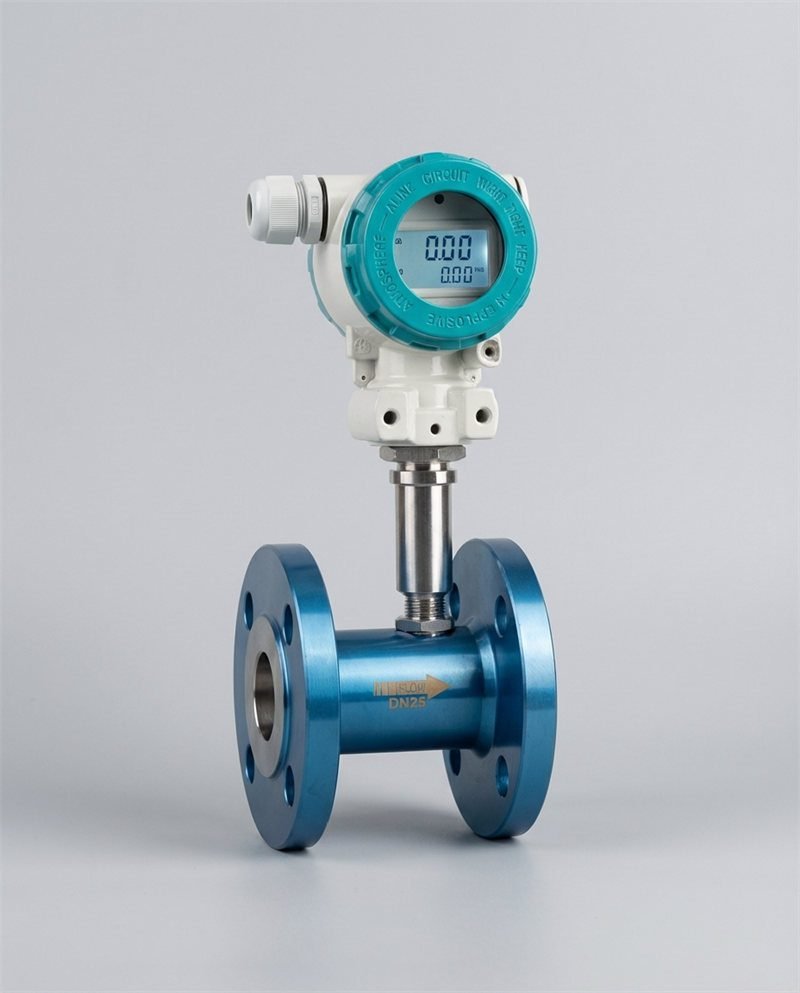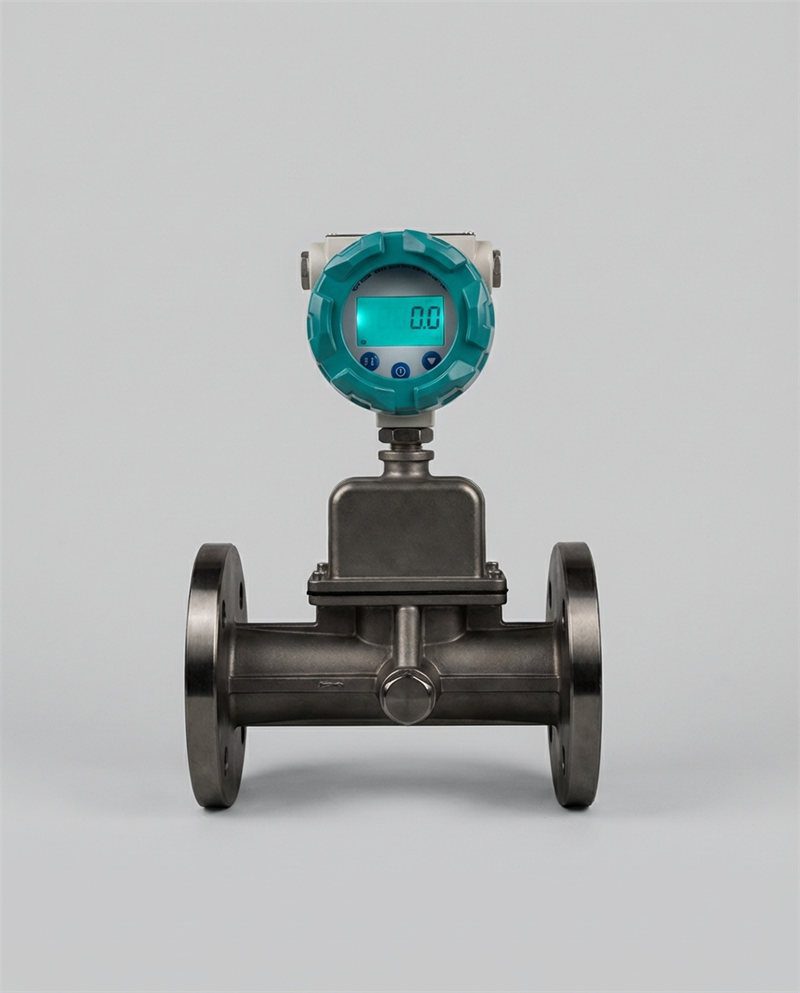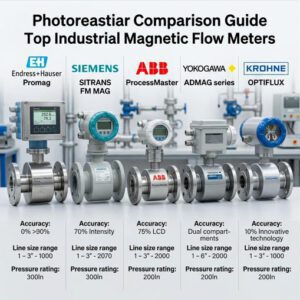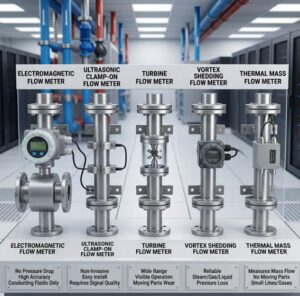
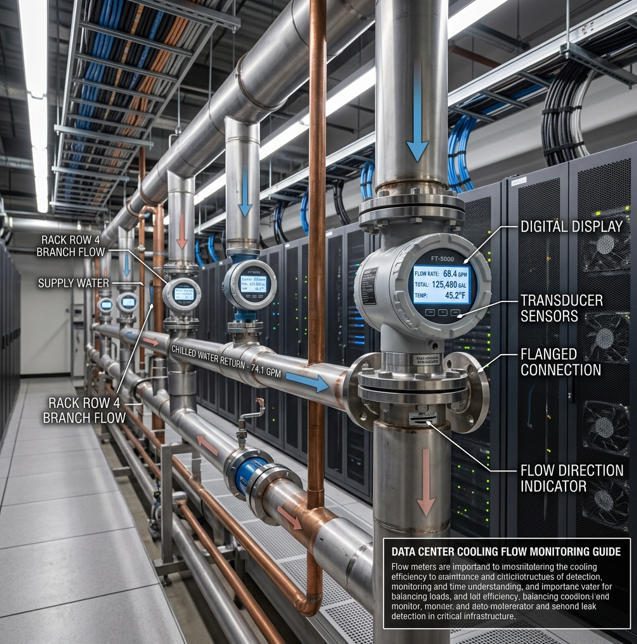
Data centers consumed an estimated 4.4 % of total U.S. electricity in 2024, with cooling infrastructure responsible for 30–50 % of that draw (LBNL 2024 U.S. Data Center Energy Usage Report — PDF). The global flow-meter market itself reached USD 11.44 billion in 2025 and is forecast to hit USD 12.14 billion in 2026 (Fortune Business Insights), driven in part by the explosion of AI-driven compute and the liquid-cooling systems it demands.
Despite this, a surprising number of facilities still operate chilled-water plants, coolant distribution units (CDUs), and cooling towers without per-loop flow measurement. The consequence is invisible: operators cannot calculate actual heat removal per rack, cannot verify that design flow rates match real conditions, and cannot pinpoint the loops that waste pump energy.
In concrete terms, an operator running a 10 MW campus at a Power Usage Effectiveness (PUE) of 1.58 spends roughly USD 5.05 million per year on non-IT overhead energy. If accurate flow measurement enables branch rebalancing, variable-frequency drive (VFD) optimization, and delta-T correction that brings PUE down to 1.31, the annual saving exceeds USD 350,000 — paying back dozens of inline flow meters within the first year.
This guide walks data-center mechanical engineers, facility managers, and MEP consultants through the five inline flow-meter technologies relevant to cooling loops, provides a concrete sizing and selection methodology, delivers a five-year total-cost-of-ownership (TCO) framework, and includes a real-world case study so you can justify instrumentation upgrades with hard numbers.
How Inline Flow Meters Fit into the Data Center Cooling Architecture
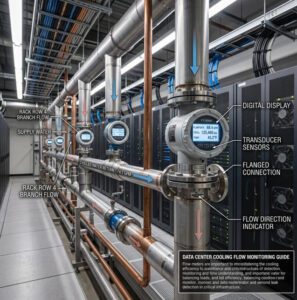
A modern data center cooling plant typically includes several distinct hydraulic circuits, each with different fluid properties, temperatures, and accuracy requirements. Understanding where meters go — and why — is the first step toward selecting the right technology.
2.1 Chilled-Water Primary and Secondary Loops
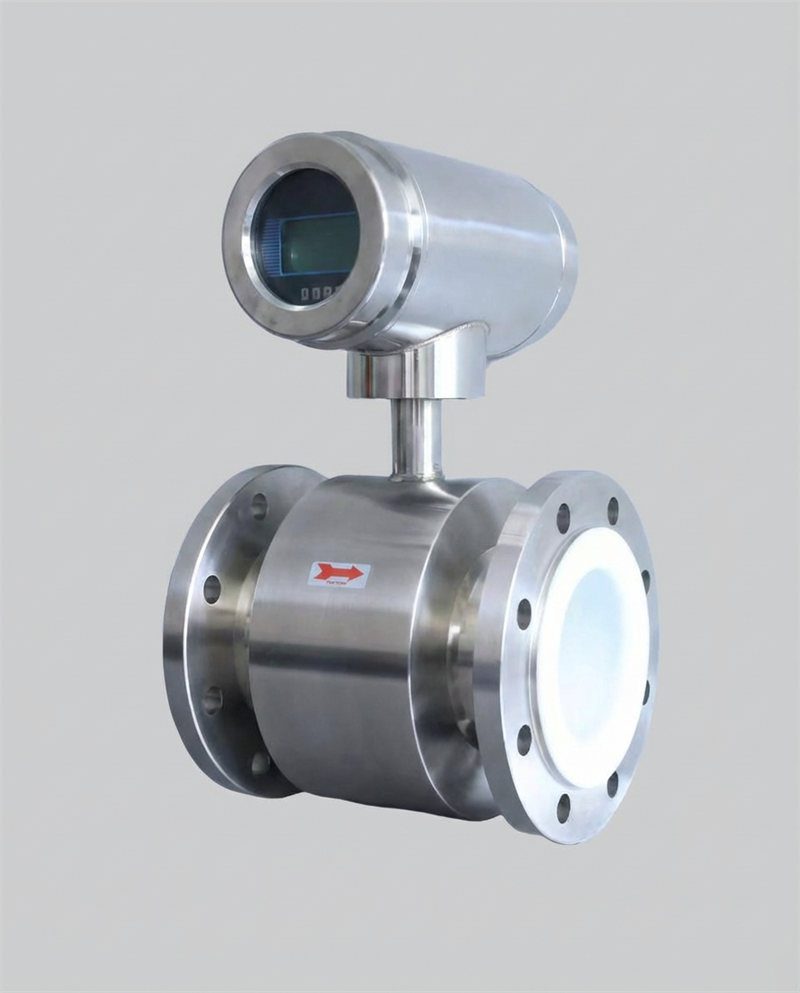
Primary loops circulate water (or a water–glycol blend up to 30 % propylene glycol for freeze protection) between chillers and a decoupling header at typical flow rates of 500–5,000 GPM per chiller. Secondary loops distribute chilled water from the header to computer room air handlers (CRAHs) or rear-door heat exchangers, usually at 50–500 GPM per branch. In both cases, the fluid is electrically conductive (conductivity ≥ 50 µS/cm even at 30 % glycol), making electromagnetic (mag) flow meters the default choice. Mag meters impose zero additional pressure drop beyond the pipe bore and deliver accuracy of ±0.2–0.5 % of reading.
2.2 Condenser-Water and Cooling-Tower Loops
Condenser water runs warmer (28–38 °C typical) and often contains treatment chemicals, dissolved solids, and occasional particulates from open cooling towers. Mag meters again excel here because they are unaffected by entrained solids. Badger Meter’s data-center cooling and water management portfolio specifically recommends its ModMAG M2000 for cooling-tower and heat-exchanger applications, and Dynasonics ultrasonic clamp-on meters for retrofit projects where pipe cutting is not possible.
2.3 Direct-to-Chip (DTC) and Rear-Door Heat Exchanger Circuits
High-performance computing (HPC) and AI training clusters increasingly use direct-to-chip liquid cooling. Fluid is typically a 25–40 % propylene-glycol/water mix, circulated at 1–8 GPM per server sled through small-bore (DN15–DN25) manifolds. Precision matters: a ±5 % flow imbalance across 48 server sleds in a rack means some chips run 8–12 °C hotter, triggering thermal throttling and reducing training throughput. Small-bore mag meters or low-flow ultrasonic meters are appropriate. MAG-VIEW electromagnetic meters have been deployed specifically for this application, while Jade Ant Instruments documents magnetic flow meter applications that include small-bore conductive-liquid cooling circuits relevant to DTC manifolds.
2.4 Immersion-Cooling and Dielectric-Fluid Circuits
Single-phase and two-phase immersion cooling use non-conductive dielectric fluids such as engineered fluorocarbon fluids, mineral oils, or synthetic esters. Because these fluids have electrical conductivity below 0.01 µS/cm, electromagnetic meters cannot function. Coriolis mass flow meters or transit-time ultrasonic meters (which rely on acoustic velocity, not conductivity) are the viable options. Coriolis meters provide mass flow directly — valuable when fluid density changes with temperature — but carry a higher price tag and pressure drop. Transit-time ultrasonic clamp-on meters offer zero pressure drop and no wetted parts, but accuracy drops to ±1–2 % on viscous dielectric oils.
Five Inline Flow-Meter Technologies Compared for Data Center Cooling
Not every meter technology suits every cooling loop. The comparison table below scores the five types most commonly deployed in data center mechanical rooms against the criteria that matter most: accuracy, pressure drop, fluid compatibility, installation complexity, and five-year cost.
| Criterion | Electromagnetic | Transit-Time Ultrasonic (Inline) | Clamp-On Ultrasonic | Coriolis | Turbine / Paddle-Wheel |
|---|---|---|---|---|---|
| Accuracy (% of reading) | ±0.2–0.5 % | ±0.5–1.0 % | ±1.0–3.0 % | ±0.1–0.2 % | ±0.5–1.5 % |
| Repeatability | ±0.1 % | ±0.15 % | ±0.5 % | ±0.05 % | ±0.25 % |
| Turndown Ratio | 100:1 | 50:1 | 30:1 | 80:1 | 10:1 |
| Pressure Drop | Zero (full bore) | Very low | Zero (external) | Moderate (bent tube) | Moderate–High |
| Works with Glycol / Water? | Yes (≥ 5 µS/cm) | Yes | Yes | Yes | Yes |
| Works with Dielectric Fluid? | No | Yes | Yes (limited accuracy) | Yes | Possible (viscosity limits) |
| Moving Parts? | None | None | None | None | Yes (rotor / paddle) |
| Maintenance Interval | Calibration check every 2–3 yr | Calibration check every 2–3 yr | Transducer couplant check annually | Calibration check every 3–5 yr | Bearing / rotor replacement every 1–2 yr |
| Typical Unit Cost (DN50 / 2″) | $1,200–$3,500 | $2,000–$5,000 | $1,500–$4,000 | $5,000–$15,000 | $400–$1,200 |
| Best Data Center Use | Chilled water, condenser, DTC glycol | Clean water, glycol loops, retrofit | Retrofit, temporary audit, dielectric | Dielectric fluid, custody metering | Non-critical monitoring, low budget |
Sources: Manufacturer published datasheets from Endress+Hauser flow measurement portfolio, Badger Meter glycol application note, Emerson Micro Motion product library, and Jade Ant Instruments industrial flow monitor comparison.
Bar Chart: Accuracy Comparison Across Technologies
Fig. 1 — Best-Case Accuracy by Inline Flow Meter Technology (% of Reading — Lower Is Better)
Coriolis
±0.1 %
Electromagnetic
±0.2 %
Inline Ultrasonic
±0.5 %
Turbine / Paddle
±0.5 %
Clamp-On Ultrasonic
±1.0 %
Pie Chart: Data Center Flow Meter Deployment by Technology
Fig. 2 — Estimated Share of Inline Flow Meter Technologies Deployed in Data Center Cooling (2025–2026)
Ultrasonic (inline + clamp-on) — 26 % (retrofits, dielectric-compatible)
Coriolis — 15 % (dielectric fluid, high-value metering)
Turbine / Paddle-Wheel — 9 % (low-cost branch monitoring)
Other (DP, vortex, variable area) — 6 %
Sizing Methodology: From Rack kW to Meter Bore
Selecting the right meter bore is not a guessing game. The methodology below converts thermal-load data into a specific pipe velocity and meter size, then validates the selection against the meter’s rangeability.
6.1 Step 1 — Calculate Required Flow Rate
The fundamental equation connecting heat load to coolant flow is:
Q̇ = ṁ × cp × ΔT
Where Q̇ is heat load (kW), ṁ is mass flow rate (kg/s), cp is specific heat capacity (kJ/kg·K), and ΔT is supply–return temperature difference (K). For a 100 kW rack row cooled by 30 % propylene-glycol/water (cp ≈ 3.85 kJ/kg·K) with a design ΔT of 8 °C:
ṁ = 100 ÷ (3.85 × 8) = 3.25 kg/s ≈ 3.14 L/s ≈ 49.7 GPM
6.2 Step 2 — Select Pipe Size and Verify Velocity
For a DN50 (2″) pipe with 52.5 mm internal diameter:
Velocity = Q ÷ A = 3.14 × 10⁻³ ÷ (π/4 × 0.0525²) = 1.45 m/s
This falls within the recommended 1.0–3.0 m/s range for mag meters and the 0.3–12 m/s range for transit-time ultrasonics — both acceptable. If velocity falls below 0.3 m/s, accuracy degrades; above 3 m/s, pressure-drop energy cost rises and cavitation risk increases.
6.3 Step 3 — Verify Turndown Ratio
During off-peak hours (nights, weekends, mild weather), IT load may drop to 30–40 % of design, reducing flow proportionally. If the minimum expected flow is 15 GPM (30 % of 49.7 GPM), the required turndown is 49.7 ÷ 15 ≈ 3.3:1 — comfortably within the 100:1 turndown of a mag meter but potentially outside the 10:1 range of a turbine meter. This is a primary reason turbine meters should be avoided for variable-flow data center branches.
6.4 Step 4 — Apply Glycol Correction
Glycol increases viscosity and alters acoustic velocity. At 30 % propylene glycol and 7 °C, kinematic viscosity is approximately 4.5 cSt versus 1.3 cSt for pure water at the same temperature. For ultrasonic meters, the manufacturer must program the correct fluid speed of sound (typically ~1,480 m/s for this mixture). Electromagnetic meters are inherently immune to viscosity changes, which is one reason they dominate glycol-loop deployments. The Jade Ant Instruments flow meter selection guide walks through fluid-property corrections for various meter types in a step-by-step format that complements this methodology.
Five-Year Total Cost of Ownership (TCO) Comparison
Upfront purchase price tells only part of the story. Pressure-drop energy cost, calibration, and maintenance can flip the ranking entirely. The table below models a DN50 (2″) meter on a chilled-water secondary branch running 8,000 hours per year at 50 GPM average, with electricity at $0.10/kWh.
| Cost Category | Electromagnetic | Inline Ultrasonic | Clamp-On Ultrasonic | Coriolis | Turbine |
|---|---|---|---|---|---|
| Unit Purchase | $2,500 | $3,500 | $2,800 | $9,000 | $700 |
| Installation (pipe mod + wiring) | $1,200 | $1,200 | $400 | $1,800 | $900 |
| Pressure-Drop Energy (5 yr) | $0 | $180 | $0 | $950 | $620 |
| Calibration (5 yr, 2 checks) | $600 | $600 | $800 | $1,200 | $500 |
| Maintenance / Spare Parts (5 yr) | $100 | $150 | $250 | $200 | $1,500 |
| Downtime Risk Premium | $200 | $200 | $100 | $300 | $1,000 |
| 5-Year Total | $4,600 ✓ | $5,830 | $4,350 | $13,450 | $5,220 |
The electromagnetic meter delivers the best combination of accuracy and TCO for conductive-fluid loops. Clamp-on ultrasonic meters win on pure TCO when pipe cutting is impossible (retrofit scenarios), but sacrifice accuracy. Coriolis meters are justified only where the fluid is non-conductive or where custody-grade accuracy (±0.1 %) is contractually required. Turbine meters appear cheap upfront but accumulate significant maintenance cost and downtime risk from bearing wear — making them the most expensive option when total lifecycle cost is considered honestly.
Installation Best Practices for Maximum Accuracy
8.1 Straight-Run Requirements
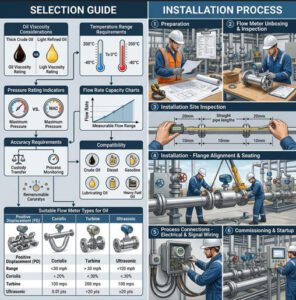
Electromagnetic meters typically need 5 pipe diameters (5D) of straight, undisturbed pipe upstream and 3D downstream of the sensor. Inline transit-time ultrasonic meters require 10–20D upstream and 5D downstream — more if there is a double elbow or partially closed valve upstream. Coriolis meters are largely insensitive to upstream flow profile and need no straight run, which is a significant advantage in space-constrained mechanical rooms where pipe routing is dictated by structural constraints. The flow meter installation best practices guide from Jade Ant Instruments includes pipe-layout diagrams covering straight-run requirements for all major meter types.
8.2 Orientation and Air Entrainment
Install mag meters and ultrasonic meters in horizontal pipe runs with the sensor electrodes or transducers positioned at the 3-o’clock and 9-o’clock positions (horizontal axis) so that entrained air bubbles migrate to the pipe crown rather than across the measurement zone. If vertical installation is unavoidable, flow must run upward to maintain a full pipe. A partially filled pipe can cause measurement errors exceeding 10 % — the single largest installation-related accuracy failure in cooling systems.
8.3 BMS and SCADA Integration
Most data-center BMS platforms (Schneider EcoStruxure, Siemens Desigo, Johnson Controls Metasys) accept 4–20 mA analog inputs, Modbus RTU/TCP, or BACnet IP. Choose meters that natively output at least two of these protocols. Digital protocols carry richer diagnostic data — for example, an Endress+Hauser Promag W meter with Heartbeat Technology can transmit electrode-coating warnings and verification test results directly to the BMS, enabling predictive maintenance without a technician on-site. The ONICON education series on data center flow and energy measurement provides a concise overview of how real-time flow data feeds into PUE and WUE calculations within DCIM software.
8.4 Grounding and Electrical Isolation
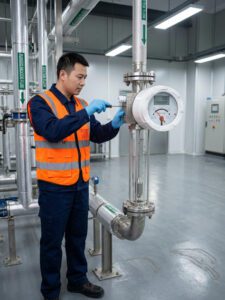
Mag meters require proper grounding to function correctly. Use grounding rings (316L stainless steel or Hastelloy C, matching the pipe material) on plastic or lined pipes. A poorly grounded mag meter on a CPVC glycol loop will produce erratic, drift-prone readings — one of the most common installation mistakes in data-center mechanical rooms. The grounding ring should make full-circumference contact with the fluid on both the upstream and downstream flanges of the meter body.
Embedded YouTube Video: Flow Meters in Data Center Cooling
Real-World Case: 10 MW Colocation Campus PUE Improvement
A 10 MW multi-tenant colocation campus in Northern Virginia operated with a measured PUE of 1.58. Cooling was provided by four 2,500-ton centrifugal chillers feeding 16 CRAHs, plus a waterside free-cooling economizer. No per-branch flow meters were installed; operators relied on chiller display readings and supply/return temperature sensors alone.
Problem Identified
During a mechanical audit, portable clamp-on ultrasonic readings revealed that two of the 16 CRAH branches received 35 % more flow than design, while three branches were starved by 20 %. The over-served branches were over-cooling (supply air at 11 °C instead of the 13 °C design setpoint), and the under-served branches triggered high-temperature alarms, forcing operators to lower the chiller supply-water setpoint campus-wide — wasting compressor energy across all four machines.
Solution Deployed
The facility installed 36 Endress+Hauser Promag W 400 electromagnetic flow meters (DN100 and DN150) across all CRAH branches, condenser-water headers, and economizer loops. Each meter outputs Modbus TCP to the Schneider EcoStruxure BMS. Flow data was combined with existing temperature sensors to compute real-time delta-T per branch and aggregate cooling load.
Results After 12 Months
Operators balanced branches within ±5 % of design flow, raised the chiller supply-water setpoint by 1.5 °C, and extended free-cooling economizer operation by 340 hours per year. Measured PUE dropped from 1.58 to 1.31. At $0.085/kWh and 10 MW IT load, the non-IT energy savings amounted to approximately $390,000 per year. The 36-meter instrumentation package, including installation and commissioning, cost roughly $185,000 — yielding a payback period under six months.
11.1 Calibration Schedule
For electromagnetic meters on clean chilled water, a verification check every 24–36 months is standard practice. Meters with in-situ verification capabilities (Endress+Hauser Heartbeat, Emerson Smart Meter Verification, or KROHNE OPTICHECK) can perform self-tests without removing the meter from the pipe — critical in 24/7 data centers where shutdowns for calibration are costly and operationally risky. For glycol loops where inhibitor breakdown can deposit films on electrodes, shorten the interval to 12–18 months or specify meters with automatic electrode-cleaning functions.
11.2 Lifespan Expectations
Electromagnetic and ultrasonic meters with no moving parts typically last 15–20+ years in data-center conditions (Kytola Instruments lifespan study). The controlled ambient temperature (18–27 °C), low humidity, and clean-air environment found in mechanical rooms is far gentler than most industrial plants, which extends electronics life significantly. Turbine meters need rotor and bearing replacement every 1–3 years, shortening their effective service life unless spare parts are stocked on-site. Coriolis meters share the 15–20 year lifespan but may require tube-set replacement if process fluid causes erosion or corrosion over time.
11.3 Spare-Parts Strategy
For a campus with 30+ meters of the same brand and model, keep two spare transmitter electronics boards and one spare sensor of each installed size. This allows immediate hot-swap replacement during a failure without waiting for manufacturer lead times. The Jade Ant Instruments flow measurement device comparison includes a maintenance-complexity rating for each technology type, helping procurement teams estimate spare-parts budgets during the specification phase.
Emerging Trend: Flow Metering for AI-Cluster Liquid Cooling
AI training clusters running high-density GPU racks dissipate 120–130 kW per rack — far beyond the 15–20 kW per rack that traditional air cooling can handle. Direct-to-chip (DTC) liquid cooling is no longer optional for these workloads; it is the baseline. Each rack may contain 72 individual cold plates fed by a manifold, with each cold plate requiring a controlled flow of 0.5–1.5 GPM of glycol-water coolant.
At the CDU level, a single unit serving four racks manages 200–600 GPM aggregate. An electromagnetic flow meter on the CDU supply header ensures total flow is within design limits, while pressure-differential measurements across the manifold detect blocked or restricted cold plates. Some operators now install miniature ultrasonic sensors on individual server sleds — a trend that the IoThrifty analysis of high-density liquid-cooled data centers documents in detail.
For two-phase immersion cooling — where servers are submerged in dielectric fluid that boils at the chip surface — flow metering shifts to monitoring condensate return flow and vapor-side conditions. Coriolis meters on the liquid-return line can simultaneously measure mass flow and fluid density, detecting refrigerant loss or contamination before cooling capacity degrades. This is one of the few data-center scenarios where the premium cost of a Coriolis meter is unambiguously justified by the operational risk it mitigates.
Inline flow meters are the missing diagnostic layer in most data center cooling plants. Without per-loop flow data, operators cannot verify that chiller output reaches every rack, cannot calculate actual heat removal rates, and cannot optimize pump VFD speed to match real-time demand. The technology choice depends primarily on fluid conductivity: electromagnetic meters dominate for water and glycol loops due to their zero-pressure-drop design, ±0.2 % accuracy, and 100:1 turndown, while Coriolis or transit-time ultrasonic meters serve non-conductive dielectric circuits.
The five-year TCO analysis presented in this guide shows that an electromagnetic meter costs roughly $4,600 over its service life on a DN50 branch — actually less than a turbine meter when maintenance and downtime risk are included. For any operator targeting a PUE below 1.3, installing flow meters on every branch circuit is not a luxury; it is the single highest-ROI instrumentation investment available in the mechanical plant room.
Whether you are designing a greenfield AI campus or retrofitting a legacy colocation facility, start by mapping your hydraulic circuits, computing design flow rates from thermal loads using the equations in Section 6, and matching each loop to the right meter technology using the framework in this guide. For electromagnetic, ultrasonic, and turbine meter sourcing with factory calibration and international shipping, Jade Ant Instruments provides a comprehensive product portfolio backed by ISO-certified manufacturing — a practical starting point for specification and procurement.
Frequently Asked Questions (FAQs)
1. What type of inline flow meter is best for data center chilled-water loops?
Electromagnetic (mag) flow meters are the top choice for chilled-water and glycol-water loops because they impose zero additional pressure drop, deliver ±0.2–0.5 % of reading accuracy, have no moving parts to wear, and work reliably with any fluid conductivity above 5 µS/cm. A typical 30 % propylene-glycol/water blend used in data center cooling has conductivity well above this threshold. Manufacturers like Endress+Hauser and Badger Meter offer models purpose-built for HVAC and data center cooling applications.
2. Can electromagnetic flow meters measure dielectric immersion-cooling fluid?
No. Electromagnetic meters require a minimum fluid electrical conductivity of approximately 5 µS/cm. Dielectric coolants such as engineered fluorocarbon fluids, mineral oils, and synthetic esters have conductivities well below 0.01 µS/cm. For these non-conductive fluids, use Coriolis mass flow meters (which also provide density measurement) or transit-time ultrasonic meters that rely on acoustic velocity rather than electrical conductivity.
3. How does adding flow meters improve data center PUE?
Flow meters provide the real-time volumetric or mass flow data needed to compute actual heat removal per cooling branch. With this data, operators can balance flow across CRAHs, raise chiller supply-water setpoints (even a 1 °C increase saves 2–3 % compressor energy), optimize pump VFD speeds to match actual demand rather than running at constant speed, and extend free-cooling economizer hours. In documented cases, these combined improvements have reduced PUE from 1.5–1.6 to below 1.3, saving hundreds of thousands of dollars annually on campuses above 5 MW IT load. The ONICON education series provides a detailed explanation of how flow and energy measurement tie directly to PUE optimization.
4. What is the recommended straight-run pipe length for an inline flow meter in a mechanical room?
It depends on the meter technology. Electromagnetic meters need approximately 5 pipe diameters (5D) upstream and 3D downstream. Inline transit-time ultrasonic meters require 10–20D upstream and 5D downstream for optimal accuracy. Coriolis meters are essentially insensitive to upstream flow profile and need zero straight run, making them advantageous in crowded data center mechanical rooms. The Jade Ant Instruments installation guide includes pipe-layout diagrams for each major meter type.
5. How often should data center flow meters be calibrated?
For electromagnetic and ultrasonic meters on clean chilled water, a verification check every 24–36 months is standard. On glycol loops where inhibitor degradation can foul electrodes, shorten this to 12–18 months. Meters with in-situ verification technologies (such as Endress+Hauser Heartbeat or Emerson Smart Meter Verification) can perform self-diagnostics without removing the meter from the pipe, avoiding costly shutdowns in 24/7 facilities.
6. Are clamp-on ultrasonic meters accurate enough for permanent data center cooling measurement?
Clamp-on ultrasonic meters offer ±1–3 % of reading accuracy, which is adequate for energy auditing, temporary diagnostics, and retrofit situations where pipe cutting is impractical. However, they are generally not accurate enough for precise branch-by-branch delta-T optimization where ±0.5 % or better is needed. For permanent installations where accuracy drives operational decisions, inline electromagnetic or inline ultrasonic meters are the better investment.
7. What flow meter works best for direct-to-chip liquid cooling on AI server racks?
Direct-to-chip (DTC) cooling typically circulates a water-glycol blend at 1–8 GPM per server sled through small-bore (DN15–DN25) manifolds. Small-bore electromagnetic meters are the primary choice because the fluid is conductive. At the CDU header level (DN50–DN100), a full-bore mag meter monitors aggregate flow. For non-conductive dielectric DTC systems (rare but emerging), miniature Coriolis or ultrasonic sensors are needed instead.
8. How much does pressure drop from an inline meter affect data center pump energy costs?
Full-bore electromagnetic and clamp-on ultrasonic meters produce zero additional pressure drop. Coriolis meters with bent-tube designs may add 0.5–2.0 bar at high flow rates, and turbine meters add 0.2–0.8 bar depending on size and condition. On a large chilled-water loop running 8,000 hours per year, even 0.5 bar of unnecessary pressure drop at 500 GPM translates to roughly $3,000–$5,000 in annual pump energy cost. Over five years, this can exceed the purchase price of the meter itself.
9. What communication protocols should a data center flow meter support for BMS integration?
At minimum, the meter should output 4–20 mA (for legacy analog loops) and Modbus RTU or TCP (for digital BMS integration). BACnet IP is increasingly required by facilities using Schneider EcoStruxure, Siemens Desigo, or Johnson Controls Metasys. For advanced diagnostics — such as remote verification results and electrode health monitoring — HART over 4–20 mA or PROFINET add significant value. Always confirm protocol compatibility with your DCIM or SCADA platform before finalizing the meter specification.
10. Where can I source factory-calibrated inline flow meters for data center cooling projects?
Global brands like Endress+Hauser, Emerson Micro Motion, KROHNE, and Badger Meter all supply factory-calibrated meters for data center cooling. For cost-effective electromagnetic, ultrasonic, and turbine meters with ISO-certified factory calibration and international logistics, Jade Ant Instruments is a manufacturer serving data center and industrial customers worldwide with a full product portfolio from DN10 to DN2000.