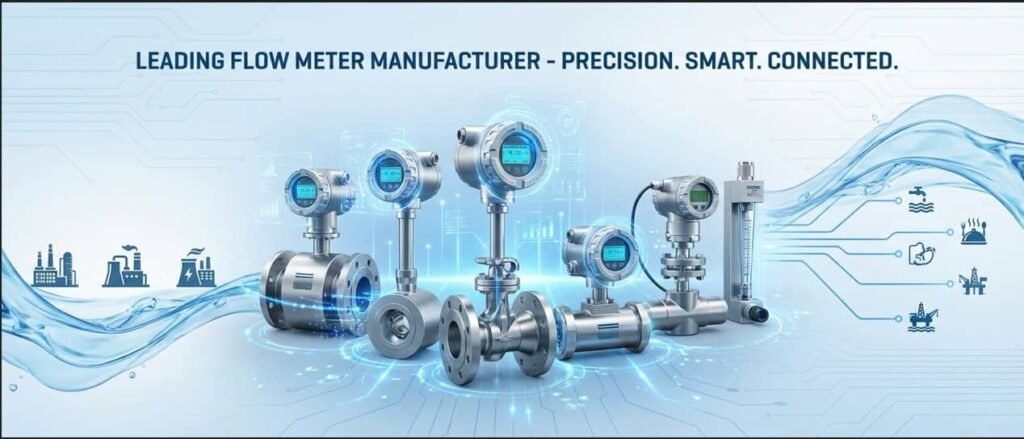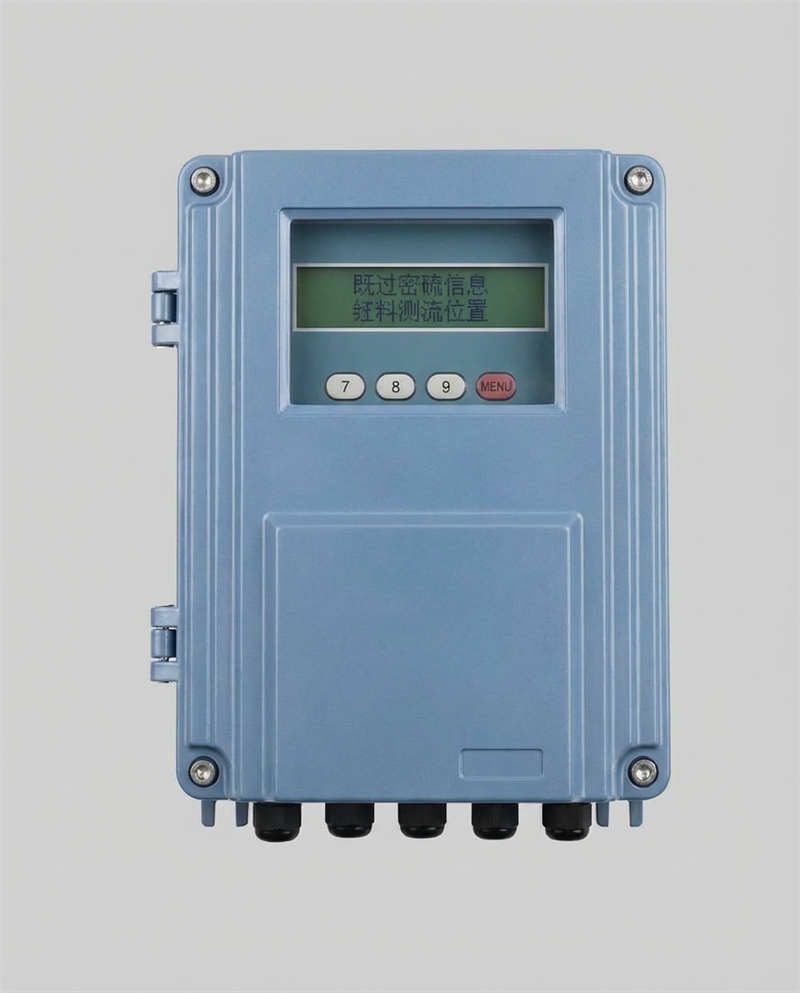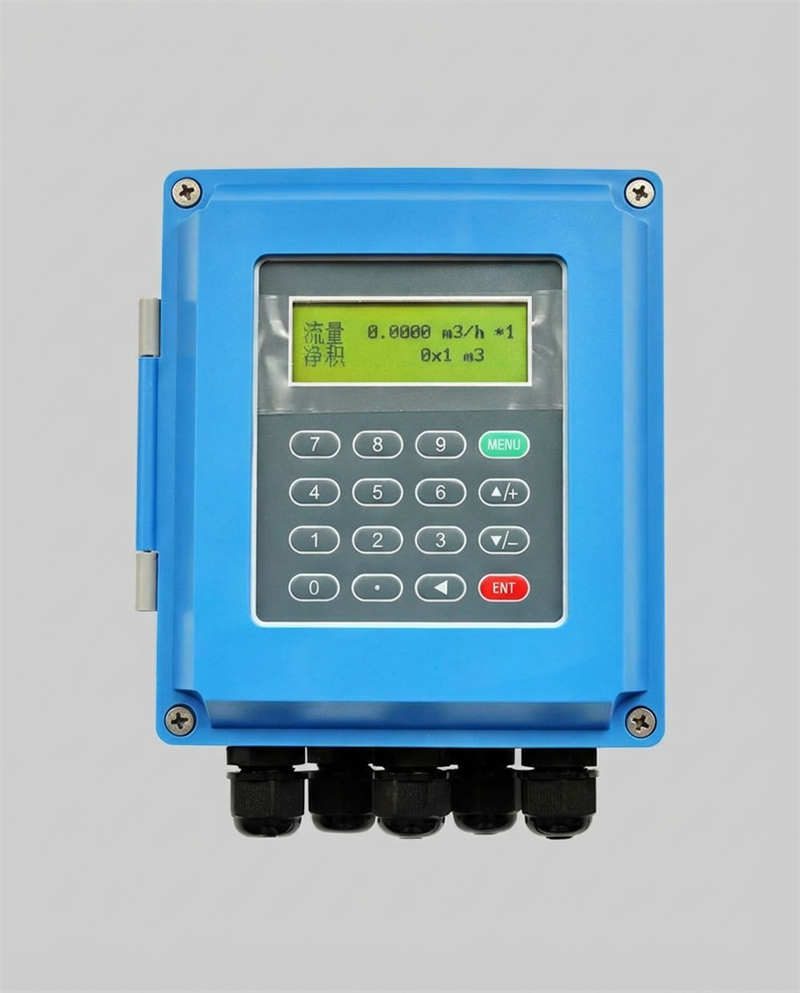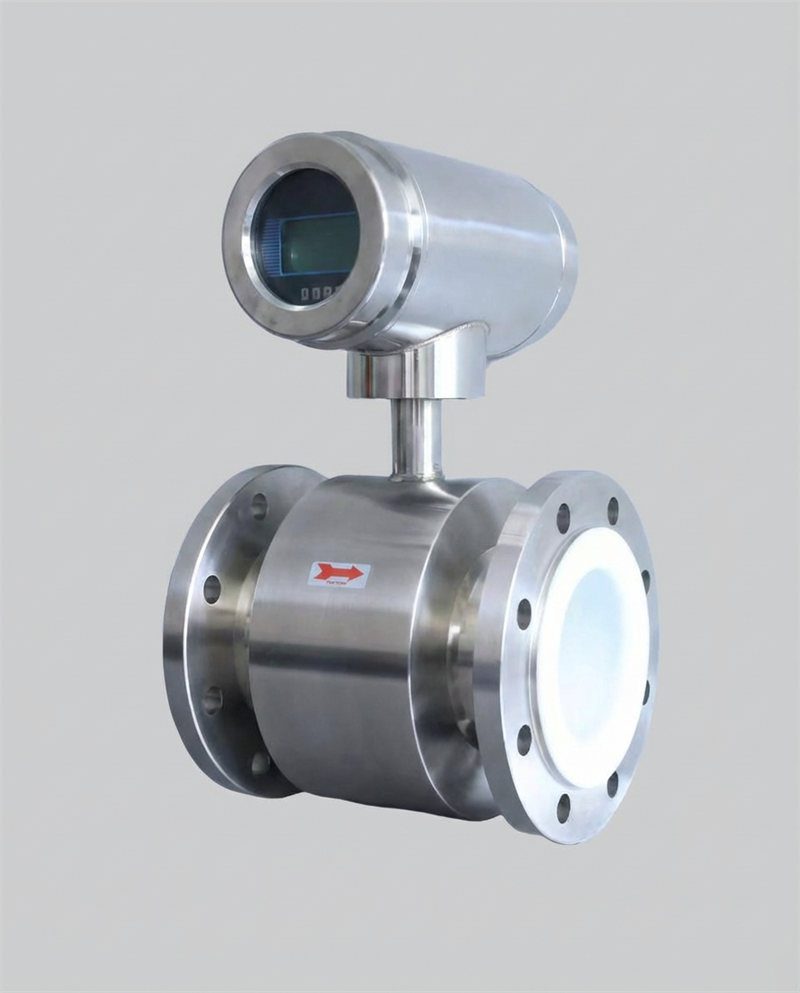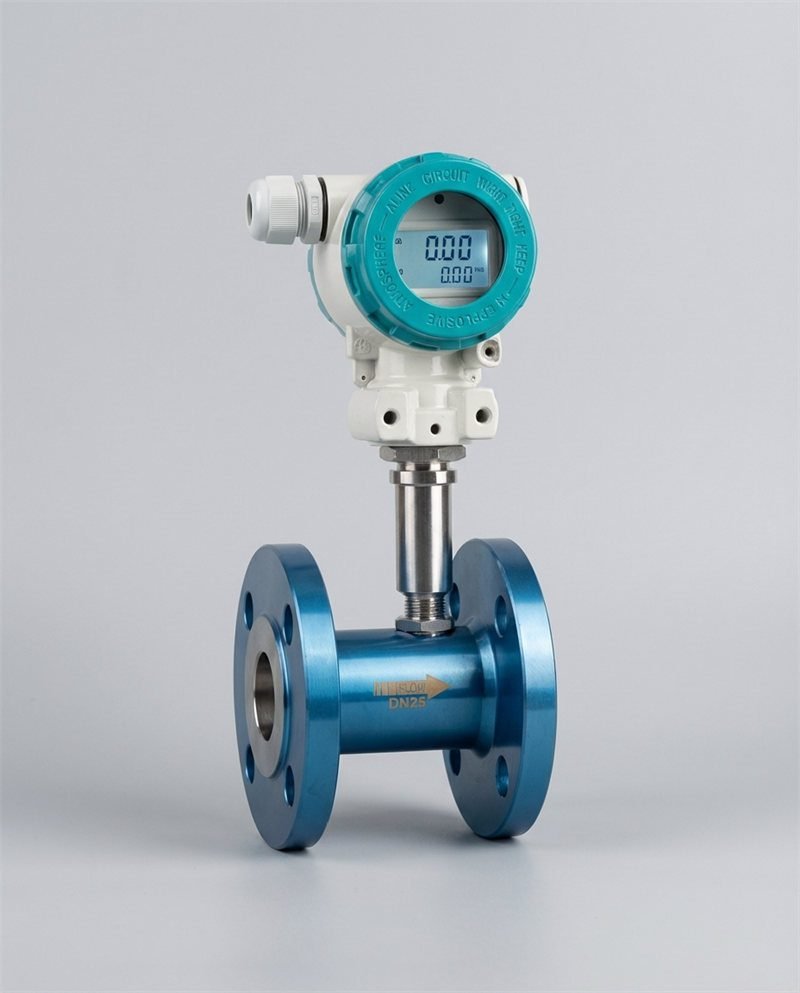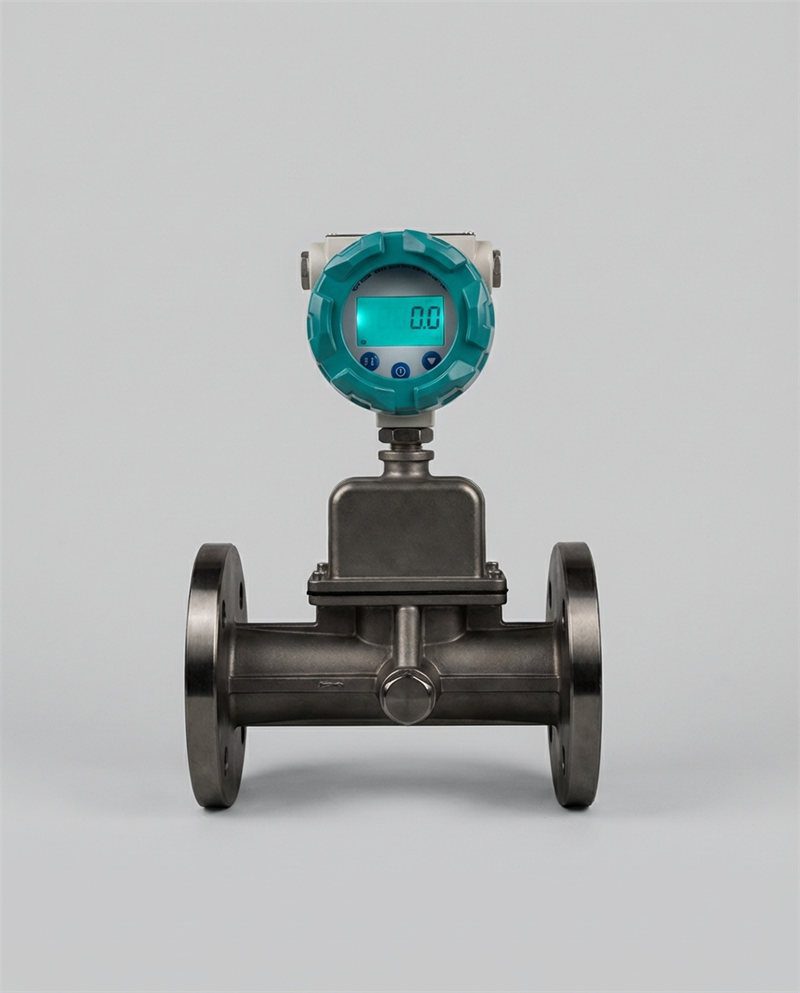
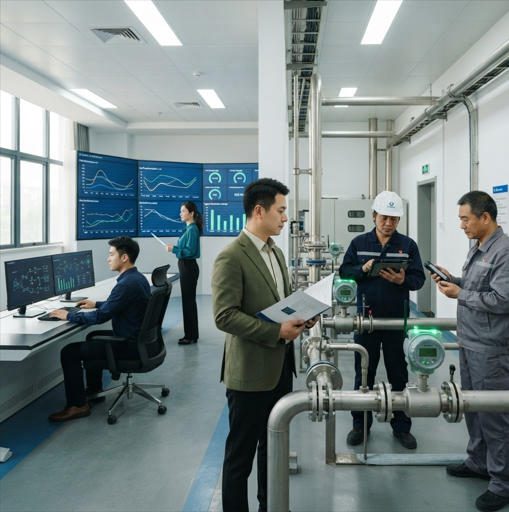
Transforming Industrial Operations Through Connected, AI-Powered Flow Measurement Technology
The intelligent flow meter market is projected to reach $5.58 billion by 2034, driven by the convergence of ultrasonic technology and IoT integration. This comprehensive guide explores how distributors and flow instrumentation agents can capitalize on this growth by understanding AI-driven analytics, predictive maintenance capabilities, and real-time data solutions that deliver measurable ROI to end-clients.

Why Smart Flow Meters Matter to Your Business
A decade ago, “checking the flow meter” meant a technician walking the line, writing a number on a clipboard, and hoping nothing had drifted since the last visit. That model is disappearing fast, and the businesses replacing it are the distributors who understood early that a flow meter could be more than a passive gauge — it could be a live data source feeding an entire plant’s decision-making process.
The Market Opportunity for B2B Distributors
Market size projections and CAGR growth rates. Multiple independent research firms converge on a similar picture: Straits Research puts the intelligent flow meter market at $3.66 billion in 2026, growing to $5.58 billion by 2034 at a 5.39% CAGR, while Fortune Business Insights projects a comparable trajectory toward the mid-single-digit billions over the same window. Regardless of which exact figure proves most accurate, the direction is unambiguous — this segment is growing faster than the broader flow meter market, which itself sits around $11 billion globally.
Why intelligent flow meters represent a high-margin product category. A standard mechanical meter is increasingly a commodity item, priced primarily on unit cost. A smart, IoT-connected ultrasonic or electromagnetic meter is sold on a different basis entirely — accuracy data, diagnostic depth, and the recurring service relationship it enables. Distributors who can speak fluently about signal quality, predictive maintenance, and total cost of ownership consistently report 15% to 25% higher margins than competitors selling on price alone, because the conversation shifts from “how cheap” to “how much this protects your operation.”
Competitive advantages of early adoption for distributors. The customers who eventually specify smart metering at scale rarely switch suppliers casually once a relationship is established — recalibrating an entire fleet of meters to a new communication protocol or dashboard is disruptive enough that incumbency matters. Distributors building this expertise now are effectively securing a multi-year advantage before the market matures and price competition intensifies.
How IoT Integration Changes the Flow Measurement Landscape
Evolution from traditional to smart metering systems. The shift is not simply “adding a sensor to an old meter.” It runs through three layers: the measurement technology itself (increasingly ultrasonic or electromagnetic rather than mechanical), the connectivity layer (wireless protocols replacing hardwired 4–20 mA loops in many retrofit scenarios), and the analytics layer (cloud dashboards and machine learning replacing manual log review).
Customer pain points that IoT-enabled solutions address. Plant managers consistently cite three recurring frustrations: they discover leaks or losses only after a billing cycle or inventory reconciliation flags the problem; unplanned equipment failures cost far more than the repair itself once downtime is counted; and manual data collection ties up technician hours that could be spent on higher-value work. IoT-connected meters attack all three by generating continuous, timestamped data rather than periodic snapshots.
The role of connectivity in modern industrial operations. As facilities invest in broader digitalization — cloud historians, digital twins, predictive maintenance platforms — flow measurement data becomes one input among many feeding those systems. A meter that cannot communicate digitally is, in practical terms, invisible to that broader infrastructure, no matter how accurate its analog reading might be.
Understanding Ultrasonic Technology in Smart Flow Meters
Core Principles of Ultrasonic Flow Measurement
How Ultrasonic Sensors Detect Flow Without Moving Parts
Non-invasive measurement methodology. An ultrasonic flow meter transmits sound pulses through a pipe wall using piezoelectric transducers, then calculates fluid velocity from how those pulses behave once inside the moving fluid. In transit-time meters, two transducers send pulses in opposite directions across the pipe; the pulse traveling with the flow arrives fractionally sooner, and that time difference is directly proportional to velocity. This design requires no probe, rotor, or electrode inside the pipe at all.
Quick definition — Transit-Time Measurement: A method that calculates fluid velocity from the time difference between ultrasonic pulses sent upstream and downstream through the fluid. Works best on clean, particle-free liquids, delivering 0.5% to 1.0% accuracy on a properly installed clamp-on meter.
Accuracy advantages over mechanical alternatives. Because there is no rotor to wear or bearing to degrade, an ultrasonic meter’s accuracy does not erode gradually the way a turbine meter’s does over years of service. Field data compiled across water utility deployments shows ultrasonic meters holding a stable 0.5% accuracy rating against the 1.5% drift typically observed in aging mechanical meters after a decade in service.
Applications across diverse fluid types and viscosities. Transit-time technology suits clean liquids — treated water, most chemicals, refined petroleum products. For fluids carrying suspended solids or gas bubbles, Doppler ultrasonic technology measures the frequency shift of signals reflecting off those particles instead, extending non-invasive measurement into wastewater, slurry, and sludge applications that would defeat a transit-time meter entirely.
Reliability and Durability Benefits for Your Clients
Extended operational lifespan. With no wearing components exposed to the fluid, a well-installed clamp-on ultrasonic meter in a protected environment routinely delivers 10 to 15 years of service, compared with the 3 to 5 year overhaul cycle typical of turbine and positive-displacement meters in continuous industrial use.
Reduced maintenance requirements and downtime. The only meaningful maintenance activity on a clamp-on ultrasonic meter is periodic inspection of the acoustic couplant — the gel or pad that eliminates the air gap between transducer and pipe — which takes roughly 30 minutes and requires no specialized equipment.
Cost-benefit analysis for end-users. Over a 10-year horizon, industry TCO studies consistently show clamp-on ultrasonic installations running at roughly 70% to 80% lower total cost than equivalent inline mechanical meters, once installation, maintenance, and eventual replacement are all factored in rather than comparing purchase price alone.
Ultrasonic Technology Advantages Over Traditional Flow Meters
Superior Accuracy and Precision in Real-World Conditions
Measurement tolerances and consistency metrics. Dual-path clamp-on ultrasonic meters typically achieve 0.5% to 1.0% accuracy, while multi-path inline configurations used for fiscal metering reach 0.15% to 0.5% — figures that meet or exceed most mechanical alternatives without the accuracy drift that comes from bearing wear.
Performance across varying temperature and pressure ranges. The speed of sound through water shifts by roughly 10% between 0°C and 100°C. Quality ultrasonic transmitters embed a temperature sensor and apply continuous compensation to the transit-time calculation, holding specified accuracy across the meter’s full rated operating range rather than only at calibration conditions.
Industry compliance certifications and standards. Depending on application, ultrasonic meters are specified against ISO 9104 for performance evaluation, OIML R49 for water metering under the EU Measuring Instruments Directive, and AGA Report No. 9 or API MPMS Chapter 5.8 for gas and liquid custody transfer respectively.
Lower Total Cost of Ownership for End-Clients
Elimination of moving parts reduces replacement costs. A turbine meter’s bearings and seals typically require replacement every 18 to 36 months in continuous service, at $800 to $2,500 per event. A clamp-on ultrasonic meter’s equivalent maintenance item — couplant refresh — costs under $50 and takes a fraction of the time.
Energy efficiency improvements. Ultrasonic clamp-on meters introduce zero pressure drop, unlike orifice plates that can permanently lose 5% to 25% of line pressure. On a pump system running continuously, that avoided pressure loss translates into real energy savings that accumulate every hour of every day the system operates.
Comparative ROI analysis: ultrasonic vs. mechanical meters. Jade Ant Instruments’ ultrasonic flow meter industrial applications guide documents 10-year TCO comparisons showing clamp-on ultrasonic solutions recovering their higher purchase price within 2 to 4 years through avoided maintenance alone, well before energy savings are counted.
IoT Integration: Connecting Flow Meters to Intelligent Networks

Essential IoT Components in Modern Flow Measurement Systems
Connectivity Protocols and Standards
Wi-Fi, cellular, LoRaWAN, and Zigbee options. The right connectivity choice depends heavily on site conditions. Wi-Fi suits facilities with existing dense network coverage. Cellular (4G/LTE, increasingly 5G) fits remote or unmanned sites where wired infrastructure would be prohibitively expensive — a rural pump station or a remote compressor station can be instrumented at a fraction of the cost of running conduit. LoRaWAN offers long-range, low-power communication ideal for battery-operated meters reporting infrequently across a large campus. Zigbee works well in denser, shorter-range mesh deployments within a single building or process area.
Choosing the right protocol for specific industrial environments. A useful rule of thumb: if the meter sits within existing plant wiring infrastructure, HART or Modbus over the existing 4–20 mA loop is the lowest-friction choice. If it sits in a brownfield location with no wiring at all, cellular or LoRaWAN eliminates the single largest cost item in many retrofit projects — the labor and materials for running new cable.
Security considerations in wireless flow meter networks. Any wireless connectivity layer introduces an attack surface that wasn’t present in a purely analog installation. Industrial wireless standards like WirelessHART (IEC 62591) address this with encrypted, authenticated mesh networking rather than open transmission, and this is a question your technical team should be prepared to answer confidently rather than deflect.
Edge Computing and Data Processing Capabilities
Local data processing vs. cloud-based solutions. Edge computing means the meter’s own transmitter performs signal filtering, cross-correlation, and diagnostic calculations locally before ever sending data anywhere — reducing the volume of raw data that needs to travel over a network connection and allowing the meter to flag an alarm condition instantly rather than waiting on a round trip to the cloud.
Latency reduction and real-time decision-making. For process control loops that need sub-second response, edge processing is not optional — a cloud round-trip measured in hundreds of milliseconds is simply too slow. For trend monitoring and predictive maintenance, cloud-based aggregation across many meters provides the broader pattern recognition that a single edge device cannot.
Bandwidth optimization for distributed meter networks. A facility with hundreds of connected meters cannot afford to stream raw high-frequency data from every point continuously. Modern transmitters address this by sending summarized values at regular intervals and only escalating to high-frequency streaming when a diagnostic threshold is crossed.
Real-Time Data Analytics and Monitoring Dashboards
Building Effective Monitoring Solutions for Your Customers
Dashboard design best practices for industrial users. The most effective dashboards resist the temptation to display every available data point. Plant operators respond best to a small set of clearly prioritized indicators — flow rate against baseline, signal quality, active alarms — with deeper diagnostic data available on drill-down rather than cluttering the primary view.
Key performance indicators (KPIs) specific to flow measurement. Beyond raw flow rate, the KPIs that matter most for hazardous or high-value fluid monitoring include signal quality index trends, totalized volume against expected consumption, and deviation from a rolling baseline that flags gradual drift before it becomes a measurable loss.
Mobile and web-based access for remote monitoring. A maintenance supervisor checking meter status from a phone during an off-site visit, rather than waiting for a site walk, is now a standard expectation rather than a premium feature — and distributors who can demonstrate this capability during a sales presentation consistently close faster.
Data Visualization and Actionable Insights
Trend analysis and pattern recognition capabilities. A single flow reading tells you almost nothing on its own. A week of readings trending against seasonal or shift-based patterns tells you whether a change represents normal variation or a genuine anomaly worth investigating.
Alert systems for anomalies and threshold breaches. Configurable alarms — high/low flow, signal quality degradation, unexpected reverse flow — turn a passive dashboard into an active monitoring tool that surfaces problems to the right person automatically, rather than relying on someone remembering to check.
Customizable reporting for different stakeholder levels. A plant engineer wants granular diagnostic data; a facility manager wants a monthly summary of consumption and anomalies; a regulatory compliance officer wants an audit-ready export. The same underlying data set should support all three views without requiring separate systems.
AI Integration and Predictive Maintenance Capabilities
Artificial Intelligence in Flow Measurement Systems
Machine Learning Models for Enhanced Accuracy
Adaptive algorithms that improve over time. Rather than applying a fixed calibration curve indefinitely, modern transmitters can incorporate historical performance data to refine their own compensation algorithms, gradually tightening accuracy as the system accumulates operating history specific to that installation.
Environmental compensation and automatic calibration. Temperature, pressure, and even fluid composition changes all affect raw signal behavior. Machine learning models trained on a meter’s own historical response can distinguish a genuine flow change from a compensable environmental effect far more precisely than a static lookup table.
Predictive error correction and self-diagnostics. Continuous monitoring of secondary diagnostic variables — signal strength, noise floor, zero-point stability — allows a smart transmitter to flag its own developing inaccuracy before that inaccuracy becomes large enough to matter operationally.
AI-Powered Anomaly Detection and Diagnostics
Real-time identification of system faults and leaks. A sudden, sustained shift in flow that doesn’t correlate with any scheduled process change is exactly the kind of pattern machine learning models excel at flagging automatically, long before it would be noticed by a technician glancing at a display during a routine walk.
Distinguishing between normal fluctuations and critical issues. The hardest part of any alarm system is avoiding false positives that train operators to ignore alerts. AI-based anomaly detection, trained on a facility’s actual historical variation, is measurably better at this than fixed-threshold alarms that treat every deviation the same way regardless of context.
Automated root-cause analysis for troubleshooting. By correlating flow anomalies with other available process variables — pressure, temperature, pump status — some advanced platforms can suggest a probable cause rather than simply reporting that a deviation occurred, cutting the diagnostic time a maintenance team spends chasing the source of a problem.
Predictive Maintenance: Preventing Costly Downtime
Condition-Based Monitoring and Health Scoring
Sensor degradation detection before failure. A declining signal quality trend over weeks or months, rather than an abrupt failure, is the typical pattern for a degrading ultrasonic couplant or a fouling electrode — and that gradual signature is exactly what condition-based monitoring is designed to catch early.
Fouling and blockage prediction in pipes and sensors. Endress+Hauser’s predictive maintenance research on Coriolis and ultrasonic installations documents unplanned-downtime reductions of 30% to 45% in process industries once condition-based monitoring replaces fixed-interval maintenance schedules.
Equipment lifespan estimation and replacement planning. Rather than replacing a meter on a fixed calendar schedule regardless of actual condition, health-scoring data lets a maintenance team plan replacement around genuine remaining service life — deferring capital spend on equipment that’s still performing well while flagging equipment that genuinely needs attention.
Maintenance Scheduling Optimization
Shifting from reactive to predictive maintenance models. The economic case is straightforward: an unplanned failure typically costs several times more than the same repair performed on a planned schedule, once production loss, emergency labor rates, and expedited parts shipping are included.
Reducing unplanned downtime by 30-40%. This figure recurs consistently across independent predictive maintenance studies and represents one of the most persuasive numbers a distributor can bring into a sales conversation with a plant operations manager who has been burned by an unplanned shutdown before.
Extending equipment service intervals through early intervention. Catching a developing fault at an early stage — before it forces an unplanned emergency repair — often means the intervention itself is smaller and cheaper, extending the meter’s overall useful life rather than shortening it.
Enterprise-Grade Security and Data Protection
Safeguarding Connected Flow Measurement Networks
Cybersecurity Architecture for Industrial IoT Systems
End-to-end encryption protocols. Data traveling from a field transmitter to a cloud dashboard should be encrypted at every hop, not just at the final storage point, to prevent interception at any stage of the transmission path.
Authentication and authorization frameworks. Role-based access control — distinguishing who can view data versus who can change meter configuration — is a baseline requirement, particularly for meters feeding into regulatory reporting or custody transfer applications where unauthorized configuration changes could have financial consequences.
Network segmentation and firewalls for meter systems. الـ CISA Industrial Control Systems security framework recommends keeping operational technology networks — including instrumentation like flow meters — segmented from general IT networks, so that a compromise on one side does not automatically expose the other.
Compliance with Industry Standards and Regulations
GDPR, HIPAA, and industry-specific data protection requirements. While flow meter data itself is rarely personally identifiable, the broader IoT platforms that aggregate it often touch adjacent systems that are subject to these frameworks, and distributors should be able to speak to how their platform partners handle that boundary.
IEC 62443 cybersecurity standards for industrial automation. The ISA/IEC 62443 series is the recognized benchmark for industrial automation and control system cybersecurity, and component-level certification (IEC 62443-4-2) on a transmitter is increasingly a specification requirement for regulated industries like water utilities and pharmaceutical manufacturing.
Regular security audits and vulnerability assessments. A one-time security certification at product launch is not sufficient; ongoing vulnerability assessment and firmware update pathways matter just as much as the initial architecture.
Data Privacy and Regulatory Compliance
Managing Customer Data Responsibly
Data retention policies and secure deletion procedures. Clear, documented policies on how long flow data is retained and how it is securely deleted when no longer needed build trust with clients who are themselves being asked these questions by their own regulators or auditors.
Transparency in data collection and usage. Clients should know exactly what data is being collected, where it is stored, and who has access — vague answers to these questions are a common reason enterprise procurement teams stall a deal.
Documentation requirements for regulatory compliance. For clients in regulated industries, being able to produce clean documentation of the data handling chain during an audit is often as important as the underlying security architecture itself.
Building Trust with Your End-Clients
Communicating security measures and certifications. A distributor who can walk a prospect’s IT security team through the encryption, authentication, and segmentation architecture in plain language removes one of the most common deal-stalling objections in enterprise IoT sales.
Incident response protocols and breach notification procedures. Having a documented, rehearsed response plan — not just a policy document nobody has read — is what separates a vendor relationship that survives an incident from one that doesn’t.
Third-party security certifications and audits. Independent verification carries more weight with skeptical procurement teams than self-reported security claims, regardless of how accurate those self-reported claims might be.
Scalability and Integration with Existing Systems
.jpg "Municipal water treatment facility where scalable flow meter networks support centralized monitoring across dozens of measurement points")
Deploying Smart Flow Meters Across Large Operations
Multi-Site Monitoring and Centralized Management
Scaling from single-location to enterprise-wide deployments. The architecture that works well for a single pilot installation at one site rarely scales without modification to hundreds of meters across a multi-site enterprise — data volume, alarm management, and user access all need rethinking at that scale.
Unified dashboards for managing hundreds or thousands of meters. A regional water utility instrumenting every District Metered Area inlet across its network needs a dashboard that can roll individual meter data up into zone-level and system-level views, not just a long list of individual instrument readouts.
Hierarchical data management and reporting structures. Different organizational levels need different views of the same underlying data — a site supervisor needs granular alarm-level detail, while a regional director needs aggregate performance trends across the portfolio.
Load Balancing and System Performance Optimization
Handling high-frequency data streams from distributed meters. A single meter reporting once per second generates a manageable data volume. A thousand meters reporting at that frequency generates a genuinely large stream that requires deliberate database architecture to handle without bottlenecks.
Database optimization for time-series flow data. Time-series databases, purpose-built for this kind of continuous, timestamped sensor data, consistently outperform general-purpose relational databases for large-scale flow monitoring deployments.
Preventing system bottlenecks in large-scale deployments. Edge-level filtering and summarization — sending aggregated values rather than every raw data point — is often the difference between a scalable architecture and one that grinds to a halt as the meter count grows.
Legacy System Integration and Interoperability
Connecting Smart Meters to Existing Industrial Infrastructure
SCADA and DCS system integration. Modern smart transmitters typically support 4–20 mA analog for universal backward compatibility, alongside HART, Modbus RTU/TCP, and increasingly OPC UA for direct integration with SCADA and DCS platforms including Siemens, Allen-Bradley, Honeywell, and Yokogawa systems.
API frameworks for third-party software connections. Open APIs allow flow data to flow into a client’s existing analytics platform, ERP inventory module, or custom application without requiring a proprietary dashboard to be the only access point.
Backward compatibility with older metering equipment. Retrofit adapter modules can add wireless or digital output capability to meters installed years earlier with HART-capable transmitters, extending the useful life of an existing installed base rather than forcing a wholesale replacement.
Phased Implementation Strategies for Minimal Disruption
Gradual migration from legacy to smart systems. Rather than a facility-wide simultaneous cutover, a phased rollout that prioritizes the highest-value or highest-risk measurement points first lets a client validate performance and build internal confidence before committing budget to the full program.
Parallel operation during transition periods. Running a new smart meter alongside an existing legacy meter for a verification period before fully decommissioning the old instrument reduces the risk of a data gap or unexpected discrepancy going unnoticed during transition.
Change management for operations and maintenance teams. Operators accustomed to a familiar mechanical gauge sometimes need structured onboarding to trust a digital dashboard reading — this is a people problem as much as a technical one, and it’s worth planning for explicitly.
ROI and Business Case Development for Your Customers
Quantifying Financial Benefits of Smart Flow Meter Adoption
Direct Cost Savings and Efficiency Gains
Leak detection and water/fluid loss reduction (15-25% typical savings). Municipal water utilities globally lose an average of 30% to 40% of treated water to non-revenue water — leakage, meter error, and unbilled consumption. Multi-point clamp-on monitoring across District Metered Areas typically recovers 3% to 8% of previously unaccounted-for water within the first 12 months of operation, and continued deployment compounds those savings further.
Energy consumption optimization through real-time monitoring. A poorly calibrated flow meter feeding an inaccurate control loop can cause a process pump to run well above required speed — since pump power scales roughly with the cube of speed, even modest overcorrection wastes meaningful energy continuously, every hour of every day.
Labor cost reduction from automated data collection and analysis. Automated logging eliminates the recurring technician hours previously spent on manual meter reading rounds, freeing that labor for higher-value maintenance and troubleshooting work.
Indirect Benefits and Competitive Advantages
Improved product quality through precise measurement control. In food and beverage or chemical batch processes, tighter flow control directly improves ingredient ratio accuracy and batch-to-batch consistency, reducing rework and waste.
Enhanced regulatory compliance and audit readiness. Automated, timestamped data logging generates the kind of continuous, tamper-resistant audit trail that regulators increasingly expect, replacing manually transcribed logbooks that are harder to defend during an inspection.
Faster response to operational issues and customer demands. Real-time alerting means a developing problem gets a response within minutes or hours rather than being discovered days later during a routine review.
Building Compelling ROI Models for Sales Conversations
Payback Period Analysis and Investment Justification
Typical payback periods across different industries. Documented case studies across water utilities, chemical processing, and industrial monitoring consistently show payback periods in the 12 to 36 month range, with the fastest returns typically coming from applications where leak detection or energy savings deliver immediate, quantifiable savings.
Financing options and capital expenditure strategies. Offering tiered pricing, phased rollout financing, or managed-service subscription models can lower the barrier for clients hesitant about a large upfront capital commitment.
Long-term value creation beyond the initial investment. The recurring data and diagnostic insight generated over a meter’s service life often exceeds the value of the initial installation itself, particularly once predictive maintenance savings are counted across a multi-year horizon.
Presenting Business Cases to End-Client Decision-Makers
Executive summaries with quantified benefits. A one-page summary translating technical capability into dollar figures — using the client’s own production value, contractor rates, and current loss estimates — is consistently the most persuasive document in a sales process, more so than any product brochure.
Industry-specific benchmarking and case studies. Decision-makers respond far more strongly to a documented result from a comparable facility in their own industry than to a generic vendor claim.
Risk mitigation and competitive positioning arguments. Framing the investment as risk reduction — avoiding the kind of unplanned outage or compliance failure that damages a facility’s reputation — resonates with executives who may not personally evaluate technical specifications but do own operational risk.
Industry-Specific Applications and Use Cases
Water and Wastewater Management Solutions
Smart Metering for Municipal and Commercial Water Systems
Non-revenue water reduction strategies. Instrumenting every District Metered Area inlet with clamp-on ultrasonic meters at a fraction of the cost of inline alternatives makes network-wide monitoring economically feasible for utilities that could never have budgeted for full instrumentation using older technology.
Treatment plant optimization and process control. Accurate flow data feeding dosing control loops directly reduces chemical consumption — one documented municipal deployment reported a 12% reduction in coagulant consumption attributable to more precise flow-based dosing after upgrading measurement accuracy.
Demand forecasting and infrastructure planning. Continuous, granular consumption data supports far more accurate demand modeling than the periodic manual readings utilities historically relied on for capital planning decisions.
Compliance and Reporting in Water Utilities
Regulatory reporting automation (EPA, state agencies). EPA’s water audit and water loss guidance establishes the standard terminology and methodology utilities use to report water loss, and automated flow data collection materially simplifies compiling those reports compared with manual reconciliation.
Consumer billing accuracy and dispute resolution. Accurate, continuously logged flow data reduces billing disputes and gives customer service teams objective data to reference when a customer questions their bill.
Water quality monitoring integration. Flow data increasingly feeds into broader water quality monitoring platforms, correlating consumption patterns with treatment process performance.
Oil, Gas, and Chemical Processing Industries
Custody Transfer and Fiscal Metering Applications
High-precision measurement for commercial transactions. نقل الحيازة — the point where ownership of a fluid changes hands between buyer and seller — demands the highest accuracy tier available, typically 0.15% to 0.25% from multi-path inline ultrasonic meters certified under AGA Report No. 9 or API MPMS Chapter 5.8, because even small percentage errors translate into significant financial discrepancies on high-volume transfers.
Proving and calibration requirements. Fiscal metering points require periodic proving against a certified reference standard, and IoT-connected meters that log this calibration history automatically simplify what has traditionally been a paperwork-heavy compliance process.
Multi-phase flow measurement capabilities. Upstream oil and gas applications increasingly use smart meters as independent check meters alongside primary custody transfer instruments, generating an automated alert if the two readings diverge beyond an acceptable threshold — catching primary meter drift before it becomes a costly reconciliation dispute.
Process Safety and Environmental Monitoring
Leak detection in hazardous material systems. Continuous flow monitoring across a pipeline network creates a real-time mass balance; any persistent divergence between input and output flow flags a potential leak location for immediate investigation rather than waiting for a scheduled inspection.
Spill prevention and containment strategies. Real-time alerting on abnormal flow patterns supports faster intervention before a developing issue becomes a reportable spill event.
Environmental compliance documentation. Automated, timestamped logs provide the kind of defensible evidence base that regulatory bodies expect during environmental compliance audits.
Food and Beverage Manufacturing
Product Quality Control Through Precise Flow Measurement
Ingredient ratio optimization and waste reduction. Precise, real-time flow control on ingredient dosing lines directly reduces the batch-to-batch variation that drives product rework and raw material waste.
Batch consistency and repeatability improvements. Continuous flow logging gives quality control teams objective data to correlate against any batch that falls outside specification, speeding root-cause investigation considerably.
Traceability and product authentication. Automated flow records tied to specific batch identifiers support the traceability documentation increasingly required by food safety regulations and customer audits alike.
Sanitation and Clean-in-Place (CIP) System Optimization
Automated cleaning cycle validation. Because non-contact ultrasonic meters are fully transparent to CIP cleaning cycles — the cleaning solution flows through the unmodified pipe exactly as the product does — flow data can verify that a cleaning cycle achieved adequate flow and duration without any additional instrumentation.
Chemical usage tracking and cost reduction. Precise flow measurement on CIP chemical dosing lines directly reduces overconsumption of cleaning chemicals, a cost that accumulates significantly across a facility running multiple cleaning cycles daily.
Hygiene compliance documentation. Automated CIP validation records support the hygiene compliance documentation that food safety auditors expect during facility inspections.
Selecting and Implementing Smart Flow Meter Solutions
Evaluating Vendors and Technology Platforms
Key Selection Criteria for B2B Distributors
Technology maturity and vendor financial stability. A manufacturer’s ability to support a product for the 10-plus year service life typical of flow instrumentation matters more than any single feature comparison at the point of sale — a distributor’s own reputation is tied to that long-term support commitment.
Product roadmap alignment with market trends. Vendors actively investing in IoT connectivity, AI diagnostics, and cybersecurity certification are better positioned to keep your product line competitive as client expectations continue rising.
Support infrastructure and training resources. The depth of a manufacturer’s application engineering support — pre-sale technical consultation, installation training, and post-sale troubleshooting — often matters more to a distributor’s day-to-day success than marginal price differences between suppliers.
Comparing Features, Capabilities, and Total Cost of Ownership
Feature comparison matrices and capability assessments. A structured comparison across accuracy, connectivity protocols, diagnostic depth, and certification coverage gives your sales team a consistent framework for positioning different product tiers to different customer segments.
Service level agreements (SLAs) and support options. Clear commitments on response time for technical support and warranty claims protect both the distributor and the end client from ambiguity when something does go wrong.
Integration capabilities with existing systems. Confirming protocol compatibility with a client’s existing SCADA or DCS infrastructure before quoting prevents the kind of post-sale integration surprise that damages a distributor relationship.
Implementation Best Practices and Project Management
Planning and Preparation for Successful Deployments
Site surveys and system requirement assessments. A pre-installation site survey — confirming pipe material, wall condition, available straight run, and existing network infrastructure — is the single highest-value technical service a distributor can offer, preventing the majority of post-sale specification disputes.
Infrastructure upgrades and network preparation. Identifying whether existing wireless coverage, power availability, or network bandwidth needs upgrading before installation avoids costly surprises mid-project.
Stakeholder communication and change management. Aligning operations, maintenance, and IT teams on the deployment timeline and expected changes to their workflow reduces resistance during the transition period.
Installation, Configuration, and Commissioning
Installation best practices for accuracy and longevity. Accurate pipe measurement, proper transducer spacing, and adequate acoustic coupling remain the most common sources of field performance issues — not hardware deficiencies — making a disciplined installation checklist more valuable than any single product feature.
Configuration and calibration procedures. Entering verified rather than nominal pipe parameters, and performing an initial signal quality check before finalizing commissioning, catches the majority of configuration errors before they become long-term measurement problems.
Testing, validation, and performance verification. A documented commissioning sign-off, including baseline signal quality and initial accuracy verification, gives both the distributor and the client an objective reference point for any future performance discussion.
Future Trends and Market Evolution
Emerging Technologies Shaping Smart Flow Measurement
Advanced Sensor Technologies and Measurement Methods
Electromagnetic and Coriolis innovations. Beyond ultrasonic, both electromagnetic and Coriolis technology continue advancing — Coriolis meters, for instance, now support IoT-native transmitters with OPC UA and MQTT outputs, letting mass flow data publish directly into cloud historians without middleware, as detailed in Jade Ant Instruments’ Coriolis flow meter trends guide.
Multi-parameter sensors (flow, temperature, pressure). Instruments that simultaneously report flow, density, and temperature from a single process connection are increasingly the norm rather than the premium option, reducing instrumentation count and simplifying installation.
Nanotechnology and advanced materials applications. Exotic tube and liner materials — titanium, Hastelloy, tantalum — are extending smart metering into aggressive chemical applications that would have destroyed standard sensor materials within months.
5G and Next-Generation Connectivity
Ultra-low latency applications and real-time control. 5G’s dramatically reduced latency compared to 4G opens genuine real-time control applications for wireless flow measurement that were previously only feasible with hardwired connections.
Massive IoT device support and network density. 5G’s capacity to support vastly more connected devices per cell than previous generations removes a practical constraint on how densely a facility can instrument itself with wireless smart meters.
Enhanced reliability for critical infrastructure. Network slicing and improved reliability guarantees in 5G deployments make wireless connectivity a more credible option even for safety-critical or fiscal metering applications going forward.
Market Growth Drivers and Opportunities
Regulatory Pressures and Sustainability Initiatives
Water scarcity and conservation mandates. Growing regulatory pressure on water utilities to document and reduce non-revenue water is a direct driver of smart metering adoption, independent of any single technology vendor’s marketing.
Carbon footprint reduction and energy efficiency regulations. ISO 50001 energy management certification, now incentivized or required across more than 40 countries, mandates continuous measurement of significant energy flows — creating structural demand for the kind of affordable sub-metering infrastructure that smart flow meters provide.
Circular economy and resource optimization trends. Corporate sustainability commitments increasingly require measurement infrastructure that simply didn’t exist at most facilities a decade ago, and every one of those commitments ultimately needs more flow measurement points than currently deployed.
Positioning Your Distribution Business for Future Growth
Developing expertise in smart metering solutions. The distributors who invest in genuine technical depth — understanding connectivity protocols, AI diagnostics, and cybersecurity architecture well enough to answer a client’s IT security questionnaire — differentiate themselves from competitors selling purely on price.
Building partnerships and ecosystem relationships. Relationships with IoT platform vendors, system integrators, and EPC contractors who specify instrumentation years before purchase orders are placed create a specification-stage advantage that locks in supply before competitive bidding begins.
Creating recurring revenue through managed services. Bundling diagnostic monitoring, calibration verification, and dashboard access as an annual service alongside hardware sales converts a one-time transaction into a recurring revenue stream — often at a considerably higher margin than the hardware sale itself.
Capitalizing on the Intelligent Flow Meter Market
Key Takeaways for B2B Distributors and Agents
Smart flow meters represent a genuine, well-documented market opportunity — projected to reach $5.58 billion by 2034 — built on the convergence of ultrasonic measurement technology and IoT connectivity. That combination creates real competitive differentiation for distributors who invest in the technical depth to sell it properly, because AI-driven diagnostics and predictive maintenance deliver measurable, quantifiable ROI that end-clients can take to their own leadership. None of this works, however, without equal attention to security, scalability, and integration — the operational fundamentals that determine whether a smart meter deployment succeeds or becomes a source of ongoing frustration.
Your Next Steps to Market Leadership
Building product knowledge and pursuing manufacturer certification programs is the foundation. From there, developing industry-specific solution packages backed by real case studies, building genuine technical support capability rather than simply reselling hardware, and establishing thought leadership through content and events all compound over time into the kind of market position that survives price competition.
Transform Your Distribution Business Today
Ready to lead your market in intelligent flow measurement solutions?
Partner with أدوات النمل اليشم to access comprehensive technical training and certification programs, co-branded marketing materials and case study development, dedicated account support and customer success resources, exclusive margin structures and volume incentives, and early access to new products and market innovations.
Contact our B2B partnership team through Jade Ant Instruments’ contact page to discuss how smart flow meters can become your highest-margin product category and strengthen customer relationships through superior technology and service.
Glossary of Key Terms
Transit-Time Measurement: Calculates fluid velocity from the time difference between ultrasonic pulses sent upstream and downstream through a clean fluid. Requires no suspended particles. Typical accuracy: 0.5%–1.0%.
Doppler-Shift Measurement: Calculates fluid velocity from the frequency shift of ultrasonic signals reflected off particles or bubbles moving with the fluid. Used for wastewater, slurry, and aerated liquid applications.
Edge Computing: Processing sensor data locally at or near the measurement point rather than sending all raw data to the cloud for analysis — reduces latency and bandwidth requirements.
IEC 62443: An international standards series defining cybersecurity requirements for industrial automation and control systems throughout their lifecycle, increasingly referenced as a specification requirement for connected flow meters.
Custody Transfer: A fiscally binding measurement at the point where ownership of a fluid changes hands between buyer and seller — the highest accuracy tier in flow measurement.
Non-Revenue Water (NRW): Water produced by a utility that is not billed to customers, lost to leakage, unauthorized use, or metering errors. Global average: 30%–40%.
Digital Twin: A live software model of a physical process, continuously updated with real sensor data such as flow rate and temperature, used to monitor and optimize process performance in real time.
Watch: How IoT-Enabled Flow Meters Are Changing Water Distribution Monitoring
https://www.youtube.com/watch?v=jUsp8Wrhq1M
An introduction to Industrial IoT concepts specifically applied to remote monitoring and flow metering in water and wastewater operations — useful context for distributors positioning smart metering to municipal and industrial water clients.
الأسئلة المتداولة
1. What is the primary difference between smart flow meters and traditional mechanical flow meters? Smart flow meters use ultrasonic or electromagnetic technology with IoT connectivity to provide real-time data, remote monitoring, and predictive analytics, whereas traditional mechanical meters require manual readings and offer no connectivity or intelligence capabilities.
2. How do ultrasonic flow meters maintain accuracy without moving parts? Ultrasonic meters measure flow velocity by calculating the difference in transit time for ultrasonic signals traveling with and against the flow direction. This non-contact method eliminates mechanical wear and provides consistent accuracy across varying conditions, unlike turbine meters whose bearings degrade over years of service.
3. What connectivity options are available for smart flow meters, and how do I choose the right one? Options include Wi-Fi, cellular (4G/5G), LoRaWAN, and Zigbee. Selection depends on site infrastructure, coverage availability, power consumption requirements, and data transmission frequency. A site assessment confirming existing network coverage and installation location is the most reliable way to determine the optimal protocol before specifying hardware.
4. How can AI and machine learning improve flow measurement accuracy? AI algorithms adapt to environmental conditions, compensate for sensor drift, detect anomalies in real time, and perform self-diagnostics. Over time, these systems learn from historical operating data to refine compensation and reduce measurement errors automatically, rather than relying on a fixed calibration curve indefinitely.
5. What is the typical payback period for smart flow meter investments? Most customers experience payback within 18 to 36 months through leak detection, energy savings, and reduced labor costs. Water utilities typically see 15% to 25% reduction in non-revenue water once multi-point monitoring is deployed, while industrial facilities benefit from process optimization and waste reduction on top of that.
6. Are smart flow meters compatible with existing SCADA and DCS systems? Yes. Modern smart flow meters include standard protocols including Modbus, HART, and OPC UA that enable direct connection to legacy industrial control systems including Siemens, Allen-Bradley, Honeywell, and Yokogawa platforms, typically without requiring a protocol converter for mainstream integrations.
7. What cybersecurity measures protect smart flow meter networks from attacks? Robust implementations employ end-to-end encryption, authentication and role-based access control, network segmentation between IT and OT layers, and alignment with IEC 62443 industrial cybersecurity standards. Regular security audits and vulnerability assessments should be an ongoing commitment rather than a one-time certification.
8. How does predictive maintenance reduce operational downtime? AI-powered condition monitoring detects sensor degradation, fouling, and blockages before failure occurs by tracking gradual trends in diagnostic variables like signal quality. This allows maintenance teams to schedule interventions proactively, and documented field studies show unplanned downtime reductions of 30% to 45% once this approach replaces fixed-interval maintenance schedules.
9. Can smart flow meters scale across multiple sites and thousands of devices? Yes, with the right platform architecture. Enterprise-grade deployments support centralized management of large meter fleets across multiple locations using hierarchical dashboards, custom reporting, and role-based access controls — though this requires deliberate database and network design rather than simply scaling up a single-site configuration.
10. What industry-specific applications provide the highest ROI? Water utilities, oil and gas operations, and food and beverage manufacturing consistently see the strongest documented ROI. Water utilities benefit most from leak detection and non-revenue water reduction; oil and gas gains come from custody transfer accuracy and check-metering; and food manufacturers see improved product quality and reduced waste from precise ingredient dosing control.
11. How long does implementation typically take from purchase to full deployment? Timeline varies by complexity. Single-site installations with a handful of measurement points typically take 4 to 8 weeks including site survey, procurement, and commissioning, while enterprise deployments spanning multiple locations and hundreds of meters may require 3 to 6 months for a properly phased rollout.
12. What training and support should distributors expect from a manufacturer partner? Look for comprehensive technical certification programs, on-site installation training, dedicated technical support channels, co-branded marketing resources, and regular updates on new features and industry best practices. أدوات النمل اليشم supports distribution partners with exactly this combination of application engineering depth and ongoing product education.