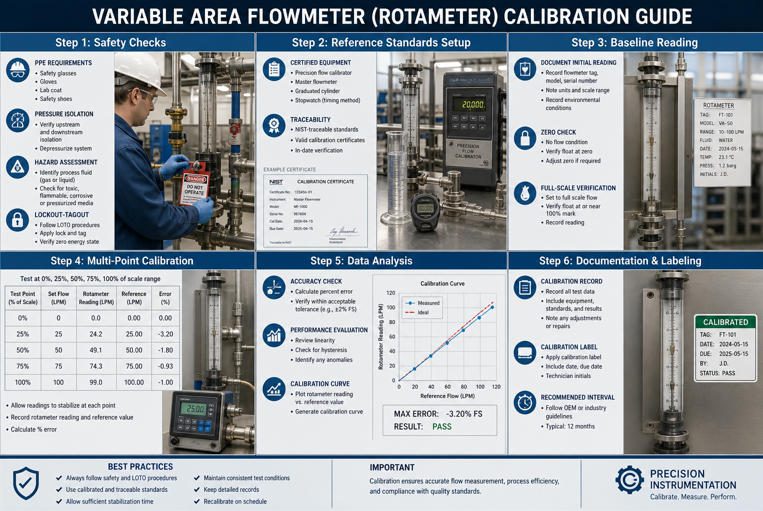
This guide explains a practical variable area flowmeter calibration procedure for technicians, engineers, and quality teams. It covers safety, setup, reference standards, data capture, correction factors, documentation, and troubleshooting.

1. Understand the Device and Calibration Objectives
Key operating principle of VA flowmeters
A variable area flowmeter works by balancing fluid force against the weight of a float. As flow increases, the float rises in a tapered tube. The larger opening around the float allows more fluid to pass. When the forces balance, the float becomes stable, and the operator reads the scale.
For glass or plastic tube rotameters, the reading is visual. For metal-tube VA meters, a magnetic follower, pointer, switch, or transmitter may convert float movement into a local indication or a 4–20 mA signal.
DwyerOmega explains that gravity-operated variable area meters normally require vertical installation because float position depends on gravity. You can read more in its technical overview of variable area flow meter operation.
Typical calibration goals: linearity, repeatability, and overall accuracy
Before calibration, define what you need to prove. Most VA flowmeter calibration work focuses on three goals:
- Linearity: Does the meter follow the reference flow across the range?
- Repeatability: Does the same flow produce the same reading each time?
- Overall accuracy: How far is the meter indication from the reference value?
Percent of full scale. A ±2% FS meter with a 0–100 L/min range may have ±2 L/min error at any point.
Percent of actual reading. A ±2% AR error at 40 L/min equals ±0.8 L/min.
A multiplier used to convert indicated flow into corrected flow.
As-found means before adjustment. As-left means after adjustment and final verification.
2. Safety and Prerequisites
Personal protective equipment and site safety
Calibration may involve pressure, chemical residue, compressed gas, steam, or electrical signals. Select PPE based on the service fluid and site rules. Common PPE includes safety glasses, gloves, safety shoes, face shield, flame-resistant clothing, or chemical apron.
Always check the fluid safety data sheet before disconnecting a meter. A rotameter may look harmless from the outside but still contain trapped chemical, condensate, or pressurized gas.
System isolation and lockout-tagout considerations
Before removing a meter from service, isolate the line, depressurize it, drain it, and verify zero energy. OSHA states that lockout/tagout procedures protect workers from unexpected release of hazardous energy during servicing and maintenance. See the official OSHA hazardous energy control guidance.

3. Tools, References, and Standards
Required instruments: pressure source, reference flow standard, thermometer, manometer, data logger
A dependable calibration setup normally includes:
- Reference flow standard: master flowmeter, gravimetric system, prover, bell prover, or calibrated mass flow controller.
- Stable pressure source: pump, compressed gas supply, pressure regulator, or flow bench.
- Temperature measurement: thermometer or RTD near the meter inlet.
- Pressure measurement: manometer, pressure gauge, or pressure transmitter.
- Data logger: used to capture reference flow, pressure, temperature, and transmitter output.
- Clean tubing and fittings: sized to reduce leakage, pulsation, and pressure drop.
Calibration standards and traceability: NIST/ISO equivalents
Traceability is not just a certificate number. NIST defines metrological traceability as a documented unbroken chain of calibrations, with each link contributing to measurement uncertainty. For audit-sensitive work, review the official NIST policy on metrological traceability.
For calibration laboratories, ISO/IEC 17025 is the key international framework for demonstrating technical competence and valid calibration results.

| Item | Purpose | Recommended Requirement | Record to Capture |
|---|---|---|---|
| Reference flow standard | Compares true flow to meter indication | Usually 3–4 times better accuracy than DUT | Certificate ID, due date, uncertainty |
| Pressure gauge or manometer | Confirms calibration pressure | Suitable range and resolution | Pressure at each test point |
| Thermometer or RTD | Captures temperature correction input | Installed near meter inlet | Fluid and ambient temperature |
| Flow control valve | Sets stable incremental flow points | Fine adjustment, low hysteresis | Valve position, if useful |
| Data logger | Reduces manual transcription errors | Time-stamped records | Raw data file name |
| Cleaning kit | Removes scale, film, or particles | Solvent compatible with meter material | Cleaning method used |
Copy this table directly into Excel or Google Sheets for a calibration checklist.
4. Initial Setup and System Checks
Inspect device condition and connections
Inspect the meter before applying flow. Check the tube, float, seals, end fittings, scale plate, transmitter housing, and process connections.
- Look for cracked glass, cloudy plastic, dented metal tubes, or loose scale plates.
- Confirm the float is the correct type and material for the meter serial number.
- Check that the float moves freely without sticking or scraping.
- Verify the flow direction and orientation.
- For metal-tube units, check pointer zero and magnetic follower movement.
Verify baseline measurements and cleanliness
With no flow, the float should rest at or below the zero mark. If it hangs above zero, common causes include residue, mechanical interference, static charge, bent guides, or internal deposits.
Clean the meter using a method compatible with its wetted materials. For example, do not use aggressive solvents on acrylic or polycarbonate tubes unless the manufacturer approves the chemical. After cleaning, dry the meter and repeat the zero check.

5. Establishment of Reference Conditions
Define flow range, ambient conditions, and reference medium
A VA flowmeter scale is valid only for defined conditions. A water-calibrated meter may not read correctly on oil. An air-calibrated meter may not read correctly on compressed nitrogen at a different pressure.
Record these conditions before testing:
- Calibration medium: water, air, nitrogen, process fluid, or approved substitute fluid.
- Minimum, normal, and maximum operating flow.
- Fluid temperature and pressure during calibration.
- Fluid density and viscosity, if correction is required.
- Meter orientation and inlet/outlet connection arrangement.
Stabilization criteria for steady-state readings
Do not record a reading immediately after changing flow. Wait until the reference flow, float position, pressure, and temperature are stable. For many industrial rotameters, 15–30 seconds is enough. For gas systems or long tubing runs, wait longer because compressibility can create slow drift.
6. Step-by-Step Calibration Procedure
Zero/offset verification
- Mount the meter in the required orientation, usually vertical with flow upward.
- Confirm the calibration bench is clean and leak-free.
- Set flow to zero and allow the meter to settle.
- Record the zero position. For a transmitter, record the output current at zero flow.
- If the float does not return to zero, clean and inspect before continuing.
Incremental flow steps and data capture
Use at least five points across the working range. A common sequence is 0%, 25%, 50%, 75%, and 100% of full scale. For critical applications, add more points and include the normal operating flow as a dedicated test point.
Approach each point from low to high flow. If hysteresis is a concern, repeat the sequence from high to low flow. Hysteresis means the meter reads differently depending on whether flow is increasing or decreasing.
| Test Point | Target Flow | Reference Flow | Meter Indication | Error | Error %FS | Temperature | Pressure | Pass/Fail |
|---|---|---|---|---|---|---|---|---|
| 1 | 0% | 0.00 L/min | 0.00 L/min | 0.00 | 0.0% | 20.1°C | 1.01 bar | Pass |
| 2 | 25% | 24.80 L/min | 25.40 L/min | +0.60 | +0.6% | 20.2°C | 1.01 bar | Pass |
| 3 | 50% | 49.90 L/min | 51.20 L/min | +1.30 | +1.3% | 20.2°C | 1.02 bar | Pass |
| 4 | 75% | 75.10 L/min | 77.40 L/min | +2.30 | +2.3% | 20.3°C | 1.02 bar | Fail |
| 5 | 100% | 99.70 L/min | 102.20 L/min | +2.50 | +2.5% | 20.4°C | 1.02 bar | Fail |
Repetition and averaging strategy
At each test point, record at least three stable readings. Average the readings only after removing invalid data caused by a pressure spike, bubble, or operator disturbance. If repeatability is poor, investigate the cause instead of hiding it with averaging.
Related video: A practical YouTube demonstration of rotameter calibration concepts and data collection.
7. Data Processing and Analysis
Plotting flow vs. indication
Plot reference flow on the x-axis and meter indication on the y-axis. A perfectly calibrated meter follows a 1:1 line. A curved result can indicate a wrong scale, density mismatch, float wear, fouling, or incorrect correction factors.
Calculating correction factors and calibration curve
Use these formulas at each test point:
Error = Meter Indication − Reference Flow
Correction Factor = Reference Flow ÷ Meter Indication
If the meter has no mechanical adjustment, the final result may be a correction table or correction curve. For transmitter-equipped VA meters, 4 mA and 20 mA trim may be adjusted to match the calibrated range.
8. Applying Adjustments and Re-Verification
How to adjust VA meter settings, if applicable
Not every VA flowmeter can be adjusted. Many glass-tube meters use fixed float geometry and a fixed scale. In those cases, calibration provides error data and correction factors rather than a physical adjustment.
For adjustable or transmitter-equipped meters, common adjustments include:
- Pointer zero adjustment for metal-tube meters.
- Scale plate alignment, if allowed by the manufacturer.
- 4 mA and 20 mA output trim.
- Alarm or flow switch setpoint adjustment.
- Transmitter damping adjustment.
If repeated calibration failures suggest the meter is not suitable for the application, compare alternatives using this Jade Ant Instruments guide on variable area, turbine, and electromagnetic flowmeter selection.
Post-adjustment verification across the range
After adjustment, repeat the calibration points. This final check is the as-left test. Do not verify only one mid-scale point because an endpoint adjustment may improve one reading while making another worse.
9. Documentation and Traceability
Recording setup, conditions, and results
A strong calibration record should allow another qualified person to understand what was tested, how it was tested, and whether the result was acceptable. Include:
- Instrument tag number, serial number, model, range, and service.
- Calibration procedure ID and revision.
- Reference standard IDs, certificate numbers, due dates, and uncertainty.
- Calibration medium, pressure, temperature, and ambient conditions.
- As-found data, adjustments made, and as-left data.
- Acceptance tolerance and pass/fail result.
- Technician name, reviewer name, and date.
Jade Ant Instruments often recommends confirming service medium, normal flow range, material compatibility, and required uncertainty before finalizing a calibration plan. This prevents a common problem: calibrating a meter under conditions that do not match real operation.
Maintaining calibration certificates and IDs
Assign a unique certificate ID to every calibration record. Store certificates in a controlled system where technicians can retrieve the latest document by tag number or serial number. For specification control, see this Jade Ant Instruments article on how to read flowmeter datasheets.
10. Troubleshooting and Common Issues
Symptom-to-root-cause guide: drift, hysteresis, leaks
| Symptom | Likely Cause | Field Check | Corrective Action |
|---|---|---|---|
| Float sticks or jumps | Dirt, coating, bent guide, static charge | Move flow slowly and observe float | Clean, inspect, and replace damaged parts |
| Reading high across range | Float erosion, wrong float, density mismatch | Compare float ID and weight | Install correct float or apply correction |
| Reading low across range | Tube fouling, wrong scale, high viscosity | Inspect tube bore and process data | Clean, verify scale, recalibrate |
| Different up/down readings | Hysteresis from friction or magnetic follower | Run rising and falling flow tests | Service follower, clean meter, reduce vibration |
| Unstable gas reading | Pulsation or low backpressure | Check regulator and downstream pressure | Add damping, regulator, or backpressure |
| Leak during test | Damaged O-ring or fitting stress | Pressure hold test | Replace seal and retest |
When to re-calibrate or replace components
Recalibrate immediately when the meter is cleaned, repaired, removed, reinstalled, exposed to overrange flow, or used with a changed fluid condition. Replace components when the float is worn, the tube is etched, the scale is unreadable, the transmitter is unstable, or seals fail a pressure test.
Variable area flowmeter calibration is a controlled comparison between the meter indication and a traceable reference under known conditions. A reliable workflow is straightforward: make the system safe, inspect and clean the meter, define reference conditions, test multiple points, calculate error, adjust if possible, re-verify, and document the result.
The best calibration programs do not treat calibration as paperwork. They use the results to improve maintenance intervals, catch installation problems, and identify process changes before those changes affect production quality or safety.
For clean utility service, a 12–24 month interval may be reasonable. For chemical dosing, gas purge, pharmaceutical, or compliance-critical service, shorter intervals are often justified by risk and historical drift data.
Need help selecting or verifying a flowmeter?
Jade Ant Instruments supports variable area, electromagnetic, turbine, vortex, and ultrasonic flow measurement applications. For sizing, material compatibility, and calibration planning, start with the engineering resources at Jade Ant Instruments.
FAQs
What is the acceptable tolerance for variable area flowmeter calibration?
The acceptable tolerance depends on the meter class and process requirement. Many industrial VA flowmeters are accepted around ±1–2% of full scale. Purge meters may have wider tolerance, while laboratory meters may require tighter tolerance. Always use the datasheet, quality plan, or process risk assessment as the final requirement.
How often should VA flowmeters be recalibrated in different service conditions?
Clean water or clean air service may support a 12–24 month interval. Chemical dosing, gas blending, pharmaceutical, or fouling-prone service often requires 6–12 months. Recalibrate sooner after repair, cleaning, overrange, process fluid change, or unexplained drift.
What are common signs that a VA flowmeter needs recalibration?
Common signs include float sticking, unstable readings, failure to return to zero, mismatch with batch results, unexplained chemical usage changes, drift against a reference meter, leaks, cloudy tubes, or transmitter output that no longer matches local indication.
Can a variable area flowmeter be calibrated in place?
Yes, in some cases. In-place verification can be useful when the meter cannot be removed. However, the reference standard, flow stability, pressure, temperature, and safety conditions must still be controlled and documented. Bench calibration is usually more accurate and repeatable.
Why does gas pressure affect rotameter calibration?
Gas density changes with pressure and temperature. A rotameter calibrated for air at one pressure may read incorrectly when used on compressed gas at another pressure. For gas service, always record actual operating pressure, temperature, gas type, and correction method.
Should the calibration medium match the process fluid?
Ideally, yes. If a substitute medium is used, corrections may be needed for density and viscosity. For high-accuracy or regulated work, confirm the correction method with the manufacturer or calibration laboratory.
What is the difference between calibration, verification, and adjustment?
Calibration compares the meter against a reference and records the error. Verification checks whether the meter remains within tolerance. Adjustment changes the meter, pointer, scale, switch, or transmitter output to improve performance.
Can calibration fix a dirty or damaged VA flowmeter?
No. Calibration can reveal the error, but it cannot make a damaged meter reliable. Clean fouled parts, replace worn floats or seals, and repair mechanical problems before final as-left calibration.